
SEO for Professional Services Firms: 2026 Playbook
Your website probably isn't invisible everywhere. It's invisible at the exact moment someone needs help.
A finance director searches for a specialist accountant. A business owner looks for an employment solicitor. A managing director compares consultants before making a shortlist. If your firm doesn't appear clearly, with the right service page, the right proof, and the right location signals, the enquiry goes elsewhere.
That's context for SEO for professional services firms now. This isn't about chasing broad traffic or publishing endless blog posts nobody reads. It's about being findable when a buyer has a specific problem, a budget, and a reason to act.
Table of Contents
- Why SEO Is No Longer Optional for Professional Services
- Build Your Digital Foundation with Keywords and Service Pages
- Establish Authority with Content and Thought Leadership
- Win Locally with Reputation Management and Local SEO
- Earn Trust Signals Through Strategic Link Building and PR
- Measure What Matters and Adapt for 2026
Why SEO Is No Longer Optional for Professional Services
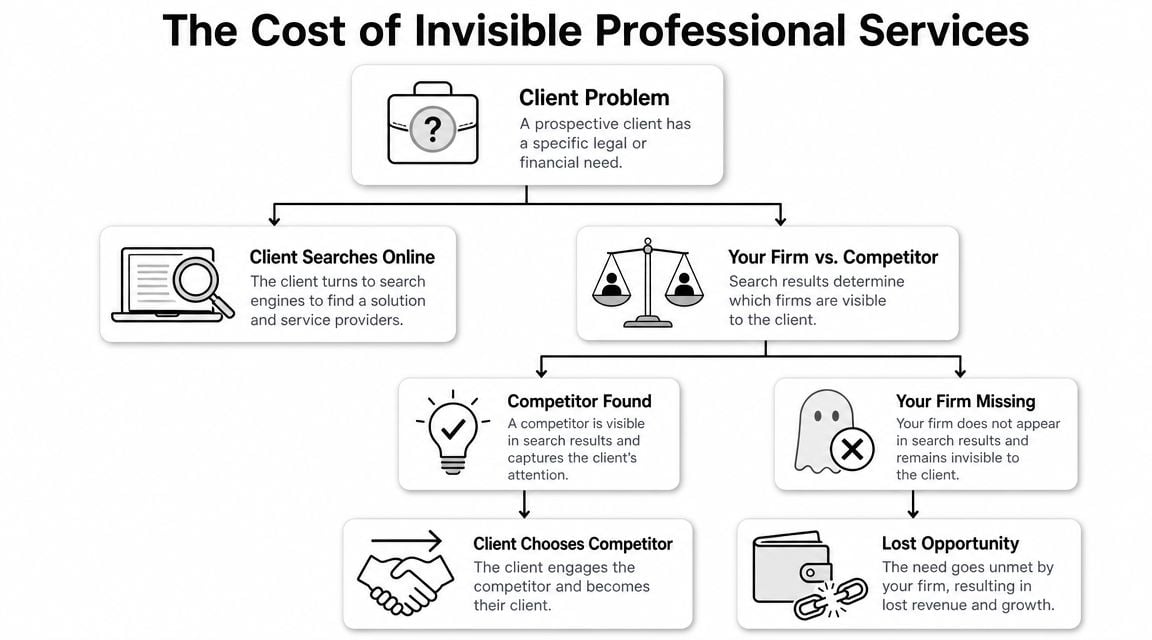
A prospect has a problem. They search. They compare. They decide who looks credible before they ever fill in a form.
That's why SEO has shifted from a marketing extra to a business development channel for firms that sell expertise. In the UK, 67% of marketing professionals classified SEO as “very important” to their strategy in 2025, according to Blue Cactus's guide to SEO for professional services firms. For accountants, lawyers, advisers, and consultants, that matters because buyers usually search with problem-led queries, not brand terms.
Buyers search before they speak to you
Professional services buyers rarely make fast decisions. They want signals that your firm understands their issue, serves their sector, and operates in their area. A referral may still start the process, but search often validates the choice.
That changes the job of your website. It can't just look respectable. It has to answer commercial questions clearly, support local discovery, and show expertise in a way that helps both Google and a cautious buyer.
If you work in legal marketing, Miles Marketing's expert guide is a useful example of how sector-specific marketing advice lines up with the way law firms generate work. The same principle applies across professional services. Generic visibility isn't enough. You need visibility tied to real services and real buying intent.
Practical rule: If a prospect can't tell within seconds whether you handle their exact problem, your rankings and your conversions will both suffer.
What strong visibility actually looks like
For most firms, strong SEO rests on four working parts:
- Foundational pages: Clear service and location pages built around what buyers search for.
- Content depth: Articles, FAQs, and explainers that help prospects validate your expertise.
- Local presence: Google Business Profile, local citations, and reviews handled properly.
- Authority signals: Mentions, links, and reputation markers that support trust.
If your current site is thin, outdated, or difficult to use, fix that before you chase advanced tactics. A practical starting point is this guide on how to improve website SEO, which covers the core site issues that often hold firms back.
The trade-off is simple. You can keep treating search as a side task and hope referrals carry the load, or you can make your firm visible where buyers are already comparing providers. In today's market, the second option is the safer one.
Build Your Digital Foundation with Keywords and Service Pages
Most professional services sites have one common weakness. They describe the firm well, but they don't organise the site around what clients search for.
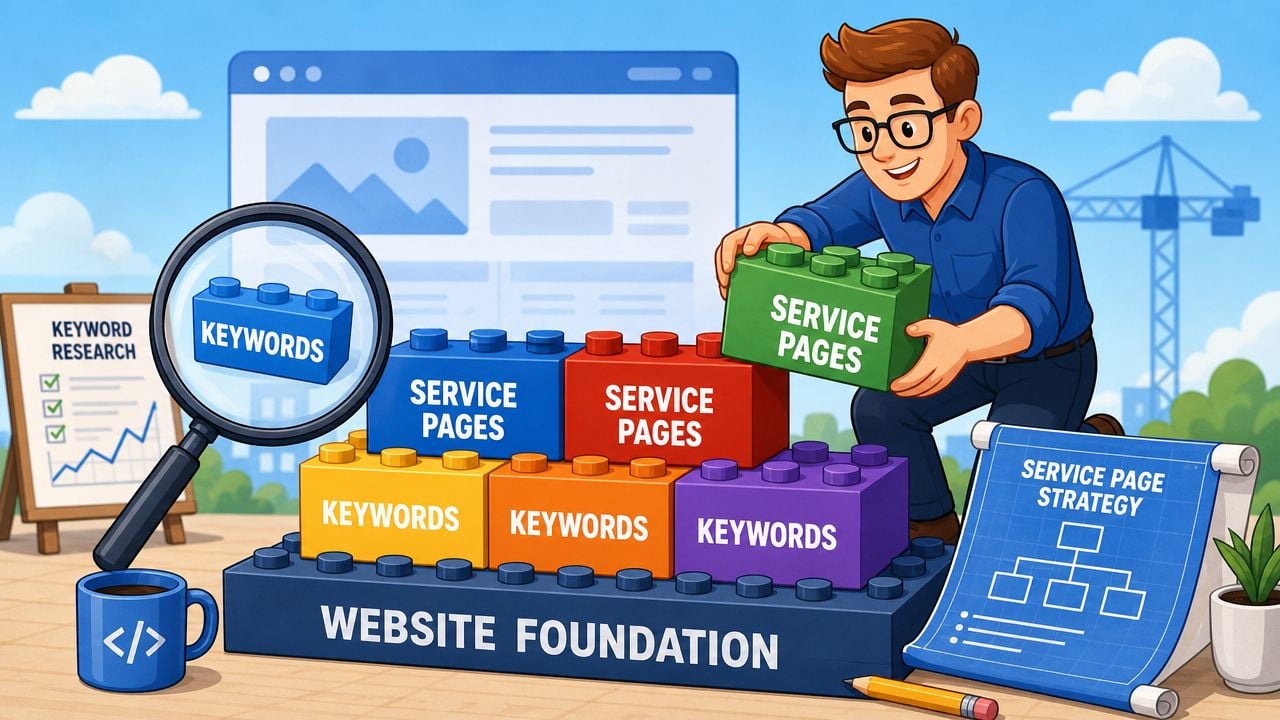
That's why service pages matter so much. Shawn The SEO Geek's guide for service-based businesses makes the point clearly: the most effective SEO tactic for UK professional services is building dedicated service pages, and each one should work as a conversion asset rather than a brochure page.
Start with commercial intent, not broad terms
Don't begin with a vanity phrase like “accountant” or “law firm”. Begin with the language a buyer uses when they're close to action.
A better keyword map usually includes combinations of:
- Service type: audit support, probate solicitor, leadership consultant
- Client type: SMEs, landlords, startups, directors
- Problem: tax investigation, contract dispute, succession planning
- Location: Dorset, Weymouth, Bournemouth, South West, UK-wide if relevant
A solicitor's site shouldn't rely on one general “services” page. It should separate employment law, commercial property, dispute resolution, and any specialist work the firm wants to grow. The same goes for accountancy and consulting firms. When one page tries to target everything, it usually ranks weakly and converts weakly.
For firms rebuilding in WordPress, it helps to plan page structure before design and migration work starts. This SEO checklist for new websites is useful because it forces that thinking early, before pages get buried in menus or duplicated.
What a service page must include
Thin copy is one of the biggest reasons professional services pages underperform. Buyers don't want a vague summary. They want enough clarity to decide whether you belong on the shortlist.
A strong service page usually needs:
- A clear H1: Name the service directly. Don't hide it behind clever branding.
- A sharp opening: State who the service is for and what problem it solves.
- Benefit-led sections: Explain outcomes, process, and common situations.
- Credibility markers: Practitioner bios, sector experience, accreditations, or process detail.
- Service area coverage: Make local reach explicit where geography matters.
- FAQs: Answer objections and comparison questions in plain English.
- A real CTA: Invite the next step. Call, enquiry form, consultation request, or document review.
A good service page answers four questions fast: what is it, who needs it, where do you deliver it, and why should a prospect trust you?
If your team needs help tightening the copy itself, this guide to SEO copywriting for businesses is a useful companion to page planning. It's especially relevant for firms that know their services well but struggle to write for search and conversion at the same time.
A practical page template
Here's a simple structure that works well for accountants, law firms, and consultants:
Headline and summary
State the service, the client type, and the practical benefit.Common problems you solve
Use the phrases clients bring into consultations and discovery calls.How your process works
Set expectations. Buyers want to know what happens next.Who delivers the work
Add practitioner names or team roles where appropriate.Relevant FAQs
Cover timing, scope, fit, location, and next steps.Call to action
Keep it specific. “Speak to our employment team” is stronger than “Contact us”.
This is the foundation of SEO for professional services firms. Get these pages right first. Until then, blogging more won't fix the structural problem.
Establish Authority with Content and Thought Leadership
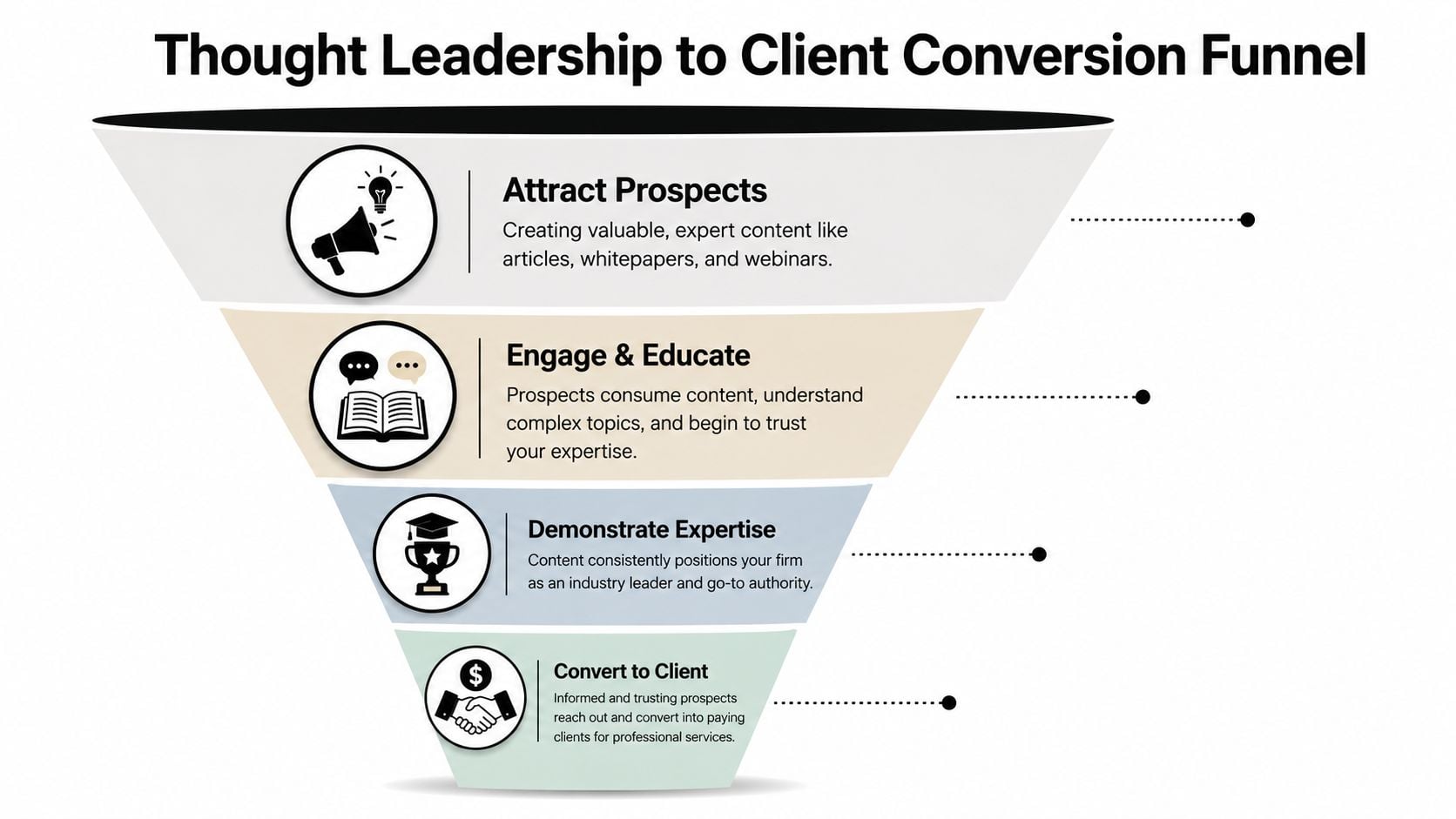
Once the core service pages are in place, content starts doing a different job. It helps buyers validate your expertise before they speak to you.
That matters because over 63% of potential clients search online to research and validate professional service providers before making contact, as noted in Fixyr's professional services marketing framework. The firms that win here usually don't publish more content. They publish more useful content.
Write for the buyer's research phase
Most firms approach content backwards. They ask, “What should we blog about?” The better question is, “What does a cautious buyer need to understand before they contact us?”
That produces stronger topics:
- Decision content: how to choose a commercial lease solicitor
- Risk content: common mistakes in inheritance tax planning
- Process content: what happens during a workplace investigation
- Scenario content: when to bring in an operations consultant
These pieces do two jobs at once. They give search engines topical context, and they reduce friction for buyers who are trying to work out whether your firm feels credible and relevant.
A broader content plan also needs structure. This explainer on what content strategy is is useful because it frames content as a system rather than a publishing habit.
Later in the buyer journey, video can reinforce trust. This example covers the same wider point from another angle:
Use case studies carefully and usefully
Case studies work for SEO, but only when they help a prospect recognise themselves in the story.
For professional services firms, weak case studies tend to read like self-congratulation. Strong ones explain the situation, the constraints, the decision points, and the approach. In regulated sectors, they may need anonymising, but they can still be persuasive.
Useful case study elements include:
- The client situation: Industry, problem type, or operating context
- The complexity: What made the matter sensitive or commercially important
- The approach: Steps taken, options considered, or process followed
- The practical outcome: Stated carefully and truthfully
- The takeaway: Why this experience matters for similar clients
Buyers trust content that explains judgment. They don't trust content that only claims expertise.
Turn expertise into a working content system
A six-month content plan doesn't need to be huge. It needs to be focused.
A practical cadence might look like this:
| Content type | Purpose | Best use |
|---|---|---|
| Service support article | Reinforce a key service page | Rank for problem-led searches |
| FAQ article | Answer specific objections | Support sales conversations |
| Case study | Build confidence and fit | Show how the firm works |
| Insight piece | Demonstrate informed opinion | Earn trust and referrals |
The trade-off is worth stating plainly. Generic blog content is easier to produce, but it rarely helps a buyer choose you. Thought leadership takes more input from fee earners or consultants, but it creates assets your team can use in search, sales, proposals, and follow-up emails.
Win Locally with Reputation Management and Local SEO
For many firms, the most valuable search battle happens inside a defined geography. A prospect wants a solicitor nearby, an accountant who understands the local market, or a consultant who can work closely with a regional team.
That makes local SEO less about technical tricks and more about trust signals that match location intent.
The local signals that matter
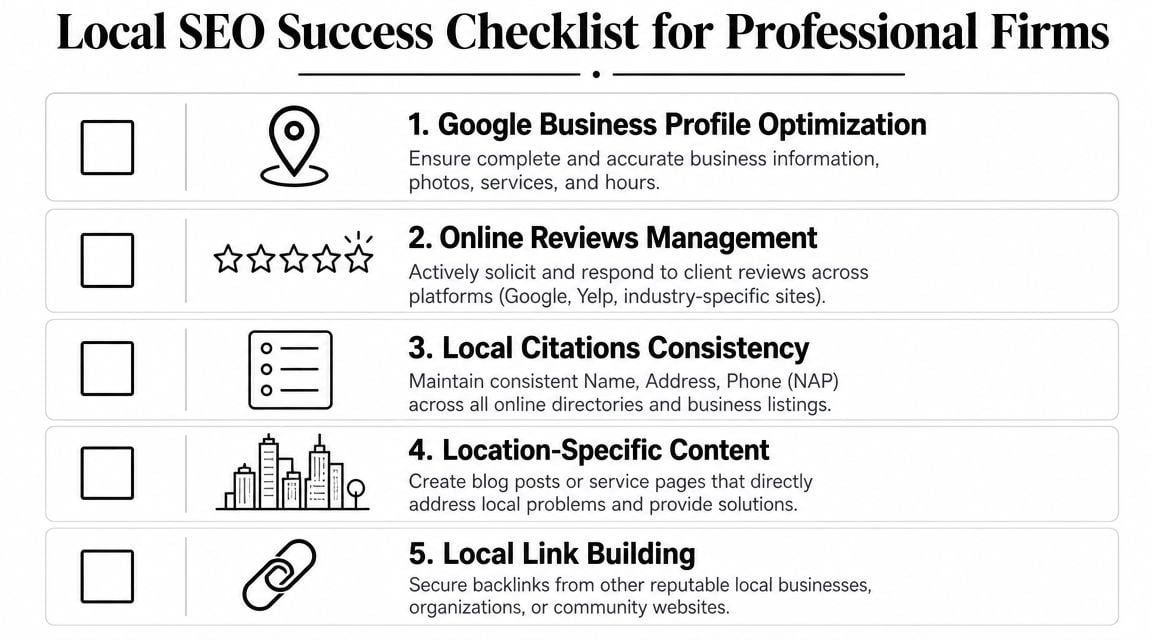
Your local setup should be boringly consistent and commercially clear. That includes your business name, address, phone details, service descriptions, categories, photos, and office information across the web.
A practical local checklist looks like this:
- Google Business Profile: Complete every relevant field, list services accurately, and keep opening details current.
- Location pages: Build pages for real offices or service areas where there's genuine delivery relevance.
- Consistent citations: Keep contact details aligned across directories, chambers, associations, and local listings.
- Local proof: Add testimonials, local case examples, or community involvement where appropriate.
- Review handling: Ask for reviews through a repeatable process and respond in a professional tone.
If you want a practical reference point for the profile side of that work, this guide to optimizing Google Business Profiles is worth reviewing. It covers the operational details many firms leave half-finished.
For a broader site and visibility view, this overview of local SEO for businesses is also useful when you're planning local landing pages and citation cleanup.
How regulated firms handle reviews and proof
Generic SEO advice often falls apart because regulated firms can't treat trust-building like a free-for-all.
According to Hinge Marketing's analysis of SEO and professional services marketing, regulated UK firms need SEO strategies that build trust through compliant proof, with safer assets such as practitioner bios and anonymised case outcomes outperforming risky “best firm” style claims.
That has real implications for local SEO:
- Use practitioner bios well: A strong profile often converts better than vague corporate copy.
- Request reviews carefully: Ask for honest feedback, not leading statements.
- Avoid inflated wording: Don't publish claims your compliance team would struggle to support.
- Show process clarity: Buyers often trust a well-explained method more than loud marketing language.
Local SEO for a law firm or financial practice isn't about looking louder than competitors. It's about looking safer, clearer, and easier to verify.
The firms that do this well usually look more credible both in search results and on the website itself. That combination matters more than any single ranking trick.
Earn Trust Signals Through Strategic Link Building and PR
Link building has a bad reputation because a lot of it deserves one.
Buying directory spam, swapping irrelevant links, or publishing thin guest posts on low-quality sites won't help a serious professional services firm. Even when those tactics create a short-term bump, they usually leave behind a backlink profile that looks manufactured and weak.
Bad link building still exists
The common mistake is treating links as a volume game. Professional services SEO doesn't work like that. A handful of relevant mentions from credible publications, associations, and business organisations is more useful than a pile of random placements.
Spammy link tactics also create a trust mismatch. A regulated law firm or advisory practice can't present itself as careful and credible on-site, then build authority through obviously low-grade websites. Buyers notice the disconnect when they research you, and search engines do too.
What professional services firms should do instead
Think of links as by-products of visibility and expertise, not products you buy.
The firms that earn the right links usually do some version of the following:
- Contribute commentary: Provide useful quotes or analysis to industry media and local business press.
- Publish original insight: Share informed opinions, practical guides, or sector explainers worth citing.
- Strengthen association presence: Keep professional body profiles complete and current.
- Support community organisations: Sponsorships, events, and partnerships can create relevant local mentions.
- Promote specialist expertise: When a named expert becomes visible, links often follow naturally.
This is one area where process matters more than hacks. Build a list of publications, local outlets, association sites, and partner organisations that your clients already know. Then look for legitimate ways to contribute insight or earn mention.
If you need tools, keep them simple. Ahrefs, Semrush, and Google Search Console can all help identify which pages attract links and where competitors get cited. For site-side support, agencies and consultants can help with audits and page structure. That can include providers such as DesignStack, which offers SEO audits and SEO-ready WordPress website support as part of broader web projects.
The trade-off is patience. Digital PR-style link building takes longer than buying placements. It also produces signals that a professional services firm can stand behind.
Measure What Matters and Adapt for 2026
A lot of SEO reporting still hides the core question. Did search generate qualified opportunities, or did it just produce charts?
That matters even more now because search behaviour is changing. Paradigm Marketing and Design's overview of SEO for professional services notes a key challenge for UK firms: adapting to zero-click search and AI Overviews, where concise answers dominate the results and visibility can rise even when website clicks don't.
Stop reporting vanity metrics on their own
Traffic still matters, but it's not the headline metric for accountants, lawyers, and consultants. A smaller number of highly relevant visits can outperform a large volume of mixed traffic.
A meaningful report for professional services should connect search performance to commercial intent. That means looking at service-page visibility, enquiry quality, and evidence that the right pages are appearing for the right searches.
Use a monthly review and a more detailed quarterly review. Monthly reporting catches movement early. Quarterly review is where you decide whether to expand content, improve internal linking, rewrite weak service pages, or tighten local signals.
A simple KPI dashboard
| Metric | What It Measures | Why It Matters | Example Target |
|---|---|---|---|
| Commercial keyword visibility | Whether core service pages appear for high-intent searches | Shows if you're becoming easier to find for buying-stage queries | Improve visibility for agreed priority terms |
| Qualified contact form enquiries | How many relevant leads come through organic search | Connects SEO activity to pipeline quality | Increase the share of relevant enquiries |
| Phone calls from organic visitors | Whether search visibility is driving direct contact | Useful for firms where buyers prefer to call | Track trend direction month to month |
| Google Business Profile interactions | Local discovery and intent to contact | Indicates local search presence for office-based firms | Grow interaction levels on priority locations |
| Thought leadership engagement | Whether expert content is being read and used | Helps judge topic relevance and buyer interest | Increase engagement on key insight pages |
| Conversion rate on service pages | How well core pages turn visits into actions | Shows whether page quality matches search intent | Improve conversion on priority services |
If your team needs help defining cleaner reporting, this guide on how to measure website success is a solid reference for turning analytics into decisions.
How to measure in a zero-click environment
AI Overviews and rich search features change what “success” looks like. Some prospects will get an initial answer on Google, then search your firm by name later. Others will compare multiple providers from the results page before clicking anyone.
That means your measurement should include signs of visibility beyond last-click traffic alone:
- Search impressions on priority pages
- Brand search growth over time
- Google Business Profile activity
- Enquiry quality from branded and non-branded search
- Pages that appear to support assisted conversions
If clicks fall on some informational queries but branded enquiries improve, your SEO may be working better, not worse.
For 2026 planning, the adjustment is practical. Build summary-ready sections into key service pages. Add concise answers, clear evidence, named experts, and trustworthy supporting details that can surface well in modern search results. Then review what's gaining visibility and refine from there.
If your firm needs a clearer SEO foundation, DesignStack can support the practical side of the work, from SEO-ready WordPress builds and audits to content structure and local visibility improvements. That's most useful when you need a site that doesn't just look professional, but helps the right prospects find and trust your firm.