

Discover what is content strategy and how it drives growth in 2026
At its heart, a content strategy is your business's master plan for using every word, video, and image to hit specific, measurable goals.
Think of it this way: building a business without a content strategy is like trying to build a house without a blueprint. You can pile up bricks of content—a blog post here, a social media update there—but you'll end up with a random heap, not a home. A documented strategy is what turns your marketing from guesswork into a reliable system for growth.
What a Content Strategy Really Means
A content strategy is the high-level thinking that answers the big questions: why are we creating this, who is it for, and how will we know if it's working? It’s the crucial difference between just publishing more stuff and publishing with genuine purpose. For a small business in Dorset, this means making sure every blog post, Instagram story, and website page has a job to do for your business.
Without a plan, your efforts will feel scattered and chaotic. You might write a fantastic blog post one week and share a few photos on Facebook the next, but with no thread connecting them. This scattergun approach rarely builds authority or delivers results because it's missing two key ingredients: consistency and intent.
A content strategy isn't about creating more content. It's about creating the right content, for the right people, at the right time, and on the right channels to achieve your goals.
This plan gives every piece of content a specific role, whether that’s attracting new visitors to your website, building trust with potential customers, or directly supporting a sale. It ensures that when you invest time and money into your marketing, you see a tangible return. A deep understanding is key, which is why mastering social media and content strategy is so important for long-term success.
To really see the difference a strategy makes, let's compare the two approaches side-by-side.
Content Strategy at a Glance: Before vs After
| Marketing Activity | Without a Content Strategy (The Guesswork) | With a Content Strategy (The Blueprint) |
|---|---|---|
| Blogging | Writing about random topics whenever you have time. | Creating posts that answer specific customer questions and rank for local keywords. |
| Social Media | Posting inconsistently with no clear message or call to action. | Sharing content that aligns with campaigns and drives traffic to your website. |
| Website Updates | Adding pages or features without a clear purpose. | Designing every page to guide visitors toward a specific goal (e.g., booking a consultation). |
| Measuring Success | Looking at vanity metrics like 'likes' and feeling unsure what worked. | Tracking clear KPIs like leads generated, online sales, or contact form submissions. |
As you can see, the blueprint gives every single marketing action a clear purpose and a way to measure its impact.
Making Your Content Actionable
A good strategy turns your marketing ideas into an organised, repeatable process. It creates a framework that anyone on your team can pick up and use to produce content that's both consistent and effective. It's not just a document that gathers dust; it's a living plan that guides your decisions.
For instance, a smart strategy always looks ahead. By 2026, the UK podcast scene is projected to have 28 million monthly listeners. For a Dorset-based hotel or charity, this isn't just a number—it's a huge opportunity. Host-read podcast ads deliver 50% higher brand recall than typical digital ads, making it a powerful channel for reaching a dedicated local audience.
Here is an actionable list to help you start shaping your own strategy right now:
- Define Your #1 Goal: What single, measurable outcome do you want to achieve in the next quarter? (e.g., increase online bookings by 15%, get 10 new enquiries for local events).
- Sketch Your Ideal Customer: Who are you talking to? Create a one-paragraph description of a real person (e.g., "Sarah, a 35-year-old mother in Weymouth looking for family-friendly holiday activities").
- List Your Core Topics: What are 3-5 subjects your business can speak about with real authority? These will become your content pillars.
- Pick Your Main Channel: Based on your ideal customer, where is the ONE place they spend the most time online? (e.g., Facebook, LinkedIn, a local Dorset forum). Commit to this channel first.
- Plan Your First 3 Pieces: Based on the above, brainstorm three specific content titles you can create immediately to move closer to your goal.
The 7 Core Components of a Powerful Content Strategy
So, what actually goes into a content strategy? It’s more than just a document you create once and forget. A proper strategy is a living framework built on seven core components. Each piece connects to the next, turning sporadic marketing efforts into a reliable engine for business growth.
Think of it like this: your strategy, goals, audience, and content are all fundamentally linked.
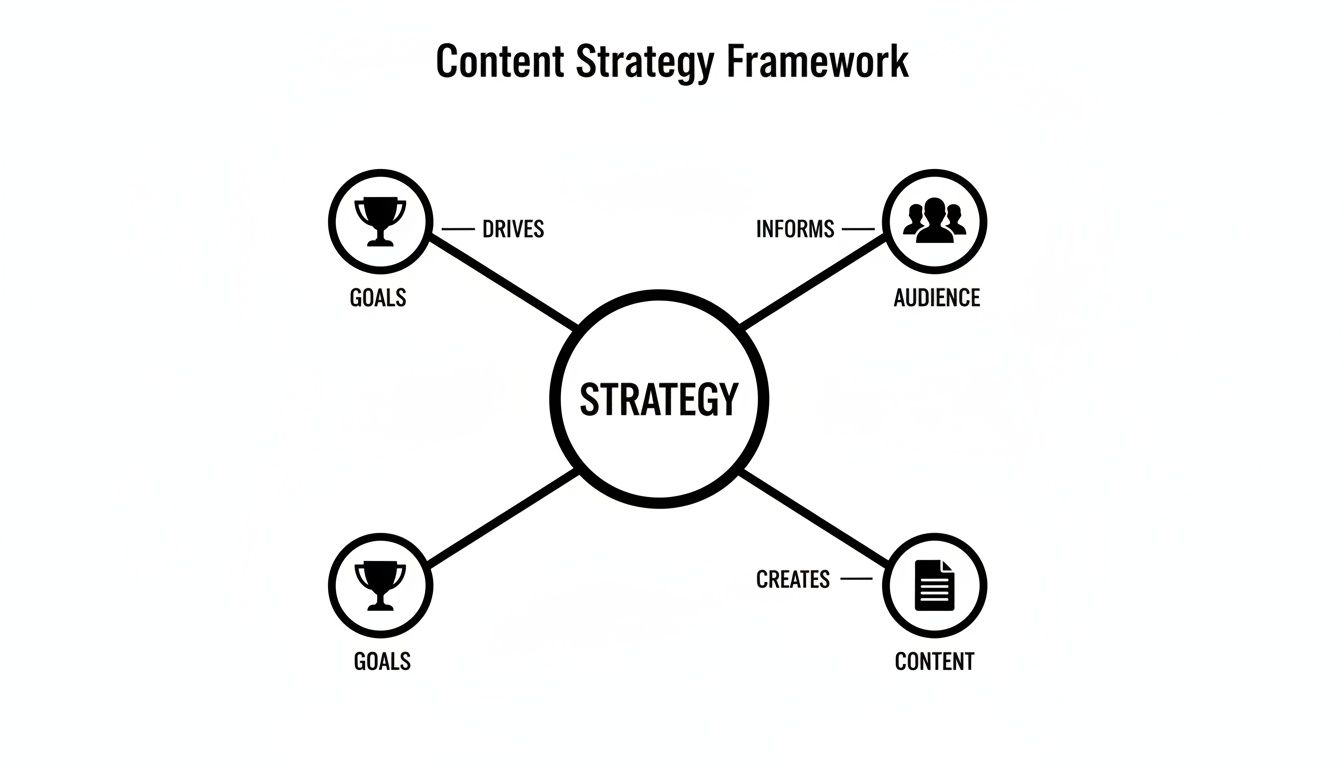
It’s a simple but powerful idea. Your content only works when it acts as the bridge between your business goals and what your specific audience actually needs. This connection is what gives your marketing real purpose and direction.
The Building Blocks of Your Strategy
You don’t need to be a marketing genius to build a solid strategy. It just takes a bit of focused thinking across these seven key areas.
Business Goals & KPIs: Start with your "why." What, specifically, do you need your content to do for your business? A vague goal like “get more customers” won't cut it. You need measurable targets, or Key Performance Indicators (KPIs). For instance, a Weymouth restaurant's goal might be to “increase online table bookings by 20% in the next six months.” That’s a goal you can work towards and measure.
Audience Personas: Next, define your "who." You can't connect with people if you don't know who they are. A persona is a detailed profile of your ideal customer, digging into their problems, what they want to achieve, and where they hang out online. For a Dorset-based charity, this could be "Charity Champion Claire," a 45-year-old resident who wants to support local causes but needs to see proof of her donation's impact.
Brand Voice & Messaging: This is all about how you communicate. What’s your personality? Are you a formal, trusted expert, or a friendly, approachable guide? This voice must be consistent everywhere, from the copy on your website to your social media replies.
Your brand voice is your business’s personality made tangible. It’s what makes customers feel like they’re talking to a person, not a faceless company, building the trust that is essential for long-term loyalty.
Content Pillars & Formats: Now we get to the "what." Your content pillars are the 3-5 core topics your business can speak about with authority. A local web design agency might choose pillars like "WordPress for Small Business," "Local SEO Tips," and "Branding Fundamentals." From there, you decide on the formats—blog posts, case studies, videos, or checklists—that will deliver that information most effectively to your audience.
Distribution Channels: This is your "where." Once you've created great content, where will you share it? The key isn't to be everywhere; it's to be where your audience is. That could be LinkedIn if you’re B2B, Instagram for a visual lifestyle brand, or even a local Dorset community Facebook group to reach people in your area.
Production Workflow: This is your system for getting things done. A good workflow maps out the entire journey from an idea to a published and promoted piece of content. It clarifies who writes, who edits, who designs, and who hits 'publish'. A clear process avoids delays and ensures you can publish consistently, which is crucial for building momentum. If you're serious about creating a robust workflow, understanding the full scope of modern search engine optimisation can provide a significant advantage.
Performance Measurement: Finally, this is how you know if any of this is actually working. Your strategy isn’t set in stone; it's meant to evolve. By tracking the KPIs you set in the beginning, you can see what content is hitting the mark, driving traffic, and bringing in leads. For robust content planning, keyword research, and competitive analysis, integrating with powerful SEO tools is often a core component, such as through a Semrush integration. This data lets you do more of what works and fix what doesn't, making your strategy smarter over time.
Defining Your Audience and Setting Clear Goals
Before you write a single word or film a single video, your content strategy needs to answer two crucial questions: who are we talking to, and what are we trying to achieve? It’s a common mistake to create content for ‘everyone’, but that’s a surefire way to connect with no one. This is where your strategy gets real, grounding every effort in actual people and tangible business outcomes.
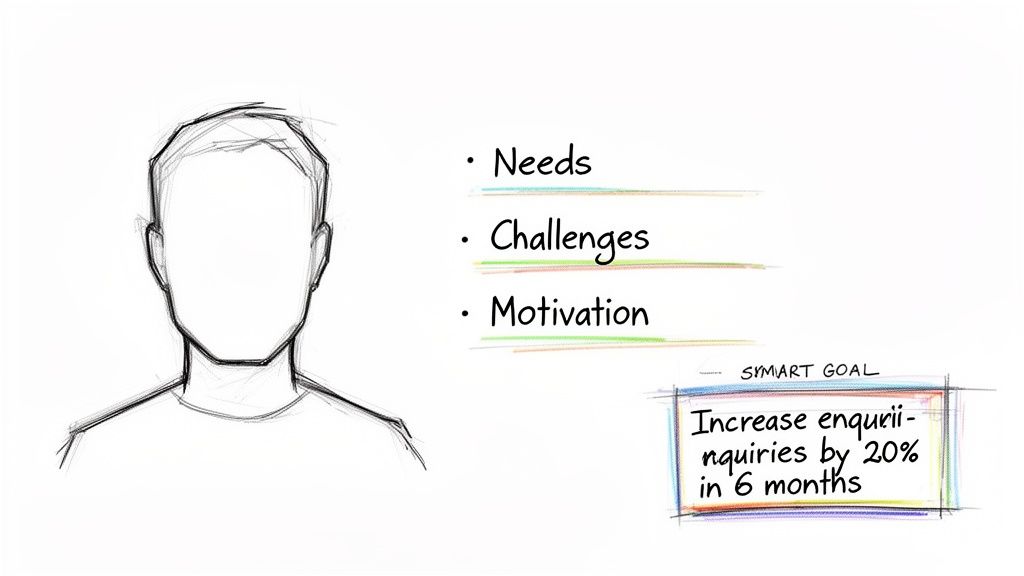
Without this clarity, you're just adding to the noise. With it, every blog post, video, and social media update becomes a targeted tool, built to connect with a specific person and guide them one step closer to your goal.
Who Are You Really Talking To?
First things first, you need to move beyond vague demographics and build a detailed customer persona. Think of this as a semi-fictional profile of your ideal customer, pieced together from real data and genuine insights. The goal is to create a character that feels like a real person, not just a list of statistics.
You don't need fancy, expensive tools to get started. Just use what you already have:
- Talk to your customers: Pick up the phone or have a quick chat with your regulars. Ask about their challenges, what they value, and why they chose you. A simple five-minute conversation can reveal more than hours of guesswork.
- Dig into your website data: Tools like Google Analytics show you who’s visiting your site, where they’re coming from, and which pages they stick around on. This is gold dust for understanding what people are genuinely interested in.
- Read customer feedback: Sift through your emails, contact form messages, and social media comments. What questions pop up again and again? What problems are people trying to solve?
With this information, you can start sketching out a profile. Give your persona a name, a job, and a bit of a backstory. For instance, a Weymouth-based accounting firm might create a persona called "Builder Brian."
Persona Example: Builder Brian
Brian is a 45-year-old self-employed builder from Dorchester. He’s brilliant at his trade but gets a headache just thinking about his finances. His biggest worries are managing cash flow and not messing up his tax returns. He feels swamped by paperwork and just wants an accountant who's approachable, speaks plain English, and can make his life easier.
This simple profile tells you exactly what kind of content Brian needs. He’s not after dense articles on complex financial theory; he wants practical guides on managing invoices or a simple checklist for tax season.
From Vague Wishes to SMART Goals
Once you know who you’re talking to, you need to decide what you want them to do. Fluffy targets like ‘get more leads’ or ‘increase sales’ aren't much help because you can't measure them. This is where SMART goals come in.
SMART is a simple framework that makes sure your objectives are focused and, most importantly, actionable.
- Specific: State exactly what you want to achieve. No ambiguity.
- Measurable: Define how you'll track your progress and know when you’ve succeeded.
- Achievable: Set a realistic goal you actually have the resources to hit.
- Relevant: Make sure the goal lines up with your bigger business ambitions.
- Time-bound: Give yourself a clear deadline.
Let's see how this works by turning a vague wish into a proper SMART goal for a local Dorset business.
- Vague Wish: "I want more website enquiries."
- SMART Goal: "Increase qualified website enquiries from businesses in Dorset by 20% within the next 6 months by publishing one locally-focused SEO blog post per week."
See the difference? This goal is powerful because it directly connects your content work (blogging) to a measurable business outcome (a 20% rise in enquiries). It gives you a clear target to aim for. Getting a handle on tracking these kinds of goals is much easier with the right tools, as you can see in our guide on the essentials of Google Analytics 4 mastery.
This kind of focused approach is becoming essential. Research shows that by 2026, 55% of UK marketing teams will be using AI-driven analytics to spot content topics before they trend, cutting wasted production effort by an average of 18%. For small businesses in places like Weymouth and Portland, where every marketing pound counts, that's a massive advantage.
Choosing Your Best Content Channels and Formats
Now that you have a solid grasp of who you’re talking to and what you want to achieve, it’s time to decide on the ‘what’ and the ‘where’. One of the most common pitfalls for any business is trying to be everywhere at once. It’s a sure-fire way to spread your resources so thin that you make zero impact anywhere.
A smarter approach is to be selective. Focus on the channels and formats that give you the best return on your time and effort.
The truth is, your ideal customer isn't on every single platform, and you don’t need to be either. The goal is to show up where they already spend their time and give them information in a way they actually want to consume it. A B2B firm providing professional services will almost certainly find its audience on LinkedIn, while a local CrossFit gym in Weymouth could build a fantastic community with energetic Reels on Instagram.
Matching Content Formats to Your Business Goals
The type of content you create needs to be a direct line to the goals you’ve already set. Think of it like a toolbox: different formats are different tools, each designed for a specific job. Trying to generate sales leads with a funny meme is like trying to hammer a nail with a screwdriver – you're just using the wrong tool.
So, what's the primary job of the content you're about to create? Is it to attract people who have never heard of you? Or perhaps to help someone who is already weighing up their options?
- To Build Awareness: Blog posts, infographics, and short videos are fantastic for this. They’re easy to share and perfect for answering the broad questions your audience is asking.
- To Drive Engagement: This is where you can go deeper. In-depth guides, webinars, and case studies work brilliantly for audiences who are already curious, helping to build trust and establish you as an expert.
- To Encourage Conversion: When someone is close to making a decision, things like customer testimonials, detailed product demos, and free consultations can be incredibly persuasive.
The growth of video, especially, is something no business can afford to overlook. Short-form video is now a dominant force in UK content strategies. Projections show users will spend an average of 95 minutes daily on platforms like TikTok and Instagram Reels by 2026. As DataReportal highlights, even small details matter; clips under 15 seconds have a 40% higher completion rate among Midlands Gen Z, a trend already making its way down to businesses here in Dorset.
| Business Goal | Primary Content Format | Example for a Dorset Business |
|---|---|---|
| Brand Awareness | Short-form Video (Reels/TikTok) | A Weymouth-based cafe creating a 15-second Reel showing how they make their signature flat white. |
| Lead Generation | Downloadable Guide / Checklist | A Poole financial advisor offering a free PDF guide: "5 Common Tax Mistakes Small Business Owners Make". |
| Build Credibility | In-depth Blog Post / Case Study | A Dorset construction firm writing a case study on a challenging barn conversion project they completed near Dorchester. |
| Drive Sales | Customer Testimonial Video | A local dog groomer in Blandford Forum sharing a short video of a happy customer talking about their great experience. |
Choosing the right format is about aligning your message with your objective. This simple table makes it easier to see how different content types can help you achieve specific goals for your business.
A Practical Guide to Choosing Your Platforms
Instead of throwing spaghetti at the wall to see what sticks, use this simple checklist to narrow your focus and commit to the channels that will actually move the needle for your business.
Revisit Your Persona: Go back to "Builder Brian". Where is he looking for answers? He's probably not scrolling TikTok for accounting tips, but you can bet he's in a Facebook group for local tradespeople or searching on Google for "simple tax tips for sole traders." Go where he is.
Analyse Your Competitors: Have a look at where your local competition is active. If three other Dorset accountants are getting great engagement from businesses on LinkedIn, that’s a massive clue that it’s a good place for you to be too.
Be Honest About Your Resources: This is a big one. If you’re a one-person show, promising yourself a daily YouTube video, five blog posts a week, and a podcast is a recipe for burnout. It is far, far better to master one or two channels than to be merely average on five. If you're a natural writer, pour your energy into brilliant blog posts and promote them on one key social platform.
Start Small, 'Own' Your Channel: Pick one primary channel and one secondary channel to start. Your aim is to become the go-to source of information on that platform for your niche in your area. Once you’ve got a smooth process and are seeing results, then you can think about expanding.
By focusing your efforts, you create a concentrated impact. Instead of shouting into a dozen empty rooms, you're building a real community in a space where people are genuinely listening.
Juggling all this might sound like a lot, but your website can be the central hub that holds it all together. For many businesses, their site is the core of their entire strategy. Take a look at our review on how a website content management system can help you organise and publish your work efficiently.
By making these smart, strategic choices about your channels and formats, you ensure that every piece of content you create is working as hard as possible to grow your business.
Common Content Strategy Mistakes to Avoid
Even the sharpest content strategy can unravel if you fall into a few common traps. Honestly, knowing what not to do is just as vital as knowing what you should be doing. By getting wise to these pitfalls early on, you can build a plan that’s far more resilient and effective from day one.
We’ve all seen it happen. A local business starts with a burst of enthusiasm, only to see it fizzle out. A few critical errors can quickly burn through your time and budget, leaving you wondering why all that hard work isn't translating into results. Let’s make sure that doesn’t happen to you.
Focusing on Quantity Over Quality
The old-school advice to "publish daily" is not just outdated; it's often damaging. Churning out low-value content just to tick a box on a calendar creates noise, not authority. Your audience isn't desperate for more content—they're looking for better content that genuinely solves their problems.
A single, well-researched, in-depth blog post that truly helps your audience is worth more than ten rushed articles that say nothing new. Quality builds trust, and trust is what drives business.
Instead of a content factory, think of your business as a specialist library. Every single piece should be a valuable, go-to resource. For a business in Dorset, this could be one definitive guide to the best local wedding venues, rather than ten generic posts about wedding planning.
Neglecting Promotion and Distribution
This is one of the biggest mistakes I see. People fall into the trap of thinking, "If you build it, they will come." Creating fantastic content is only half the job. If you spend five hours writing a blog post, you should be ready to spend at least another five hours getting it out there.
Without a solid distribution plan, even the most brilliant article will sit unread. Promotion isn't just about dropping a link on social media and calling it a day. It’s a sustained effort to make sure your content lands in front of the right people, time and time again.
Forgetting About SEO
Another critical error is treating search engine optimisation (SEO) as an afterthought you can sprinkle on later. You can write the most compelling article in the world, but if nobody can find it on Google, its impact is almost zero. If you're trying to answer the question "what is content strategy" for your customers, you have to be visible when they ask it.
Effective SEO has to be baked into your content process from the very beginning. It should guide the topics you choose and the way you structure your articles.
To help you sidestep these common issues, here's an actionable checklist to keep your strategy on the straight and narrow:
- Create with Purpose, Not Pressure: Before you start writing, ask yourself: "Does this piece solve a real problem for my audience?" If the answer is no, it's not worth creating.
- Budget Time for Promotion: For every hour you spend creating content, block out a matching hour for promotion. This includes your email newsletters, social media sharing, and reaching out to other relevant sites.
- Give Every Piece an SEO Job: Assign a primary keyword to every blog post. Use free tools like Google's Keyword Planner to find what your audience is actually searching for.
- Define Clear Ownership: Decide who is responsible for each part of the process—writing, editing, publishing, promoting, and measuring. This simple step prevents content from getting stuck in limbo.
- Measure What Matters: Track metrics that are directly tied to your business goals (like leads or sales), not just vanity metrics (like 'likes'). This is how you'll know what's actually working.
Your Actionable Content Strategy Launch Plan
A strategy document is just that—a document. It’s time to bring it to life. This is where your hard work meets the real world, turning all that research and goal-setting into a simple, repeatable process that actually gets things done. We’ll break down how to get your content plan off the ground without the overwhelm, using steps that even a one-person business can manage.
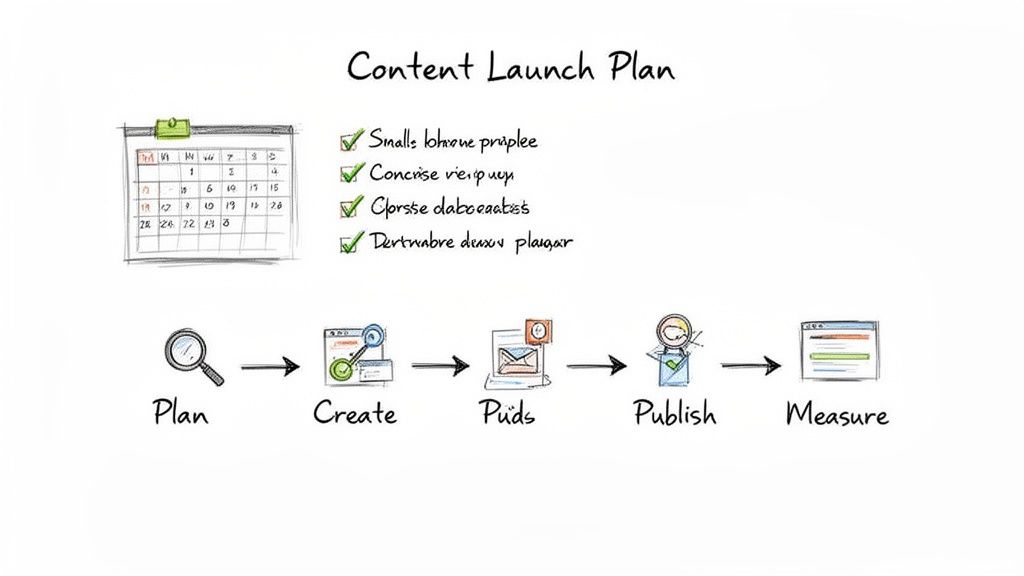
The secret to a great launch isn't chasing perfection from day one; it's all about consistency. It's about building a reliable system that helps you show up for your audience, time and time again.
Building Your Simple Content Calendar
Your content calendar will become the single source of truth for your entire operation. It doesn't need to be some fancy, expensive software. Honestly, a simple spreadsheet is all you need to start bringing some order to the creative chaos.
Think of it as your mission control. It tells you what you’re publishing, when it’s scheduled to go live, and who’s doing what. This simple tool is your best defence against last-minute panic, ensuring a steady, reliable stream of content for your audience.
To get your first calendar going, just create a spreadsheet with these columns:
- Publish Date: The day it all goes live.
- Content Title/Topic: The working title for your blog post, video, or social update.
- Primary Keyword: The main search term you're aiming to rank for.
- Content Format: Is it a blog post, a case study, or maybe an Instagram Reel?
- Status: A simple tracker to see where everything is at (e.g., Idea, In Progress, Ready for Review, Published).
To begin, fill it with 8-12 content ideas you’ve pulled from your content pillars and keyword research. This immediately gives you a clear runway for the next two or three months, which is a fantastic place to start.
Establishing Your Content Workflow
A workflow is simply the journey an idea takes to become a finished, published piece of content. It’s crucial to map this out because it gives you a repeatable process, saving you from having to reinvent the wheel every single time.
A solid workflow is your quality control. It makes sure no crucial steps get missed, like a final proofread or adding that all-important call to action.
A documented workflow is the engine of your content strategy. It turns creative chaos into a predictable system, empowering you to produce high-quality content consistently, even when you're busy.
Your workflow doesn't need to be complicated. For most small businesses, a straightforward five-step process provides a brilliant foundation.
- Plan: This is where you pick a topic from your calendar, lock in a primary keyword, and sketch out a quick brief. Just outline the goal, who it's for, and the key points you need to hit.
- Create: Now for the fun part—the actual writing, filming, or designing. Your main goal here is to create the most helpful resource you possibly can for your audience.
- Optimise & Edit: This is the polishing stage. Proofread everything, then optimise it for your chosen keyword by tweaking the title, headings, and meta description. Don't forget to add internal links and a clear call to action.
- Publish & Promote: Getting it live on your site is a huge step, but the work isn't over. Now you need to share it on your social media channels, send it to your email list, and start thinking about how to get it in front of new people.
- Measure: Give it about a month, then check in on how it’s performing. A free tool like Google Analytics 4 is perfect for seeing how much traffic it’s bringing in and where those visitors are coming from.
This structured approach is what separates strategic content from just posting randomly and hoping for the best. It ensures every single piece you create has the best possible chance to succeed.
Your 5-Step Launch Checklist
Ready to get started? Here’s a simple checklist to guide you through the first few weeks. It breaks the entire process down into small, manageable tasks so you can build momentum without feeling overwhelmed. The aim is to get your first piece of strategic content out the door.
Week 1: Foundation
- Set up a basic content calendar in a spreadsheet.
- Brainstorm and add 10 initial content ideas that align with your business goals.
- Choose the topic for your very first blog post from the list.
- Do some basic keyword research for that topic using a free tool.
Week 2: Creation
- Write a simple brief for your first post (goal, audience, key points).
- Draft the content, focusing purely on providing genuine value.
- Find or create at least one relevant image or visual for the post.
Week 3: Refinement
- Edit and proofread your draft with fresh eyes.
- Optimise the title, headings, and meta description with your keyword.
- Add at least two internal links to other relevant pages on your website.
Week 4: Launch
- Publish your content on your website. Go on, hit the button!
- Share the live link on your main social media channel.
- Send a quick email to your mailing list to let them know it's live.
By following this straightforward plan, you can confidently launch your content strategy and start building a genuinely powerful asset for your business.
Frequently Asked Questions About Content Strategy
Once you’ve wrapped your head around the 'what' and 'why' of content strategy, the practical questions start to surface. That’s a great sign! It means you’re ready to move from theory to action. Here are the answers to the questions we hear most often from small business owners just like you.
How Much Should a Small Business Budget for Content Strategy?
This is the million-dollar question, isn't it? While there’s no universal figure, a good rule of thumb is to set aside 25-30% of your total marketing budget for your content.
For a startup in Dorset, that doesn't just mean cash. It could be the value of your own time spent writing expert articles, or a small pot of money for a keyword research tool. The whole point of the strategy is to make every pound and every hour count, so you stop throwing money at marketing that doesn't deliver a clear return.
How Long Until I See Results from My Content?
Patience is a virtue here. Content strategy is a marathon, not a sprint. While you might notice a little buzz early on, building the kind of authority that brings in consistent organic traffic usually takes 6-12 months of dedicated effort.
Your strategy is your roadmap for the long haul. It helps you track the small wins along the way—like climbing a few spots in Google rankings or seeing more shares on social media—which prove you're heading in the right direction long before the big sales figures roll in.
Can I DIY My Content Strategy or Do I Need an Agency?
You can absolutely do this yourself. Using the steps in this guide, many business owners create and run brilliant strategies. After all, nobody knows your business better than you do, and that expertise is your most valuable asset.
Hiring an agency, however, is like adding a turbocharger to your engine. It gets you to your destination faster. Here’s what a partnership typically adds to the mix:
- Expertise: We’ve been down this road many times and can help you sidestep the common potholes that slow businesses down.
- Resources: We come equipped with professional-grade tools for deep-dive keyword research and analysing what your competitors are up to.
- Time: We can manage the technical side and the heavy lifting, freeing you up to do what you do best—run your business.
For instance, an agency can build you a professionally optimised WordPress site that’s ready for content from day one, giving you the perfect platform to share your expertise with the world.
A smart content strategy is one of the most reliable engines for growth you can build for your business. If you’re a Dorset-based business ready to build a website that works as hard as you do, DesignStack is here to help. Get in touch with us to start the conversation.


Leave a Reply