

8 Branding Tips for Small Businesses
Branding affects more than appearance. It changes how often people click, enquire, trust, and buy.
For small businesses, that shows up in real places. Website conversion rates. Google Business Profile clicks. Referral quality. How often a quote gets accepted without a price battle. Lucidpress reports that consistent brand presentation can increase revenue by 10 to 20%, and you can review that finding in their brand consistency research. The commercial upside is clear.
In agency work with Dorset businesses, the pattern is usually the same. The companies that look established online are not always the biggest or the oldest. They are the ones that present themselves clearly, repeat the same message across every touchpoint, and make it easy for customers to understand why they should choose them.
Branding also reaches further than a logo. It covers the words on your homepage, the tone in your emails, the quality of your photography, the consistency of your colours, and the proof you show to support your claims. If those pieces conflict, potential customers hesitate. If they line up, trust builds faster.
That is why this guide stays practical. Each tip is tied to implementation, with quick wins you can act on this week and a clear link to outcomes such as stronger website performance, better local SEO signals, and more qualified enquiries. Even early-stage exercises can help sharpen positioning. For founders refining direction, these vision board tips for Indian mompreneurs offer a useful example of turning broad ambition into a clearer brand point of view.
Small business branding improves when the basics are documented, applied consistently, and reviewed against results. That is the standard to aim for here.
1. Define and Document Your Brand Identity
Most branding problems aren't design problems. They're clarity problems.
If a business can't explain what it stands for, who it serves, and how it should sound, the visuals become inconsistent fast. One post feels playful, the next sounds corporate, and the website ends up trying to speak to everyone. That never works well.
A simple brand guide fixes more than people expect. It gives your team a reference point for decisions, especially when different people handle your website, social posts, emails, quotes, and printed materials. It also helps external partners produce work that consistently looks like your business.
What to put in the first version
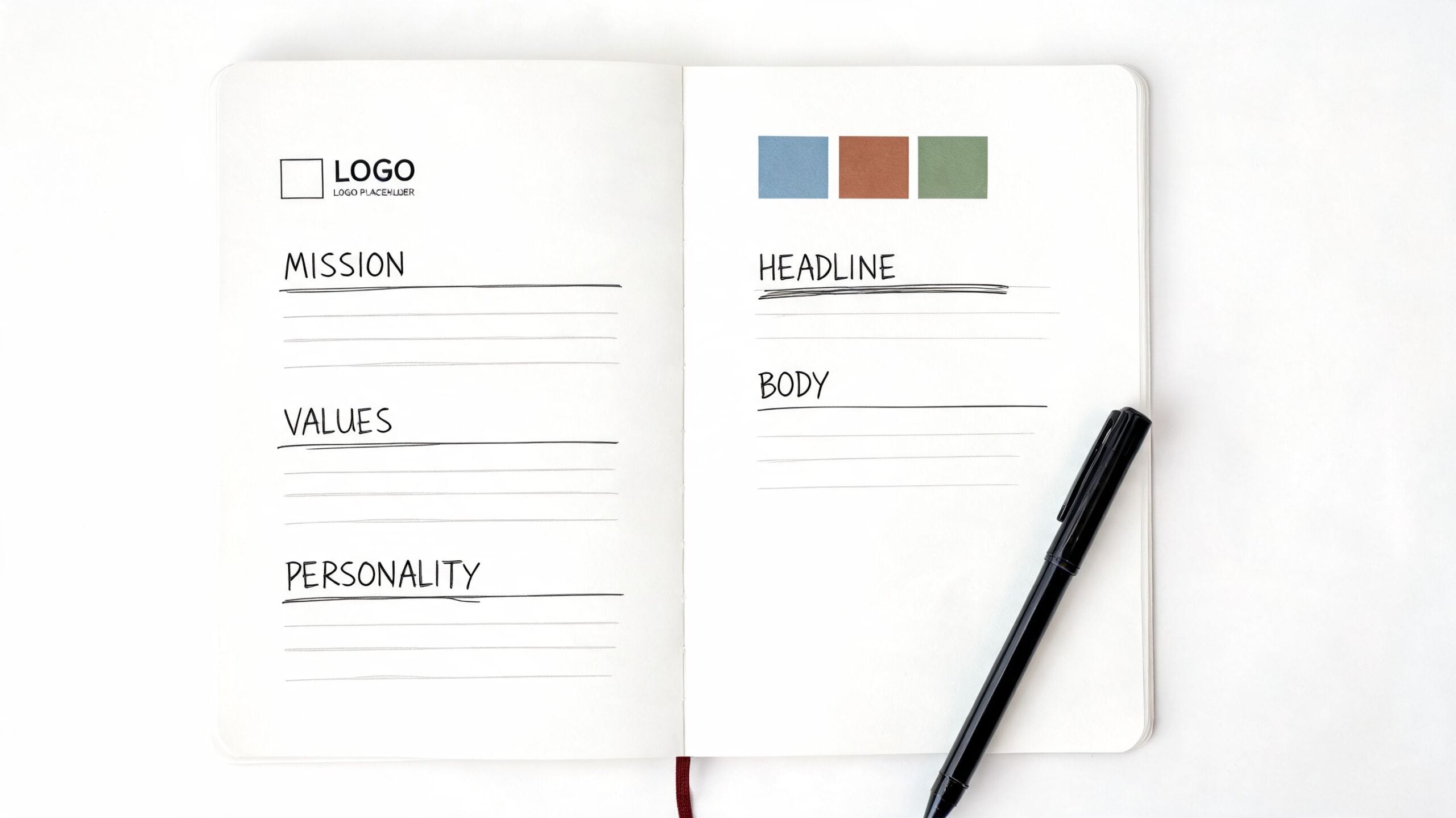
Your first brand guide doesn't need to be a polished document with fifty pages. A strong one-page version is enough to create order.
- Start with your position: Write down who you help, what you do, and why customers choose you instead of the obvious alternative.
- Define your personality: Pick a few traits that describe how the brand should come across, such as practical, warm, direct, or premium.
- List your visual basics: Include logo versions, colours, fonts, image style, and examples of what looks on-brand versus off-brand.
- Capture your voice: Add short “do” and “don't” examples so your team knows the difference between clear messaging and vague marketing language.
The value of this kind of documentation shows up in results. According to a UK-focused summary, small businesses that have a tightly linked brand experience across channels often still lack formal guidance, with only 22% having guidelines covering both physical and digital touchpoints in the UK Digital Economy context cited here. That gap is exactly where inconsistency starts.
Practical rule: If a new employee or freelancer can't look at your guide and produce on-brand work, the guide is still too vague.
A Dorset restaurant, a gym, and a professional services firm won't need the same tone. But all three need the same level of clarity. If you want a useful outside perspective on defining purpose and direction, this guide to vision board tips for Indian mompreneurs is a helpful reminder that mission and brand direction need to be written down, not just discussed.
2. Invest in Professional Logo and Visual Design
A weak visual identity costs small businesses more than the design fee they tried to save.
I see the same pattern often. A founder starts with a low-cost logo, then pays again for revised signage, website fixes, new social assets, packaging tweaks, and print files that should have worked from day one. Good design reduces that waste. It also gives the business a more credible first impression across every customer touchpoint.
A logo has one job. Make the business recognisable and usable everywhere you need it.
That means the mark has to hold up in a website header, a social profile image, an invoice, a van graphic, a leaflet, and a favicon. If it only works in one setting, it is not finished. Colour also plays a measurable role in recall. The University of Loyola, Maryland has been widely cited for finding that colour increases brand recognition, a point summarised in this review of logo colour psychology and brand recognition. For a small business, that makes colour choice a commercial decision, not a decorative one.
From agency work with Dorset businesses, the practical trade-off is usually this. Owners want something distinctive, but they also need something simple enough to reproduce consistently. Complexity tends to fail first at small sizes and lower-cost print runs. Clear, well-built identities usually perform better than clever ones.
What to ask for, and how to use it
Treat logo design as a small system, not a single file.
Start with a short implementation plan:
- Write a proper brief: Include your audience, price point, competitors, and where the identity will appear first. A trades business, café, and consultant need different visual signals.
- Get the core variants: Ask for horizontal, stacked, icon-only, one-colour, and reversed versions for dark backgrounds.
- Test real applications before approval: Put the design on your website header, Google Business Profile image, printed card, and mobile screen. Problems show up fast in real use.
- Request usable file formats: You need vector files for print, plus web-ready PNG and SVG versions for digital use.
- Set basic rules: Define clear space, minimum size, colour values, and misuse examples so freelancers and printers stop improvising.
A quick win is to audit every place your logo appears today. If versions differ across Facebook, your website, invoices, and email signatures, fix that first. Consistency improves recognition and removes the low-trust signals that hurt conversion.
If you are hiring support for the wider digital rollout, this guide on finding a website designer who understands your vision helps you assess whether a designer can apply the identity properly, not just make mockups look good.
If you sell physical goods, extend the same discipline to packaging and presentation. This guide on how to brand a product is a useful reference for turning visual identity into a buying experience customers remember.
Good visual design does not just make the business look better. It makes marketing assets easier to produce, improves recognition across channels, and supports the trust needed for clicks, enquiries, and sales.
3. Build a Professional, Mobile-Responsive Website as Your Digital Storefront
A weak website will undo good branding faster than almost anything else.
Small business owners often invest in a logo, tidy up their social profiles, then send traffic to a site that loads slowly, feels dated, or makes basic tasks hard on a phone. That gap costs enquiries. It also weakens local search performance, because poor engagement, thin service pages, and confusing structure make it harder for both users and search engines to trust what they are seeing.
Your website is not a digital brochure. It is the place where brand strategy turns into action. People decide whether to call, book, buy, or leave based on what happens in the first few seconds.
A strong small business site usually gets the basics right. Clear message. Fast load times. Mobile-friendly layouts. Obvious calls to action. Proof that the business is real and competent.
To see what a more structured design process looks like before you hire, this guide on finding a website designer who understands your vision is worth reviewing.
What to prioritise first
Start with the pages that influence enquiries and sales. For most small businesses, that means the homepage, service pages, about page, contact page, and any booking or quote request flow. If those pages are vague or awkward to use on mobile, the brand takes the hit.
Here is the order I would fix things in.
- Clarify the offer above the fold: State what you do, who you help, and the next step. Visitors should not have to scroll to work out whether they are in the right place.
- Build for mobile use first: Check thumb-friendly buttons, readable font sizes, short forms, tap targets, and sticky contact options. A site can look polished on desktop and still fail where most visitors use it.
- Create service pages with intent: Give each core service its own page with a plain-English explanation, benefits, FAQs, local relevance, and a clear conversion action. This helps both rankings and enquiries.
- Reduce friction in navigation: Keep menus short. Put contact details where people expect them. Remove dead-end pages and unnecessary dropdowns.
- Add proof near decision points: Place testimonials, accreditation, photos, project examples, or before-and-after results next to enquiry forms and service descriptions, not hidden on a separate page.
A quick win is to test your own site like a customer. Open it on your phone, use mobile data instead of office Wi-Fi, and try to book, call, or request a quote with one hand. Most conversion problems show up in under two minutes.
Here's a useful walkthrough on what makes website design work in practice:
We see this regularly with local businesses in Dorset. A gym site needs class times, membership options, location details, and mobile booking to be easy to find. A restaurant site needs menus, opening hours, directions, and click-to-call to work without friction. If those basics are hard to use, branding does not carry the experience. The website does.
Crossfit Durnovaria and The Lobster Pot are good examples of the type of small business that benefits from a site doing more than presenting information. Schedules, bookings, menus, contact details, and location information become part of the brand experience. When those elements are clear and easy to use, conversion rates usually improve and the business gives search engines stronger signals about relevance and quality.
4. Develop a Consistent Visual Style Across All Marketing Materials
Inconsistent branding costs small businesses more than polish. It weakens recall, lowers trust, and makes every marketing channel work harder than it should.
A prospect might see your van signage, then your Instagram feed, then your quote PDF. If each one looks like it came from a different business, recognition drops. People hesitate. That hesitation shows up in slower buying decisions, weaker conversion rates, and less repeat business. Lucidpress reported that consistent brand presentation can increase revenue by up to 23% in its brand consistency research.
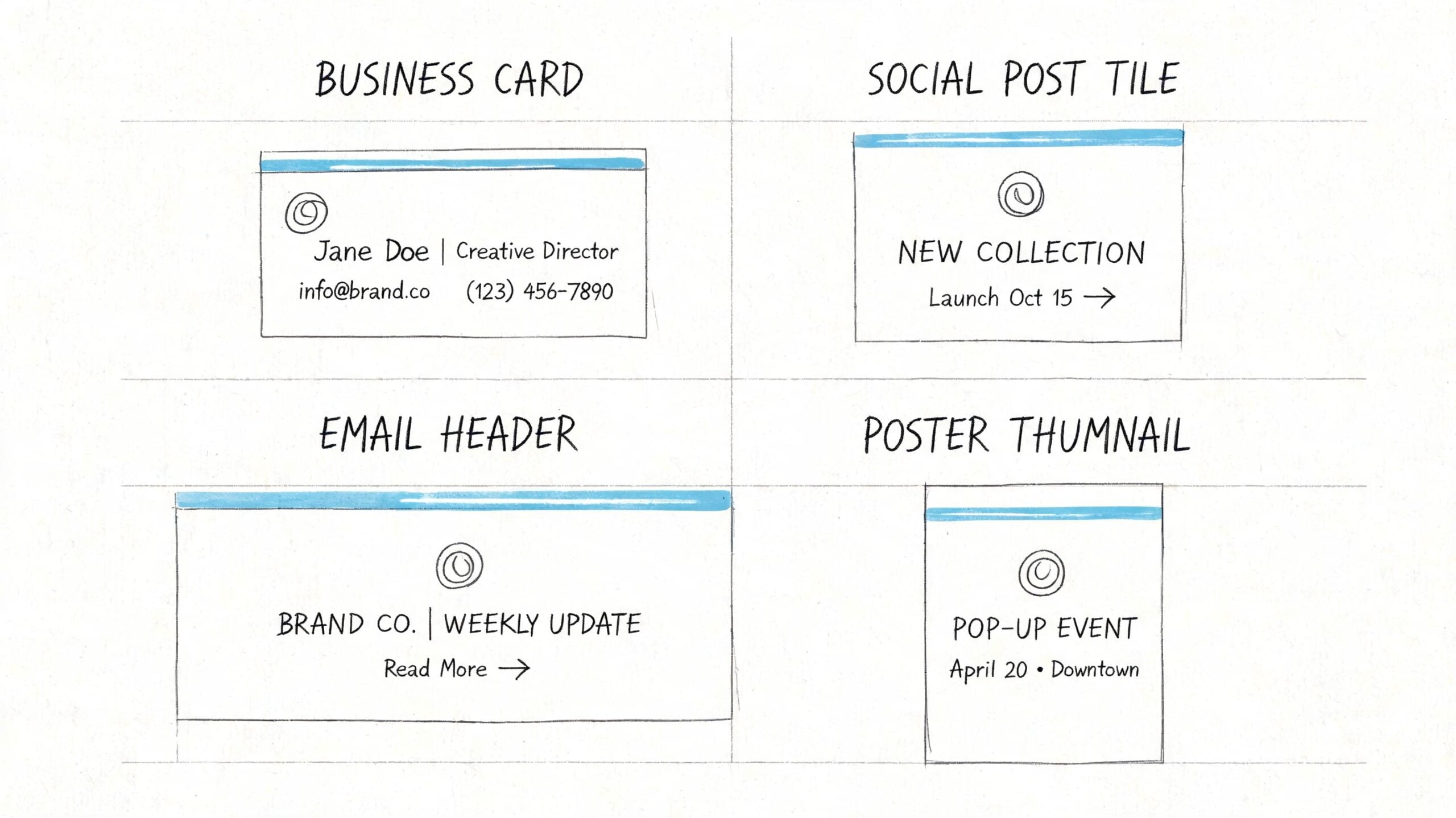
Consistency is an operations decision as much as a design one. Small businesses rarely fail here because they lack taste. They fail because nobody has defined the rules, stored the right files, or made it easy for staff and suppliers to follow the same system.
Build consistency into the process
Start with the assets people use every week, not a 40-page brand manual nobody opens.
- Create working templates: Set up approved layouts for social posts, proposals, email headers, flyers, and presentation decks.
- Keep one live asset folder: Store the current logo files, colour codes, font choices, image treatment, and icon style in one shared location.
- Match physical and digital materials: Menus, signage, packaging, invoices, and web graphics should clearly belong to the same business.
- Audit old materials: Replace outdated PDFs, social covers, printed leaflets, and event banners that no longer reflect the current brand.
A quick win is to choose five customer-facing assets and review them side by side today. Homepage, Instagram grid, email signature, proposal template, and one printed item is enough. If they do not look related, fix those before creating anything new.
We do this with Dorset businesses because the gap is usually obvious once the materials are in one place. A chamber organisation such as Weymouth & Portland Chamber of Commerce needs event graphics, member emails, and web pages to feel aligned. A hospitality brand needs menus, window posters, and social graphics to carry the same visual cues. The trade-off is simple. More consistency means less room for one-off creative decisions, but it gives the business stronger recognition and better marketing efficiency.
Customers see one brand, not your internal workflow.
If one supplier designs your leaflet, another updates your socials, and a third prints your signage, someone still needs to own the standard. That role does not need to be complicated. It just needs to be clear.
5. Leverage Customer Testimonials and Case Studies for Social Proof
A strong brand still loses work if prospects cannot see proof.
Small businesses usually have that proof already. It sits in inbox replies, Google reviews, WhatsApp messages, and post-project thank-yous instead of appearing where buying decisions happen. On service pages, in proposals, and near enquiry forms, proof reduces hesitation and helps more visitors take the next step.
For branding, that matters because recognition gets attention, but evidence gets action. Nielsen's Global Trust in Advertising report found that people trust recommendations from other people far more than brand-led messaging. On a practical level, that can improve conversion rates on key pages because the visitor no longer has to rely on your claims alone.
Make testimonials do a job
A testimonial should answer one question fast. Why should a similar customer trust this business?
“Great service” does not do much. A useful testimonial names the problem, the experience, and the result. “We were getting enquiries from the wrong type of customer until the site and messaging were reworked” is stronger because it tells a prospect what changed.
That is the standard to aim for.
If you have worked with recognisable local businesses such as Crossfit Durnovaria, The Lobster Pot, or Weymouth & Portland Chamber of Commerce, show the context. What was unclear before? What decision improved the outcome? What happened after launch? Even without hard numbers, a grounded before-and-after story gives the reader something concrete to judge.
A simple implementation plan
Start with three recent clients. Pick the ones that reflect the type of work you want more of, not just the ones who were easiest to please.
Then do this:
- Ask at the right point: Send the request straight after a launch, successful delivery, or positive feedback call.
- Use guided questions: Ask what they needed help with, why they chose you, what changed, and what they would say to someone considering you.
- Add credibility cues: Include the client's full name, business name, role, and photo if permission allows.
- Match proof to the page: Put relevant testimonials on the service page they support, not only on a standalone testimonials page.
- Turn one good project into a case study: Cover the brief, the constraint, the decision made, and the outcome in plain English.
A quick win is to replace one vague testimonial on your homepage this week with one specific result-led quote.
Case studies usually do more than testimonials because they show judgement. They let you explain trade-offs, which is often what convinces a serious buyer. A retail business may need a faster path to checkout but still want enough brand personality to avoid looking generic. A local membership organisation may need a more established web presence without sounding stiff or corporate. Those decisions show how you think, and that is part of the brand.
We use this approach with Dorset clients because it connects branding work to business outcomes people can see. Better proof on the right pages can lift enquiries. Stronger case studies can support SEO by adding richer service content and clearer relevance signals. Better client stories also give you useful material for social posts, including content tied to current hashtag trends and platform behaviour, without slipping into generic self-promotion.
Client-proof test: If a prospect can read the testimonial and immediately understand the problem you solve, the type of customer you help, and the result you delivered, publish it.
6. Create a Cohesive Social Media Strategy Aligned with Your Brand
Social media should support your brand, not dilute it.
Small businesses usually run into trouble when every post is treated as a separate idea. The result is familiar. Product shot on Monday, staff selfie on Wednesday, discount graphic on Friday, then nothing for a week. That inconsistency weakens recall and sends mixed signals to people who are deciding whether to trust you.
The fix is practical. Choose a small number of channels, give each one a clear job, and make sure the experience matches what people see on your website, in your emails, and in the way your team communicates offline. Social content should not sit off to one side. It should help more people recognise the business, click through, and convert.
Give each platform a specific role
A restaurant does not need the same content strategy as an accountant. A Dorset café may get more value from Instagram stories, community reposts, and location-based content, while a local consultancy may see better results from LinkedIn posts that show expertise and send traffic to service pages.
The trade-off is reach versus manageability. More channels can expand visibility, but they also increase production time and make inconsistency more likely. In practice, two well-run platforms usually outperform five neglected ones.
Use this simple setup:
- Pick two priority platforms: Choose the channels your customers already use, not the ones you feel guilty about ignoring.
- Assign one purpose to each: Instagram can build familiarity. LinkedIn can build authority. Facebook can handle updates and local community engagement.
- Set three to five content pillars: Use recurring themes such as advice, proof of work, customer questions, team insight, and offers.
- Build reusable templates: Keep fonts, colours, photo treatment, and post structure consistent so the brand is recognisable at a glance.
- Write captions in your actual brand voice: If your website sounds clear and professional, your captions should too.
- Respond consistently: Comments, DMs, and tagged posts shape brand perception as much as the feed does.
A quick win is to audit your last nine posts today. If they look like they belong to three different businesses, fix the template, tone, and topic mix before posting anything new.
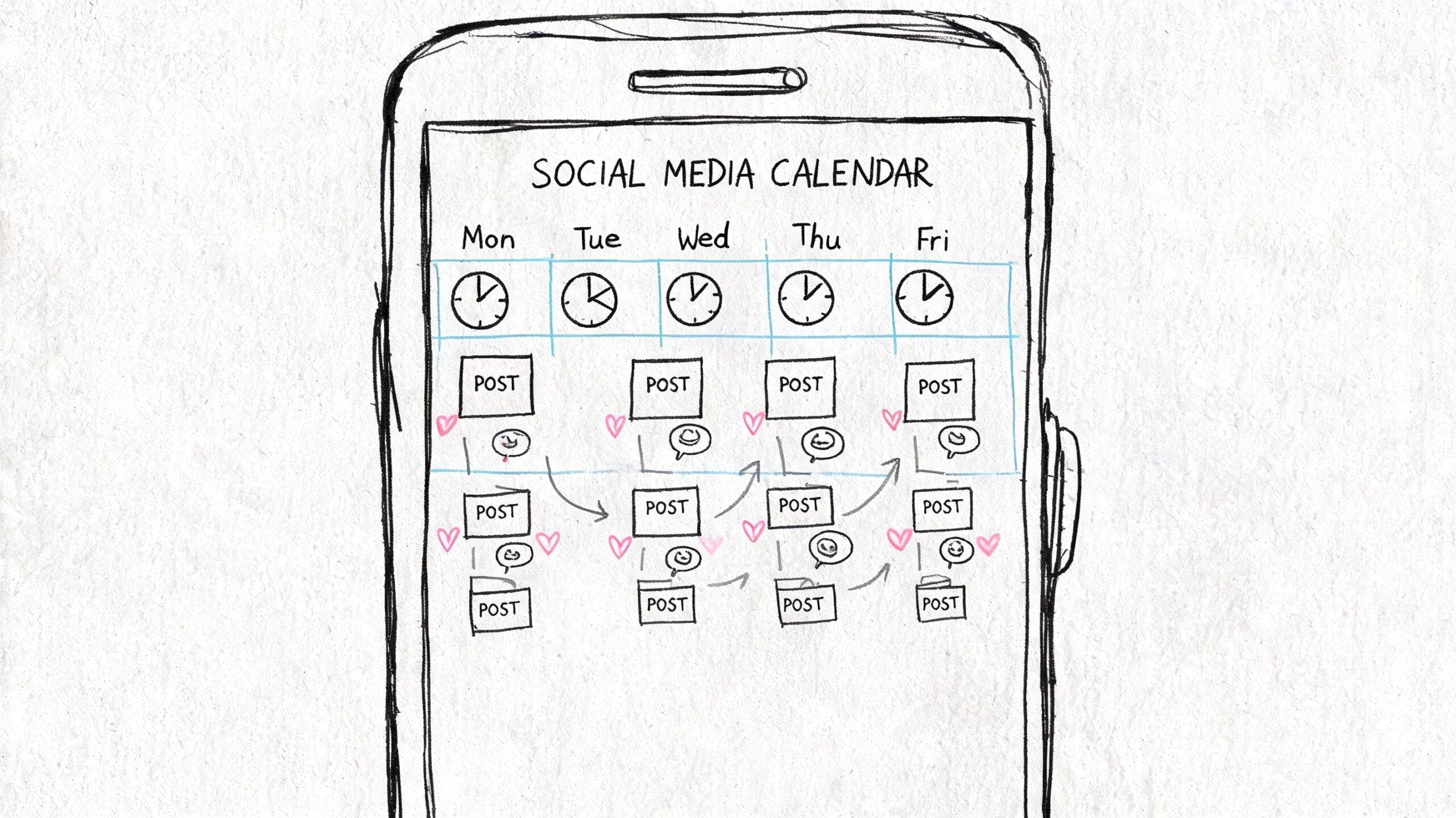
Build a weekly system you can maintain
Small businesses get results here. Success comes not from posting more, but from posting with a plan they can sustain.
Create a simple weekly workflow. One post should build trust. One should show the product or service in use. One should move people to your website or enquiry page. That gives you a balanced mix of attention, proof, and action.
For example, a local trades business could run:
- A short before-and-after project post.
- A practical tip that answers a common customer question.
- A testimonial clip or photo with a clear outcome.
- A direct call to book a quote through the website.
That kind of structure does two jobs at once. It keeps the brand steady, and it gives social traffic a clearer path into pages that convert. If your website is underperforming, review how social and search are working together with a proper SEO audit for small business websites.
There is also a local trust factor here that generic branding advice often misses. Small firms tend to perform better on social when they show real people, real work, and real context. Staff faces, local references, customer wins, and behind-the-scenes moments often do more for credibility than polished stock-style graphics because they reduce doubt.
For businesses refining discovery on social platforms, these hashtag trends to watch out for can help you avoid lazy tagging habits and think more strategically about reach.
From agency work with Dorset businesses, the pattern is consistent. Brands that tighten their social system usually see better quality traffic, stronger recognition across channels, and fewer drop-offs between first impression and website visit. Social media does not need to do everything. It needs to make the next step easy and consistent.
7. Optimise Your Website for Search Engines SEO
A good-looking brand that cannot be found is doing half the job.
SEO affects branding at the point where buying intent is highest. Someone searches for a service, compares a few options, clicks a result, and makes a trust decision fast. If your site is hard to find, slow to load, or unclear about what you do and where you do it, brand work loses commercial value.
For small businesses, the win is usually local and practical. Better search visibility means more qualified visits, more enquiry-page views, and more chances to convert people who already have a need. In agency work with Dorset businesses, the sites that perform best tend to share the same traits. Clear service pages. Consistent business details. Useful location signals. Brand presentation that matches what people saw in search results and Google Business Profile.
Treat search and brand clarity as one system
Google does not rank a website because the colours are polished. It does reward pages that are clear, relevant, technically sound, and helpful. Strong branding supports that by reducing hesitation once people arrive. If the site looks credible, the message is easy to follow, and the service pages answer obvious questions, users stay longer and take the next step more often.
Start with the pages that matter most:
- Tighten page targeting: Give each core service page a specific job. One main service, one main search intent, one clear location context if you serve a defined area.
- Fix business consistency: Your business name, address, phone number, opening details, and service descriptions should match across your website and Google Business Profile.
- Write for real searches: Build pages and articles around the questions customers ask before they enquire.
- Sort technical issues early: Broken links, thin pages, duplicate metadata, and slow load times waste traffic you already worked to get.
Here is the quick-win version I usually recommend to small businesses. Pick your top three revenue-driving services. Check whether each one has its own page, a clear title tag, a useful headline, and copy that mentions the area served in a natural way. Then review whether each page gives people a reason to act now, such as a quote form, phone number, or booking step.
That work improves more than rankings. It usually improves conversion paths as well.
A proper review helps you spot where visibility and brand experience are pulling in different directions. If you need a starting point, this SEO audit service overview shows the kinds of issues worth checking first.
Search visibility gets the click. Brand clarity helps turn that click into an enquiry.
8. Build Email Marketing Campaigns to Nurture and Retain Customers
Email is one of the few channels a small business fully controls.
Algorithms change. Social reach fluctuates. Paid ads get more expensive. But an email list gives you direct access to people who already know your business. That makes it a retention tool, a repeat-sales tool, and a branding tool all at once.
The mistake is using email only when there's something to sell. That trains subscribers to ignore you. Better email branding feels consistent with the business as a whole. Same tone, same visual style, same standards, same level of usefulness.
Write emails people want to receive
Email works best when it extends your brand rather than interrupting it. A restaurant can share seasonal updates, special events, and behind-the-scenes stories. A gym can send class news, member highlights, and practical tips. A design agency can send launch advice, project examples, and useful website guidance.
The structure can stay simple:
- Offer a reason to subscribe: Exclusive updates, useful advice, early access, or local news can all work.
- Set expectations early: Your welcome email should explain what people will receive and how often.
- Segment when possible: Past customers, active leads, and general subscribers shouldn't all get identical messages.
- Keep the design on-brand: Use your colours, typography, and tone, but don't over-design the email.
There's also a practical partnership angle here. In South West England, branded content marketing adoption is high, and community organisations and retailers using co-branded campaigns saw referral growth in the BCC-related summary published here. For local businesses, that can translate into joint guides, seasonal roundups, event promotions, or shared email features with complementary brands.
A good email strategy doesn't need to be clever. It needs to be consistent, useful, and recognisably yours.
8-Point Branding Strategy Comparison
| Item | Implementation 🔄 (complexity) | Resources ⚡ (requirements) | Expected outcomes 📊 (results/impact) | Ideal use cases 💡 | Key advantages ⭐ |
|---|---|---|---|---|---|
| Define and Document Your Brand Identity | High 🔄, strategic workshops, audits, stakeholder alignment | Moderate–High: time, possible agency/designer | Strong long-term consistency and clearer messaging across channels | Startups, rebrands, teams needing alignment before scaling | Provides clear direction, reduces inconsistent decisions |
| Invest in Professional Logo and Visual Design | Moderate 🔄, discovery, iterations, final assets | Moderate: designer fees, multiple file formats, revisions | Immediate credibility and recognisability across mediums | New brand launch, visual refresh, product packaging, signage | Versatile identity assets, long-term ROI and brand recall |
| Build a Professional, Mobile-Responsive Website | Moderate–High 🔄, design, development, content, testing | High: dev time, hosting, CMS, content creation, maintenance | 24/7 storefront, higher conversions, improved search visibility | eCommerce, service bookings, businesses needing credibility | Conversion-focused presence, analytics, scalable platform |
| Develop a Consistent Visual Style Across Materials | Moderate 🔄, templates, guidelines, team training | Moderate: design system creation, template production, training | Increased recognition, faster content production, consistent UX | Brands with multiple touchpoints, scaling marketing teams | Efficiency in production, cohesive customer experience |
| Leverage Customer Testimonials & Case Studies | Low–Moderate 🔄, collection, editing, publishing | Low–Moderate: time to gather, possible video/production costs | Higher conversion rates and stronger trust with prospects | B2B services, agencies, eCommerce proving results | Powerful social proof, reduces sales objections, reusable content |
| Create a Cohesive Social Media Strategy | Moderate–Ongoing 🔄, planning, content calendar, community mgmt | Moderate–High: time (15–20 hrs/wk), content creation tools, advertising budget | Greater brand awareness, website traffic, community engagement | D2C brands, local businesses, thought leaders, community-driven businesses | Direct engagement, traffic driver, audience insights for optimisation |
| Optimise Your Website for Search Engines (SEO) | Moderate–High 🔄, technical work, content, link-building | High: ongoing content, SEO tools, possible specialist support | Sustainable organic traffic, lower CAC, authority in search results | Local businesses, professional services, content-led growth strategies | Long-term, cost-effective traffic; measurable ROI over time |
| Build Email Marketing Campaigns to Nurture & Retain | Low–Moderate 🔄, setup, segmentation, automation | Low–Moderate: platform fees, copy/design, list-building effort | High ROI and improved customer lifetime value and repeat purchases | eCommerce, membership services, businesses prioritising retention | Owned communication channel, personalised messaging, measurable conversions |
Your Next Steps From Quick Wins to Professional Partnership
Branding gets overcomplicated far too often. For most small businesses, the next step isn't a massive rebrand or a six-month strategy project. It's fixing the obvious inconsistencies that are already costing trust.
Start with the quick wins. Write a one-page brand guide. Choose one approved logo set. Update your social profiles so they match your website. Replace weak testimonials with specific ones. Check your homepage on mobile. Make sure your Google Business Profile and website use the same business description, tone, and visuals. None of that is glamorous, but all of it matters.
Then look at the bigger picture. If your brand feels fragmented, the issue usually isn't one asset. It's the lack of a system. The website, the social channels, the printed materials, the email design, the photography style, and the messaging all need to support the same impression. That's where small businesses either start looking established or continue looking improvised.
There are real trade-offs involved. A DIY approach can work when you're early-stage and disciplined, but it often creates patchwork branding over time. Hiring specialist support costs more up front, but it usually saves time, reduces rework, and gives you a brand system you can use across channels. The right choice depends on your stage, your budget, and how visible brand inconsistency has become in sales conversations.
If you're in a local market, don't overlook the offline side either. Your signage, packaging, printed handouts, staff presentation, and social presence all shape the same reputation. Customers don't separate those experiences neatly. They form one overall judgement about whether the business feels trustworthy, clear, and worth choosing.
That's why strong branding tips for small businesses always come back to implementation. Not theory. Not mood boards without follow-through. Not vague promises about “standing out”. What works is clarity, consistency, proof, and a website that supports the brand instead of undermining it.
When you're ready to move beyond quick fixes and build a stronger foundation, working with a specialist partner can make the process more practical. A Dorset-based agency like DesignStack offers branding, web design, WordPress builds, SEO support, hosting, and post-launch updates, which is useful for businesses that want the brand and website to be aligned from the start.
If your business needs a clearer brand, a stronger website, or both, DesignStack can help you turn scattered marketing into a consistent digital presence that works online and in print.

Leave a Reply