

Local SEO for Businesses: The Complete 2026 Playbook
Let's cut through the noise. Local SEO for businesses isn't some dark art. It’s simply about making sure you’re the first business that comes up when someone nearby searches for what you do. Think of it as being the most talked-about, go-to shop on the high street, but in the digital world.
Why Local SEO Is Your Best Marketing Investment
With so many marketing channels vying for your budget, local SEO consistently proves its worth. Why? Because it delivers real, measurable results. You aren't just casting a wide, expensive net and hoping for the best. You're connecting with people in your area—whether you’re a café in Weymouth or a law firm in Dorchester—right at the moment they’re ready to buy.
This sharp focus is exactly why local SEO makes so much financial sense. It’s no surprise that 49% of business owners now consider SEO their best marketing investment. From our experience with Dorset businesses, the break-even point for a solid technical SEO investment is often just six months. It’s a powerful, sustainable way to grow.
From Visibility to Growth
The path with local SEO isn't complicated. It boils down to a simple, three-stage journey: get seen, build a connection, and then drive real business growth. It’s the process that turns an online search into a customer walking through your door.
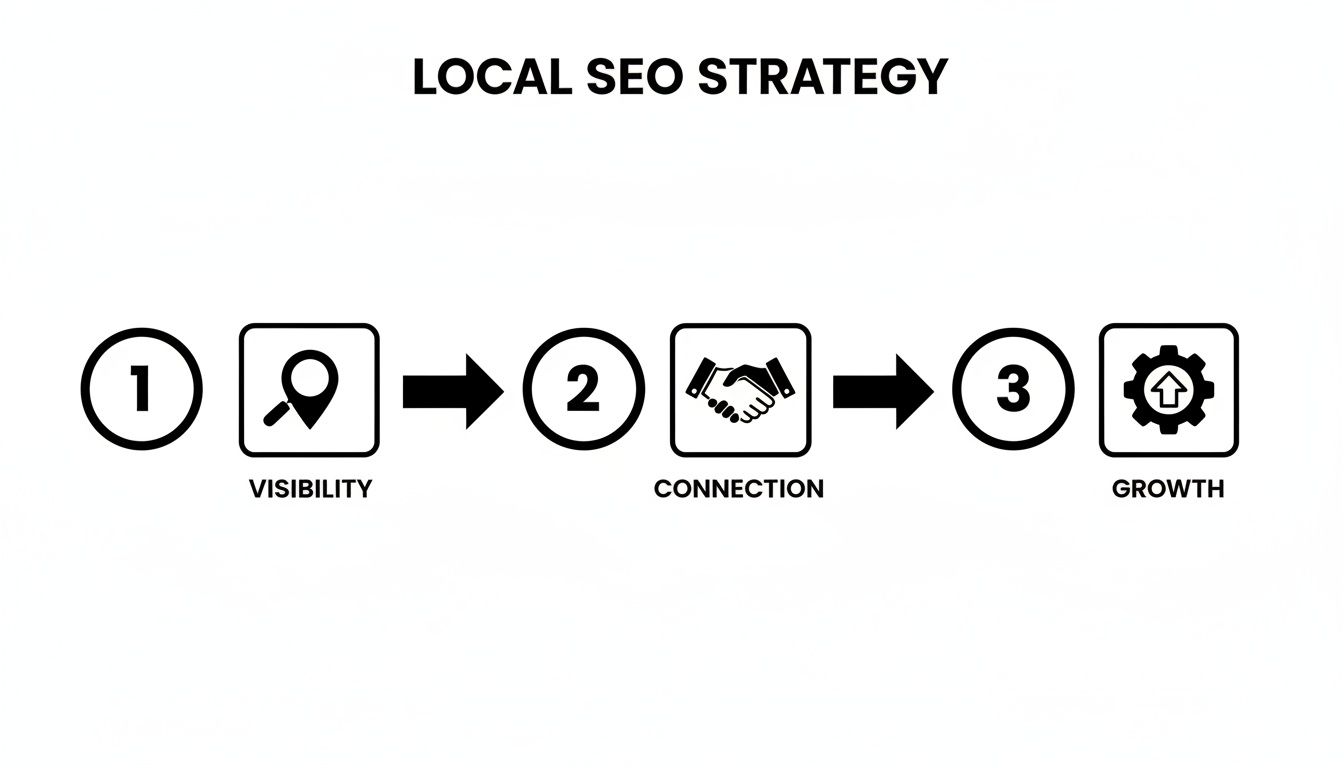
The logic here is straightforward: each stage builds on the one before it. You can't connect with customers if they can't find you, and you can't grow your business without first building that connection.
This entire playbook is built to walk you through these stages, giving you a practical framework that any business owner can put into action. We’ll break down the key pillars that turn search engine clicks into paying customers.
Local SEO isn't about chasing vanity rankings; it's about driving revenue. It's making sure that when a local customer needs your services, your business is the obvious choice.
To get this right, you need to know where you stand. That's why we'll touch on the core elements of a modern audit, something expertly detailed in this Modern Geo Audit Playbook. We're talking about mastering your Google Business Profile, creating hyperlocal content, and managing your online reputation to own your local market.
Our goal here is to demystify the entire process. And if you decide you'd rather have an expert handle it, you can always check out our dedicated search engine optimisation services. But for now, let's give you the confidence and the know-how to build a powerful local strategy yourself.
Getting Your Google Business Profile Spot On
Let's be blunt: for most local businesses, your Google Business Profile (GBP) is your new homepage. It's often the very first thing a potential customer sees. It’s their first impression, and it’s what makes them decide whether to call you or click on your competitor down the road. Nailing this is the absolute bedrock of local SEO for businesses.
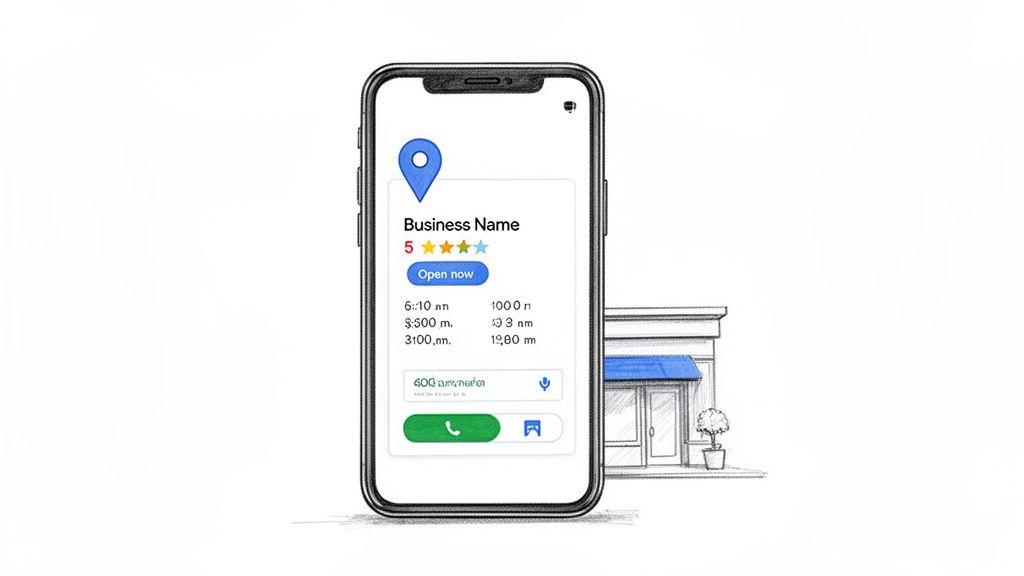
It might sound simple, but the data tells a stark story. Here in the UK, a well-tuned Google Business Profile is the single most powerful tool for local search. The shocking part? A massive 56% of local businesses haven't even claimed their free listing.
That's a huge opportunity missed. Businesses with complete, optimised profiles are 70% more likely to get someone walking through their door and 50% more likely to be shortlisted for a purchase. And when you consider that 86% of people use Google Maps to look up local info, ignoring your GBP is like leaving your shop door locked during opening hours.
The Key Parts of a Profile That Ranks
A truly optimised profile isn't just about sticking your name and number online. It's about meticulously feeding Google every last detail about your business, leaving no doubt in its algorithm that you are the best result for a local search.
Think of it as building a case file for your business. The more complete and accurate it is, the more trust you build with Google, and the more confident it becomes in showing you to people searching for what you do.
Your 5-Step GBP Action List
To get started, here's a simple, actionable list to transform your GBP from a blank slate into a customer-generating machine. Follow these steps methodically.
- Claim and Verify: The first, non-negotiable step. Go to Google Maps, find your business (or add it), and follow the steps to claim it. Google will usually send a postcard with a verification code to your address to prove you're real.
- Complete Core Information: This is the foundation. Fill out every single field you can:
- Business Name: Must be your exact, real-world business name. No extra keywords or locations.
- Categories: Choose the most specific primary category possible (e.g., "Plumber" not "Home Services"), then add all relevant secondary categories.
- Address & Service Area: For storefronts, pin your exact location. For service businesses, hide your address and define the towns or postcodes you cover.
- Hours & Contact Info: Ensure your phone number, website, and opening hours are 100% accurate.
- Write a Compelling Description: You have 750 characters. Use them to explain what makes you unique, who you help, and what problems you solve. Weave in local terms naturally (e.g., "Proudly serving the Dorset community for over 20 years…").
- Add Services and Products: Be exhaustive. Use the 'Services' and 'Products' tabs to list everything you offer. Add descriptions and prices where possible. This is free advertising space directly in search results.
- Upload High-Quality Photos: This is crucial for building trust. Add photos of your storefront, your team, your work in progress, and your finished projects. Aim for at least 10 high-quality images to start.
By working through this list, you're doing much more than just filling out a form. You are building a powerful digital asset that shouts your relevance and authority to both Google and your future customers.
Go Beyond the Basics with Active Features
Once the core details are locked in, you need to bring your profile to life. These next features signal to Google that your business is active and engaged, which is a major factor in boosting your rankings in the local map pack.
An active profile is a healthy profile. Think of it like a shop window; you need to change the display regularly to keep it interesting. If this all feels a bit much, our guide on free GBP optimisation offers some extra help.
Here’s what to focus on:
-
Google Posts: These are like free mini-adverts right on your profile. Use them constantly to announce offers, show off a new project, share an update, or highlight a specific service. Most posts last for seven days, so aim to post at least once a week to keep a fresh stream of content flowing.
-
The Q&A Section: This is a goldmine for addressing customer concerns before they even have to ask. People can ask questions publicly, but you can also be proactive. I always advise clients to "seed" this section themselves by posting their most frequently asked questions and then answering them clearly and concisely.
-
Photos and Videos: People buy from people. Show them who you are! Profiles with plenty of photos get far more clicks and direction requests. Upload high-quality shots of your storefront, your team at work, before-and-after photos of your projects, and even short videos. It helps a potential customer in Poole feel like they know you before they've even picked up the phone.
Developing a Hyperlocal Content and Keyword Strategy
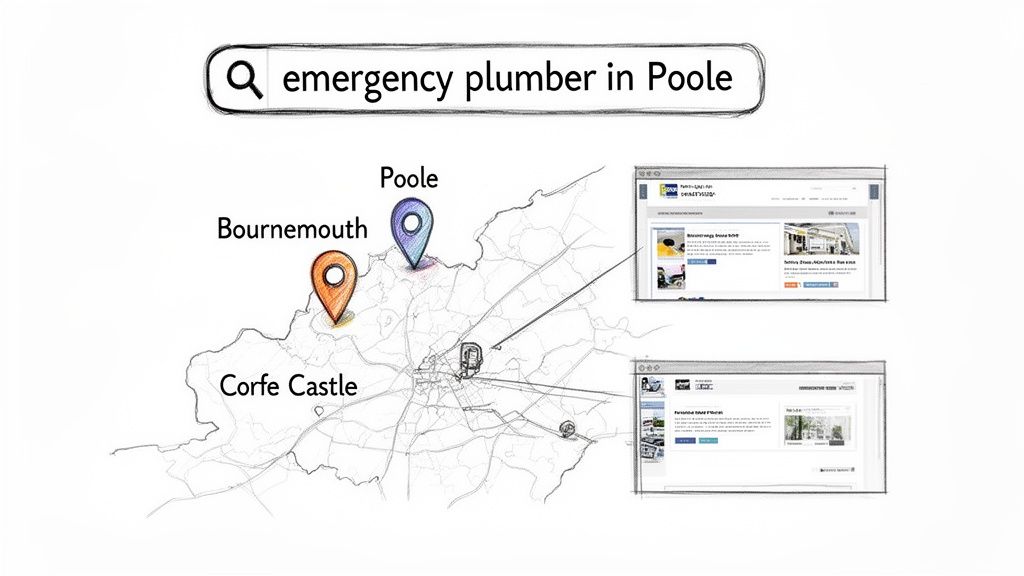
If you want to master local SEO for your business, you need to start thinking exactly like your customers. To pull in people from your immediate area, you have to look past the generic keywords and get laser-focused on the specific, urgent phrases they use when they need a solution right now.
Forget about broad terms like "plumber." The real gold is in hyperlocal searches like "emergency plumber in Poole" or "dog-friendly pub near Corfe Castle." These aren't just idle searches; they're cries for help from potential customers who are ready to buy or book.
Our job is to create content that lines up perfectly with these local queries, positioning your business as the obvious, most helpful answer. This is a two-step dance: first, we'll dig up the right local keywords, and then we'll build content that nails the intent behind them.
Finding Keywords That Drive Local Action
Building a keyword strategy shouldn't be a random shot in the dark. It’s about creating a simple, repeatable system that marries your services with the specific places you do business. The result? A powerful list of phrases that actual customers are plugging into Google.
Think about all the different ways someone might search for you. They could use a town name, a specific neighbourhood, a postcode, or even a local landmark. Your task is to get ahead of these variations and capture that intent.
If you're looking for a deep dive, this practical guide to local SEO keywords is an excellent resource for drilling down into the exact phrases customers use. It’s fantastic for closing the gap between the services you offer and how people actually look for them.
Your Actionable Local Keyword Brainstorming List
Right, let's get practical. Grab a spreadsheet or even just a pen and paper, and let's map out the keywords for your business.
-
Service + Town/City: This is your bread and butter. For a business in Dorset, we're talking "web design Weymouth" or "accountant in Dorchester." List every single town you want to work in.
-
Service + Neighbourhood: Now, let's get even more specific. If you're based in Bournemouth, you could be targeting "coffee shop in Westbourne" or "solicitor in Southbourne." This is how you catch those hyper-local searchers.
-
"Near Me" Modifiers: You can't technically target "near me" — Google figures that out based on the user's location. But you can (and should) create content that screams "we are right here!" This helps you show up for these all-important searches.
-
Qualifier + Service + Location: Think about what makes a customer's need urgent or specific. Things like "emergency drain unblocking Blandford", "24-hour locksmith Poole", or the classic "best Sunday roast in Bridport".
-
Service + Postcode: Don't forget postcodes, especially for delivery services or in dense towns. A customer might well search for "takeaway DT4" or "flower delivery BH16".
Remember, this is all about relevance, not just volume. Ranking for "emergency plumber in Poole" is infinitely more valuable than ranking for a generic term like "plumbing tips" if your phone needs to ring today.
Turning Keywords into High-Value Content
Once you've got that golden list of hyperlocal keywords, it's time to build content that serves them on a silver platter. For local service businesses, this is where you can run rings around competitors who are still just writing generic blog posts.
So, instead of a vague article like "5 Signs You Need a New Roof"—which attracts researchers, not buyers—we're going to build targeted, valuable pages that speak directly to a customer's problem. This approach creates assets that don't just rank; they convert.
Here’s how you do it.
Build Hyper-Local Service Pages
This is, without a doubt, the most powerful local content strategy I've seen work time and time again. Ditch the single, generic "Services" page. Instead, you're going to create a dedicated page for each core service in each key location you serve.
Let's see it in action:
Imagine you run a web design agency. You're based in Weymouth, but you're happy to take on projects in Bournemouth and Dorchester too. Instead of one "Web Design" page, you'd build out:
-
Web Design Weymouth: A page that lives and breathes Weymouth. You'd mention local clients you've worked with, talk about understanding the unique business community there, and feature testimonials from Weymouth-based companies.
-
Web Design Bournemouth: A completely separate page, tailored for Bournemouth businesses. Here, you could talk about your experience with the town's booming tech or hospitality sectors and showcase a portfolio of your Bournemouth projects.
Each page needs to be written uniquely and optimised for its specific "service + location" keyword. This sends a massive signal to Google that you are the authority for that service in that town. It works because it perfectly matches what the user is looking for, making it far more effective than any generic blog post ever could be.
Essential On-Page SEO for Local Dominance
While your Google Business Profile gets you noticed, it’s your website that truly seals the deal. On-page SEO is how we fine-tune your site, sending loud and clear local signals straight to Google. It’s not about getting lost in complicated code; it's about making deliberate, common-sense changes to prove you’re the best local choice.
Nailing this tells Google that your website is the go-to resource for a specific town or county. When someone in Dorset searches for what you offer, you want Google to have zero doubt about showing them your site first.
Solidify Your NAP and Location Signals
The absolute bedrock of local on-page SEO is consistency. Your business Name, Address, and Phone number (NAP) needs to be written out identically everywhere it appears on your website. My advice is to put it right in the footer, so it’s on every single page.
This consistent NAP is your digital anchor. If your address is "Unit 5, Poole" on one page and "U5, Poole, Dorset" on another, it creates tiny seeds of doubt for search engines. Keep it the same, every time.
Another non-negotiable is embedding a Google Map on your contact page. Don't just pop a link there – use the 'Embed a map' feature from Google Maps to display an interactive map showing your exact location. For a Weymouth-based business, this is a far more powerful signal to Google than simply listing the address. It’s a direct, undeniable confirmation of your physical presence.
Implement Local Business Schema Markup
Schema markup is a bit like a secret language that helps you talk directly to search engines. It’s a small bit of code you add to your site that spells out exactly who you are, what you do, and where you are, leaving no room for interpretation.
For any local business, this is one of the most effective things you can do. It helps Google instantly understand your NAP, opening hours, and what services you provide. Get it right, and you could be rewarded with "rich results" – those eye-catching search listings that include star ratings or extra details.
Don't let the word "code" put you off. If you're on WordPress, you don't need to be a developer. It's surprisingly easy.
Here’s how to get it done quickly:
- Install a WordPress Plugin: Grab a tool like Rank Math or Yoast SEO. Both have excellent, easy-to-use Local SEO modules.
- Enter Your Information: Head to the plugin's settings, find the 'Local SEO' section, and just fill in the form with your business details.
- Select Business Type: Be specific. Don’t just choose ‘Local Business’. If you’re a plumber, select ‘Plumber’. If you run a garage, pick ‘Automotive Business’. This detail helps Google categorise you perfectly.
- Test Your Markup: Once you’ve saved your settings, pop your website URL into Google’s free Rich Results Test tool. It will show you if Google can read your local business schema correctly.
This entire process can take less than 15 minutes but sends incredibly strong local signals to Google for years to come.
Prioritise Mobile-Friendliness and Page Speed
Think about when people do local searches. They're often out and about, maybe looking for "car repair near me" after breaking down, or "best coffee in Dorchester" while walking through town. These searches are urgent and almost always on a smartphone.
In fact, more than half of all web traffic now comes from mobile devices, and for local queries, that figure is even higher.
If your website is clunky or takes an age to load on a phone, that potential customer is gone. They’ll hit the back button and be on your competitor’s site before you can blink. Slow speed is a conversion killer.
A fast, mobile-friendly website isn't a 'nice-to-have'; it's fundamental. You should be aiming for a load time of under 3 seconds. A great free tool for this is Google’s PageSpeed Insights. It gives you a clear score and, more importantly, a to-do list of how to make your site faster on both mobile and desktop.
Building Trust Through Citations and Online Reviews
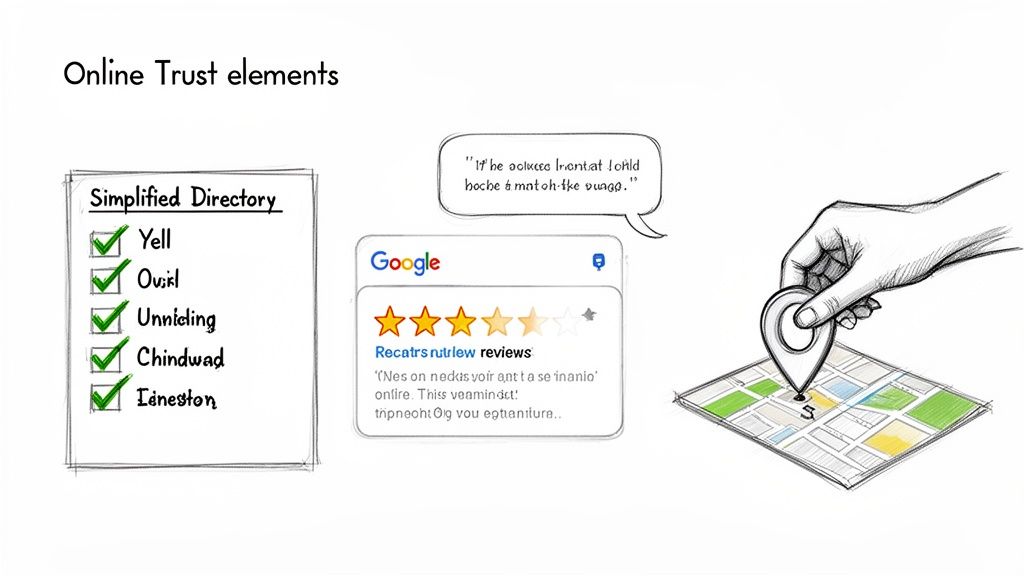
So you've got your website and Google Business Profile sorted. That’s the foundation. But to really stand out locally, you need to build trust across the wider web. For a small business, that trust comes from two things: citations and reviews.
Think of them as digital word-of-mouth. These are the signals that prove to Google, and more importantly, to potential customers, that you're a real, active, and respected business in the area.
One person recommending you is nice. But hearing your name pop up in conversation all over town? That’s powerful. Citations and reviews do exactly that for your business online.
The Groundwork: Consistent Citations
A citation is just a mention of your business's Name, Address, and Phone number (NAP) on another website, usually in an online business directory. Every time Google finds a consistent mention of your NAP, it's like a small vote of confidence that confirms who you are and where you are.
The crucial word here is consistent. I can't stress this enough.
Your NAP details need to be identical everywhere. If you're "The Dorset Pie Co." on one directory but "Dorset Pies Ltd" on another, you're creating confusion for search engines and eroding your local authority. Accuracy is everything. Building citations isn't glamorous work, but it's absolutely essential.
An Actionable List of UK Citation Sources
The good news is you don't need to guess where to start. Your aim is to get your business listed on the big national directories and then layer on relevant local or industry-specific ones. If you're a plumber in Dorset, that means getting on the major UK sites and local Dorset directories.
Here’s a priority list to get you going:
-
The Big UK Players: These are the heavyweights. You have to be on these.
- Yell.com
- Thomson Local
- The Independent
- The Sun Directory
- Scoot
- Hotfrog
-
Niche & Local Directories: These add a powerful layer of local relevance.
- Industry-Specific: Think of sites like Checkatrade for tradespeople or TripAdvisor for hotels and restaurants. Find the leader in your sector.
- Local Chambers of Commerce: Joining the Weymouth & Portland Chamber of Commerce, for instance, usually includes a valuable directory listing.
- Local News Sites: Check the business directory section on sites like the Dorset Echo.
Before you do anything else, search for your business on these sites. You might already be listed. Claim any existing profiles and fix any errors before you start creating new ones. A clean, consistent presence here sends a huge trust signal to Google.
Mastering the Art of Online Reviews
While citations lay the data foundation, reviews build social proof. A steady flow of genuine, positive reviews is probably the single most powerful factor in local SEO today. Research shows that a staggering 93% of consumers read online reviews before making a purchase.
Reviews work their magic in two ways. First, they give Google fresh, user-generated content full of keywords about your services and location. Second, and more critically, they build trust with potential customers before they’ve even clicked through to your website.
If you take one thing away from this section, let it be this: The best way to improve your local ranking is to get more authentic, positive reviews than your competitors. It proves your value in a way nothing else can.
How to Get More Reviews, The Right Way
Getting more reviews isn't about being pushy; it's about having a simple process. It's about asking the right customer at the right time and making it dead simple for them to say yes.
First, pinpoint the "happy moment." This is that golden window when a customer is most delighted—right after you've finished a job, just after they've raved about your food, or when they send you an email thanking you. That’s your moment.
Next, ask personally and directly. A generic mass email just doesn't cut it. A simple, human request works wonders. Something like, "I'm so glad you were pleased with the result today. Reviews from customers like you really help our small business. Would you mind taking a minute to share your thoughts on Google?"
This next part is crucial: give them a direct link. Don't just say "find us on Google." Use a free tool to generate a link that takes them straight to the "leave a review" pop-up on your Google Business Profile. Removing that friction is the key to getting a response.
Finally, respond to every single review. Thank people for the good ones, and more importantly, address the bad ones professionally. A thoughtful, helpful response to a negative review can often win over more future customers than a dozen five-star ratings. It shows you care.
Your Local SEO Questions, Answered
Even after laying out the entire playbook, it’s completely normal to have a few questions buzzing around. Getting started with local SEO can feel like a huge undertaking, so let's clear the air and tackle some of the most common things we get asked by business owners across Dorset.
How Long Does Local SEO Take to Show Results?
This is the big one, isn't it? The honest answer is: it depends.
You can often see some quick wins within a few weeks, especially after giving your Google Business Profile a solid optimisation. More phone calls, more direction requests—that’s the low-hanging fruit.
But a proper, comprehensive local SEO strategy is a long game. Real, lasting results usually start to become noticeable within 3 to 6 months. That’s the typical timeframe for the foundational work—like on-page fixes, building citations, and getting a steady stream of reviews—to really take hold. The key is consistency. Think of it as a marathon, not a sprint, where the return on your effort compounds over time.
Do I Need a Physical Address for Local SEO?
For classic local SEO, where you're aiming to show up in Google's Map Pack for searches like "café near me," then yes, a legitimate, verifiable physical address is crucial. It’s the clearest signal you can send to Google about where you are.
However, what if you're a Service Area Business (SAB)? Maybe you’re a plumber in Poole or a mobile dog groomer covering the whole of Dorset. You absolutely can still dominate local search. The trick is to hide your home address in your Google Business Profile and clearly define your service area instead.
For service businesses, think beyond just your address. Your digital reputation, built through consistent reviews, hyperlocal service pages, and strong local citations, often carries more weight than a postcode alone.
How Much Should I Budget for Local SEO?
There’s no magic number here; your budget will really hinge on how competitive your market is. A florist in a small Dorset village has a very different landscape to a solicitor in central Bournemouth.
But to give you a rough idea:
- Getting Started in a Small Town: If you're in a less competitive area, you might invest anywhere from £100 to £600 a month. This would cover the absolute essentials like managing your Google Profile and actively getting reviews.
- Competing in a Busy Market: For businesses in a more crowded space like Bournemouth or Weymouth, a budget from £600 to several thousand pounds per month is more realistic. This gives you the firepower for a proper content strategy, link building, and deeper technical work.
- The DIY vs. Agency Question: Kicking things off yourself is a fantastic way to save money and learn the ropes. But as you grow, you'll quickly find your time is better spent running your business. That's when hiring an expert makes sense.
Can I Do Local SEO Myself or Should I Hire an Agency?
You can absolutely make a huge difference doing it yourself. Seriously. By following the steps in this guide—especially nailing your Google Business Profile and building up reviews—you will see results. It’s the best way to grasp the fundamentals. If you want to get comfortable tracking your own progress, our guide on getting started with Google Analytics 4 mastery is a great place to begin.
The reality, though, is that time becomes your biggest bottleneck. As you get busier, dedicating hours to technical fixes, writing content, and building links just isn't feasible.
A smart path for many is to handle the basics in-house first. Once you've got momentum, partnering with an agency can help you scale up, tackle the more complex strategies, and really pull ahead of the competition.
At DesignStack, we specialise in helping Dorset businesses like yours build a powerful online presence that drives real growth. If you're ready to get noticed by more local customers, visit our website to see how we can help.


Leave a Reply