Is SEO Worth It for Small Business?
So, is SEO really worth the effort for a small business? As someone who has worked with countless business owners, I can tell you that for most, the answer is a firm yes. It’s one of the smartest long-term investments you can make, creating an asset that brings in customers for years to come.
The Honest Answer to Your SEO Question
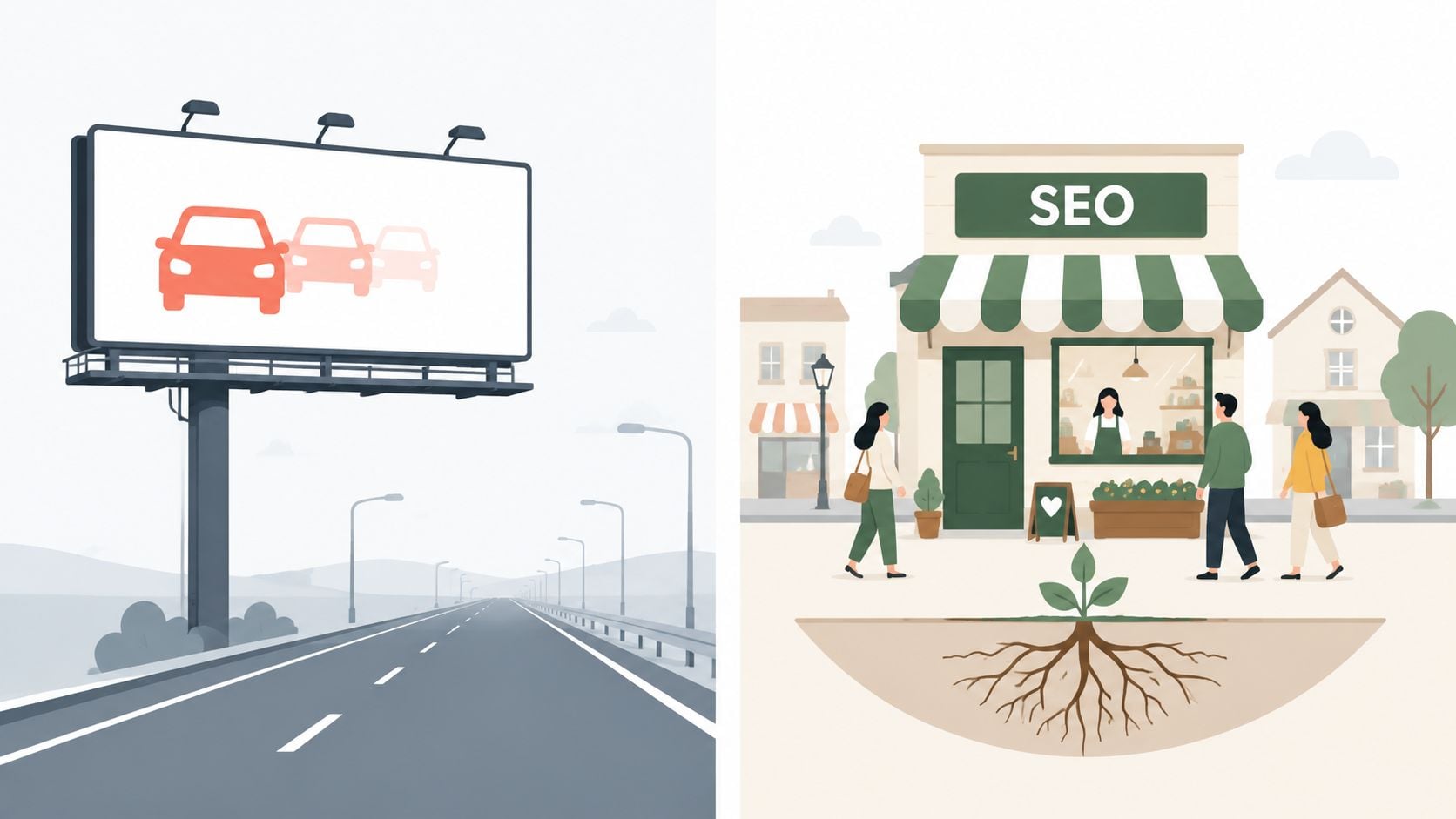
Let's break it down with an analogy I often use. Think of your online presence like a physical shop.
Paid ads are like renting a massive billboard on the motorway. You’ll get a flood of traffic right away, which is great. But the second you stop paying the rent, that billboard comes down, and the traffic disappears completely.
SEO, on the other hand, is like buying the land and building your own shop in the perfect high-street location. It takes more time, effort, and upfront work to get established. But once you're there, you get a steady stream of local shoppers—people who are actively looking for exactly what you sell.
This is about building sustainable visibility and trust. When people find you naturally through a Google search, they automatically see your business as more credible. It’s a frustratingly common problem when customers tell you they can’t find your business online. If you're sat there wondering, "why does my website not show up on Google?", a proper SEO strategy is almost always the solution.
SEO vs Paid Ads at a Glance
To make the choice clearer, it helps to see the two approaches side-by-side. Both have their place, but they serve very different strategic goals for a small business.
| Factor | SEO (Search Engine Optimisation) | Paid Ads (PPC) |
|---|---|---|
| Cost | Upfront investment in time/money; no per-click cost | Pay for every click or impression |
| Timescale | Slower; results build over months (long-term) | Immediate; results appear as soon as the campaign is live |
| Longevity | Results are lasting and can grow over time | Visibility stops the moment you stop paying |
| Trust | Builds high credibility and organic trust | Often perceived as advertising; lower trust |
| ROI | Generally higher over the long term | Can be high, but requires ongoing spend to maintain |
Ultimately, paid ads are fantastic for short-term promotions or to get initial data, but SEO is what builds the foundation of a resilient business.
Building a Long-Term Business Asset
Unlike a social media post that's gone in a day or an ad campaign that ends, the work you put into SEO compounds. The articles you write and the authority you build today will continue to attract customers months, or even years, from now. It isn't about chasing quick wins; it's about methodically building a reliable pipeline of customers that strengthens your business from the inside out.
For small businesses here in the UK, this investment consistently delivers. Good data shows an average Return on Investment (ROI) of around 400% for well-planned SEO campaigns. This is especially true for local businesses. A plumber in Dorset, for example, can use local SEO to appear right when someone in their area searches for "emergency plumber near me"—a massive advantage when 88% of consumers trust online reviews as much as a personal recommendation.
So, when you ask if SEO is worth it, what you’re really asking is if you want to build a lasting digital presence that generates leads, establishes you as an authority, and delivers genuine, long-term profitability. For most small businesses, that's an easy question to answer.
Table of Contents
- The Honest Answer to Your SEO Question
- SEO vs Paid Ads at a Glance
- Building a Long-Term Business Asset
- What SEO Actually Delivers for Your Business
- Understanding the Real Costs and Timelines of SEO
- How to Calculate Your Potential Return on Investment
- Choosing Your Path: DIY SEO vs. Hiring an Agency
- A Few Lingering Questions About Small Business SEO
What SEO Actually Delivers for Your Business
Let's cut through the jargon for a second. What does a good SEO strategy really do for your business? Think of it like having your best salesperson working 24/7, greeting potential customers the very moment they start searching for what you sell. That’s SEO in a nutshell.
When it works, it means you stop being invisible online. Instead, your business pops up on the first page of Google right when a local customer is looking for a solution you offer. This isn't just about getting more website clicks; it's about building instant credibility. People instinctively trust the businesses Google ranks at the top.
Moving Beyond Clicks to Real Customers
The real magic of SEO is its power to attract qualified leads. These aren't just random browsers. They are people who have a genuine need or problem and are actively looking for a fix. This means the phone calls you get and the contact forms you receive are from people already interested in buying.
An effective SEO strategy doesn't just bring you website visitors. It brings you future customers who have already raised their hand and said, "I need what you're selling."
This targeted approach turns your website from a simple online brochure into a powerful tool for attracting new business. You're no longer shouting into the void; you're placing your business directly in front of the people who need you most. This focus on high-intent traffic is a huge part of the answer to the question, is SEO worth it for a small business?
The Tangible Business Outcomes
A well-run SEO campaign produces concrete results that you can see on your balance sheet. Forget abstract metrics—you'll notice real growth in the areas that matter. If you’re curious about what this looks like for companies in your area, you can learn more about how local SEO for businesses drives these kinds of measurable outcomes.
Here’s what that looks like in practice:
- More phone calls coming straight from your Google Business Profile.
- Increased foot traffic to your physical shop or office.
- A higher number of quote requests and enquiries through your website.
- More online sales if you run an e-commerce business.
Ultimately, a solid SEO foundation makes every other part of your marketing more effective. It creates a trustworthy, central hub for your brand online, making sure that when people go looking for you, they find you, trust you, and are ready to take the next step.
Of course. Here is the rewritten section, crafted to sound like it was written by an experienced human expert.
Understanding the Real Costs and Timelines of SEO
One of the first questions I always get from small business owners is, "What's this actually going to cost me, and when will I see results?" It's a fair question. To figure out if SEO is worth it for a small business, you need to have a clear-eyed view of the investment required, both in money and in time.
Let’s be upfront: SEO is not a magic wand. It’s a strategic investment that gathers momentum and builds real, lasting value over time.
So, let's talk numbers. Here in the UK, the cost can shift depending on your industry and where you're based. For a one-off project to get your foundations right—think a full website audit and initial setup—you're typically looking at somewhere between £500 and £2,000.
After that initial work, you’d move onto a monthly plan. For a local business in a place with moderate competition, like Weymouth in Dorset, a monthly retainer might be in the £300 to £800 range. If you’re in a more competitive city or a crowded industry, that could climb towards £800–£1,500. While wider industry data often shows higher average spending, this range is a realistic starting point for essential local SEO services. You can explore more data in these small business SEO statistics from PageOptimizer.pro.
What to Expect From Your Investment
Okay, so you're investing a few hundred pounds a month. What does that actually get you, and how long before your phone starts ringing more? The SEO journey tends to follow a predictable path. You won’t hit page one overnight, but you will see definite signs of progress along the way.
It’s so important to think of SEO as a marathon, not a sprint. The first few months are all about laying a solid groundwork—fixing technical gremlins and establishing your credibility with Google. This early work is absolutely vital for long-term success, but it doesn't always deliver a sudden flood of new customers. As you keep going, the results start to compound on themselves.
This roadmap gives you a good idea of what a typical 12-month SEO campaign looks like.
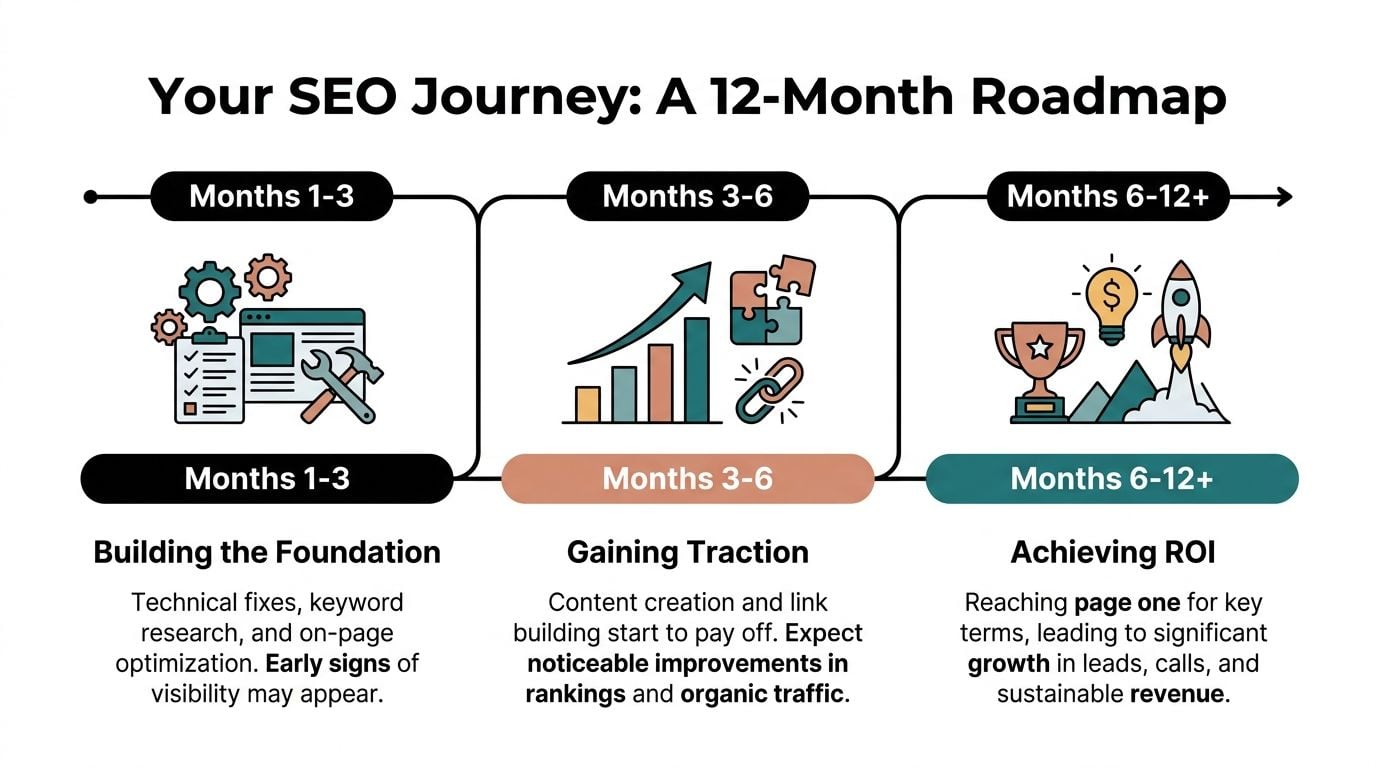
As you can see, the initial heavy lifting on the foundations leads to real traction and, eventually, a strong return on your investment as your website starts to build authority.
Key Milestones on Your SEO Journey
Progress doesn't happen all at once; it comes in stages. Each phase builds on the last, creating a powerful and sustainable engine for business growth.
Months 1–3: Building the Foundation
This is where we get your house in order. The focus is on technical SEO fixes, deep keyword research to discover what your customers are really searching for, and optimising the pages you already have. You might see some small wins and early improvements in visibility as Google takes notice of the changes.Months 3–6: Gaining Traction
Now the real growth starts. With a solid base in place, the work shifts to creating genuinely helpful content and building your website's reputation with high-quality backlinks. During this phase, you should start seeing noticeable jumps in your keyword rankings and a steady climb in organic traffic. This is the first clear sign that your strategy is working.Months 6–12+: Achieving ROI
This is where your investment really begins to pay dividends. Consistent effort often gets you onto the first page for your most valuable keywords. That kind of visibility drives a significant increase in leads, calls, and sales, turning your website into a reliable profit centre. The authority you've built also makes it much easier to rank for new keywords in the future. If you're curious about how that works, you can understand what domain authority is and why it’s so important in our detailed guide.
How to Calculate Your Potential Return on Investment
So, let's talk numbers. It's one thing to hear that SEO is a good idea, but it’s another to see how it actually impacts your bottom line. Figuring out your potential return on investment (ROI) is the best way to decide if SEO is worth it for your small business, and it's much simpler than you might think.
Forget complex spreadsheets and financial jargon. The real question is: how many new customers does SEO need to find you before it pays for itself and starts making you a profit?
A Simple Formula for SEO ROI
When I break this down for clients, I start with just three key numbers. This simple approach cuts through the noise and gets right to the heart of what matters.
- Estimated Monthly SEO Spend: What’s your budget? How much are you planning to invest each month?
- Average Customer Lifetime Value (LTV): Think about your average customer. How much profit do they bring to your business over the entire time you work with them?
- Website Conversion Rate: Out of every 100 visitors to your website, how many realistically become a paying customer?
With these figures, you can quickly work out your break-even point. For instance, if your SEO costs £500 a month and a new customer is worth £250 in profit, you only need to win two customers through your SEO work each month to cover the expense. Anything more than that is pure profit in your pocket.
For most small businesses, this break-even point is surprisingly low. Often, just one or two new clients a month can make the entire investment profitable, turning SEO from an expense into a genuine growth engine.
When you look at the options, SEO is one of the most cost-effective marketing channels out there, especially when you compare it to the endless cycle of paying for ads. A good, professional agency in the UK might charge anywhere from £350 to £1,500 per month, which covers everything from the initial strategy to the ongoing technical work and content. For many, that sustainable investment is far more appealing than paying for every single click. Discover more insights about UK SEO costs here.
Putting It Into Practice with an Example
Let’s make this real. Imagine you're a plumber based in Weymouth. You know that the average job brings in £300 in profit (your LTV), and you decide to invest £600 a month in a local SEO campaign to get more calls.
Your Break-Even Point: To cover your £600 investment, you'd only need to land two new customers each month (£600 investment / £300 profit per customer). That’s it. Just two jobs.
Realistic Growth: Once it’s up and running, a solid local SEO campaign could quite reasonably start bringing you five new customers a month.
The Actual ROI: Those five customers generate £1,500 in profit (£300 x 5). After you subtract your £600 investment, you’re left with £900 in clear monthly profit.
And this simple maths doesn't even touch on the other fantastic benefits. You're also building your brand, becoming known as the go-to plumber in Weymouth, and establishing trust. Over time, these so-called 'intangible' returns add immense value. Of course, it's crucial to keep an eye on these results, and our guide on how to measure website success can show you exactly how.
Choosing Your Path: DIY SEO vs. Hiring an Agency
So, you're convinced that SEO could be a game-changer for your business. That brings you to the next big question: who is actually going to do the work? You really have two paths: roll up your sleeves and do it yourself (DIY), or bring in a professional agency.
Going it alone is tempting, especially when you're watching every penny. You get total control and learn the ins and outs of your own website. But the real cost isn't money; it's time. Your most precious asset. You'll have to carve out hours to learn everything from keyword research to the technical nuts and bolts of your site.
Beyond the learning curve, you'll need to pay for essential tools to track your progress and see what competitors are up to. And there's a genuine risk. One wrong move—like accidentally blocking Google from crawling your site—can get you penalised, making you disappear from search results and wiping out months of effort in a flash.
When to Hire an SEO Agency
That’s where bringing in the professionals comes into play. Hiring an agency isn't just about outsourcing tasks; it’s about trading a budget for expertise, efficiency, and—most importantly—results. A good agency already has the specialist team, the expensive tools, and the proven processes to navigate SEO’s complexities and sidestep those common pitfalls that trip up so many business owners.
So, when is the right time to make that call? Often, it’s when you hit one of several clear turning points in your business journey.
For many business owners, the turning point is realising that their time is better spent serving customers and running their business, not trying to become a part-time SEO expert. Handing it over to a trusted partner frees you up to focus on what you do best.
A dedicated partner can be transformative. If you're exploring your options, it's worth understanding what a digital marketing agency for a small business can do for you, as their work often goes beyond just SEO to create a more powerful, unified strategy.
Key Signs You Need a Professional
Knowing when to ask for help is a sign of a smart business owner. If any of these sound painfully familiar, it’s probably time to think about partnering with an agency like DesignStack to manage your growth.
- You're too busy running your business: You just don't have the hours to learn and implement SEO properly. Your focus needs to be on your operations, not Google's algorithms.
- Your own efforts have stalled: You've been trying for months, but your rankings are stuck and your website traffic is flat. An expert can quickly spot why and build a strategy that actually works.
- You're in a cut-throat market: If you're up against big, established competitors, a DIY approach is like bringing a knife to a gunfight. You need the strategic firepower that only professional expertise can provide.
Choosing to hire an agency isn't giving up; it's a strategic investment. It’s about putting a plan in place for long-term, sustainable growth so your business can truly thrive.
Right, you've decided SEO is a game you want to play. That's a huge first step. But knowing you need it and knowing where to start are two very different things.
To help you get going without feeling completely lost, here’s a straightforward, 90-day plan. Think of it as a blueprint for laying the right foundations, just like a professional agency would.
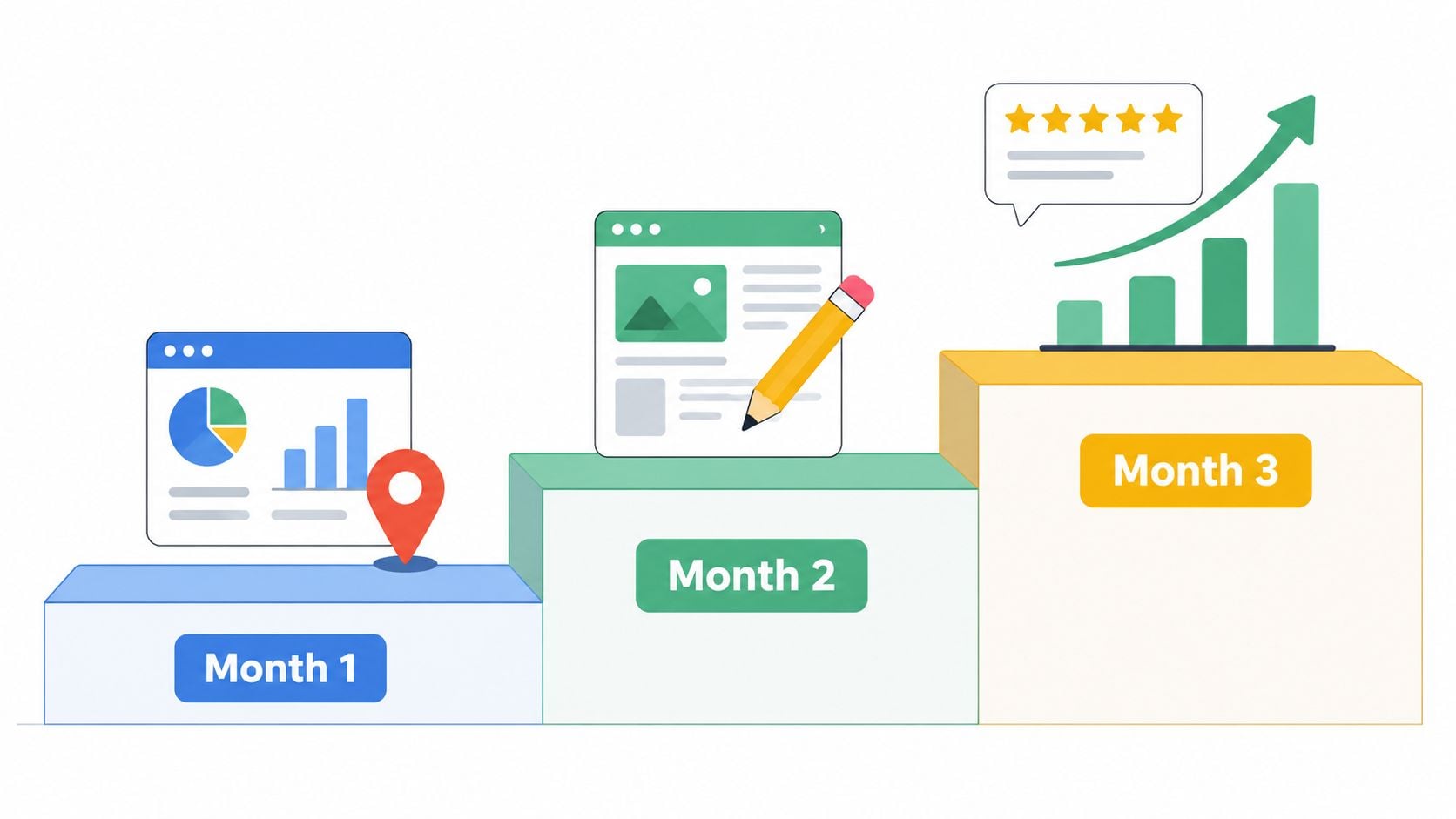
Month 1: Laying the Groundwork
The first 30 days are all about getting your house in order. This isn't the glamorous part of SEO, but every single thing you do later will build upon this essential setup.
Get Your Tools Ready: First things first, install Google Analytics and set up Google Search Console. You simply can't do SEO without them. They're free and give you the vital data on who's visiting your site and how they found you.
Claim Your Digital Shopfront: Your Google Business Profile (GBP) is often the first impression a local customer will have. Optimise it properly. Fill out every section with care—add sharp photos, write a proper business description, double-check your opening times, and tick all the service categories that apply to you.
Find Your “Money” Keywords: Don't just guess what people are searching for. Identify 5-10 key phrases that signal someone is ready to buy. A plumber in Weymouth shouldn’t just target “plumber”; they need to think like a customer. What would someone with a burst pipe type? Probably something like “emergency boiler repair Weymouth” or “local plumber for leaking tap.”
Month 2: Building Content and Presence
With your foundations firmly in place, month two is about showing Google (and your customers) what you know. This is where you start to create value and demonstrate your expertise.
The aim isn't just to churn out content. It's to create the single best answer to a question your ideal customer is asking. That's what builds real authority and brings in the right kind of traffic.
Start by creating one fantastic piece of content. This could be a detailed page for your most profitable service or a truly helpful blog post answering a common question you get all the time. Your goal is to make it more thorough and easier to read than anything your competitors have published.
Next, start building out your online business listings (often called citations) on important directories. This reinforces your business name, address, and phone number across the web, cementing your location and services in Google's eyes.
Month 3: Earning Trust and Gaining Traction
In the final 30 days of this initial push, your focus shifts to building trust and looking at the first signs of progress. For any small business, social proof is pure gold.
- Start a Review Campaign: You need to get into the habit of asking happy customers for a review on your Google Business Profile. Don't be shy! A quick follow-up email with a direct link or a simple QR code on your final invoice can make all the difference.
- Analyse the First Shoots of Growth: It's time to open up Google Search Console and see what's happening. What search terms are you starting to appear for? Which pages are getting seen the most? This early data is invaluable—it tells you what's beginning to work so you can do more of it.
This 90-day plan won't magically land you on page one overnight. What it will do is build a solid foundation for real, sustainable growth. It's the perfect starting point to prove that yes, SEO is worth it for a small business.
A Few Lingering Questions About Small Business SEO
Even when you understand the costs and can see the potential return, it’s natural to have a few final questions before taking the plunge. Deciding if SEO is worth it for a small business usually means getting satisfying answers to these common queries. Let’s tackle them head-on.
How Long Does SEO Really Take to Show Results?
This is probably the first question on every business owner's mind. The honest answer? It takes time.
While you might see some early wins within one to three months—like showing up more often on Google Maps for local searches—the deep, meaningful growth takes longer. You should really be looking at a timeframe of six to twelve months to see a significant impact on your organic traffic, keyword rankings, and, most importantly, your lead generation.
I often tell clients to think of it like getting fit. You don't see a dramatic transformation after one or two trips to the gym. It’s the consistent effort over many months that builds real, lasting strength. SEO isn’t a quick fix; it's a long-term investment in your business's sustainable growth.
Can I Just Do SEO Myself, or Do I Need to Hire Someone?
Going the DIY route is definitely an option, especially if you run a very simple local business and, crucially, have a lot of time to dedicate to learning. But be warned: the learning curve is steep, and a wrong move can set you back, sometimes even earning you a penalty from Google that makes you invisible.
For most business owners I've worked with, hiring a specialist agency is simply more effective. It saves you from making those costly beginner mistakes and, more importantly, frees you up to do what you’re brilliant at—running your business—while the experts focus on your digital growth.
With All the Data, What Metrics Actually Matter?
It’s incredibly easy to get swamped by graphs and charts. My advice is to cut through the noise and focus on the numbers that directly affect your bank balance.
- Organic Traffic: How many people are finding your website through a search engine?
- Keyword Rankings: Where do you appear for search terms that signal someone is ready to buy? (e.g., "emergency plumber near me" vs. "how does a tap work").
- Google Business Profile Actions: Are people clicking to call you, visit your website, or ask for directions from your Google listing?
- Conversion Rate & Leads: This is the big one. How many of those website visitors are actually picking up the phone, filling out a form, or buying a product?
If you're ready to move past the questions and get a clear strategy tailored for your business, the team at DesignStack is here to help. See how we drive real, measurable growth for businesses like yours at https://designstack.co.uk.