

What Is Domain Authority: A Guide for 2026
Domain Authority is a Moz score from 1 to 100 that predicts how likely a website is to rank compared with other sites. It isn't a Google ranking factor, so the useful way to read it is as a comparison tool against your direct competitors, not as a magic number to chase.
If you're reading this, you've probably had one of these moments. A marketing report mentions DA and assumes you already know what it means. A freelancer says your site needs "more authority". Or you've typed your website into an SEO tool, seen a number, and wondered whether it should worry you.
That confusion is normal. Domain Authority sounds technical, but the basic idea is simple once someone explains it in plain English. For most Dorset and UK businesses, the true value isn't in obsessing over the score itself. It's in using that score to understand where your website stands against the firms you're competing with.
Table of Contents
- What Is Domain Authority in Simple Terms
- Common Misconceptions and Powerful Alternatives
- How to Check Your Website's Authority Score
- Actionable Strategies to Build Real Authority
- Measuring Progress and Setting Realistic Goals
- Frequently Asked Questions for Business Owners
What Is Domain Authority in Simple Terms
You've probably heard someone say, "Your DA is low", as if that settles the matter. It doesn't. The phrase only helps if you know what DA is measuring and what it isn't.
A simple way to think about it
Domain Authority, usually shortened to DA, is a score created by Moz. Moz describes it as a predictive score on a 1 to 100 scale that estimates how likely a domain is to rank relative to competitors, and says it uses dozens of link-based signals including the number of linking root domains and backlink quality, while also making clear that DA is not a Google ranking factor (Moz's explanation of Domain Authority).
The easiest analogy is a website credit score.
A credit score doesn't guarantee you'll get a mortgage, and it isn't the only thing a lender considers. It gives a rough prediction based on a wider picture. Domain Authority works in a similar way. It's a third-party estimate of website strength, not a direct signal used by Google.
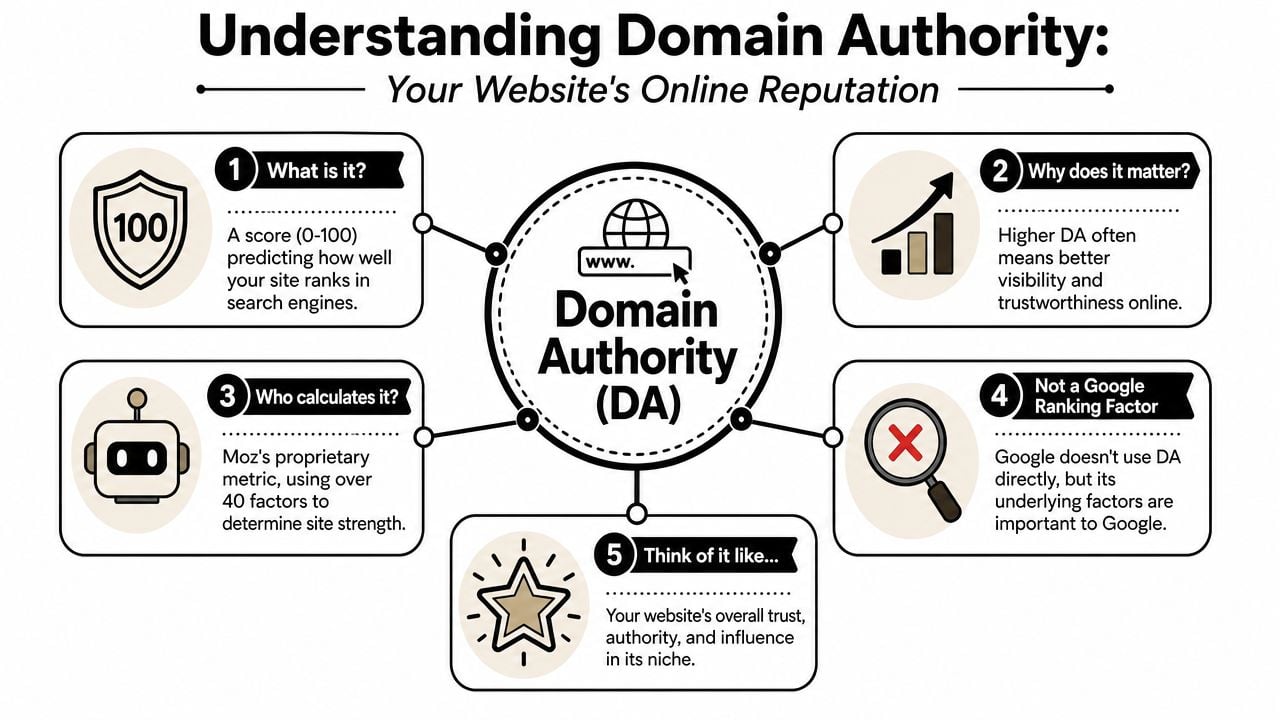
For a local business, that matters. If you're a solicitor in Weymouth, a builder in Dorchester, or an online shop serving customers across the UK, DA is most useful when it helps you compare your site with others in the same market. It isn't a pass or fail test for your website.
Practical rule: Treat Domain Authority as a benchmark. Don't treat it as the goal of SEO.
Why people get confused by the score
Part of the confusion comes from how people talk about it. They often speak as if improving DA automatically improves rankings. That isn't how it works.
What truly improves a website is the work underneath the score. Better links from relevant sites. Stronger content. Cleaner site structure. Fewer technical issues. If you've never looked at those foundations before, a plain-English guide to technical SEO basics can help make sense of the parts search engines need in place.
Another point that catches people out is that DA is comparative by nature. A lower score doesn't always mean a weak business website. It might mean you're in a market where competitors have built stronger backlink profiles over time.
Think of a Dorset accountant and a national newspaper. They don't need to play the same game. A local firm can still win valuable searches, leads, and enquiries without having the kind of authority score a huge publisher has. What matters is whether your site is strong enough for the searches and competitors that affect your business.
Common Misconceptions and Powerful Alternatives
A lot of bad SEO advice starts with one false assumption. It treats DA as if it's the final answer. It isn't.
What DA does not tell you
DA predicts ranking potential. It doesn't promise results. Moz's metric is on a logarithmic 1 to 100 scale, and the explanation highlighted by Crazy Egg's Domain Authority guide notes that moving from 20 to 30 is not the same as moving from 70 to 80. That same explanation also stresses that DA is most useful as a comparative benchmark against local competitors, rather than an absolute good or bad score.
That leads to a few common myths:
- "A higher DA means you'll outrank everyone." Not necessarily. A weaker site can still win searches if its pages are more relevant, better written, and better matched to what people want.
- "I need to hit a specific number." Usually no. There isn't one magic target that applies to every industry, town, or website.
- "DA is the only authority metric that matters." Also no. Different SEO platforms build their own authority scores.
A healthy website can have a modest DA and still bring in solid business if it targets the right searches and serves users well.
Business owners often benefit from a wider lens. When you compare tools, you quickly realise there isn't one universal website authority score. Moz has DA. Ahrefs has DR. Semrush has AS. Each tool looks at authority through its own model.
If your work includes outreach, PR, or partnership emails as part of your marketing, domain reputation also matters in a different context. This guide to B2B email deliverability is useful because it shows that website authority and email domain reputation are related ideas, but they aren't the same thing.
Authority Metrics Compared DA vs DR vs AS
| Metric | Provider | Primary Factor | Best Use Case |
|---|---|---|---|
| DA | Moz | Link-based signals including linking domains and backlink quality | Comparing your website with direct competitors |
| DR | Ahrefs | Backlink profile strength | Reviewing link-building progress in Ahrefs |
| AS | Semrush | Authority signals from Semrush's own model | Broader competitive checks inside Semrush |
The practical takeaway is simple. Pick one tool for consistency, then use the number as context rather than as a trophy.
If you're a professional services firm, this matters even more because trust, relevance, and local visibility usually matter more than vanity metrics. That's one reason firms reviewing SEO for professional services should look beyond a single score and judge the full picture.
How to Check Your Website's Authority Score
Checking DA is easy. Interpreting it properly takes a bit more thought.
A simple checking routine
Start with Moz's Link Explorer. Enter your domain and review the authority score it gives you. Don't stop there.
Check a shortlist of competitors as well. Pick businesses that are competing for the same customers, location, or service searches. For a Dorset business, that usually means local firms first, then any stronger regional or national sites that keep appearing in the same search results.
A simple routine works well:
- Check your own domain in Moz.
- Check several competitors that target similar services.
- Write down the results in one place so you can compare them later.
- Look for patterns, not just the single number.
If you're also trying to work out why pages aren't showing in search at all, the authority score might only be part of the picture. This guide on why a website may not show up on Google is helpful because indexing, page quality, and technical issues can block visibility even when a site has decent authority signals.
What to write down when you check
Don't just note the score. Add context beside it.
Record which competitors seem to earn links from trade bodies, directories, local press, suppliers, or community organisations. Those clues tell you more than the number alone. If you're trying to understand link-related strength in a bit more depth, this article on SEO gains from higher Mozrank offers another useful angle on link authority signals.
This walkthrough gives a useful visual overview if you'd rather see the process than read about it.
Actionable Strategies to Build Real Authority
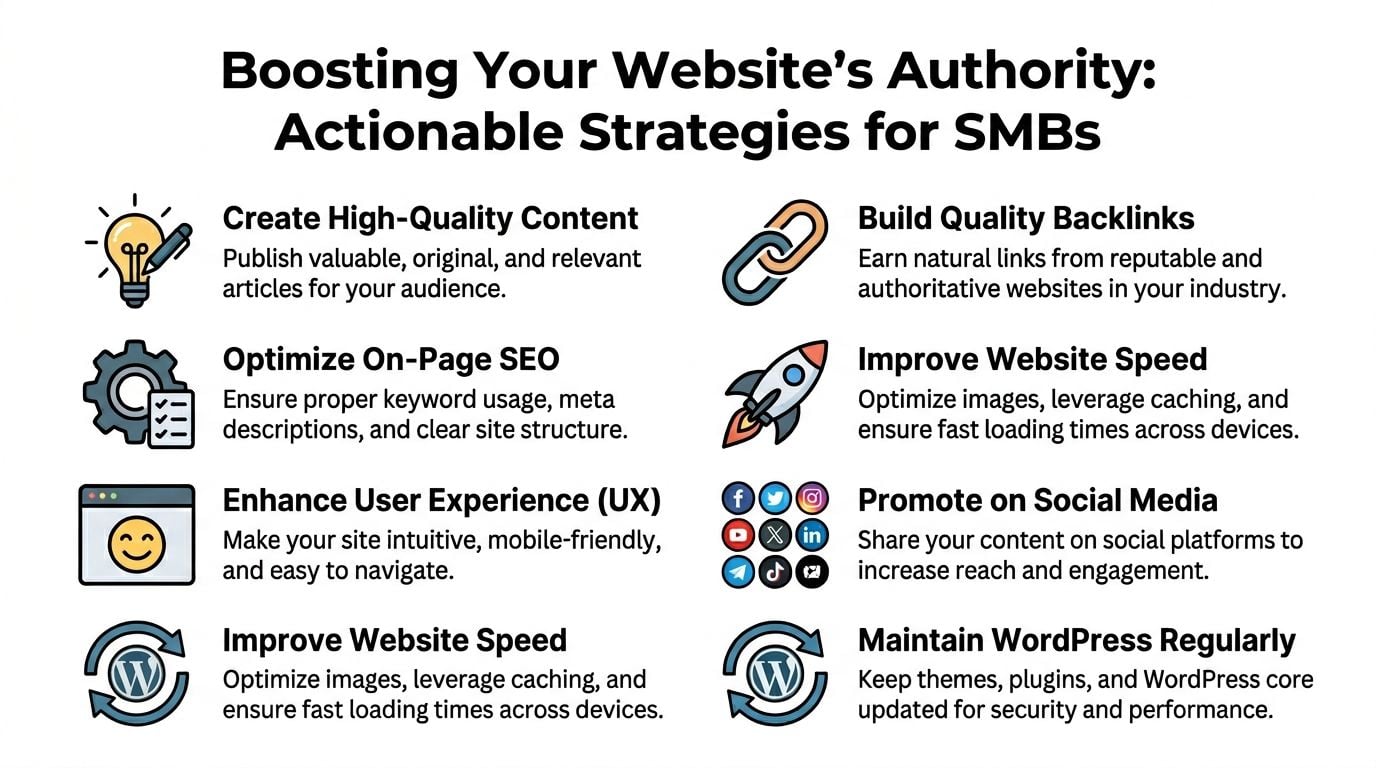
The fastest way to get Domain Authority wrong is to chase the score directly. The better approach is to build a website that deserves stronger authority.
A practical benchmark can help frame expectations. One industry explanation says 30 to 50 is often treated as average, 50 to 60 as good, and 60+ as strong, while also stressing that competitive context matters more than any universal threshold (Marketing Illumination's guide to understanding Domain Authority). For most small and medium-sized UK businesses, that means your real target is to become more authoritative than the firms you're up against.
Create pages people actually want to cite
Most sites don't attract links because they don't publish anything worth referencing.
A brochure-style site with a home page, an about page, and a service page can still convert well, but it usually won't earn many backlinks on its own. To build real authority, publish material that helps people enough that they want to mention it.
That might include:
- Local guides: A Dorset venue guide, a buyer's checklist, or a page answering common local questions.
- Useful how-to articles: Clear advice based on your real expertise.
- Original resource pages: Templates, explainers, FAQs, or comparison pages customers keep coming back to.
For a WordPress business site, this often starts with a proper content plan and a clean page structure. If you need a grounded starting point, this resource on how to improve domain authority gives a broad list of methods worth reviewing alongside your own SEO work.
Earn links through real relationships
Good links usually come from real-world trust.
If you're already connected to suppliers, trade associations, local events, charities, schools, business groups, or chambers of commerce, you may already have link opportunities in front of you. A mention on a relevant local organisation's website can be far more useful than chasing random links from unrelated sites.
Consider approaches like these:
- Partnership mentions: Ask suppliers or collaborators if they list trusted partners.
- Community involvement: Sponsorships, talks, and local events often lead to genuine citations.
- Industry contributions: Guest commentary, interviews, and trade articles can earn relevant links.
Strong authority usually grows from reputation first, and backlinks second.
One practical option for businesses that want support with the underlying work is website SEO improvement services. That kind of support typically covers technical fixes, content structure, and authority-building tasks together rather than treating DA as a stand-alone target.
Fix the site so authority can work
Links and content help most when the website itself is solid.
If pages are slow, confusing, thin, or difficult to crawl, authority has less impact. Search engines still need to understand your site. Users still need to trust it. That means the basics matter:
- Technical health: Fast loading, mobile-friendly layouts, secure browsing, and pages that can be crawled properly.
- On-page clarity: Clear headings, useful page titles, sensible internal links, and content that answers real questions.
- User experience: A site that's easy to use, easy to read, and easy to contact.
A lot of business owners hope for one trick that lifts authority quickly. There usually isn't one. Real authority is the combined result of content quality, relevant links, and a website that does its job properly.
Measuring Progress and Setting Realistic Goals
A DA score can move slowly, and that's one reason people get frustrated with it. They make improvements, refresh the tool, and expect the number to jump straight away.
A better way to track progress is to watch the signals that feed authority and the outcomes that affect the business.
Watch the inputs before the score
If you're investing in SEO, keep an eye on whether more relevant websites are linking to you, whether your important pages are improving in search, and whether your organic traffic is becoming more useful. Those indicators usually tell the underlying story before any authority metric catches up.
A simple review checklist helps:
- New linking websites: Are reputable sites beginning to reference your business?
- Link relevance: Are those links coming from places that make sense for your market and services?
- Search visibility: Are your key service pages appearing more often for the terms that matter?
- Content performance: Are your guides, FAQs, and service pages attracting the right visitors?
Keep in mind: Authority is usually a lagging metric. The work happens first. The score reflects it later.
Set goals around business outcomes
The score itself doesn't pay the bills. Enquiries, sales, bookings, and qualified traffic do.
That means your goals should sound more like this: better visibility for service pages, stronger enquiries from organic search, and more trust signals on the site. If you're measuring website performance more broadly, this guide to how to measure website success is a sensible companion because it shifts attention from vanity numbers to business results.
For most businesses, the healthiest mindset is patience. Build the site properly. Publish useful content. Earn relevant links. Then review trends over months, not every other day.
Frequently Asked Questions for Business Owners
My competitor has a much higher DA should I panic
No. A higher score tells you they may have a stronger backlink profile, but it doesn't automatically mean they have the better website for every search. If your pages are more relevant, more local, or more useful, you can still compete well.
The right response is analysis, not panic. Check where their links come from, what content they publish, and whether they cover topics you haven't tackled yet.
How long does it take to increase Domain Authority
Usually longer than people hope.
Authority grows from consistent work, and the score doesn't always reflect improvements immediately. If you're earning stronger links, improving content quality, and fixing technical weaknesses, you're moving in the right direction even if the number itself hasn't changed much yet.
Is low DA the only reason my site gets little traffic
Not at all.
Low traffic can come from weak content, poor keyword targeting, technical issues, thin service pages, weak local relevance, or a site that doesn't answer what customers are searching for. DA may be one part of the picture, but it rarely explains everything on its own.
Should I judge an agency by its own DA
Only partly.
An agency's own website can tell you something about its visibility and backlink profile, but it shouldn't be the only test. Look at how clearly they explain things, whether they understand your market, how they approach content and technical SEO, and whether they can turn search traffic into useful business results.
A good partner won't just say "your DA is low" and leave it there. They should explain what the score means in context, where your site is being held back, and what practical work will improve your overall online presence.
If you want help making sense of your site's authority in plain English, DesignStack can review the bigger picture with you. That includes how your website is built, how it compares with competitors, and what changes are likely to improve search visibility in a way that supports real business growth.


Leave a Reply