Graphic Design Services Contract: Protect Your Work
You've probably had this happen, or come close to it. A client asks for “a quick logo and a few socials”. The brief is agreed on over email, the tone is friendly, and everyone wants to get moving. A few weeks later, the logo has turned into a full brand identity, the “few socials” have become an ongoing stream of ad graphics, and payment is somehow tied to a final sign-off that never quite arrives.
That's the point where it becomes clear a graphic design services contract isn't admin. It's project control.
After years of running design work for businesses across Dorset and beyond, I can say this plainly. The best contracts don't create friction. They remove it. They tell the client what they're buying, tell the designer what they're delivering, and give both sides a fair process when the job changes, stalls, or ends.
Table of Contents
- Why Your Handshake Agreement Is a Liability
- The Core Components of Your Design Contract
- Defining Payment Milestones and Revisions
- Navigating Ownership IP and AI Usage
- Termination Disputes and Keeping Things Amicable
- FAQ on Graphic Design Contracts
Why Your Handshake Agreement Is a Liability
A handshake agreement works right up until the first disagreement. Then everyone starts relying on memory, old messages, and assumptions that were never tested properly.
I've seen the same pattern many times. A designer says the fee included reasonable amends. The client thinks reasonable means “until we're happy”. The designer assumes final files means a print-ready PDF and PNGs. The client expects editable working files as well. Nobody is acting in bad faith, but the project still turns sour.
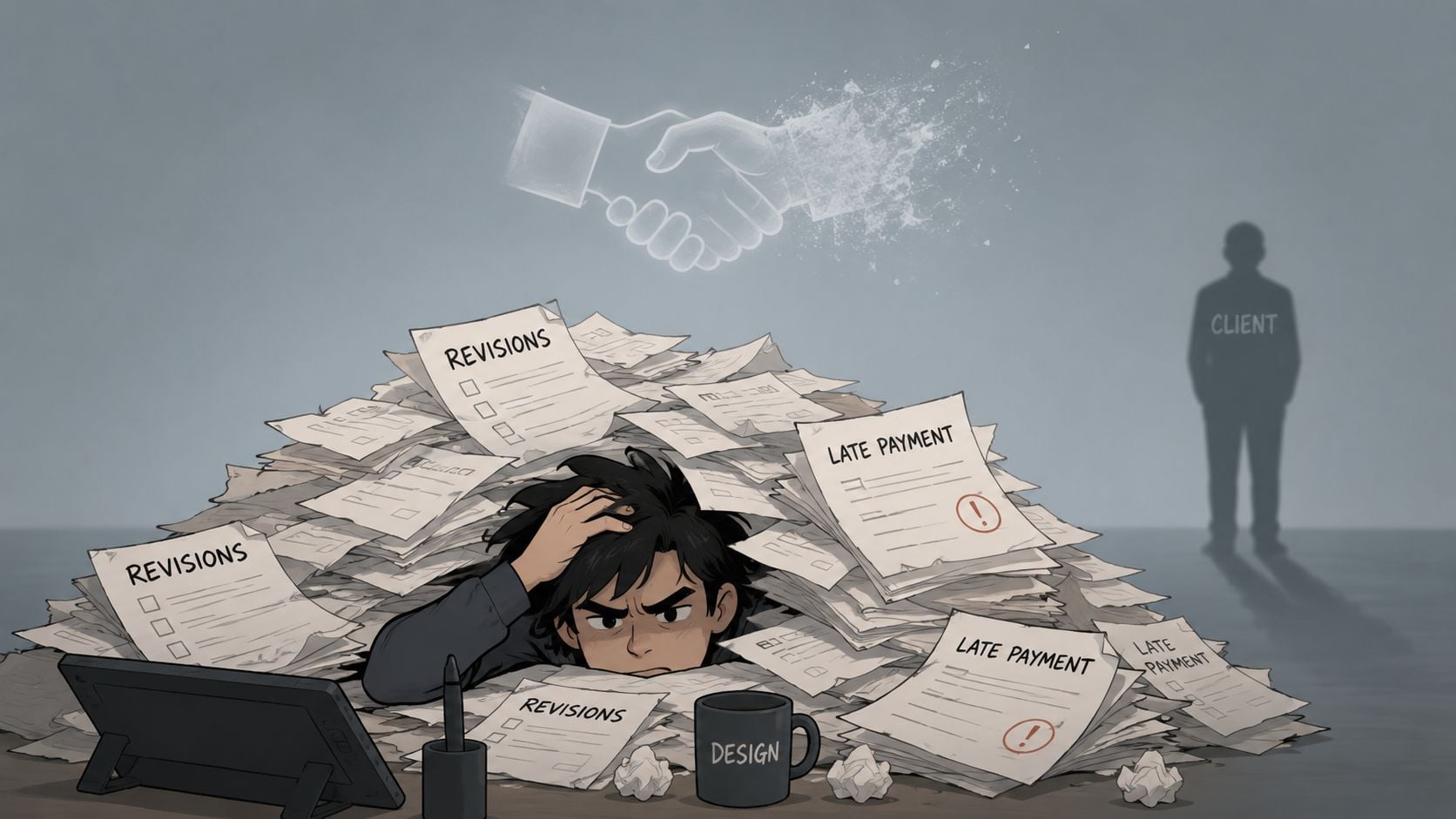
A proper graphic design services contract fixes that by turning assumptions into agreed terms. It gives the relationship structure. It also signals professionalism. If a studio offers graphic design services, the contract should be treated as part of the service, not an awkward attachment at the end.
Consumer protection has changed the baseline
In the UK, the closest authoritative foundation for a graphic design services contract is the legal framework for digital content and services established by the Consumer Rights Act 2015, which came into force on 1 October 2015 and gives consumers a 30-day right to reject faulty digital content in qualifying cases, as explained in this Consumer Rights Act design contract guidance. That matters because design deliverables now often include websites, brand assets, templates, and editable files, not just printed artwork.
If your contract still relies on vague phrases like “best efforts” or “client to be satisfied”, it's behind the reality of modern design work. You need wording around scope, acceptance, and remedies. Without it, both sides are exposed.
Practical rule: If the job produces files, approvals, or live digital assets, the contract should say exactly what “done” looks like.
A contract protects the client too
Clients often worry that a contract is written for the designer's benefit. A poor contract can feel that way. A good one doesn't.
It should protect the client from missed deliverables, unclear billing, and endless project drift just as much as it protects the designer from unpaid work and uncontrolled changes. It should state when drafts will be shown, how feedback will be gathered, and what happens if the work doesn't meet the agreed specification.
That's why I never treat a contract as legal padding. It is the operating manual for the project. If you're clear at the beginning, you usually avoid the unpleasant emails later.
The Core Components of Your Design Contract
Most weak contracts fail in the same place. They describe the project in broad language, then hope goodwill will carry the rest.
That doesn't work. A graphic design services contract needs enough detail that someone outside the project could read it and understand what is being bought, what is being delivered, and what triggers the next step.
Start with the parties and the project
The opening section should identify the legal parties properly. That means full names or company names, addresses where appropriate, and the project title. Don't leave this loose, especially if the client trades under one name but invoices through another entity.
Then define the project in a single plain-English paragraph. Not the sales pitch. The actual job.
For example:
- Too vague: Design a new logo for the business.
- Better: Design three initial logo concepts for review, followed by refinement of one selected concept and final supply in agreed formats.
If the client needs help creating the brief, point them to a structured process. A good design brief checklist often prevents scope confusion before the contract is even signed.
Write the scope so a stranger could manage it
UK contract guidance for designers recommends specifying scope in measurable terms, including deliverables, file formats, proof and approval method, revision rounds, ownership rules, and payment milestones, because missing details commonly lead to missed deadlines and uncontrolled scope growth, as set out in this guide on why designers need contracts.
That sounds simple, but it's a common pitfall that makes many contracts woolly. “Brand pack included” means nothing unless you define the contents.
Include wording that covers:
- Deliverables such as logo suite, brand colour palette, type recommendations, flyer artwork, or social templates
- File formats such as PDF, PNG, SVG, AI, EPS, or other agreed exports
- Approval method such as feedback by email, annotated PDF, Figma comments, or presentation sign-off
- Revision limit so both sides know how many rounds are included
- Exclusions covering work that is not part of the fee
- Milestones showing when each stage begins and what triggers the next invoice or next phase
A vague scope creates the very argument people hope to avoid by “keeping it informal”.
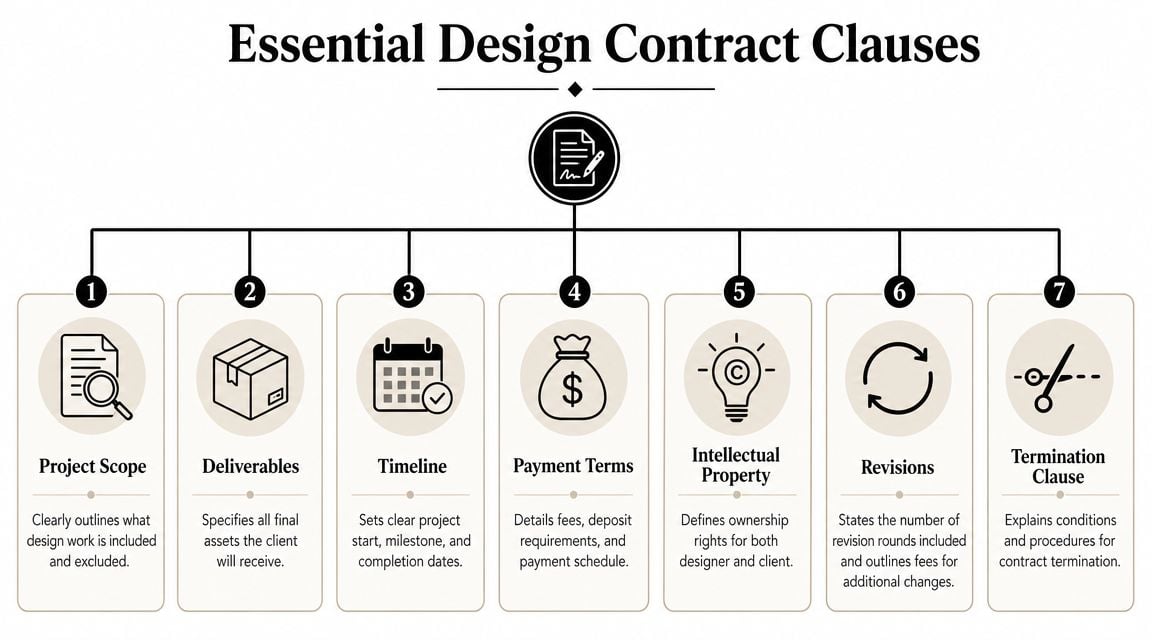
Essential Contract Clauses at a Glance
| Clause | Purpose | Key Wording to Include |
|---|---|---|
| Parties | Identifies who is bound by the agreement | Full legal names, trading names if relevant, and contact details |
| Project scope | Defines what work is included | Clear description of the design service, included tasks, and exclusions |
| Deliverables | States what the client receives | Asset list, final formats, and whether working files are included |
| Timeline | Sets project flow | Start date, review dates, client response times, and completion target |
| Payment terms | Controls fees and cash flow | Fixed fee or other model, deposit, milestone invoices, due dates, late payment position |
| Revisions | Prevents endless amends | Number of rounds included and what counts as additional work |
| Intellectual property | Clarifies ownership | When rights transfer, what is licensed, and what the designer retains |
| Termination | Creates an exit route | Notice process, payment for completed work, and treatment of unfinished files |
A strong contract is specific without becoming unreadable. If the wording feels long, that's usually because the project itself has moving parts. Better to name them now than argue about them later.
Defining Payment Milestones and Revisions
If there's one part of a graphic design services contract that causes repeated trouble, it's this one. Money and feedback.
Clients want certainty. Designers want fairness. You only get both when the pricing model and revision rules are written clearly enough to survive pressure.
Why fixed fee works better in practice
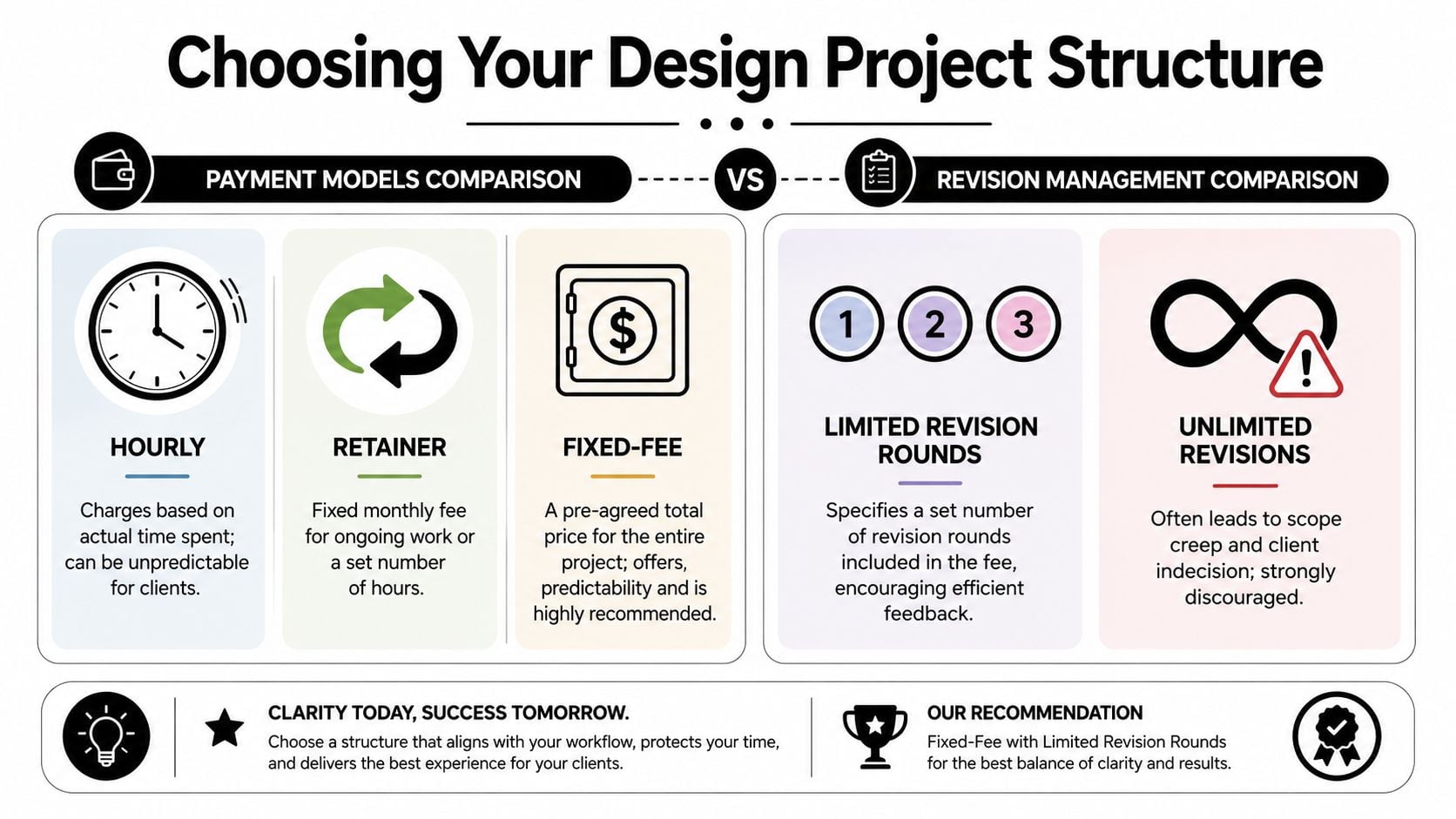
For UK small businesses buying design, the most practical benchmark is a fixed-fee agreement with a defined change-order process rather than open-ended hourly work, according to this pricing guide for graphic design projects. The reasoning is straightforward. Design work moves through research, ideation, testing, and revision. A flat fee gives the client clearer budget expectations and rewards the designer for working efficiently.
Hourly billing can still suit consulting, fast-turnaround support, or undefined work. But for branding, campaigns, brochures, packaging, or website visuals, fixed fee is usually cleaner.
A sensible milestone structure often includes:
- Upfront deposit to reserve the slot and cover project setup
- Mid-project payment when concepts are approved or a key stage is signed off
- Final balance before release of final files or launch assets
The exact split can vary. What matters is that the contract ties payment to clear stages, not wishful thinking.
If you're trying to benchmark project pricing before writing terms, agency pricing for branding work is worth reviewing alongside your contract template so the commercial side and legal side match.
What counts as a revision and what does not
Unclear definitions lead to designers losing margin and clients losing momentum. The contract should define a revision as refinement of an existing agreed direction, not a restart.
For example, these are usually revisions:
- Minor copy updates after proofing
- Colour adjustments within the chosen direction
- Layout refinements to spacing, hierarchy, or alignment
- Small image swaps that don't alter the concept
These are usually new scope:
- A fresh concept route after one has already been chosen
- A change in target audience or positioning
- Additional deliverables not listed in the contract
- Substantial rewrite requests that require redesign of the layout
If the feedback changes the decision, not just the design, it's usually a change request.
The change-order clause should say that extra work is quoted separately and work can pause until the client approves the revised scope or settles overdue invoices. That last point matters. It prevents a project from sliding into a half-paid, half-approved state that nobody can manage.
One practical way to reduce revision chaos is to standardise how comments are collected. When feedback arrives through scattered emails, messages, and meeting notes, the client often thinks they've made one request when they've made twenty. Teams that need a better review process can use resources like FLYP's design tools guide to compare ways of consolidating visual feedback into one clear approval trail.
Unlimited revisions sound friendly in a proposal. In reality, they usually reward indecision and punish the people trying to finish the work.
Navigating Ownership IP and AI Usage
Most contract templates still treat ownership as if every design project is produced by hand, from scratch, in a fully traceable chain of authorship. That's no longer how a lot of design work happens.
Today, a designer might sketch manually, build layouts in Adobe Illustrator, source stock elements, test prompts in a generative tool for concept exploration, and then redraw or refine the final output. If your graphic design services contract ignores that reality, it's outdated.

Traditional ownership still needs clear wording
Even before AI enters the picture, contracts often blur ownership. My view is simple and fair. The client should own the final approved deliverables they have paid for, subject to any third-party elements that are licensed rather than owned. The designer should retain ownership of unused concepts, production methods, and pre-existing materials unless the contract says otherwise.
That avoids a common misunderstanding. Paying for design work does not automatically mean buying every draft, source method, or internal working file.
Put these points in writing:
- Final approved assets transfer or are licensed only after full payment
- Unused concepts stay with the designer unless separately assigned
- Third-party assets such as stock imagery or fonts remain subject to their original licence terms
- Working files are included only if specifically listed in the deliverables
AI changes the contract even when the output looks normal
A major underserved angle in UK coverage of design contracts is who owns what when AI tools are used, as discussed in this UK-facing graphic design contract article. Most template guidance still covers ownership in general terms but doesn't deal properly with disclosure, originality, assignment, and warranty limits when generative tools are involved.
That gap matters because clients increasingly expect fast iteration. Designers increasingly use AI-assisted workflows for concepting, mockups, asset generation, background extensions, copy variants, or stock substitutions. The contract has to reflect that.
For a broader primer on the territory clients are now entering, it helps to explore the future of synthetic media. Not because every design project is synthetic media, but because the ownership and authenticity questions overlap.
Here's a useful explainer to pair with your legal wording:
Clauses worth adding now
A future-proof contract should stop pretending AI doesn't exist. It should name how it may be used and what follows from that.
Consider clauses covering:
- Disclosure of AI use stating whether generative tools may be used for ideation, mockups, or production support
- Assignment limits clarifying that rights can only be transferred to the extent the designer holds them
- No absolute originality warranty where AI-assisted elements are involved, especially if third-party tools contribute to concept generation
- Client approval of risk profile where the client chooses speed and experimentation over a manual-only process
- Replacement remedy stating that if a disputed asset is identified, the designer may replace or revise it rather than offer broad unlimited indemnities
Don't promise ownership rights you can't verify. Promise a fair process for disclosure, replacement, and documented approval.
For brand identity projects, this matters even more because logos and core assets are expected to carry long-term value. If your work includes identity systems, make sure the ownership language aligns with the client's actual use case, whether that's a campaign asset or a full brand identity service in the UK.
The firms that avoid this topic now will have to revisit it later. Better to fix the contract before the dispute appears.
Termination Disputes and Keeping Things Amicable
Every design contract needs an exit. Not because you expect the job to fail, but because projects sometimes change for reasons that have nothing to do with the quality of the work. Budgets get frozen. Internal teams change. Businesses change direction.
The mistake is writing termination clauses as punishment. Good contracts treat termination as a managed process.
Write the exit before the project starts
At minimum, the contract should say how either party can end the agreement, what notice is required, and what gets paid if the project stops midway.
In practice, a fair termination clause usually covers:
- Client cancellation with payment due for work completed up to the termination date
- Non-response allowing the designer to pause or end the project after a defined period of silence
- Non-payment allowing work to pause and, if needed, the agreement to be terminated
- Designer withdrawal where the designer can end the project for breach, abuse, or repeated failure to supply required materials
A kill fee is often sensible, though I prefer to frame it in plain business language. The client pays for completed work, committed time, and any non-recoverable costs already incurred. That's fairer than pretending the project can vanish without consequence.
Use mediation language before legal threats
Most disputes aren't about dramatic wrongdoing. They're about poor wording, delayed decisions, missing files, or different expectations. That's why a dispute resolution clause should encourage a practical first step before anybody starts throwing legal terms around.
A sensible route is:
- Written notice of the issue so the problem is recorded clearly.
- A short period to resolve it directly between client and supplier.
- Mediation if direct discussions fail.
- Formal legal action only if the previous steps don't resolve it.
If you need a plain-English refresher on what legally counts as a contract breach, this guide to contract law violations is useful background reading. It helps business owners understand the difference between a frustrating project and an actual breach.
The contract should lower the temperature, not raise it.
That wording matters. Clients are more likely to sign a contract that feels balanced, and designers are more likely to enforce one that doesn't read like a threat letter. A calm process protects the relationship even when the project itself can't be saved.
FAQ on Graphic Design Contracts
Are e-signatures legally binding in the UK
In most day-to-day business use, yes, e-signatures are widely used and accepted for service agreements. The practical point isn't just legality. It's proof. A proper signing platform gives both parties a dated record, keeps the signed version in one place, and removes the delay of printing and scanning.
What matters most is consistency. Use a recognised signing workflow, make sure the contract version is final before sending, and ensure the signer has authority to sign on behalf of the business if the client is a company.
What if a client refuses to sign
Treat that as a business conversation first, not an argument. Some clients don't object to the contract itself. They object to one clause, or they've had a bad experience with an overly aggressive template.
A professional response is usually enough:
- Ask the reason so you know whether the issue is legal, commercial, or unfamiliarity
- Explain the purpose of the contract as mutual clarity on scope, fees, ownership, and timing
- Offer to clarify wording without removing the parts that protect the project properly
- Hold the line on starting work until the agreement is signed
If a client still refuses any written agreement at all, that's a red flag. You don't need to dramatise it. You just need to recognise that they're asking you to take on avoidable risk.
For freelancers who are fielding local enquiries and trying to set boundaries early, this is just as important as portfolio quality or pitch confidence. The same discipline applies whether you're an agency or a freelance graphic designer near me option someone found through search.
How do you adapt this for a monthly retainer
A retainer contract should not read like a one-off project contract with a different title. The structure changes because the work is ongoing.
The key adjustments are:
- Monthly scope definition based on included tasks, deliverable categories, or allocated capacity
- Request process stating how work is submitted and prioritised
- Turnaround expectations for standard tasks versus urgent requests
- Unused time or deliverables policy clarifying whether anything rolls over
- Review cycle so both sides can assess whether the retainer still matches the business need
- Termination notice that gives both parties a workable exit without cutting off active work overnight
Retainers go wrong when they are sold as “design support as needed”. That phrase sounds flexible, but it usually creates mismatched expectations. The client hears unlimited access. The designer means reasonable ongoing support within a defined monthly arrangement. Write the definition down and most of the confusion disappears.
If you need a graphic design services contract that matches how modern projects run, including scope control, approval stages, ownership wording, and sensible terms around AI-assisted workflows, DesignStack can help as part of a wider branding or digital project. The aim isn't to bury a client in legal text. It's to give both sides a clear, workable agreement that keeps the job moving.