

Brand Identity UK: A Guide for Ambitious Businesses
52% of UK exporters say linking their business to “Brand Britain” directly boosts sales, according to a 2024 report on Brand Britain's commercial effect. That matters well beyond exporting. It tells you something simple and commercially useful. Identity changes how people value what you sell.
For a small or mid-sized business, brand identity uk work isn't about making things look polished for the sake of it. It's about making your business easier to recognise, easier to trust, and easier to choose. A Dorset restaurant, a trades firm in Weymouth, a local retailer with an online shop, or a professional services practice all face the same practical problem. If your visuals, messaging and website feel disconnected, buyers hesitate.
I see this often with growing businesses. The service is strong. The owner knows their market. But the logo is being used three different ways, the website tone doesn't match the printed materials, and social posts look like they belong to another company. That isn't a style issue. It's a commercial drag.
A good identity gives people a clear signal. It tells them what sort of business you are, what standard to expect, and whether you feel established enough to trust.
Your Brand Identity is a Commercial Asset
Many business owners still file branding under “nice to have”. That's usually because they've only seen it discussed as a logo choice, a colour palette, or a vague creative exercise. In practice, it works more like infrastructure.
If a customer lands on your website, sees your van, notices your signage, gets a quote PDF, and then checks your Instagram, they're forming one judgement. Not five separate ones. Your brand identity either supports that judgement or weakens it.
Why SMEs feel the impact quickly
Larger companies can absorb inconsistency for longer. They have bigger ad budgets, stronger name recognition, and more margin for waste. Smaller firms don't.
For an SME, identity affects practical outcomes such as:
- Recognition in crowded local markets: If your business looks generic, buyers remember the category, not your company.
- Confidence at first contact: People often decide whether you seem credible before they've compared prices properly.
- Sales conversations: A strong identity makes your offer feel more deliberate and established.
- Recruitment and partnerships: Suppliers, collaborators and staff also judge whether your business feels organised and dependable.
Practical rule: If your business is good but your presentation feels improvised, your identity is already affecting revenue.
What Brand Britain means for local firms
In the UK, identity also carries cultural signals. Britishness can suggest quality, heritage, restraint, humour, craft, and reliability. Those signals won't suit every business in the same way, but they are commercially useful when handled with integrity.
A Dorset food brand might lean into provenance and tradition. A modern B2B service brand might borrow the clearer parts of that language, namely trust, competence, and understated confidence. What doesn't work is forcing a fake heritage story or dressing a young business in borrowed nostalgia.
A useful test is this: does your identity reflect how you operate?
| Identity choice | Works when | Fails when |
|---|---|---|
| Heritage-inspired visuals | Your product, place or process has genuine roots | It feels decorative and unsupported |
| Minimal modern branding | Your offer is clear and premium | It strips out personality |
| Playful British tone | Your audience responds to warmth and wit | It makes serious services look flippant |
Effective brand identity uk work provides customers with a reason to trust what they are seeing. High-quality visual assets are part of that. Commercial clarity is the essential objective.
What Brand Identity Really Is and Why It Matters
People often mix up brand, brand identity, and branding. They're related, but they're not the same thing.
Your brand is your reputation. It's what people believe about your business after they've seen you, heard about you, or bought from you.
Your brand identity is the system you create to shape that perception. It includes your logo, typography, colours, photography style, tone of voice, messaging and the way those pieces work together.
Branding is the active use of that system. It's the day-to-day application across your website, packaging, proposals, signs, social content and emails.
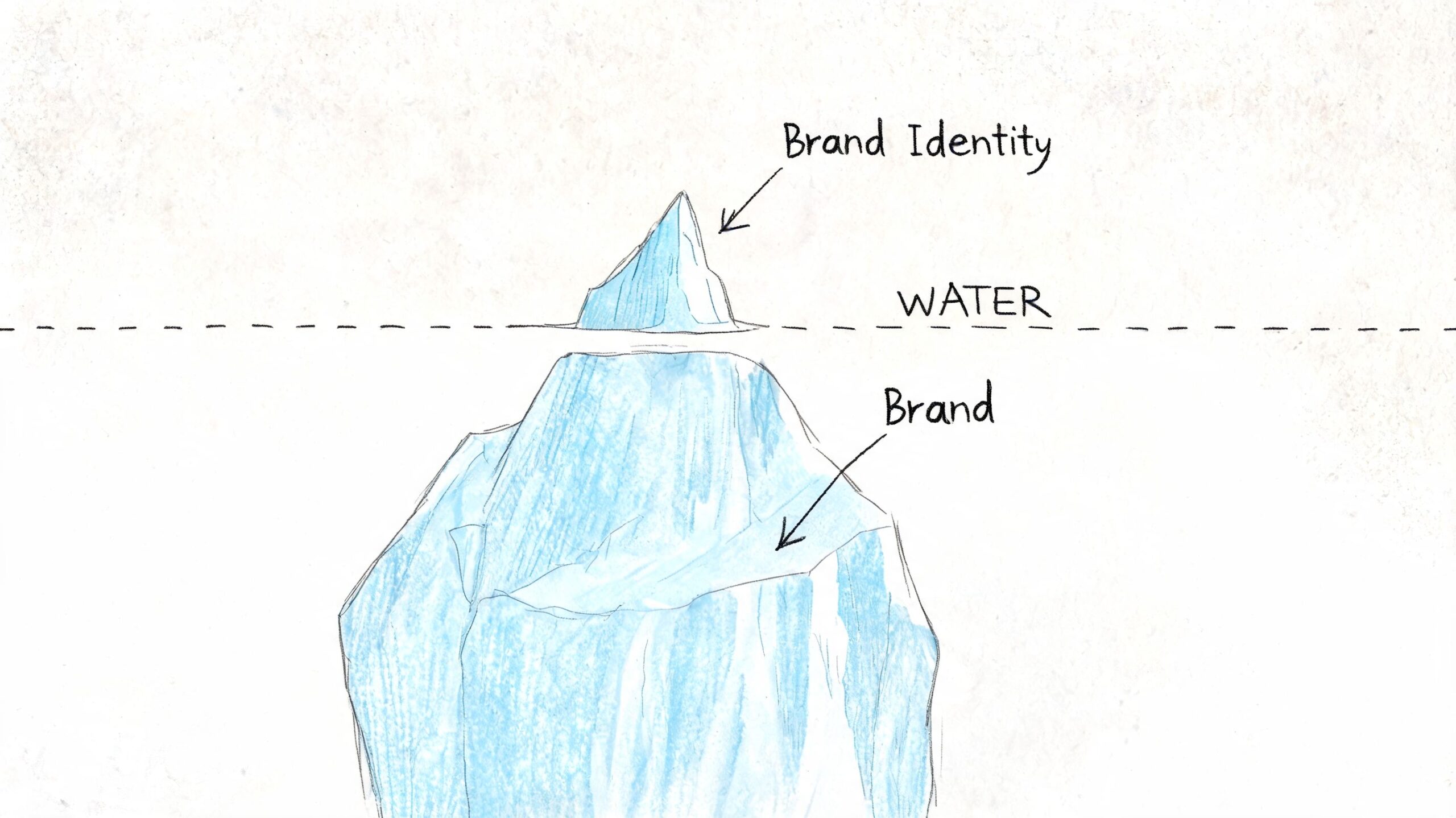
A simple way to think about it
Think of a person. Their reputation is what other people say they're like. Their clothes, voice, posture and manners are the visible signals that shape that impression.
A logo on its own is not a brand identity in the same way a pair of shoes is not a personality. It matters, but only as part of a larger whole.
This matters commercially because consistency affects behaviour. Brand consistency can increase revenue by 10-20%, and 71% of UK consumers show trust in a brand by increasing their purchase frequency. That's the business case in one line. A coherent identity helps people come back.
What a weak identity usually looks like
A weak identity isn't always ugly. Often it's just fragmented.
- Visual mismatch: The website looks corporate, the social content looks casual, and printed materials feel dated.
- Verbal mismatch: The homepage sounds formal, sales emails sound chatty, and proposals use generic jargon.
- Decision fatigue: No one knows which logo file to use, which colour is correct, or how the business should sound.
That's why it helps to think in systems, not individual assets. If you want a useful primer on building trust through a cohesive brand identity, that piece makes the same core point from a corporate branding angle.
A recognisable business doesn't happen by accident. It happens when repeated choices start to feel unmistakably connected.
Why this matters before you redesign anything
Many owners want to jump straight to concepts. New logo. New homepage. New colours. That's understandable, but it usually creates another layer of inconsistency if the underlying thinking isn't settled first.
Before design starts, you need agreement on a few basics:
- Who you serve
- What you want to be known for
- What tone fits your market
- What should stay stable as the business grows
Once those decisions are clear, the design process gets easier and the results last longer.
The Core Components of a Powerful Brand Identity
A proper identity system is more than a logo pack. It gives your business a repeatable visual and verbal language that works across print, web, social, signage and internal documents.
Professional systems often separate core and extended identity. That model helps brands retain 32% more customers during market shifts. The idea is practical. Some elements should stay fixed. Others need room to adapt.
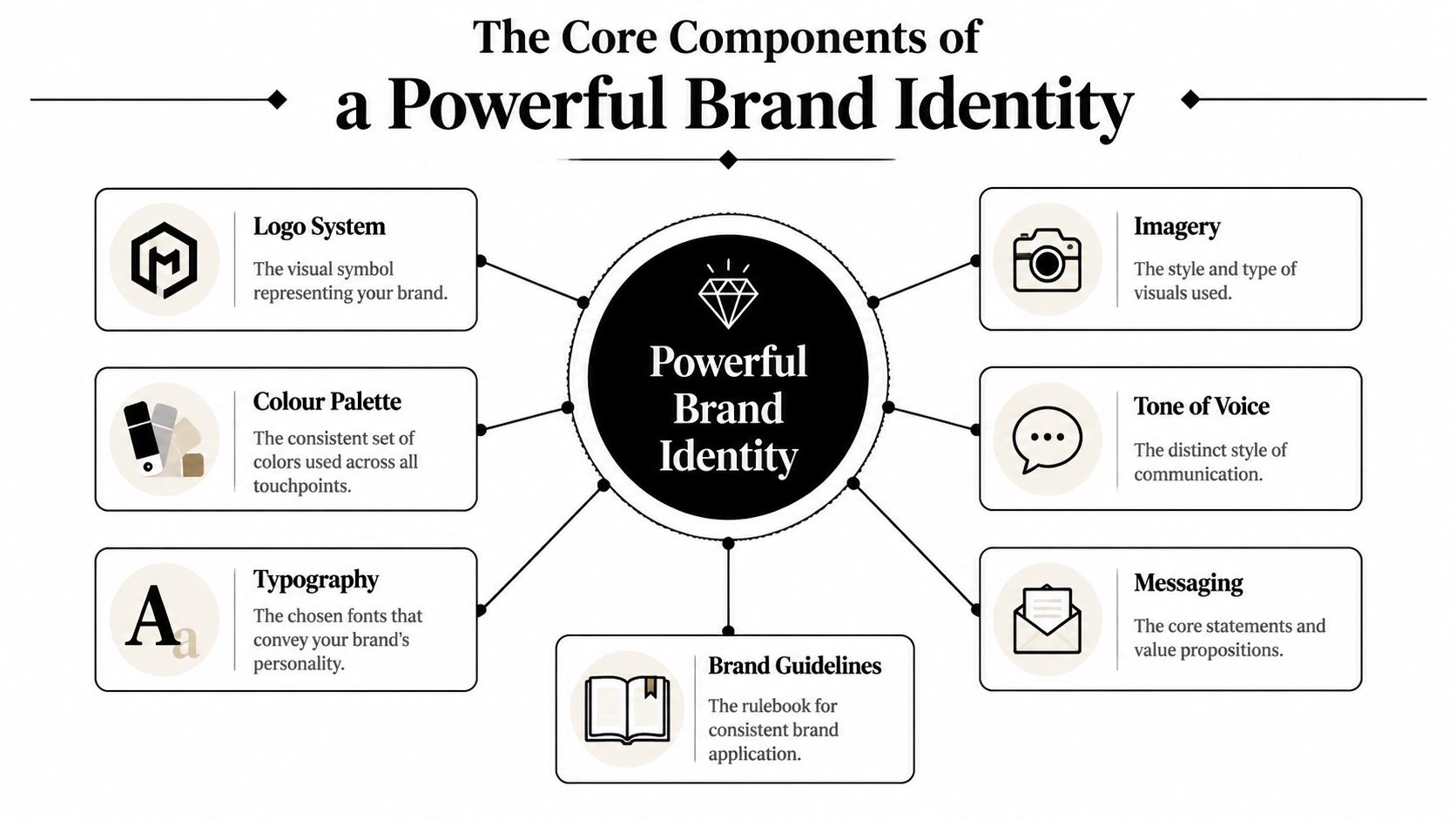
Core identity elements
These are the parts you don't want shifting every few months.
Logo system
Not just one logo. You usually need a primary version, a simplified version, and layouts that work in square, horizontal and small-format spaces. If your mark only works on a white desktop screen, it isn't ready.Colour palette
This isn't about picking favourite colours. It's about choosing colours with enough contrast, range and discipline to work across web pages, printed pieces, presentations and signage.Typography
Type carries personality faster than many owners realise. A refined serif can suggest heritage or authority. A clean sans serif can feel contemporary and direct. The trick is choosing fonts your business can use consistently, not just attractively.
Extended identity elements
These are the flexible parts that help the brand work in real life.
Imagery style
Photography direction matters. Some businesses need crisp documentary-style images. Others need warmer, more editorial photography. Stock imagery can fill gaps, but if it dominates, your business starts to look interchangeable.Tone of voice
This covers how you sound in headlines, emails, captions, proposals and service pages. It should fit your audience and the stakes of the buying decision. Friendly is not the same as casual. Professional is not the same as stiff.Messaging
Clear value propositions, service descriptions, tagline options and proof statements all belong here. Many rebrands look better but still underperform because the words stayed vague.
Useful test: Remove your logo. If the colours, typography, imagery and tone still feel like your business, the identity is doing its job.
The piece owners forget most often
Brand guidelines are what turn design into a working system. Without them, the business drifts back to guesswork.
A lightweight guideline pack should normally cover:
| Component | What it should define |
|---|---|
| Logo usage | Which versions to use, and where not to use them |
| Colours | Primary and supporting colours for screen and print |
| Typography | Headline, body and fallback font choices |
| Imagery | Style, treatment and subject direction |
| Tone | How the business should sound across channels |
If you're comparing options for graphic design support, this is the level of thinking worth asking about. Not “can you make a logo”, but “can you build a system people can easily apply”.
A strong identity is stable without being rigid. That balance matters. Too loose, and the brand fragments. Too fixed, and it becomes awkward across real-world platforms.
Navigating the UK Cultural and Legal Landscape
Generic branding advice often ignores local context, and that is where smaller UK firms get caught out. Brand identity decisions land differently in Britain than they do in the US, Europe, or a global startup playbook. UK buyers tend to respond well to clarity, restraint, credibility, and signals that a business understands its place in the market.
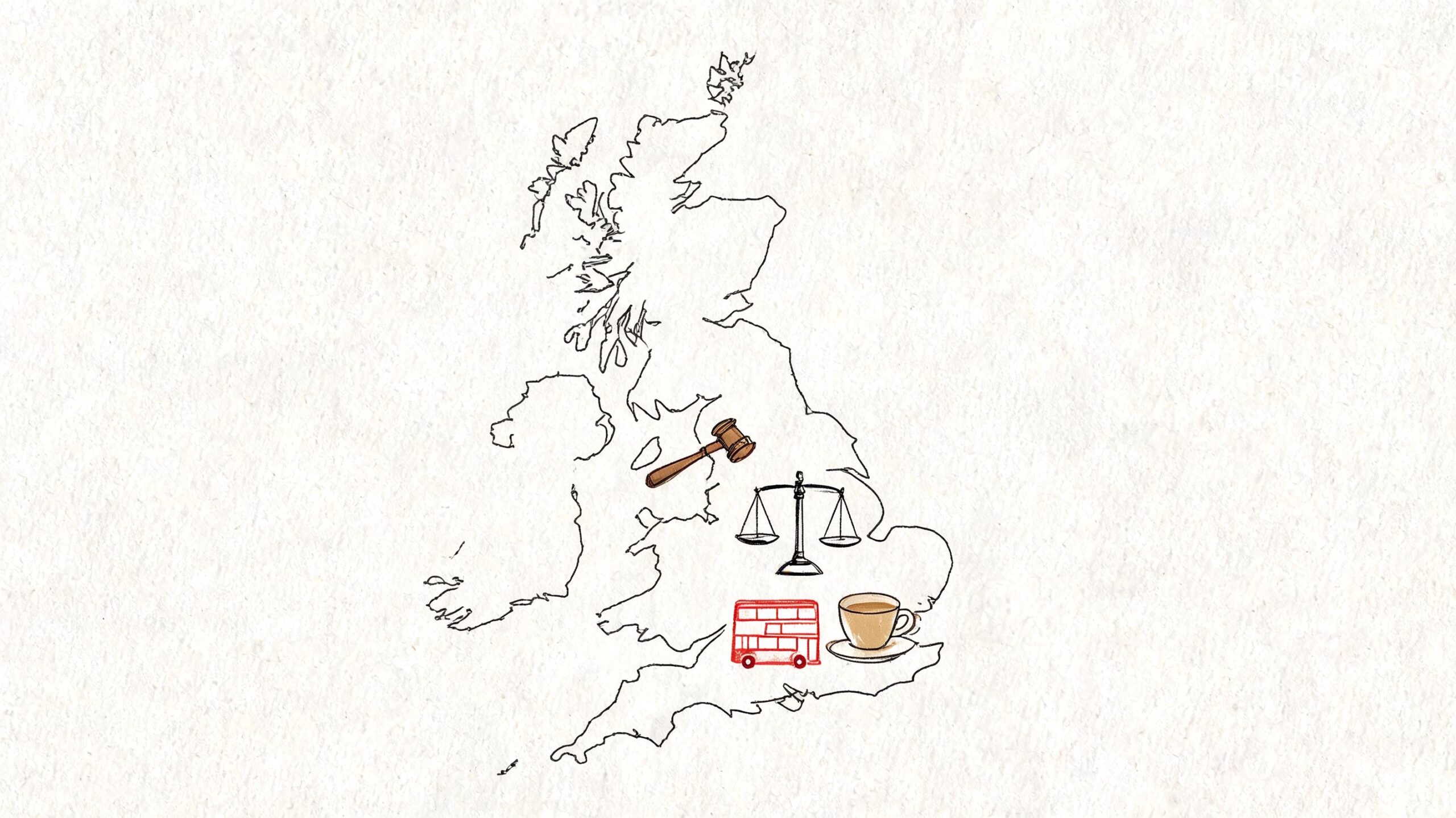
Cultural cues that work in the UK
In British markets, hype wears thin quickly. Overblown claims, imported trends, and flashy language can make a business feel less dependable, especially in service sectors where trust drives enquiries.
What usually performs better is a more measured approach. Clear wording. Confident design. Personality that feels earned rather than forced. Provenance helps too, but only when it is real. Dorset businesses often have an advantage here. Local craft, coastal setting, food production, tourism, marine work, and independent retail all carry character if the identity reflects the truth of the business rather than a stereotype of it.
Audience matters. A boutique hotel in Lyme Regis can use warmth and atmosphere. An accountancy firm in Bournemouth needs steadier visual choices and tighter language. A premium food producer selling across the UK may need to balance regional charm with packaging that still feels credible on a national shelf.
This is the practical point. “British” is not one style. It is a set of expectations around tone, trust, and social cues.
Consistency builds recognition
One useful UK reference point is government identity. The UK Government Identity System uses the Royal Coat of Arms and strict rules to achieve 95% recognition. The SME lesson is simple. Repetition builds memory, and memory supports trust.
I see this often with growing local firms. The website looks polished, the van uses an older logo, the proposal template feels generic, and social posts drift between styles. Each piece may be acceptable on its own, but together they weaken recognition.
Keep the basics aligned across every customer touchpoint. The logo version should stay consistent. Colours should match in print and on screen. Type choices should not change from page to page. Service descriptions should sound like they came from the same business. If you are reviewing your site at the same time, this guide to finding a website designer who understands your vision helps you connect brand decisions with the build, rather than treating them as separate jobs.
Here's a short explainer that helps show how identity systems work when applied at scale:
If every touchpoint looks slightly different, customers don't read that as creativity. They read it as uncertainty.
Legal checks before rollout
One of the costliest branding mistakes is committing too early. A business owner approves a name, orders signage, updates the website, prints packaging, and then finds the name is too close to an existing mark.
Check availability before rollout. For UK SMEs, that usually means searching the UK Intellectual Property Office register, reviewing Companies House results, checking domain names, and looking at social handles. If you plan to sell outside your county or grow nationally, this work matters even more.
Use a practical filter before you spend money:
- Check the business name
- Check key product or service names
- Check similar visual marks in your sector
- Check domain and social availability
- Check whether your chosen identity creates avoidable confusion
There is also a commercial angle here. Legal clearance helps avoid disputes, but it also protects the value you are building. If customers start to recognise your name and visual identity, you need to be able to keep using them.
It helps to test perception early as well. A short customer survey can show whether your identity reads as premium, trustworthy, local, or dated. You can measure brand health with Formbricks before a full rollout and catch problems while changes are still affordable.
Good brand identity work in the UK comes down to fit. It should suit the market, reflect the character of the business, and stand up to legal checks before you put it into daily use.
An Actionable Checklist to Develop Your Brand Identity
Most branding projects feel overwhelming because owners try to solve everything at once. A better approach is to treat it like a build. One decision sets up the next.

A practical order of work
Write down the commercial problem first
Don't begin with colours. Begin with the business issue. Are you attracting the wrong leads? Looking dated next to competitors? Struggling to justify pricing? Launching a new offer? A useful identity solves a business problem, not just a visual one.Define your essentials
Keep this tight. What do you do, who do you help, what do you want to be known for, and what three words should describe the business? If you can't answer those clearly, design decisions become subjective and slow.Review the market properly
Look at direct competitors, not random brands you admire. Save screenshots of websites, packaging, vans, brochures and social posts. Then ask two questions. What does the category expect? Where do you need to fit in, and where do you need to stand apart?
Build the identity system
Create verbal and visual references together
Moodboards help, but they're more useful when paired with language. Gather examples of colours, typography, layouts, photography and brand voice. The aim isn't to copy. It's to agree on direction before anyone starts refining a logo.Develop core assets first
Start with the logo system, colour palette, typography and messaging hierarchy. Leave secondary applications until the core decisions feel settled. Many rushed projects fail because owners are reviewing van livery and Instagram templates before the fundamentals are agreed.Test it in real touchpoints
A concept on a presentation slide can look excellent and still fail in use. Apply it to your homepage, a social post, a printed document, a mobile header, a sign, or a product label. If it falls apart there, revise it early.
Field note: The strongest concepts usually look calm in review and useful in application. If an idea only shines when it's being explained, it probably isn't strong enough.
Document and measure
Turn decisions into guidelines
Even a slim brand guide prevents a lot of drift. Include logo rules, colours, fonts, headline style, image direction and tone examples. If several people create content, this step is essential.Roll it out in priority order
Don't try to update everything in one frantic week. Start with the assets customers see most often. Usually that means website, email signature, social profiles, sales documents, signage, and any printed material used at point of contact.Check whether the new identity is working
Not by asking “do we like it?” but by asking what changed in perception. Customer interviews, short surveys, sales team feedback and on-site behaviour all help. If you want a structured way to measure brand health with Formbricks, that template is a practical starting point.
A lot of owners stall at this point because they don't have time, or because too many choices create drag. If you're preparing to brief an agency or even choosing the right process for a website-led rebrand, this guide on finding a website designer who understands your vision is worth reading before you buy anything.
UK Brand Identity in Action Local Case Studies
The principles sound abstract until you see how they play out in different sectors. The useful part isn't copying another business's style. It's seeing how identity decisions change depending on the job the brand needs to do.
Hospitality needs atmosphere and clarity
A hospitality brand such as The Lobster Pot has to do two things quickly. It needs to create appetite and it needs to feel dependable. If the visual identity leans too far into novelty, it can cheapen the experience. If it becomes too plain, it loses warmth.
For this sort of business, the strongest route is usually a clear visual character with enough restraint to work across menus, signage, web pages and seasonal promotions. The identity should feel local, memorable and easy to recognise at a glance.
Fitness and community brands need energy without chaos
Crossfit Durnovaria sits in a different category. The audience expects movement, strength, momentum and belonging. The temptation in this market is to go too aggressive. Heavy textures, crowded layouts, shouting headlines, and overworked graphics can make a brand feel dated very quickly.
A sharper approach is to keep the system disciplined. Strong typography. Clear hierarchy. Confident use of colour. Photography that shows real effort and community rather than generic “fitness” clichés. That gives the brand energy while still making it usable across social content, membership information and the website.
The right identity doesn't make every business look impressive in the same way. It makes each one feel more itself, and more usable.
Professional organisations need authority people can navigate
Membership groups and business organisations have another challenge. They need to look established and accessible at the same time. Too formal, and they feel remote. Too informal, and they lose authority.
The Weymouth & Portland Chamber of Commerce portfolio example shows the sort of balance this kind of organisation needs. The identity has to support communication across events, membership materials, website pages and public-facing updates. It isn't there to decorate. It's there to organise trust.
Across all three examples, the pattern is the same. Brand identity works when it matches the audience, the sector, and the way the business operates.
Next Steps Your Future-Proof Brand with DesignStack
Nearly half of UK business owners say time is the main reason branding work gets pushed back, according to Adobe's research on UK branding challenges. In practice, I see the same pattern across Dorset SMEs. The issue is rarely a lack of ambition. It is uncertainty about what to change first, how to make decisions quickly, and how to avoid paying for a rebrand that looks better but solves very little.
That is why the next step should be practical and scoped. Start by checking whether your current identity still fits the business you have now. If your website, signage, sales decks and social posts all feel like they came from different companies, you do not have a style problem. You have an operational one.
A good brand process reduces that friction. It sets criteria before visuals, tests ideas against real customer touchpoints, and gives your team rules they can effectively use. For a UK SME, that usually means balancing three things at once. Local credibility, room to grow beyond your postcode, and enough structure to keep everything consistent once the project is finished.
DesignStack is a Dorset studio that handles branding, WordPress websites, graphic design and rollout support with fixed costs and a defined revision process. That sort of setup suits owner-led businesses because it keeps the work contained and helps you make decisions without dragging the project out for months.
If you are serious about future-proofing your brand, ask straightforward questions early. Does the name need a UK trademark check before you invest further? Will the identity work on a van, a trade stand and a mobile screen? Can someone new in the business apply it correctly without calling the designer every time?
Those are the questions that protect growth.
If your business has outgrown its early branding, treat identity as a commercial asset and not a finishing touch.
If you're based in Dorset or anywhere in the UK and want a clearer, more usable brand identity, talk to DesignStack. A short conversation can usually tell you whether you need a full rebrand, a focused refresh, or tighter brand guidelines to make what you already have work harder.

Leave a Reply