

Brand Identity Cost: How Much Should You Pay in 2026?
A complete brand identity package for a UK small business typically costs £3,750 to £15,000, while a basic logo-only package usually starts between £750 and £3,750. If you've been collecting quotes and wondering why one proposal feels suspiciously cheap and another looks alarmingly high, that range is the reason.
Most business owners asking about brand identity cost aren't really asking for a number. They're trying to work out whether they're about to make a smart investment or overpay for a logo wrapped in agency language. That confusion is common, especially for Dorset and South Coast businesses comparing local studios, London agencies, and offshore providers that look cheaper at first glance.
The problem is that branding is still sold like a black box. One quote includes strategy, messaging, and guidelines. Another includes a logo and a few files. A third is hourly, so the final total is anyone's guess. If you want to budget properly, you need to know what sits behind the price and where the risk usually hides.
Why "How Much Does Branding Cost" Is the Wrong Question
A Dorset business owner gets three branding quotes in the same week. One is £900 for a logo. One is £4,800 for identity design and guidelines. One starts at £3,000, then lists discovery, revisions, templates, and rollout support as extra. The numbers look comparable at first. They are not buying the same thing.
Price on its own is a poor filter because agency quotes are rarely built in the same way. Some studios price the visible outputs. Others price the thinking, meetings, revisions, and implementation support that stop the project drifting. If you only ask, "How much does branding cost?", you leave too much room for hidden scope and expensive assumptions.
Cheap branding often solves the smallest part of the problem
A low quote can work if you need a new logo file and nothing more. That is not the same as building a usable brand identity for a business that has to appear consistent across a website, vans, signage, social posts, quotes, brochures, and email signatures.
Small firms often get caught in this trap. The first supplier gives them a mark. Six months later, the website designer has no brand rules, the printer is guessing colours, and the team is creating their own versions of the logo in Canva. You have paid once for design, then again for correction.
Rebrands also tend to happen in cycles rather than once in a business lifetime. The CMO Survey has tracked how firms update and refresh branding over time, which is useful context if you want to avoid short-term fixes that age quickly, as covered in the CMO Survey's reporting on brand strategy and change over time. The practical point is simple. Under-scoped work often creates a second bill sooner than expected.
Practical rule: If a quote cannot show how decisions will be made and documented, you are probably buying artwork, not a brand system.
The better question is what the brand needs to do in your business
For a local business in Weymouth, Dorchester, or Bournemouth, the brand usually has a job to do before it has a style to show off. It needs to make you look credible, help customers recognise you quickly, and give your team a consistent way to present the business.
That is why I usually advise owners to ask three things before they compare prices. What needs to change? Where will the new identity be used first? Who inside the business will apply it day to day? Those answers shape the scope far better than an abstract budget conversation.
If the website is part of the same project, the handover between branding and digital matters. A business that can connect positioning, visuals, and site execution will usually save you time and rework. That is why many owners start by looking for a website designer who understands your vision instead of treating brand and web as separate purchases.
Cost matters, but scope control matters more
The risk in branding is not always the headline fee. It is the quote that looks affordable until revisions, extra concepts, messaging help, social templates, or rollout support are added later.
For UK SMBs, especially those comparing Dorset studios with larger city agencies, fixed-cost pricing is often easier to manage because it makes the boundaries visible. You can see what is included, what is not, and what a change will cost before the work starts. That is far safer than agreeing to an open-ended hourly model and hoping the project stays tidy.
You should also judge the investment against what success looks like afterwards. Better consistency. Faster marketing production. Fewer internal debates. Stronger recall. If you want to track whether the brand is becoming more recognisable after launch, these top brand awareness measurement tools give a useful overview of what to monitor.
The right question is more practical. What level of brand work will help this business grow without paying twice for the same problem?
What Are You Actually Paying For?
When a professional quote comes in above what you expected, the gap usually comes from one thing. You thought you were buying a logo. The agency priced a system.
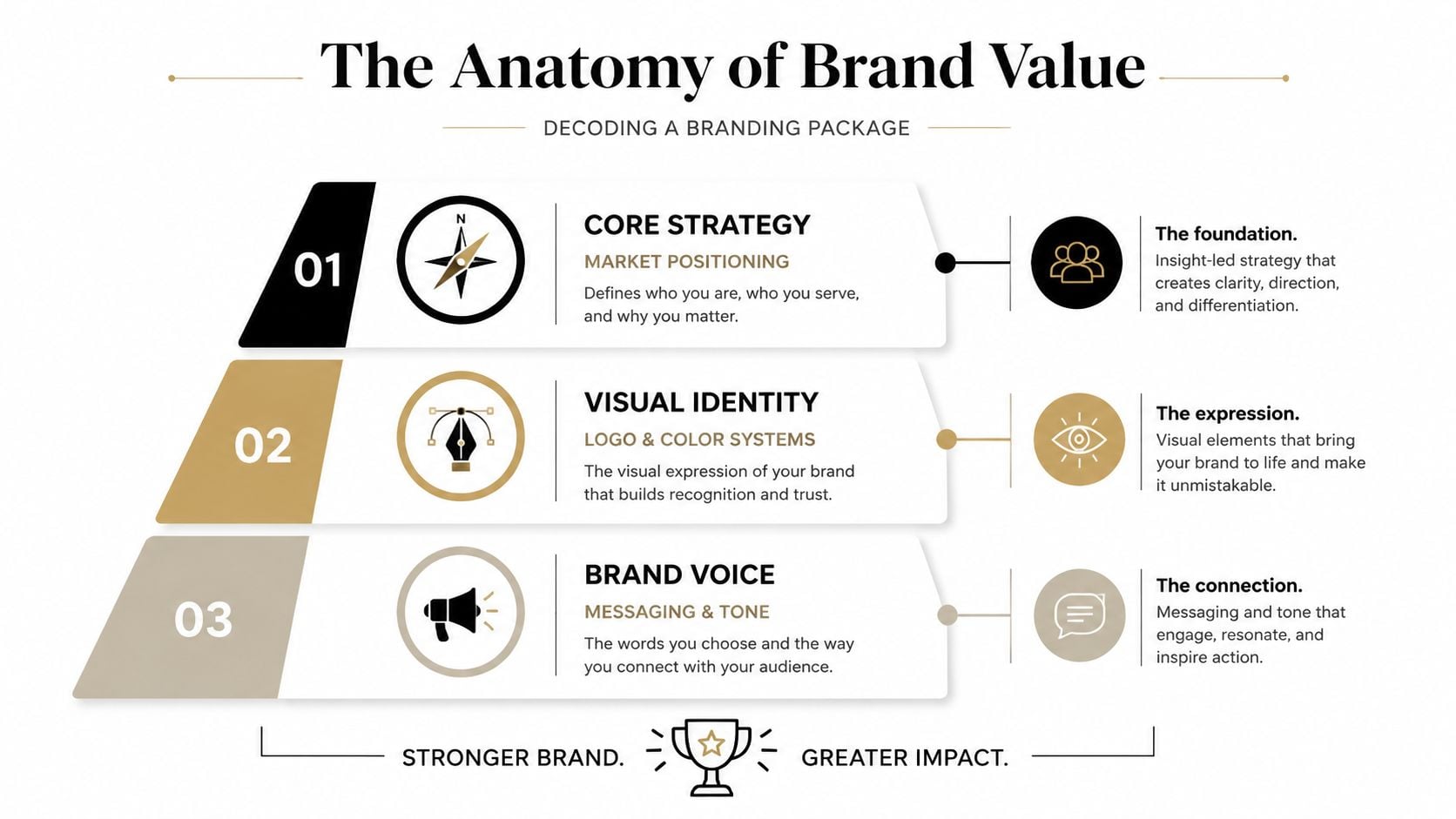
Strategy is where the expensive mistakes get prevented
The part many buyers can't see is often the most valuable. Strategy work includes understanding your audience, your competitors, your positioning, your offer, and how your business should be perceived. Without that, design choices become subjective very quickly.
Industry benchmarks show that professional brand identity packages requiring 200 to 300 hours of work across strategy, competitive research, and visual systems typically range from £20,000 to £50,000+, while a surface-level identity at 60 to 80 hours costs £5,000 to £20,000 and in-depth brand strategy at 200 to 300+ hours demands £30,000 to £75,000+, according to Connective Web Design's branding investment guide.
That gap tells you something important. The brand identity cost rises when research depth rises. More discovery means more time, more senior input, and fewer assumptions.
Visual identity is only one layer
Most proper identity projects include several moving parts:
- Brand strategy and positioning helps decide what you stand for and how you should be differentiated.
- Logo and wordmark design gives you the recognisable core assets.
- Colour palette and typography create consistency across screens, print, packaging, and signage.
- Imagery direction helps photos, graphics, and layouts feel like one brand rather than mixed sources.
- Brand voice or messaging guidance keeps copy aligned with the same personality and market position.
- Brand guidelines show your team and suppliers how to use the system correctly.
- Initial collateral may include social templates, business cards, presentation slides, or other core assets.
A logo file by itself doesn't solve any of that.
A strong identity reduces decision-making friction. Your team knows what to use, your suppliers know what to produce, and your customer sees the same business at every touchpoint.
You're also paying for process and judgement
Good branding work isn't just production time. It's curation, challenge, refinement, and restraint. An experienced team will often remove weak directions before you ever see them. That invisible editing is part of the value.
If you want to understand what happens after launch, especially when you're trying to judge whether your new identity is gaining traction, it helps to look at practical resources on top brand awareness measurement tools. Not because branding should be reduced to dashboards, but because visibility and consistency are easier to manage when you decide early how success will be observed.
What doesn't usually work
Three patterns tend to disappoint small businesses:
| Approach | What usually happens |
|---|---|
| Logo-first buying | You get files, but no rules for applying them |
| Too many stakeholders with no clear brief | Revisions spiral and direction gets diluted |
| Choosing on price alone | Important strategic work gets omitted, then paid for later |
A professional package costs more because it removes ambiguity. That's the part buyers often appreciate most once the project is finished.
Brand Identity Cost Ranges for UK Businesses
A Dorset business owner gets three quotes for “branding.” One is under £1,000. One is £4,500. One is over £12,000. The gap looks absurd until you read the scope.
That spread is normal in the UK market because “brand identity” can mean anything from a basic logo pack to a full identity system with positioning, typography, colour rules, templates, and brand guidelines. If the quote does not spell that out, the price tells you very little.
Creative Boom's guide to logo design pricing gives a useful benchmark for one part of the market. Freelance logo design can sit at the lower end, while agency-led identity work climbs as strategy, consultation, and application work are added. That lines up with what many SMEs see when comparing quotes.
Typical UK Brand Identity Costs 2026
| Business Size / Type | Typical Scope | Estimated Cost Range (GBP) |
|---|---|---|
| Startup or solo business | Logo-only package or light identity setup | £750 to £3,750 |
| Small business | Brand identity with core strategy, colour palette, typography, and basic guidelines | £3,750 to £15,000 |
| Growing SMB with more complex needs | Identity work with deeper research, broader asset creation, and rollout support | £5,000 to £20,000 |
| Established business | Strategic identity programme with research, competitor review, messaging input, and wider system development | £30,000 to £75,000+ |
For many Dorset and wider South West businesses, the realistic decision is not between “cheap” and “expensive.” It is between a focused package that covers what you need now, and a broader programme that prevents extra spend six months later.
Local agencies often come in below London prices, but that does not automatically make them better value. Better value comes from a quote you can read clearly. Fixed deliverables, named review rounds, and defined outputs make it easier to compare one proposal with another. If you are still understanding agency pricing models, that distinction matters more than the headline number.
A higher quote may include the pieces that stop scope creep. Workshop time. Brand rules. Social templates. Launch files your printer, sign maker, and web designer can all use without calling for extra fixes.
What UK SMEs should compare before accepting a quote
Price matters. Scope matters more.
Check these points before you decide:
- Strategy included or not. Some packages start at visuals only. Others include positioning and audience work.
- Guidelines depth. A one-page logo sheet is very different from a usable brand guide.
- Number of applications. Social assets, stationery, signage, packaging, and presentation templates all affect cost.
- Revision limits. Undefined revision rounds often lead to higher final bills or stalled projects.
- Handover files. You want usable formats, not just a few exported images.
The right budget matches the stage your business is in. A new venture testing its offer may not need a full strategic exercise yet. A trading business with staff, sales activity, printed material, and an existing website usually needs more than a logo to stay consistent.
Good brand identity work should feel expensive only once. Poorly scoped work gets paid for repeatedly.
Fixed-Fee vs Hourly Rates What's Best for You?
A Dorset business owner asks for a branding quote, sees one proposal at a fixed price and another at a lower day rate, then assumes the second option is safer. A month later, the lower quote is no longer lower. Extra calls, more revisions, and a few “while we're here” requests have pushed the bill past the fixed-fee option.
That happens often because the pricing model shapes the risk, not just the number on page one.
Hourly pricing works when the brief is still shifting
Hourly or day-rate billing suits projects that are still being defined. That might mean early naming work, stakeholder workshops, or a wider brand review where nobody can sensibly promise a set list of outputs yet.
The trade-off is uncertainty. If feedback is slow, decisions keep changing, or the scope expands halfway through, the budget expands with it. For some businesses, that flexibility is useful. For a small or mid-sized company trying to plan cash flow properly, it can become hard to control.
That is the part many owners dislike most. The final cost depends partly on how decisively the project is managed by both sides.
Fixed-fee pricing works when the outcome is clear
Fixed-fee branding suits a defined brief. You agree the deliverables, the number of revision rounds, the timeline, and the handover files before work starts. That makes quotes easier to compare, especially if you are understanding agency pricing models for the first time.
For UK SMBs, especially around Dorset and the South Coast, fixed pricing usually removes the black-box feeling from agency quotes. You can see what you are buying, what happens if the brief changes, and where the boundaries sit. That clarity is often more valuable than chasing the lowest starting figure.
A fixed fee also puts pressure on the agency to scope the work properly from the start.
| Pricing model | Best for | Main risk |
|---|---|---|
| Hourly | Strategy or identity work with unclear scope | Final invoice grows as the project grows |
| Fixed-fee | Defined brand identity projects with agreed outputs | Changes to the brief may need a new quote |
| Retainer | Ongoing monthly design support after launch | You may pay for capacity before you need it |
What usually works best for local SMBs
For most established small businesses, fixed-fee branding is the safer buying model.
It suits owners who need to know the cost before they commit, need sign-off from another director, or do not want branding to turn into an open-ended meter. That is why I usually recommend a fixed project fee for identity work, then separate any extra rollout items once the core brand is approved. It keeps the budget honest and stops the identity project carrying costs that belong elsewhere.
This is the same problem you see with the hidden costs of cheap website design. A low headline price can look sensible until exclusions and change requests start stacking up.
A good fixed-fee proposal should make five things plain:
- What is included in the project
- What is excluded and priced separately
- How many revision rounds are allowed
- What triggers extra cost
- What files and guidance you receive at handover
If a quote cannot answer those points clearly, the pricing model is not the issue. The issue is scope control.
How to Maximise Your Branding Investment
A Dorset business owner gets three branding quotes. One looks cheap but says little beyond “logo design”. One is expensive and packed with jargon. One is a fixed fee with clear deliverables, revision limits, and rollout options. The third quote is usually the safest buy, even if it is not the lowest price.
That is because branding value rarely comes from buying more. It comes from buying the right work, in the right order, with enough clarity to avoid paying twice for the same problem.
A strong identity usually saves money later because it reduces rework, internal debate, and inconsistent rollout. A weak one often looks cheaper at the start, then starts generating extra design costs as soon as it meets the actual world.
Six ways to get better value without buying the cheapest option
Write a proper brief before asking for quotes
“We need branding” is not a brief. State what the business does, who it serves, what has changed, what must stay, and what you need first. If you are a local trades business in Weymouth, a hospitality brand in Dorchester, or a growing service firm selling across the UK, the brief should reflect that commercial reality. Better briefs produce cleaner quotes and fewer expensive misunderstandings.Prioritise phase one properly Start with the assets you will use. For many SMBs that means core identity, colour palette, typography, logo rules, and a simple brand guide. Social templates, vehicle graphics, signage systems, brochures, and packaging can follow if they are not immediately needed. That protects budget without stripping the project down so far that it becomes cosmetic.
Control feedback before it slows the project down
Too many voices create weak branding. I have seen good identity work drift because every director, manager, and family member wanted a say on fonts and colours. Choose one accountable decision-maker, gather input once, and give the agency a clear route to approval.Ask what happens after the logo is approved Costs often start hiding at this stage. A brand has to be applied to website pages, social graphics, printed material, presentation decks, signs, menus, uniforms, or packaging. If that rollout work is not included, ask for it to be priced separately up front so you can judge the full investment, not just the first stage.
Join up branding and website decisions
If your site also needs work, handle both pieces with the same commercial logic. Brand identity and web design affect each other. A weak website brief can force brand compromises, and a rushed brand can make the website harder to build well. That is why the same warning shows up in discussions about the hidden costs of cheap website design. A low entry price often leaves out the thinking and implementation work that make the end result usable.Buy clarity, not endless options
More concepts do not always mean better thinking. For a small business with a defined audience and a clear offer, a focused process usually produces a stronger result than paying for a long menu of alternatives. What matters is whether the work solves the right problem and gives you tools you can use consistently.
A practical test: if a deliverable will not be used in the next few months, price it as phase two instead of folding it into the first quote.
Watch this before you approve scope
This short video is a useful reminder that design investment works best when tied to business clarity, not just visual preference.
What usually wastes budget
A few patterns show up again and again:
- Changing business goals mid-project and expecting the original quote to still fit
- Approving work by committee instead of through one responsible lead
- Starting with visual preferences before agreeing on audience, positioning, and priorities
- Forgetting rollout costs until after the identity is signed off
- Buying on headline price alone without checking what is excluded
The best branding investments are usually not the biggest. They are the clearest. For UK small businesses, especially those comparing local agency quotes, the safest route is usually a fixed-cost identity project with a tight brief, defined outputs, and a realistic phase-two plan. That keeps the budget under control and stops scope creep turning a sensible brand investment into an open-ended bill.
What to Expect When Working with DesignStack
Many UK SMEs delay branding work because they're worried about two things. The total cost and the fear that the quote will expand once the project is underway. That concern is well recognised in UK market commentary, which notes that SMEs often hold back because of perceived cost and scope creep, while agencies that publish transparent pricing and defined revision limits are better placed to build trust, as discussed in FZP Digital's analysis of brand identity pricing gaps.
That's exactly why process matters.
What a sensible agency process should include
A practical branding process for a small business should be straightforward:
- Clear scope before work starts
- Fixed project cost rather than vague time estimates
- Defined revision rounds
- Regular updates during delivery
- Clarity on post-launch support and extra items
That model suits businesses that need a dependable budget and don't want to manage creeping hourly charges.
The DesignStack approach in plain terms
For Dorset businesses comparing options, DesignStack's graphic design services sit within that fixed-cost, clearly-scoped model. The studio is based in Weymouth, works with local and wider UK organisations, includes three design revisions as standard, and combines branding with web design when a business needs both delivered together.
That's useful for companies that don't want strategy separated from implementation. It also helps when the same identity has to work online, in print, and across day-to-day marketing materials.
The wider business context matters too. A local restaurant, membership organisation, retailer, or service firm doesn't need a bloated process. It needs a brand system that's clear enough to use and strong enough to support growth. Experience helps here, especially when the agency has worked with organisations such as The Lobster Pot and the Weymouth & Portland Chamber of Commerce and understands the pace and budget pressures of regional businesses.
Transparent pricing doesn't make a project smaller. It makes the decision easier.
Common Questions About Brand Identity Costs
How long does a brand identity project usually take
It depends on scope, feedback speed, and how much strategic work is included. A focused visual identity project moves faster than a deeper engagement involving positioning, messaging, and a broader rollout. The biggest delays usually come from internal bottlenecks on the client side, not from design software or production.
If you want the project to move well, decide early who signs things off and when feedback will be returned. That matters more than trying to rush the creative work itself.
Is a cheap logo from a freelance site good enough
Sometimes, but only for very narrow needs.
If you need a basic mark to get a side project online, a low-cost logo may be enough for the moment. If you need a consistent business identity that will appear on a website, signage, social media, printed pieces, proposals, and packaging, it usually won't be enough on its own.
The issue isn't that freelancers are poor value. Many are excellent. The issue is scope. A cheap logo purchase rarely includes the strategic thinking, usage rules, and wider identity system that makes branding practical day to day.
Do I have to pay the full amount upfront
Not usually. Most professional providers break projects into staged payments tied to agreed milestones. The exact structure varies, but the important thing is clarity before the project starts.
Ask these questions before you sign:
- What deposit is required
- When are later payments due
- What triggers each stage
- What happens if scope changes
- What counts as out-of-scope work
That conversation often tells you more about the agency than the price itself. Clear payment terms usually sit alongside a clearer process overall.
How do I know if a quote is fair
Start with scope, not headline price. A fair quote explains deliverables, revision limits, ownership of files, and any post-launch support. It should also make clear whether you're buying a logo, a visual identity, or a fuller brand system.
If one quote is much lower than the others, check what's missing before you assume it's a bargain. If one is much higher, ask whether the additional research and strategy are necessary for your stage of business.
Should branding and website work be done together
Often, yes. Not always, but often.
If your website already performs well and only your visual identity needs updating, a separate branding project can work. If your site is dated, inconsistent, or being rebuilt anyway, pairing the two often creates a cleaner result because the same decisions around positioning, messaging, visuals, and user experience get applied in one coordinated process.
If you're weighing up brand identity cost and want a quote that's clear about scope, revisions, and what happens after launch, DesignStack is a practical place to start. The studio works with Dorset and UK businesses that need branding, graphic design, and websites delivered with fixed costs, straightforward communication, and no mystery around what's included.
Leave a Reply