


SEO for Medical Websites: Boost Visibility 2026
If you manage a clinic, you've probably felt this already. Your practitioners are qualified, your care is good, your patients are happy, and yet your website still isn't pulling its weight. Competitors with weaker branding and thinner content appear above you for local searches, while your site sits on page two, page three, or disappears from map results entirely.
That usually happens because SEO for medical websites isn't standard business SEO. In healthcare, visibility depends on trust, regulation, technical clarity, and local relevance working together. A clean homepage and a few service pages won't carry you far if your practitioner bios are thin, your accessibility is weak, or Google can't properly read your services and clinicians.
Table of Contents
- Why Your Medical Practice Is Invisible Online
- Building Your Foundation of Trust and Authority
- Essential Technical SEO for Healthcare Websites
- Creating Content That Answers and Reassures Patients
- Dominating Local Search and Managing Your Reputation
- The Future of Medical Search and Ongoing Success
Why Your Medical Practice Is Invisible Online
A common pattern shows up in clinic websites. The site looks respectable, the contact form works, and the service list is there, but the structure behind it is too shallow for healthcare search. Google doesn't just want to see that you offer treatment. It wants clear evidence of who provides it, where you provide it, and why a patient should trust the information on the page.
That's why many clinics misjudge both the workload and the budget. For UK medical practices, specialist healthcare SEO services typically cost between £2,500 and £5,000 per month, while technical and local SEO improvements can produce visible changes in map pack rankings within six to twelve weeks, and content-driven results typically take four to six months from publication, according to this UK healthcare SEO pricing and timeline breakdown. A clinic with one location and limited previous SEO investment may spend less, but the broader point stays the same. Medical SEO needs sustained work, not a one-off tidy-up.
Visibility problems usually come from the same few gaps
Some clinics assume they have a keyword problem when their issue is a trust problem. Others pay for blog posts before fixing the practitioner pages, service structure, or local profile signals that support rankings in the first place.
The usual weak points are:
- Thin clinician information. A short paragraph and a headshot won't carry medical authority.
- Generic service pages. If every treatment page reads like brochure copy, it won't answer patient intent.
- Poor local signals. Inconsistent address details, weak Google Business Profile setup, or missing location relevance all hold back visibility.
- Technical confusion. Slow mobile pages, inaccessible design, and weak schema make the site harder for both patients and search engines to use.
Practical rule: If your site looks polished but still doesn't rank, the problem usually isn't design alone. It's the lack of structured trust signals behind the design.
A lot of clinic managers also expect SEO to work like paid ads. It doesn't. Technical corrections can help relatively quickly, especially in local search, but authority takes time because medical topics are scrutinised more heavily.
If your current site barely appears in search, it's worth reviewing the broader causes behind why a website may not show up on Google. In healthcare, those causes are usually amplified. A weak legal footer, an incomplete clinician page, or a missing local signal matters more here than it might for a florist or café.
What works and what doesn't
A practical way to think about it is this:
| Approach | What happens |
|---|---|
| Publish blogs before fixing trust and technical basics | You create more pages, but not more authority |
| Optimise local signals and practitioner credibility first | You give Google clearer reasons to rank the site |
| Chase broad vanity keywords | You compete too widely and convert poorly |
| Build pages around services, clinicians, and local intent | You attract patients who are closer to booking |
Medical SEO works best when the site behaves like a trustworthy clinic front desk. Clear answers, verified professionals, simple navigation, and no ambiguity.
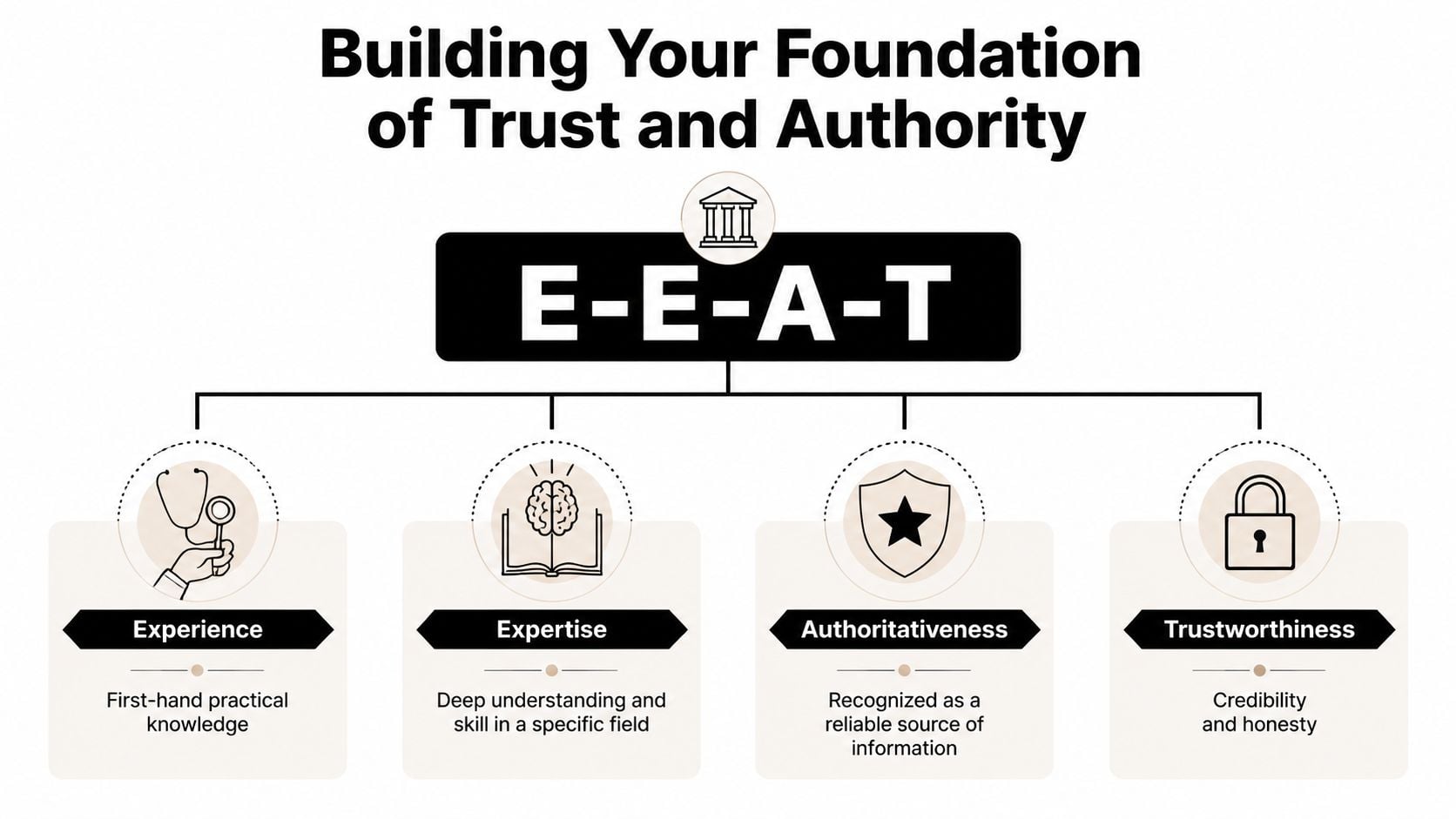
Building Your Foundation of Trust and Authority
In healthcare, trust isn't branding polish. It's infrastructure. Before a medical website earns visibility, it has to prove that real, accountable professionals stand behind the content and services on the page.
That's where many websites fall short. They have an “About Us” page, a “Meet the Team” section, and perhaps a few logos for memberships, but nothing is built deeply enough to support search performance or patient confidence.
Why generic bios underperform
A generic clinician bio usually says something like “Dr Smith is an experienced specialist with a passion for patient care.” That sounds harmless, but it doesn't prove anything meaningful to a patient or to Google.
What does move the needle is detail. UK medical directory audit findings report that practices with fully populated practitioner pages featuring registration numbers rank 34% higher in local search than those with generic bios, yet only 18% of private clinics in Dorset and the South West currently implement this correctly. That's one of the clearest examples of a ranking signal that generic SEO advice often misses.
Clinician pages aren't just staff profiles; they are evidence pages. They show that named professionals, with recognised registrations and relevant clinical background, are attached to the treatments you offer.
Patients don't separate SEO trust from real trust. If a bio feels vague to a human reader, it usually looks weak to a search engine too.
What a strong practitioner page should include
A strong practitioner page should do more than introduce a name. It should remove doubt. For most clinics, that means each page needs to include:
- Full practitioner name and role. Use the exact professional identity patients would expect to verify.
- Registration number. GMC, NMC, HCPC, or the relevant UK regulator, shown clearly and accurately.
- Clinical experience. Keep it plain English. Focus on areas of treatment, patient groups, and practical expertise.
- Qualifications and training. Include relevant degrees, certifications, and specialist education.
- Professional affiliations. Memberships help support credibility when they are directly relevant.
- Services linked to that practitioner. Connect the person to the treatments they provide.
- Location relevance. If a clinician works across sites, make that explicit.
This is also one of the few areas where site architecture and authority overlap. A good clinician page should link to the services they perform, the clinic locations where they practise, and the content they review or contribute to. That internal linking pattern helps search engines understand the relationship between people, services, and place.
If your broader site authority feels uneven, it helps to understand how search engines evaluate the strength and reputation of a website over time. This primer on domain authority and related trust signals gives useful context, especially for practices comparing themselves against larger providers.
The trade-off clinics need to manage
Some teams worry that adding registration details or fuller practitioner information will make pages feel too formal. In practice, the opposite usually happens when it's written well. Patients don't need sterile bios. They need clarity.
The right balance is professional, readable, and verifiable. Not over-optimised. Not promotional. Not anonymous.
A medical website starts to feel authoritative when every important page answers the same silent question: “Who is responsible for this information and this care?” If the site doesn't answer that cleanly, rankings tend to stall.
Essential Technical SEO for Healthcare Websites
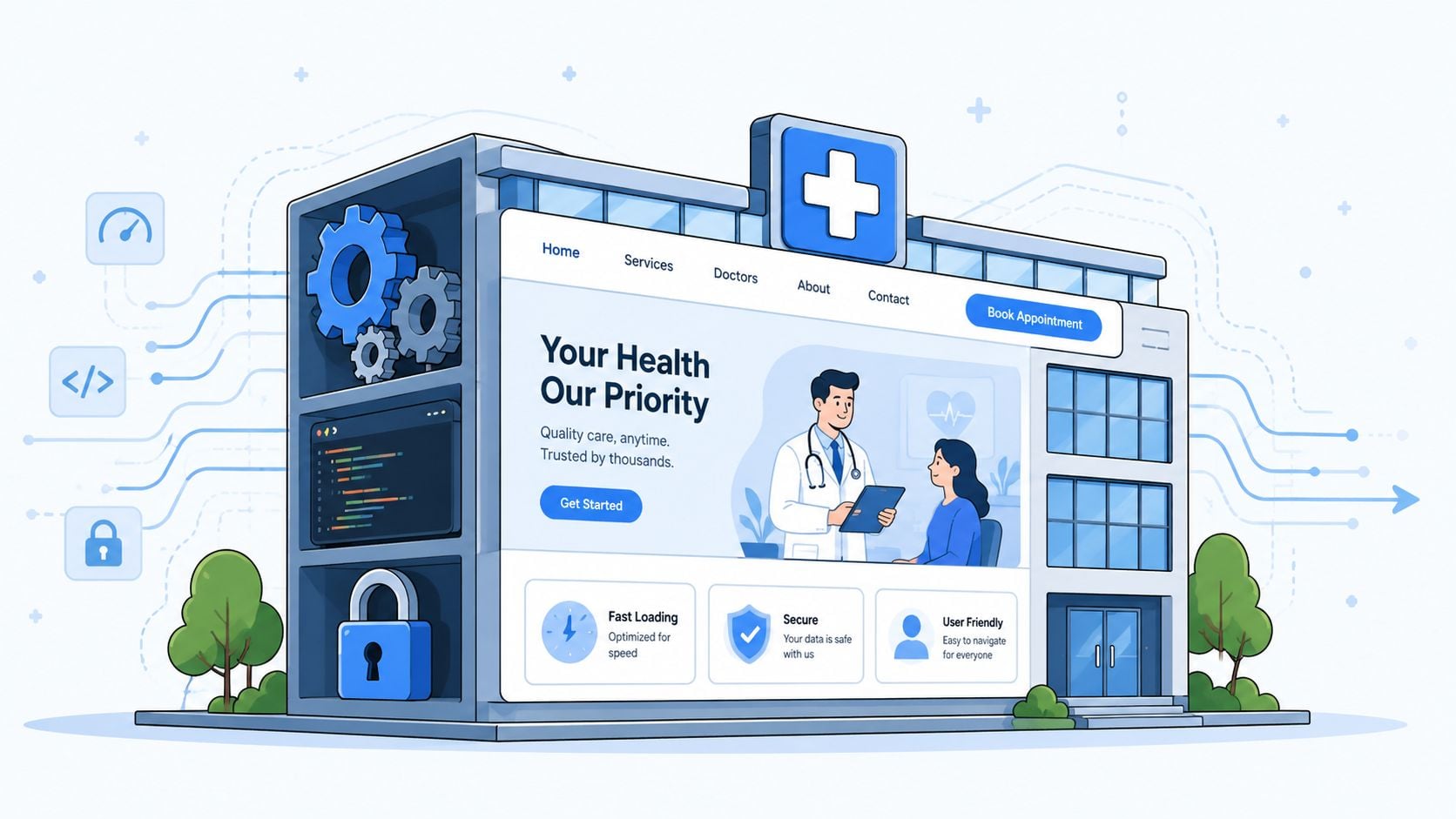
Technical SEO is where many medical sites lose ground. Not because the clinic has done anything dramatic wrong, but because the site sends mixed signals. It may look fine on a desktop screen in the office, yet still be difficult for mobile users, inaccessible for some patients, or unclear to Google's systems.
Accessibility is not a side task
For UK healthcare websites, accessibility is not optional polishing. According to this UK healthcare SEO guidance, implementing WCAG 2.1 AA accessibility compliance is a mandatory minimum standard, and using precise JSON-LD schema types such as Physician and MedicalClinic is also mandatory to trigger rich results in Google.
That changes how a medical site should be built. Colour contrast, form labels, keyboard navigation, readable page structure, and descriptive links are not only usability issues. They're part of whether the website is fit for patient use.
A clinic manager doesn't need to memorise WCAG standards, but they do need to ask direct questions of their web team:
- Can a patient use the site without a mouse?
- Do forms work properly with assistive technology?
- Are headings structured logically on treatment pages?
- Is text readable on mobile without strain?
If the answer to those questions is unclear, the site isn't finished.
Schema gives Google the context it needs
Medical schema is one of the most practical technical tasks because it helps Google understand your organisation without guessing. If your homepage says you're a clinic and your team page lists doctors, schema can formally label those entities.
That usually means implementing structured data around:
| Page type | Useful schema focus |
|---|---|
| Main clinic page | MedicalClinic |
| Practitioner pages | Physician |
| Key business details | address, opening hours, contact details |
| Service pages | medically relevant service context where appropriate |
Without that markup, a clinic can still rank. But Google has less certainty about who you are, what you offer, and how to display you well in search.
A broader explanation of technical SEO fundamentals is useful if you want the non-jargony version of how crawlability, structure, and performance fit together.
Technical priorities that actually matter
Some clinics get pulled into the weeds with minor SEO tasks while larger issues stay untouched. For healthcare sites, I'd prioritise the technical work in this order:
Accessibility and mobile usability
If patients can't comfortably use the site, every other improvement is weakened.Secure, stable core pages
Your service pages, practitioner pages, contact page, and booking paths must load reliably and feel trustworthy.Clear schema implementation
Give Google explicit clinic and practitioner context.Navigation and page hierarchy
Patients should reach the right service or clinician in as few steps as possible.
This short video gives a useful visual overview of the technical side of medical website performance before deeper SEO work begins.
The trade-off here is simple. Fancy design effects often make accessibility, speed, and clarity worse. In healthcare, I'd choose readable, stable, and obvious over clever every time. That's what supports bookings.
Creating Content That Answers and Reassures Patients
A patient searching for a clinician rarely starts with your brand name. They start with a worry, a symptom, or a treatment question. A phrase like “knee pain specialist Dorset” isn't just a keyword. It's a person trying to work out what's wrong, whether they need help, and who they can trust.
That should shape your content strategy. Good SEO for medical websites doesn't begin with “What shall we blog about this month?” It begins with “What does this patient need to know before they feel safe enough to contact us?”
A better way to plan patient content
Take that knee pain example. A strong content journey might include a dedicated service page for the relevant specialist care, a condition-focused page explaining common causes of knee pain, a practical FAQ on appointments or referral expectations, and a clinician page that shows who provides the treatment.
Those pages do different jobs. Together, they reduce friction.
A useful planning model is:
- Service pages for treatments and consultations
- Condition pages for the problems patients are trying to understand
- FAQ content for anxieties around process, cost structure, timescales, or suitability
- Clinician pages for proof of expertise
- Location pages where geography changes patient intent
If you need a framework for organising those pieces properly, this guide to content strategy for websites is a practical starting point.
A lot of clinic content fails because it tries to sound authoritative before it tries to be useful.
What reassuring medical content looks like
Reassuring content is specific, calm, and easy to scan. It doesn't rely on hype. It anticipates the next question and answers it clearly.
For a treatment page, that usually means covering points such as:
- Who the service is for. Help the reader identify themselves without self-diagnosing.
- What the appointment involves. Remove uncertainty around first contact.
- What symptoms or concerns are commonly discussed. Use the language patients use.
- Who provides the care. Link directly to named clinicians.
- What happens next. Make booking or contacting the clinic feel straightforward.
A weak page often makes one of two mistakes. It either reads like a generic textbook summary, or it reads like sales copy. Neither works especially well in healthcare. Patients want plain language backed by professional certainty.
What doesn't work
There are a few recurring content problems I see on medical sites:
| Weak approach | Better approach |
|---|---|
| One short page trying to rank for every condition and service | Separate pages with clear purpose and intent |
| Anonymous blog content | Content linked to named clinicians or reviewed by them |
| Heavy use of medical jargon | Plain English with accurate explanations |
| No emotional reassurance | Clear next steps and realistic expectations |
Content should also be updated when services, staff, or treatment scope changes. Outdated clinic content creates a subtle trust problem. Even when rankings hold, patient confidence drops if pages feel neglected.
The best-performing medical content usually feels less like marketing and more like a competent conversation at reception, followed by a clear consultation.
Dominating Local Search and Managing Your Reputation
For most clinics, local visibility matters more than broad national traffic. You don't need everyone in the country finding you. You need the right patients in the right catchment area seeing your clinic when they search.
That makes your Google Business Profile one of the most important assets you control outside your website. It influences how you appear in map results, branded searches, and local service discovery.
Your Google Business Profile checklist
A properly maintained profile does more than list your opening hours. It helps search engines connect your clinic to services, location, and credibility.
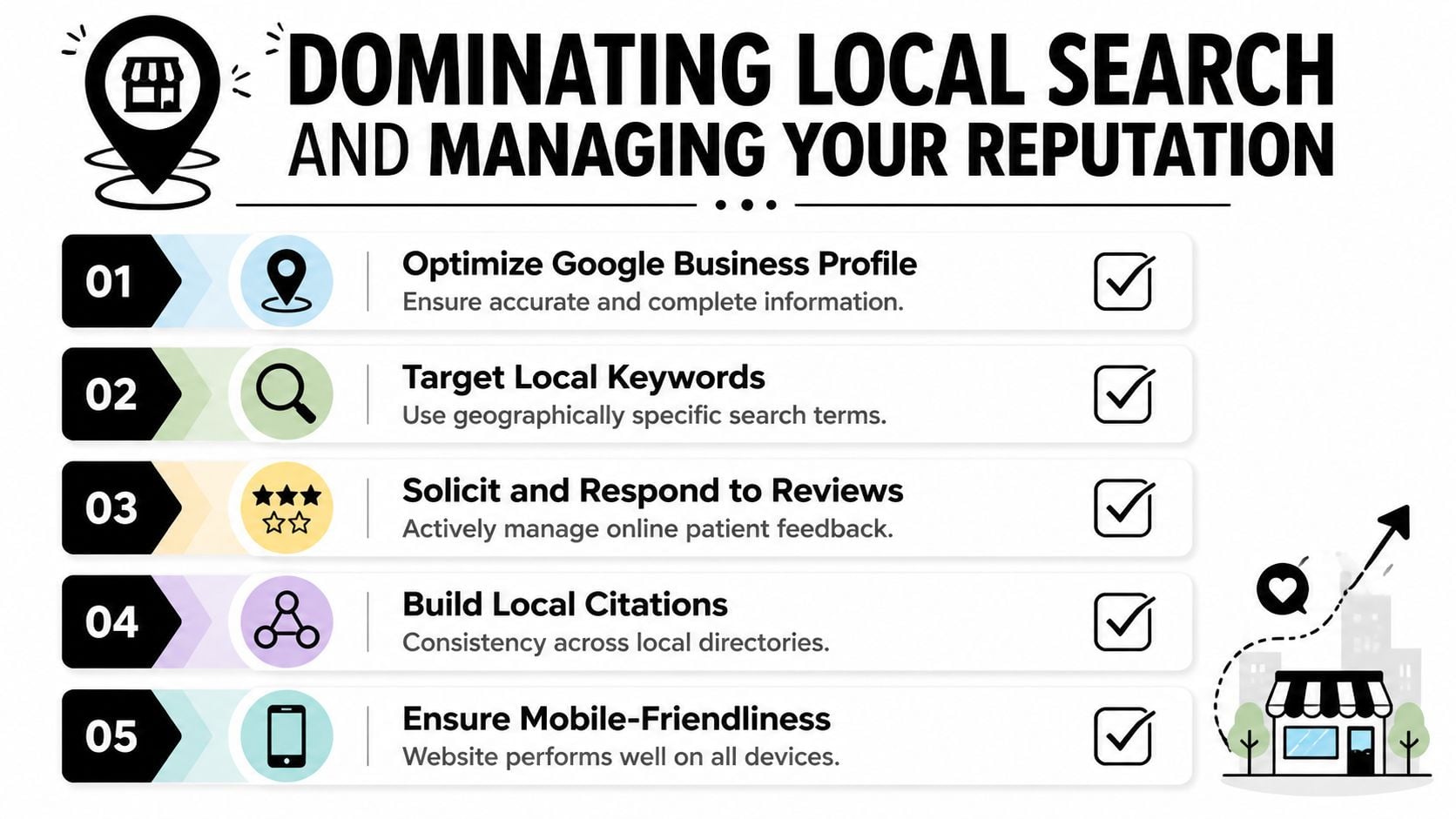
Use this checklist:
- Choose the most accurate primary category. Don't pick a broad category just because it feels bigger. Relevance beats vagueness.
- Complete every service field carefully. Your listed services should align with the service pages on your website.
- Keep name, address, and phone details consistent. Even small differences across listings can create confusion.
- Upload real photography. Exterior shots, reception, treatment rooms, and team images help patients confirm they've found the right place.
- Use posts for timely updates. Short updates can support freshness and answer practical questions.
- Link to the right landing page. Don't always default to the homepage if a service page is the better match.
For a wider look at location-based optimisation, this guide on local SEO for businesses covers the practical building blocks.
Reviews and local consistency
Reputation management in medical settings needs tact. You can't treat reviews like a restaurant would, and you shouldn't pressure patients into public feedback. But you can create ethical review processes.
That usually means asking at the right moment, making the path simple, and never discussing personal health details in a public response.
A good review workflow includes:
Train front-desk staff on when to ask
Timing matters. The request should feel natural, not scripted.Make the review path easy
Send patients to the correct profile, not a generic search page.Respond professionally
Thank positive reviewers briefly. With negative feedback, stay calm, avoid clinical specifics, and move the conversation offline.
Local search habit: Clinics often obsess over homepage rankings while neglecting the listing most patients see first. The profile needs the same care as the website.
The other half of local SEO is citation consistency. Your clinic's name, address, phone number, and website should match across your own site, your Google profile, and important directories. Inconsistent details weaken confidence. They also create unnecessary friction for patients trying to call or find information.
Local SEO works when the clinic looks settled, current, and easy to verify. The more a patient has to second-guess your details, the less likely they are to book.
The Future of Medical Search and Ongoing Success
A lot of medical SEO advice is still built around one assumption: if you rank your pages for the right keywords and earn enough links, you'll stay visible. That assumption is getting weaker.
Search is shifting toward AI-generated summaries and answer layers that sit above traditional blue links. For healthcare practices, that matters because patients often start with condition-based or specialist-based queries.
Why keywords alone are no longer enough
A 2026 study of UK healthcare queries found that 42% of patient searches for terms such as “knee pain specialist Dorset” now return AI-generated summaries, while 89% of UK medical SEO content still focuses solely on traditional Google ranking factors. Treated as a projection for 2026, that's a warning sign for any clinic relying on an old SEO playbook.

If your site only targets isolated keywords, it may still rank for some searches. But it becomes easier for AI systems to summarise broader topic coverage from more organised, more authoritative websites.
That means clinics need to think in topics and entities, not just phrases.
How to build topic authority for AI search
An effective response isn't to chase every new platform. It's to structure your expertise more clearly.
Start with your core clinical areas and build connected content around them:
- Create a central service page for the treatment area
- Support it with condition pages that answer adjacent patient questions
- Link named practitioners directly to those pages
- Add FAQs that address practical concerns and pre-appointment friction
- Keep terminology consistent across page titles, headings, and internal links
That creates what many marketers now describe as a content hub. In plain terms, it means your site stops looking like a stack of unrelated pages and starts looking like a coherent body of knowledge.
Ongoing success in SEO for medical websites also depends on steady maintenance. Not constant reinvention. Just disciplined upkeep.
A sensible clinic checklist looks like this:
| Ongoing task | Why it matters |
|---|---|
| Review practitioner pages | Staff, registrations, and roles change |
| Update service pages | Treatments and wording evolve |
| Check local profile accuracy | Hours and contact details drift over time |
| Improve internal linking | New pages need context and support |
| Refresh older FAQs | Patient concerns change with demand and seasonality |
The clinics that stay visible usually aren't the ones making dramatic SEO moves every month. They're the ones that keep their information accurate, their authority visible, and their site organised around what patients are trying to understand.
If your clinic website needs stronger visibility, cleaner technical foundations, or a more credible structure for medical SEO, DesignStack can help you tighten the parts that matter most. From website rebuilds to content structure and local SEO support, they work with UK businesses that need a site that looks professional and performs properly.



Leave a Reply