Freelance Graphic Designer Near Me: A UK Hiring Guide
You’re probably here because a real job needs doing. A brochure has to go to print. Your logo suddenly looks dated next to a competitor’s. Your website graphics no longer match the business you’ve become.
Then you search freelance graphic designer near me and get buried in marketplace profiles, overseas listings, portfolio sites, and advice written for American buyers. It is hard to tell who is local, who is good, and who will still answer the phone once the invoice is paid.
That confusion is normal. Hiring design support for the first time is rarely about finding the “best-looking” work. It is about finding someone who can understand the brief, stay organised, handle feedback well, and deliver files you can use. For many UK businesses, especially in places like Dorset, local fit still matters more than people think.
Why Hiring a Local Designer Still Matters in 2026
The common assumption is that design is fully global now, so location no longer matters. For some jobs, that is partly true. If you need a one-off social media graphic with a tight brief, you can often work with someone anywhere.
But that logic breaks down when the job affects your brand, your website, your signage, your printed material, or how customers recognise you locally.
A local designer brings context. They understand how your business appears in Weymouth, Dorchester, Portland, Bournemouth, or the wider South West. They know that a farm shop, solicitor, café, trades business, tourism brand, or membership organisation all need different visual priorities. They can also sit in a room with you, look at packaging samples, compare print stocks, or review a homepage on a laptop together without losing a day to back-and-forth emails.
Most online advice is not written for UK buyers
One of the biggest problems with this search is that the available information is often built around US markets. For example, US-focused freelance design data cites 265,900 graphic designers nationally, but offers no equivalent local picture for places like Dorset. That leaves UK business owners trying to make decisions with the wrong context.
So when a search result tells you what a designer “should” cost, how long a logo project “normally” takes, or what platform to use, check whether it reflects a UK buying process. Often it does not.
What local collaboration fixes
Local hiring does not magically make a designer better. It does make some problems easier to solve.
- Briefing gets clearer: You can explain the business in plain language, show examples in person, and reduce misunderstandings.
- Timelines become more realistic: Shared working hours matter when a print deadline is close or a launch date moves.
- Accountability improves: A local professional depends on reputation in the same business community.
- Support is easier after launch: Small fixes, replacement files, resized artwork, and follow-up jobs are simpler when the relationship stays active.
Tip: If you are searching locally because you want fewer surprises, trust that instinct. Convenience is not the only reason to hire nearby. Clarity and accountability are usually worth more than a slightly cheaper quote.
There is also a strategic reason to stay local. Businesses that want stronger visibility in local search often benefit when branding, website presentation, and Google Business Profile assets line up properly. If your next design hire may affect that, it is worth reviewing how your business appears locally before you brief anyone. Design and local presence are closely linked, especially for service-led firms. A useful place to start is this guide to Google Business Profile optimisation.
Where to Find Your Local Design Talent
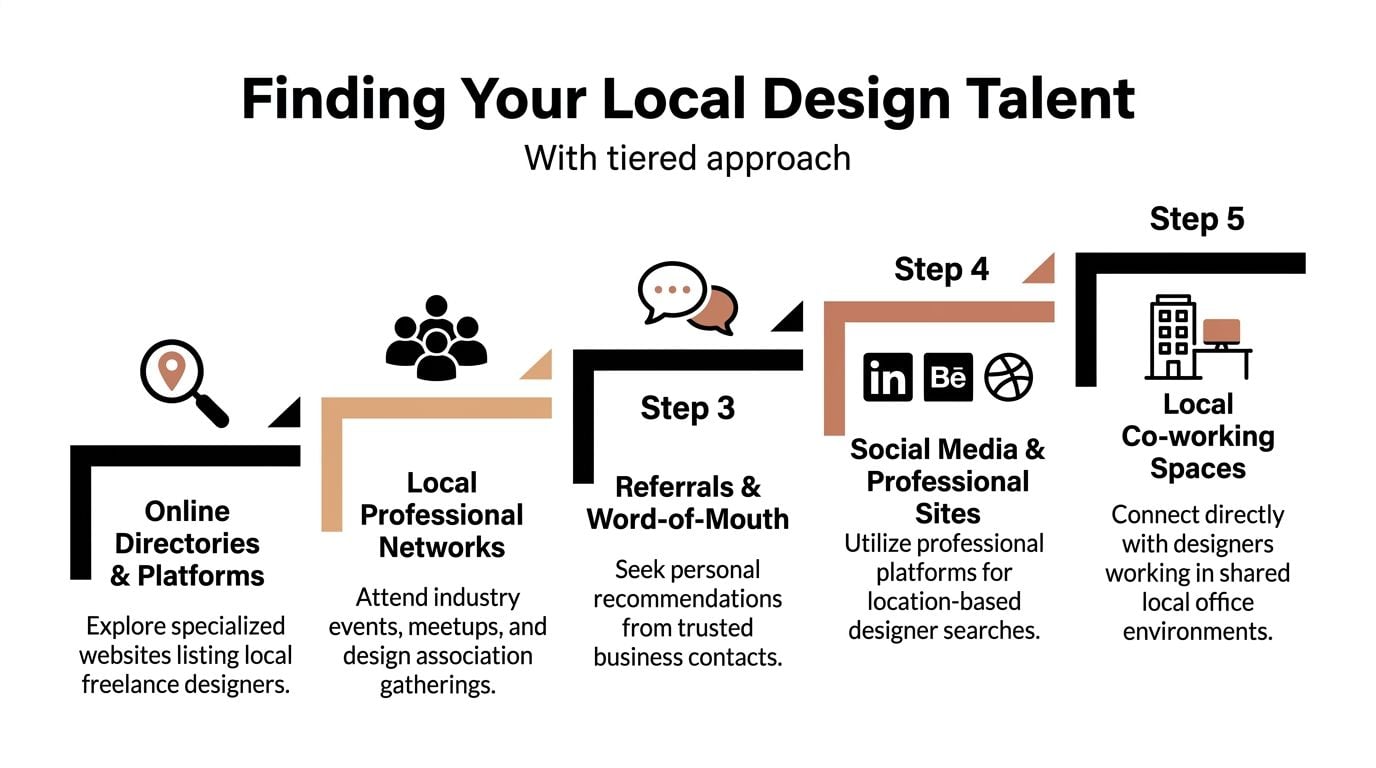
If you type freelance graphic designer near me into Google, do not stop at the first directory result. Start narrow, then widen the search only if the local pool is too thin.
A focused local search can work better than browsing giant platforms. Data cited by Adobe shows that searching for a local term such as “graphic designer Weymouth” can produce 40% higher match rates than browsing broad national platforms.
Start with the obvious local signals
A lot of good freelancers are easier to find than people expect. They may not be spending heavily on ads or pushing themselves on every platform.
Try these first:
Google with place names included
Search for terms like “graphic designer Weymouth”, “branding designer Dorset”, “brochure designer Dorchester”, or “logo designer near me”. Add the actual service you need. A logo specialist and a print designer are not always the same person.Check Google Business Profiles
Look at review quality, not just star ratings. You want signs of responsiveness, reliability, and repeat work.Ask local business owners who they used
Referrals cut through a lot of noise. Ask who designed the menu, van livery, website graphics, annual report, or event materials. Then ask one more question: would they hire them again?Use local networks
Chamber groups, business meet-ups, coworking spaces, and local Facebook or LinkedIn groups often surface people who have already worked with nearby firms.
Use platforms, but filter hard
Platforms can help if your local search is too limited. The mistake is treating them like a shopping catalogue.
Use them as a shortlist tool, not a decision tool.
- Bark and PeoplePerHour: Useful if you want multiple quotes quickly.
- Behance and Dribbble: Better for visual discovery than due diligence.
- LinkedIn: Good for checking whether someone looks established, active, and connected to real businesses.
- Upwork: Broad reach, but you will need a stricter brief and more screening.
When you search these platforms, filter by location where possible. If location filtering is weak, use your brief to state that you prefer someone in Dorset or within practical travel distance for meetings. That alone changes who responds.
What to search for instead of just “graphic designer”
Broad searches produce broad results. Narrow searches produce better candidates.
Try terms tied to the actual problem:
- Brand identity designer
- Packaging designer
- Brochure and print designer
- WordPress website designer
- Menu designer
- Exhibition graphics designer
- eCommerce product graphics designer
A specialist often shows stronger judgement in that category than a generalist with a mixed portfolio.
Build a shortlist the right way
Aim for a shortlist of three to five candidates. More than that usually creates noise, not clarity.
Here is the practical filter I use:
- Relevant work first: Ignore beautiful projects that do not resemble your kind of job.
- Real-world applications: Look for signage, packaging, printed items, website pages, ad creatives, brand guidelines, or social posts shown in use.
- Consistency: One nice logo means little. A designer who can carry a visual system across different materials is usually the safer hire.
- Writing quality: Portfolio copy matters. Clear explanation usually signals clearer thinking.
If you are also weighing website support alongside graphic design, this guide on working with web page designers near you helps sharpen the shortlist.
Places many buyers overlook
Some of the strongest local hires do not dominate search results. Look in less obvious places:
| Channel | Why it helps | What to check |
|---|---|---|
| Local printers | They often know which designers supply clean files | Ask who sends press-ready artwork consistently |
| Sign makers | They work with branding files in practice | Check whether the designer understands scale and legibility |
| Photographers | They often collaborate on launches and rebrands | Ask who was easy to work with under deadlines |
| Event organisers | They see who handles banners, flyers, programmes, and sponsor assets well | Look for calm delivery, not drama |
| Copywriters | They know who can turn words into a coherent layout | Ask who takes direction well |
Key takeaway: The best local designer is rarely the one with the slickest profile. It is usually the one whose work fits your job, whose process sounds organised, and whose past clients would recommend them without hesitation.
How to Read a Portfolio and Spot Real Talent
A polished portfolio can mislead first-time buyers. Mock-ups look impressive. Fancy presentation helps. Neither proves the designer can solve your problem.
You are not trying to hire the person with the prettiest Instagram feed. You are trying to hire the person who can take a brief, make sound decisions, and give you usable assets at the end.
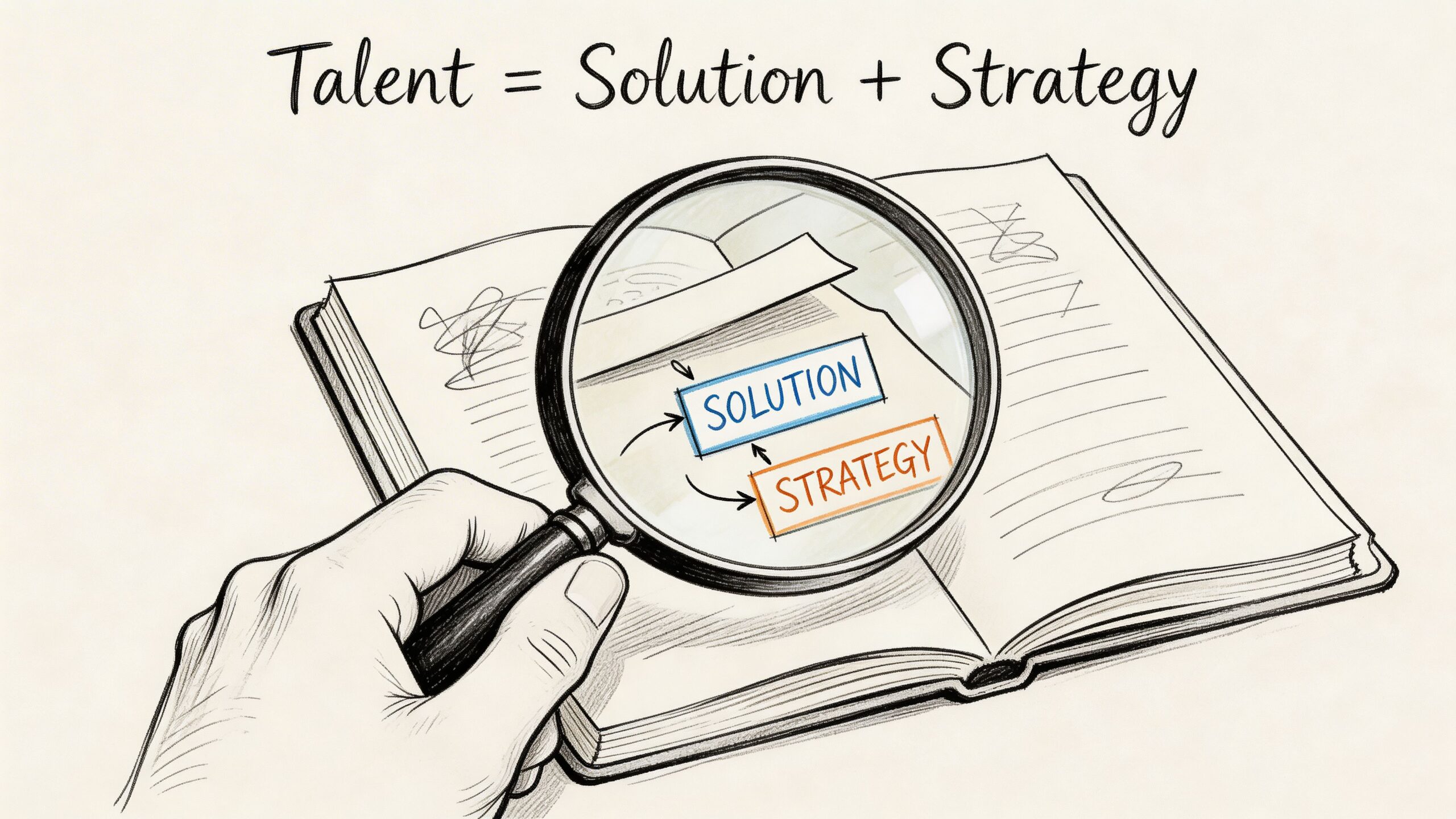
The first thing to know is that vetting matters more than most clients realise. Data cited by Wave notes that an estimated 50% of UK freelancers struggle with client acquisition because their profiles are generic and unspecialised. That means plenty of portfolios will look broad, polished enough, and still tell you very little about whether the designer is right for your job.
Read for thinking, not decoration
A strong portfolio answers questions without you having to chase them.
Look for signs the designer can explain:
- what the client needed
- what constraints existed
- what choices were made
- how the design system was applied
- what deliverables were produced
If a portfolio only shows isolated images with project names, be careful. You may be looking at taste, not process.
What good portfolio evidence looks like
A useful portfolio usually contains a mix of visuals and context. Not every freelancer writes deep case studies, but the stronger ones give you enough detail to judge competence.
Here is what to scan for.
Branding work
For logo and identity projects, do not stop at the logo mark.
Check whether the portfolio includes:
- Logo variations such as stacked, horizontal, icon-only, and single-colour versions
- Typography choices that feel deliberate rather than random
- Colour systems that can work across print and digital
- Application examples such as business cards, signage, packaging, or social templates
- Brand guidelines or at least evidence of consistency
A logo shown only on glossy mock-ups tells you very little. A logo shown on a shop sign, takeaway menu, van, website header, and invoice template tells you far more.
Print design
Print separates experienced designers from hobbyists very quickly.
Look for work that suggests they understand:
- bleed and trim
- margins and hierarchy
- legibility at size
- image quality
- multi-page layout
- consistency across a set of materials
If you need brochures, leaflets, menus, packaging, or event collateral, ask to see real printed work or at least flat artwork examples. Mock-ups can hide weak layout decisions.
Digital design
For website graphics or digital brand assets, check if the design still works when stripped of animation and effects.
Strong digital portfolio pieces show:
- clear hierarchy
- deliberate spacing
- sensible use of calls to action
- responsive thinking
- visual consistency with the wider brand
A homepage concept can look attractive and still fail as a business tool. You want structure, not just style.
Questions a portfolio should answer unprompted
When I review work, I look for whether the designer has already answered these questions through the portfolio itself:
| Question | Why it matters |
|---|---|
| Can they work in more than one style? | You want adaptability, not a one-style shop |
| Can they keep a system consistent? | Real projects involve repeatable assets |
| Can they design for practical use? | Files need to work on paper, screens, signs, and social |
| Can they organise information? | Good layout is not just aesthetic |
| Can they finish things properly? | Delivery quality matters as much as concept quality |
If you want to compare that against examples of finished commercial work, a well-curated design portfolio is useful for seeing how presentation and application should come together.
Watch how they talk about revisions
A portfolio shows finished work. It does not show what the designer is like when you disagree with them.
That is where conversation matters. Ask a candidate to walk you through one portfolio project and explain what changed from the first concept to the final version. Listen for whether they sound defensive, thoughtful, or vague.
A professional designer can explain trade-offs. They can tell you why one option was dropped, how feedback changed the outcome, and what they would improve next time.
Here is a useful explainer on evaluating design thinking in practice:
Use a paid test when the project matters
If the brief is substantial, a small paid test can save a lot of money later.
Keep it modest. Ask for something like:
- one social graphic in your existing brand
- a flyer cover concept
- a homepage hero section
- a single product sheet layout
Pay for that time. You are not looking for free ideas. You are testing communication, responsiveness, judgement, and how well they interpret a brief.
Practical tip: A paid test works best when you assess the process, not just the output. Did they ask smart questions? Did they follow the brief? Did they supply files neatly? Did they take feedback without turning it into a drama?
Warning signs buyers miss
Some portfolio issues are easy to overlook.
Be wary if you see:
- work that all feels visually similar, regardless of industry
- no explanation of deliverables
- mock-ups only, with no flat artwork
- obvious trend-following without much structure
- no sign of long-term or repeat client work
- unclear authorship in agency or team projects
The safest hire is not always the flashiest one. It is often the designer whose work still holds up when you remove the presentation tricks and focus on decisions.
Key Questions to Ask and What to Expect on Pricing
Most bad design hires go wrong before any design starts. The brief is thin, the quote is vague, the revision process is unclear, and both sides assume they mean the same thing when they do not.
The interview stage is where you avoid that.
Ask questions that expose process
You are not interviewing for charm. You are checking how the designer thinks, communicates, and manages work.
Use questions like these:
| Question Category | Sample Question | What to Listen For |
|---|---|---|
| Process | How do you take a project from brief to final delivery? | A clear step-by-step process, not vague improvisation |
| Feedback | How do you handle critical or conflicting feedback? | Calm problem-solving, not defensiveness |
| Briefing | What do you need from me before you begin? | A proper asset and information checklist |
| Deliverables | What files will I receive at the end? | Specific file types and practical explanation |
| Revisions | How do you structure revision rounds? | Clear limits and a method for collecting feedback |
| Communication | How often do you update clients during a project? | Predictable communication habits |
| Suitability | Which parts of this brief fit your strengths best? | Honest self-awareness |
| Timelines | What usually causes delays on projects like this? | Realistic answers that include client-side delays |
| Ownership | When does usage or ownership transfer? | Confidence on rights and handover terms |
| Aftercare | Do you offer support once the project is complete? | Boundaries, plus some form of practical follow-up |
A good answer is specific. A weak answer sounds like “it depends” without giving you a framework.
The pricing question most buyers ask badly
Do not ask, “What do you charge for a logo?” as if there is one market price. A logo can mean a quick mark supplied as a PNG, or a full identity system with usage rules, colour variants, typography, templates, and rollout assets.
Ask instead:
- What is included in that fee?
- How many concepts are included?
- How many revision rounds?
- What final files do I receive?
- Is rollout support included?
- Is copywriting, print liaison, or stock sourcing included?
Those answers matter more than the headline number.
What pricing looks like in the UK and South West
There is no perfect rate card, but there is a useful benchmark. Data cited by Thumbtack indicates that UK freelance graphic designers earn a median of £25 to £35 per hour, while rates in Dorset and the South West can average 15% to 20% lower.
That does not mean the cheapest local quote is the best value. It often means you need to look harder at what is missing.
Hourly pricing
Hourly pricing can work well for:
- ongoing design support
- small updates
- monthly marketing assets
- ad hoc website graphics
- artwork amends
It can work badly when the brief is fuzzy. If the scope is unclear, hours drift.
Fixed project pricing
Fixed pricing suits:
- logo and identity projects
- brochures
- packaging
- campaign asset bundles
- defined website page design work
This model is usually easier for a small business to budget for. It also forces both sides to define deliverables.
Tip: Fixed project pricing only works when the scope is written properly. If the brief says “branding package” without listing actual deliverables, the number means very little.
What affects the quote
Two designers can quote very different figures for the same request and both can be acting reasonably.
The price often changes because of:
- complexity of the brief
- speed required
- number of stakeholders
- whether copy is supplied
- amount of research needed
- number of formats and variations
- print prep or handover support
- file organisation and documentation
A careful, experienced designer may cost more because they include thinking time, cleaner delivery, and fewer avoidable mistakes. A cheaper designer may still be the right fit for a simple job, but only if the job is simple.
A simple way to compare quotes
When three quotes land in your inbox, compare them line by line.
Use this checklist:
- Scope: Are the deliverables clearly named?
- Concept stage: How much exploration is included?
- Revisions: Is there a clear cap?
- Files: Will you receive editable source files?
- Timeline: Is the schedule realistic?
- Meetings: Are calls or in-person sessions included?
- Usage rights: Are they addressed in writing?
- Aftercare: Is any support included after sign-off?
The quote you want is rarely the cheapest one. It is the one that removes the most ambiguity for a fair fee.
From Handshake to Hired Contracts and Onboarding
A friendly agreement is not enough. Even if the designer came recommended by someone you trust, the project should still be documented properly.
Good contracts protect both sides. They reduce memory-based disputes, stop scope creep, and make awkward conversations less likely.
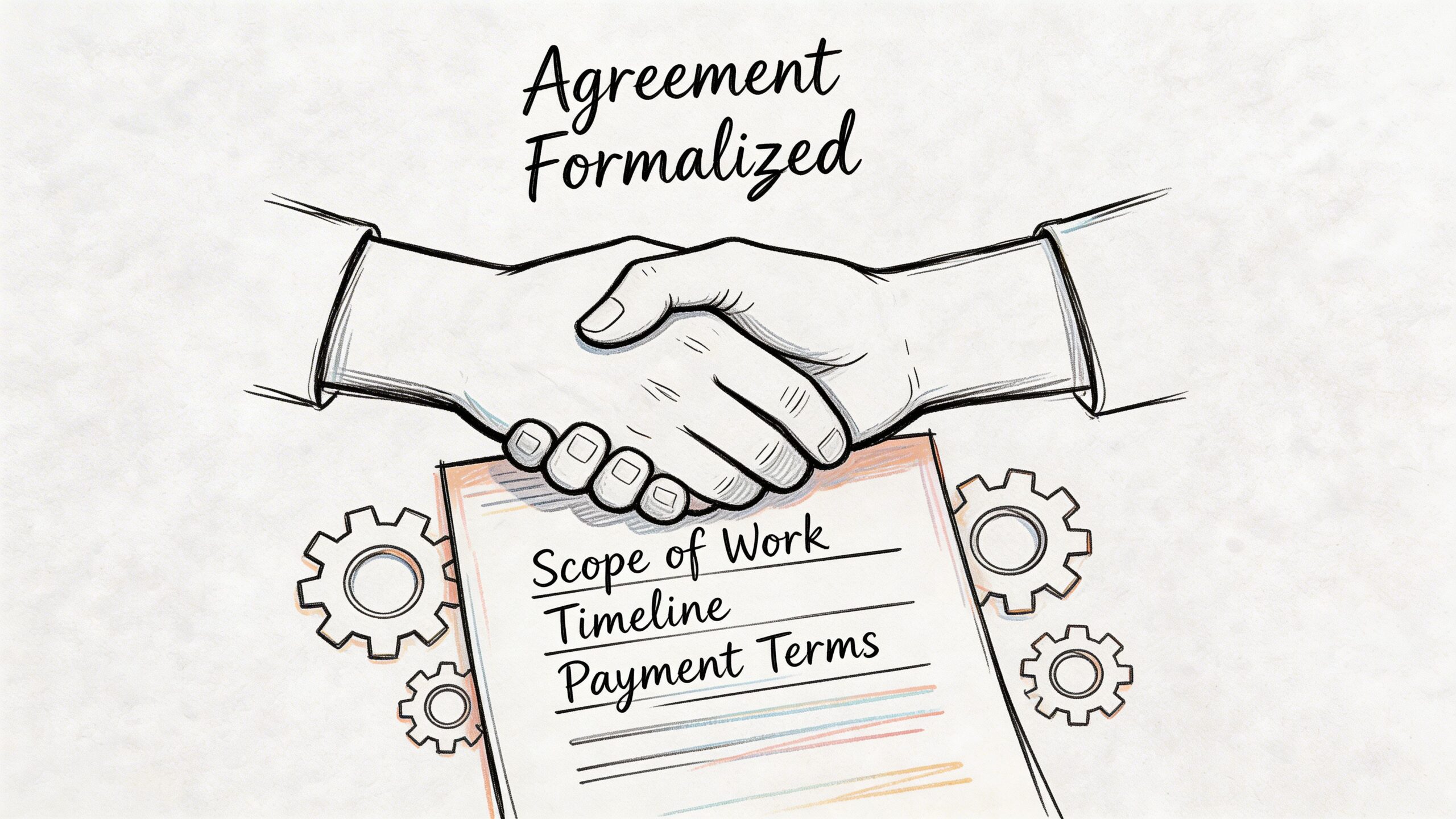
What the contract must cover
A solid freelance design contract should state the basics in plain English.
Include these points:
Scope of work
List each deliverable clearly. “Branding” is too vague. “Primary logo, secondary logo, icon, colour palette, typography selection, business card artwork, social profile image” is far better.Revision terms
State how many rounds are included and what counts as a revision. Without this, clients keep tweaking and freelancers keep charging, often without either side handling it well.Payment terms
Set deposit amount, stage payments if needed, due dates, and late payment terms.Timelines and dependencies
Include who is responsible for supplying copy, images, approvals, and feedback.Ownership and usage
Clarify when rights transfer and whether any third-party assets have separate licences.Termination terms
If the project pauses or stops, both sides need to know what happens next.
If you need a starting point, this freelance contract template UK is a useful reference for structure and wording.
Onboarding should be simple and tidy
The best projects usually start with boring admin done well.
Before the first proper design session, set up:
| Item | What to include |
|---|---|
| Shared folder | Existing logo files, fonts, images, copy, brand colours, previous materials |
| Main contact | One person who collects internal feedback |
| Communication channel | Email, Slack, Teams, or a project board |
| Approval process | Who signs off each stage |
| Live brief | Goals, audience, constraints, examples, deadlines |
That one-time setup prevents weeks of confusion.
Make the kick-off meeting do real work
Do not use the first meeting to repeat the brief. Use it to resolve open questions.
A productive kick-off should confirm:
- business goals
- target audience
- mandatory content
- format requirements
- examples you like and dislike
- approval order
- launch or print deadline
Key takeaway: The smoother the onboarding, the better the design work tends to be. Designers make stronger decisions when the brief, assets, contacts, and timeline are all settled before concept work begins.
Keep feedback controlled from day one
The fastest way to derail a project is to let five people send separate feedback in different places.
Choose one method. One document, one email thread, or one approved project board. Ask the business to consolidate comments before sending them on. This keeps revisions coherent and reduces contradictory instructions.
Professional design projects do not need heavy bureaucracy. They do need a clean paper trail.
When to Choose a Local Agency Like DesignStack
Freelancers are a good fit for many jobs. A capable one can handle logos, brochures, campaign graphics, packaging, and even ongoing design support very well.
But some projects stop being a freelancer job once complexity rises.
Agency makes more sense when the work spans disciplines
If your project combines brand strategy, website design, development, SEO input, content structure, hosting considerations, and post-launch support, you are no longer buying a single creative task. You are buying coordination across several moving parts.
That is where an agency setup often wins.
You get:
- one accountable process
- broader capability under one roof
- backup if someone is unavailable
- clearer timelines across multiple tasks
- a more stable support structure after launch
Long-term support changes the buying decision
A lot of businesses do not just need files. They need continuity.
That may mean:
- new landing pages after launch
- print updates every quarter
- campaign graphics tied to web pages
- technical fixes alongside design changes
- someone to keep the brand consistent over time. Here, the trade-off becomes clear. A freelancer may be flexible and cost-effective for standalone work. An agency is often safer when the relationship needs to continue beyond the first deliverable.
Local support matters more after launch than before it
The design phase gets all the attention. The support phase is where many buyers feel the difference.
As noted earlier, local partnerships tend to produce higher satisfaction than remote ones, largely because communication is simpler and support is easier to maintain. That matters when something small but urgent appears after launch and you need a quick answer, not a vanished contact.
Practical rule: Choose a freelancer when the brief is focused and self-contained. Choose an agency when the project affects several parts of the business at once, or when you know you will need dependable support after the initial job is delivered.
The right choice is not about status. It is about matching the structure of the supplier to the complexity of the job.
Your Graphic Design Hiring Questions Answered
Do I need a graphic designer, a brand designer, or a web designer
It depends on the job. A graphic designer usually handles visual assets across print and digital. A brand designer focuses more on identity systems, logo work, visual rules, and consistency. A web designer focuses on page layouts, user journeys, and on-screen experience. Some people do all three, but do not assume they do each one equally well.
How many revisions are normal
A limited number of revision rounds is standard. What matters is that the quote defines them clearly. Endless revisions usually mean the brief was weak, too many people are giving feedback, or the designer has not controlled the process properly.
Should I expect editable files
Yes, if that is part of the agreement. Ask for this before you hire. It is common to receive final export files for use, but source files such as Illustrator, InDesign, Photoshop, or Figma files should be discussed explicitly.
Who owns the design when the project ends
That should be stated in the contract. Usually, ownership or usage rights transfer once final payment is made, but the exact wording matters. Also ask whether any stock assets, fonts, or licensed elements have separate restrictions.
What files should I receive for a logo project
Ask for practical formats for both print and digital use. That often includes vector files and standard export formats, plus colour and mono versions. If you do not know what to request, ask the designer to list the handover files in the quote.
Is local still worth it if the designer works remotely most of the time
Yes, if they still understand your market, keep sensible communication hours, and can meet when needed. “Local” is not only about sitting in an office nearby. It is about accessibility, context, and accountability.
If you want a Dorset-based team that can handle branding, graphic design, web design, and ongoing support in one place, DesignStack is worth a look. They work with businesses that need clear communication, fixed-cost projects, and reliable follow-through after launch.