

How Much Do Branding Agencies Charge? UK Price Guide 2026
Branding work for UK businesses rarely comes in under a few thousand pounds. A basic identity package often sits around £2,500 to £5,000, a fuller brand identity with strategy and guidelines commonly falls into £5,000 to £25,000, and broader agency-led branding projects can run much higher depending on scope.
If you're a business owner in Dorset trying to budget for a rebrand, that's probably the part that's driving you mad. One quote looks close to the cost of a laptop. Another looks closer to a small van. Both say "branding", yet they clearly aren't selling the same thing.
That's the core issue. Branding isn't a single product with a single market price. A cheap logo is one narrow design task. A strategic brand investment is the work that helps your business look right, sound right, and stay consistent across your website, signage, packaging, sales material, and day-to-day customer experience.
A Weymouth café, a Poole trades business, and a Dorset eCommerce brand might all ask for "branding" and need completely different levels of work. One may only need a tidier visual identity. Another may need a proper repositioning, sharper messaging, and a system that works on menus, vans, uniforms, and social posts. That difference is what creates the spread in agency pricing.
Table of Contents
- Untangling the Big Question on Branding Costs
- The Three Ways Branding Agencies Charge for Their Work
- What Are You Paying For When You Hire an Agency
- Realistic Branding Budgets for UK Businesses in 2026
- Key Factors That Influence Your Final Branding Quote
- How to Evaluate Quotes and Spot the Red Flags
- Finding the Right Branding Partner for Your Business
Untangling the Big Question on Branding Costs
The short version is that "how much do branding agencies charge?" has no honest single-number answer. The price depends on what you're asking the agency to solve, how much thinking is involved before design starts, and how many places the final brand needs to work.
Clutch's market benchmark is still one of the clearest reference points for buyers. It reports that most branding projects fall within the $10,000 to $49,999 band, which tells you straight away that agency branding is usually a serious business investment rather than a quick logo purchase (Clutch pricing benchmark via Netwave Interactive).
That range sounds wide because it is wide. But it isn't random.
Why prices vary so much
A local firm asking for a logo refresh and a few simple visual rules is buying a different service from a company that needs naming, positioning, tone of voice, customer research, packaging direction, vehicle livery, and a website redesign. Both may use the word "branding". The workload is nowhere near the same.
Here are the biggest differences in plain terms:
- Depth of thinking: A cheap job starts with style. A strategic job starts with market position, customer perception, and what you need the brand to say.
- Number of deliverables: A logo file is one item. A full identity system can include typography, colour rules, image direction, social templates, print assets, and brand guidelines.
- Business risk: If your brand needs to appear on shop signs, brochures, proposals, uniforms, and a new site, mistakes get expensive quickly.
Most small businesses don't actually struggle with the price first. They struggle with not knowing whether the quote covers the work they really need.
If you're still weighing up the difference between identity design and wider brand thinking, DesignStack's brand identity articles are a useful place to get your bearings before you ask for quotes.
The better question to ask
Instead of asking only what branding costs, ask what problem the branding work is solving.
If the problem is "our logo looks dated", the answer may be relatively contained. If the problem is "customers don't understand what makes us different, our materials all look disconnected, and the website doesn't match the business we've become", you're not shopping for a logo. You're shopping for clarity.
That distinction is what separates a low-cost design job from a proper brand investment.
The Three Ways Branding Agencies Charge for Their Work
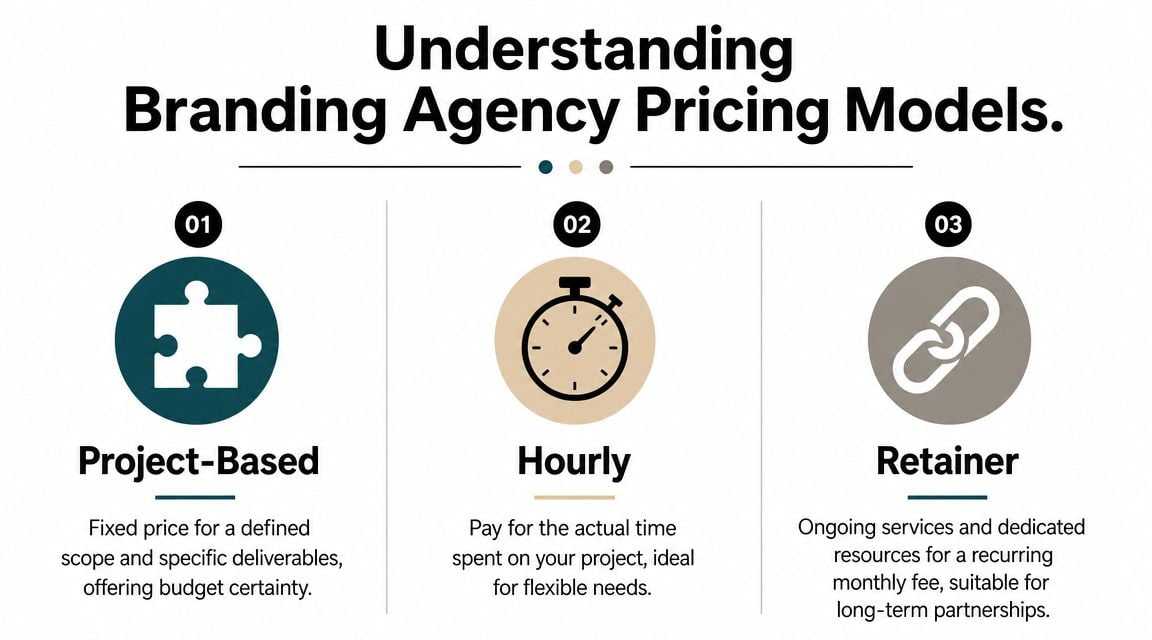
Branding agencies usually structure fees in one of three ways. Project-based, hourly, or retainer. The easiest way to understand them is to think about hiring builders.
If you ask a builder to fit one extra shelf, paying by the hour makes sense. If you're extending the kitchen, you'd probably want a fixed project quote. If you're managing an ongoing property portfolio, a retainer relationship may suit you better. Branding works in much the same way.
Project-based pricing
This is often the best fit for small and medium-sized businesses doing a defined branding job. You agree the scope, deliverables, process, and price up front.
That matters because budget certainty is often more valuable than shaving a little off the headline cost. If you're planning a rebrand alongside a website, print updates, and launch materials, you need to know where the edges are.
- Best for: A launch, rebrand, identity refresh, or packaging of specific deliverables.
- Main strength: You know what you're getting and what you're paying.
- Main risk: If the scope is vague, extra requests can still push cost up.
Hourly pricing
Hourly billing tends to suit smaller pieces of work or jobs where the brief isn't fully defined yet. It can work well for advisory sessions, brand reviews, or extensions to an existing identity.
Market guidance places branding agency hourly rates at £100 to £200, with higher-cost UK and Western Europe work often nearer £150 to £250 per hour (DesignRush branding cost guide).
Practical rule: Hourly pricing is fine for contained tasks. It's a poor fit when you need cost certainty before the work begins.
Retainers
A retainer means you pay an ongoing monthly fee for continued brand support. This is common when branding sits inside a wider marketing relationship and the business needs regular design, rollout, messaging help, or campaign support.
HawkSEM notes that project-based branding fees can range from £7,000 to £150,000, while ongoing support retainers often start around £3,500 per month (HawkSEM agency pricing overview).
That model can be right for a growing business with regular needs, but it isn't always the first step a Dorset SME should take. If you still need to define the core brand, a clearly scoped project often makes more sense before committing to an ongoing arrangement.
For businesses comparing local support with broader digital delivery, it's worth looking at agencies that combine brand and web work under one roof, such as DesignStack's branding and digital marketing services.
What Are You Paying For When You Hire an Agency
A Dorset business owner usually feels the tension at quote stage. One option is a few hundred pounds for a logo from a freelancer or online service. The other is a five figure proposal from an agency that includes strategy, messaging, identity design, and rollout support. On paper, both can sound like "branding". In practice, they solve very different problems.
A cheap logo gives you a graphic. A branding agency is being hired to reduce guesswork.
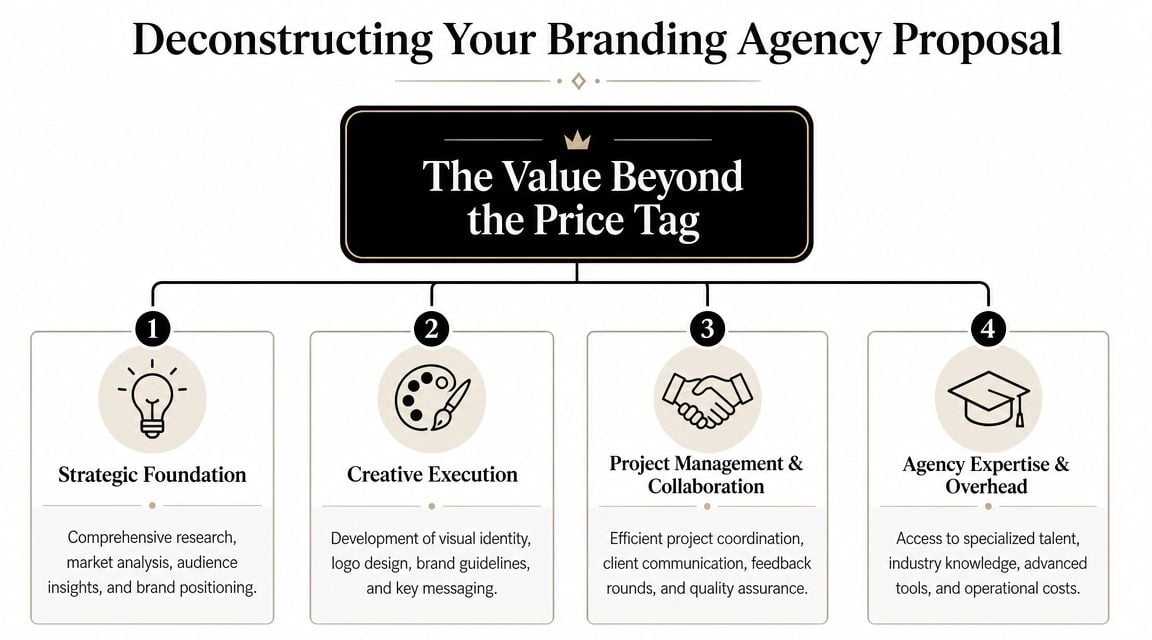
Discovery and strategy
A good agency earns its fee early.
Before any design work starts, the team needs to understand what the business is trying to fix or achieve. That might be a Poole trades firm that wants better quality enquiries, a Bournemouth hospitality brand trying to stand out beyond summer footfall, or a Dorset manufacturer that needs to look credible with larger commercial buyers. Those are different commercial jobs, and they need different brand decisions.
That work often includes stakeholder interviews, competitor review, audience definition, offer clarity, and positioning choices. It is less visible than logo design, but it stops expensive mistakes. Without it, businesses often approve branding that looks tidy yet says nothing clear about why a customer should choose them.
Messaging and brand voice
Plenty of small businesses invest in a new visual identity, then keep using the same vague copy on the website, brochures, sales emails, and social posts. The result is familiar. The business looks more polished but still sounds generic.
Messaging work gives the brand a point of view. It defines the value proposition, the tone, the phrases to repeat, and the language to avoid. For an owner-manager, that means less second-guessing every time a page needs writing or a proposal needs sending. If you want a practical reference for this part of the process, Riff Analytics' brand voice framework is useful because it turns voice into something a business can apply day to day.
A closer look at this side of the process is covered in DesignStack's brand identity development service.
Visual identity and guidelines
This is the part clients expect to see, and it matters. Logo, colour palette, typography, graphic devices, imagery direction, and layout rules all shape how the business is recognised.
The difference is that agency identity work should be built for use, not just presentation. A local café needs branding that works on signage, menus, takeaway packaging, and Instagram stories. A construction firm needs it to hold up on vans, tender documents, workwear, and site boards. A professional services business needs consistency across proposals, LinkedIn graphics, and its website.
Guidelines protect that investment. They give staff, suppliers, printers, and web teams clear rules so the brand does not drift within six months.
Later in the process, video can help explain how identity systems work across channels:
Project management and quality control
This cost is easy to underestimate because it sits behind the scenes.
Someone has to structure the project, run workshops, keep feedback focused, control revisions, prepare usable files, and make sure the strategy, words, and visuals still line up by the end. Without that discipline, projects drag on, internal opinions pull in different directions, and the final result loses coherence.
That is why a professional branding fee can look high compared with a logo-only quote. You are paying for clearer decisions, stronger consistency, and a brand your business can keep using with confidence.
Realistic Branding Budgets for UK Businesses in 2026
If you want a planning figure rather than a theory lesson, UK pricing guidance gives a fairly usable set of bands. A basic identity package often costs £2,500 to £5,000, while a fuller brand identity with strategy and guidelines commonly falls into the £5,000 to £25,000 range. Extensive projects can exceed that when the work expands across channels and teams (UK branding cost tiers from Tenet).
The point isn't to memorise brackets. The point is to match the budget to the job.
A simple way to think about budget levels
A Dorset startup launching a new service doesn't need the same level of branding as an established regional business reworking its entire market position. Here is a practical way to frame it.
| Project Scope | Key Deliverables | Typical Price Range |
|---|---|---|
| Startup essentials | Logo, core visual identity, basic usage rules | £2,500 to £5,000 |
| Small business rebrand | Strategy, messaging direction, visual identity, guidelines | £5,000 to £25,000 |
| Growth-ready brand system | Broader strategic work, extended asset suite, rollout support across multiple touchpoints | Comprehensive projects can exceed this |
Startup essentials
This level usually suits a new business that needs to look credible quickly without building a huge system on day one. Think a local consultant, trades business, independent retailer, or new hospitality venture.
What should you expect here? A clear identity, sensible typography, a practical colour system, and enough structure to keep things consistent. What you shouldn't expect is deep market research, complex naming work, or a large library of launch assets.
That difference matters because some buyers compare a basic identity quote with a full branding proposal and assume one agency is overpriced. Often, they just aren't pricing the same thing.
Small business rebrand
Many established SMEs find themselves in this situation: the business already exists, but the brand no longer reflects the quality of the service, the audience has shifted, or the company has outgrown its original look.
A proper rebrand at this level often includes:
- Strategic review: Positioning, audience clarity, and what needs to change.
- Messaging direction: Core brand statements and a more consistent tone.
- Identity system: Logo refinements or redesign, colours, type, supporting graphics.
- Brand guidelines: Enough rules to help your website, print, and social content stay aligned.
For many firms, this is the smartest middle ground. It gives the business a usable foundation without wandering into enterprise-style complexity.
Growth-ready brand system
Once a business has multiple services, channels, locations, or stakeholder groups, the work becomes broader. The brand may need to perform across packaging, printed sales materials, recruitment, social media, signage, and a more advanced website.
At that stage, costs rise because every decision has more consequences. One typography choice has to work everywhere. One messaging line has to survive internal debate and still make sense to customers.
If your branding needs to work across website, print, packaging, and signage at the same time, you're buying a system, not a logo.
If you're a smaller company trying to set a realistic budget before speaking to agencies, DesignStack's small business branding support is one example of the kind of focused service many SMEs look for when they want clearer scope and fixed project costs.
Key Factors That Influence Your Final Branding Quote
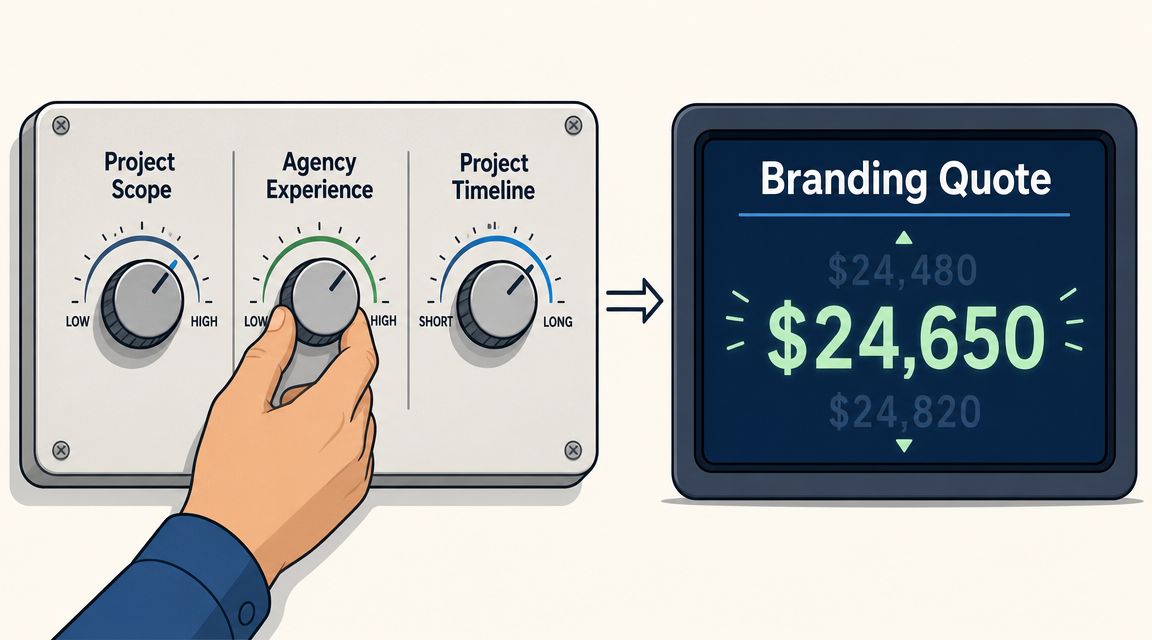
Two agencies can look at the same business and produce very different quotes. That doesn't automatically mean one is wrong. It usually means they have made different assumptions about the scope, the level of strategic input, and how many outputs the business needs.
Scope is the biggest cost driver
A visual tidy-up costs less than a repositioning exercise. A logo and colour palette cost less than a full identity system with rollout support.
The fastest way to control budget is to be precise about what you need now versus later. If the immediate problem is your website and proposals looking inconsistent, solve that first. Don't casually add naming, packaging, signage, social templates, and investor materials unless they're genuinely required.
Adjacent deliverables catch people out
Budgets frequently drift from their initial estimates. A branding quote can look manageable until you realise it doesn't include the assets needed to launch the new identity properly.
UK pricing guidance shows that businesses often underestimate follow-on costs such as website design at £5,000 to £200,000+, visual identity packages at £5,000 to £50,000, and style guides at £2,500 to £10,000 (Ikon on branding and adjacent costs).
That doesn't mean your project will hit the top end of those ranges. It means the actual cost of branding is often the rollout, not the logo concept itself.
Other levers that move the number
- Agency experience: Senior strategic teams tend to charge more because they handle deeper positioning, more complex stakeholder input, and stronger quality control.
- Revision load: The more indecision in the process, the more hours and rounds the job absorbs.
- Timeline pressure: If you need the work turned around quickly to meet a launch, event, or seasonal push, cost can rise.
- Application count: The more places the brand has to live, the more production and checking are required.
A local Dorset business can often save money by narrowing phase one. Get the core strategy and identity right first. Then expand into rollout items in a controlled order.
How to Evaluate Quotes and Spot the Red Flags
Once the proposals arrive, price alone won't tell you much. A lower quote can be excellent value. It can also be a sign that the agency has priced a narrow design task while you think you're buying a broader rebrand.
The strongest proposals usually feel specific. They tell you what the agency will do, what you will receive, how feedback will be handled, and what is not included.
What a good quote usually includes
Look for practical detail, not polished language.
- Clear deliverables: You should see exactly what is being produced, such as strategy sessions, messaging outputs, logo files, guidelines, and rollout items.
- Defined process: Discovery, concepts, revisions, sign-off, and final file delivery should all be mapped out.
- Boundaries: A reliable quote states what falls outside scope so nothing becomes fuzzy halfway through.
- Implementation thinking: If the rebrand touches a website, packaging, or signage, the proposal should show awareness of those real-world uses.
If your business operates in a specialist or trust-sensitive sector, check whether the agency understands category expectations as well. For example, firms in security and technical markets often need clearer positioning and reputation management than a standard lifestyle brand. This guide to cybersecurity public relations is useful reading because it shows how brand credibility, communications, and sector nuance come together in a high-trust field.
Red flags worth taking seriously
A cheap quote isn't automatically a problem. A vague cheap quote usually is.
"If the proposal can't tell you how the agency thinks, it probably won't give you the clarity your business needs."
Watch for these issues:
- Logo-only framing: If your business clearly needs strategy, but the quote talks almost entirely about logo options, you're likely buying surface-level work.
- No discovery stage: Skipping discovery often leads to subjective design rounds and weak positioning.
- Unlimited vagueness: Terms like "branding package" without itemised outputs make comparison almost impossible.
- Pressure selling: If you're pushed to sign fast before you've understood scope, step back.
You should also check whether the agency's previous work matches the level of challenge you have. A team good at simple identity design may not be right for a more complex repositioning project. If you're comparing options, DesignStack's overview of brand identity companies is one route into that wider comparison process.
The right quote won't always be the lowest. It will be the one that solves the actual business problem with the least confusion.
Finding the Right Branding Partner for Your Business
The right branding budget depends on what your business needs the brand to do. If you need a quick visual clean-up, the spend can stay relatively contained. If you need sharper positioning, better messaging, and a brand system that works across your website, print, packaging, and signage, the investment moves up for good reason.
Most business owners don't regret spending money on branding when the work gives them clarity and consistency. They regret unclear scope, weak strategy, and having to pay twice because the first round only delivered a nicer logo.
A good agency should help you simplify decisions, not make them harder. You should come away knowing what is included, what the process looks like, how revisions work, and how the brand will be used after sign-off.
For a Dorset business, local access can help. So can a team that understands the realities of small and medium-sized companies balancing ambition with budget. But location matters less than fit. The useful question is simple. Does this agency understand the problem behind the brief, or are they just pricing artwork?
If you're weighing up a rebrand or trying to understand what a realistic branding investment looks like for your business, DesignStack offers branding, web design, and graphic design from its Dorset base in Weymouth. A practical first step is to ask for a clearly scoped conversation around what you need now, what can wait, and how to avoid paying for a logo when the core issue is brand clarity.
Leave a Reply