Your Guide to a Branding and Digital Marketing Agency
You might be in that awkward middle ground right now. Your business is established enough to know that a logo alone isn't a brand, and a website alone won't bring in steady enquiries. But you're still trying to juggle updates, social posts, search rankings, leaflets, emails, and a website that no longer reflects where the business is heading.
That’s where many Dorset business owners get stuck.
A local retailer might have a loyal customer base in town but weak visibility online. A professional services firm might look polished in person but inconsistent across its website, proposals, and social channels. A growing eCommerce business might be driving traffic, yet still losing sales because the site is slow, unclear, or hard to trust.
A branding and digital marketing agency sits in the gap between where your business is now and how it needs to show up to grow. Not just by making things look better, but by making the whole customer journey work better.
Why Your Business Might Need a Digital Growth Partner
A common story goes like this. You built the business through hard work, referrals, and reputation. That worked for years. Then buying habits changed, competitors improved their websites, and more customers started checking Google before they ever picked up the phone.
Now your marketing feels patchy.
Your logo might be fine, but the website looks dated. Your social posts go out when someone remembers. Your service pages don't explain what makes you different. You may even be spending money on ads or content without being sure what's bringing leads in.
For many SMEs, that point arrives subtly. There isn't one dramatic failure. It's more that growth starts to stall because the digital side of the business hasn't kept up.
In the UK, 72% of overall marketing budgets are now directed towards digital channels, and 63% of UK firms increased digital spend over the past year according to Insivia's digital marketing statistics roundup. That doesn't mean every business should chase every channel. It does mean digital is no longer the optional extra.
What business owners usually notice first
- Enquiries feel inconsistent. Some months are busy, others go quiet, and there's no clear reason.
- Your brand feels muddled. The van signage, brochure, website, and LinkedIn page don't quite look like the same business.
- You're hard to find online. People who already know your name can find you. New prospects can't.
- Your team is improvising. Different people write emails, update pages, or post on social in different tones.
- You’ve outgrown DIY marketing. What got you started isn't enough to support the next stage.
Practical rule: If customers regularly ask questions your website should already answer, your digital presence is making sales harder than it needs to be.
A good agency doesn't replace your knowledge of the business. It brings structure to it. It helps you decide what matters, what can wait, and how each part of your brand and marketing should work together.
That’s the true value. Not more activity. Better direction.
The Two Pillars of Growth Branding and Digital Marketing
Most confusion starts because people use the terms as if they mean the same thing. They don't.
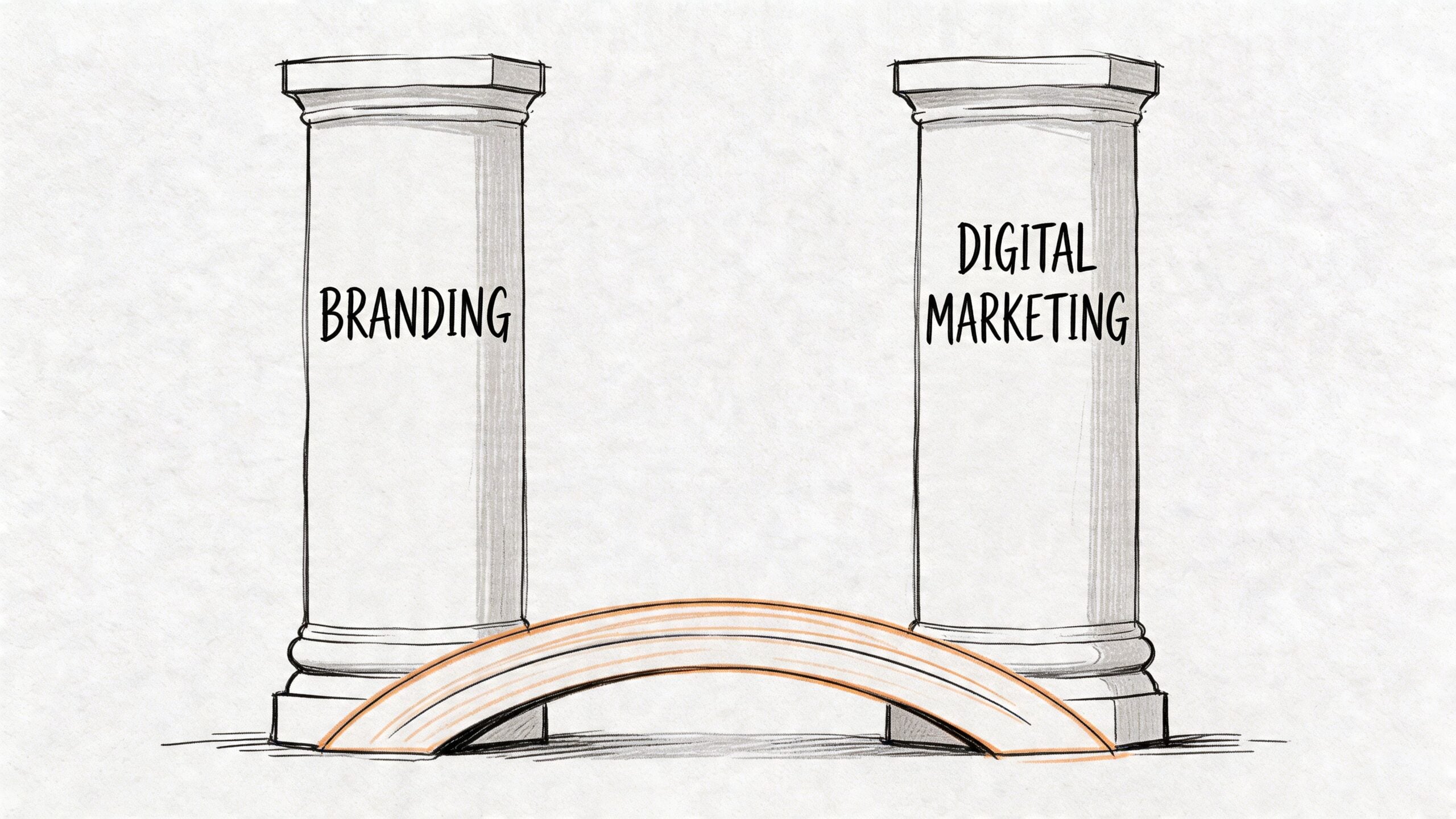
Branding is who your business is. Digital marketing is how you get that business in front of the right people online.
Think of them as two pillars holding up growth. If one is weak, the whole thing wobbles.
What branding actually covers
Branding isn't just the logo. That's the bit people see first, but it's only one piece.
A proper brand includes:
- Positioning. What space you want to own in the market.
- Message. How you explain what you do and why it matters.
- Tone of voice. Whether you sound expert, friendly, technical, bold, or calm.
- Visual identity. Logo, colours, typography, imagery, layout style.
- Consistency. Making sure all of that appears the same across every touchpoint.
If branding is unclear, marketing gets expensive. You spend more time explaining yourself. Your ads, pages, and posts don't connect. People visit the site but don't feel a clear reason to trust you.
That problem is more common than many owners realise. A UK Government report found only 28% of SMEs in South West England track brand equity metrics beyond sales, compared with 45% nationally, which points to underinvestment in the long-term side of brand building according to this analysis on digital brand marketing.
What digital marketing actually does
Digital marketing takes the brand and puts it to work.
That includes search, content, email, social media, paid campaigns, landing pages, reporting, and ongoing improvements. It answers practical questions such as:
- How do people discover you?
- What do they see first?
- What makes them enquire or buy?
- Where do they drop off?
- Which messages bring the right sort of customer?
Without marketing, a strong brand stays hidden. Without branding, marketing may bring attention but not confidence.
A helpful way to picture it is this. Branding is the reason someone remembers you. Marketing is the reason they meet you in the first place.
Why local firms often lean too far one way
In Dorset, I often see two extremes.
One business invests in a nice-looking identity but doesn't support it with search visibility, content, or conversion-focused pages. Another throws money at ads, social posts, and SEO, but the brand underneath feels generic, so the results flatten out.
That’s why services like graphic design for business branding and marketing materials matter most when they’re tied to a wider plan, not treated as isolated jobs.
Some owners also focus only on short-term wins because they’re easier to measure. A lead this month feels real. Brand recognition feels harder to pin down. But both matter.
A short explainer can help make that distinction clearer:
A simple way to balance both
Use this split when thinking about priorities:
- Clarify the brand first. Know what you stand for and how you want to be seen.
- Build the digital assets next. Website, landing pages, profiles, content structure.
- Drive traffic after that. SEO, email, social, paid campaigns.
- Review what the market responds to. Then refine both message and tactics.
Your brand shapes the promise. Your marketing proves it in public.
If you're choosing a branding and digital marketing agency, you're really choosing a partner that can handle both sides without treating them as separate projects with separate logic.
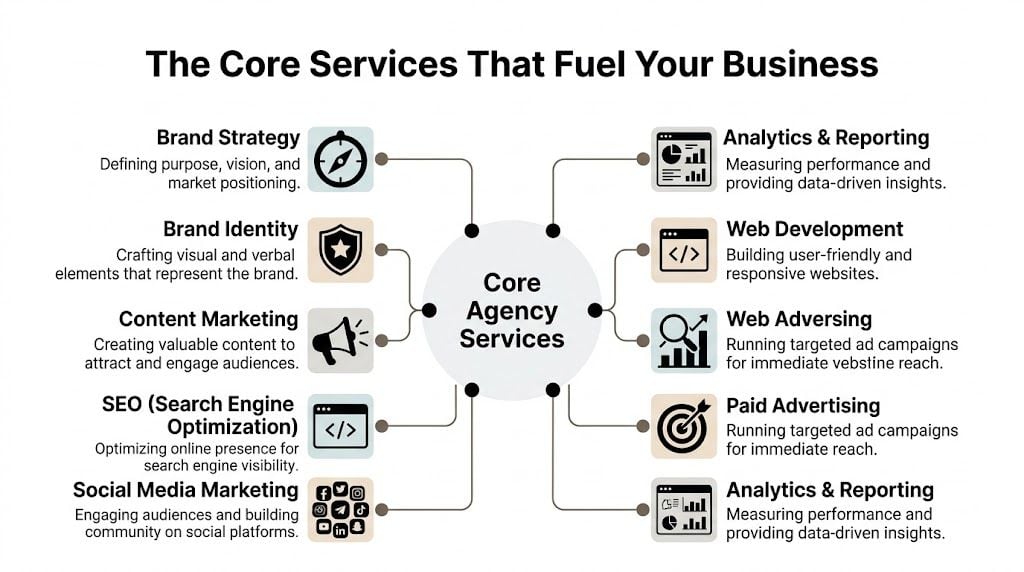
The Core Services That Fuel Your Business
Once the brand and marketing roles are clear, the next question is usually straightforward. What does an agency do day to day?
The answer isn't "everything". A good agency chooses the right tools for the stage your business is in. Some firms need a full rebrand. Others need technical SEO, better landing pages, or a sharper content plan.
This is the core toolkit.
Brand strategy and identity
This is the thinking before the design.
An agency helps define who you serve, how you differ, and what you want customers to associate with your name. Then that strategy gets translated into visible assets like logos, colour systems, typography, imagery rules, presentation templates, signage, and social graphics.
A lot of confusion disappears at this stage. Staff know how to describe the business. Designers know what to create. Customers get a cleaner message.
Website design and development
Your website is usually the centre of the whole system.
It needs to do more than look modern. It must load well, read clearly, work on mobile, guide users toward action, and give you room to grow. For many SMEs, WordPress is a sensible choice because it offers flexibility without locking the business into a rigid platform.
A well-built site should help with things like:
- Trust. Clear pages, good structure, strong visuals, straightforward navigation.
- Conversions. Better contact forms, clearer calls to action, better service explanations.
- Updates. Your team should be able to manage routine content without friction.
- Expansion. New landing pages, blog content, bookings, shop features, or integrations later on.
SEO that supports revenue
SEO gets reduced to "ranking on Google", but that's too narrow.
Done properly, SEO makes your business easier to find when people are already looking for what you sell. That includes page structure, copywriting, internal links, metadata, technical fixes, site speed, schema, and content planning.
For UK SMBs, improving Core Web Vitals correlates with a 24% increase in conversion rates, while structured data can lift click-through rates from Google by up to 30%, according to DesignRush's overview of digital marketing agencies.
That matters because technical issues aren't just technical. They affect sales.
If a service page loads slowly on mobile, or if Google can't properly interpret the page, fewer people visit and fewer still enquire. That's why businesses often invest in focused work such as search engine optimisation for stronger online visibility.
A slow, confusing website doesn't just rank worse. It makes good traffic less valuable.
Content marketing
Content gives people reasons to stay, trust, and come back.
That can mean service pages, location pages, blog articles, email sequences, guides, FAQs, downloadable resources, and product copy. The purpose isn't to publish for the sake of it. It's to answer real questions customers have before they buy.
For a Dorset accountant, content might clarify tax deadlines and common bookkeeping mistakes. For a retailer, it might explain product ranges, delivery details, and buying advice. For a trades business, it may show project types, process, and service areas.
Social media and paid campaigns
Social media is where many firms either overdo it or avoid it completely.
You don't need to be everywhere. You do need the right presence in the right places, with a clear purpose. Sometimes that means regular organic posting. Sometimes it means paid social campaigns with a defined offer. Sometimes it means using social mainly as proof that the business is active and credible.
Paid advertising adds speed. SEO and content often build over time. Ads can generate visibility faster, test offers, and support launches, promotions, or seasonal demand.
eCommerce and conversion work
If you sell online, the agency role expands.
Now it's not just about traffic. It's product organisation, category structure, checkout friction, shipping information, trust signals, photography, email flows, and post-purchase follow-up. Small changes in product pages, copy, or site speed can affect whether visitors complete the order.
Behind the scenes, tools also matter. If you're comparing systems for campaign reporting, workflow management, and ad operations, a practical overview of specialized advertising agency software can help you understand what agencies use to keep delivery organised.
Analytics and reporting
A modern agency should tell you what happened, not just what was done.
That means tracking enquiries, form submissions, calls, downloads, bookings, page performance, and campaign behaviour in a way the business owner can understand. Not a giant spreadsheet with no interpretation.
Useful reporting usually answers four things:
- What changed
- Why it likely changed
- What it means for the business
- What should happen next
Mobile apps and custom systems
Not every business needs an app. Some do.
If your customers book repeatedly, manage accounts, place regular orders, or need member access, a custom app or online system may make sense. The same goes for internal tools that save staff time.
That's where a broader digital partner can be useful. Some agencies handle branding, website work, SEO, hosting, and app development under one roof. DesignStack, for example, offers WordPress builds, branding, hosting, and iOS/Android app development as part of a connected service set. For the right business, that reduces handoffs between separate suppliers.
Your Journey With an Agency From Brief to Launch and Beyond
For most business owners, the hardest part isn't deciding they need help. It's not knowing what the process will feel like.
A good agency project shouldn't feel mysterious. It should feel organised.
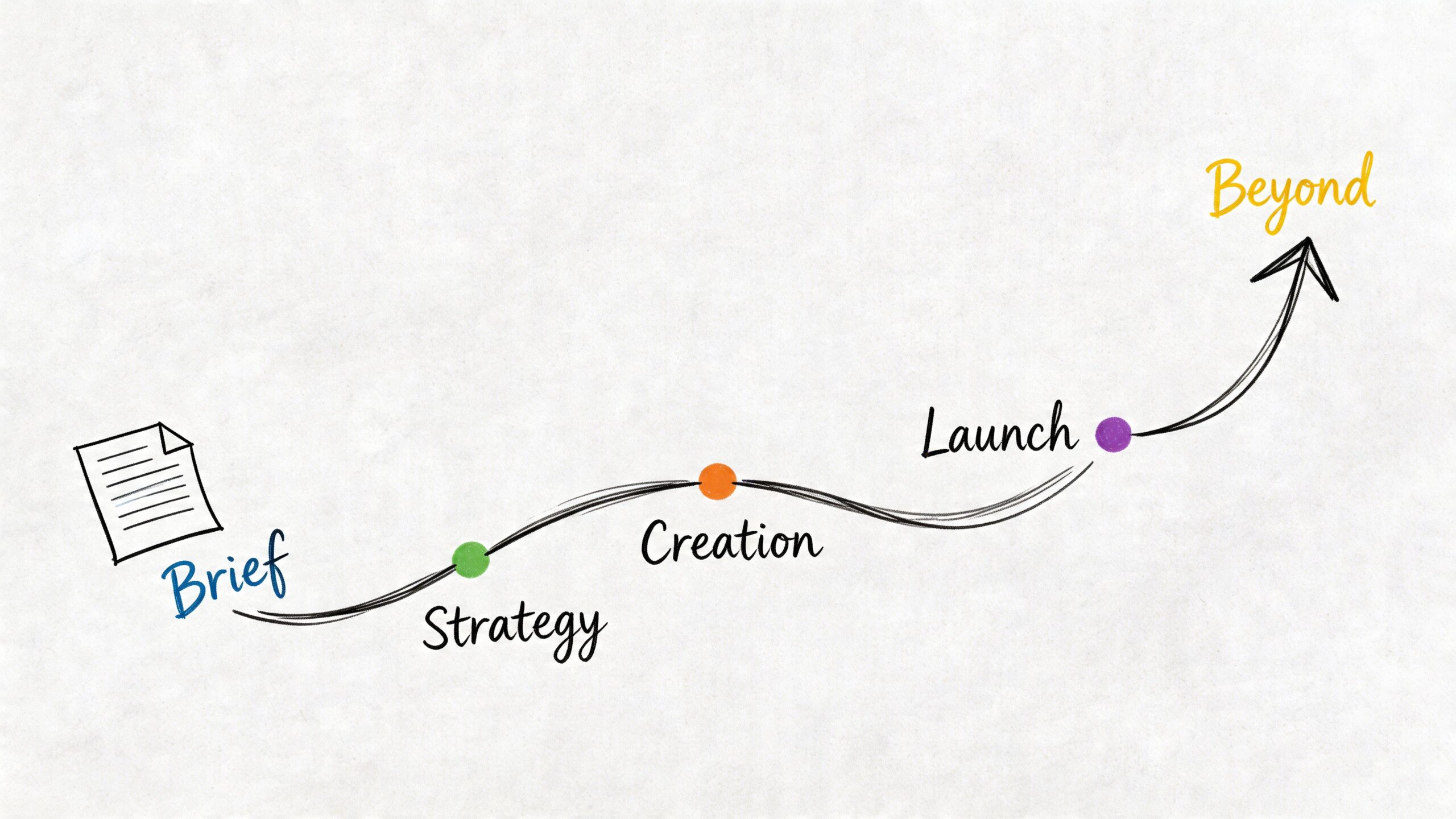
It starts with a proper brief
The first conversations are rarely about colours or homepage layouts. They should be about the business.
An agency will usually ask what you're selling, who you're targeting, what has changed recently, what isn't working, and what success would look like. They may review your current website, competitors, search visibility, customer journey, and existing brand material.
At this stage, the useful outputs are things like:
- A clearer project scope
- Priority goals
- Audience understanding
- A recommendation on what to tackle first
If a business owner says, "We need a new website," the deeper issue might be that the messaging is unclear, the enquiry path is weak, or the current traffic isn't qualified.
Design turns strategy into something visible
Once the direction is set, the creative work begins.
For branding, that may involve logo routes, typography choices, colour systems, tone guidance, and example applications. For websites, it usually means wireframes, page layouts, and visual mock-ups.
Many owners worry they'll be buried in jargon or endless choices. They shouldn't be. Good design rounds narrow the options and explain the reasoning behind them.
You’re not being asked to become a designer. You’re being asked to judge whether the work feels right for your business and your customers.
If you can't explain why a design option fits your business, ask the agency to explain the thinking in plain English.
Development makes it real
Approved designs then move into build.
For websites, that means front-end development, content setup, mobile optimisation, forms, performance checks, integrations, testing, and browser reviews. For eCommerce, there’s added work around products, categories, payments, shipping, and transactional emails.
This stage is less visible but extremely important. A polished design can still fail if the build is slow, clumsy, or hard to maintain.
Launch isn't the finish line
A proper launch involves checks, redirects where needed, analytics setup, device testing, and handover guidance. The best launches feel calm because most of the heavy lifting happened before the button was pressed.
Then comes the part many firms forget. Post-launch learning.
Data-driven follow-up matters here. Marketing automation can deliver a 35% uplift in lead nurturing efficiency and reduce customer acquisition costs by 27% for UK firms, and tools like GA4 support clearer ROI measurement, according to O8's data-driven marketing agency overview.
That’s useful because a launch gives you a stronger starting point, not a final answer. Once real users start moving through the site, you begin to see where attention goes, where leads drop, and which pages need refinement.
What happens after launch
Post-launch support often includes a mix of these:
- Content updates. Refining copy, adding pages, improving FAQs.
- SEO improvements. Adjusting structure, metadata, internal links, and content depth.
- Tracking checks. Making sure forms, clicks, and enquiry points are reporting properly.
- Campaign support. Running email, social, or paid traffic into the new site.
- Technical maintenance. Updates, backups, hosting, and performance care.
For a Dorset SME, this matters because businesses don't stand still. Services change. Offers change. Staff change. Customers ask new questions. Your digital presence has to keep pace.
The most useful agency relationships aren't one giant reveal followed by silence. They're a structured build followed by sensible ongoing improvements.
How to Choose the Right Agency for Your Dorset Business
Not every agency is right for every business.
Some are brilliant at national paid campaigns but poor at brand development. Some produce attractive visuals but don't think much about leads, search, or performance. Some are geared for large corporate teams and aren't a natural fit for an owner-managed Dorset business that needs straight answers and practical delivery.
That’s why choosing well matters more than choosing quickly.
Demand for integrated services has grown. Promethean Research reported that demand for integrated branding services within UK agencies grew by 4 to 6 percentage points from 2023 to 2025, and agencies expanding their offerings saw 9.7% growth versus 1.1% for firms with static service lists in its 2025 digital agency industry report. The message is simple. Versatility matters when your business needs joined-up work.
Questions worth asking before you hire anyone
Use the first call to test how the agency thinks, not just what it sells.
- How do you approach projects like ours. Listen for a method, not a vague promise.
- Who will handle the work day to day. You want to know whether you're speaking to the people doing the job or just the sales layer.
- What needs to happen before design starts. Good agencies don't jump straight to mock-ups.
- How do you measure progress after launch. If they can't explain that clearly, reporting may be weak.
- What will you need from us. The best relationships are collaborative, not passive.
- What happens if scope changes. This tells you a lot about communication and project control.
- How do you balance branding, website performance, and lead generation. That's the true test for a branding and digital marketing agency.
If you’re also reviewing outside providers for outbound support or pipeline building, a curated list of best GTM lead generation companies can help you compare where an agency ends and a specialist lead generation partner may begin.
Red flags that usually show up early
Some warning signs are obvious. Others sound impressive until you look closer.
- Guaranteed rankings. No serious agency can promise exact Google positions.
- Vague deliverables. If the proposal is fuzzy, the project may be too.
- No questions about your business. If they don't ask much, they may be offering the same plan to everyone.
- Poor communication before the contract. It rarely improves afterwards.
- Overfocus on trends. You need a partner grounded in your business model, not just the latest platform features.
- A portfolio with no relevance to your size or type of business. Great work for a huge brand doesn't always translate to a local SME.
Choose the agency that explains the trade-offs clearly, not the one that promises the easiest story.
Comparing Agency Pricing Models
Pricing confuses a lot of business owners because the same service can be sold in very different ways. The best model depends on the kind of work you need.
| Pricing Model | Best For | Pros | Cons |
|---|---|---|---|
| Project-based | Rebrands, new websites, one-off builds | Clear scope, defined deliverables, easier budgeting | Less flexible if needs change significantly mid-project |
| Monthly retainer | Ongoing SEO, content, campaign management, support | Consistent momentum, regular input, easier long-term planning | Can feel vague if outputs and reporting aren't clearly defined |
| Hourly rate | Small updates, consulting, troubleshooting | Simple for ad hoc work, useful for specific tasks | Costs can become unpredictable if the work expands |
For many SMEs, project-based pricing works well when the business needs a clear reset. A new identity, a new website, or a platform rebuild suits that model because the deliverables are easier to define.
That’s one reason some local firms look at website design services in Dorset from agencies that offer fixed-cost project structures. It gives the owner more certainty around cost, scope, and timelines.
The local fit matters
A Dorset business often benefits from an agency that understands the realities of local trading. Seasonal footfall. Regional reputation. Service-area targeting. Word-of-mouth combined with online search. Community organisations, hospitality businesses, trades, retailers, and professional firms all behave differently from venture-backed tech companies in London.
A slick deck means very little if the agency doesn't understand how your customers buy.
Your Practical Next Steps to Getting Started
If you're preparing to speak to an agency, don't try to arrive with every answer. Just arrive organised.
A better first conversation usually starts with a handful of practical notes, not a full marketing plan. That gives the agency enough context to guide you without forcing you into guesswork.
A simple checklist before your first conversation
Write down your top business goals
Keep this short. More enquiries, better quality leads, stronger local visibility, improved online sales, or a clearer brand are all valid starting points.List what isn't working now
Be honest. Maybe the site looks dated. Maybe enquiries are patchy. Maybe customers don't understand the difference between you and competitors.Gather examples you like
Save a few websites, logos, brochures, or social accounts. You don't need to justify them perfectly. Even saying "this feels clear and trustworthy" is useful.Note your main services or products
Agencies need to know what drives revenue, not just what exists in the business.Think about your audience in plain terms
Who are you trying to reach. Local families, trade buyers, tourists, business owners, members, or repeat customers.Decide your rough budget range
You don't need a perfect figure. You do need to know whether you're planning a focused refresh or a broader digital overhaul.Choose who signs things off
Projects slow down when too many people approve each step without clear ownership.
What a useful first call should feel like
You should come away with more clarity than you started with.
That doesn't mean getting every answer immediately. It means you should better understand the likely route, the priorities, and what the agency would need from you next.
For local firms wanting one partner for branding, website work, and digital support, it's sensible to look for a Dorset team that offers clear scope, regular updates, and practical aftercare. DesignStack is one local option. The studio works on fixed-cost projects, has more than 20 years of experience, and has delivered work for businesses and organisations including The Lobster Pot and the Weymouth & Portland Chamber of Commerce.
That sort of local track record matters because trust often starts close to home.
Frequently Asked Questions
How much does a new website or rebrand typically cost
There isn't one standard price because scope changes everything.
A small brochure website is different from an eCommerce build. A logo refresh is different from a full brand system with guidelines, packaging, social templates, and print material. The most useful quote is one tied to a defined brief, clear deliverables, and a realistic timeline.
How long does a project usually take
It depends on complexity, feedback speed, and how much content is ready.
A focused project can move quickly when decisions are clear and approvals are timely. A larger project takes longer because strategy, design, development, testing, and revisions all need proper attention. Delays often come less from the agency and more from unclear content, changing scope, or slow sign-off.
What do I need to provide to get a quote
Usually these basics:
- Your business overview
- What you need help with
- Any deadlines
- Examples you like
- Your rough budget range
- Your current website or existing brand assets
If you don't have all of that, don't worry. A good agency can help shape the brief.
Do I need branding before I do marketing
Not always in a formal sense, but you do need clarity.
If your message, visual identity, and positioning are inconsistent, marketing will be harder and less efficient. Some businesses need a full rebrand first. Others only need tighter messaging and a more consistent presentation before marketing can work properly.
Should one agency handle both branding and digital marketing
Often, yes, if the agency is indeed capable in both areas.
The advantage is continuity. The same team understands the strategy, the visuals, the website, and the growth plan. That usually leads to better consistency and fewer disconnects between design and performance.
What happens after the website goes live
That should be agreed before the project starts.
Some businesses need only light support after launch. Others need ongoing SEO, content updates, reporting, campaign management, or technical maintenance. A launch is the start of the next stage, not the end of the relationship.
If you're ready to turn a dated website, unclear branding, or scattered marketing into something more joined-up, take a look at DesignStack. As a Dorset-based digital agency, it offers branding, web design, graphic design, and digital support for businesses that want a clearer online presence and a more practical path to growth.