

How to Hire Brand Identity Companies A UK Guide
You're probably here because the business has moved on, but the brand hasn't.
That happens a lot. A company starts with a logo, a basic website, maybe a Facebook page and a few printed flyers. Then the business grows. The audience changes. New competitors show up. The old brand starts to look patchy across your website, socials, signage, packaging, proposals, and email templates. At that point, hiring one of the many brand identity companies on the market feels necessary, but also hard to judge.
The biggest mistake I see is treating the search like a design shopping exercise. It isn't. You're not only buying visuals. You're choosing how clearly your business presents itself, how consistently your team communicates, and how easy it is for customers to recognise and trust you.
For UK SMEs, especially local firms in places like Dorset, the right branding partner can sharpen the whole commercial picture. The wrong one can leave you with a tidy logo file and the same business problems you started with.
Why Your Brand Is More Than Just a Logo
A lot of business owners come to this point with a similar problem. Sales are steady enough, the service is good, and customers recommend them, but the brand now feels behind the business. The website doesn't match the printed materials. Social posts look like they belong to a different company. Packaging or signage uses different colours. Staff write in completely different tones depending on who sends the message.
That isn't a small aesthetic issue. It affects how people judge you before they've spoken to you.
A brand system does the heavy lifting
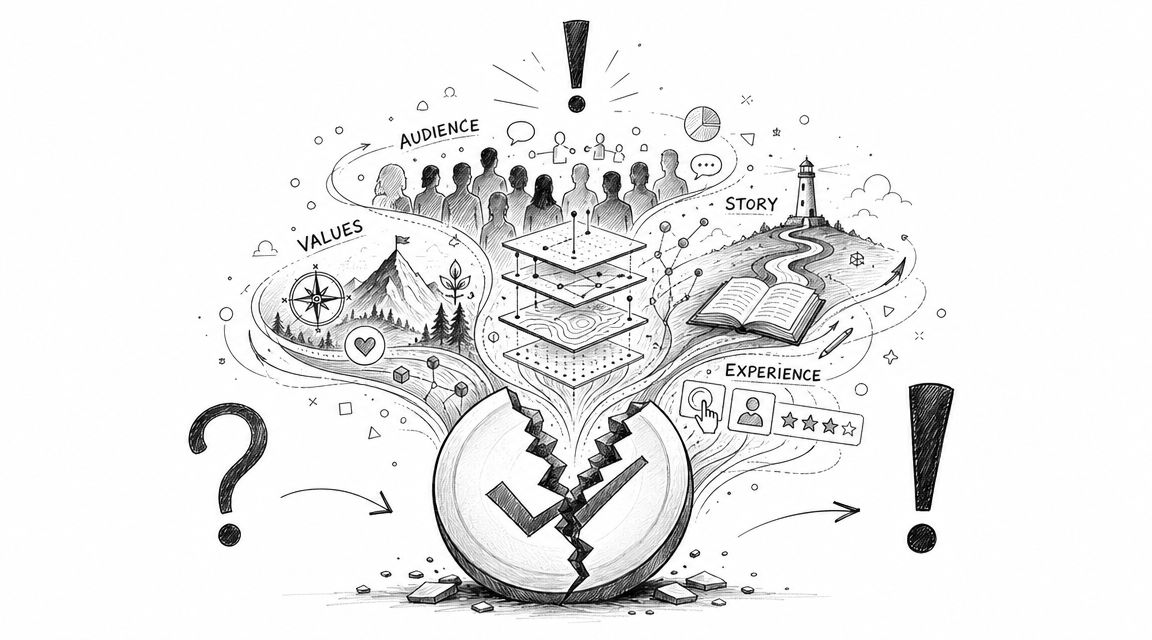
A proper identity is a system. It includes the logo, of course, but also the rules around colour, typography, imagery, tone of voice, layout, icon style, messaging, and where each element should and shouldn't be used.
That matters because consistent branding is tied to business performance. A 2026 report covered by DesignRush's branding statistics roundup says 68% of companies attribute 10 to 20% revenue growth to brand consistency, and the same source notes that 32% of organisations saw revenue increases of more than 20% from consistent messaging alone.
For a local retailer, that might mean the shopfront, takeaway menu, Instagram feed, and online ordering experience finally look and sound like one business. For a service company, it often means proposals, vans, uniforms, web pages, and follow-up emails stop pulling in different directions.
Practical rule: If your brand only works on a homepage mock-up, it isn't finished.
Where businesses usually feel the strain
Most companies don't need a rebrand because they're bored. They need one because the current setup is creating friction.
Common signs include:
- Sales conversations start from confusion. Prospects don't quickly understand what you do, who you do it for, or why they should trust you.
- Your visuals vary by channel. The website looks one way, LinkedIn another, and printed material another again.
- You've moved upmarket but still look entry-level. This is common with firms that began as owner-led startups and now want larger contracts.
- Packaging or presentation no longer supports positioning. If you sell physical products, the thinking behind Afida on food packaging branding is useful because it shows how identity has to work in real buying environments, not just on a brand board.
A good agency should be able to show how the identity will operate in the places customers encounter it. That's why reviewing a live body of work matters more than admiring a logo on its own. A portfolio such as DesignStack's recent branding and digital work is useful for that kind of evaluation because you can see whether the thinking carries through different formats and sectors.
Define Your Brand Needs Before You Search
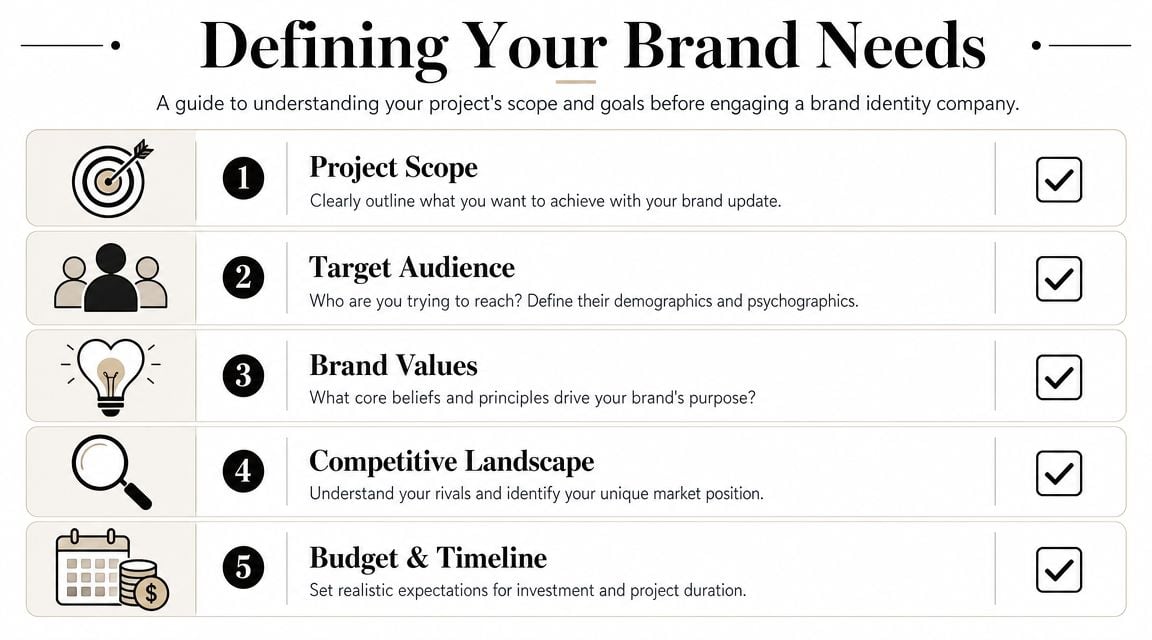
Before you contact any brand identity companies, get your own brief straight. If you skip that step, agencies end up guessing, and you end up comparing proposals that answer different questions.
The biggest internal mistake is vague targeting. UK-focused branding guidance warns that trying to appeal to “all demographics” usually fails, and that branding has to reflect the target market's needs and the business's core values or it risks coming across as untrustworthy, as outlined in the URI SBDC branding advice referenced in the brief.
Start with the commercial problem
Don't begin with “we need a new logo”. Begin with what isn't working.
A Dorset trades business wanting larger commercial contracts has a very different branding problem from an eCommerce food brand trying to improve shelf recognition. One may need credibility and consistency across tenders, vans, and the website. The other may need stronger packaging hierarchy, a clearer value proposition, and cleaner photography direction.
Write down the issue in plain language. For example:
- We look smaller than we are
- Our current identity feels dated
- We attract the wrong type of customer
- The website and printed materials don't match
- Different team members describe the business differently
- We're expanding into a broader UK market and the brand still feels too local
- We want to charge more confidently, but the presentation doesn't support it
That list gives agencies something real to respond to.
Build a brief with usable detail
A short, practical brief beats a vague, polished one. Include these points:
Who you want to reach
Be specific. Name the customer group, buying context, and what matters to them.What you want the brand to change
Recognition, trust, perceived quality, internal consistency, better alignment across channels, or all of the above.What must stay
Existing colours, a trading name, legacy elements, local recognition, or stakeholder concerns.Where the identity needs to work
Website, signage, social media, brochures, packaging, uniforms, PowerPoint templates, email signatures, sales decks.What success looks like operationally
Easier rollout, fewer off-brand materials, clearer communication, and a more consistent customer experience.
If you can't describe your audience without using the word “everyone”, you're not ready to hire yet.
A practical way to sharpen this is to gather feedback directly. If you need a starting point, privacy-first brand perception surveys can help you ask structured questions about how customers currently see your business.
Later, when you compare agencies, you'll want to know whether they can turn this thinking into real assets. Looking at a service page such as graphic design and branding support helps clarify the sort of deliverables that often sit around a brand project, from identity work through to collateral and rollout.
A quick visual overview can also help if you're briefing internally first:
A simple pre-agency checklist
Use this before you send any enquiry:
- Target customer defined. You can describe who they are, what they need, and why they choose.
- Current brand issues listed. Not just “needs refreshing”, but specific commercial or operational problems.
- Core values written down. A few clear principles are enough if they're real and usable.
- Touchpoints mapped. Every place the brand shows up, online and offline.
- Decision-makers identified. Too many brand projects stall because nobody knows who signs off strategy versus design.
Do that homework and agency conversations improve quickly. The brief gets clearer, timescales become more realistic, and you stop wasting time on suppliers who only want to talk about style references.
How to Find and Evaluate Branding Agencies
Once you know what problem you're solving, the shortlist gets smaller and better.
For UK SMEs, the search usually starts in two places. Local recommendations and online research. Both matter. If you're in Dorset or Weymouth, local business groups, chambers, and referrals can surface agencies that already understand the regional market. Online search broadens the field, which is useful if your sector is niche or you need specialist experience in packaging, membership organisations, or eCommerce.
Don't judge a portfolio by taste alone
A portfolio should answer more than “do I like this look?”
Branding is heavily visual, so first impressions count. Dash's branding statistics report that 55% of a brand's first impression comes from visuals, and the same source notes that 75% of consumers recognise a brand by its logo, while colour can improve recognition by up to 80%. That means a portfolio does need visual strength. But visual strength on its own isn't enough.
Ask these questions while reviewing work:
| What to check | What a strong answer looks like | Warning sign |
|---|---|---|
| Business problem | The agency explains what needed fixing | Only moodboards and logo reveals |
| Range of application | Identity appears across web, print, social, packaging, signage | One isolated logo on a blank page |
| Consistency | The system holds together in different formats | Every application looks improvised |
| Audience fit | The style suits the market and price point | Attractive work that feels aimed at the wrong buyer |
| Strategic thinking | There's evidence of positioning, messaging, or rollout logic | Everything is framed as personal taste |
What separates a real identity project from a logo job
A logo job gives you a mark. An identity project gives you a usable framework.
That framework often includes:
- Primary and secondary logo versions
- Colour palette rules
- Type hierarchy
- Image direction
- Tone of voice cues
- Templates or examples for rollout
If none of that appears in the agency's work, be careful. Many firms present themselves as brand identity companies when they really offer logo design plus a PDF.
Good identity work should survive contact with reality. It should still make sense on a van, a mobile screen, a proposal cover, a product label, and an exhibition banner.
Look for evidence of joined-up thinking
A lot of branding projects now sit alongside web rebuilds, content updates, and broader digital changes. That's why it helps to review agencies that understand how branding and digital execution affect one another. This is also where a practical guide like finding a website designer who understands your vision becomes relevant, because many businesses don't need isolated branding. They need identity decisions that carry into the website and customer journey.
When reviewing agencies, give extra weight to those that can explain:
- how they research your audience
- how they test positioning choices
- how the identity will be implemented after approval
- who handles rollout across web, print, and social assets
- what happens if internal teams need support using the new system
That's usually the point where the shortlist separates itself. One group shows attractive design. The other shows thinking you can run a business with.
Key Questions to Uncover the Right Partner
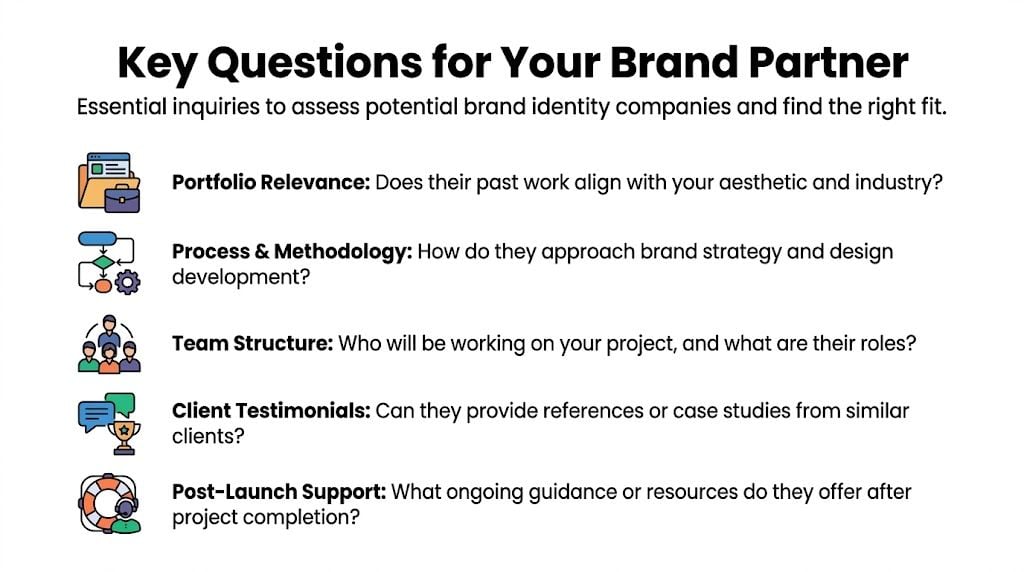
The first call with an agency is a chance to test their strategic depth, not just get a price.
A Dorset manufacturer, a regional law firm, and a growing ecommerce brand can all ask for a “brand refresh” and mean completely different things. One may need sharper positioning to win better-fit clients. Another may need a clearer identity system that works across vans, signage, proposals, and a dated website. If an agency treats those briefs as the same job with a different logo style, that is a warning sign.
Many SMEs struggle to separate a design supplier from a growth partner. The difference shows up in the questions the agency asks, the commercial context they look for, and whether they connect brand work to sales, recruitment, customer trust, and day-to-day implementation.
Questions that reveal how they think
Use the first conversation to find out how they make decisions under real business conditions.
Ask these:
How do you define the problem before you start designing?
Strong agencies talk about interviews, audience evidence, competitor context, commercial pressures, and where the current brand is failing. Weak ones move straight to colours, fonts, and moodboards.What have you heard in our brief that matters most?
This tests listening. A good partner can play your situation back to you in plain English and spot the tension between where the business is now and where it wants to go.What input will you need from our side?
Good branding work needs access to decision-makers, sales insight, customer knowledge, and timely feedback. If an agency claims they can do it all with very little involvement, expect generic output and late-stage friction.What will we actually have at the end of the project?
Ask for specifics. Brand strategy summary, messaging guidance, logo files, typography rules, social assets, proposal templates, signage direction, rollout support. “Full branding package” tells you nothing.How do you handle rollout once the work is approved?
This matters a lot for UK SMEs with lean teams. A new identity only helps if staff can use it properly across the website, print, email signatures, pitch decks, packaging, and sales documents.
Questions that expose a vendor mindset
Some agencies present well and still operate like production suppliers. That is not always a problem. If you already have a clear strategy in-house and only need execution, a supplier may be enough. But if the business needs sharper market positioning or a brand system that supports growth, you need more than polished design.
Use this table to spot the difference:
| Question | Strong signal | Weak signal |
|---|---|---|
| Who will actually do the work? | Named people, clear roles, senior strategic input | Generic references to “the team” |
| How do you justify creative decisions? | Based on audience, positioning, use cases, and business goals | Based on taste, trends, or what looks current |
| How do you manage conflicting stakeholder feedback? | Clear sign-off structure and a way to resolve disagreement | No visible process, or they leave you to sort it out |
| What happens if the brief changes halfway through? | They can explain scope control, trade-offs, and how decisions get documented | They sound evasive or promise to “work it out” |
| Can you support implementation beyond the brand files? | They can explain what happens across web, print, content, and internal adoption | They stop at asset delivery |
One of the most useful questions I've seen business owners ask is this: Tell me about a project that went off track, and what you did next.
The answer tells you how the agency behaves when reality shows up. In practice, branding projects go off track for ordinary reasons. Late stakeholder input. A founder changing their mind. Sales teams rejecting messaging that sounded good in a workshop. A website build exposing gaps in the identity system. Experienced agencies do not pretend that never happens. They explain how they handle it.
The question many businesses skip
Ask this directly: How will we know this worked?
A sensible answer does not need brand tracking software or a pile of dashboards. For many SMEs, success looks more practical than that. Sales conversations become easier because the offer is clearer. Staff stop creating off-brand materials from scratch. The website, proposals, and printed collateral finally feel like the same business. Recruitment gets easier because the company presents itself with more confidence and consistency.
If an agency can only describe success as “a professional new look,” keep looking. That answer usually comes from a design vendor. The right partner should be able to explain what changes in the business once the brand is doing its job.
Decoding Proposals Timelines and Deliverables
When proposals arrive, the temptation is to compare the price first. That's understandable, but it's usually the quickest way to misread value.
Two branding proposals can look similar on page one and be completely different in substance. One may include research, strategic direction, internal workshops, multiple logo formats, messaging support, and a proper rollout pack. Another may include a logo, a colour palette, and not much else.
What a solid proposal should include
The strongest proposals tend to make the process legible. You should be able to see what happens, when it happens, and what you'll receive.
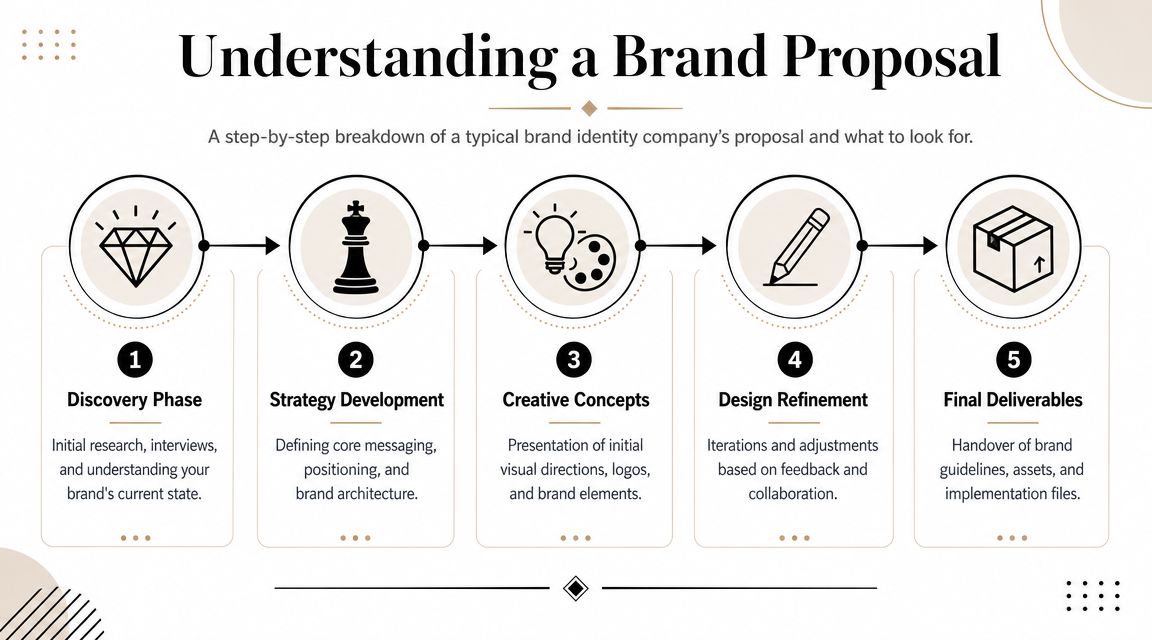
Look for these elements:
Discovery
Interviews, brand review, audience understanding, and competitor context.Strategy
Positioning, messaging direction, value proposition, personality, and any audience decisions.Creative development
Concepts, rationale, and shown applications, not just isolated logos.Refinement
A clear feedback structure. You need to know how revisions are handled and who signs off.Final handover
Files, usage rules, templates, and implementation guidance.
If any of those stages are missing, ask why.
Brand guidelines are not optional
One of the most common branding failures is skipping proper guidelines. Sage Island's summary of branding pitfalls points out that failing to create and use brand guidelines makes a company look inconsistent and unprofessional across platforms. The same guidance stresses that a professional process involves research, codifying the identity system in guidelines, and then rolling it out.
That means a useful guideline document should cover more than logo spacing.
A workable set of guidelines often includes:
- Logo usage. Primary, secondary, icon-only, monochrome, spacing, minimum size.
- Colour system. Core colours, supporting colours, and where each should appear.
- Typography rules. Headings, body copy, digital use, print use, hierarchy.
- Imagery style. Photography or illustration direction and what to avoid.
- Voice and messaging. Tone, phrasing examples, short positioning statements.
- Application examples. Social tiles, proposal covers, signage, packaging, email signatures, slide decks.
A brand guideline should let someone new to your team produce on-brand work without guessing.
How to compare proposals properly
Don't compare line by line on cost alone. Compare them on risk.
Here's a simpler way to assess them:
| Proposal area | Better sign | Concern |
|---|---|---|
| Scope clarity | Deliverables are listed in plain English | Generic phrases like “branding package” |
| Process | You can see stages and responsibilities | No explanation of how work gets approved |
| Feedback | Revisions and review rounds are defined | “Unlimited revisions” with no process |
| Handover | Guidelines and usable files are included | Final files only |
| Rollout | There's support beyond the design stage | Handover ends at concept approval |
Fixed-cost pricing can work well when scope is clear. Retainers can work when branding is part of ongoing digital support. Neither is automatically better. The important question is whether the pricing matches the actual shape of the work.
Final Steps From Briefing to Hiring
By the time you're choosing between two or three agencies, the decision usually stops being about visuals. It becomes about confidence.
Can this team understand the business, challenge weak assumptions, make sensible decisions under pressure, and leave you with something your staff can practically use?
Red flags worth taking seriously
Some warning signs show up early and are easy to ignore.
Watch for these:
- They ask almost nothing about your business. Good agencies are curious. Weak ones rush to style.
- They present one-size-fits-all packages. Your project should have a point of view, not a template with your name inserted.
- They lean on trends more than strategy. A fashionable look can date fast if it isn't rooted in your market.
- They can't explain implementation. The launch often matters as much as the design itself.
- They pressure you to decide quickly. Good work doesn't need a hard sell.
A simple way to choose
When clients are stuck between finalists, I usually suggest scoring each option against the same few criteria:
- Commercial understanding. Did they grasp the actual problem?
- Process quality. Is the route from research to rollout clear?
- Deliverables. Will you receive assets your team can use properly?
- Fit. Can you work with them for the next few months without friction?
- Confidence in rollout. Do they understand web, print, social, and internal use?
If one agency produces stronger design but another shows better judgement, choose judgement. Strong branding work needs both, but judgement is what prevents expensive mistakes.
A brief template you can send before kickoff
Keep it short. One or two pages is plenty.
Include:
- Business overview
- What's changed in the business
- Current brand problems
- Target audience
- Core value proposition
- Required deliverables
- Key touchpoints
- Stakeholders and sign-off process
- Budget range
- Preferred timeline
That document doesn't need to sound polished. It needs to be honest.
The right brand identity companies won't be the ones that merely promise a better logo. They'll be the ones that help your business look, sound, and operate with more clarity across every place customers meet you.
If you're reviewing brand identity companies and want a practical second opinion, DesignStack can help with branding, graphic design, and website work for businesses in Dorset and across the UK. The useful starting point is a clear conversation about what isn't working now, what needs to change, and where the new identity has to perform day to day.
Leave a Reply