

Small Business Branding Agency: 2026 Hiring Guide
You might be in that awkward spot right now. The business is decent. Customers who do find you tend to buy, book, or recommend you. But your website looks dated, your logo feels like it belongs to a previous version of the business, your signage doesn’t match your social pages, and every new leaflet, email footer, or Facebook post seems to come out slightly differently.
That usually isn’t a design problem first. It’s a brand problem.
For small firms in the UK, that matters more than many owners realise. Small businesses make up 99.9% of all UK businesses, and businesses that invested in rebranding after 2021 saw a 15-23% revenue uplift from a consistent visual identity, yet only 7% of typical business budgets are allocated to brand building, according to Clutch’s small business stats. In plain English, most firms are competing hard while underinvesting in how they’re recognised, remembered, and trusted.
A good small business branding agency helps fix that. Not with fluff. With structure, clarity, and a brand you can apply day to day.
Why Your Brand Is More Than Just a Logo
A logo matters. It’s just not the whole job.
Most Dorset business owners I speak to don’t come in saying, “I need brand strategy.” They say, “Our website’s not bringing in the right leads,” or “People keep confusing us with another business,” or “We’ve grown, but the brand still looks like a startup we made up on a Friday night.”
That’s the core issue. The brand no longer matches the business.
What a branding agency is actually fixing
A proper small business branding agency doesn’t just draw a mark and send over some files. It works on the full set of signals your customers use to decide whether you look credible, relevant, and worth contacting.
That usually includes:
- Positioning: What you want to be known for, and what you don’t.
- Messaging: The language you use on your website, proposals, socials, and print.
- Visual identity: Logo, colour system, type choices, imagery style, layout rules.
- Application: Website pages, social graphics, van livery, signage, packaging, presentations, and email signatures.
- Consistency: Making sure the whole thing still looks like the same business six months later.
If any one of those is off, the customer feels it. They may not say, “Your verbal identity is inconsistent.” They’ll say, “I wasn’t sure what you do,” or “You looked smaller than I expected,” or “I checked a few others and they felt more established.”
Practical rule: if your business looks different in every place a customer finds you, people assume the experience will be inconsistent too.
What works and what doesn’t
What works is a brand built around commercial reality. Who are you for. What problem do you solve. Why should someone choose you instead of the similar-looking option down the road or further up the search results.
What doesn’t work is treating branding as surface decoration.
A few common mistakes show up again and again:
| Approach | What happens |
|---|---|
| Buying a cheap logo in isolation | You get a graphic, but no system for using it |
| Copying bigger brands | You look generic and lose local distinctiveness |
| Letting different suppliers design different things | Website, print, socials, and signage drift apart |
| Skipping messaging work | The visuals improve, but the business still sounds unclear |
The growth angle most owners miss
Branding earns its keep when it makes sales easier.
That might mean a clearer homepage. Better signage. Packaging that looks professional on a shelf. A service brochure that stops needing explanation. A social profile that feels trustworthy before someone clicks through. None of that is glamorous. All of it is useful.
A branding agency worth hiring acts more like a growth partner than a design vendor. It helps you decide what should stay, what needs tightening, and what needs replacing so the business looks coherent to the people you specifically want to attract.
Defining Your Branding Needs Before You Search
Before you contact any agency, get your own thinking straight. If you skip this step, you’ll waste time on proposals that look polished but don’t solve the underlying problem.
This matters even more now. 75% of UK SMEs lack a professional website, 63% are planning marketing budget increases, and strong branding can boost customer trust by 81% and recall by 30%, according to these UK small business marketing statistics. If you’re going to spend money, spend it against a clear brief.
Start with what’s broken
Don’t begin with “we need a new logo.” Start with symptoms.
Write down where the current brand is getting in the way. Be blunt. A few examples:
- Wrong-fit enquiries: You’re attracting people who want the cheapest option, while your actual service sits at a more professional level.
- Outdated perception: The business has matured, but the brand still looks homemade.
- Poor online credibility: Your site looks thin, inconsistent, or old enough to make people hesitate.
- Internal confusion: Staff, partners, or suppliers all describe the business differently.
- Expansion friction: You’re adding services, locations, or products and the current brand can’t stretch.
If you can name the problem clearly, an agency can respond properly. If you can’t, you’ll get vague creative work and vague results.
Ask the four questions that shape the brief
A useful branding brief for an SME doesn’t need to be fancy. It just needs to answer the right things.
Who do you actually want more of
Not “everyone”. Not “anyone who needs our service”.
Be specific. Are you trying to win local homeowners, trade buyers, higher-value retail customers, startups, membership organisations, or professional services clients? Different audiences need different levels of explanation, reassurance, and tone.
The best small business brands usually become clearer by excluding people, not by trying to appeal to all of them.
What should people think when they see you
Pick a short list of words that fit the business you want to be, not the one you were three years ago.
For example:
- Reliable and established
- Modern and efficient
- Premium but approachable
- Creative and local
- Straight-talking and practical
You don’t need ten. Three or four is enough.
What assets do you actually need
Some businesses need a full rebrand. Others need a sharper website and a proper identity system wrapped around what already exists.
Use this checklist:
- Core identity: logo, colours, typography, brand rules
- Website: homepage, service pages, about page, contact journey
- Print: business cards, brochures, menus, flyers, packaging
- Physical presence: signage, uniforms, vehicles, point-of-sale material
- Digital templates: social graphics, proposal documents, slide decks, email signature
- Photography or imagery guidance: so the visual tone doesn’t fall apart after launch
What will success look like in real life
Avoid vague goals like “look more professional.”
Better versions are:
- More confidence sending traffic to the website
- Easier sales conversations because the offer is clearer
- Better quality enquiries
- A brand staff can apply consistently without guessing
- Materials that work both online and in print
Set a budget with real trade-offs in mind
Most small businesses don’t have endless budget, and that’s fine. The mistake is pretending you can buy a full strategic rebrand, website, copy, photography, signage, and launch campaign for a token amount.
A practical approach is to split needs into three groups:
| Priority | What belongs here |
|---|---|
| Need now | The items stopping sales or trust today |
| Need soon | Assets that should follow once the core brand is set |
| Nice later | Extras that can wait until the business sees movement |
That helps you discuss scope clearly.
If budget is tight, I’d usually favour getting the foundations right over buying lots of disconnected outputs. A clear brand system plus a strong website tends to outperform a pile of random design pieces made without strategy.
Build a one-page brief
Before you contact agencies, create one page with the following:
- What your business does
- Who you want to attract
- What isn’t working now
- What you need delivered
- Examples of brands you like, and why
- Your preferred timeline
- A realistic budget range
That document will save you a lot of back and forth. It also helps you spot whether an agency listens or just jumps straight into selling a package.
How to Find and Evaluate Potential Agencies
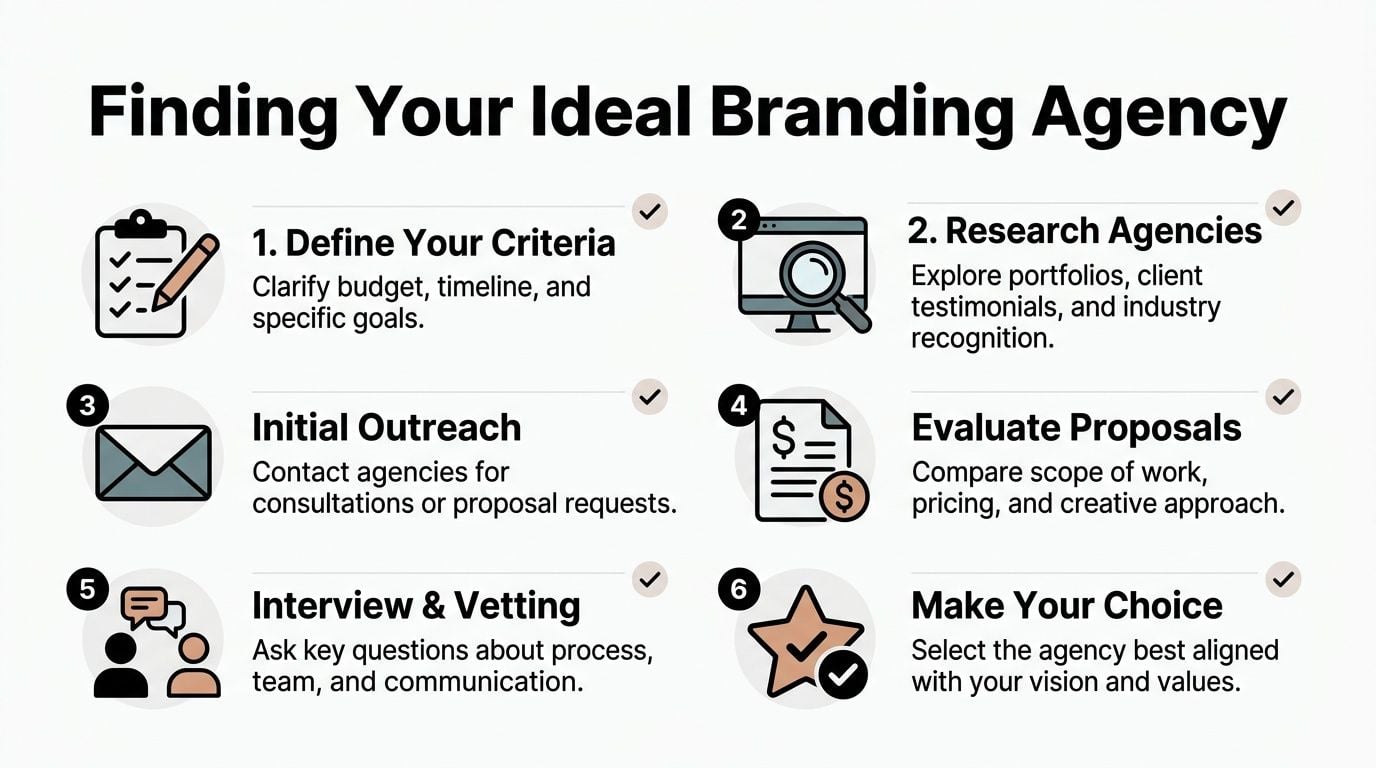
Searching “small business branding agency” into Google is easy. Choosing one well isn’t.
You’re not only buying design. You’re buying judgement, process, communication, and the ability to turn a half-formed business problem into something customers can understand quickly.
Where to look without getting lost
A decent shortlist usually comes from a mix of sources, not one directory.
Try this:
- Look at local businesses you already rate: If a Dorset business has a strong website, consistent signage, and smart print material, find out who did the work.
- Ask trusted suppliers: Your web developer, printer, photographer, or marketing consultant often knows who is organised and who creates chaos.
- Search for specialists, not just generalists: Some agencies are better at startups, some at retail, some at professional services.
- Review practical guidance on adjacent services: If branding and website work are connected for you, this guide to finding a website designer who understands your vision helps you assess overlap between brand and web capability.
Don’t build a long list. Build a sharp one. Three to five agencies is enough.
What to look for in a portfolio
Most agency portfolios are designed to impress. Your job is to inspect.
Pretty visuals alone don’t tell you much. You need to see whether the agency can create a brand that works across real business touchpoints.
Check for these signs:
Strategic clarity
Can you tell what the business does, who it serves, and how the brand supports that? If every project looks stylish but says nothing, be careful.
Range without chaos
You want an agency with range, but not one that applies the same visual recipe to everyone. Good agencies adapt. Weak ones repeat themselves.
Application beyond the logo
A proper branding job should show use in context. Website pages. Packaging. menus. Signage. Social graphics. Printed material. If you only see floating logos on mockups, you’re not seeing enough.
Relevance to your size and type of business
An agency may produce great work for funded tech firms and still be a poor fit for a local retailer, trades company, or membership group. Look for evidence they understand SME constraints.
If the portfolio makes every client look expensive but doesn’t show how the brand works in day-to-day business use, ask harder questions.
The interview questions worth asking
Often, the outcome of hiring decisions is determined by how questions are asked. Don’t ask soft questions that invite polished answers. Ask questions that reveal process.
Questions about approach
- How do you define the problem before designing anything?
- What do you need from us during discovery?
- How do you handle messaging as well as visuals?
- What happens if we’re not fully aligned internally when the project starts?
A serious agency should have a structured answer. If they jump straight to concepts, that’s a warning sign.
Questions about consistency
This one matters because only 30% of firms enforce brand guidelines, leading to off-brand output in 77% of cases, and good agencies can help avert the 59% customer churn rate caused by poor promotion, according to JK Marketing’s branding cost guide.
Ask:
- What does your style guide include?
- How do you stop the brand falling apart after launch?
- Do you create reusable templates for staff and suppliers?
- How do you handle rollout across website, print, and social channels?
Questions about project management
- Who will do the work?
- Who is our day-to-day contact?
- How often will we get updates?
- How are feedback rounds handled?
- What typically causes delays on projects like ours?
Herein lies the difference between smooth projects and frustrating ones.
Questions about commercial fit
- Do you work on fixed cost, estimate, or hourly billing?
- What is included, and what counts as extra scope?
- How many revisions are included?
- What support do you offer after launch?
Small business owners often underestimate how much stress clear scope removes. Ambiguity is expensive.
Red flags that usually show up early
Some warning signs are obvious. Others are subtle.
| Red flag | Why it matters |
|---|---|
| They promise fast answers without asking many questions | Good branding depends on diagnosis first |
| They only talk about aesthetics | Your problem probably isn’t visual alone |
| Their proposal is vague on deliverables | Scope creep usually follows |
| You can’t tell who’s running the project | Communication gets messy fast |
| They dismiss budget questions | That’s how SMEs end up overcommitted |
Choose chemistry, but not only chemistry
You do need a working relationship you can tolerate. Branding projects involve feedback, challenge, and decisions that won’t always be instant.
But don’t choose the friendliest meeting if the process feels loose. And don’t choose the slickest proposal if the agency seems uninterested in your actual business.
The right small business branding agency should make you feel two things at once. Clearer, and calmer.
The Branding Process What to Expect
Once you’ve hired an agency, the mystery should disappear. You should know what happens, when it happens, what you need to provide, and what you’ll get at the end.
A standard agency process usually takes 6-10 weeks, and consistently applying final brand colours can boost recognition by 80%. UK businesses that do this report revenue growth of 10-20% in 68% of cases, according to these branding statistics for small business owners.

Discovery comes first
This is where the useful work starts.
The agency should ask about your audience, competitors, offer, pricing position, service mix, and where the current brand is failing. Expect questions that feel commercial, not just creative.
You’ll usually need to provide:
- Business background: what changed, what’s growing, what’s stalled
- Audience insight: who buys, who doesn’t, and who you want more of
- Existing materials: website, brochures, social pages, packaging, signage
- Examples: brands you like and brands you definitely don’t
If discovery feels rushed, the creative stage usually suffers.
Strategy turns opinion into decisions
This part gives the project backbone. It’s where the agency defines the direction before making things look good.
Expect work around:
| Area | Typical output |
|---|---|
| Positioning | What makes you distinct in your market |
| Brand personality | The tone and feel you want customers to experience |
| Messaging | Headline direction, key statements, value propositions |
| Visual direction | Moodboards, references, creative routes |
You don’t need fifty-page strategy decks for an SME. You do need enough clarity that later design decisions aren’t just personal taste battles.
A branding project goes wrong when every decision becomes “I like this one better.” It goes right when choices are tied back to audience, offer, and business aim.
Creative development should feel focused, not endless
After strategy, the agency develops identity concepts. That can include logo routes, colour systems, type choices, icon styles, imagery guidance, and layout direction.
This is also where it helps to work with an agency that can carry design into practical assets, not stop at concept boards. If your project includes printed materials or supporting visual assets, a service like graphic design support is part of what often turns a nice identity into a usable one.
When reviewing concepts, don’t ask, “Which one do I personally like most?” Ask:
- Does this feel right for the audience?
- Does it suit the level we want to compete at?
- Will it work on the website, signage, print, and social?
- Will it still make sense in two years?
Rollout is where value gets protected
A lot of branding work looks good up to approval day and then falls apart in rollout.
That’s why deliverables matter. At minimum, you want a practical style guide. Not a ceremonial PDF no one opens. A guide people can use.
A useful guide should cover:
- Logo versions and clear usage
- Colour palette and combinations
- Typography rules
- Image style
- Tone of voice basics
- Spacing and layout guidance
- Examples of correct and incorrect use
Here’s a useful explainer on brand consistency and implementation:
Fixed cost versus open-ended pricing
For SMEs, fixed-cost pricing usually makes the process easier to manage. You know what’s included, what the revision rounds are, and when extra work becomes a separate quote.
Open-ended hourly models can suit larger organisations with moving scope. For most small businesses, they create uncertainty.
A sensible project agreement should define:
- Deliverables
- Timeline
- Feedback stages
- Revision limits
- What happens after launch
That last point matters. Some agencies disappear at handover. Others provide a short post-launch period to tidy details, answer rollout questions, and help the new brand settle into use. That support often makes the difference between a clean transition and a scrambled one.
Choosing a Local Agency The Dorset Advantage
A remote agency can do good work. That isn’t the question. The key question is whether they understand the market you’re selling into, the pace you work at, and the commercial limits you’re operating within.
For many regional SMEs, local fit matters more than agency size.
In South West England, 62% of small businesses cite cost as the main barrier to rebranding, and 45% of Dorset SMEs prefer local partners to benefit from community trust, according to Parallel’s review of small business branding services. That preference makes sense. A local agency usually understands both the budget pressure and the reputation dynamics that come with trading in a connected regional market.
Local knowledge changes the brief
A Dorset retailer, hospitality business, membership organisation, or service firm doesn’t need branding in the abstract. It needs branding that works where it conducts business.
That means understanding things like:
- Seasonal demand patterns: especially for coastal and tourism-linked businesses
- Local trust signals: people often buy through reputation, familiarity, and recommendation
- Mixed audiences: locals, visitors, trade clients, and online buyers may all see the same brand
- Practical rollout: signage, print, events, local partnerships, community visibility
A London agency might produce something sharp. A Dorset agency is more likely to ask the right local questions early.
Fixed-cost thinking tends to be stronger locally
Regional SMEs usually don’t want a grand branding exercise with layers of consultants and vague billing. They want clarity.
That’s one reason local agencies often suit smaller firms better. They’re used to scoping tightly, prioritising deliverables, and balancing website, print, and identity work around real budgets. DesignStack, for example, is a Dorset-based option that provides web design, branding, graphic design, fixed-cost pricing, three design revisions, and post-launch support, which is the kind of structure many smaller firms look for when risk tolerance is low.
That doesn’t mean “local” automatically means “right.” It means local agencies often start from a more realistic SME brief.
A local agency is often easier to challenge, easier to brief, and easier to keep aligned because both sides understand the trading environment.
Local branding works better when promotion follows through
A rebrand on its own won’t carry growth if your lead generation stays messy. Once the identity is clear, the next question becomes how people discover you and what they see first.
For local firms planning paid promotion after a rebrand, this Facebook Ads for Local Businesses playbook is a useful practical read. It helps connect branding work to actual local visibility rather than treating the rebrand as the finish line.
Portfolio relevance matters more than geography alone
Don’t hire an agency just because it’s nearby. Hire one because it understands local business conditions and can show work that feels commercially grounded.
That’s why it helps to inspect relevant examples, such as this Dorset microgreens project, where brand and digital presentation are tied to a real regional business context. You’re looking for evidence that the agency can make a local brand feel clear and usable, not merely attractive.
Your Next Steps to a Stronger Brand
By this point, the decision usually feels less abstract. You’re not looking for “branding” in the vague sense. You’re looking for a partner who can make the business easier to trust, easier to understand, and easier to choose.
That starts with action, not more browsing.
Use this shortlist process
Keep it simple and disciplined.
Finish your one-page brief
Write down the current problems, the audience you want, the assets you need, and the rough budget you can commit.Shortlist three agencies
Include at least one local option if your business depends on community trust, regional visibility, or face-to-face rollout.Send the same brief to all three
That gives you comparable responses instead of three completely different conversations.Book calls and ask the same core questions
Focus on process, deliverables, consistency, revisions, and post-launch support.Compare how they think, not just how they pitch
The right agency will clarify your problem, not just decorate it.
Decide what you need first
Not every business needs the full package immediately.
A few examples:
| If this is your issue | Start here |
|---|---|
| Your business looks inconsistent everywhere | Brand identity and style guide |
| Your visuals are decent but the website lets you down | Website redesign built on clearer brand rules |
| You’re launching something new | Positioning, identity, and launch-ready assets |
| Your team creates off-brand materials constantly | Template system and usage guidelines |
That sequencing matters. It stops you paying twice for work that should have been built on stronger foundations.
Think beyond launch day
The best branding projects don’t end at approval. They carry into sales, enquiries, staff communication, social content, and follow-up systems.
Once the brand is tidied up, make sure your enquiry handling is too. If leads arrive through forms, calls, and multiple channels, a practical guide to lead management software for small business can help you organise what happens after the brand starts attracting attention. Better branding brings more clarity to the front end. Better lead handling protects it at the back end.
Keep the decision commercial
A lot of owners delay branding because it feels indulgent. Usually it isn’t. It’s operational.
If your website undersells you, if your printed material looks disconnected, if staff improvise brand decisions every week, or if customers don’t quickly understand why you’re worth the money, you’re already paying for weak branding. You’re just paying in a less visible way.
A strong brand doesn’t solve every business problem. But it does remove friction from a surprising number of them.
If you’re choosing a small business branding agency in 2026, keep your standards practical. Look for clarity, structure, and work that fits your market. Look for a process you can understand. Look for pricing that won’t drift. Look for someone who can build a brand your business can live with and use.
If you’re weighing up a rebrand, a new website, or a more consistent identity across print and digital, DesignStack is a Dorset-based option for SMEs that want fixed-cost delivery, clear communication, and practical support from strategy through launch.

Leave a Reply