


Mastering Logo Design for Law Firms
The most repeated advice in logo design for law firms is also the least useful: make it look traditional, add a legal symbol, keep it formal.
That approach produces a lot of forgettable logos.
A managing partner rarely needs a logo that does no more than look “like a law firm”. They need one that helps the firm look credible, clear, and distinct to the right client, in the right place, at the right moment. A family law practice in Dorset shouldn’t signal the same tone as a commercial disputes boutique in London. A conveyancing firm serving local clients shouldn’t feel as cold as a City litigation brand. Tradition matters, but generic tradition is lazy branding.
The better question is this: does the logo make a prospective client trust you quickly, and does it do that without creating regulatory risk?
Beyond the Gavel Why Your Law Firm Logo Matters
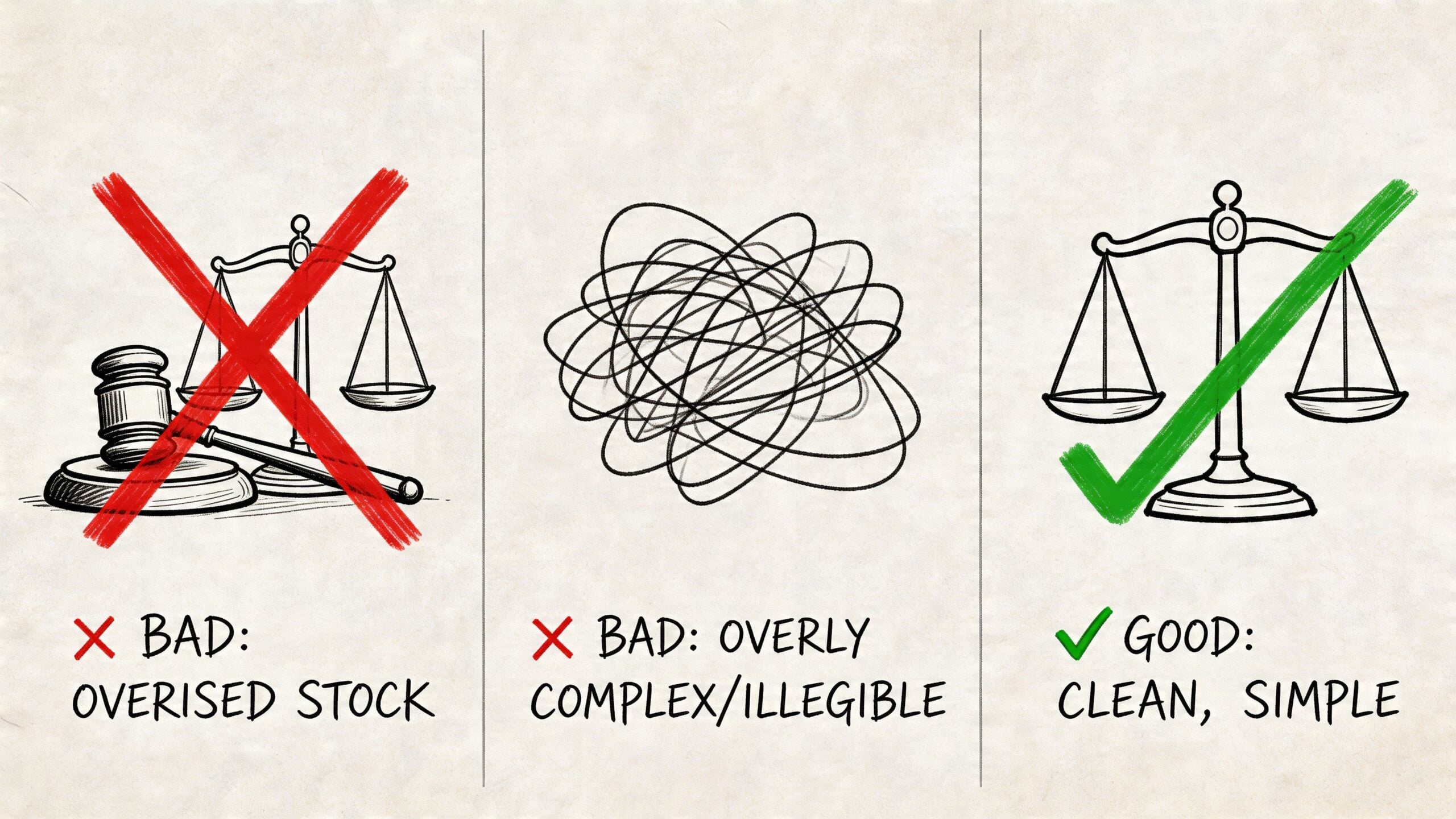
The gavel, the scales, the pillar, the shield. These symbols aren’t automatically wrong, but they’re often used as shortcuts. When firms rely on them without any strategic thought, the result feels dated and interchangeable. Instead of communicating judgement and professionalism, the logo starts to say, “we picked the first legal icon available”.
That matters because a logo is usually seen before a fee earner speaks to the client. It appears on the website header, the email signature, the proposal document, the office sign, the LinkedIn banner, and the invoice. In practice, it’s part of your opening statement.
A logo is a business tool, not decoration
Strong law firm branding does two jobs at once. It reassures people that the firm is serious, and it gives them a reason to remember that specific firm.
For legal practices, that balance is delicate. Too traditional, and the firm can look stiff or behind the times. Too modern, and it can lose the gravitas clients expect when the issue is their business, their property, their family, or their future. The best work sits in the middle. It feels established without looking trapped in another decade.
A law firm logo shouldn’t try to impress other lawyers. It should help a nervous client feel they’ve found a competent, credible firm.
That’s why visual choices need to be judged by effect, not taste. Partners often ask whether they personally like a logo. The better test is whether the intended client reads it correctly.
First impressions happen before anyone reads the website copy
Most firms already understand the value of a polished headshot because it shapes perception before a meeting starts. The same principle applies to the logo. If you’re thinking about making a winning first impression through visual branding, it helps to see the logo as part of that same trust-building system, not a separate design exercise.
A weak logo doesn’t always fail dramatically. Often it fails subtly. It blends into a crowded market, looks poor at small sizes, or sends the wrong message about the type of firm behind it. That’s enough to make a capable practice seem less established than it is.
Three warning signs usually show up early:
- It looks generic: remove the firm name and it could belong to any solicitor’s practice in the UK.
- It depends on clichés: it borrows authority from stock legal imagery instead of expressing the firm’s own position.
- It breaks across touchpoints: it works on a website header but not on signage, stationery, or social profile images.
A law firm logo matters because clients use visual cues to make fast judgements about professionalism. The firms that understand that don’t treat logo design as the finishing touch. They treat it as part of how the practice is perceived from the first glance.
Core Design Principles for Trust and Authority
Authority in a law firm logo rarely comes from legal symbols. In the UK, it comes from control. A logo has to read as credible on a website header, on a letter of engagement, on signage outside the office, and inside regulated communications where sloppy presentation can undermine trust before a fee earner has spoken to the client.
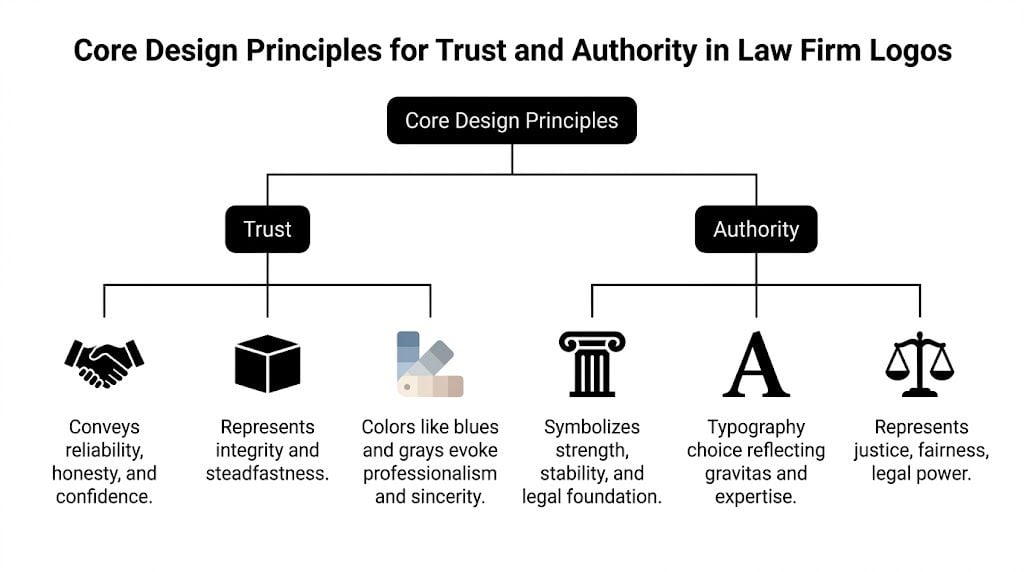
Colour should signal stability and professional judgement
Colour shapes expectation fast. For law firms, the safest palettes usually sit around navy, deep blue, charcoal, black, and restrained secondary tones because they support a perception of seriousness without looking dated.
That does not mean every firm should look the same. The real design decision is how to create distinction without creating doubt. A corporate practice can carry a cooler, sharper palette. A private client or family law firm may need warmer neutrals to feel more human. In both cases, contrast matters more than novelty. If the wordmark disappears on a mobile screen or on printed correspondence, the palette has failed.
There is also a UK compliance angle that generic logo advice often misses. The Solicitors Regulation Authority expects firms to present information in a way that is clear and not misleading. A colour system that makes status lines, disclaimers, or office descriptors hard to read creates a practical risk. Brand style should support legibility first and expression second.
Typography carries more trust than the icon
Partners often focus on symbols. Clients usually read the name first.
Type choice tells people whether the firm feels established, precise, contemporary, expensive, approachable, or careless. Traditional serif typefaces still work well for many firms because they echo the tone of formal documents and established institutions. A sans-serif wordmark can work just as well for a modern commercial or specialist practice, but only if the spacing, weight, and proportions are properly resolved. If those details are off, the result feels generic very quickly.
My usual approach involves pushing back on internal preference. The question is not whether the partnership likes a font in isolation. The question is whether the typography supports the firm’s market position and remains readable across every regulated touchpoint, from engagement letters to email signatures.
For firms reviewing concepts, it helps to understand visual hierarchy in graphic design, because hierarchy decides what the eye notices first, second, and last. In a law firm logo, that affects whether the client sees the firm name clearly, gets distracted by initials, or misses an important descriptor such as Solicitors or Family Law.
Symbols should earn their place
A symbol is optional. Clarity is not.
The strongest routes are usually simple:
- Wordmark first: best for firms whose full name already carries recognition or authority.
- Lettermark or monogram: useful where partner surnames make the name long, awkward, or hard to scale.
- Abstract supporting mark: helpful when it adds memorability without relying on gavels, columns, shields, or scales.
The trade-off is straightforward. A symbol can improve recall, but every extra element creates another opportunity for clutter, cliché, or misreading. I have seen firms choose ornate crests that looked impressive in a boardroom PDF and fell apart on social avatars, embroidered materials, and document footers. That is not a styling problem. It is a usability problem.
A stronger test is to strip the concept back. If the mark works in black and white, at small size, and beside required firm information, it has a better chance of surviving real use.
For firms refining these decisions across print, digital, and office materials, professional graphic design support for branding systems matters because the logo has to operate as part of a consistent identity. It needs to hold its shape across documents, web headers, social profiles, presentation decks, and signage without losing authority or clarity.
Real-World Examples What Works and What Doesnt
Theory is helpful, but most partners judge design by comparison. They look at one concept and say it feels right, or too cold, or too busy, or not serious enough. That instinct is valid. It just needs a framework.
The easiest way to assess logo design for law firms is to move from acceptable to exceptional.
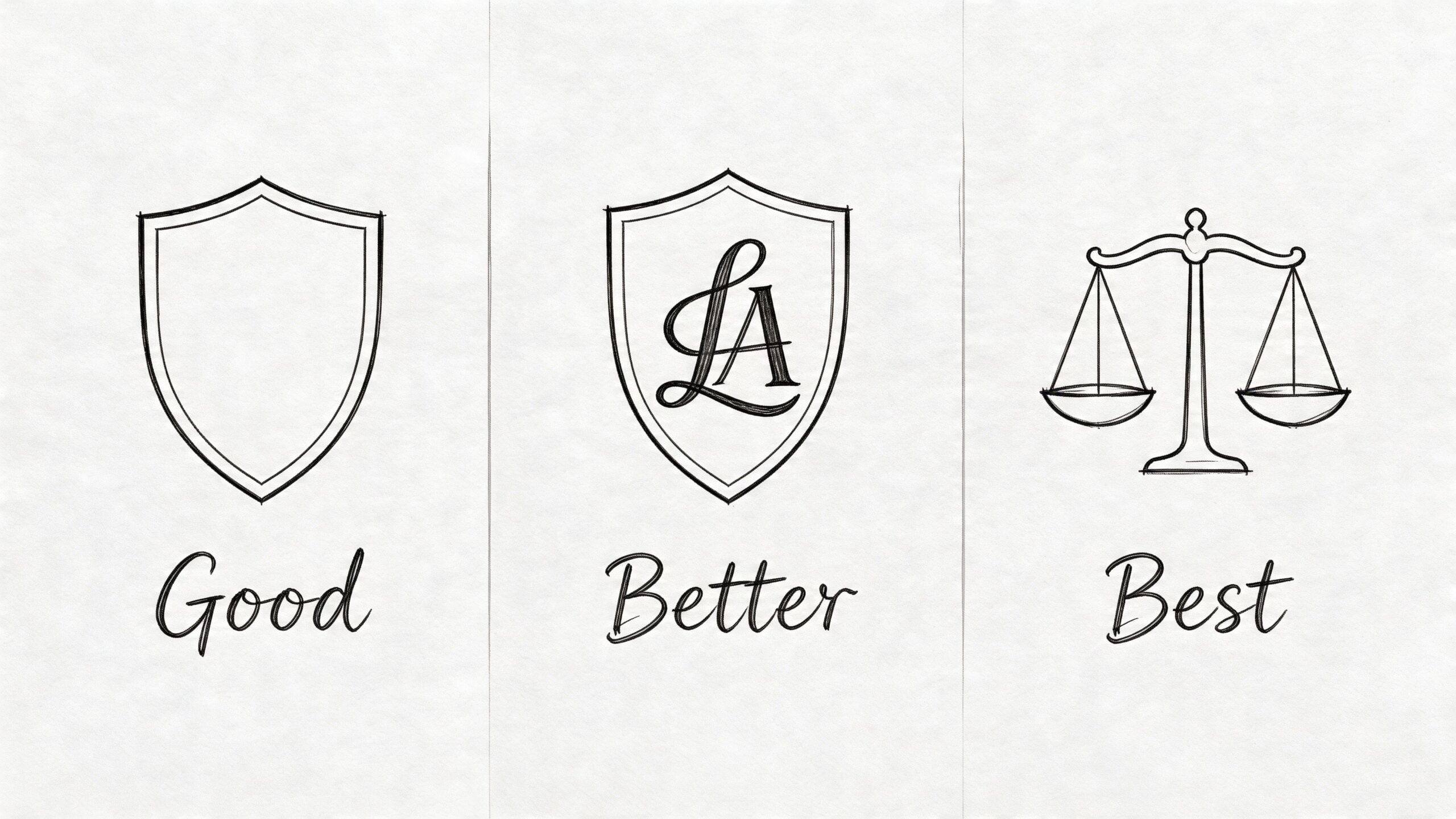
Good
A plain wordmark reading “Harrison Cole Solicitors” in a traditional serif, set in dark blue, with no icon.
This works because it doesn’t create confusion. It’s legible, professional, and easy to apply across stationery and a website header. For many established firms, that already puts it ahead of fussy competitor logos built from stock symbols and awkward spacing.
Where it falls short is memorability. There’s nothing wrong with restraint, but there is a difference between restrained and anonymous. If five firms in the same town use nearly identical typography and colour, clients won’t distinguish them easily.
Better
A partner-led firm called “AB & Co Solicitors” uses a custom monogram, paired with a refined wordmark and a disciplined amount of white space.
This is often a smarter route for firms with long names or multiple surnames. A monogram can simplify recognition, especially where the full trading name is cumbersome. The key is execution. A good monogram looks constructed, not decorative. It should feel like an identifying mark, not a wedding invitation.
What improves the outcome here is the relationship between symbol and type. The monogram supports recall, while the full name provides clarity. The design starts to look owned rather than assembled.
Best
A modern private client and property practice uses a custom wordmark with subtle letterform adjustments and a compact abstract mark based on structure and balance, not literal legal imagery.
The logo starts doing strategic work. The firm doesn’t need to shout “law” through clichés because the full identity already signals professionalism. The typography carries authority. The abstract mark creates recognition across favicon, sign, and social profile. The system feels considered.
The best law firm logos don’t explain the profession. They express the character of the practice.
A concept at this level usually succeeds because it solves several problems:
- It scales well: the mark stays clear at small sizes.
- It avoids visual clutter: there’s no dependence on fine detail.
- It differentiates: the identity feels specific to the firm, not the sector template.
- It ages well: the design isn’t driven by short-term trends.
What doesn’t work
A surprising number of logos still fail for basic reasons. The common weak examples tend to look like one of these:
| Type | Why it struggles |
|---|---|
| Stock scales icon plus generic text | It signals “legal” but says nothing about the specific firm |
| Crest with too many details | It collapses at small sizes and feels overstated |
| Thin sans-serif with pale grey palette | It can look neat, but lacks authority |
| Literal gavel icon | It often feels imported from generic US legal branding rather than grounded in UK practice |
The pattern is consistent. Weak logos either overstate authority through cliché, or understate it through minimalism with no substance behind it. The strongest concepts know exactly what the firm should feel like and remove everything that doesn’t help communicate that.
Avoiding Costly Mistakes and SRA Compliance Traps
The expensive part of a weak law firm logo is rarely the first invoice. It is the moment the firm starts using it everywhere and realises the identity creates practical and regulatory problems.
A mark can look acceptable in a presentation and still fail where it matters. Reception signage exposes poor line weights. Printed stationery reveals colour choices that never translated properly from screen to paper. A social avatar turns an intricate crest into visual noise. Then the variations begin. Different offices tweak the colours, fee earnners copy and paste stretched versions into documents, and the firm ends up with a brand system nobody can control.
That is why cheap creative work often costs more later. The same pattern shows up across digital projects, as explained in this piece on the hidden costs of cheap website design. Early savings disappear once the firm has to correct preventable mistakes under time pressure.
For UK firms, there is another layer of risk. The logo can create a misleading impression before a client reads a single line of copy.
The SRA is clear that publicity must be accurate and not misleading. That standard does not only apply to body text on a website. It applies to the overall impression created by your marketing, including name, positioning, and visual identity, as set out in the SRA's guidance on publicity and solicitors' websites. Generic legal branding advice from US agencies usually skips this point, which is exactly why firms get caught out.
In practice, the risk shows up in subtle design decisions. A pseudo-heraldic crest can imply public standing the firm does not have. A badge-style emblem can suggest accreditation or institutional authority. A descriptor built into the logo, such as "specialist", "expert", or a narrow practice claim, can create a burden of proof that the firm may struggle to support consistently across its services, offices, or regulated entities.
The designs that create trouble usually fall into four groups:
- Claims disguised as branding: visual or verbal cues that suggest the firm is pre-eminent, officially recognised, or uniquely authoritative.
- Implied specialism: marks that signal accredited expertise without clear evidence to support that impression.
- Official-looking symbolism: crests, shields, seals, pillars, crowns, or court-style motifs that borrow trust from institutions the firm is not connected to.
- Overstated heritage: logos that imply centuries of history, ceremonial status, or national significance beyond the firm’s actual profile.
I often use a simple test with law firm partners. If the logo suggests something your COLP or compliance lead would want qualified in writing, it is too aggressive for the identity.
That does not mean the answer is a bland wordmark. It means the authority has to come from choices you can defend. Strong typography, disciplined spacing, a restrained colour palette, and a mark built around the firm’s real position in the market will carry more weight than any borrowed legal symbol. A good logo should make the firm look credible, established, and clear headed. It should not hint at regulator approval, specialist status, or institutional prestige unless those signals are warranted.
How to Brief a Designer for a Successful Outcome
Law firm logo projects usually fail in the brief, not in the artwork. Partners ask for something "professional", the agency hears ten different interpretations, and the firm ends up reviewing concepts against taste rather than business criteria.
A useful brief gives the designer constraints they can work with and gives the firm a fair basis for approval.
Start with decisions the partnership has already made
Resolve the commercial position before anyone discusses typefaces, colour palettes, or symbols. A designer cannot produce a credible identity for a firm that has not agreed who it wants to attract or how it needs to be perceived.
Get alignment on five points:
- Target client mix. Private client, family, conveyancing, litigation, employment, owner-managed businesses, or larger corporate instructions.
- Market position. Established and traditional, modern and efficient, discreet and premium, local and approachable, or technically specialist.
- Red lines. Visual tropes, language, or stylistic directions the firm does not want associated with its name.
- Priority applications. Website header, signage, proposal documents, email signatures, LinkedIn, office frontage, or print.
- Final authority. One accountable decision-maker, or a small review group with a clear sign-off process.
This prevents the common law firm pattern where one partner is judging for heritage, another is judging for modernity, and nobody is judging for fit.
Build compliance into the brief from day one
For UK firms, generic logo advice proves inadequate. The brief should tell the designer about any SRA-sensitive points before concept work starts.
Include practical notes such as:
- whether the trading name differs from the regulated entity name
- whether the firm operates multiple offices or brands
- whether any descriptor could imply a specialism, accreditation, or official status
- whether the mark will sit alongside SRA numbers, regulated status wording, or company details on the website and stationery
- whether there are chambers, ABS, or group structure considerations that affect naming clarity
Designers do not need to become compliance officers. They do need enough context to avoid producing a mark that creates avoidable legal and regulatory questions later.
Use references to show direction, not to request a copy
Reference logos are helpful when they explain judgement. They are harmful when they become templates.
A good reference note sounds like this: "we like the restraint, spacing, and confidence of this wordmark." A poor one sounds like this: "use this structure but change the initials."
Ask the partnership to provide:
- Three to five reference identities
- One sentence on what each example gets right
- A short list of visual cues that feel wrong for your firm
- The exact firm name, descriptor, and any regulated wording likely to appear with the logo
- Known compliance concerns raised by the COLP, marketing lead, or managing partner
That level of direction gives the designer room to think while keeping the work anchored to the firm's real position.
Ask for deliverables that hold up in daily use
A law firm logo has to work across digital, print, and signage without degrading. That means requesting the right file types and usage rules at the outset.
The W3C's WCAG 2.1 guidance requires content to remain perceivable and readable across different contexts and screen sizes. In practice, that means your logo assets need to reproduce clearly, scale cleanly, and maintain legibility when used online. Vector formats such as SVG help with that because they scale without losing quality, unlike flattened image files.
Request, at minimum:
| Deliverable | Why you need it |
|---|---|
| SVG | Clean scaling for websites, portals, and digital interfaces |
| EPS | Print production, signage, and supplier handoff |
| PNG exports | Quick-use files for presentations, email signatures, and documents |
| Colour versions | Primary branded use |
| Black and white versions | Forms, invoices, and low-colour print situations |
| Small-size variant or monogram | Social avatars and restricted spaces |
| Basic brand guidance | Rules on spacing, colour use, background control, and misuse |
Also confirm ownership and licence terms. Firms are often surprised to learn that receiving logo files is not the same as receiving unrestricted rights to use them.
Set the review process before concepts arrive
The best identity projects have a disciplined approval structure. Without one, each feedback round gets broader, slower, and more subjective.
I usually recommend one lead partner, one operational stakeholder, and one person with compliance oversight. Everyone else can comment, but that small group decides. Set the number of concept routes, the number of revision rounds, and the criteria for approval before design starts.
If the logo project sits inside a wider site or rebrand programme, this guide to finding a website designer who understands your vision helps with the selection process. The principle is the same. Clear inputs produce better work.
A strong brief does not make the project rigid. It makes the outcome defensible, usable, and far less likely to create expensive confusion once the logo goes live.
Your Actionable Checklist for Evaluating a New Logo
Partners don’t need to become designers to judge a logo well. They need a clear test. The checklist below works for reviewing new concepts or assessing an existing identity that may no longer fit the firm.
Law Firm Logo Evaluation Checklist
| Criteria | Check (Y/N) | Why It Matters |
|---|---|---|
| Is it clearly legible at small sizes? | If the name or mark disappears in an email signature or social profile, the logo won’t work in daily use. | |
| Does it look distinct from local competitors? | A logo that blends into the regional legal market won’t help recall. | |
| Does it avoid obvious clichés? | Generic gavels and stock scales often weaken originality and can make the firm feel interchangeable. | |
| Does it feel appropriate for your actual clients? | A family-focused practice and a corporate advisory firm shouldn’t project the same tone. | |
| Does it work in black and white? | Many practical applications strip colour away. The structure has to survive without it. | |
| Is the typography doing real work? | Type should communicate professionalism and character, not just fill space. | |
| Can it scale across signage, print, and digital? | A logo has to hold together from small icons to large physical applications. | |
| Is the symbol necessary? | If removing the icon improves the design, the icon was probably decorative rather than strategic. | |
| Does it look current without chasing trends? | Law firms need longevity, not something that dates quickly. | |
| Would the compliance team be comfortable with the implied message? | A logo can create a misleading impression even when the text is technically accurate. | |
| Is there a usable system around it? | The best logo still needs practical variants for different contexts. | |
| Could a client describe it from memory? | Memorability is a better test than novelty. |
How to use the checklist properly
Don’t score in isolation. Print the concepts. View them on screen. Shrink them down. Remove the colour. Put them beside competitor logos. Most weak ideas reveal themselves quickly under those tests.
A useful internal review method is to ask three people different questions:
- The managing partner: Does this reflect the firm we are?
- The person responsible for marketing: Can we use this everywhere without workarounds?
- The compliance-minded reviewer: Does anything here imply more than we can support?
If a concept passes all three, it’s usually on solid ground.
One final test
Show the logo to someone outside the firm for five seconds, then ask what kind of practice they think it represents. Their answer won’t be perfect, but it will be revealing. If the intended positioning and the perceived positioning are miles apart, the design isn’t doing its job.
Your Logo Is Your First Argument
A law firm logo isn’t a decorative badge. It’s the first argument your brand makes on your behalf.
Before a client reads your credentials, understands your pricing, or speaks to a solicitor, they’ve already formed an impression from the identity in front of them. If that identity feels generic, dated, unclear, or overstated, the firm starts the relationship on the back foot. If it feels measured, credible, and well judged, trust begins earlier.
That’s why logo design for law firms deserves more rigour than most firms give it. The mark has to look right, work everywhere, and avoid saying anything the firm can’t support. It has to balance authority with clarity and professionalism with accessibility.
A proper review is worth the time. If your current logo feels inherited rather than intentional, that’s usually a sign to reassess it.
Frequently Asked Questions About Law Firm Logos
How long does a professional law firm logo project take
It depends on the number of stakeholders and how clear the brief is. A firm with one decision-maker and a defined brief usually moves much faster than a partnership trying to design by committee.
The delays rarely come from the software work. They usually come from unclear feedback, late input, or unresolved disagreement about positioning.
How much should a law firm budget for logo design
Budgets vary widely by provider, scope, and whether the work includes wider brand guidance. The more useful question is what the fee includes. A proper logo project should cover strategy, concept development, refinement, final artwork, and professional file delivery.
The cheapest quote often excludes the things that matter later, such as scalable formats, practical variants, and usage guidance.
Are online logo makers good enough for a solicitors practice
Usually not for firms that care about credibility, distinction, and compliance. Online tools can produce something fast, but they tend to rely on templates, generic symbols, and limited typographic control.
That may be acceptable for a temporary placeholder. It’s rarely good enough as a long-term identity for a regulated professional service.
Does a firm need a symbol, or is a wordmark enough
A wordmark is often enough. In many cases, it’s the better option. If the firm name is clear and the typography is strong, a symbol may add nothing.
Symbols become more useful when the firm has a long name, wants a compact social or favicon asset, or needs a recognisable mark for signage and repeated brand use.
Should we trademark the logo
That’s a legal and commercial decision rather than a design one. Many firms at least consider it if the identity is central to long-term brand investment or market differentiation.
The important point is to think about ownership early. Make sure the design is original, the rights are clearly assigned, and the firm understands what it can legally protect.
What should we receive at the end of the project
At minimum, you should receive professional master files, web-ready files, print-ready files, and practical variants for different uses. You should also know which version to use where.
If the handover consists of a single low-resolution image file, the project wasn’t finished properly.
If your firm’s current identity feels dated, generic, or risky from a compliance point of view, DesignStack can help you review it properly. As a Dorset-based digital agency working across branding, graphic design, and web design, the team focuses on practical identity systems that look credible online, in print, and in front of clients.

Leave a Reply