
Local Citation Building Made Simple for UK Businesses
31% of the top 10 organic results for the average UK local search are business directories, according to BrightLocal's UK citation resource. That should change how you think about local citation building. It isn't just a matter of adding your business to a long list of websites. The right listings help search engines verify who you are, where you operate and whether your business details can be trusted across local search surfaces.
A citation is any online mention of your business details, usually its name, address and phone number, known as NAP. The practical work involves finding existing mentions, correcting errors, claiming important profiles, creating relevant listings and maintaining the information when your business changes.
Table of Contents
- Why Local Citations Still Drive Visibility for UK Businesses
- Getting Your NAP and Citation Template Ready Before You Build
- How to Audit Existing Citations and Prioritise What to Fix First
- Choosing Where to List and How to Submit Without Wasting Time
- Cleaning Up Duplicates and Keeping Citations Accurate Over Time
- Your Local Citation Building Checklist and Next Steps
Why Local Citations Still Drive Visibility for UK Businesses
A typical citation problem starts innocently. A business moves premises, changes its phone system or shortens its trading name. Google Business Profile gets updated, but an old address remains on a directory, a chamber page still shows the previous phone number and a map provider has a duplicate listing. Customers see conflicting information. Search engines have to decide which version is reliable.
That confusion is why citation building still matters for UK SMEs. Directories occupy a substantial share of local organic results, and search engines use business references across the web to corroborate legitimacy and location. BrightLocal's UK guide to citation sites groups citation opportunities by authority and relevance, which supports a focused approach rather than indiscriminate submission.
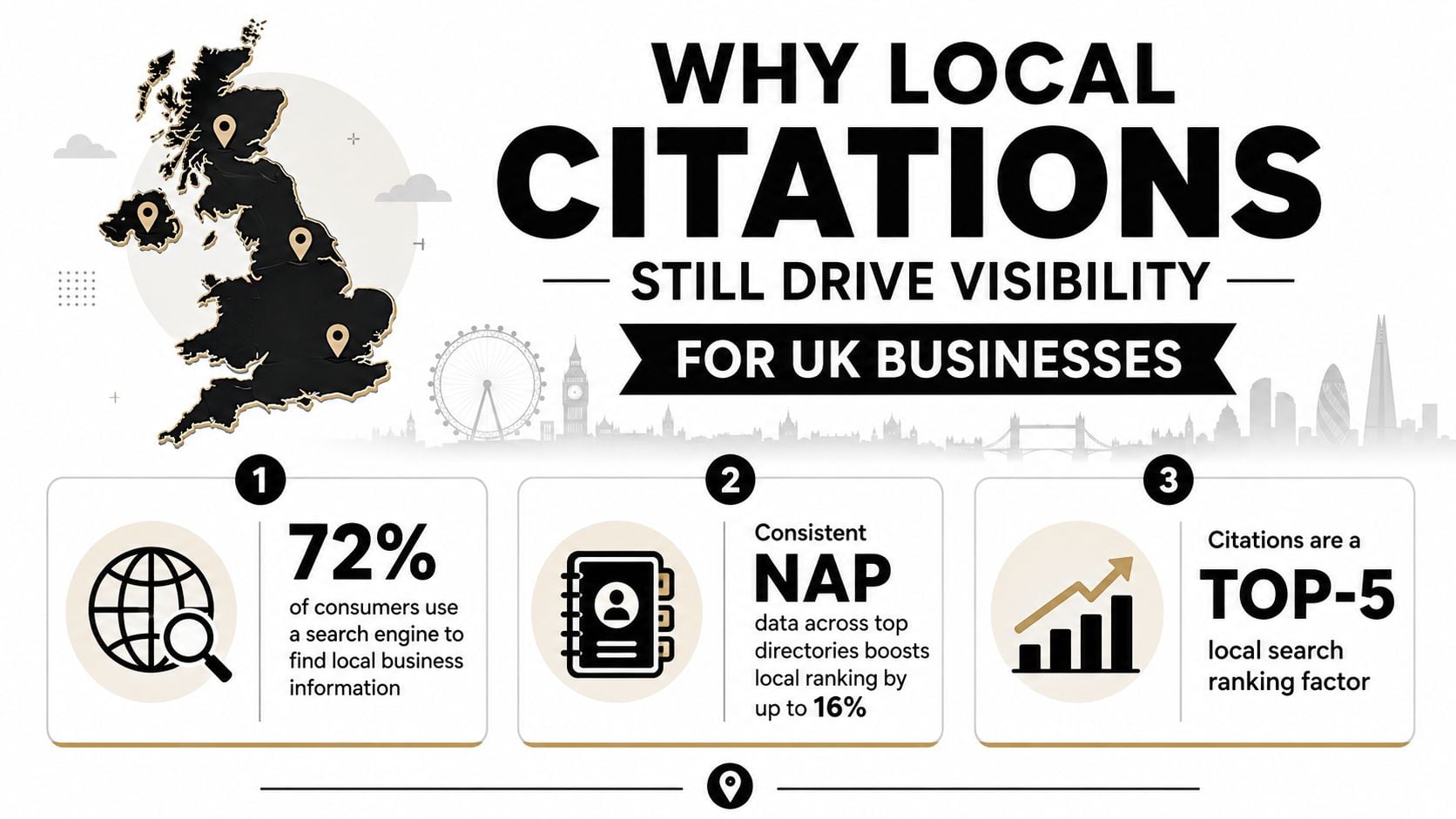
Citations are more than directory entries
A traditional directory can help a customer discover a plumber, solicitor, café or retailer. But local business data also travels through larger systems that feed maps, search databases and recommendation interfaces. That makes the important question less about how many profiles you can create and more about which sources can influence several discovery surfaces at once.
Traditional UK directories such as Yell, Thomson Local, FreeIndex and Scoot can still support human discovery, particularly when the listing is complete and relevant to the business. At the same time, upstream providers and map platforms can affect how business information is interpreted elsewhere. UK citation guidance from InvoNexT highlights this shift towards understanding the data sources behind map and AI-driven local recommendations.
Practical rule: Treat every citation as part of your business's public data record, not as an isolated backlink.
Quality beats volume. A UK analysis of more than 122,000 businesses reported that top-ranked local businesses averaged 86 citations, compared with 75 for businesses ranking in positions 7 to 10. The same source stresses that 50 accurate, regularly maintained citations can outperform 200 scattered listings containing errors or outdated details. Those figures don't create a universal target, but they do demonstrate why accuracy and relevance should lead the process.
For a wider introduction to local visibility principles, the Morristown small business guide offers useful context on how local businesses can build a stronger presence online. UK businesses can also use DesignStack's local SEO guidance when connecting citations with their broader website and search strategy.
Getting Your NAP and Citation Template Ready Before You Build
Before submitting a single listing, create one master document containing the exact business information you want published. This document becomes your source of truth. Without it, small differences creep in quickly, especially when several people handle submissions or updates.
Start with the legal or customer-facing business name you use consistently. Do not add extra keywords to the name field just because a directory allows it. A listing called “Smith & Sons Plumbing” shouldn't become “Best Emergency Plumber Smith & Sons Plumbing Dorset” unless that is the genuine trading name.
Build the core business record
Include the following fields in your template:
- Business name: Use the canonical trading name, including punctuation and capitalisation.
- Address: Decide how you'll format the building number, street, town, county and postcode.
- Phone number: Select one preferred presentation, such as the UK local format or the international +44 format, then use it consistently.
- Website: Record the correct homepage or the most relevant location page.
- Opening hours: Include standard hours, holiday arrangements and appointment-only notes where applicable.
- Primary category: Choose the category that best describes the main service, rather than a broad category selected for convenience.
- Additional categories: Record approved secondary categories so different team members don't improvise.
- Business description: Prepare a short, factual description that explains what you do and where you serve customers.
- Images: Keep approved logos, exterior photographs, team images and service photographs in a clearly labelled folder.
The address needs extra care when the business operates from a shared premises. Decide whether the suite or unit identifier is part of the address customers use, and apply that decision consistently. If the business serves customers at their location rather than welcoming visitors, document the service area separately from the registered address. Don't create fake addresses in towns where you have no staffed location.
Remove ambiguity before it spreads
Record variations that staff should avoid. For example, note whether the phone number should contain spaces, whether the address uses “Road” or “Rd”, and whether the business name includes a trading suffix. These details may look minor, but a repeatable format prevents avoidable inconsistencies.
Your template should also include ownership information. Store the login email, verification status, profile URL, last update date and notes about pending changes. Keep access secure, and don't rely on a former employee's personal email account.
A clean template saves more time than a fast submission. Every mistake copied into a directory becomes another record to find and correct.
A written style guide for business communications can support this process by documenting approved wording, visual assets and brand conventions. Citation work sits alongside branding, so the same discipline helps keep your name, descriptions and images recognisable across platforms.
How to Audit Existing Citations and Prioritise What to Fix First
An audit should come before new citation building. Creating more listings while old records contain conflicting information spreads the problem and makes it harder to identify the original source of an error.
A practical UK workflow is to audit 50 to 100 or more directories, as recommended in this UK local directory workflow. Export the results into a spreadsheet and record the listing URL, platform, business name, address, phone number, website, category, duplicate status, ownership status and required action.
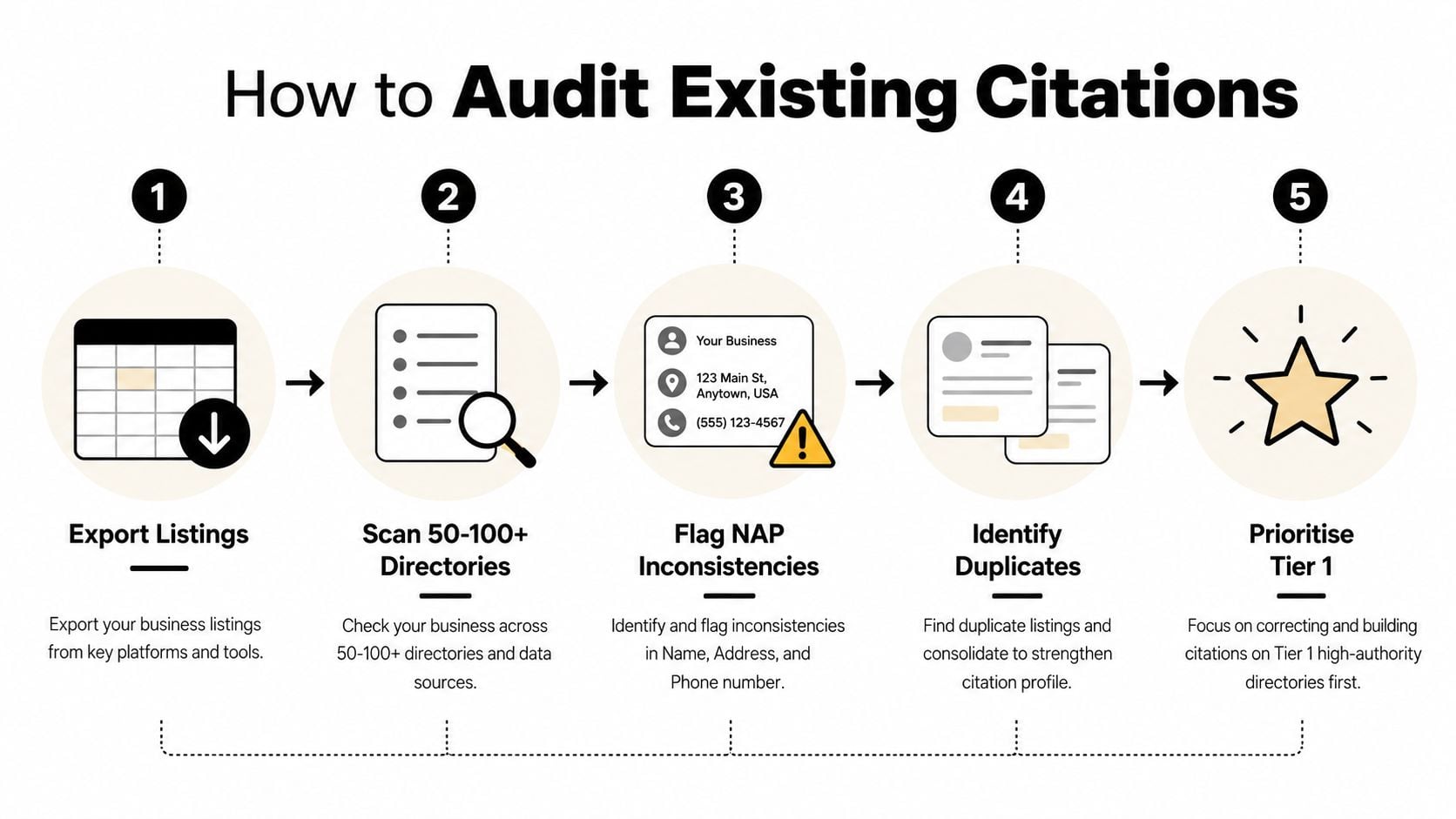
Search for the errors that matter
Use exact searches for the current and historic versions of the business details. Search the business name with the town, postcode, old phone number and previous address. Search engines may surface listings you won't find through a directory's internal search.
Mark each record using clear statuses:
| Status | What it means | Action |
|---|---|---|
| Correct | Details match the master template | Monitor |
| Inconsistent | One or more core fields differ | Correct |
| Duplicate | More than one profile represents the same business | Request a merge or removal |
| Unclaimed | The profile exists but no one controls it | Claim and verify |
| Irrelevant | The listing is unsuitable, closed or clearly low value | Assess removal or suppression |
Don't treat every error as equally urgent. A typo on an obscure directory isn't the same as a wrong address on Google Business Profile or Apple Maps. Fix the records that customers and data systems are most likely to encounter first.
Prioritise upstream platforms
The Tier 1 group should normally include Google Business Profile, Bing Places, Apple Maps, Yell, Thomson Local, FreeIndex and Scoot. UK citation audit guidance recommends this sequencing because consistency on important platforms acts as a trust signal for Google Maps and local results.
This is also where formatting errors can multiply. If one source passes an old phone number to another platform, correcting a downstream listing won't solve the upstream problem. Identify the earliest or most authoritative record you can control, update it, then monitor related profiles.
The audit should show patterns, not just isolated mistakes. A business that has the wrong suite number across several platforms has a template problem. A business with duplicate profiles after moving premises has a change-management problem. Diagnose the cause before assigning more submissions.
For a broader technical review of the website and its search foundations, you can use DesignStack's SEO audit resource. Citation findings should sit in the same action plan as location pages, Google Business Profile work and conversion issues.
Use this video as a practical visual aid while reviewing the workflow:
Choosing Where to List and How to Submit Without Wasting Time
Once the audit is complete, divide targets into two groups. Traditional directories help people discover a business. Authoritative data providers and map platforms supply information that search systems can interpret and distribute across Google Maps, Apple Maps, Bing and AI-generated local answers.
The distinction affects both priority and workload. A niche directory may bring qualified visitors because its audience matches the business. A data provider may influence several downstream services, even when customers never visit the provider's own site. The strongest citation plan uses both where the evidence supports them.
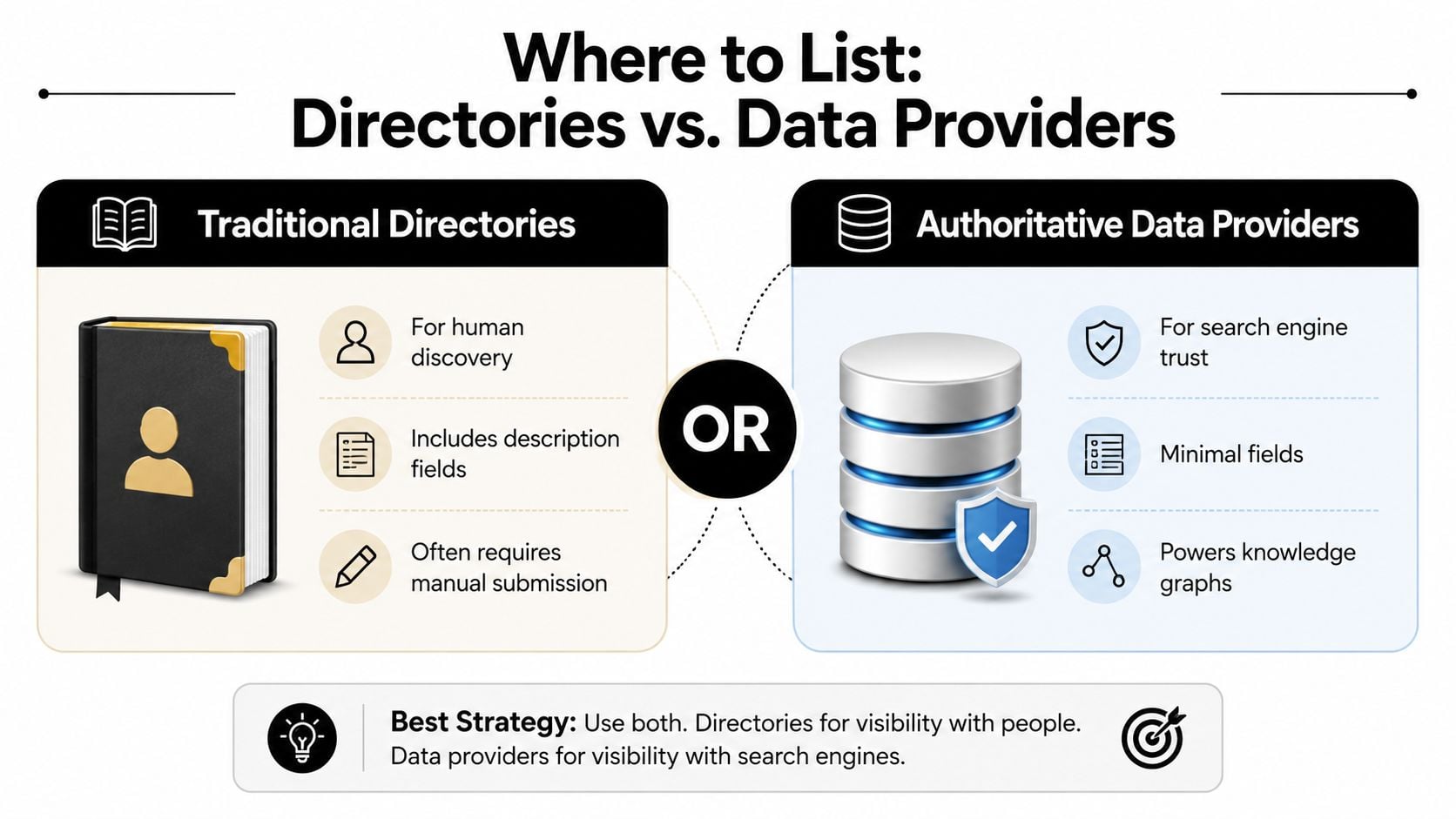
Choose sources by influence and relevance
Use traditional directories when they have a genuine audience or clear local value. Yell, Thomson Local, FreeIndex and Scoot can be sensible options for many UK firms, but industry and location should determine the final list. A trade association, local chamber, professional body or recognised sector directory may contribute more than a generic site with no identifiable audience.
Give upstream data sources separate consideration. Recent UK citation coverage identifies Foursquare as a source increasingly used by AI search tools for local recommendations. That does not justify submitting to every available platform. It does justify checking which records support the surfaces customers use, such as Apple Maps, Bing and AI-driven local answers.
A practical filter keeps the list focused:
- Customer relevance: Would a genuine prospect use this platform to find a provider?
- Geographic relevance: Does it cover the town, county or wider UK market?
- Data influence: Does it feed or support a map, search or recommendation system?
- Editorial quality: Does it maintain credible, usable business records?
- Maintenance burden: Can the team keep the profile accurate?
Compare submission methods
Manual submission provides the clearest control. Each field can be checked, descriptions can be adjusted to fit the platform, and verification problems can be handled as they arise. The cost is staff time and repeated entry, especially when platforms request similar information in different formats.
Automated submission reduces repetitive work and can extend coverage, but the business then depends on the provider's database, update cycle and treatment of unusual UK address formats. Automation does not replace review. It can distribute an incorrect phone number as efficiently as a correct one.
A hybrid approach often fits time-limited SMEs. Complete priority profiles and important industry listings manually, then use a reputable service for suitable secondary platforms. Keep the master template under your control, and retain submission records showing which fields were sent, where they went and when changes were made.
| Approach | Main strength | Main risk |
|---|---|---|
| Manual | High control and clear verification | Slow, repetitive work |
| Automated | Efficient distribution | Less control over fields and updates |
| Hybrid | Balances control with scale | Requires organised oversight |
Submission volume matters less than verification and maintenance. UK-focused citation guidance covers tiered priorities, controlled submission velocity and ongoing upkeep. Set a manageable rhythm that gives the team time to verify listings, store credentials and correct failed submissions.
For Google Business Profile work, DesignStack's free GBP optimisation guidance can support the citation plan. Complete and accurate profile information should be in place before spending time on directories with weaker influence. This approach concentrates effort on sources that can affect several search and map surfaces, rather than rewarding a high submission count on its own.
Cleaning Up Duplicates and Keeping Citations Accurate Over Time
Duplicate listings usually come from a recognisable business event. A company moves, changes its name, switches phone providers, opens a second location or shares a building with another firm. Sometimes an employee creates a new profile because they can't access the old one. Each event can leave a stale record behind.
Start by comparing the duplicate profiles against your master template. Check the address, phone number, website, photographs, reviews and creation history. If both profiles represent the same location, use the platform's merge or duplicate-reporting process instead of creating another listing to compete with them.
Resolve duplicates with evidence
Platforms handle duplicates differently. Some allow a merge request, some provide a removal form and others require verification through an account or support channel. Prepare evidence before contacting support, including the correct profile URL, the duplicate URL, proof of the current business details and an explanation of which profile should remain.
Don't remove a profile just because it has fewer reviews or looks less complete. First confirm which record is verified, which one uses the canonical details and which one has the strongest history. The wrong removal can create more work and may cause valuable customer information to disappear.
Keep a change log with:
- Date of request: Record when you contacted the platform.
- Old details: Note the previous name, address or phone number.
- New details: Copy the approved version from the master template.
- Profile links: Store both the retained and duplicate URLs.
- Outcome: Mark the request as completed, rejected or awaiting review.
Make maintenance part of operations
Review the important profiles whenever opening hours, services, contact details or premises change. Don't wait for customers to report a problem. A stale holiday schedule or old phone number can send ready-to-buy customers in the wrong direction, even when your website is correct.
A lightweight routine works better than occasional panic. Assign one person to check priority profiles, review new duplicate discoveries and update the change log. Re-audit after a rebrand, relocation or phone-number change, then inspect secondary directories once the upstream records are stable.
Maintenance beats accumulation. A smaller citation set that stays accurate is more useful than a larger set nobody owns.
Businesses that need help connecting listings with wider website and marketing activity can review DesignStack's digital marketing support for local businesses. The important point is ownership. Citation accuracy shouldn't depend on an undocumented task that disappears when responsibilities change.
Your Local Citation Building Checklist and Next Steps
Local citation building works best as a controlled data process. You create one accurate record, audit what already exists, fix the highest-impact sources, add only relevant listings and maintain the information when the business changes.
The most common waste comes from reversing that order. Businesses submit to every directory they can find, overlook a duplicate Google profile, use different phone formats and then assume more listings will repair the inconsistency. They won't. More records can make diagnosis harder when the underlying source data is wrong.
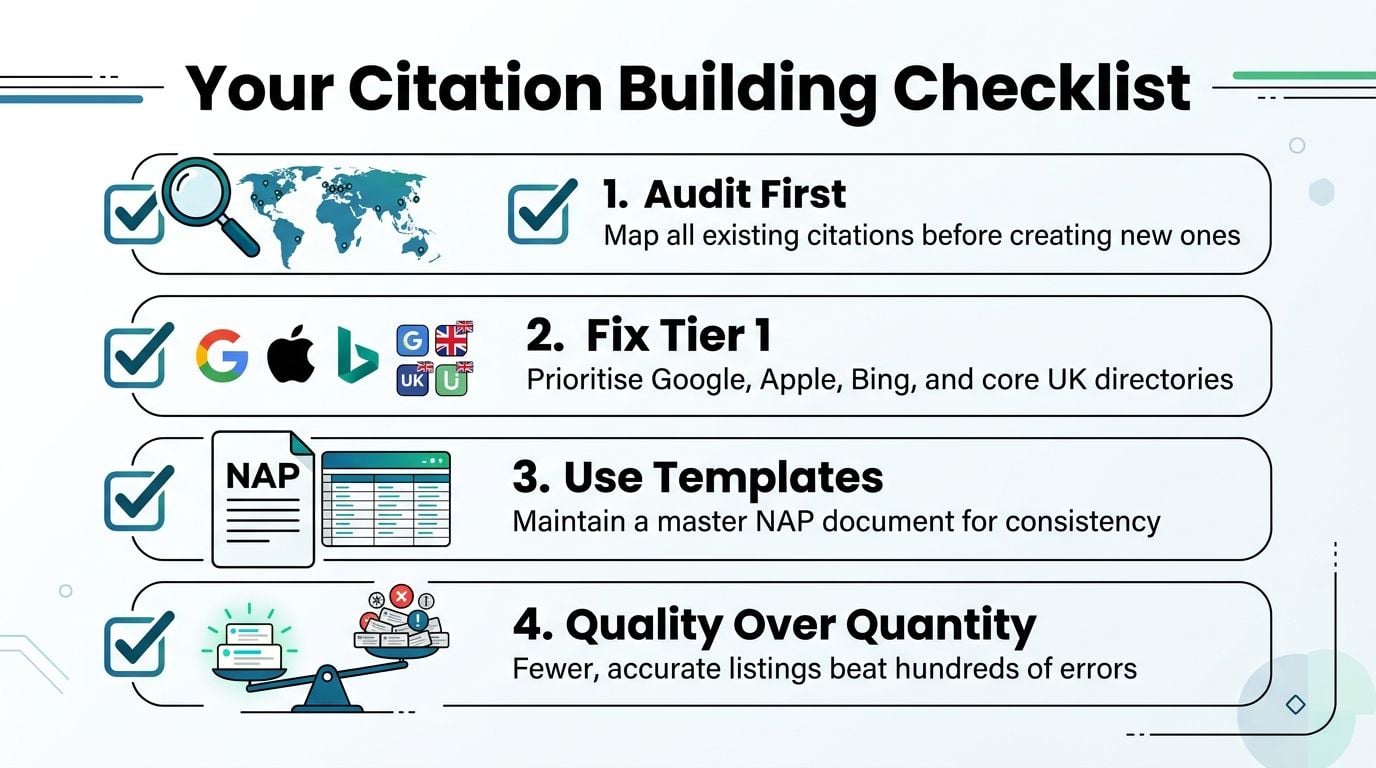
Use a repeatable working checklist
- Audit first: Map existing listings before creating new profiles, including old names, addresses and phone numbers.
- Fix Tier 1: Prioritise Google Business Profile, Apple Maps, Bing Places and core UK directories before secondary opportunities.
- Use templates: Keep the approved NAP, hours, categories, descriptions and image references in one controlled document.
- Choose relevant sources: Prefer directories, associations and data providers that support customer discovery or wider search visibility.
- Remove duplicates: Request merges or removals and document the outcome rather than opening another listing.
- Review changes: Update citations promptly after a move, rebrand, phone update or change to opening hours.
- Track ownership: Record profile URLs, access details, submission dates and unresolved issues.
Keep the routine manageable
Set aside a regular maintenance session to check priority listings, scan for new duplicates and compare important fields with the master template. After a significant business change, treat citations as part of the launch checklist, alongside the website, email signatures, signage and customer communications.
Measure progress through practical signals rather than a vanity count of directory entries. Look for fewer conflicting records, accurate map information, completed verification tasks, stronger profile coverage and clearer customer journeys. Citation work supports local visibility, but it should sit alongside a useful website, relevant service information and a credible Google Business Profile.
The right question isn't “How many listings do we have?” It's “Can customers and search systems find one accurate version of our business?”
Start with the audit spreadsheet, correct the master record and work through the most influential platforms in a controlled order. That approach gives a small UK business a process it can repeat without turning local SEO into an endless submission exercise.
DesignStack can help you align your website, local SEO foundations and citation information so customers encounter consistent business details across search and local discovery platforms. Visit DesignStack to discuss a practical website, SEO or branding project for your business.