SEO for Service Businesses That Actually Wins Local Work
The plumber in Cardiff has a polished website, professional branding and a gallery of excellent work. Yet when a homeowner searches for an emergency plumber nearby, the calls go to a competitor whose website looks dated and whose service pages barely deserve the name.
The difference usually isn't design. The competitor appears in the local results, carries a steady stream of recent reviews and sends searchers to a page that answers the urgent question immediately. SEO for service businesses is not a traffic contest. It's a sales pipeline. Every optimisation should help generate an enquiry, phone call, quote request or booking.
Table of Contents
- Why Service Businesses Need a Different SEO Playbook
- Google Business Profile and Local SEO Foundations
- Service Pages That Rank and Convert
- Reviews and Citations as the Trust Layer
- Content and Blogging Plan for Buyer Intent
- Technical and On-Site Checklist for Service Sites
- Measuring Results, Budgets and Your Launch Checklist
Why Service Businesses Need a Different SEO Playbook
A service business doesn't sell from a product catalogue. It sells confidence at the moment someone has a problem.
A Cardiff plumber, Dorset solicitor or local landscaping firm competes inside a tight geographic market. Customers want someone who serves their area, understands their situation and can respond quickly. They aren't comparing dozens of ecommerce products. They're deciding which business feels credible enough to contact.
That changes what deserves attention. A national content campaign might bring visitors from places you don't serve. A beautifully written blog post might attract readers who have no intention of buying. Meanwhile, a complete Google Business Profile, a recent review mentioning the right service and a well-matched location page can put your business in front of someone ready to act.
The UK SEO and internet marketing consultancy industry was estimated at £24.6 billion in revenue for 2025-26, following five years of 6.6% compound annual growth, with 35,088 businesses in the sector, according to the UK SEO Industry Report. That scale matters because search visibility is now a mature commercial channel, not an experimental add-on for service firms.
Rankings are only useful when they create movement
A ranking has value when it puts a customer closer to your phone number, booking form or quote request. If it doesn't, it may be an interesting metric rather than a business result.
For most local service firms, the practical order of importance is:
- Discovery: Can the customer find you in Google Search and Maps?
- Relevance: Does your profile or page match the exact service and location?
- Trust: Do your reviews, credentials and examples remove doubt?
- Action: Can the customer call, book or request a quote without friction?
- Measurement: Can you connect that action to organic search?
Local pack visibility is especially important. UK local-search data reports that the local pack appears on 95.6% of trades queries and on more than 90% of searches across most local-service sectors studied, as reported in UK local SEO statistics for 2026. Google also holds over 90% of the UK search market, so Google Search and Google Business Profile deserve priority before you spend time chasing obscure platforms.
Practical rule: Stop asking, “How do we rank for more keywords?” Ask, “Which search should produce our next profitable job?”
The playbook that follows starts with local visibility, builds pages for high-intent searches, strengthens trust and tracks the actions that lead to revenue.
Google Business Profile and Local SEO Foundations
Start with Google Business Profile because it connects your business to local discovery, calls, website visits and directions. A UK SME study found that 78% of surveyed businesses identified GBP optimisation as their highest-ROI channel, while fully optimised profiles generated 3.2 times more website visits from local searches than incomplete profiles. Those findings are reported in the UK SME SEO report.
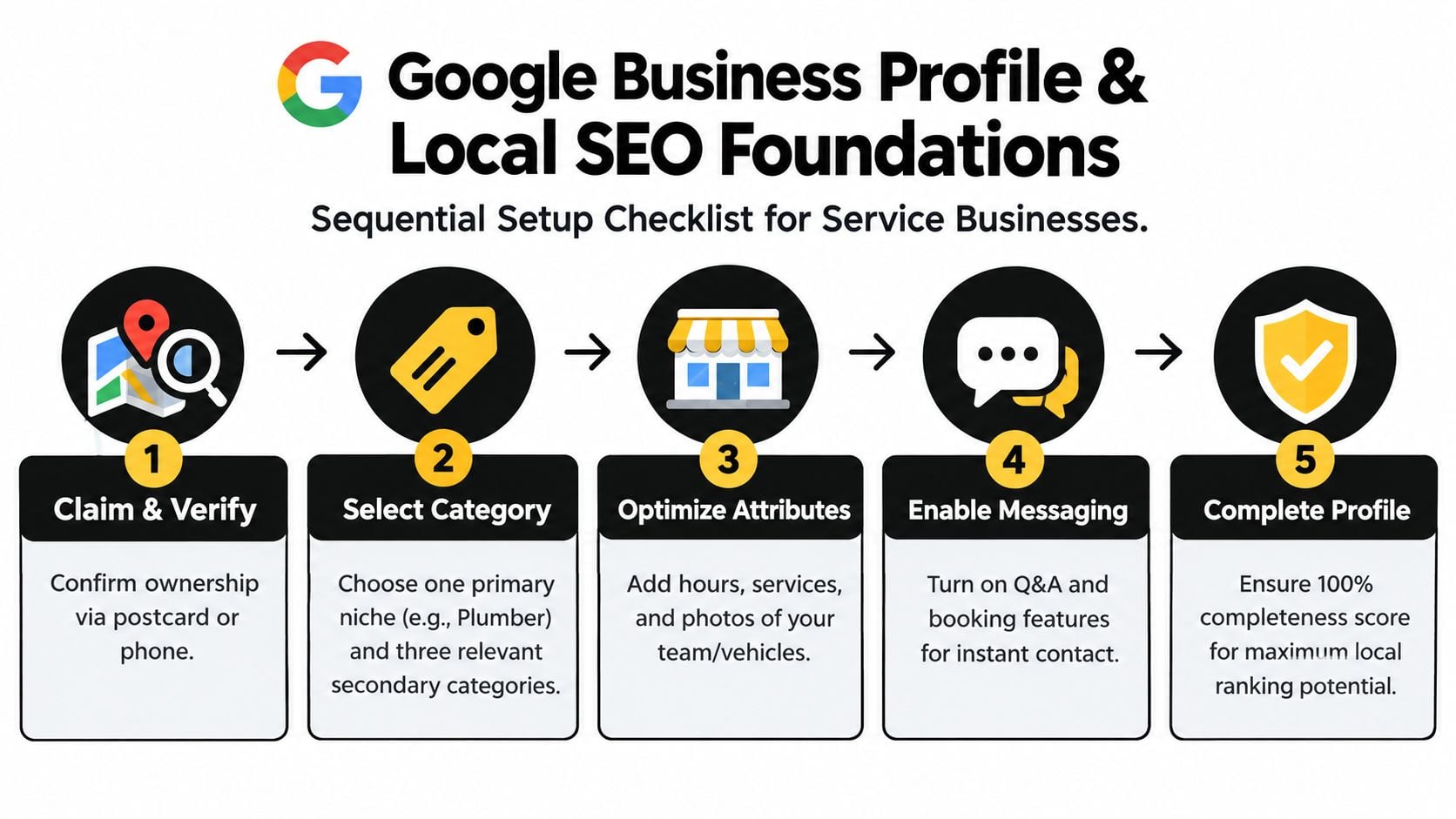
Complete the profile in the right order
Claim and verify the listing. Confirm ownership and use the actual trading location or permitted service-area setup. Your completion test is simple: the correct owner has access and every core field is populated.
Choose the category that describes the main service. A plumber should normally lead with plumbing rather than stacking unrelated categories. Add only relevant secondary categories. Category selection should reflect what you sell, not every service you hope to attract.
Write a useful description. Explain who you help, what you do and where you work. Include service language naturally, without repeating locations or forcing keywords. Add service menus, opening hours, holiday updates, attributes, FAQs and a clear booking or call route.
Define service areas accurately. List the towns and areas you genuinely cover. Create matching website pages only where you can provide a useful, distinct service, not thin pages that swap one town name for another.
Add evidence of real work. Upload photographs of your team, vehicles, premises and completed projects. Keep the profile active with a weekly photo cadence and regular updates. Audit completeness monthly, because an abandoned profile quickly becomes less useful to customers.
A useful reference for specialist service providers is this guide from Bornbir for doulas, which shows how a focused service profile and website can address the precise questions a local client asks.
Make the wider local footprint consistent
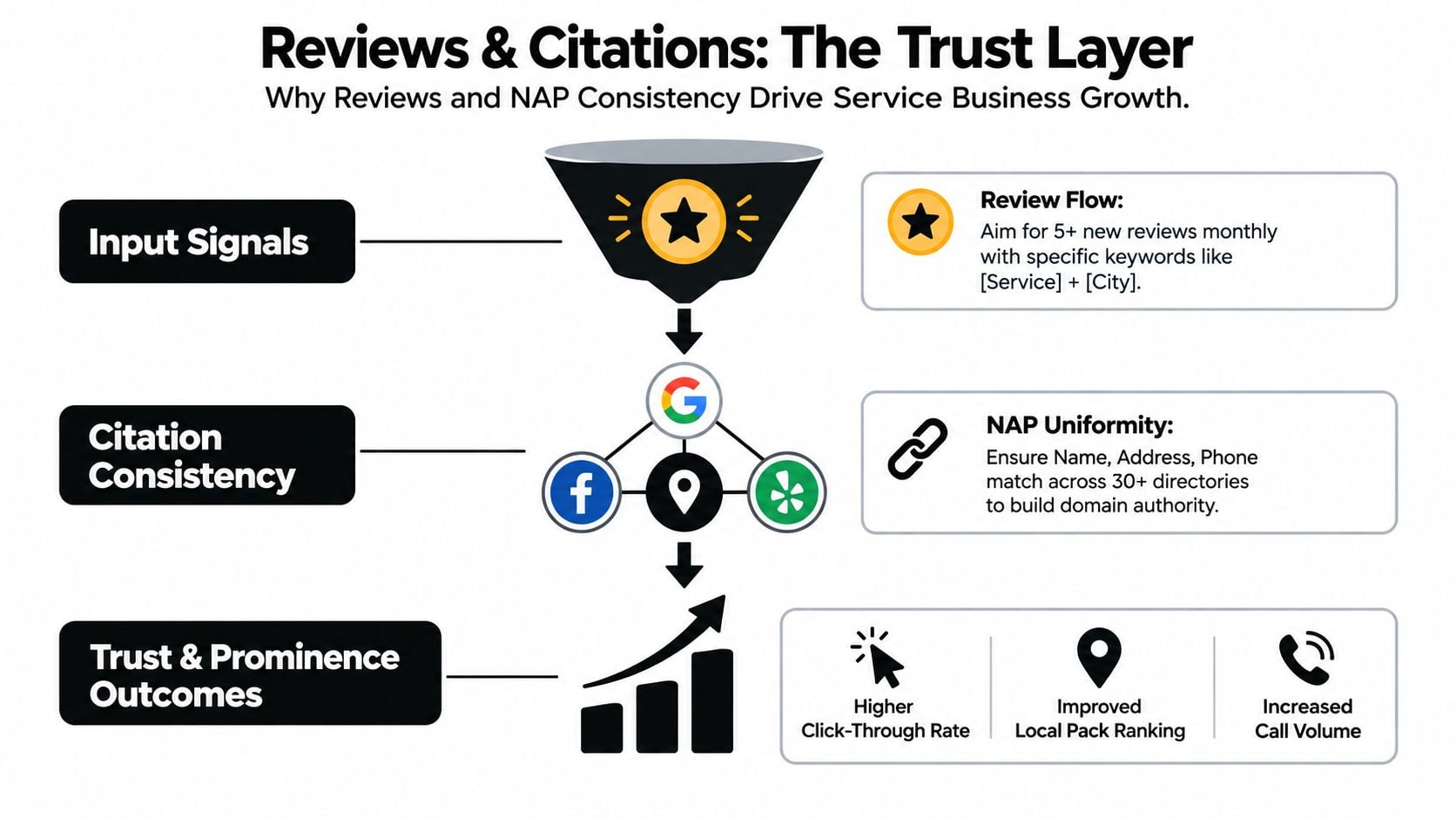
Your business name, address and phone number should match across your website, Google profile and important UK directories. Run an audit of 15 core listings and make the pass condition absolute, no conflicting names, old numbers or outdated addresses.
Connect the profile to a relevant service page rather than a generic homepage. Add tracked booking and call links so you can distinguish profile activity from other organic traffic. If you need a broader foundation, use this local SEO guide for businesses alongside your listing audit.
Google's local results are commonly understood through relevance, distance and prominence. Improve relevance with accurate categories and service details, distance with a legitimate location and clearly defined service areas, and prominence with reviews, citations, useful content and recognised local authority. Don't use virtual offices or stuff keywords into the business name. Those shortcuts create risk and rarely build durable visibility.
Service Pages That Rank and Convert
A homeowner searching for an urgent repair, a new installation or a design consultation is already close to contacting a provider. Your service page must turn that intent into an enquiry, call or booking by answering two questions quickly: “Can you solve my problem?” and “Should I contact you?”
Build the page around the service and location in a benefit-led H1. Then describe the customer's problem in plain language. “We provide professional services” creates no buying confidence. “Create a low-maintenance garden in Dorset with a planting and paving plan built around how your family uses the space” gives the visitor a clear outcome and a reason to continue.
Put decision-making evidence near the top. Show relevant reviews, accreditations, experience, areas served and a real photograph where these details support the choice. Explain the process from first contact to completion. State how quickly you respond, what information you need and whether you handle the customer's type of property or problem. Clear expectations remove friction before the visitor reaches the form or phone number.
Compare the page a customer sees
| Element | Weak version | Strong version |
|---|---|---|
| Heading | “Our Services” | “Emergency Boiler Repairs in Weymouth” |
| Opening | Generic company introduction | Direct explanation of the problem and next step |
| Trust | “Quality guaranteed” | Relevant review, qualification or completed-work example |
| Process | No explanation | Clear stages from enquiry to completion |
| Pricing | Hidden behind a form | Honest factors that affect the quote |
| CTA | “Submit” | “Call for emergency advice” and a specific quote form |
| FAQs | Questions written for keywords | Real questions from calls and enquiries |
| Location | One generic page | Useful local detail without duplicated copy |
Use LocalBusiness and Service schema to identify your business, services, areaServed and, where appropriate, priceRange. Add FAQPage markup only when the questions and answers appear visibly on the page and help customers decide. Schema can clarify page meaning for search engines, but it will not compensate for vague copy or a weak offer.
Build a connected service architecture
Link relevant blog posts to the service page they support. Connect related services, such as boiler servicing and boiler repairs, when the links help a customer choose the next step. Keep each town page distinct with local proof, service details and customer concerns. If two pages provide substantially the same information, consolidate them or use a canonical approach instead of publishing near-duplicates.
Use this practical resource on how to write website copy to make the page clearer and more customer-focused. For services involving visual planning, link to this guide on garden design software for homeowners. The supporting article serves an early research need, while your service page should make the commercial next step clear.
End with a choice of actions. Put a visible phone number, form or booking option where mobile visitors can use it easily. Repeat the primary call to action after the process, proof and FAQs, so a customer who is ready to act does not need to search for the next step.
Reviews and Citations as the Trust Layer
Reviews aren't decoration. For local service businesses, they help customers decide whether your business deserves the call, and they contribute to the prominence signals that separate similar providers.
Recent UK-focused analysis says local prominence is increasingly influenced by verified review count, recency and reply cadence. A well-reviewed business several miles away can outrank a nearby competitor with a weak reputation, as discussed in this analysis of reviews and local SEO for service businesses. That makes reviews a commercial system, not an occasional request made by whoever remembers.
Build a review routine customers can follow
Ask after a clear success point, such as a completed repair, approved design or satisfied handover. The person closest to the customer should make the request, because the message feels personal rather than automated. Give the customer a direct review link and ask them to describe the service and location naturally, without scripting praise or offering an incentive.
Reply to every review. Thank people for specific details, acknowledge the outcome and answer criticism calmly. A negative review needs a factual response and an attempt to resolve the issue privately, not an argument in public.
Google matters most for local discovery, but relevant industry directories, professional bodies and trusted local platforms can reinforce credibility. Prioritise places your customers use and those that accurately represent your service.
Clean citations by business risk
Start with the listings that carry the wrong phone number, address or business name. Then correct major UK aggregators, trade directories and professional listings before lower-value profiles. Keep one approved version of your NAP details in a shared document, and record who owns each correction.
A small team can manage this with a simple cadence:
- First 30 days: Fix the worst inconsistencies and introduce a post-job review request.
- Next 60 days: Monitor new reviews, reply consistently and update important service details.
- By 90 days: Review the profile, citations and enquiry data, then assign an owner to maintain the system.
More blog posts won't compensate for a business that customers don't trust when they reach the map results.
Content and Blogging Plan for Buyer Intent
Service-business content should come from sales conversations, not a calendar filled with invented themes. The best subjects are the questions customers ask before they commit: what a service costs, whether a problem needs urgent attention, which option suits their property and whether you cover their location.
Start with the enquiry trail
Pull questions from call logs, sales emails, quotation notes, lost-deal reasons and Google autocomplete. Group them under each service line, then classify them by intent:
- Problem awareness: “Why is my boiler losing pressure?”
- Diagnosis: “Do I need boiler repair or replacement?”
- Commercial research: “How much does a boiler replacement involve?”
- Comparison: “Repair or replace an old combi boiler?”
- Local action: “Boiler repair in Dorchester.”
Each group needs a destination. Awareness content can attract a new visitor, but diagnosis and comparison articles should link prominently to the relevant service page. Location searches should land on pages that explain the local service, not a generic blog archive.
A lean publishing rhythm of two to four useful posts a month is enough to create momentum when the topics come from real demand. Brief each article with one question, the intended reader, the service page it supports, the evidence the writer should include and one clear action.
Use a brief your team can repeat
Working title: A specific customer question with a location when it changes the answer.
Opening: Give the direct answer immediately, then explain the circumstances that alter it.
Body: Cover symptoms, options, costs or decision factors, and when professional help is sensible. Add an authentic example from your team's experience without exposing customer details.
Conversion route: Link to the appropriate service page, explain what happens after contact and finish with one action, such as calling, booking or requesting an assessment.
Review older content when the service changes, the information becomes stale or customers keep asking a question the article doesn't answer. Add internal links from the article to the money page, and from the money page to the most helpful supporting article. This content strategy guide can help you turn those individual posts into a coherent commercial plan.
Don't publish content merely to fill a blog. Publish it because a customer has a question and your business has a useful, credible answer.
Technical and On-Site Checklist for Service Sites
Technical SEO is valuable when it removes a barrier between a customer and a service page. It becomes a distraction when owners spend weeks polishing minor details while important pages remain inaccessible, slow or untracked.
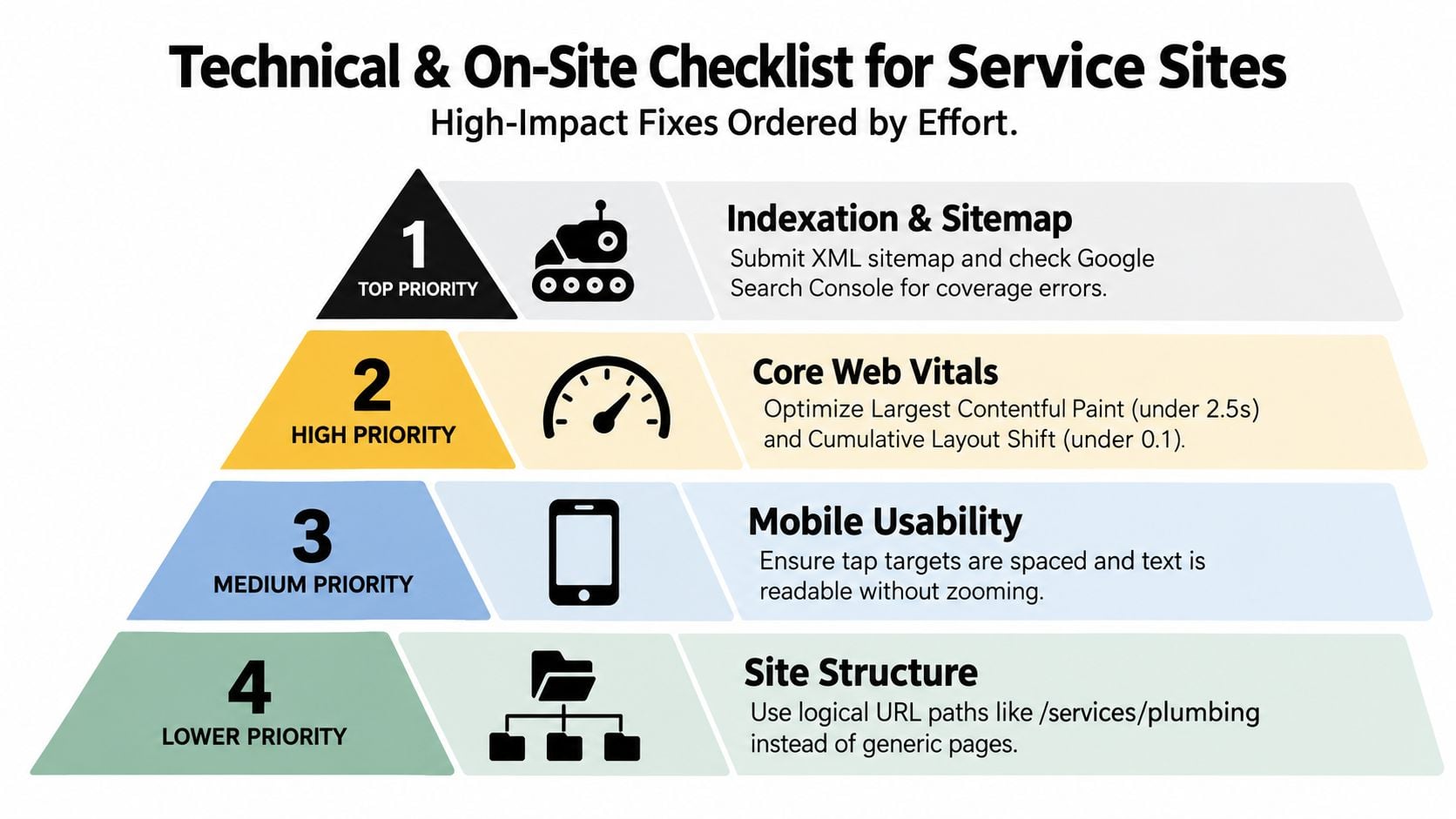
Fix the problems that block discovery
Ask your developer these questions in order:
- Indexation: Can Google crawl and index every important service page, and does the XML sitemap reflect the current site?
- Mobile usability: Can a customer read the page, tap the phone number and complete the form without zooming or fighting the layout?
- Performance: Do the main service templates load quickly enough for someone on a mobile connection?
- Structure: Can every money service be reached within two clicks of the homepage?
- Analytics: Do phone clicks, form submissions and bookings appear as separate events in GA4?
Use Google Search Console to inspect coverage, indexing and search queries. Fix accidental noindex directives, broken internal links, redirect chains and orphaned pages before asking for new content.
Add clarity, then remove waste
Implement appropriate LocalBusiness and Service schema, making sure the markup matches visible content. Use hreflang only where the site serves different language or regional versions. Prevent faceted navigation, search results and stray parameter URLs from creating crawlable duplicates.
Compress images, use descriptive filenames and add useful alt text. Test the form confirmation path, call tracking and attribution. If a developer needs a plain-language brief, this guide to what technical SEO means provides a useful starting point.
A technical audit should end with pass or fail answers, named owners and a release date. “We should improve speed” is not a task. “The mobile service template passes the agreed performance checks after image compression” is.
Measuring Results, Budgets and Your Launch Checklist
A service-business SEO programme needs a small measurement system, not a dashboard full of vanity metrics. Track the actions that indicate buying intent and connect them to completed work wherever your sales process allows.
The five KPIs I recommend are:
- GBP calls and direction requests, which show local actions from the profile.
- Organic sessions to service pages, which reveal whether commercial pages attract the right visitors.
- Contact-form completions, separated from general page views.
- Booked jobs attributed to organic search, the closest measure of pipeline value.
- Review velocity, monitored alongside review detail and response cadence.
The UK evidence on local behaviour supports this sales-led view. 76% of people who search for something nearby visit a business within 24 hours, 82% of UK consumers use search engines to find local businesses and services, and 28% of local searches result in a purchase, according to UK local SEO service research. That is why a phone click or quote request matters more than a pageview from someone outside your service area.
Track actions without creating reporting theatre
Configure GA4 events for phone-link clicks, form submissions, booking confirmations and key engagement points. Use consistent campaign parameters on profile links and record the original source in your CRM or lead spreadsheet. For calls, use a call-tracking system that preserves the source while keeping the number and customer experience reliable.
Review one Looker Studio dashboard each week. Compare local profile actions, service-page traffic, enquiries, booked work and review activity. Don't change the strategy because rankings moved for a day. Look for patterns in qualified enquiries and booked jobs.
Budget should follow complexity and internal capacity. A capable owner can handle profile updates, review requests and basic content personally. A freelancer suits businesses that need regular page and content support without strategic oversight. An agency retainer makes sense when the site needs technical work, multiple service areas, content production, reporting and ongoing optimisation. Ask each supplier what will be delivered, who owns implementation and how results will be tied to enquiries, not just rankings.
Use a focused 90-day launch sequence
Weeks one and two: Claim or correct the Google Business Profile, complete missing fields, check service areas and clean the most important citation inconsistencies.
Weeks three to six: Rewrite the highest-value service pages. Add strong calls to action, trust evidence, useful FAQs, clear processes and internal links.
By week four: Launch the review request routine. Give the team a simple script and review responses weekly.
By week eight: Publish the first three buyer-intent articles, each linked to a relevant commercial page.
By week ten: Complete the technical sweep. Check indexation, mobile usability, performance, schema, forms, tracking and broken links.
Use this guide to measuring website success to keep the reporting tied to business outcomes rather than disconnected SEO metrics.
Before kickoff, assign an owner to each item:
- Profile: Access confirmed, categories accurate, services and hours complete.
- Citations: Approved NAP recorded, priority listings checked and corrections assigned.
- Service pages: Priority pages selected, copy owner named and conversion paths tested.
- Reviews: Request timing agreed, link available and response owner appointed.
- Content: Customer questions collected, briefs written and internal links planned.
- Technical: Search Console reviewed, indexation checked and developer tasks scheduled.
- Measurement: GA4 events tested, calls tracked and booked jobs recorded.
- Review meeting: Weekly dashboard owner assigned and monthly decision point booked.
SEO works when it behaves like a sales process. Give every task a customer action, every action a measurement and every measurement a person responsible for improving it.
DesignStack can help service businesses connect SEO foundations with a responsive WordPress website, crawlability improvements, on-page optimisation, structured data and local search support. Visit DesignStack to discuss a website or SEO plan built around the enquiries and booked work you want next.