WordPress SEO Services: A Guide for UK Businesses
You've probably had this experience already. You paid for a smart-looking WordPress website, approved the design, launched it, and waited for enquiries that never really came. The site isn't broken. It just isn't being found by the right people at the right moment.
That's where most Dorset SMEs get frustrated. They don't need another vague pitch about “visibility” or “digital growth”. They want to know what WordPress SEO services include, what they cost, and whether they're paying for real work or recycled agency jargon.
A good website matters, but design on its own won't carry the business. If you want a site that both looks credible and performs commercially, it helps to understand what makes a good business website. SEO is the part that helps people find it, trust it, and act on it.
Table of Contents
- Why Your WordPress Website Needs More Than a Great Design
- The Four Pillars of WordPress SEO Services
- Building a Solid Technical SEO Foundation
- Creating On-Page SEO and Content That Attracts Customers
- How to Measure Your SEO Success with the Right KPIs
- UK Pricing for WordPress SEO Services
- Your Checklist for Hiring a Dorset SEO Agency
Why Your WordPress Website Needs More Than a Great Design
A polished website can still be commercially invisible. That's the part many owners only realise after launch, when the phone doesn't ring and the contact form stays quiet.
A local business might have strong branding, clear services, and decent photography, yet still struggle because the pages aren't structured for search, the copy doesn't match buying intent, and the site gives Google very little context. It's like opening a well-fitted shop on a side street with no sign outside. The premises are fine. Footfall is the problem.
WordPress is the right platform for many businesses, but it still needs proper optimisation. Established UK WordPress SEO agencies report that over 90% of their clients operate on WordPress, and over 50% of all website traffic in the UK comes from organic search, which is why platform-specific work matters for visibility and lead generation (UK WordPress SEO agency data).
Design gets attention. SEO gets discovery.
A strong design creates trust after someone lands on the site. SEO helps them land there in the first place.
That difference matters because many SMEs buy a website as if it's a one-off asset, then discover it behaves more like a commercial premises. It needs upkeep, organisation, signage, and a clear route for customers to reach the enquiry point.
A great-looking website with weak SEO often feels “finished” to the owner and “incomplete” to Google.
What local businesses usually mean when they ask for SEO
They usually don't mean rankings in the abstract. They mean practical outcomes:
- More relevant visitors: People looking for the service you provide.
- Better local visibility: Showing up when someone searches with place-based intent.
- More enquiries: Calls, forms, bookings, quote requests, and product sales.
- Clearer accountability: Knowing what work is being done each month.
That's why good WordPress SEO services aren't an optional add-on after web design. They're part of making the website commercially useful.
The Four Pillars of WordPress SEO Services
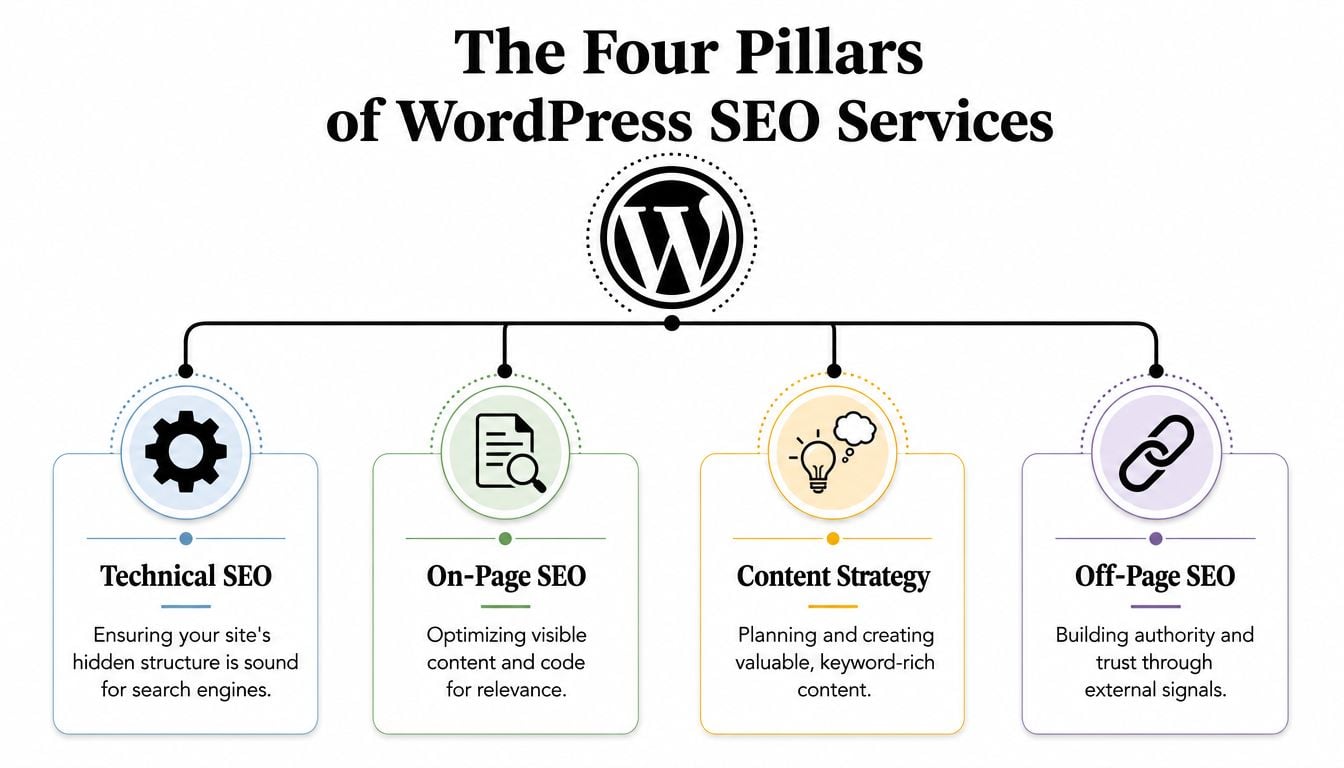
Most business owners hear “SEO” as one bundled service. In practice, it works better when you understand the separate parts. Good WordPress SEO services usually sit on four pillars. If one is weak, the rest often underperform.
Technical SEO
This is the hidden structure. It covers crawlability, page speed, mobile performance, indexing controls, redirects, image handling, schema, and site architecture.
If the technical base is messy, search engines waste effort trying to understand the site. That usually means slower progress, weaker visibility, and pages that never reach their potential.
On-page SEO
This is the visible layer on each page. It includes headings, page titles, meta descriptions, internal links, URL structure, service page copy, and how clearly a page matches a real search query.
Think of it as shop layout. A visitor should know what you do, who it's for, and what to do next without hunting for answers.
Content strategy
Many agencies either overcomplicate things or oversimplify them. Content strategy isn't just “write blogs every month”. It's choosing which pages need to exist, what questions they should answer, and how each page supports a commercial goal.
For a solicitor, that may mean service pages that answer legal concerns plainly. For a trades business, it may mean location pages, service comparisons, and clear trust signals. For a retailer, it often means category copy, product guidance, and buying support.
If you want a clearer view of how planning fits into growth, this guide to content strategy for business websites is useful.
Off-page SEO
This is authority-building outside your own website. It includes backlinks, citations, brand mentions, and external trust signals.
It's also where some of the worst agency promises appear. Buying low-quality links, using private blog networks, or chasing irrelevant directory listings might produce activity, but not useful authority. Off-page work should support reputation, not imitate it.
What a balanced service looks like
A credible provider won't fixate on one pillar and ignore the rest.
| Pillar | What it affects | What weak delivery looks like |
|---|---|---|
| Technical SEO | Site performance and search engine understanding | Slow pages, indexing issues, poor structure |
| On-page SEO | Relevance and click-through | Generic copy, weak titles, confused page targeting |
| Content strategy | Topic coverage and customer trust | Random blogs, duplicated pages, no buyer journey |
| Off-page SEO | Authority and credibility | Spammy links, empty reporting, little commercial impact |
A business owner doesn't need to do this work personally. But they do need to know what they're paying for.
Building a Solid Technical SEO Foundation
Technical SEO is the part clients rarely see and often benefit from most. When it's done well, the site becomes easier to crawl, faster to load, clearer to interpret, and more dependable across devices.
That matters because technical problems don't usually announce themselves. They sit in the background and suppress performance. A page may be well written and still underperform because it loads poorly, uses oversized images, or gives Google weak structural signals.

Schema, speed, and crawl clarity
One of the clearest examples is schema markup. In simple terms, schema is structured labelling that tells search engines what a page represents. A service page, local business page, or product page becomes easier to classify.
Expert WordPress SEO work requires valid schema markup, and that can lead to 2.3x more impressions in UK local searches. The same source notes that using image formats such as WebP can reduce page weight by 60%, leading to sub-1-second load times that correlate with a 27% higher conversion rate for UK eCommerce sites (technical WordPress SEO findings).
That's the point business owners often miss. Speed work isn't just a technical nicety. It affects whether people stay, browse, and buy.
If you want the non-jargon version of what sits behind this work, this explanation of technical SEO for business websites breaks it down clearly.
Practical rule: If your developer can't explain why a page is slow, why a page isn't indexed, or what schema has been added, the technical work probably isn't under control.
The parts that usually need attention on WordPress
WordPress is flexible, which is good. It's also easy to clutter, which isn't. Common technical issues tend to come from years of plugin buildup, theme shortcuts, image bloat, and pages created without a clear structure.
A solid technical pass usually involves work like this:
- Image optimisation: Converting oversized images, serving modern formats, and removing unnecessary media weight.
- Template cleanup: Making sure service pages, archive pages, and product templates don't create duplication or thin content.
- Internal crawl control: Checking which pages should be indexed and which shouldn't.
- Redirect management: Preserving value when pages move, merge, or get removed.
- Mobile review: Testing layout, speed, and user flow on real devices, not just desktop previews.
What doesn't work
Technical SEO isn't installing one plugin and calling the job done. Tools such as Yoast SEO, Rank Math, caching plugins, image compression tools, and schema plugins can help, but they don't replace judgement.
Poor agencies often rely on plugin checklists. Good agencies use tools as part of a process. They review templates, test page types, audit actual search behaviour, and fix the causes, not just the symptoms.
That's why technical SEO should be treated like site infrastructure. It's not glamorous, but it supports everything else.
Creating On-Page SEO and Content That Attracts Customers
The most effective WordPress SEO services don't chase traffic for its own sake. They create pages that answer the questions buyers already have, in the language buyers already use.
That's why content work shouldn't be dismissed as “just blogging”. Most enquiries come from people comparing options, checking credentials, narrowing suppliers, or looking for reassurance before they make contact. If your website doesn't answer those needs, someone else's will.
Start with search intent, not keywords on a spreadsheet
A Dorset business owner might say, “We offer plumbing, boiler repairs, and bathroom installs.” A potential customer searches in a completely different way. They might look for emergency help, installation advice, pricing expectations, local availability, or differences between services.
Good on-page SEO turns those real-world searches into useful page structure. That includes:
- Service pages: Clear pages for each core offer, written for buying intent.
- Location relevance: Sensible coverage of the areas you serve.
- Page titles and descriptions: Strong snippets that improve relevance and click appeal.
- Internal links: Helping users move naturally between related pages.
Meta descriptions are a small part of the picture, but they still matter because they influence how your listing appears in search results. This short guide on how to write meta descriptions explains the basics well.
Content that earns trust
For service businesses, the strongest content often answers the questions owners assume are too obvious to publish.
A solicitor can build trust by explaining the process, expected timelines, or what documents a client may need. A roofer can explain repair versus replacement. A catering company can show how booking works, what affects pricing, and what to expect on the day.
The best content usually sounds like a good sales conversation written down clearly.
That's why thin, generic blog posts don't perform well for long. “Top tips” content with no depth and no commercial purpose often adds clutter rather than value.
What strong on-page work usually includes
Instead of publishing aimlessly, useful content planning often looks like this:
Map the core services
Build pages around the main revenue-driving offers first.Answer pre-sale questions
Add content that handles hesitation, confusion, and common objections.Support decision-making
Create comparison pages, FAQs, process pages, and trust-building content.Link pages logically
Help visitors move from awareness to enquiry without dead ends.
What to avoid
There are a few repeated mistakes that waste budget:
- Keyword stuffing: Writing awkward copy for search engines instead of humans.
- Duplicate service pages: Creating near-identical pages for every town with little unique value.
- Publishing without purpose: Adding articles because “SEO needs blogs” rather than because the page serves a real customer need.
- Ignoring conversion: Forgetting calls to action, proof, and next steps.
On-page SEO works best when it supports both discovery and decision-making. The page has to rank, but it also has to persuade.
How to Measure Your SEO Success with the Right KPIs
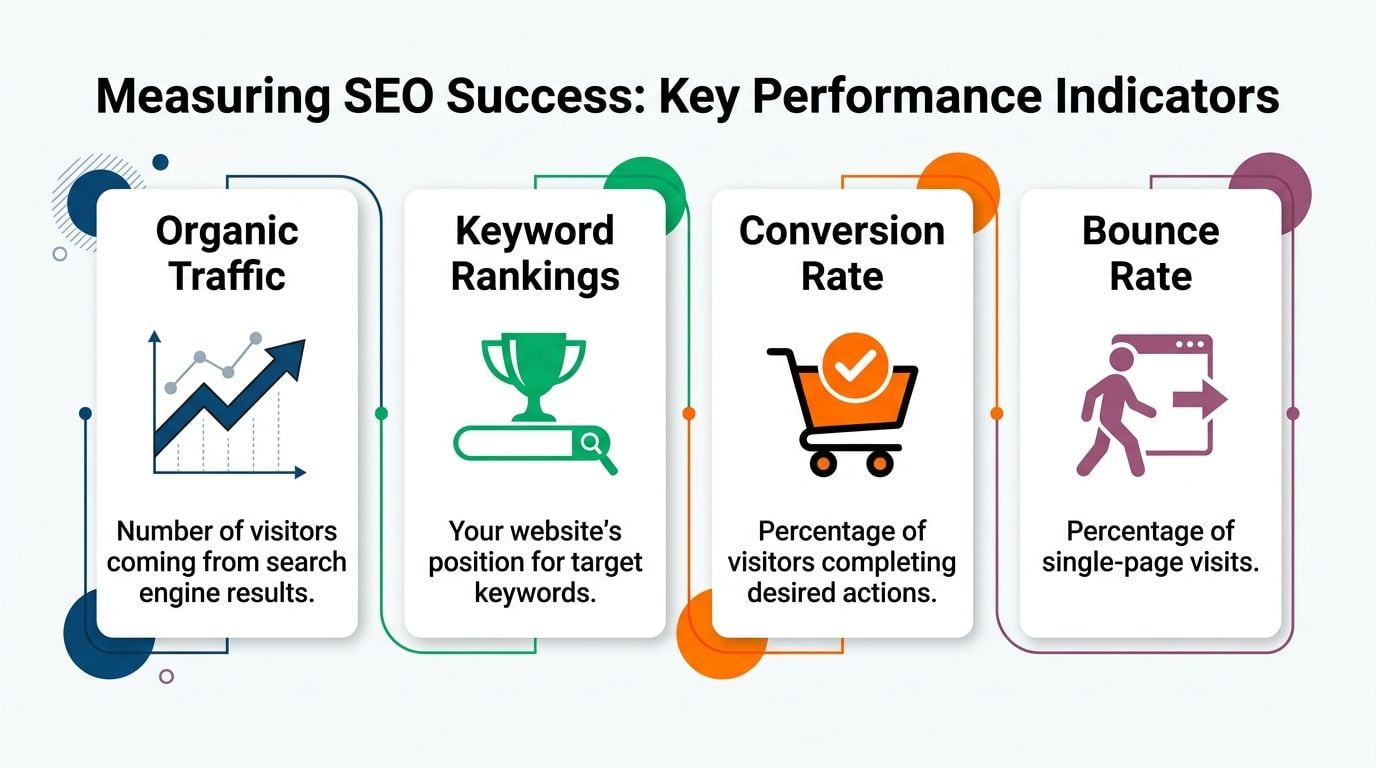
A lot of SEO reporting still hides behind charts that look busy and say very little. Traffic goes up. Impressions move around. A few keywords improve. None of that automatically means the work is helping the business.
The question is simpler. Are the right people finding the site, and are more of them turning into enquiries or sales?
Vanity metrics versus business metrics
Some measurements are useful but incomplete. Ranking first for a phrase nobody serious uses won't help much. A spike in visits from irrelevant blog traffic won't pay wages.
Better KPIs usually include commercial context. If you need a practical framework, this guide on how to measure website success is a sensible place to start.
What matters most tends to fall into a few categories:
| KPI | Why it matters | What to ask |
|---|---|---|
| Organic traffic quality | Shows whether relevant visitors are arriving | Are these visits reaching service and product pages? |
| Keyword visibility | Indicates whether buying-intent terms are improving | Are the terms tied to real commercial services? |
| Conversion rate | Shows whether visits lead to action | Are forms, calls, bookings, or checkouts increasing? |
| Lead quality | Separates useful enquiries from poor-fit traffic | Are we attracting the right type of customer? |
What a useful monthly report should show
A good report should be readable by a business owner, not just a specialist. It should explain what changed, why it changed, what work was completed, and what happens next.
It should also connect actions to outcomes. If pages were rewritten, say which ones. If internal links were improved, explain the reason. If technical fixes were made, show what problem they solved.
Here's a useful explainer on reporting and evaluation:
Don't let an agency hide weak commercial results behind impressive-looking ranking screenshots.
Questions worth asking every month
- What changed on the site this month?
- Which pages improved, and why?
- Which keywords matter commercially, not just cosmetically?
- Did organic visitors convert into leads or sales?
- What are you doing next based on the data?
If the answers stay vague, the strategy probably is too.
UK Pricing for WordPress SEO Services
A Dorset business owner usually asks the sensible question first. “What will this cost me each month, and what am I getting for it?”
Fair question. SEO pricing in the UK varies because the workload varies. A five-page brochure site targeting one town is different from a multi-service WordPress site trying to win leads across Dorset, Hampshire, and Somerset. The problem is that many agencies use that truth to stay vague.
For a UK SME, a realistic monthly range for specialist WordPress SEO often sits around £1,500 to £3,500 per month, with lower-cost offers tending to cover a narrower scope and higher fees reflecting more content, technical work, and strategy (WordPress SEO pricing overview).
Price on its own tells you very little.
What matters is the amount of real work behind it. At the lower end, you may get basic reporting, light on-page changes, and limited content input. At the higher end, you should expect technical fixes, page rewrites, internal linking work, local search improvements, content planning, and proper review of what is producing enquiries. If someone is selling “full SEO” for a fee that barely covers a few hours of skilled time, the scope will be thin, the service will be templated, or both.
Why fixed-cost work appeals to Dorset SMEs
Many local firms prefer defined costs because cash flow matters more than agency rhetoric. A plumbing company in Poole, a law firm in Dorchester, and a builder covering Weymouth all need the same thing from a supplier. Clear scope, clear timing, clear cost.
That is why fixed-cost SEO projects often make sense as a starting point. A business can pay for a technical clean-up, a set number of service page rewrites, or a local SEO foundation without signing up to an open-ended retainer from day one.
That preference is not unique to marketing. It comes up whenever a business compares outsourced services and wants predictable budgeting. The same logic applies in admin and finance, which is why articles on understanding 2026 bookkeeping rates are useful when comparing service pricing models more broadly.
Retainer or fixed project?
Both can work. The right choice depends on what the website needs now, how competitive the market is, and how much change the business can realistically support each month.
- Retainers suit ongoing growth work. Best for firms that need regular content production, technical oversight, link earning, testing, and monthly refinement.
- Fixed-cost projects suit clearly defined jobs. Best for audits, repair work, local landing page improvements, or a first-stage clean-up of a neglected WordPress site.
- Hybrid models are often the most practical option. A one-off project first, then a smaller monthly plan, gives many SMEs better cost control.
- Ranking guarantees are still a bad sign. No agency controls Google, and honest providers do not price SEO as if they do.
In practice, local businesses usually do better when they buy a specific outcome first. For example, improve crawlability, rewrite ten core service pages, fix local search signals, and track lead volumes properly. Once that groundwork is in place, a retainer becomes easier to justify because the business can see what it is funding.
If pricing stays vague, the deliverables usually are too. A better question is simple. Which pages will you work on, what will you change, and how should that improve leads or sales?
Your Checklist for Hiring a Dorset SEO Agency
Hiring an SEO agency shouldn't feel like buying a mystery box. If you ask the right questions early, weak providers usually reveal themselves quickly.
The simplest test is whether the agency can explain the work in plain English. If everything sounds slippery, over-technical, or oddly secretive, that's usually a bad sign.
Questions worth asking before you sign
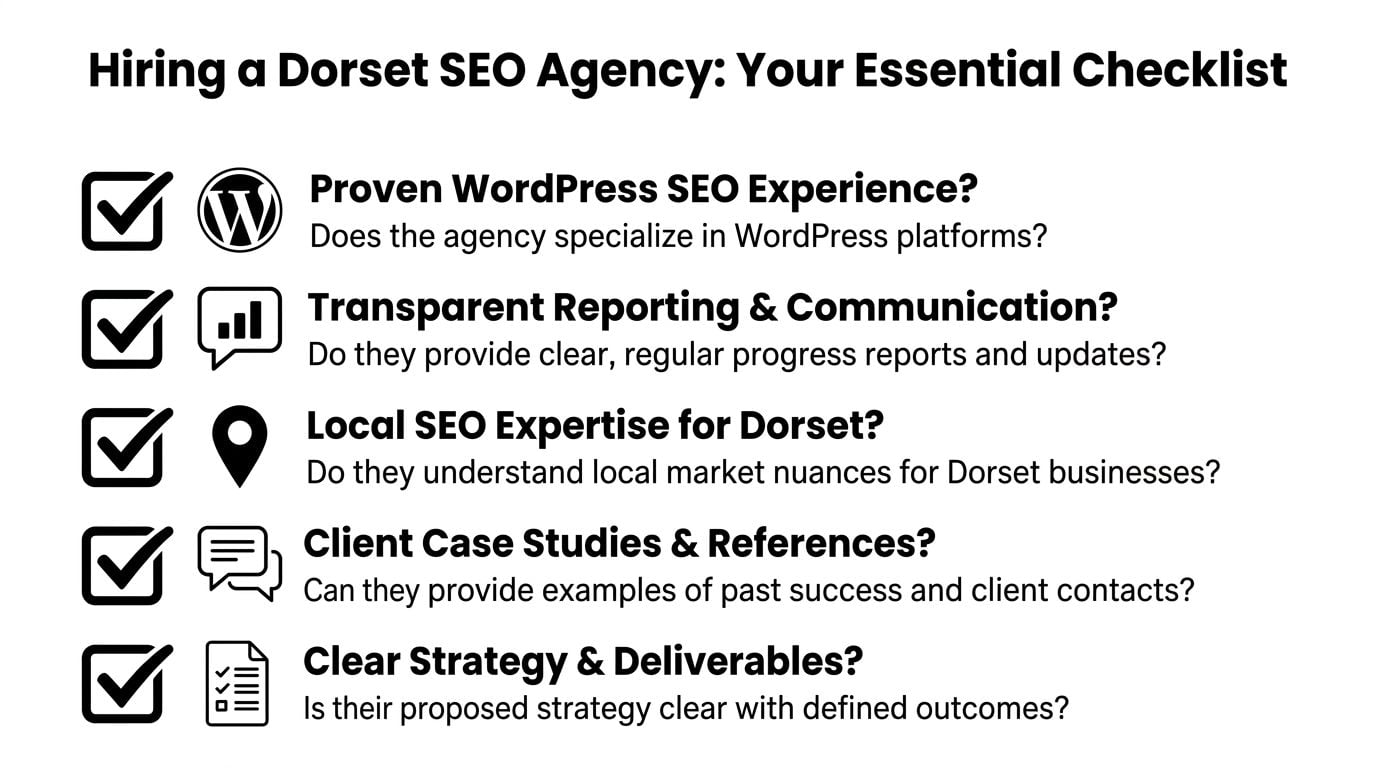
Use this as a practical shortlist when speaking to agencies:
Do you specialise in WordPress?
WordPress SEO has its own patterns, strengths, and common technical issues.What exactly will you do in the first month?
You want tasks, not broad intentions.How do you measure success?
Look for answers tied to leads, sales, and commercially relevant visibility.Can you explain your reporting process?
Reports should be understandable without translation.Do you offer fixed-cost projects as well as retainers?
This matters if you want cost control before committing long term.How do you approach local SEO for Dorset businesses?
Local understanding matters when service areas, intent, and competition vary by town.
Red flags that shouldn't be ignored
Some warning signs are consistent across the industry.
| Red flag | Why it matters |
|---|---|
| Guaranteed number one rankings | No agency controls search results that way |
| No clear deliverables | You can't assess value without scope |
| Heavy focus on jargon | Confusion often covers a weak process |
| Cheap, vague link building | Low-quality off-page work can damage trust |
| Reporting without business context | Activity isn't the same as progress |
What a good agency relationship feels like
A reliable SEO partner won't promise miracles. They'll give you a sensible roadmap, explain trade-offs, show you where the site is weak, and tell you what needs to happen first.
They should also be comfortable with scrutiny. If you ask hard questions about pricing, process, timescales, or accountability, a credible agency won't become defensive. They'll answer directly.
Good SEO advice often starts with restraint. Not every page needs rewriting. Not every business needs a long retainer. Not every problem is solved with more content.
That kind of honesty usually saves money as well as time.
If you want a Dorset-based team that builds and improves WordPress websites with clear communication and fixed-cost options, take a look at DesignStack. They help businesses get beyond a good-looking site and turn it into something that's organised, visible, and commercially useful.
Want help with your rankings? See our SEO services, our WordPress website design, or get in touch.