

What Is Brand Storytelling: Boost UK Business Growth
You've probably had this thought already. Your business does good work, your customers are happy, and your website explains what you offer. But enquiries still feel harder to win than they should.
That usually happens when a business relies on features, price, or a polished logo alone. Bigger competitors can always shout louder. Cheaper competitors can always undercut you. What they often can't copy is the reason your business exists, how you solve problems, and why customers trust you once they've worked with you. That's where brand storytelling starts to matter.
Brand storytelling is the way a business turns its purpose, values, customer experience, and proof into a narrative people can understand and remember. It isn't fiction. It isn't fluff. It's the difference between saying “we provide accountancy services” and showing a stressed business owner how you help them regain control, make decisions with confidence, and sleep better at night.
For a small business, that shift is practical. A good story helps people recognise themselves in your message. It gives your website a clear point of view. It makes your brand easier to trust before someone picks up the phone. If you want a second perspective on the basics, this guide to brand storytelling for SMEs offers a useful companion read alongside a stronger brand identity approach for your site and wider marketing.
Table of Contents
- Your Story Is Your Strongest Asset
- Why Your Business Needs a Story Not Just a Slogan
- The Anatomy of a Compelling Brand Story
- A Practical Framework for Crafting Your Narrative
- Brand Storytelling Examples from UK Businesses
- Bringing Your Story to Life on Your Website
- How to Measure Your Story's Return on Investment
Your Story Is Your Strongest Asset
A lot of small business owners think they need sharper ads when what they really need is a clearer story.
Take the common situation of a local retailer, studio, consultancy, or trades business trying to compete online. The website lists services. Social posts show finished work. The copy is tidy enough. Yet the whole thing feels interchangeable with ten other firms in the same county. When that happens, customers compare on price because there's nothing else to hold onto.
Your story is the part of your brand that gives context to everything else. It explains why you do the work, who you help best, what problem you care about solving, and what kind of outcome people can expect. That's what gives a small business weight.
Story beats polish when buyers need trust
A slogan can sound good and still say very little. “Quality you can trust” isn't a story. “Built for busy clinic owners who need a booking system that patients do use” is moving in the right direction because it identifies a person, a frustration, and a result.
That difference matters most when customers don't know you yet. They're asking themselves simple questions.
- Who is this for: Do you understand my situation or are you speaking to everyone?
- Why this business: What makes you different beyond the service list?
- Can I trust you: Do your words match the experience I'm likely to get?
Practical rule: If your copy could be pasted onto a competitor's website without anyone noticing, you don't have a brand story yet.
A strong story gives every channel a job
When a business gets this right, the story doesn't sit in a PDF and gather dust. It shapes the homepage message, the tone of your service pages, the case studies you choose, your social captions, and even the way you answer enquiries.
That's why what is brand storytelling isn't just a marketing definition. It's a business tool. It helps a smaller company look clearer, more focused, and more trustworthy than a larger one that sounds generic.
Why Your Business Needs a Story Not Just a Slogan
A potential customer lands on your website, scans the top of the homepage, and leaves 20 seconds later. The service may be right. The pricing may be fair. The problem is that nothing in the message gives them a reason to care, remember you, or enquire now.
That is why storytelling matters commercially. For a small business, it changes the job your marketing does. Instead of listing features and hoping people join the dots, you show the context around your offer, the problem it solves, and the result a buyer can expect. That makes your website easier to act on, and easier to measure.
Stories change how people value what you sell
Feature-led messaging pushes buyers towards quick comparisons. They look at price, turnaround, location, or a claim they have seen on three other websites that morning. A story gives your offer more shape. It helps people understand why your approach exists, who it is for, and what makes the outcome different.
Research often cited in marketing circles suggests stories can lift perceived value sharply, and in some cases improve conversion performance too, but the more useful point for an owner-manager is simpler. Clear narrative usually improves the quality of attention. Visitors spend longer, understand faster, and arrive at an enquiry with fewer doubts.
A short strapline can create recognition. A story gives that recognition substance.
Here's the trade-off in practice:
| Approach | What the buyer hears | Likely outcome |
|---|---|---|
| Feature-led messaging | “We do X, Y and Z” | Easy to compare with others |
| Price-led messaging | “We're affordable” | Margin pressure starts quickly |
| Story-led messaging | “We understand your problem and here's the change we help create” | Trust, memory, and better-fit leads |
For UK SMBs, brand work becomes tangible. If the story is clear, it can be carried into homepage headings, service page intros, email follow-ups, and paid landing pages. That gives you something you can test. Better scroll depth, lower bounce rates, stronger enquiry quality, and higher conversion rates are all easier to improve when the message has a consistent narrative behind it.
Memory matters in a crowded market
Plenty of small business websites look decent and still underperform. The issue is often recall. Visitors leave without a clear sense of who the business helps, what problem it is best at solving, or why it feels different from the next option in the tab bar.
Story fixes that because it organises information in a way people can hold onto. A list of services is easy to skim and forget. A clear before-and-after picture is easier to retain. That matters on websites where buyers rarely convert on the first visit.
People may not remember your exact wording. They do remember whether your message felt relevant to their situation.
This is one reason campaign examples from entertainment and gaming can still teach useful lessons to service firms. The strongest campaigns build interest around identity, tension, and outcome. Viral.new's video game marketing insights show how narrative shapes response long before the final sale, and that principle carries across to local and specialist businesses.
Storytelling strengthens the whole brand
A good story also improves the operational side of marketing. It gives your team a clearer filter for what belongs on the site, which case studies to lead with, how to describe your service, and where to place proof. That saves time and reduces the patchwork effect many small brands drift into as they grow.
It also supports consistency across the basics covered in these branding tips for small businesses. Visual identity, tone of voice, offer positioning, and website copy work harder when they are all pointing at the same narrative.
That consistency has a direct commercial benefit. Buyers feel less friction, your website becomes easier to optimise, and your marketing starts producing signals you can effectively use.
The Anatomy of a Compelling Brand Story
A good brand story isn't a long founder biography. It has structure.
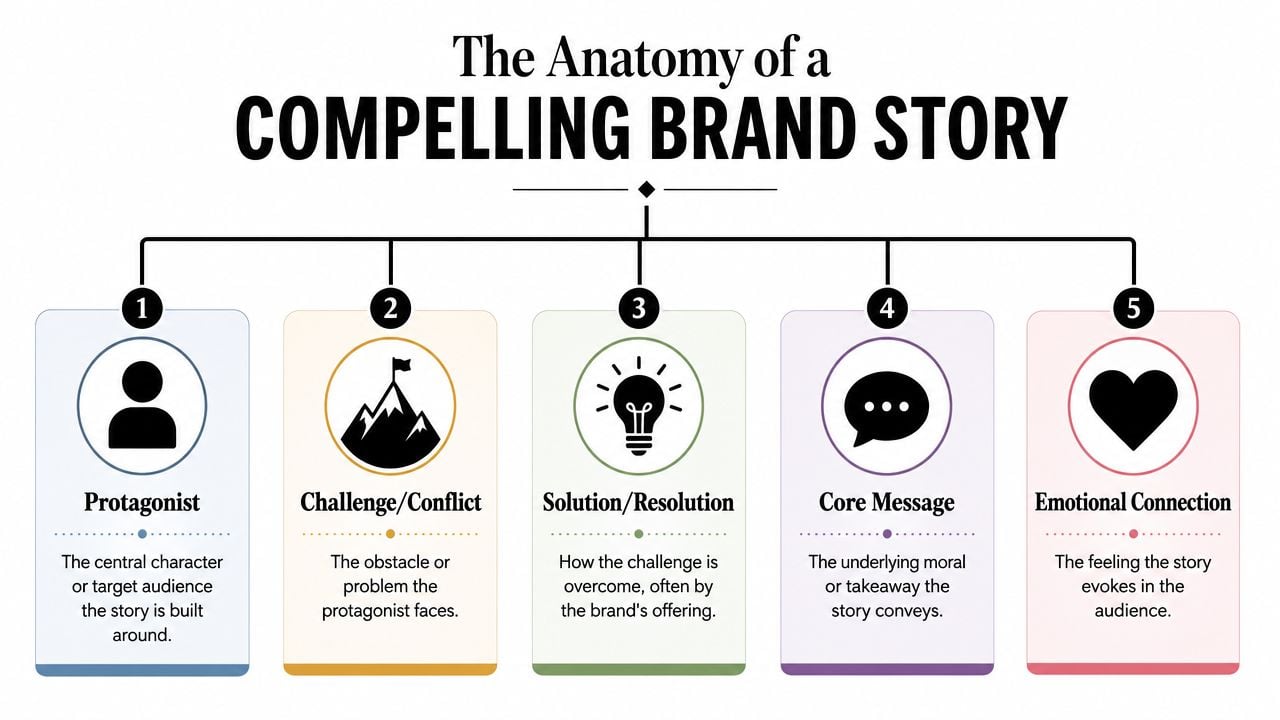
The most effective stories treat the customer as the protagonist, define a concrete conflict, show a transformation, and support the message with proof points, as explained in this brand storytelling strategy guide. That makes storytelling testable. You can see what's working, refine it, and use it across your website and campaigns.
Start with the customer
Most businesses get this wrong by making themselves the hero. They open with their history, their passion, their process, and their awards. Some of that can help, but it isn't the core story.
The customer should be at the centre. They're the person with the problem, the frustration, the ambition, or the decision to make.
A simple way to frame it:
- The customer wants something: More bookings, less admin, better margins, fewer delays.
- Something gets in the way: Confusing systems, poor design, slow suppliers, inconsistent leads.
- Your business helps them move forward: You provide the clarity, tool, service, or support they need.
That shift changes tone immediately. Instead of “We are a full-service agency established in…” you get “You need a website that explains your offer clearly and turns visits into enquiries.”
Conflict gives the story weight
Without a problem, there's no reason to care.
The conflict doesn't need to be dramatic. For a Dorset café, it might be seasonal footfall. For a solicitor, it might be the stress clients feel before they even make contact. For an eCommerce brand, it could be the gap between product quality and how cheaply the website makes it look.
The point is to name the tension explicitly. If your copy skips straight to “we're here to help”, it often feels shallow because it hasn't shown that you understand what the customer is dealing with.
A brand story becomes persuasive when the customer thinks, “Yes, that's exactly the problem I've been having.”
Proof turns narrative into strategy
Many stories falter at this point. They sound warm but they don't feel credible.
Your story needs proof. That might include customer feedback, recognisable outcomes, process details, before-and-after examples, or clear reasons your offer works. Even small proof points matter. Response times, local expertise, specialist knowledge, or the way you structure delivery can all support the story.
A short checklist helps:
| Story element | What to include |
|---|---|
| Customer | Who they are and what they're trying to do |
| Conflict | The obstacle or frustration they face |
| Guide | How your business helps without dominating the story |
| Plan | What happens next in practical terms |
| Proof | Real signals that support your claims |
If you're working on your wider brand identity development, this framework helps keep the verbal and visual sides aligned. The story gives your design choices a reason for being, not just a style.
A Practical Framework for Crafting Your Narrative
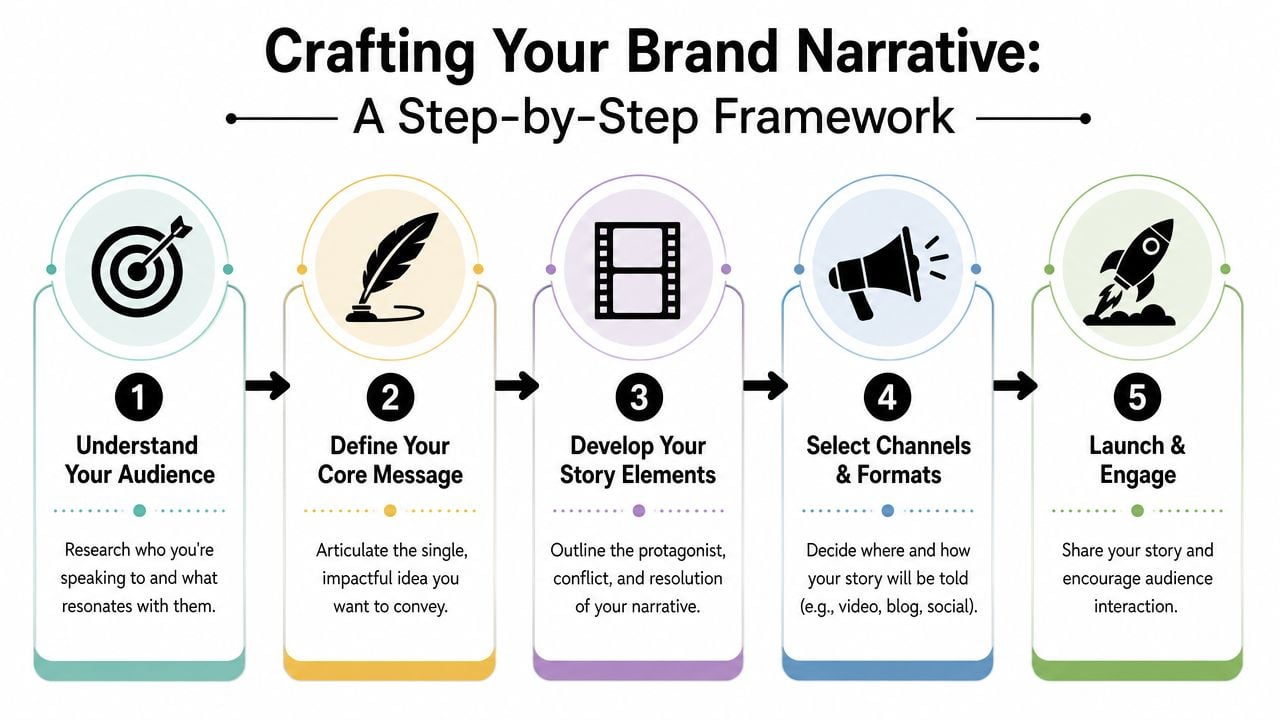
A clear story rarely appears in one sitting. For most small businesses, it comes from turning day-to-day customer insight into a process the whole team can use.
That matters because brand storytelling has to do more than sound good. It has to improve how your website explains the offer, how your sales conversations progress, and how confidently people take the next step. If the story cannot be applied across pages, emails and follow-up messages, it is still just an idea.
Start with customer evidence
The fastest way to write vague messaging is to start with what the business wants to say about itself. A better starting point is what customers are already trying to solve, and what gets in their way.
Use five questions.
What does your customer want right now
Keep it specific to an immediate goal. More enquiries. Better-looking packaging. A website that reflects the quality of the service. Less confusion before they buy.
What is making that harder than it should be
The useful detail is found in: Slow suppliers, unclear pricing, poor presentation, inconsistent delivery, lack of trust, too many choices.
Why do customers pick you over the alternative
Listen for the words they use, not the phrases you wish they used. They may talk about responsiveness, clear advice, patience, quality control, local knowledge, or a smoother buying process.
What improves after they buy
Focus on the visible result. Fewer support issues. Better first impressions. Faster internal sign-off. More confidence in front of clients.
What proof supports that claim
Gather evidence you can publish. Testimonials, before-and-after examples, process screenshots, turnaround times, product imagery, FAQs, and case-specific outcomes.
This step is less creative than people expect. It is closer to research and pattern spotting. That is why it tends to produce stronger copy.
Turn the answers into a one-page brief
Small businesses do not need a long strategy document to make storytelling useful. They need one working page that gives everyone the same message architecture.
Include:
- Core value: What the business stands for in practical terms
- Target audience: The customer group you can describe without hand-waving
- Main tension: The problem, frustration or risk they want to resolve
- Desired outcome: What success looks like after buying
- Proof points: Three believable reasons your claim holds up
- Tone cues: A few words that keep the voice consistent across channels
Once this is written, the story becomes operational. You can brief a designer, review a homepage, rewrite a proposal, or check whether a social post sounds like the same business.
That consistency affects performance.
When I audit SMB websites, the pattern is usually the same. The visual brand looks fine, but the message shifts from page to page. The homepage speaks in broad promises, the About page tells a different story, and service pages drop into generic copy. A one-page brief fixes that by giving every page a clear role.
Map the story to the website
Storytelling starts to earn its keep. Each page should carry part of the narrative and help the visitor move.
| Page area | Story job |
|---|---|
| Homepage headline | Show the problem you solve and the outcome the customer wants |
| About page | Explain the business perspective, values and credibility behind the work |
| Service pages | Connect the offer to specific customer needs and objections |
| Testimonials | Prove the promised change happened for real customers |
| Calls to action | Ask for the next step in language that fits the customer's stage |
For businesses tightening this part of their site, guidance on how to write an About Us page can help turn a flat company summary into a page that builds trust.
The main point is simple. A brand story should improve clarity at each decision point. If bounce rates stay high, enquiries stay weak, or visitors keep asking basic questions, the story is not yet doing enough work.
Test the narrative like any other business asset
Good storytelling is not a one-off writing exercise. It is a message system you can test.
Start small. Try one version of a homepage headline against another. Rewrite a service introduction to focus on customer tension rather than business history. Compare a generic call to action with one that reflects the outcome people want. Then watch what changes in clicks, time on page, enquiry quality or conversion rate.
This is the part many introductory guides skip. For a UK SMB, the value of storytelling is not that it sounds polished. It is that it can reduce hesitation, improve page performance, and help more of the right visitors turn into leads.
Use AI with control
AI is useful for summarising interviews, grouping themes, drafting rough options and speeding up first passes. It is less useful at sounding like a real business with real experience.
That trade-off matters. If you rely on it too heavily, the copy becomes smooth but forgettable. The safer approach is to use AI for structure, then add the specifics yourself. Customer language, buying objections, delivery details, local context, and proof should come from your business, not a tool.
Guidance referenced in Acquia's brand storytelling overview also points to the pressure on businesses to keep AI-assisted content transparent and credible.
Use AI to organise and speed up the work. Keep the judgement, specificity and final wording human.
Later in the process, a short video can help you pressure-test whether the narrative sounds natural when spoken, not just when read.
If you need outside support to turn the brief into web copy and brand assets, options include a strategist, a copywriter, or a studio such as DesignStack for website and brand identity work. Keep one person responsible for maintaining the story across the site, campaigns and sales materials.
Brand Storytelling Examples from UK Businesses
The easiest way to understand brand storytelling is to look at businesses that feel coherent. Not flashy. Coherent.
In local and regional markets, that often matters more than scale. Customers want to know who they're dealing with, what kind of experience they can expect, and whether the business feels credible.
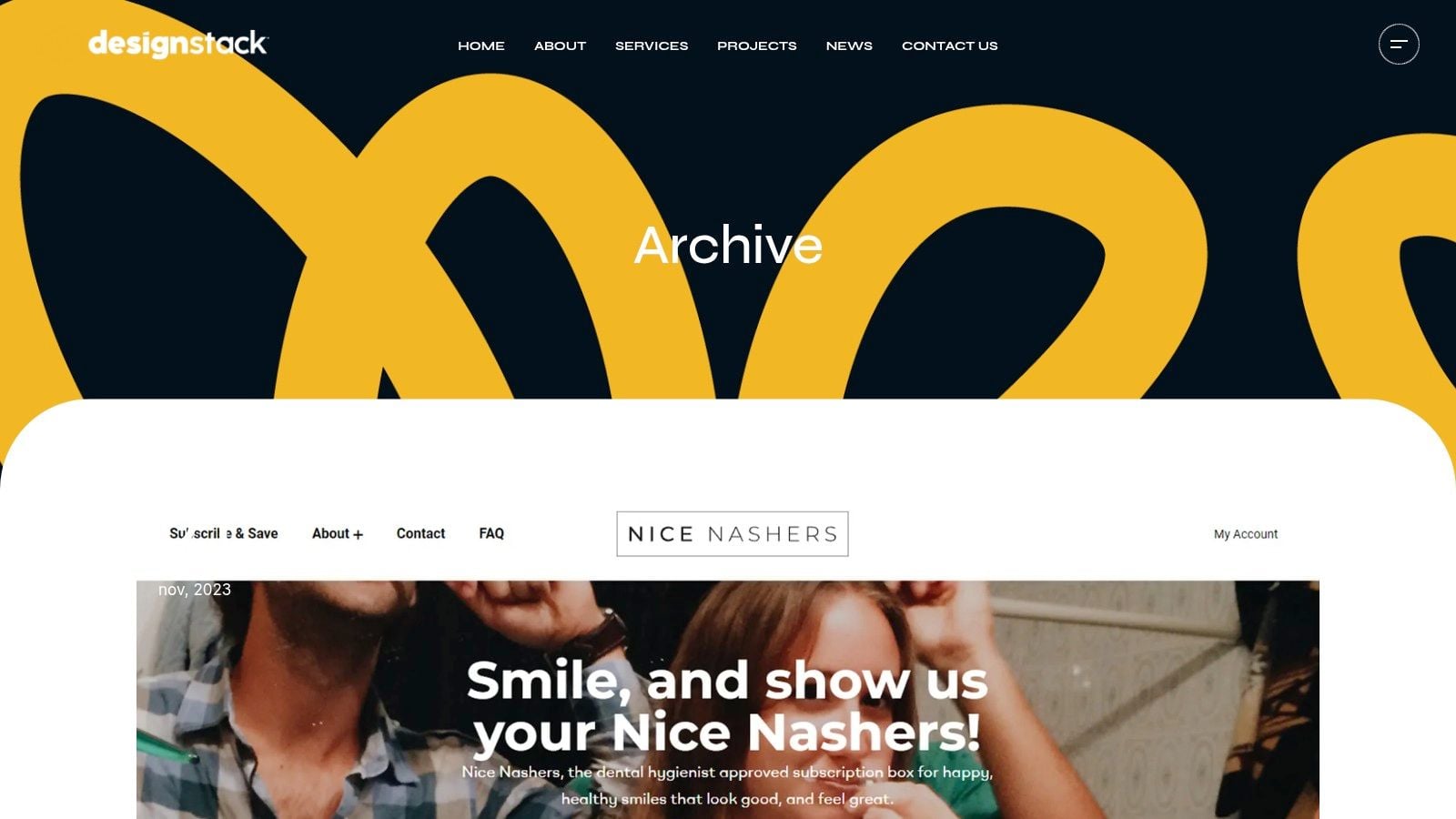
A useful backdrop here comes from a 2015 Headstream survey of 2,000 UK adults, which found that 79% considered stories important in marketing messages and 15% would make an immediate purchase if they loved a brand's story, as cited in these UK brand storytelling statistics. That helps explain why local businesses with a clear narrative often feel more persuasive than larger firms using generic copy.
Local brands work because they feel specific
Consider hospitality brands such as The Lobster Pot. A business like that doesn't need a dramatic origin myth. Its story works when it leans into place, experience, familiarity, and the quality people expect when they visit. The customer is someone looking for a dependable experience, not just a meal. The conflict is uncertainty. Will this place be worth it? The story resolves that by signalling atmosphere, consistency, and local character.
A fitness brand such as Crossfit Durnovaria works differently. Here the story usually centres on the customer's hesitation. They want to get fitter, stronger, or more consistent, but they may worry about confidence, routine, or whether they'll fit in. The brand's role is to guide them into progress. That's a much stronger narrative than listing classes alone.
Professional services offer another useful example. A local accountant, legal firm, or consultant often wins not because the service is unique, but because the messaging lowers anxiety. If the story says “we bring order to something stressful”, the brand becomes easier to trust.
What these examples have in common
They tend to share a few traits:
- A clear audience: They don't sound like they're speaking to everyone.
- A visible problem: The tension is obvious, even if it's subtle.
- A believable resolution: The promise matches what the business can deliver.
- A recognisable tone: The words, visuals, and customer experience feel connected.
The strongest local brands don't sound bigger than they are. They sound clearer than their competitors.
If you want to study how different businesses express that visually, reviewing a set of brand identity examples is useful because it shows how narrative can shape design choices without becoming overcomplicated.
Bringing Your Story to Life on Your Website
A brand story has no value if it only exists in a workshop document. Your website is where most customers test whether the story is real.
They won't read every word. They'll scan your homepage, click into a service page, glance at your About page, and look for reasons to trust you. That means the story needs to appear in the structure, not just in one paragraph near the bottom.
Your homepage should frame the journey
The homepage headline is usually the first test. If it only says what you do, you miss the chance to connect. Stronger headlines speak to the customer's situation and the outcome they want.
For example, compare these two approaches:
| Weaker version | Stronger version |
|---|---|
| “Professional bookkeeping services” | “Bookkeeping for growing businesses that need clear numbers without the monthly scramble” |
| “Custom web design” | “Websites that help service businesses explain their value and win better enquiries” |
The stronger version gives context. It begins the story.
From there, the page should continue the journey:
- Opening section: Identify the audience and problem.
- Middle sections: Show the offer as a practical path forward.
- Proof sections: Add testimonials, examples, or process notes.
- Call to action: Make the next step feel easy and relevant.
Don't trap the story on the About page
Many businesses assume storytelling belongs on the About page alone. It doesn't.
Your service pages should explain how each offer helps the customer move from one state to another. Your testimonials should reinforce that change. Your imagery should support the tone. Even your contact page can reduce friction by sounding human and clear rather than formal and distant.
A few practical checks help:
- Read your headlines aloud: If they sound generic, rewrite them.
- Check service introductions: Are they framed around the customer's problem or your internal process?
- Look at your calls to action: “Get in touch” is acceptable. “Tell us what you need help with” often feels more natural.
- Review your content offers: Interactive tools, quizzes, and calculators can extend the story by helping users see themselves in the problem. For ideas, this guide on grow your list using interactive content is a useful reference.
When a website tells one consistent story across pages, visitors don't need to work as hard to understand the business. Clarity does a lot of the selling before any enquiry form is filled in.
How to Measure Your Story's Return on Investment
A small business owner rewrites their homepage, adds a clearer customer story, and starts getting enquiries that say, "You sound like exactly who we need." That is the point where brand storytelling stops being a creative exercise and starts acting like a business asset.
Small firms do not need more vague brand language. They need a story that improves website performance, sharpens lead quality, and gives them a clearer route from visit to enquiry. That is the part many introductory guides miss, even in broad explainers such as this overview of what brand storytelling leaves out about measurement.
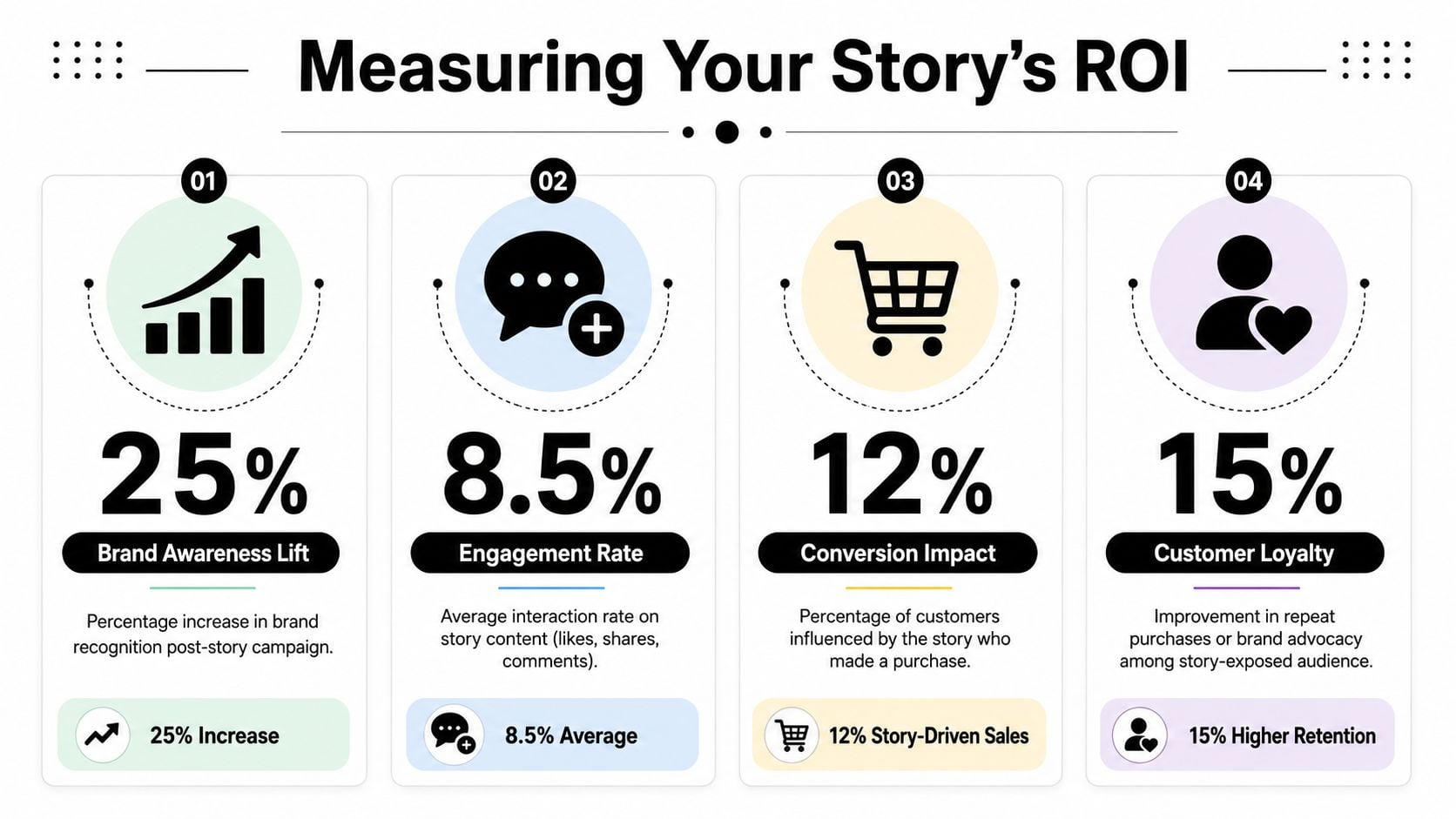
Track business outcomes tied to the story
Start with metrics that show whether the narrative is helping people act with more confidence.
- Page-level conversion: Did enquiry rates improve after changing the message on a homepage, landing page, or service page?
- Lead quality: Are prospects arriving with a clearer understanding of your offer, budget range, or fit?
- Engagement depth: Are visitors reading further, clicking into the next step, or spending more time on key pages?
- Sales friction: Are you spending less time correcting misunderstandings on calls or in emails?
- Response quality: Are social posts and email campaigns generating replies that show genuine interest rather than passive clicks?
One good story can reduce wasted conversations. That matters for SMBs where every lead takes time to handle.
Use a simple test cycle
Keep the process tight so you can see what changed and why.
Choose one page or campaign
Start with a high-impact page such as the homepage or a core service page.Set one commercial metric
Use something concrete: form completions, booked calls, qualified enquiries, or proposal requests.Change the story, not the whole page
Rewrite the headline, opening copy, proof points, and call to action around the customer journey. Leave design, offer, and traffic source alone if possible.Review numbers and enquiry language together
Analytics show behaviour. Enquiry forms, sales calls, and email replies show whether the message is attracting the right people.
In practice, the trade-off lies. A warmer, more human story may increase time on page but weaken conversion if the call to action becomes too soft. A sharper, more direct version may reduce page depth but bring in better-fit leads. Measure both quality and quantity before deciding which version is better.
If your story is working, prospects arrive with fewer basic questions, stronger intent, and a clearer sense of why they should choose you.
That is ROI in real terms. Better enquiries. Shorter sales cycles. A website that does more of the pre-sale work before you ever reply.
If your business needs help turning its message into a clearer brand story, DesignStack can support the practical side of that work through brand identity, website design, and content structure that carries the story across your site.

Leave a Reply