Find a Marketing Agency in UK: The SME’s 2026 Guide
You're probably in one of two places right now. Your website no longer reflects the business you've built, or you've been buying bits of marketing help and still don't feel like you own a reliable growth engine. The agency market in the UK is huge, crowded, and full of overlap. Plenty of firms sell SEO, PPC, paid social, content, branding, development, and “full service” support, but that doesn't mean they're the right fit for what most SMEs need.
For a lot of businesses, the actual requirement isn't “more marketing”. It's a better foundation. That usually means a website that converts, a brand that looks credible, content that's structured properly, and support that doesn't disappear after launch. If you're trying to find a marketing agency in UK searches, that distinction matters more than most agency websites admit.
The UK sector is also a serious commercial market. Businesses spent an estimated £66.6 billion in 2024, and advertising spend alone is forecast to reach £49.8 billion in 2026 according to ICAEW's advertising and marketing industry profile. That scale is exactly why you need a sharper buying process. There's too much money in the space for fluff not to thrive.
Table of Contents
- Define Your Goals Before You Start Searching
- How to Find and Shortlist Potential UK Agencies
- Decoding Agency Costs and Setting a Realistic Budget
- Key Questions to Ask and Red Flags to Watch For
- Making Your Choice and Ensuring a Smooth Onboarding
- Why a Website-Led Strategy Is Your Best Investment
Define Your Goals Before You Start Searching
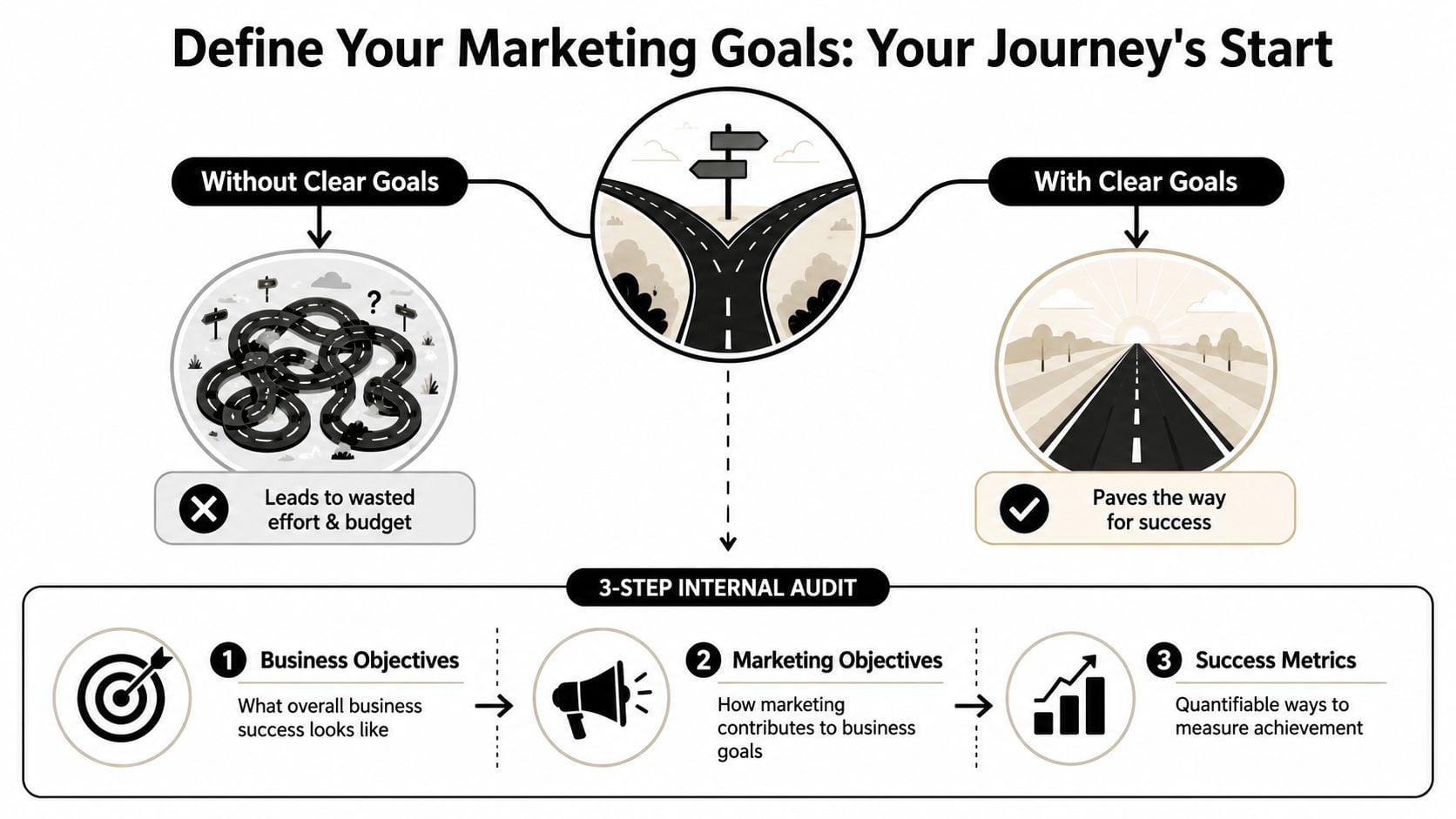
Most bad agency hires start before the first call. The brief is vague, the owner wants “better marketing”, and the agency fills the gap with its favourite service. If you don't define the problem clearly, you won't get proposals you can compare. You'll get sales pitches.
Start with the business problem
Begin with what the business needs over the next year. Not what channel sounds exciting. Not what a competitor is doing. The business problem comes first.
A few examples:
- Lead generation issue means your website may need stronger service pages, better enquiry paths, cleaner forms, and proper tracking.
- Low-quality leads often points to weak positioning, vague messaging, or offers that attract the wrong type of prospect.
- Poor conversion from existing traffic usually means the site, not the traffic volume, is the bottleneck.
- A dated brand can erode trust before a sales conversation even starts.
That's why I'd split your needs into two buckets.
| Priority | What belongs here |
|---|---|
| Core needs | New website, rebrand, clearer messaging, better enquiry flow, technical fixes, hosting reliability, essential SEO structure |
| Secondary wants | More blog content, extra social activity, ad expansion, campaign experiments, new channels |
If your core asset is weak, paying an agency to drive more traffic into it rarely ends well.
Practical rule: if your website doesn't explain what you do, who it's for, and what the next step is within a few seconds, don't start with campaign spend.
To sharpen your brief, write down these five points in plain English:
Business goal
Example: generate better enquiries from the website.Commercial priority
Example: higher-value projects, not more low-margin volume.Primary audience
Be specific about buyer type, not just sector.Main obstacle
Confusing offer, weak brand, slow site, poor content structure, broken tracking.Desired agency role
Website rebuild, brand refresh, SEO foundation, hosting and support, ongoing optimisation.
Build a brief an agency can price properly
A decent agency can help shape the brief, but you still need a starting point. If you're unsure how to articulate your positioning, this guide on what a unique value proposition is is useful because it forces you to explain why a buyer should choose you over the obvious alternatives.
I also like frameworks that tie activity back to business goals rather than channel noise. Samuel Woods' 2026 marketing framework is a useful reference for thinking through strategy before you start collecting quotes.
Your brief doesn't need to be polished. It does need to be usable. Include:
- Current state. What's outdated, broken, unclear, or underperforming.
- Must-haves. New site, refreshed identity, CMS access, hosting support, SEO basics, integrations.
- Nice-to-haves. Additional content, paid media, email, social support.
- Internal constraints. Budget comfort, team availability, deadlines, approval bottlenecks.
- Definition of success. What would make you say the project worked six months after launch.
The businesses that get the best agency fit usually aren't the ones with the biggest budget. They're the ones that know what they're solving.
How to Find and Shortlist Potential UK Agencies
There are too many agencies to browse casually. Statista reports around 8.42 thousand digital advertising agencies in the United Kingdom in 2024, and IBISWorld estimates the broader UK advertising agencies industry includes 17,862 businesses according to this UK agency market summary. That's why random searching is a poor method. You need a filter.
Look in the right places
Google is fine for discovery, but it's not enough on its own. Agencies that are good at ranking aren't always the ones that are right for your business model.
Use a mix of sources:
- Referrals from owners you trust. Best when the referrer can tell you how the agency behaved after the contract was signed.
- Industry directories. Useful for comparing positioning, sectors, and service mix.
- Local business networks. Often better for finding agencies that understand your region and can meet in person.
- Agency content. Good agencies usually publish thinking that reveals how they approach real problems.
If you want a practical outside view on how to evaluate digital marketing firms for ROI, that resource gives a sensible lens for comparing firms beyond surface claims.
Keep the first shortlist broad, then tighten quickly. I'd aim for 3 to 5 serious contenders, not a list of twelve names you'll never review properly.
Judge the work behind the glossy homepage
A polished agency site proves they can market themselves. It doesn't prove they can solve your problem.
When reviewing portfolios, look for signs of commercial thinking:
- Was the project similar to yours in complexity, not just industry?
- Is the site easy to understand or is it only visually impressive?
- Can you spot a clear conversion path from landing to enquiry or sale?
- Do they discuss structure and outcomes or only colours and animations?
- Does the agency seem comfortable with support after launch?
A lot of SMEs looking for a marketing agency in UK searches need a capable web and brand partner more than a channel-first supplier. If your priority is a site rebuild or repositioning exercise, this guide on how to choose a web design agency will help you separate design-led partners from campaign-led firms.
A homepage mock-up is easy to sell. A clear content hierarchy, sensible CMS setup, and a conversion path that works are harder. That's the work that matters.
Local agency or national agency
There isn't a universal right answer here. There is a trade-off.
A local agency can be the better fit when:
- you value face-to-face meetings
- your market is regionally driven
- you want closer collaboration
- you prefer a smaller team that knows your business well
A national agency can suit you better when:
- you need specialist capability across multiple channels
- you have a more complex buying journey
- your internal team wants broader resource coverage
- your project requires niche technical support
The mistake is assuming bigger means better. Bigger often means more layers, more handoffs, and less senior attention. For many SMEs, a focused agency with web, branding, technical SEO, and support capability is a cleaner fit than a large campaign machine built around media volume.
Decoding Agency Costs and Setting a Realistic Budget
Agency pricing feels confusing because firms package the same work in completely different ways. One sells a monthly retainer. Another sells a fixed project. A third quotes a strategy phase, then adds development, content, and support later. The format matters because it changes your risk.
What you're actually paying for
The price isn't just for output. You're paying for thinking, process, project management, technical implementation, revisions, and what happens when something needs changing after launch.
The two most common models are simple enough:
- Monthly retainers suit ongoing work such as SEO, paid media, content, CRO, reporting, and support.
- Project-based fees suit defined outcomes such as a website rebuild, rebrand, or platform implementation.
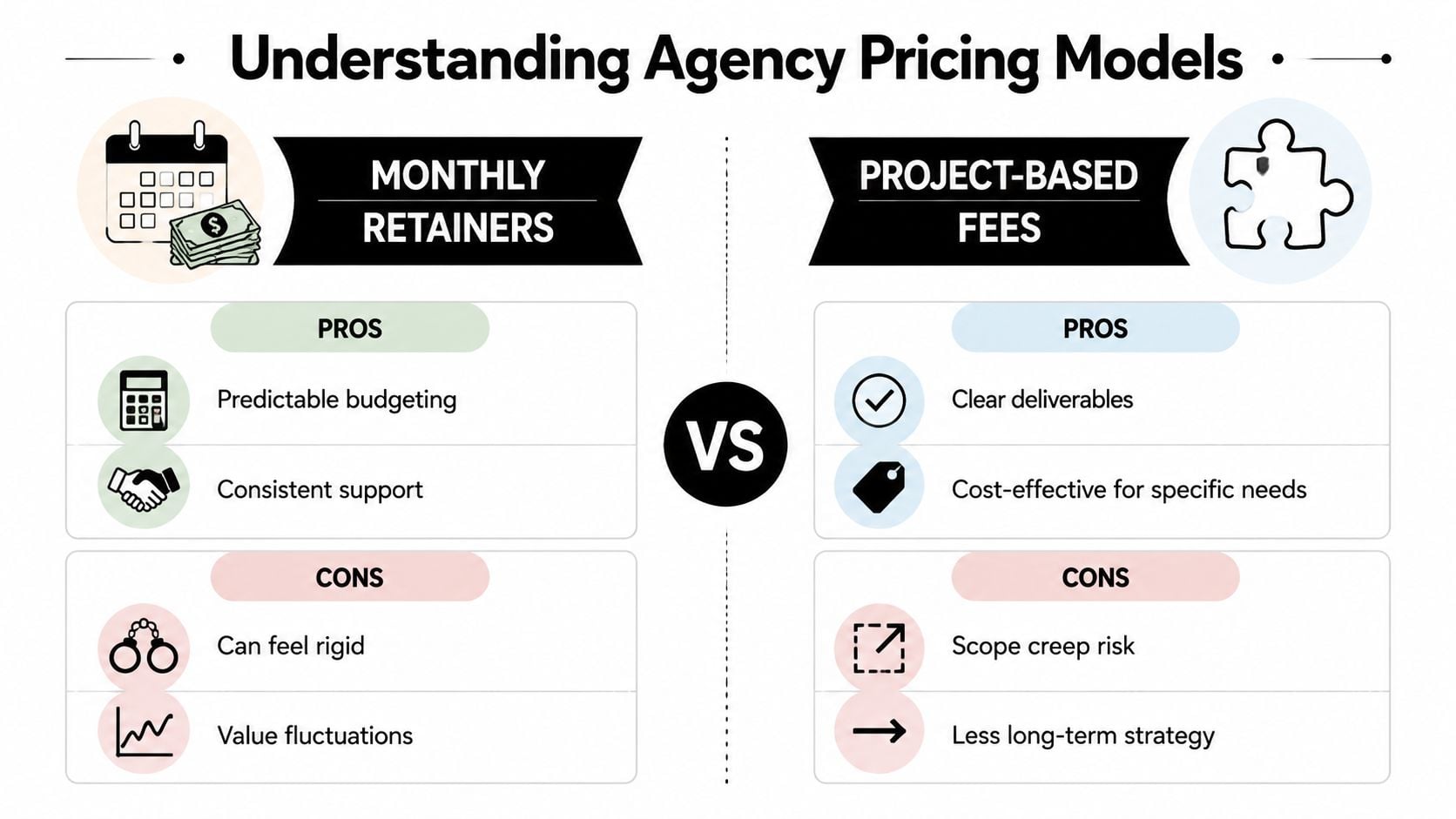
A realistic budget conversation also needs some market context. A healthy LTV:CAC ratio is 3:1 or better, London-based agencies often charge a 30 to 40% premium, and project work such as a HubSpot implementation can range from £5,000 to £75,000, as explained in this growth marketing agency pricing and ROI guide.
That range is exactly why the cheapest quote can be misleading. A low number often means one of three things. The scope is thin, the support disappears after delivery, or key work hasn't been included yet.
For extra perspective on visual identity costs around site projects, this breakdown of how much branding agencies charge is worth reading before you approve a combined website and brand brief.
Later in the buying process, it helps to hear how agencies explain pricing in their own words:
How to judge value instead of just price
A useful proposal does four things clearly:
| Checkpoint | What you want to see |
|---|---|
| Scope | What is included, what is not, and who is responsible for each part |
| Decision points | Where approvals happen and what can delay delivery |
| Measurement | How the agency will judge progress and what it will report |
| Support | What happens after launch or handover |
If the proposal is vague, the cost will become vague later too.
Buying advice: ask which parts of the quote are strategic, which are production, and which are ongoing support. If they can't separate those cleanly, budgeting will get messy fast.
Key Questions to Ask and Red Flags to Watch For
The chemistry call isn't a formality. It's where you find out whether the agency thinks clearly, communicates plainly, and understands the difference between activity and progress. Good questions expose that fast.
Questions that reveal how they really work
Skip generic questions like “What services do you offer?” Their site already tells you that. Ask about behaviour, decision-making, and accountability.
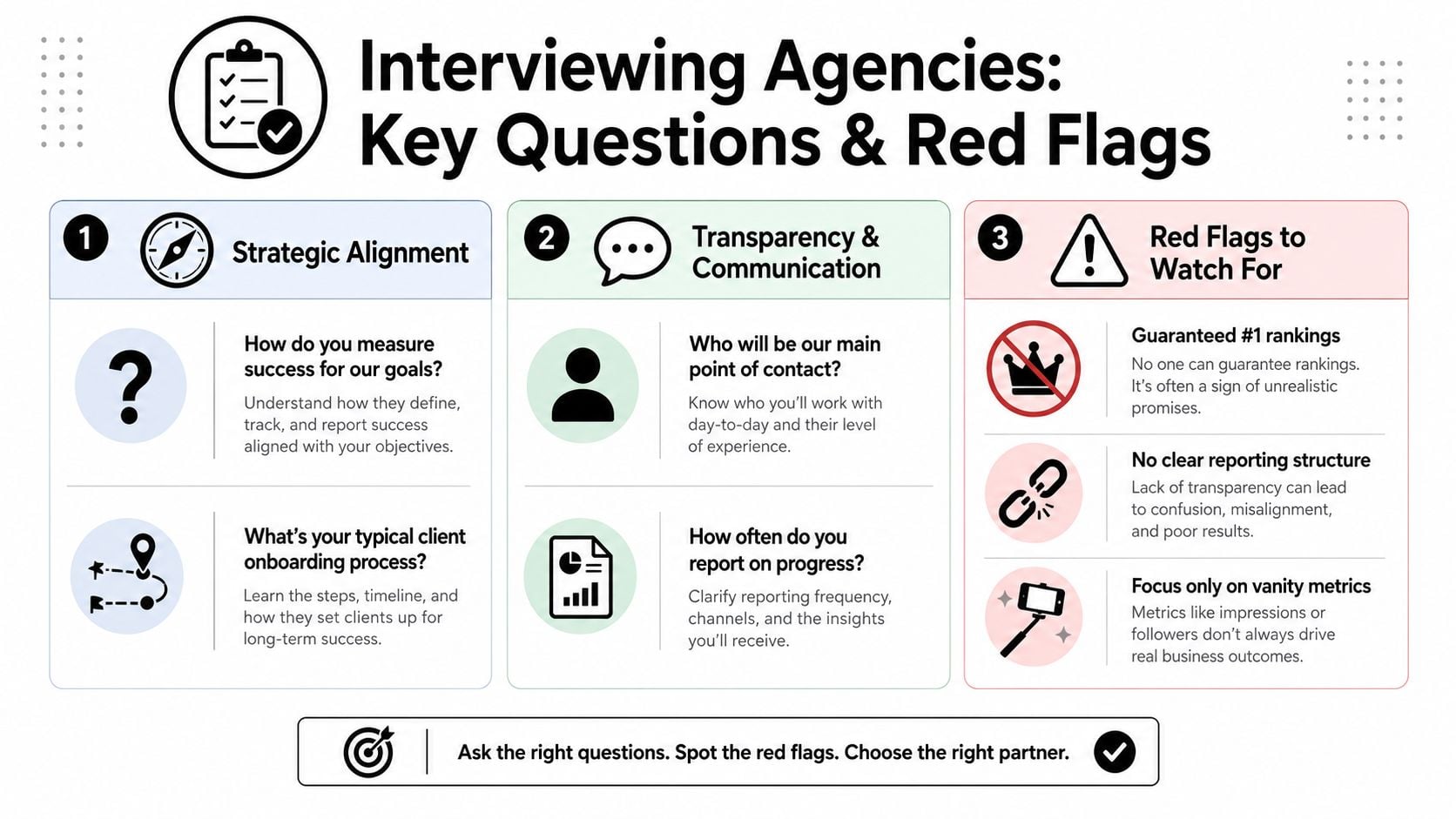
Here are the questions I'd prioritise:
How would you approach our brief if the website is the main growth asset?
This shows whether they can think beyond channel packages.What would you want to audit first before changing anything?
Serious teams usually want to inspect the current site, analytics setup, forms, CRM flow, content structure, and search visibility before prescribing work.How do you decide whether a site needs rebuilding or improving?
Useful because some agencies default to a new build when the better answer is a clearer offer and tighter conversion path.Who will actually do the work?
Sales-led agencies often put the senior person on the call and a junior team on the account.How do you handle messaging and positioning if the client isn't clear yet?
Important for businesses whose problem is strategic confusion, not design polish.What does reporting look like in practice?
Ask to see a sample report or dashboard.
A good interview also tests whether they can speak like normal people. If every answer sounds abstract, the project probably will too.
If branding is part of the requirement, it also helps to compare how specialist identity firms think about brand systems, rollout, and consistency. Reviewing the kind of work covered by brand identity companies can sharpen your questions before the call.
Red flags that should slow you down
Some warnings are obvious. Others sound reassuring until you've lived through them.
The most common red flags:
Guaranteed rankings
No credible agency should promise search positions.Long lock-ins with weak exit terms
That usually protects the agency, not you.A heavy focus on vanity metrics
Impressions, reach, and traffic can matter, but they are not the same as qualified demand.No curiosity about your sales process
If they don't ask what happens after a lead comes in, they're not thinking commercially.Instant certainty
If they know the answer before reviewing anything, they're selling a template.No clear owner on the account
Diffuse responsibility creates slow projects and weak communication.
Here's another one people overlook. Watch how the agency talks about projects that didn't go to plan. If they can't discuss mistakes, revised assumptions, or lessons learned, they either don't review their work properly or they don't want to be transparent.
“Tell me about a project where your original recommendation changed once the data or user behaviour came in.”
That single question often tells you more than the rest of the call.
A strong agency should also be comfortable explaining trade-offs. For example, whether you should delay paid media until the site is rebuilt. Whether SEO content should wait until core service pages are sorted. Whether a rebrand should happen before or after a new build. If they can't discuss sequencing, they'll probably try to sell everything at once.
Making Your Choice and Ensuring a Smooth Onboarding
Once you've got proposals in front of you, the final choice rarely comes down to who had the slickest pitch. It comes down to clarity. Which agency understood the brief properly, challenged weak assumptions, and showed a process you can trust?
Choose on fit, not presentation
A simple decision grid helps here. Score each contender against the factors that affect delivery.
| Criteria | What good looks like |
|---|---|
| Understanding | They grasp the business problem without forcing a generic package |
| Relevant capability | Strong in websites, brand, messaging, technical setup, and ongoing support if that's what you need |
| Communication | Clear answers, sensible timelines, realistic expectations |
| Commercial logic | They connect work to leads, sales process, and ROI |
| Operational fit | The team size, workflow, and contact model suit how your business works |
Don't overvalue charisma. Calm, organised, and honest usually beats high-energy sales confidence.
The onboarding phase matters just as much. According to this guide to hiring an online marketing agency, strong agencies begin with a Discovery-to-ROI audit in the first 30 to 60 days, and 30 to 40% of early wins can come from fixing conversion tracking rather than creating new content. The same source notes typical retainers range from £1,250 to £16,750 per month and warns against agencies that can't explain ROI measurement from day one.
What good onboarding looks like
Your first month or two should feel structured, not rushed. Before anything launches, the agency should be gathering access, understanding the business, and checking that your measurement setup can be trusted.
A practical onboarding checklist looks like this:
Access and ownership
Confirm who owns the domain, hosting, analytics, ad accounts, CMS, and CRM access.Commercial briefing
Share your sales process, average deal shape, lead qualification logic, and what counts as a good enquiry.Technical audit
Check forms, conversion paths, page speed, indexing basics, analytics events, and CRM handoff.Messaging alignment
Agree the core offer, audience language, and priority pages before design or campaigns start.Reporting rhythm
Set the meeting cadence, dashboard format, and who signs off decisions.
Good onboarding is boring in the right way. It's organised, documented, and clear about who is doing what.
If an agency wants to launch activity before it understands the basics, be cautious. Fast starts sound attractive, but hurried starts usually create expensive clean-up work later.
Why a Website-Led Strategy Is Your Best Investment
A lot of marketing activity rents attention. You pay for visibility on a platform you don't control, then pay again next month to stay visible. That can work, but it's not a great foundation for an SME that needs stability.
Owned assets beat rented attention
A website-led approach starts with the things you own. Your site. Your brand system. Your service pages. Your content structure. Your hosting environment. Your conversion paths. Those assets keep working after the campaign ends.
That's one reason this angle matters more now. The UK marketing agencies market is projected to grow from USD 24.89 billion in 2025 to USD 31.50 billion by 2030, according to Cornerstone DM's UK market overview. In a crowded market like that, broad “digital marketing” offers can blur together. For many SMEs, the clearer route is choosing a partner that can build a conversion-focused website, support the brand properly, and provide ongoing support in one joined-up setup.
What to look for in a website-led partner
You're looking for a firm that treats the site as commercial infrastructure, not a design ornament.
That means they should be able to handle:
- Positioning and structure so the offer is clear
- Design and development that supports conversion, not just appearance
- Brand consistency across pages and materials
- Technical reliability including hosting and post-launch support
- Search foundations so the site can be discovered and expanded over time
One practical option in that category is DesignStack, which provides website design, branding, graphic design, hosting, and related digital support for UK businesses. If you want to judge whether your current site is helping or holding you back, this guide on what makes a good business website is a sensible place to start.
The simplest test is this. If you stopped all campaign activity tomorrow, would your website still make a strong case for your business and still turn interest into enquiries? If the answer is no, that's where I'd invest first.
If you want a practical conversation about your website, brand, or a more joined-up digital setup, DesignStack is worth considering. The team works with businesses that need a clearer online presence, stronger design foundations, and ongoing support without unnecessary complexity.