Logo Design Cost in the UK: A Practical 2026 Guide
In the UK, freelance logo design typically costs about £200–£1,500, with graphic designers charging roughly £20–£75 per hour; a starter studio identity package is around £1,500–£5,000. Those figures buy different things: a logo file at the lower end, or, at a broader scope, research, concepts, revisions and an identity system prepared for real-world use.
You might be comparing a low-cost marketplace listing with a freelancer's proposal and a studio quote, all for what sounds like the same job. In Weymouth or anywhere else in Dorset, the prices can look baffling until you check what each provider will deliver.
The logo design cost isn't a single market price. It reflects time, expertise, deliverables and the risks you're prepared to carry. A cheap mark may be perfectly adequate for a temporary project. A business planning to use its identity across a website, packaging, signage and print needs more than a picture that looks good on screen.
This guide gives you a practical way to compare those options. The central question isn't, “Which quote is cheapest?” It's, “What do I receive, what can I use, and what might I have to pay for later?”
Table of Contents
- Why a Logo Quote Feels So Hard to Read
- What You Are Actually Paying For in a Logo
- The Five Levers That Drive Logo Design Cost
- Freelance, Marketplace, or Studio, Which Route Fits You
- The Costs Most Logo Quotes Quietly Miss
- Getting Real Value From Any Logo Budget
- Choosing the Right Logo Design Cost for Your Business
Why a Logo Quote Feels So Hard to Read
“Logo design” is too vague to be a useful line item on a quote. For a Dorset business owner, the difficult part is spotting what sits outside that label: revision limits, usable files, ownership rights and the work needed to apply the design consistently.
A marketplace offer might cover a single concept and a web-ready file. A freelancer's proposal may include original design work and a defined revision process. A studio's identity package might specify how the logo works across materials and platforms. Compare those commitments before comparing the totals.
The UK guide to graphic design outsourcing costs puts freelance graphic-design rates at approximately £20–£75 per hour, with typical logo projects around £200–£1,500. Use that range as context. It cannot tell you whether a particular quote includes the handover your business needs.
Ask each provider to spell out:
- How many initial concepts and revision rounds are included.
- Which final file formats and logo versions you receive.
- Whether usage guidance or brand guidelines are included.
- What the contract grants you through ownership or licensing.
Get those answers in writing.
A screen preview does not establish whether the supplied artwork is suitable for signage or print. Nor does paying an invoice settle every question about rights. Ask what you can use, adapt and pass to another supplier, and have any restrictions stated before you commit.
A fair comparison starts with scope, not the headline figure.
Cut unnecessary applications from the commission if money is tight. Keep file usability and clear rights in the agreement. Give every designer the same description of your business, audience and intended uses, using a design brief to make those requirements consistent. Then judge each quote against that shared scope, including whether you need a standalone mark or a reusable identity system.
What You Are Actually Paying For in a Logo
A logo fee pays for a sequence of decisions and outputs, not just the final graphic. Commissioning a tailor-made suit differs from buying one off the rack. A ready-made option can do the job, but bespoke work involves understanding the wearer, shaping the design and making adjustments so the result fits the need.
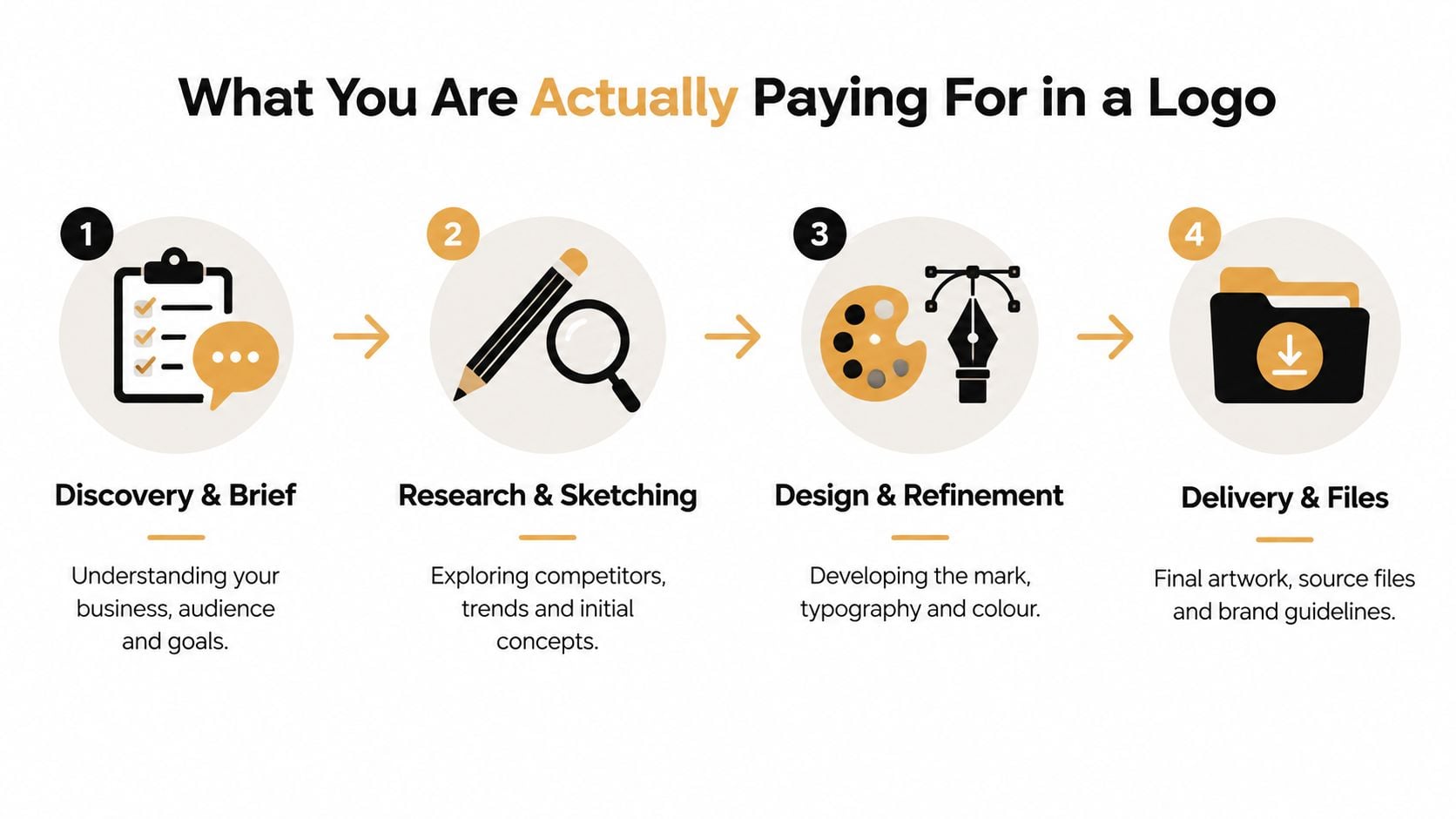
Discovery and brief
First, the designer needs to understand your business, audience, goals and practical requirements. A local service business that needs a clear wordmark has a different brief from a retailer preparing to use its identity on packaging and an online shop. The more the designer needs to clarify or research, the more time this stage takes.
A short, specific brief helps keep this work focused. A vague brief can mean more back-and-forth and more rounds of changes later.
Research and sketching
The designer considers the market, competitors and possible visual directions before settling on concepts. A simple logo-only job may call for a lighter process. A more complex identity needs more deliberate exploration to avoid looking generic or overlapping too closely with familiar work in its category.
Design and refinement
The chosen direction is developed and adjusted, and clear revision limits matter. A quote should say how many rounds are included and what counts as refining the selected route rather than starting over with a different one.
File delivery
The project ends with a handover, but “final files” can mean different things. Ask for vector artwork that can scale for print, alongside suitable digital files, and clarify whether you'll receive colour variations and basic usage guidance. Without the right outputs, a cheap logo can lead to extra work when a supplier needs a format you weren't given.
For a fuller checklist of outputs, use this guide to brand identity deliverables. When reading a quote, treat each stage and each file as part of the service you're buying.
The Five Levers That Drive Logo Design Cost
The price moves with the amount and kind of work involved. A UK dataset checked in October 2026, covering publicly listed prices from UK providers, recorded median entry prices of about £19 for logo-maker packages, £30 for marketplace listings, £272 for the cheapest fixed-price studio package, and £519 for a brand-identity package. These are useful benchmarks, not like-for-like promises: an entry listing isn't equivalent to a bespoke studio project. The UK logo design price report makes that distinction important.
| Provider type | Typical median | What's usually included |
|---|---|---|
| Logo-maker package | About £19 | A basic, often template-led logo package |
| Marketplace listing | About £30 | An entry-level listing, with scope and files varying by provider |
| UK design studio package | About £272 | The cheapest published fixed-price studio package in the dataset |
| Brand-identity package | About £519 | A wider identity package, potentially including rules for consistent use |
Five levers explain why quotes can diverge, even when two providers appear to offer the same thing.
Designer type and experience. A marketplace listing, an independent designer and a studio have different processes and levels of involvement. Experience can affect the quality of the questions asked, the judgement behind a design direction and how carefully the final files are prepared.
Brief complexity. A single logo for a local service is a narrower job than an identity that needs to work across an online shop, product labels and signage. More applications create more design and testing work.
Research and strategy. Some providers begin with a focused brief and move quickly into design. Others spend more time learning about the business, its audience and its market before proposing a direction. Ask what research is included, rather than assuming the word “custom” guarantees a strategic process.
Concepts and revisions. More concepts and additional revision rounds take time. Check how many options you'll see, how feedback is gathered and whether changing direction uses up a revision or requires a new fee.
Ownership and rollout. A design fee doesn't automatically settle rights, licensing or future use. Clarify the agreement and whether the provider will support practical rollout, including variations and usage guidance.
Before accepting a quote, ask: What's included? What isn't? Which files will I receive? What rights do I get? How are extra revisions priced? Those answers explain the fee better than a bare figure.
Freelance, Marketplace, or Studio, Which Route Fits You
Choose your provider around what the business needs to use: a temporary mark, a dependable custom logo or a reusable identity across several channels. Spend where failure would create rework. Cut scope where it would only add decoration.
Marketplace and logo-maker options
A marketplace or logo-maker package suits a temporary project, a basic launch or a business with limited applications. Keep the job narrow. A low entry price is useful only if the package gives you permission to use the result commercially and files your suppliers can work with.
Don't buy on the preview alone. Check whether the artwork is editable and what the ownership terms allow before committing. The guide to top logo makers for indie founders is a starting point for comparing tools, rather than evidence that every package delivers original strategic work.
Independent freelancers
Choose a freelancer when you want direct access to the designer and a custom logo without a full studio identity. The UK graphic-design pricing guide places typical freelance logo projects at about £200–£1,500, with hourly graphic-design rates of approximately £20–£75.
For an SME with a focused requirement, this is often the sensible middle route.
Look for relevant finished projects, including examples of the logo in use. Agree the handover and revision limits before work starts; a lower fee loses its advantage if another supplier must rebuild the artwork. This guide to finding a freelance graphic designer near me explains what to consider when choosing nearby support.
Studios and agencies
Commission a studio when the business needs coordinated applications, rather than a logo file alone. The UK marketing cost index places starter identities at around £1,500–£5,000, full identity work at £5,000–£20,000, and research-led rebrands at £10,000–£50,000 or more.
A starter identity includes a logo, colour palette, typography and basic rules. Those deliverables give suppliers a shared system to follow. For a business using signage, packaging and digital channels, that consistency justifies broader scope. A solo business with limited applications should buy a dependable mark and usable handover, then expand the system when the work demands it.
The Costs Most Logo Quotes Quietly Miss
Paying more for visual design doesn't automatically make a logo safer to use. A beautifully drawn mark can still be hard to register or unsuitable for the way your business operates. Design quality and legal clearance are separate issues, so don't assume the creative fee covers both.
Legal checks and ownership
A logo can look original without being distinctive enough to register, or it may be confusingly similar to a mark already used by another UK business. A design quote doesn't necessarily include name or logo conflict checks, intellectual-property advice, filing fees or paperwork transferring ownership. A discussion of UK logo design and legal considerations highlights why the design process and the clearance process should be treated separately.
Ask what the agreement says about ownership and permitted commercial use. If the logo matters to your business long term, make clearance a separate decision in your budget and seek appropriate UK intellectual-property advice rather than relying on the designer to guarantee registrability.
Files and rollout
The operational gaps are just as easy to miss. If you receive only a raster image, you may struggle to prepare it for a printer or scale it cleanly. If the handover lacks editable vector files, colour variations and basic rules for applying the mark, different suppliers may use inconsistent versions.
A quote may also exclude adapting the logo across a responsive website, online shop, social profiles, signage or packaging. Those are rollout tasks, not automatically part of logo design. For physical merchandise, production choices add another practical cost to plan for; a guide to compare screen printing prices per unit can help when you're considering printed items.
A higher creative fee isn't a substitute for documented rights, usable files and a sensible clearance process.
Set out what's covered before you sign. A design services contract should make the scope, handover, payment terms and ownership arrangements clear to both sides.
Getting Real Value From Any Logo Budget
Ask for a written quote that itemises the work. If a provider won't explain what their fee covers, you can't judge whether the proposal suits your business.
What the quote should spell out
- Concepts: How many initial directions will you see, and what happens if none fits?
- Revisions: How many rounds are included, and what counts as a new direction?
- Files: Which vector and digital formats will be supplied?
- Rights: What ownership or licensing terms apply, and are they written into the agreement?
- Guidance: Are colour specifications, typography choices or brand guidelines included?
- Timing: When will you receive concepts, feedback rounds and final artwork?
- Exclusions: Are research, legal checks, rollout applications or later amendments outside the fee?
Then negotiate the scope, not just the price. You can remove a deliverable you don't need, phase the work so a logo comes first and supporting materials follow later, or ask whether a defined rollout can be quoted as a fixed project. Don't cut the vector handover or written rights terms just to shave down the fee. Those omissions can leave you paying to fix the practical problem later.
Ask how the designer handles feedback and approvals, too. If several people need to approve the work, nominate one decision-maker and provide consolidated comments. Clear feedback keeps the project focused.
For further preparation, see these logo design tips. DesignStack's stated project approach includes three design revisions as standard and one month of post-launch updates. That's an example of how a clearly defined scope can make expectations easier to manage, not a universal rule for every provider.
Choosing the Right Logo Design Cost for Your Business
A local service business that needs a durable, straightforward mark can start by comparing a focused freelancer project with a basic package. A retailer or eCommerce brand preparing for web, packaging and print should ask for scalable artwork and clear application guidance. A startup or professional-services firm building recognition across multiple channels may be better served by a starter identity package than by buying a logo file alone.
The right budget follows your planned use and the risk of having to redo the work. If you're preparing branded merchandise as part of a wider rollout, a resource on promotional products to boost brand visibility can help you think through how the identity will appear beyond your website.
Don't ask only, “How cheap can I get this?” Ask what you need now, what rights and files you must have, and what you're willing to manage yourself. Then request a written, fixed-cost proposal using the checklist above.

DesignStack offers fixed-cost branding and logo projects alongside web design and graphic design for businesses in Dorset and across the UK. If you want a clear scope for a logo or wider identity, visit DesignStack to discuss what your business needs.