How to Respond to Google Reviews: A UK Business Guide
You open your Google Business Profile and find a glowing review, a complaint you disagree with, and a comment that shares more project detail than you'd ever publish yourself. You want to reply, but a rushed thank-you feels careless and a detailed defence could make things worse.
Knowing how to respond to Google reviews means deciding what belongs in public and what needs a private conversation. Write for the customer who posted the review, but also for the person reading it before deciding whether to contact you. They need to see that you listen, act reasonably and protect confidential information.
Table of Contents
- Match Your Reply to the Type of Review
- How to Write Any Reply in Five Steps
- Reply to a Negative Review Without Escalating It
- Reply Examples for Common Review Situations
- When to Reply Report or Escalate
- Track Replies and Turn Feedback Into Fixes
- Set Up Your Review Response Process This Week
Match Your Reply to the Type of Review
A five-star review naming a helpful team member needs a different response from a two-star complaint about missed deadlines. A review that exposes personal or project details needs more restraint still. Start by naming the situation, then choose the response that fits it. Every reply is also read by people who have not contacted you yet, so the tone has to satisfy the reviewer without exposing information that should stay private.
Reply standards by Google review type
| Review type | Reply goal | Target timing | Include | Avoid |
|---|---|---|---|---|
| Five-star, names a specific service | Thank the reviewer and reinforce the benefit | Within 2 business days | First name, service mentioned, what you value | Generic thanks or offers tied to future reviews |
| Four-star with one minor note | Thank the reviewer, then address the note | Within 2 business days | Specific praise, the minor point, any verified change | Arguing about the rating |
| Three-star, mixed experience | Acknowledge both sides | Within 2 business days | Positive point, concern, action being taken | Defensive phrasing |
| One- or two-star service failure | Apologise for the impact and move details offline | Public reply within 2 business days; aim for resolution within 5 business days | Apology, corrective action, named contact | Admitting fault for unchecked facts |
| One- or two-star revealing personal or project details | Acknowledge briefly and take details offline | Within 2 business days | General apology and invitation to call | Repeating the information disclosed |
Treat the two-day and five-day figures as internal service targets. They are not statutory deadlines, and complex disputes often take longer. Keep the public promise modest, put the detail into a private conversation, and tell the customer what happens next.
Praise deserves the same discipline. In 2024, Feefo's Consumer Benchmark research involving 2,002 UK consumers found that UK customers were 97% more likely to repeat-purchase from a merchant that replied to reviews. That is a reason to answer positive reviews with a specific detail, not a copied thank-you.
Replies sit alongside accurate business information and useful website content in your local SEO work. They are not a guaranteed ranking shortcut, but they let prospective customers assess how you handle service. Choose the matching row and draft from it. A reply that stays calm under criticism, gives a clear next step and withholds private details does more for future business than a forceful defence ever will. Suspicious reviews need a reporting decision; a tougher reply rarely helps.
How to Write Any Reply in Five Steps
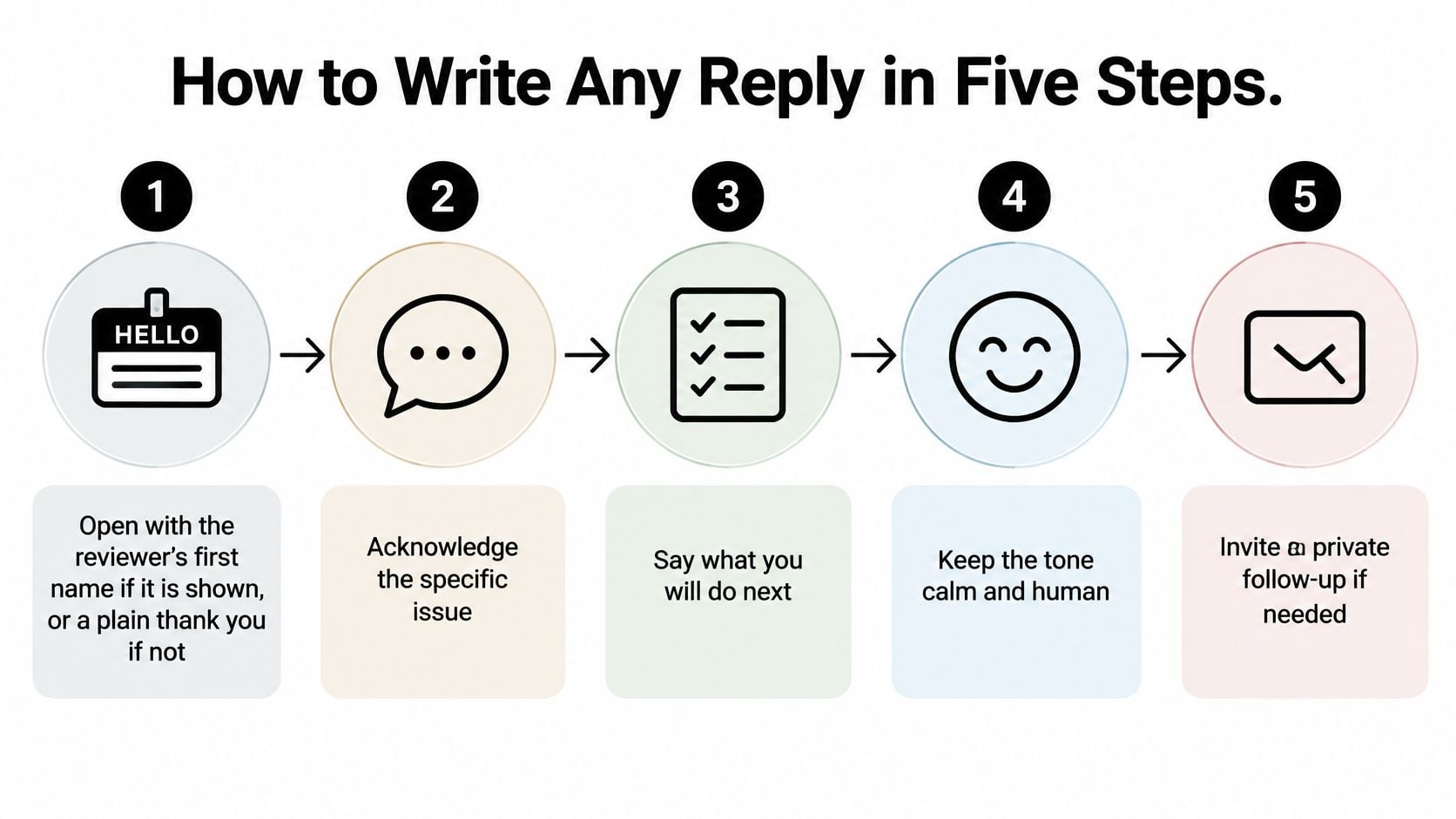
Use a consistent build order, not identical wording. That gives staff a reliable starting point without making every response sound as though it came from the same saved message.
Open with the reviewer's first name if it's shown. Otherwise, a plain thank-you is enough. Don't guess their identity from an unfamiliar profile name or use a full name unnecessarily.
Reference one safe, specific detail. Mention the helpful explanation, clear layout or friendly service they described, so readers can see you've read the review. The common slip is either repeating the whole review or thanking someone for praise they never gave.
Add a useful line about the benefit or concern. For praise, explain why that outcome matters, such as making the website easier to update. For criticism, acknowledge the issue without turning the reply into a catalogue of your services or a defence of your team.
Give a next step only when needed. A complaint might need an invitation to speak with a named manager; a happy customer usually doesn't need another task. Keep the action in a single sentence and make sure the person responsible knows about it.
Read for privacy, accuracy and length. Remove prices, account information, private correspondence and unnecessary project details, even if they support your position. Check that the wording describes what you know, not what you assume happened.
Use this visual prompt when drafting, then apply the privacy check before posting.
Keep your voice recognisable
Your reply should sound like the same business customers encounter on the phone and on your website. That's a practical part of brand consistency, not a reason to force marketing slogans into a complaint.
A friendly business can still sound serious when something goes wrong. Drop the exclamation marks, avoid jokes and don't add a sales pitch beneath someone's frustration.
At a glance, a good reply is a short paragraph with one relevant detail, a clear purpose and no surprises. Read it on your phone before posting. If the useful point disappears among explanations, cut the explanations.
Reply to a Negative Review Without Escalating It
A one-star review says a website launch slipped by several weeks and nobody explained why. The urge is to list the missing approvals and unanswered emails. The public job is narrower: show the next reader that someone will investigate, take responsibility and move the conversation private.
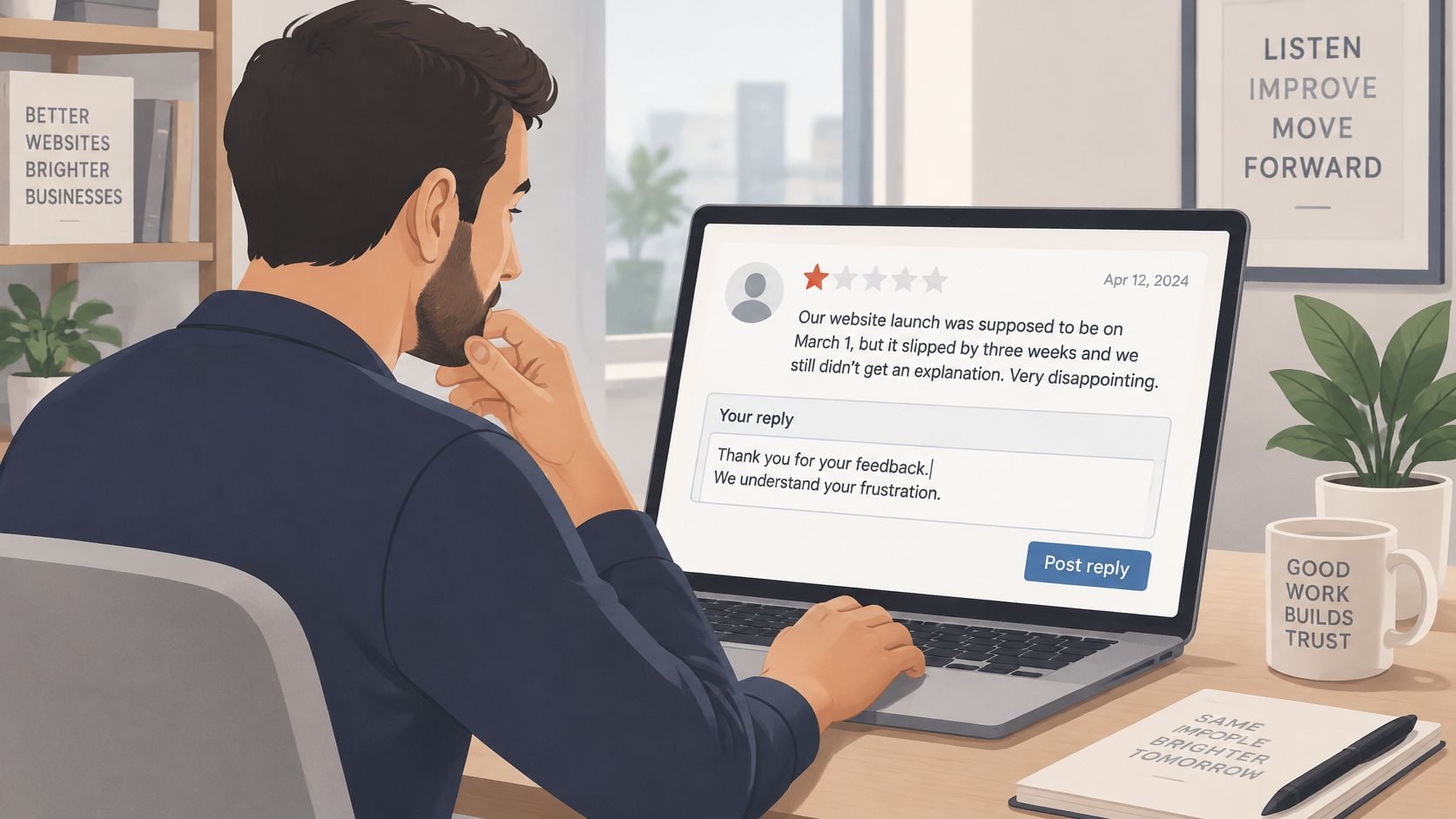
Name the delay the customer described and apologise for its impact without confirming a cause you have not checked. Offer one concrete action, such as having the project lead arrange a call that week to walk through the timeline. Give a private contact route, then stop.
If you draft while angry, leave it and read the project log before returning. Being factually right does not make every fact suitable for publication. A public reply is a message to future customers, not a courtroom statement.
Replace defensive wording with useful action
| Avoid saying | Say instead | Why it works better |
|---|---|---|
| That is not what happened | I'm sorry this isn't how you experienced it | Acknowledges the experience without debating details publicly |
| As per our terms | I'd like to understand what happened | Opens a conversation instead of leading with policy |
| We always deliver on time | We know timelines matter, and here is what we are changing | Replaces an unsupported absolute with a checkable action |
| Please take this review down | Let's sort this directly so we can put it right | Avoids pressuring someone to remove truthful criticism |
| You are wrong about the invoice | Let's go through the invoice together by phone | Keeps pricing and account details private |
Only promise a change if you can name the change. If not, say you are reviewing what happened and give the customer a private route to follow up. A public reply must not present information misleadingly or selectively, and a remedy should never be used to suppress criticism. Keep pricing, account details and admissions out of the public thread.
Wispra's guide to manage Google reviews effectively covers the wider reputation process if you want a comparison point.
Use the video below as a prompt for tone and pacing before you post.
Where someone feels ignored, offer a call or an in-person meeting if practical. DesignStack's local team is set up to allow better communication, in-person meetings and faster response times. A calm, specific response gives future customers something more useful to judge than an argument beneath a star rating.
Reply Examples for Common Review Situations
These are structures to adapt, not finished replies to paste. The names and situations are hypothetical. Replace them with wording that accurately reflects the review, and only promise actions your team has agreed to carry out.
Positive and mostly positive feedback
Five-star praise for a team member
Thanks, Priya. It's lovely to hear that Alex explained the website editor clearly. Helping you feel comfortable making updates was an important part of the handover.
This recognises the person and the outcome; change the names and benefit to match the review without adding private handover details.
Four-star feedback with a practical concern
Thanks, Ben. We're pleased the new layout is easier to navigate, and your point about the help guide is useful. We've added clearer instructions for finding the settings you mentioned.
This addresses the reservation without challenging the rating; only say the instructions have changed after checking they have.
Mixed feedback and service complaints
Three-star mixed experience
Thanks for the honest feedback, Amira. We're glad you're happy with the design, but we're sorry the updates weren't clear enough. Morgan will contact you on the agreed day to discuss how we handle the remaining work.
This balances praise with a named action; arrange the contact first and replace the vague timing with a real weekday or agreed date.
One-star service complaint
I'm sorry the delay and lack of updates have been frustrating, Daniel. Our project lead, Morgan, can review the timeline with you on Tuesday. Please contact the office so we can arrange a suitable time.
This moves the investigation somewhere useful; confirm Morgan's availability before publishing and don't disclose the disputed timeline.
Customer reviews are a form of user-generated content, but your replies are your responsibility. Keep order numbers, prices and confidential project facts out of them.
Maintain a small library of different openings, then rewrite each response around the actual review. One master template makes it too easy to answer the rating rather than the person.
When to Reply Report or Escalate
Since April 2025, fake reviews and concealed incentivised reviews have been banned practices under UK consumer-protection law; the CMA's online consumer reviews case page also records that its 2025 review of more than 100 businesses found 54 appeared potentially non-compliant with fake-review guidance.
That calls for an evidence-led process, not public accusations. An unfamiliar name doesn't prove a review is fake, and a strongly worded complaint doesn't automatically breach Google's policies.
Use a separate reporting workflow for suspicious or sensitive content.
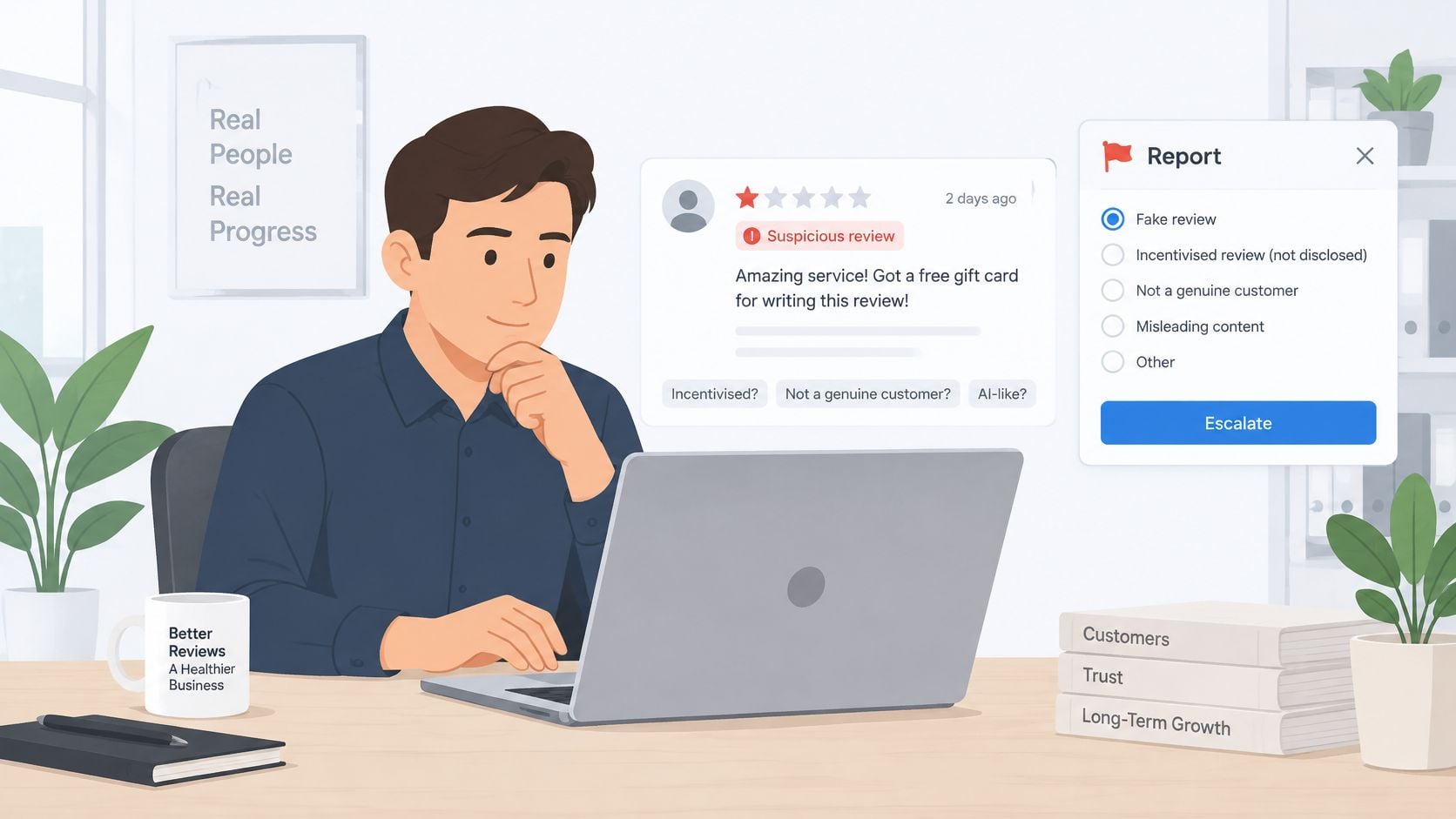
Routing problem reviews to the right action
| Situation | Public reply | Next action | Keep as evidence |
|---|---|---|---|
| Anonymous allegation of wrongdoing | Neutral acknowledgement that you take concerns seriously | Log it, check records, report if it breaks policy | Screenshot, date and reviewer profile |
| Suspected competitor review | No public accusation | Report the suspected policy violation to Google with supporting evidence | Profile links and activity timeline |
| Review reveals a customer's personal data | Brief reply without confirming their identity | Report the disclosure; keep it out of your replies | Review copy and report reference |
| Suspected fake or incentivised review from a rival or staff member | Neutral reply only | Escalate internally; seek legal advice if serious | Messages, payment records and dates |
| Genuine complaint with a confidential remedy | Apology and offline invitation | Assign a manager and deadline; follow up publicly only with permission | Dated customer-service log |
Separate suspicion from evidence
Preserve the review before reporting it. Record the policy concern precisely, such as disclosed personal information or evidence of a conflict of interest, rather than writing that the review is unfair.
Google's reporting route is for policy violations, not criticism you dispute. Don't promise removal, and don't encourage staff to submit counter-reviews.
A safe interim response can acknowledge that you take the concern seriously and invite private contact without confirming whether the reviewer is a customer. Avoid admissions about disputed events, prices, health information or order details.
For serious allegations, threats or an organised campaign, let the responsible manager coordinate legal or regulatory advice. Keep access to the evidence restricted, rather than circulating screenshots containing personal information throughout the business.
Track Replies and Turn Feedback Into Fixes
Set acknowledgement and resolution aims, then measure whether the team meets them. Keep unresolved complaints visible rather than marking them complete because someone posted a polite reply.
A spreadsheet is enough to start. Give each review a received date, reply date, status and owner so your monthly measures come from records rather than memory.
Review response measures to track each month
| Metric | What it shows | Target |
|---|---|---|
| Response coverage | Share of reviews receiving a reply | Every review, with sensitive exceptions documented |
| Median response time | How quickly the team replies | Within the acknowledgement target |
| Complaint resolution | Share resolved privately, plus time to resolution | Work towards the resolution aim; record exceptions |
| Non-generic replies | Share of sampled replies judged specific | Establish a baseline, then reduce generic replies |
| Rating distribution | Pattern across the available star ratings | Investigate changes rather than chase a predetermined mix |
| Reviews per completed project | Whether feedback follows delivery | Establish a baseline using neutral invitations |
Use the visual checklist alongside the spreadsheet to keep operational follow-through visible.
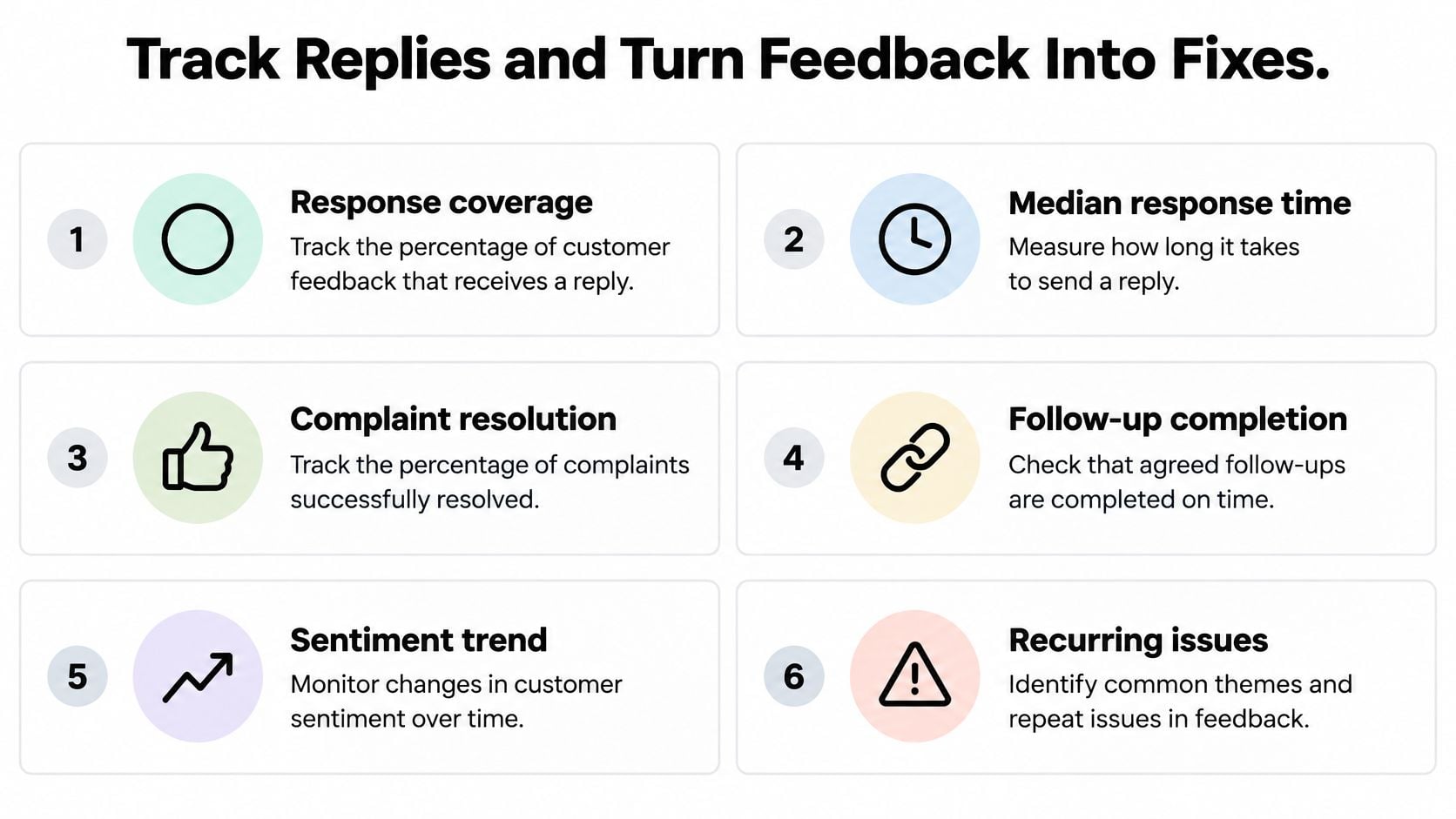
Audit quality, not just activity
In a weekly sample, assess specificity, professionalism, resolution offer, privacy protection and response speed. Flag repeated phrases, unsupported claims and pressure to remove criticism.
UK-focused benchmarks compiled by ReviewTactic report that 50% of consumers are unlikely to choose a business using generic responses. Use templates as prompts, not finished text.
Compare review patterns with enquiries through your website analytics, but don't assume a simultaneous change proves that replies caused more sales.
If several reviews describe unanswered emails, assign someone to fix inbox ownership and handovers. MakeAutomation's guidance to improve customer service for SaaS teams is useful for thinking through those responsibilities, particularly where support crosses different tools.
Keep a feedback-to-action log recording the issue, owner, change and completion status. That's how a complaint becomes an operational improvement rather than another carefully worded apology.
Set Up Your Review Response Process This Week
Pick a process small enough that it survives a busy week. You do not need reputation-management software before you have agreed who replies, who checks sensitive wording and who follows through on the action behind the reply. Every public answer is also a message to the next customer who opens that review, so the system has to show accountability without putting private detail on display.
Name an approval owner and open the log. Give one person responsibility for approving negative or sensitive replies before publication. Record the review, the public reply, the posting date and the private resolution. Restrict access where the log contains personal information.
Put the working rules where staff can find them. Save adaptable openings, the reporting criteria and the escalation contact in a shared workspace. Reserve a regular calendar slot for checking reply quality, and give a deputy access so holidays do not leave complaints unattended.
Work through a manageable batch of live reviews. Match each review to its situation, write a relevant response and check the promised action with its owner. Start with unresolved service issues, then deal with unanswered praise. Do not spend the whole session perfecting one difficult draft.
Automate reminders, not judgement
Use customer-service automation to assign tasks and remind staff about outstanding actions. Keep a human approval step for complaints involving personal information, disputed charges or allegations of wrongdoing. Automation can chase an owner for an update; it should not publish an apology on its own.
If you are reviewing the wider profile alongside your response process, Silver Spoon Agency's Google Maps SEO provides a separate reference point for local visibility work. Keep that work distinct from complaint resolution. A customer asking for help should not receive an SEO-led response.
Review the log after the team has used it consistently. Check whether unanswered reviews are being cleared, whether actions have owners and whether customers are getting the follow-up they were promised. The useful habit is completing the action behind the reply. Publishing more text is the easier half.
DesignStack can help with the website and local visibility work that sits alongside your review process. Visit DesignStack to request a no-obligation call back about your project, or call (01305) 301404 or email hello@designstack.co.uk to discuss your setup.