SEO Services What Is, Explained for UK Small Businesses
If you've typed SEO services what is into Google and come away with a page of jargon about backlinks and SERPs, you're not alone. The usual answer stops at rankings. It tells you SEO gets a website onto page one and leaves it there, as though visibility alone pays the bills.
It doesn't. A page can be found and still fail. The visitor lands, waits three seconds for a hero image to load, can't see a phone number, and goes back to the results. The work that fixes that gap is part of SEO too, and it's the part most small businesses notice first.
So here's the plain-English version. SEO services are the coordinated technical, content and reputation work that helps a business appear when somebody types a need into a search engine, and then helps that visitor take the next step. Picture a shop with a clean window on the right high street, a readable sign, and an open door. Being findable only matters if the rest follows.
Table of Contents
- What SEO Services Are in Plain English
- The Core Services Inside a Typical SEO Package
- Why Technical Health and Trust Come First
- Where AI Search Fits Into SEO Services
- How SEO Services Unfold Over the First Year
- Deciding Whether Your Business Needs SEO Services
What SEO Services Are in Plain English
SEO services are the work that makes a business easy to find when someone searches for what it sells, and easy to act on once they arrive. A tighter definition: a coordinated set of technical, content and authority actions that improve a website's visibility in unpaid search results, as opposed to paid ads.
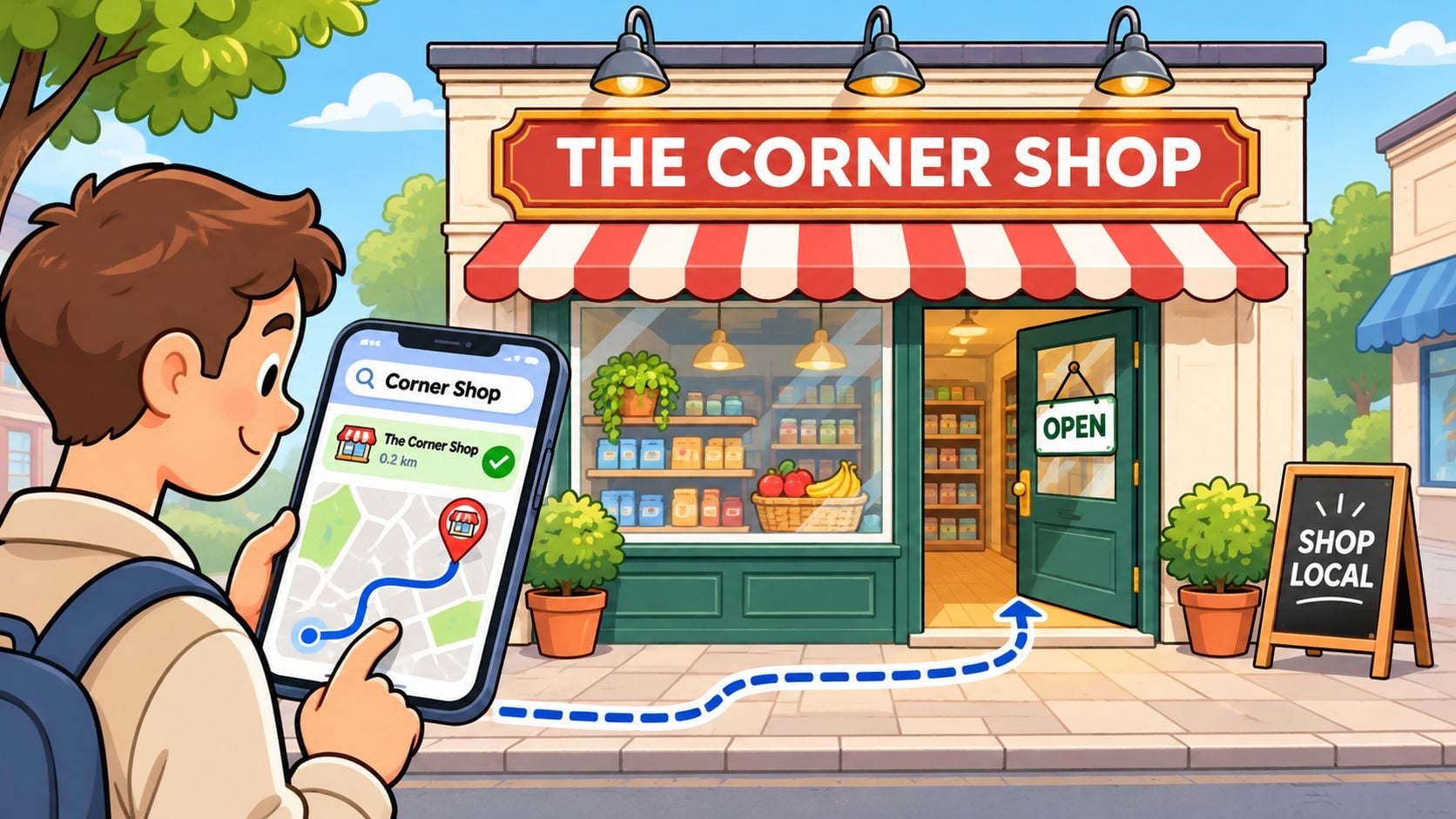
The shop comparison holds up. A shop needs the right street, a window people can see through, a sign at eye level and a door that opens. A website needs crawlable pages, clear titles and headings, content that answers the question, and an obvious next step. Miss any of those and the other three work harder for nothing.
Nearly all of this work targets one platform in the UK. The Competition and Markets Authority found that Google Search accounted for more than 90% of annual traditional-search queries in the UK between January 2018 and June 2025. On mobile devices Google's share stayed within the 90 to 100% range across 2018 to 2024; on desktop, within 80 to 90%.
That dominance is why UK SEO isn't a keyword sprinkling exercise. Pages have to be crawled, understood, indexed and presented properly on a phone as well as a laptop, because a page that fails any of those tests is invisible no matter how well it's written.
For a local firm the target looks different again. A Dorset business might build pages around service plus place, pairing what it does with Weymouth, Portland or Dorset, so someone searching nearby lands on a relevant page rather than a generic homepage. The same discipline applies to any organisation with a physical home, including clubs and venues; this guide to improve your club's local search visibility shows how those local signals stack up.
Three questions follow from the definition, and they're the ones worth answering in order: what's included, how the work unfolds over a year, and whether your business needs it at all.
The Core Services Inside a Typical SEO Package
A package is a group of separate jobs wearing one monthly invoice. That's why two quotes can look similar and cover completely different work. Search demand explains why there are so many jobs to do: UK government market analysis reported average monthly Google Search queries grew from approximately 5 to 20 billion in 2020 to approximately 10 to 25 billion in 2024, which it put at roughly 50 to 60% growth from 2017 to 2024.
More searches, spread across more stages of the buying journey, means one homepage can't carry the load. Here's how the components break down.
| Service component | What it covers | What you receive |
|---|---|---|
| Technical audit | Crawlability, indexing, page speed, broken links | Prioritised fix list |
| Keyword and intent research | Searches people use for each service and town | Keyword map by page |
| On-page optimisation | Titles, headings, copy and internal links | Updated service pages |
| Local SEO | Google Business Profile, local pages and reviews | Local search visibility plan |
| Content creation | Guides, FAQs and case studies | Articles targeting real queries |
| Authority building | Relevant links and brand mentions | Referring domains over time |
| Reporting | Impressions, clicks and enquiries | Monthly or quarterly review |
Nobody needs every row in month one. A local retailer usually starts with the audit, on-page work and local SEO, because those three change the pages that already exist. Content creation and authority building come once the foundation can carry them.
The three parts most small businesses start with
The audit comes first because it's the only honest starting point. DesignStack performs SEO audits, and the useful output isn't a score, it's an ordered list: what's broken, what it costs you, and what to fix first.
On-page work turns research into pages. Each target search gets its own URL with a clear title, one main heading, copy that answers the query, and internal links to the related service page. One page trying to cover four services ends up ranking for none of them well.
Local SEO covers the searches with a place attached. That means a complete Google Business Profile, location pages with distinct content, and a steady habit of asking happy customers for reviews.
Content, technical work and organic search don't run in isolation here. DesignStack's SEO strategy combines content, technical work and social media, paid promotion, research, content creation and organic SEO, so a page published for search also has a life on social and in paid campaigns. If you want the long version of how those pieces join up, this explanation of a joined-up SEO content strategy is worth twenty minutes.
The test of a good package: every line on the quote should name the page it changes or the outcome it moves. If a line can't be tied to either, ask why it's there.
Why Technical Health and Trust Come First
A click is a promise. The visitor has decided you might have the answer, and the page now has a few seconds to keep that decision alive.
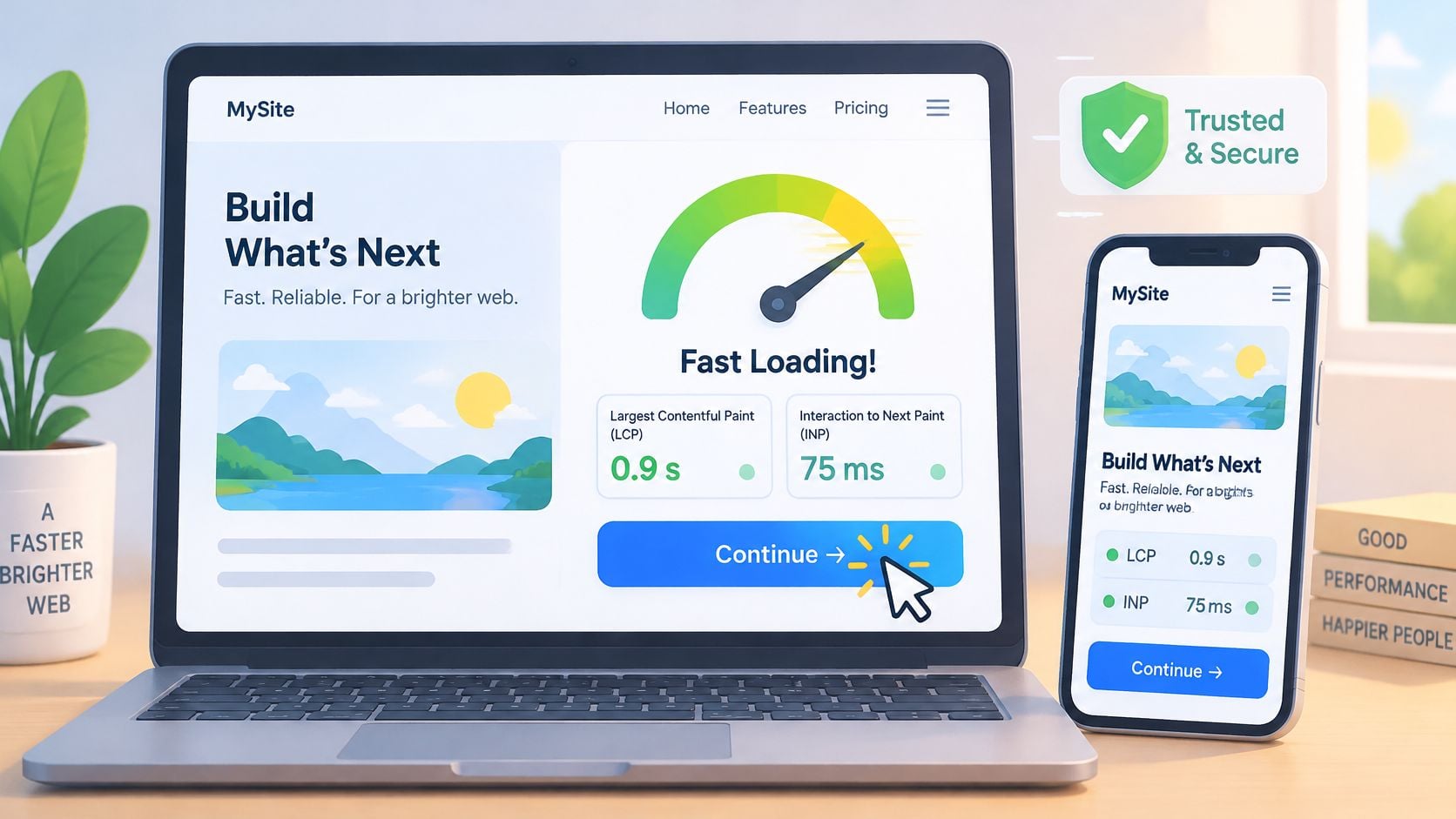
Speed decides most of those seconds. A UK ecommerce speed study reports that 53% of mobile users leave pages that take more than three seconds to load, and research cited in the same study indicates that a 0.1-second improvement in load time can increase retail conversions by up to 8%. Google's Core Web Vitals framework gives you the three things to watch: Largest Contentful Paint for how quickly the main content appears, Interaction to Next Paint for how fast the page responds to a tap, and Cumulative Layout Shift for whether the page jumps around while loading.
Then there's trust, which is where most small sites lose the enquiry after winning the click. A UK audit of 4,324 small-business websites found that 61.6% had at least one image missing alternative text, 45.8% lacked a click-to-call phone number, 43.5% had no schema markup, and 28.4% had GDPR or privacy gaps. The same audit reported an average SEO score of 85.5 out of 100 against an average accessibility score of 77.8.
That gap is the whole argument in two numbers. A site can score respectably on SEO and still be awkward to use, unclear about who it is, and quiet on privacy.
The fixes that pay back fastest
- Compress and size images properly: Large media files are the most common cause of slow mobile pages, and fixing them usually costs nothing but an afternoon.
- Write real alt text: "Red leather chesterfield sofa in a Weymouth shop window" beats "image1" for screen readers and for search engines reading the page.
- Make the phone number tappable: A visible, clickable number on every page removes the most basic friction between interest and enquiry.
- Add structured business data: Schema markup spells out your name, address, opening hours and service area so machines don't have to guess.
- Write a plain privacy notice: One page, no legal theatre, saying what you collect and why.
Your Google Business Profile carries much of this trust work before anyone reaches the site at all, and these Google Business Profile optimization tips cover the fields most owners leave blank.
A site can have a respectable SEO score and still lose the sale at the phone number. Fix the doorway before you buy more traffic.
The technical detail behind all of this is covered in this guide to what technical SEO actually involves. The question to put to any provider is simple: which of these fixes will you make first, and which page does each one affect?
Where AI Search Fits Into SEO Services
Most explanations of SEO services assume nothing has changed since 2015. Keywords, backlinks, rankings. Then a customer asks an AI assistant for "a good web designer near Weymouth" and gets an answer with no blue links at all. Any provider still describing SEO as a rankings-only job is describing half the picture.
The evidence says business owners already sense this. Research on UK small business AI search found that 57% of UK businesses expect AI search to generate more customers over the next three years, yet only 9% have taken steps to improve their visibility. Among firms with fewer than 10 employees, 30% didn't know they could appear in AI search and 64% had taken no action. Expectation is high; preparation is close to zero.
Here's the part that gets missed in the panic. AI visibility doesn't replace SEO. The same source reports that traditional organic clicks still represent about 68% of search clicks, while AI-referred visitors may convert at a higher rate despite arriving in smaller numbers. Fewer visits, better visits.
What supports both channels is largely the same work:
- Well-structured, sourced content that states facts clearly enough for a machine to quote with confidence
- Clear business entities, meaning consistent names, addresses, service areas and descriptions across the site and listings
- Reviews and reputation signals, because recommendation engines lean on what other people say about you
- Technical accessibility, since an assistant can't cite content it can't read
- Tracking branded mentions, so you know when you're being described rather than linked
Structured data does a lot of the heavy lifting for the machine-readable side, and this breakdown of structured data and how search engines read it explains the markup in plain terms.
Two questions will sort a provider quickly. First: which tasks on this quote serve Google rankings, and which serve AI recommendations? Second: how will you show me the difference in a report? A provider with a real answer will point at specific pages and specific measurements. One without will talk about algorithms.
Expect AI visibility to be part of a scoped SEO service, not a separate product with its own invoice and a new set of promises.
How SEO Services Unfold Over the First Year
Search engines need time to recrawl a page, and trust accumulates rather than arriving. That shapes the order of work more than any agency preference does.
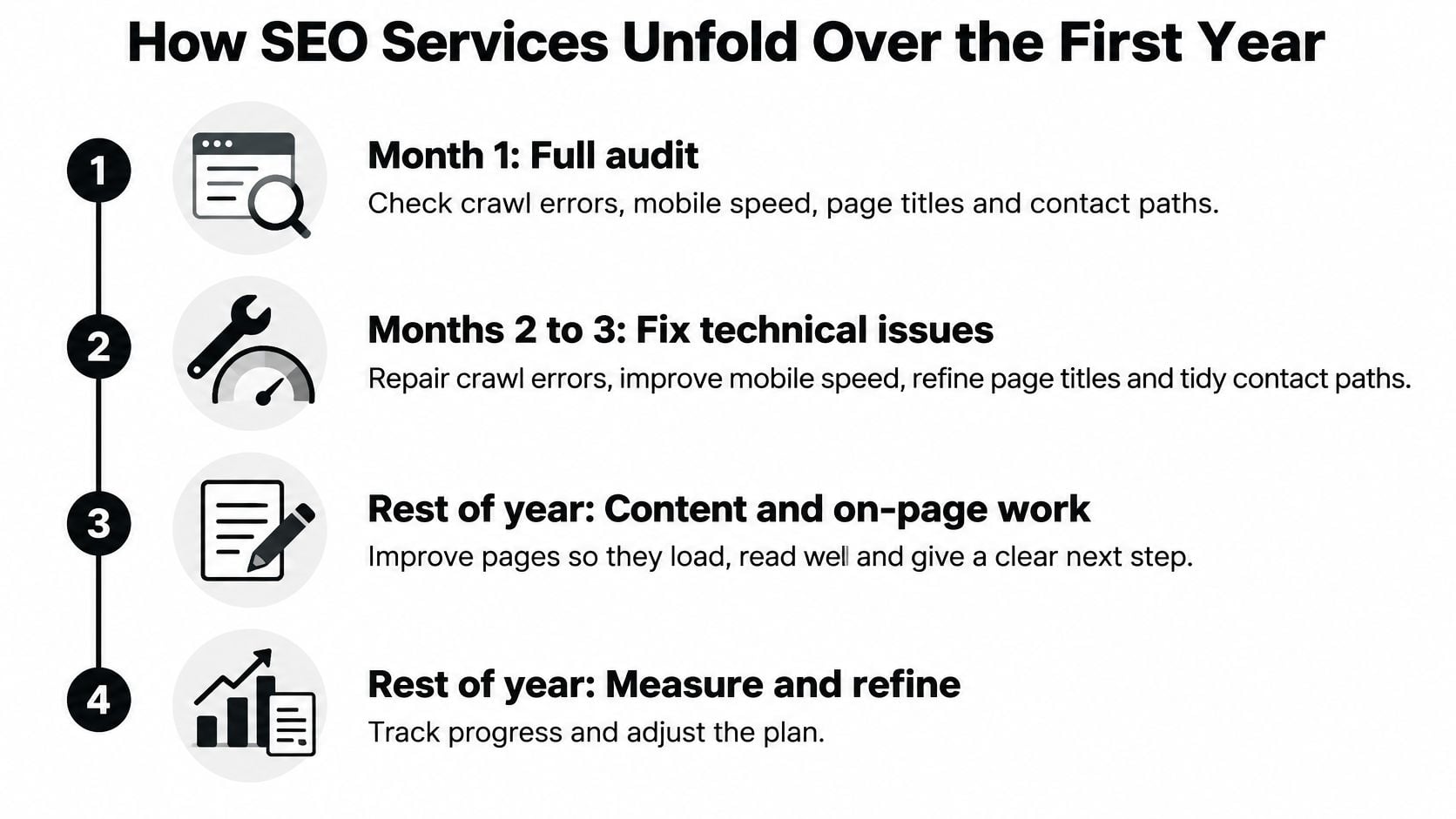
Month one is diagnosis. A full audit covers crawl errors, mobile speed, page titles, internal links and contact paths. Nothing gets rewritten yet, because you can't prioritise fixes until you know which pages are affected.
Months two and three are repair and mapping. Technical issues get cleared while target searches get assigned to individual pages: a web design page for Weymouth, a separate eCommerce development page for Dorset, and so on. Each search gets one page, and each page gets one job.
Months three to six are publishing and local groundwork. Useful content goes live, internal links get tidied so related pages point at each other, and local listings and reviews move forward together. This is the slowest stretch and the one where owners most often lose patience.
Months six to twelve are measurement and adjustment. Reports shift from position to outcome: non-branded query visibility, clicks, qualified enquiries and conversion rate. Pages that earn enquiries get expanded. Pages that earn nothing get rewritten or merged.
Why the order matters
Fixing speed before mapping keywords means you're fast and still irrelevant. Publishing content before repairing crawl errors means good pages that never get indexed. Building links before the pages are ready sends authority to thin copy.
Practical rule: if a provider promises a specific position by a specific date, ask which page, which search term and which market. Vague guarantees are the cheapest thing an agency can sell.
Progress at three months looks like an audit closed out, pages mapped, technical errors gone, and early movement on non-branded searches. At six months you should be able to point at enquiries that arrived from organic search and name the pages they came from.
That's the honest measure. Rankings are a diagnostic, not a result, and a monthly report showing positions without enquiries tells you nothing about your business. Here's a fuller look at SEO help for small businesses if you want to see how a scoped engagement is structured.
Deciding Whether Your Business Needs SEO Services
Here's an odd split. In 2025, SEO Caddy's study of 439 UK SMEs found that 91% considered SEO essential, while only 28% felt confident in their SEO knowledge. Most owners are committing budget to something they'd struggle to describe, which is exactly how bad quotes get signed.
The starting point depends on where you are now, not on what a package says.
| Business situation | Likely SEO need | Sensible first step |
|---|---|---|
| New local service business | Local visibility and service pages | Local audit and location pages |
| Online shop or eCommerce brand | Product pages and mobile speed | Speed and product page audit |
| Community group or membership club | Accurate local details and contact paths | Local listing and contact fixes |
| Site with traffic but few enquiries | Conversion, trust and accessibility | Experience audit before new content |
| Business with no site yet | Build with SEO included | Plan the site around target searches |
Website ownership is uneven by company size, which affects how much groundwork each business needs. The UK Business Data Survey reports websites for 92% of small businesses, 84% of microbusinesses and 76% of sole traders.
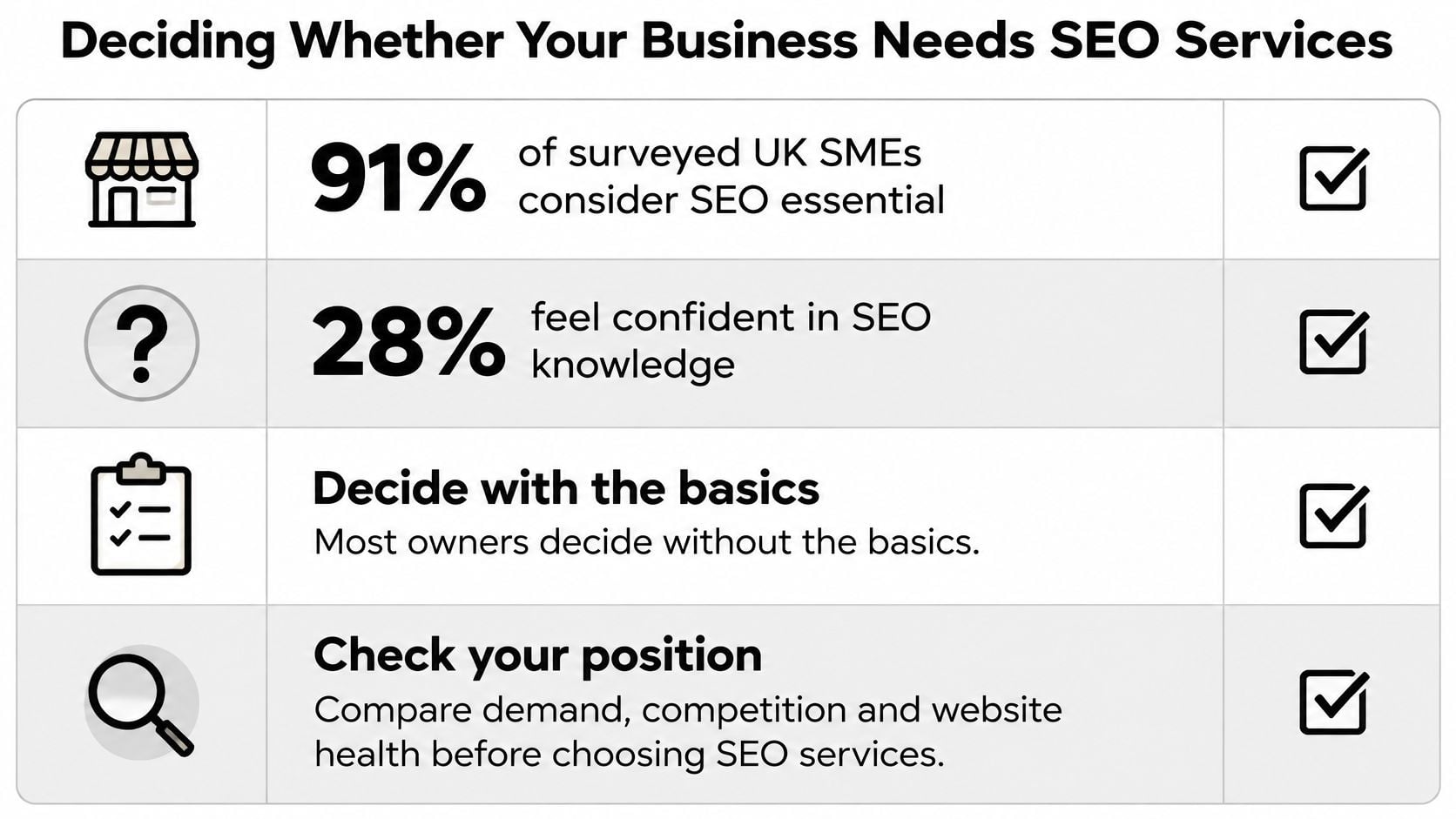
A short checklist before you spend anything
- Can Google crawl the site? Check that pages appear in a site search and that there's no stray "noindex" tag left over from launch.
- Can you name the five searches that matter? The five phrases a real customer would type, in their words, not yours.
- Is the phone number tappable on mobile? Test it on your own phone on mobile data, not office wifi.
- Is there a privacy notice? Any page collecting an email address needs one.
- Have you picked one enquiry-based measure? Form submissions or phone calls, tracked monthly.
Comparing two quotes fairly
Match each line to the page or outcome it changes, then compare scope rather than headline price. Research gives no standard rate, and a cheap retainer that never touches your service pages costs more than a fixed audit that does. DesignStack creates websites at a fixed cost and builds SEO into the plan rather than bolting it on later, which matters if you're starting from nothing.
Cheapest sensible first step: pay for a fixed-scope audit, read the fix list, and decide about a monthly retainer afterwards with evidence in front of you.
DesignStack offers four services, website design, graphic design and branding, SEO, and mobile app development, and works with businesses across Dorset with local pages for Weymouth, Dorchester, Bridport, Bournemouth, Poole, Wimborne, Wareham, Swanage, Blandford Forum and Salisbury. If you're weighing up whether it's worth it at all, this piece on whether SEO is worth it for a small business sets out the trade-offs, including what SEO can't fix.
If you want a straight answer on what your own site needs first, DesignStack runs fixed-scope SEO audits from its Weymouth studio and builds the pages, speed fixes and local listings that come out of them, combining content, technical work and organic SEO for businesses across Dorset and the wider UK. Start with the audit, see the fix list, and decide about the rest with something concrete in front of you. Visit DesignStack to get that conversation started.