Website Redesign Cost Breakdown: A UK Guide for 2026
UK website redesigns typically cost between £1,500 and £15,000+, depending on scope. This website redesign cost breakdown shows, line by line, where that money goes and which decisions push a project from a light refresh towards a full rebuild.
That range isn't a mysterious agency number. It reflects the work behind the visible changes. A new colour palette may be straightforward, while reorganising navigation, rewriting content, moving platforms, protecting search rankings, and testing integrations can turn the same brief into a much larger technical project.
For a Dorset business owner, the useful question isn't “How much does a redesign cost?” It's “What outcome does each part of this quote buy me?” The sections below walk through that bill of materials in practical terms, using the pricing bands UK studios commonly apply.
Table of Contents
- What a UK Website Redesign Actually Costs in 2026
- Discovery and Content Audit Costs
- Design Costs From Wireframes to Revision Rounds
- Development Costs and the Replatform Decision
- SEO Migration Costs That Protect Your Rankings
- Hosting Maintenance and the True First-Year Total
- Optional Features and Integration Costs
- Building Your Own Redesign Budget That Holds Up
What a UK Website Redesign Actually Costs in 2026
A redesign quote should show a bill of materials, not one unexplained total. The useful question is what each scope choice buys: a refreshed appearance, new templates, content work, platform changes, SEO protection, integrations, testing, or support after launch.
UK guidance commonly places a visual refresh at £1,500 to £4,000, a redesign that stays on the current platform at £3,000 to £10,000, and work involving platform migration at £5,000 to £15,000+. The UK website cost guide from DesignStack offers a useful comparison when deciding between a redesign and a new build.
Three pricing tiers
| Tier | Typical scope choice | Quote outcome |
|---|---|---|
| Starter refresh | Small brochure site, existing pages, template-based styling, responsive layouts, standard contact form | A cleaner mobile-friendly presentation without rebuilding the site structure. £1,500–£4,000 (UK redesign cost guide) |
| SME redesign | New information structure, custom templates, blog or case study area, stronger lead forms | A clearer route from landing page to enquiry, with reusable layouts for ongoing content. £3,000–£10,000 |
| Replatform or complex build | Platform migration, larger catalogue or booking functionality, integrations, SEO preservation | A new technical foundation, transferred content or products, tested connections, and protected search visibility. £5,000–£15,000+ |
A small Dorset trades business may only need a modern WordPress layout using its existing pages. A professional services firm may need revised navigation, several reusable templates, stronger enquiry paths, and a case study hub. A retailer may need product migration, payment testing, and a revised checkout journey.
The price rises because the studio has more to plan, build, migrate, test, and protect. Design style alone does not justify a higher quote. Keep the current CMS and structure when they still support the business. Replatform when the existing system blocks required functionality, maintainability, or growth.
Use the tier as a scope check, not a package to select blindly. A quote near £1,500 usually depends on preserving structure and content. Reaching £15,000+ means paying for migration, technical connections, content handling, and testing that a visual refresh does not include.
Discovery and Content Audit Costs
A cheap redesign quote often cuts discovery first. The saving disappears when nobody agrees which pages matter, what action should generate enquiries, or whether existing content remains usable. Discovery is the work that keeps a quote near its intended scope instead of pushing decisions into design and development.
A practical discovery phase produces three deliverables:
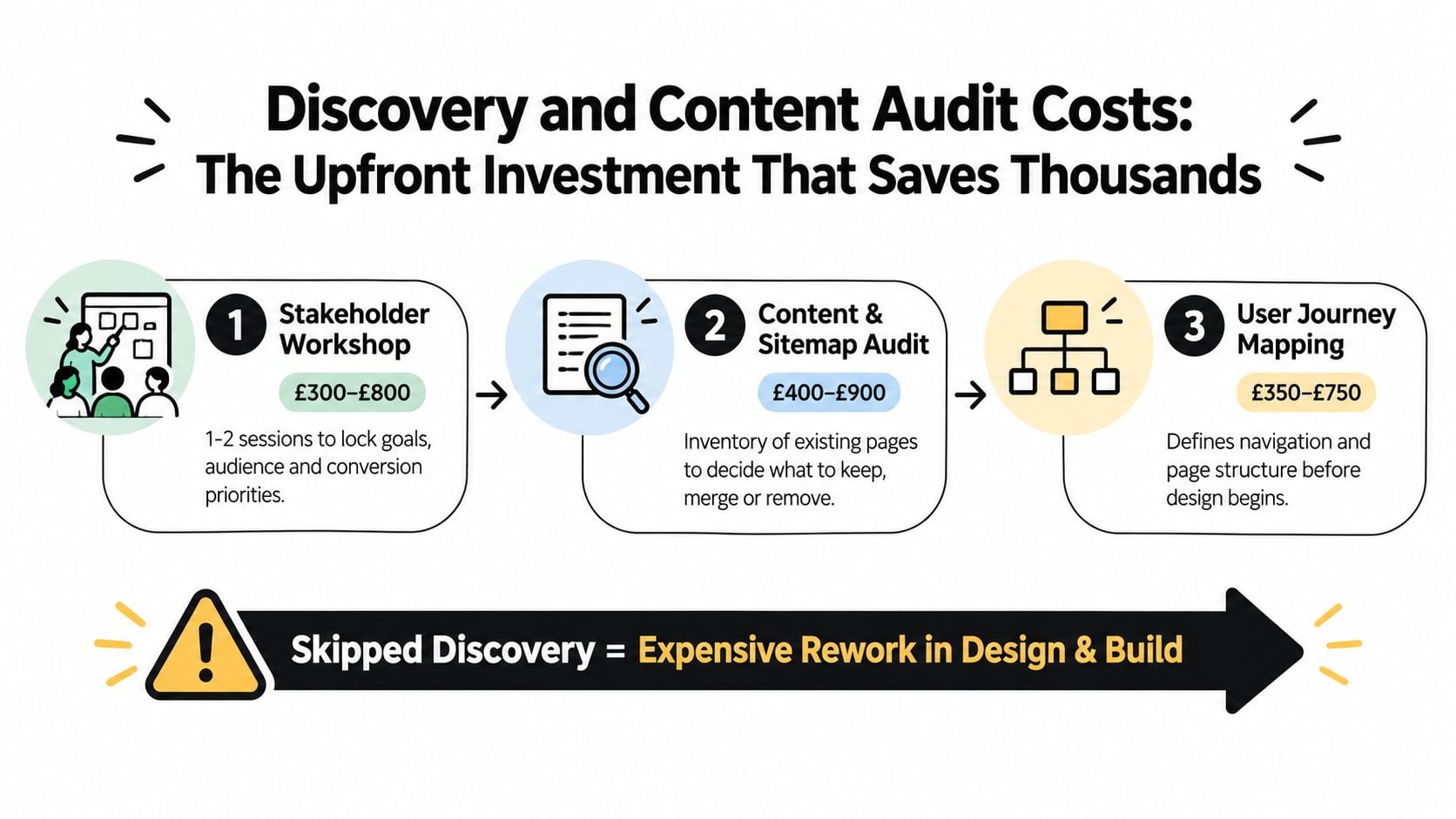
- Stakeholder workshop: Focused sessions to agree business goals, audiences, priorities, and enquiry actions. Allow £300 to £800, as outlined in the UK website redesign pricing guidance.
- UX and sitemap review: An audit of navigation, page hierarchy, and user journeys, usually budgeted at £400 to £1,200.
- Content audit: A page-by-page inventory showing what to keep, merge, rewrite, or retire. For a site with 10 to 30 pages, allow £500 to £1,500.
These line items change the quote outcome. Retaining the existing structure can keep a smaller redesign close to £1,500. Reworking navigation, reviewing every page, and preparing content for new templates adds work before any polished screen is designed.
Why the first meeting saves money
Without an agreed sitemap, designers make assumptions. Without a content inventory, developers can build templates around pages that later disappear. Without agreed conversion actions, visual revisions may improve appearance while leaving the sales problem untouched.
Discovery usually represents 8% to 15% of the project total, according to the UK website redesign cost breakdown. That budget pays for decisions that prevent rework and makes the rest of the quote easier to defend.
Content migration needs its own line, not a vague allowance under “development”. A content migration service can cover old URL inventories, structured content transfers, formatting checks, and validation that important pages work in the new environment.
Practical rule: Ask for discovery deliverables in writing. If the quote says only “research” without naming the workshop, sitemap, audit, or approved brief, the scope is too vague.
Include discovery from day one. Removing the line rarely removes the work. It shifts that work into revision rounds, development changes, and copywriting extras, where controlling the final cost is harder.
Design Costs From Wireframes to Revision Rounds
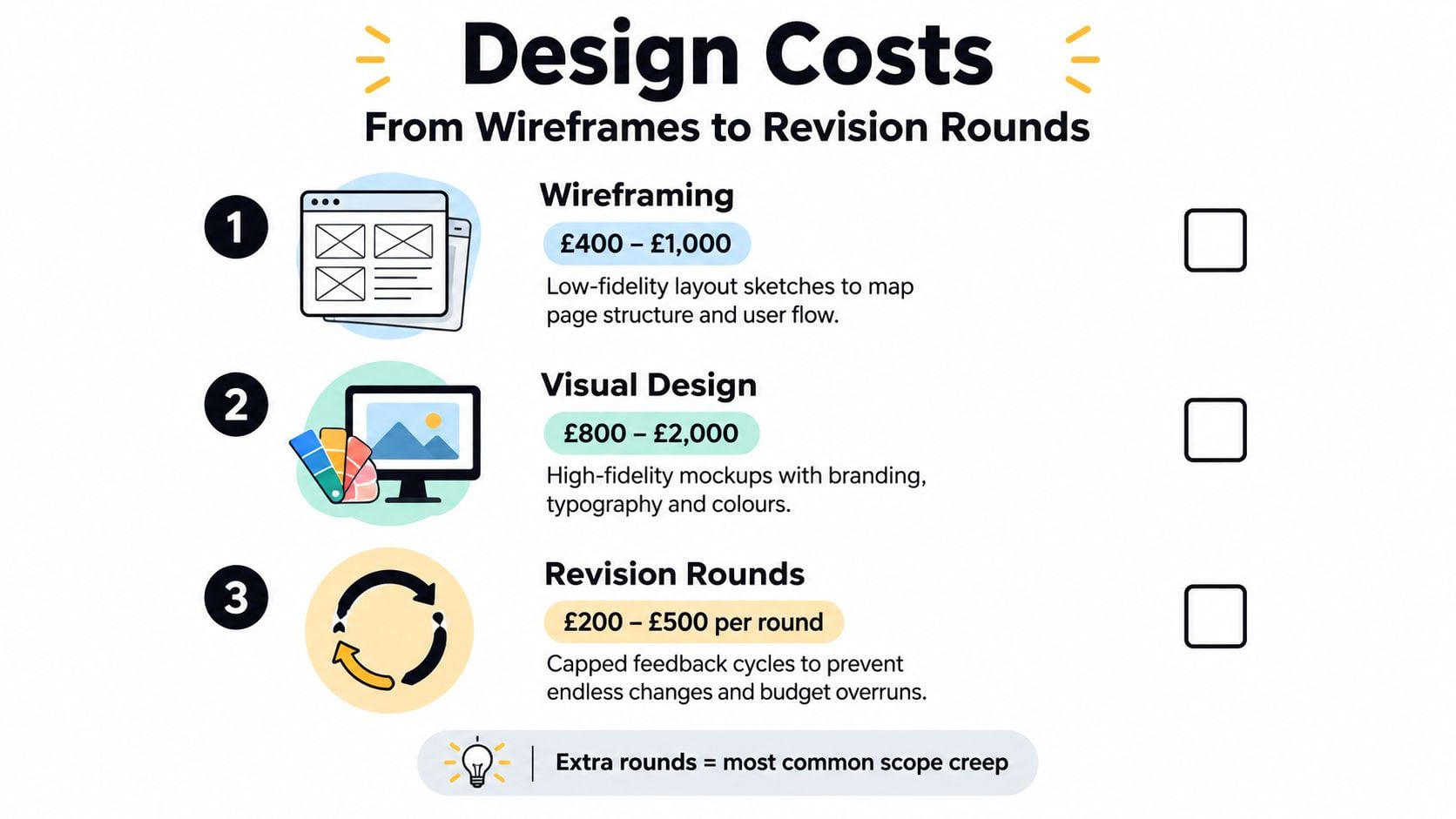
The most expensive design cost is rarely the mock-up. It is the extra revision round that reopens an approved structure, changes the build, and pushes the quote beyond its original scope.
A clear design quote separates three jobs. Wireframes set the page hierarchy and user route. Visual design establishes the interface style. Revision rounds let the client refine an agreed direction within a defined limit. Combining these into one “design” allowance hides where the price can move from a smaller redesign towards a larger project.
Wireframes are low-fidelity page plans showing headings, navigation, content blocks, calls to action, and forms before final colours or imagery are added. Allow £400 to £1,000 for this stage. It is the cheapest point to find an overcrowded service page or an awkward enquiry route. Clients who want the process explained can read this explanation of wireframes in web design.
Visual design follows approved structure. High-fidelity mock-ups define typography, colour, imagery, spacing, buttons, and responsive behaviour. The wider full redesign range is £3,000 to £10,000, with the quote driven by template count and customisation depth. A small set of reusable layouts keeps the design line closer to the lower end. Bespoke layouts for multiple services, products, or content types move it higher.
Revisions are where scope moves
The quote must state the included feedback rounds. DesignStack's published approach includes three design revisions as standard, although another studio may agree two or a different defined number. The number matters less than a written limit and a clear charge for additional work.
A button change can become a request to revisit hierarchy, content length, development effort, and mobile layouts. Use one feedback tool, appoint one decision-maker, and approve wireframes before visual design begins.
A disciplined quote identifies:
- Included screens: Home page, key service or product template, contact page, and unusual layouts.
- Responsive coverage: Desktop and mobile behaviour, not one static screen.
- Feedback process: Who gathers comments and how the studio receives them.
- Revision limit: Included rounds and the rate or process for extra work.
Design should close decisions in order, not leave the project open to continual changes in direction.
Development Costs and the Replatform Decision
The platform choice can move a redesign quote from £1,500 towards £15,000+. Keeping WordPress, for example, may preserve the existing editor, content structures, and suitable plugins. Moving to another CMS, a custom frontend, or an e-commerce platform creates a rebuild behind the new visual design.
UK guidance places small-business visual refreshes on the same platform at £1,500 to £4,000. Replatforming can reach £4,000 to £15,000+ because content transfer, redirects, connected systems, and testing require separate work, as explained by Digital Otter's UK redesign cost guidance.
| Work Area | Same-Platform Rebuild | Full Replatform |
|---|---|---|
| Templates | Existing CMS templates adapted or rebuilt | New templates and platform components |
| Content | Existing structures can often be retained | Content models and formatting may need redesign |
| Admin workflow | Familiar editing process | New CMS training and permissions may be required |
| Integrations | Existing connections can be reviewed and retained | Connections need configuration and full testing |
| SEO | URL structure may remain stable | Redirect mapping and migration checks become central |
| Main cost risk | Custom templates and plugin conflicts | Migration, new architecture, integrations, and QA |
What should appear in the build quote
“Development” is too vague for a useful quote. Ask the studio to separate:
- CMS configuration, including roles, settings, and reusable components.
- Custom content types, such as case studies, team profiles, properties, or products.
- Template development, covering the approved page layouts.
- Integration work, including forms, CRM connections, booking tools, or payments.
- Migration work, including structured content and media.
- Quality assurance, including forms, mobile layouts, browsers, and accessibility checks.
The WordPress, Squarespace, and Wix comparison helps clarify which platform fits your editing needs before the studio prices the build.
Keep the current platform unless it blocks required functionality, cannot receive sensible security updates, or creates an ongoing operational problem. Replatforming makes sense when the platform itself causes the cost or limits the result. It should not appear in the quote because a newer system sounds more modern.
SEO Migration Costs That Protect Your Rankings
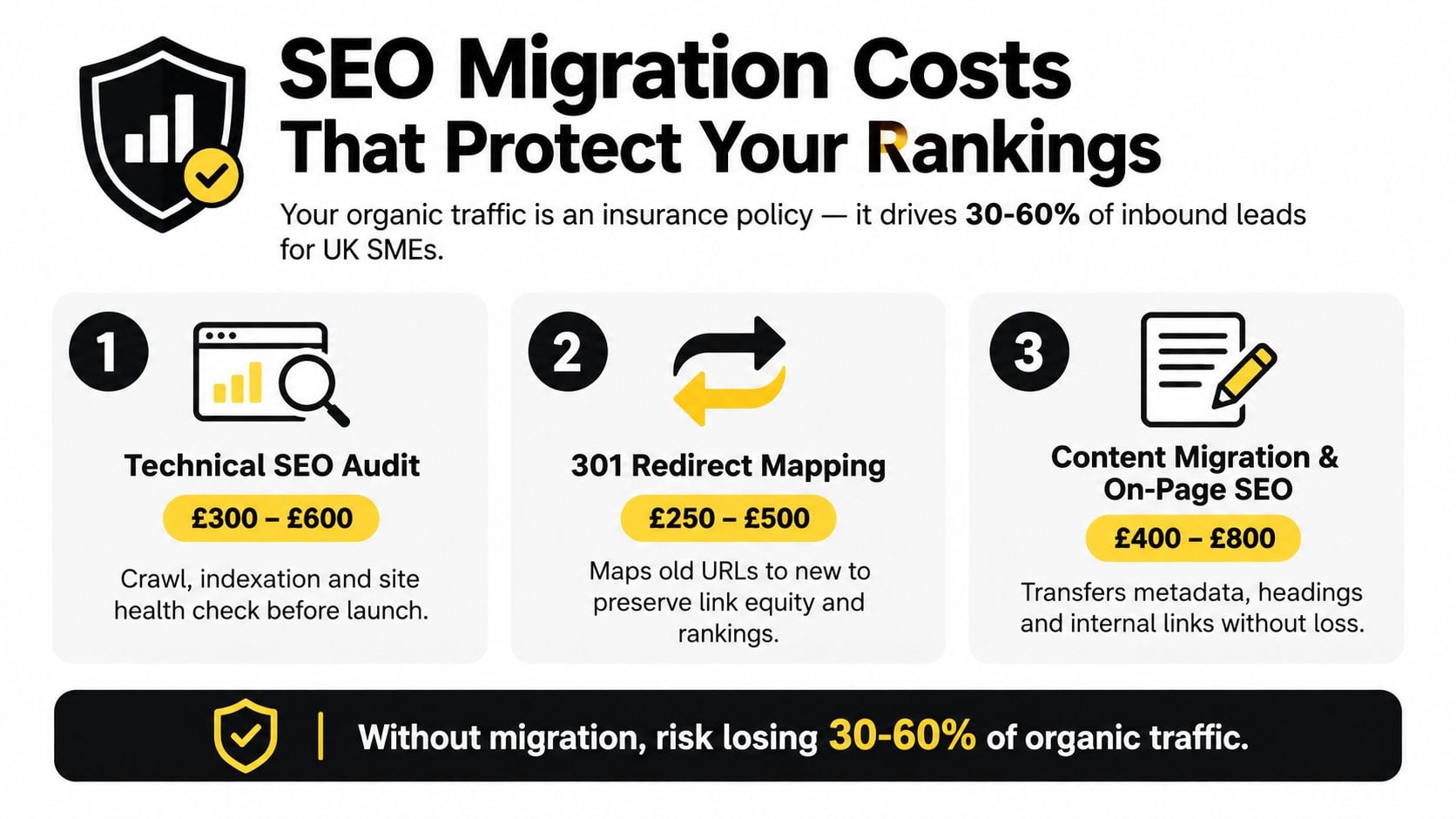
A redesign can erase years of organic visibility overnight if valuable URLs disappear, metadata is lost, internal links break, or search engines index duplicate versions of content. SEO migration belongs in the quote from the start, not as a rushed task after launch.
Allow £800 to £2,500 for SEO migration and related preservation work on a UK SME website. The final amount depends on the number of URLs, the complexity of the site structure, and how far the redesign changes the information architecture.
The three deliverables your quote should name
- Technical SEO audit: Check crawlability, indexation, page hierarchy, metadata, internal links, and technical issues before development is signed off.
- Redirect map: Match every valuable old URL with the most relevant new destination, then implement and test each redirect.
- On-page preservation: Transfer or improve titles, descriptions, headings, structured data, image information, and internal links.
Make the redirect map an approved deliverable. If it is left until handover, the team will be making high-impact decisions under launch pressure.
Use the website migration SEO checklist to organise pre-launch and post-launch checks. A migration fails when URLs change without mapping, pages lose metadata, staging restrictions reach production, or forms and canonical signals go untested.
Ask for a quote outcome, not a vague “SEO review.” A smaller, stable site may need audit, redirects, and verification. A larger rebuild with new templates, changed navigation, or replatforming needs URL-by-URL mapping, content checks, staging review, and post-launch monitoring. Those scope choices are what move the SEO line from a modest allowance towards the higher end of the range.
If organic enquiries matter, lost visibility means lost opportunities and extra marketing spend while rankings recover. Fund the protection alongside design and development.
Hosting Maintenance and the True First-Year Total
The build price covers launch, not ownership. Hosting, licences, security updates, backups, and post-launch changes can materially alter the first-year cost, so each line should appear in the quote rather than being left as an afterthought.
Typical allowances include hosting at £15 to £150 per month, premium SSL at £50 to £120 per year where a paid certificate is required, plugin and theme licences at £100 to £500 per year, and maintenance retainers at £80 to £350 per month. Treat these as separate budget lines, because the platform, traffic, tools, and support arrangement determine which costs apply.
| Cost Line | Monthly | Annual | Notes |
|---|---|---|---|
| Hosting | £15–£150 | £180–£1,800 | Depends on platform, traffic, support, and resources |
| SSL certificate | Not usually monthly | £50–£120 | Many sites use a free certificate, but premium options exist |
| Plugin and theme licences | Not usually monthly | £100–£500 | Renewal costs vary by tools and features |
| Maintenance retainer | £80–£350 | £960–£4,200 | Updates, security checks, backups, and small edits |
A £4,000 redesign, combined with £120 monthly hosting and £200 monthly maintenance, produces a first-year total of £8,440, before separate licence or SSL costs. The calculation is straightforward, yet proposals often show only the build figure. Ask for the full first-year total and the recurring cost after year one. Those figures reveal whether the quote reflects a simple £1,500 refresh or a wider project approaching £15,000.
Define support before signing
A maintenance contract should state whether it includes CMS and plugin updates, backups, security monitoring, uptime checks, recovery support, and minor content edits. It should also set response times and define an emergency.
New page templates, major campaigns, integrations, copywriting, and structural changes belong in project work. Get those boundaries in plain English. Routine updates should not trigger a new quote, while a maintenance retainer should not be expected to fund an entirely new feature.
Optional Features and Integration Costs
Optional features turn a modest brochure redesign into a technical project. A new button may connect to payments, calendars, customer records, email automation, user permissions, or regulated data. Each connection adds configuration, testing, security checks, and handover work to the quote.
Booking, CRM, and payment integrations can add approximately £600 to £5,000. E-commerce and builds connecting several systems can reach £4,000 to £15,000+, according to Cambria Digital's redesign cost breakdown. These choices can move a project from a £1,500 refresh towards £15,000, so name them before approving the scope.
| Feature category | Common examples | Cost range | Add-on impact |
|---|---|---|---|
| Payments | Stripe, Worldpay, SagePay | £600–£1,500 | Checkout testing, security review, transaction handling |
| Bookings | Calendly, salon schedulers, custom booking tools | £400–£2,000 | Availability rules, confirmations, cancellation flows |
| CRM and marketing | Mailchimp, HubSpot, ActiveCampaign | £500–£2,500 | Field mapping, consent handling, lead testing |
| Multilingual and portals | WPML, Weglot, client login areas | £1,500–£5,000 | Permissions, translated content, account workflows |
Choose the launch requirements
List every feature under one of three headings:
- Required: The site cannot launch or sell properly without it.
- Useful at launch: It improves the customer experience, with a workable manual alternative.
- Phase two: It needs more discovery, data, or budget than the first release allows.
A simple booking embed may suit launch. A custom scheduler with staff availability, payment collection, reminders, and customer accounts is a separate product decision, with a different quote outcome.
Third-party subscriptions need their own budget line. Development fees may exclude the provider's licence, transaction fees, API limits, and future renewals. Ask who owns each account, who pays for renewals, and what happens if the provider changes its service.
Avoid vague “enhancements” allowances. The proposal should name each integration, describe the expected user journey, list the test cases, and assign handover responsibility. That detail shows whether the quote covers a genuine feature or leaves the expensive work for later.
Building Your Own Redesign Budget That Holds Up
A reliable budget starts with decisions you can make before contacting a studio. You don't need a technical specification, but you do need an honest description of the pages, features, platform, content, and support your business expects.
Use this five-step workflow
- List pages and templates: Count the content that needs review, then identify repeated layouts such as service pages, product pages, case studies, or team profiles.
- Separate essentials from extras: Mark the features required for launch and move ambitious additions into a later phase.
- Allow for revisions: Keep a contingency of 15% for agreed changes and unknowns, as recommended in the supplied budgeting brief.
- Price year one: Include hosting, licences, maintenance, launch support, and any content work rather than comparing build prices alone.
- Name the platform and connections: State whether you expect WordPress, Squarespace, Shopify, or another system, and list every CRM, booking, payment, or email tool.
Use the table as a quote-checking framework, not as a promise of a fixed final figure.
| Line item | Starter £1.5k–£4k | Mid £3k–£10k | Upper £5k–£15k+ |
|---|---|---|---|
| Discovery and audit | Included in limited form | Clearly itemised | Detailed workshop, UX, and content planning |
| Design | Reusable layouts | Custom templates and defined revisions | Bespoke design system and complex journeys |
| Development | Existing platform | New templates and structured content | Replatforming, e-commerce, or integrations |
| SEO | Basic preservation checks | Redirects and on-page review | Full migration planning and validation |
| Hosting and launch | Setup may be separate | Setup and handover should be stated | Infrastructure and ongoing support need careful scoping |
| First-year working budget | £2,400–£6,000 | £5,000–£12,000 | £8,000–£18,000 |
The first-year figures above are working budget ranges built from the supplied tier structure, not guaranteed quotes. Your page volume, content condition, platform choice, and integrations will determine where you land.
Request a written scope against this checklist. A transparent proposal should show what is included, what is excluded, how revisions work, who owns third-party accounts, and which tasks count as new project work. That document will tell you far more than an attractive headline rate.
DesignStack offers fixed-cost WordPress and e-commerce projects with clear scope, three design revisions as standard, hosting options, and post-launch updates. If you want a line-by-line quote for your Dorset or UK business, visit DesignStack with your page list, platform details, and must-have integrations ready.