SEO Help for Small Business: A Practical 2026 Plan
Most small businesses don't need another generic blog post. They need a Google Business Profile that answers basic customer questions, service pages that match buying intent, and location signals that make it obvious where they operate. Publishing “helpful content” while those foundations remain weak is a reliable way to stay busy without generating more enquiries.
That matters in Dorset, where a plumber, accountant, restaurant, builder, or professional service firm usually wins work from people searching for a specific service in a specific area. SEO help for small business should be treated as a prioritised commercial operation, not a content treadmill. Fix the pages and listings closest to a sale first, then build authority and supporting content around them.
Table of Contents
- Why Most Small Business SEO Plans Start in the Wrong Place
- Running a Quick SEO Audit Without Getting Lost in Data
- Priority Fixes That Actually Move Small Business Rankings
- A Simple Content and Link Strategy That Fits a Small Team
- Measuring SEO Progress With the Right Timelines and KPIs
- DIY SEO Versus Hiring an Agency and What to Ask First
Why Most Small Business SEO Plans Start in the Wrong Place
The most common SEO recommendation for small firms is often the wrong first move: publish more blog posts. A blog can support visibility later, but it cannot repair an incomplete Google Business Profile, vague service pages, inconsistent contact details, or a website that makes requesting a quote difficult.
A UK-focused 2019 SME digital marketing study found that 60% of small and medium-sized businesses were already using SEO or optimisation methods, while 62% handled digital marketing in-house and only 14% outsourced it. The study also identified SEO as the best-performing channel for one-third of respondents. 28% said online marketing contributed 30% to 50% of annual revenue, while 10% said it contributed up to 100%. That context supports a practical conclusion: SEO support should be judged by its ability to create enquiries and sales, not by how much content gets published. The UK SME digital marketing study shows why owners need to rank commercial priorities before adding more activity.
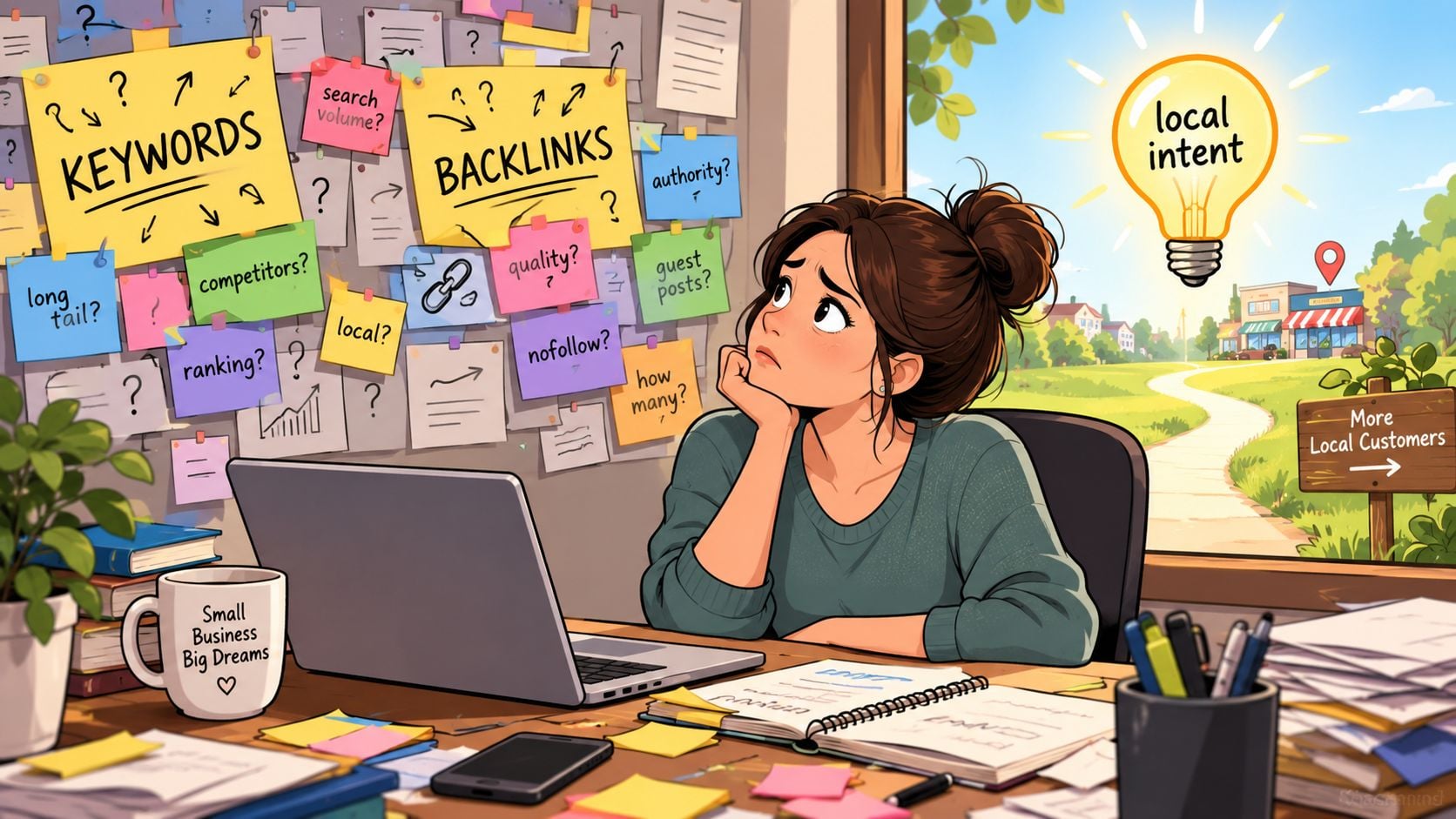
Start with local signals and buying intent
A search such as “commercial electrician Weymouth” signals a clearer need than a broad question about electrical safety. Build a page that explains the commercial electrical service, areas covered, customer types, evidence of relevant work, and the next step. Match that information in the Google Business Profile, including the correct category, services, contact details, opening information, photos, and review activity.
The UK had 5.64 million small businesses in 2025, representing 99.18% of the total business population, according to UK local SEO data summarising the business population and practical optimisation guidance. Dorset firms therefore compete in a crowded market. Clear local relevance and complete profile information can matter more than another general article.
Separate useful work from spreadsheet work
Prioritise tasks that improve one of four commercial outcomes:
- Local discovery: Customers find the business in Google Maps and location-based results.
- Relevance: A service page answers the searcher's specific need.
- Trust: Reviews, credentials, project evidence, and consistent business information reduce hesitation.
- Conversion: Visitors can call, enquire, book, or buy without confusion.
DIY SEO works for straightforward improvements, but owners should stop before technical problems or broad keyword plans consume operating time. A practical guide to whether SEO is worth it for a small business can help assess the likely commercial return.
Ask one question first: which searches could produce a profitable conversation, booking, or order? Start there, then support those pages with content and links that strengthen their relevance.
Running a Quick SEO Audit Without Getting Lost in Data
A useful small-business audit produces a short, ranked action list. It does not produce a colourful dashboard of metrics nobody uses. Set aside an afternoon, open Google Search Console, and inspect the website as both a search engine and a potential customer. Start with pages and profiles that can generate calls, enquiries, bookings, or orders. Generic blogging and link chasing can wait until those foundations work.
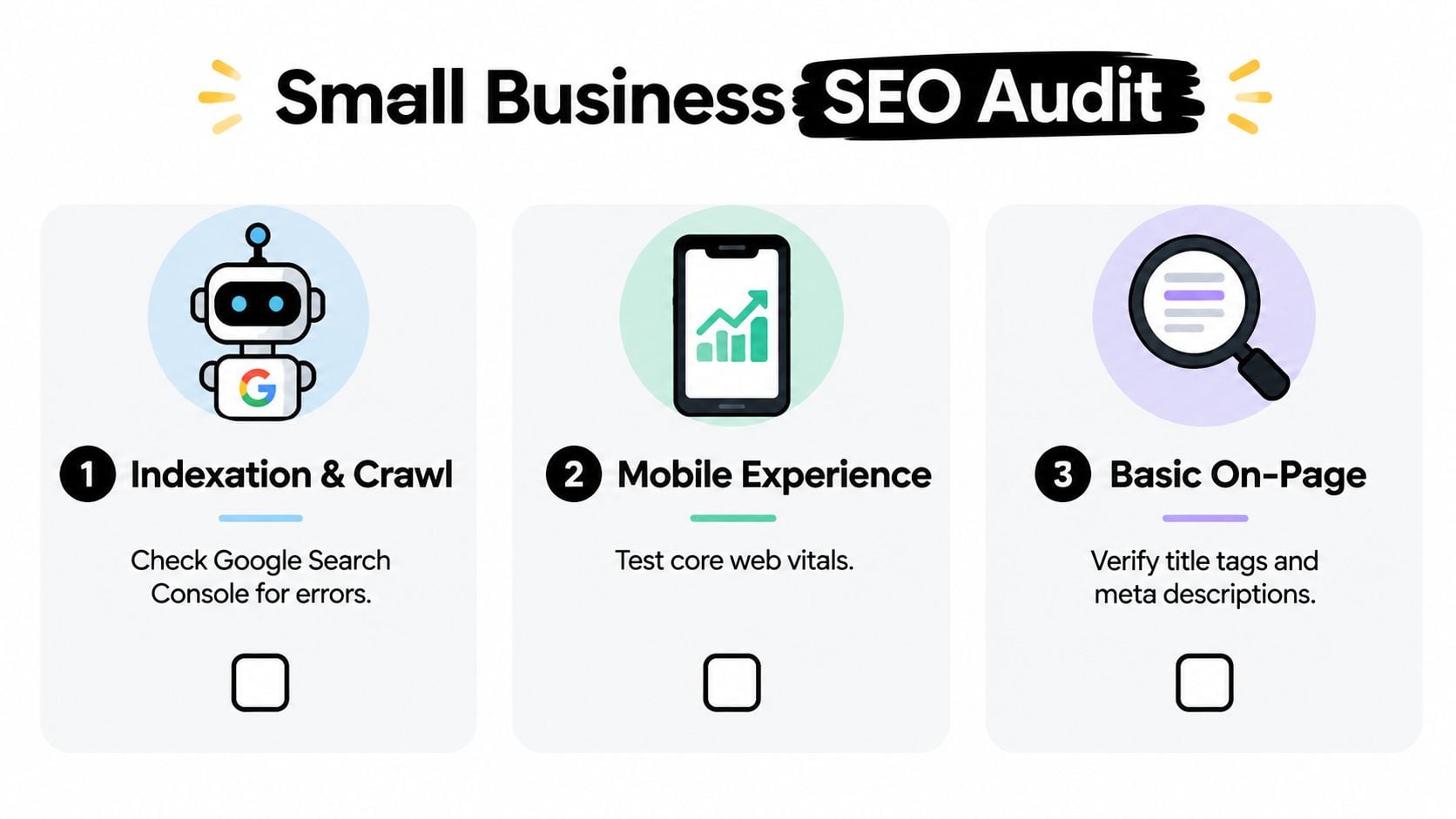
Check indexation and crawl access
Start in Google Search Console. Review the pages Google has indexed, inspect the homepage and your main service URLs, and look for obvious exclusions or errors. If an important service page is not indexed, rewriting its copy will not help until the technical blockage is fixed.
Click through the website manually. Confirm that the navigation reaches every core service, old URLs do not lead to dead ends, and contact details are easy to find. A basic crawl tool can identify broken internal links, missing titles, duplicate metadata, and redirect problems. Do not let a long export set your priorities. A broken link to an obsolete blog post can wait. A broken link to the main “request a quote” page cannot.
Check the Google Business Profile at the same time. Confirm the category, services, address, opening information, photos, and review activity are complete and accurate. For a Dorset firm, these local map-pack signals often deserve attention before another general article.
Review the mobile experience
Open the site on a real phone, not only in a desktop browser resized into a narrow window. Can someone tap the phone number? Do forms work? Are buttons visible without excessive scrolling? Does the page load smoothly on a normal mobile connection?
Google's public guidance connects usability with discoverability, but the practical business test is simpler. If a potential customer struggles to read a service page or submit an enquiry, rankings are not the main problem. Fix the experience between visibility and revenue.
Inspect the pages that sell
Choose the pages for the most commercially important services. On each page, ask:
- Does the title describe the service and area?
- Does the main heading confirm what the page offers?
- Does the opening paragraph address the customer's problem?
- Does the page show evidence, process, service areas, and a clear call to action?
- Does it link to related services and the contact page?
Use intent-led service pages before adding broad informational content. A Dorset roofing page should explain the repairs covered, emergency availability, towns served, information needed for an initial assessment, and how the quote process works. A page that merely swaps “Poole” for “Dorchester” adds little local value. Create separate location pages only when the service, evidence, and customer questions differ.
The UK government's SEO guidance for data publishers recommends titles of around 50 to 60 characters, placing important terms early, keeping URLs stable, avoiding keyword lists, and testing changes with evidence. Apply those principles without forcing every phrase into metadata.
For online shops, inspect category structure, product descriptions, filtering, and internal linking. Use tips for scaling your ecommerce brand when a catalogue creates more complexity than a straightforward service website.
Use this scorecard:
| Audit area | Fix this week | Schedule later |
|---|---|---|
| Indexation | Important pages excluded or blocked | Minor crawl improvements |
| Mobile | Broken forms, unreadable text, unusable navigation | Cosmetic refinements |
| Service pages | Missing pages, unclear offers, weak calls to action | Supporting articles |
| Local signals | Incorrect hours, address, category, or service area | Wider citation cleanup |
| Measurement | No Search Console or enquiry tracking | Advanced reporting |
For a structured technical review, this SEO audit guide can turn findings into a manageable work plan. Owners can handle clear fixes themselves, but technical errors and large site changes need experienced help before they affect enquiries.
Priority Fixes That Actually Move Small Business Rankings
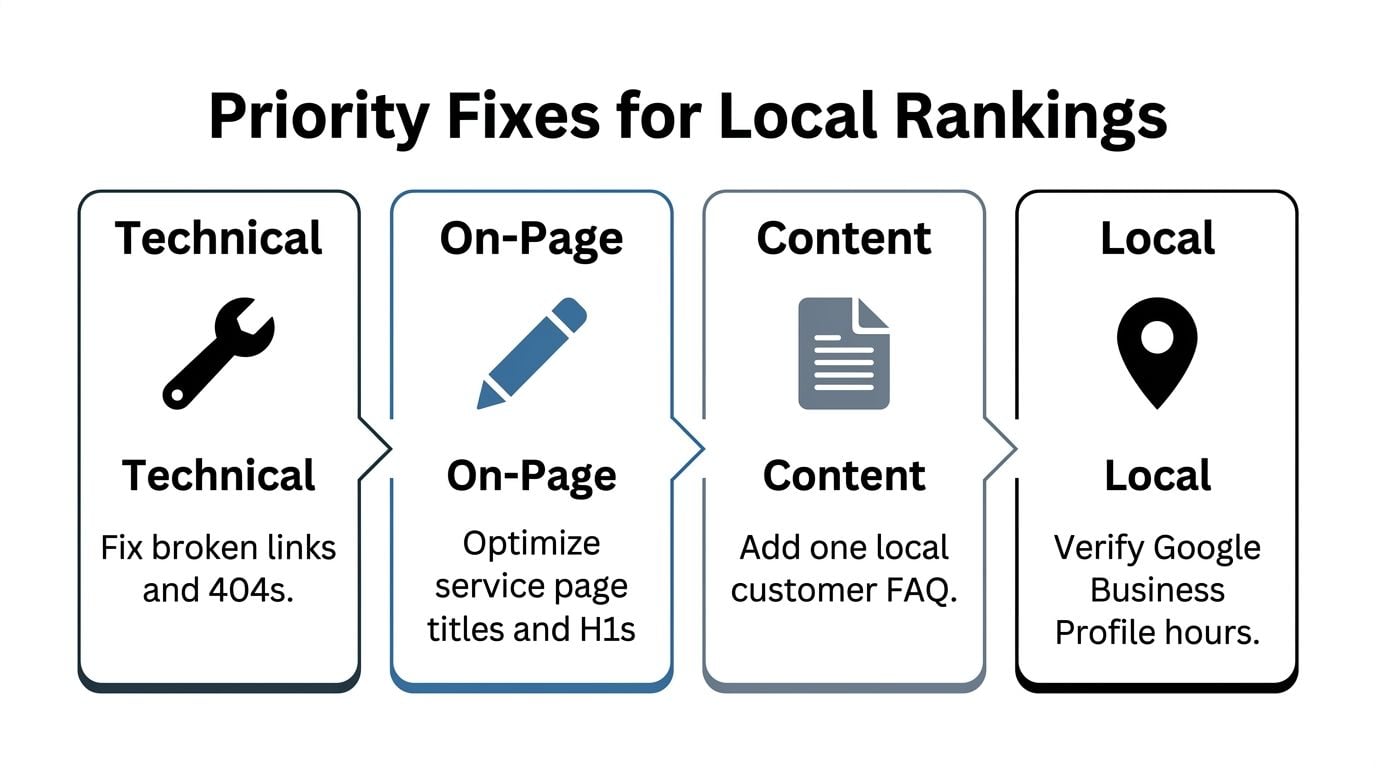
SEO improvements don't all deserve equal attention. A small business should first repair anything that prevents Google from understanding the site, then improve the pages and profiles closest to customer action.
Remove technical obstacles
Start with broken service URLs, accidental noindex settings, poor mobile layouts, and weak internal linking. A page buried several clicks deep, with no clear link from the navigation or related services, is harder for customers and search engines to discover.
Check titles and descriptions across the main pages. Every core service should have a distinct title that describes the offer and location naturally. Don't turn the metadata into a keyword list. Write it for the person deciding whether to click.
This explanation of technical SEO is useful if you need to understand the difference between crawlability, site structure, performance, and the visible content on a page.
Rewrite pages around real buying intent
A good service page answers the questions that stop someone making contact. A Dorset roofing page might need to explain the types of repairs covered, whether emergency work is available, which towns are served, what customers should send for an initial assessment, and how the quote process works.
Replace vague headlines such as “Quality solutions for every need” with something specific, such as “Roof repairs in Weymouth and across West Dorset”. The headline should confirm the service. The supporting copy should prove competence. The call to action should tell the reader what happens next.
Use customer language from phone calls, emails, reviews, and sales conversations. Keyword tools can reveal search phrasing, but your existing customers reveal objections and decision criteria.
Treat local visibility as a separate job
Many owners claim their Google Business Profile and then leave it untouched. UK-focused data indicates that 56% of UK businesses use local SEO, while 56% of UK small businesses have never optimised their Google Business Profile beyond the initial claim. The same source reports that 76% of nearby searches lead to a visit within 24 hours and 28% result in a purchase within 24 hours. The local SEO and Google Business Profile data supports a blunt conclusion: map visibility deserves attention before another generic article.
Complete the profile properly:
- Choose the closest primary category: Don't select a broad category because it sounds popular.
- Describe the service area accurately: Make it consistent with the areas shown on your website.
- Add services and products: Use plain customer language, not internal jargon.
- Upload useful photographs: Show the premises, team, completed work, vehicles, or products where relevant.
- Keep hours current: Include holiday and exceptional opening information when needed.
- Request genuine reviews: Ask customers after a successful job and make the request easy.
- Respond professionally: Address positive and negative feedback without arguing or revealing private details.
Build location pages that deserve to exist
Create a location-specific page when you have useful information for that place. Include local service details, access or coverage information, relevant examples, and a clear route to contact. Don't create thin pages that copy the same service text and swap the town name. One strong page is more valuable than a collection of near-duplicates.
A Simple Content and Link Strategy That Fits a Small Team
A small team shouldn't promise a new article every week unless someone has the time and expertise to produce it properly. The better approach is to create content that supports a core service, answers a customer question, and gives other people a legitimate reason to reference your business.
Start with the commercial page. If you provide loft conversions in Dorset, build content around decisions customers make before requesting a quote. Possible topics include planning considerations, choosing materials, comparing conversion types, preparing a property, and understanding the stages of a project. Each article should link naturally to the relevant service page, not sit alone in a blog archive.
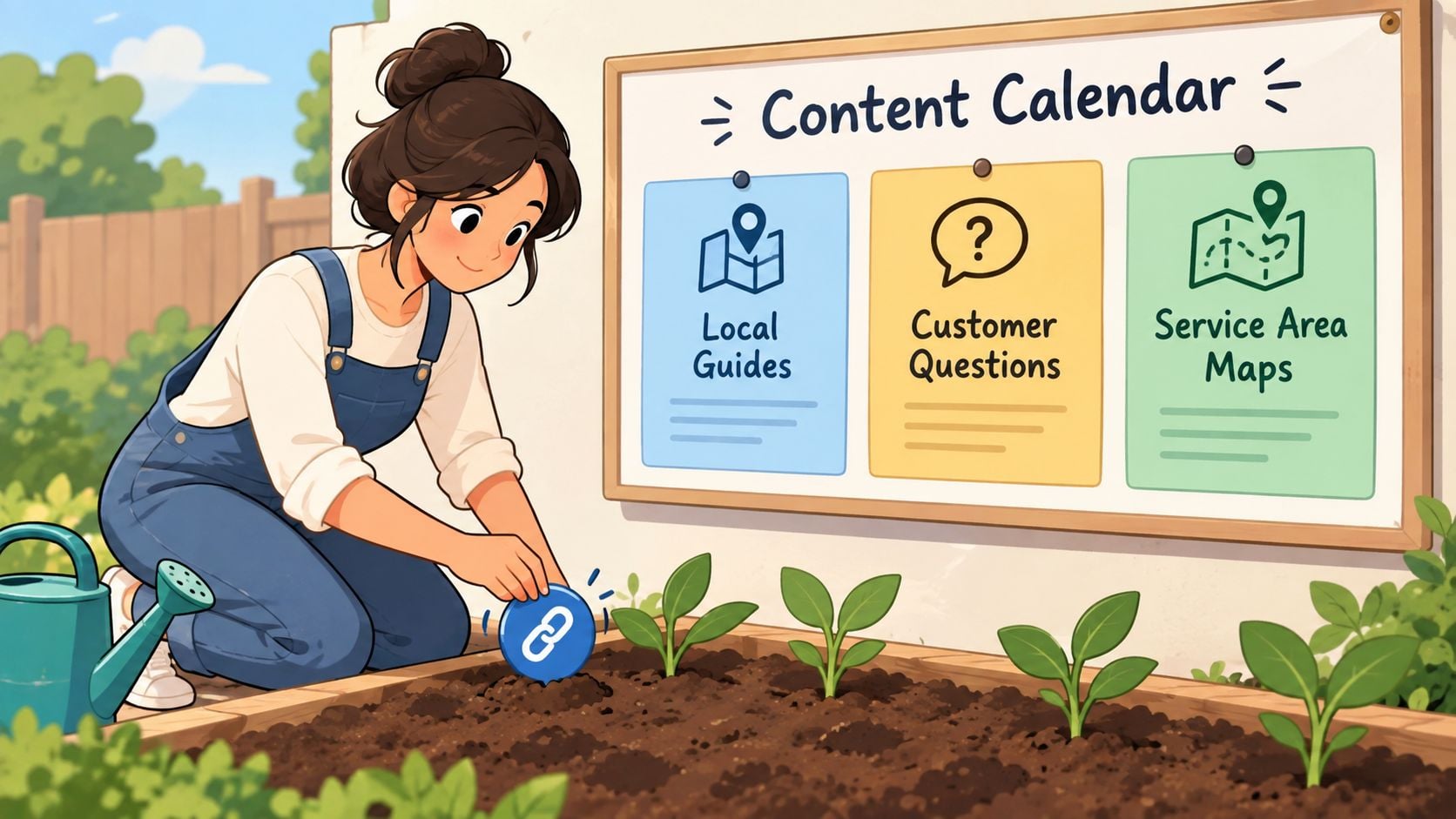
Choose topics from conversations, not content calendars
Your best subjects are usually already hiding in:
- Sales questions: What do prospects ask before they commit?
- Objections: What makes a customer delay or choose another provider?
- Aftercare requests: What do customers need to know once the work is complete?
- Local considerations: What differs between Weymouth, Dorchester, Poole, or rural Dorset?
- Product comparisons: Which option suits different budgets, buildings, or use cases?
A useful article should leave the reader better prepared to act. It can include photographs from your own work, a checklist, a clear explanation of the process, or questions to ask when comparing suppliers. Avoid padding a short answer into a long article to satisfy an imagined word count.
Earn links through real local relationships
Link building works best when it reflects something true about the business. A Dorset firm might earn relevant links from a trade association, supplier, local business group, chamber, community project, event organiser, or partner whose customers overlap.
That doesn't mean submitting the same article to low-quality websites or buying a collection of unrelated links. Those shortcuts create administrative noise and can associate your brand with poor-quality pages.
Practical rule: Ask whether the linking website would still be relevant if Google didn't exist. If the answer is no, don't pursue the link.
Create one useful asset, then reuse it intelligently. A customer guide can become a short email, a series of social posts, a sales-team reference, and a source for answers on relevant service pages. The work stays consistent, while each channel serves a different audience.
This guide to building a content strategy can help you organise those assets around business goals rather than publishing frequency. Keep the rhythm realistic. One useful resource that strengthens a service page is better than several rushed posts that attract no relevant customer.
Measuring SEO Progress With the Right Timelines and KPIs
Rankings matter, but they're not the business outcome. A page can rank well for a phrase that produces no enquiries, while a less visible query can bring a highly suitable customer. Measure the path from search visibility to action.
Use a staged measurement plan
In the early stage, Google Search Console should show whether Google is discovering your pages and which queries produce impressions. Watch for changes in impressions, clicks, click-through rate, and the pages attracting attention. Don't obsess over a single ranking position because location, device, personalisation, and search features can change what different people see.
Once key pages have been improved, connect Search Console with analytics and enquiry records. Track form submissions, phone clicks, booking actions, purchases, and meaningful visits to contact pages. Ask new enquiries how they found you, then compare that answer with the data rather than relying on one source.
A practical timeline looks like this:
- First month: Confirm measurement, repair urgent technical issues, correct profile information, and establish a baseline for priority pages.
- Following months: Assess whether impressions and relevant clicks are expanding, whether local visibility is improving, and whether service pages are generating more meaningful actions.
- Longer term: Compare organic enquiries and sales quality with other channels, then reinvest in the pages, locations, and topics producing the strongest commercial evidence.
These are working stages, not promises of instant rankings. SEO compounds through repeated improvements, and competitive services may take longer to establish. A new website, a neglected profile, and a well-established local competitor each start from different conditions.
Report what an owner can use
A useful monthly report should answer four questions:
- What changed in visibility?
- Which pages and queries improved?
- Did more visitors contact, call, book, or buy?
- What will be changed next, and why?
Include examples of queries and pages, not just charts. Explain whether a drop reflects seasonality, a technical issue, a change in search behaviour, or normal fluctuation. This guide to website analytics provides a practical starting point for connecting website activity with business decisions.
A ranking is an indicator. An appropriate enquiry is evidence.
Don't report traffic in isolation. If visitors arrive on an informational article and never reach a relevant service page, the next action may be better internal linking or a clearer call to action, not more traffic.
DIY SEO Versus Hiring an Agency and What to Ask First
DIY SEO works when the owner understands the business, has time to update the Google Business Profile, can improve basic page copy, and is willing to review Search Console regularly. It becomes a poor choice when technical problems, multiple locations, ecommerce complexity, or inconsistent publishing create a backlog that never gets addressed.
A hybrid model often suits a Dorset SME. The owner supplies customer knowledge, photographs, reviews, and approval. A specialist handles technical checks, page structure, local optimisation, tracking, and a prioritised roadmap. Fully managed support makes more sense when SEO is a significant acquisition channel and nobody internally can maintain the work.
| Approach | Best For | Typical Timeline to Impact | Key Risk |
|---|---|---|---|
| DIY | Owners with time and straightforward websites | Early improvements can follow basic fixes, while broader gains take sustained work | Important technical or local issues get missed |
| Hybrid | Teams with knowledge but limited specialist capacity | Progress follows the agreed priority sequence | Responsibilities remain unclear |
| Agency | Businesses needing technical, local, content, and measurement support | Impact varies with competition, site condition, and consistency | Paying for activity without commercial accountability |
Typical costs vary by scope, complexity, and the amount of implementation included. Don't choose a provider because they promise a position on Google. Ask:
- Which local businesses and service areas do you understand?
- Will you optimise the Google Business Profile as well as the website?
- What will you change during the first phase?
- Who owns the content, accounts, and website access?
- How will you track calls, forms, bookings, and relevant enquiries?
- What will the monthly report show?
- Which tasks are recommendations, and which will you implement?
- How will you decide what to stop, continue, or test?
DesignStack offers website, on-page SEO, crawlability, and Google Business Profile support as part of its digital services, so it's one option to assess alongside other agencies or consultants.
If your Dorset business needs more than generic blog ideas, visit DesignStack to discuss a website and SEO plan built around local visibility, clear service pages, and measurable enquiries. Ask for a focused review of your Google Business Profile, priority pages, and tracking before committing to ongoing work.