Sales Funnel Optimization: A UK SMB’s Guide for 2026
Your website is getting visits. Some people click through from Google, a few come in from Facebook, and others arrive after hearing about you locally. Then almost nothing happens. The phone stays quiet, quote requests are thin, and the online shop ticks over without ever feeling reliable.
That's usually not a traffic problem. It's a funnel problem.
A sales funnel is the path someone takes from first noticing your business to becoming a customer, then ideally coming back again. If that path is unclear, slow, or full of friction, people drop away. Historical data from UK government reports reveals that 65% of UK businesses lost potential revenue between 2018 and 2023 due to unoptimized sales funnels, with an average drop-off rate of 58% between the interest and decision stages.
Table of Contents
- Why Your Sales Funnel Might Be Leaking Profit
- Auditing Your Funnel with a UK-First Mindset
- Optimizing the Top of Your Funnel Awareness and Consideration
- Driving Conversions at the Bottom of the Funnel
- Beyond the Sale The Profitable Post-Purchase Funnel
- Your Continuous Optimization Toolkit and Next Steps
Why Your Sales Funnel Might Be Leaking Profit
A Dorset business owner often sees the same pattern. The website looks decent, there's some traffic in Google Analytics 4, maybe the business even ranks for a few useful local searches, but enquiries don't match the attention. Someone visits the services page, glances at pricing, then disappears. Another adds a product to basket and vanishes before payment.
That's what a leaking funnel looks like in real life. People are entering the journey, but they're not being guided through it clearly enough to take the next step. In many cases, the leak isn't dramatic. It's a dozen small issues: weak messaging, too many form fields, poor mobile layout, unclear trust signals, or follow-up that arrives too late.
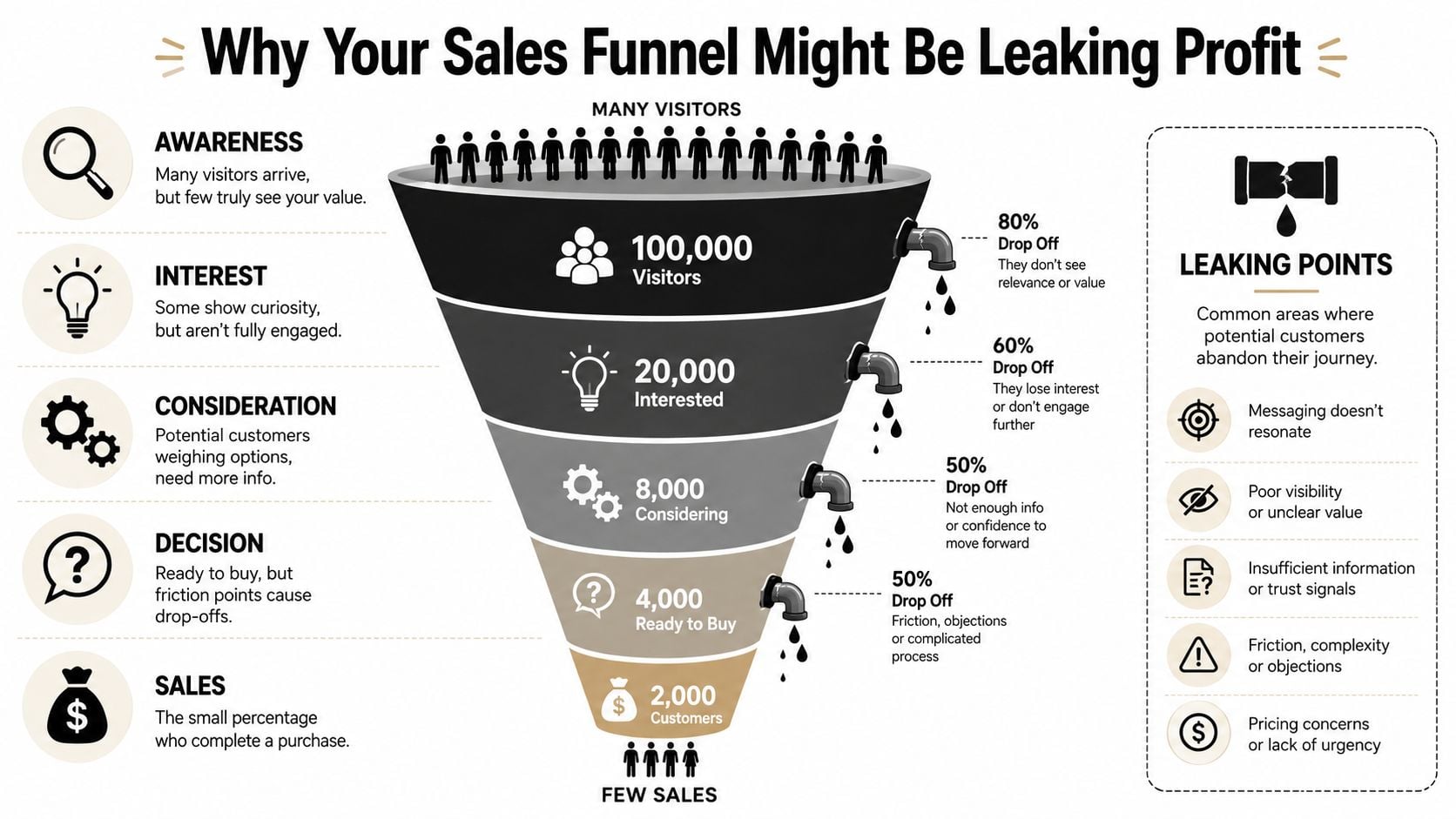
One of the quickest ways to spot this is to map what people do, not what you assume they do. A proper funnel analysis for small business websites usually shows the same truth. Buyers don't leave because they hate your business. They leave because the next step feels uncertain, unnecessary, or awkward.
Practical rule: If people have to stop and think about what happens next, your funnel is already losing them.
The fix isn't a clever hack. It's structured sales funnel optimization. You look at each stage, remove friction, tighten the message, and make the next action obvious. That matters because a survey of 1,200 UK SMEs showed that structured sales funnel optimization resulted in an average conversion rate uplift of 34% within the first six months, with Dorset firms seeing even higher gains.
Auditing Your Funnel with a UK-First Mindset
Most businesses start in the wrong place. They redesign a page, change button colours, or add another pop-up before they've diagnosed what's broken. That wastes time and usually creates new problems.
Start with the full journey, not just the checkout
Look at your funnel as a sequence. For most SMEs, that means:
- Awareness through Google search, referrals, social media, or local discovery.
- Consideration when someone reads service pages, compares options, or reviews product details.
- Decision when they request a quote, book a call, add to basket, or start checkout.
- Post-purchase when they decide whether they trust you enough to buy again or recommend you.
Open Google Analytics 4 and your CRM side by side. Then ask practical questions:
- Where do people enter? Homepage, blog post, landing page, product page.
- Where do they stall? Pricing page, enquiry form, basket, booking page.
- Where do leads go cold? After download, after quote, after first purchase.
- Which traffic source brings intent? Not all traffic is worth the same effort.
If you're a local service business in Weymouth, your top funnel might rely on searches with local intent and direct visits from referrals. If you run an eCommerce shop, category pages and product pages do much more of the selling than your homepage ever will.
Make compliance part of the audit
Generic advice from US blogs often falls apart for UK businesses. Aggressive gating, vague consent language, and relentless automated follow-up can hurt performance as much as poor design.
A 2025 report by the UK Information Commissioner's Office found that 34% of UK digital marketing complaints stemmed from non-transparent data practices in funnels, which is exactly why your audit must include consent wording, form language, cookie handling, and email follow-up rules. If your forms feel pushy or unclear, buyers hesitate.
A cleaner funnel often converts better because it feels safer, not because it shouts louder.
That's especially true for professional services, healthcare-adjacent businesses, trades, and any company asking for personal details early. GDPR and PECR aren't side issues. They shape how you capture leads and how comfortable people feel giving you their information.
For a fuller view of what's worth tracking on your site, use a framework like this guide on how to measure website success. It helps shift the focus from vanity metrics to actions that move buyers forward.
Key Metrics to Track at Each Funnel Stage
| Funnel Stage | Primary Metric | Secondary Metric | What it Tells You |
|---|---|---|---|
| Awareness | Traffic source quality | Landing page engagement | Whether the right people are arriving in the first place |
| Consideration | Page progression | Form starts or basket adds | Whether your message is strong enough to create intent |
| Decision | Enquiry completion or checkout completion | Drop-off point before submission or payment | Where friction blocks action |
| Post-purchase | Repeat purchase behaviour | Review requests, support interactions, email engagement | Whether customers are staying engaged after the sale |
What a useful audit usually uncovers
In practice, most audits reveal a mix of issues rather than one dramatic fault.
- Message mismatch between the ad, the search term, and the landing page.
- Weak page hierarchy where visitors can't quickly find proof, pricing, or next steps.
- Overbuilt forms that ask for too much too early.
- Compliance friction caused by unclear consent or vague data use language.
- No post-purchase path after the first transaction or first enquiry.
A good audit gives you a list of leaks in priority order. That matters more than having a beautiful dashboard.
Optimizing the Top of Your Funnel Awareness and Consideration
If the wrong people enter your funnel, the rest of your optimisation work becomes expensive guesswork. Top-of-funnel work is about attracting relevant visitors and helping them realise quickly that you fit their needs.
Bring in the right people, not just more people
A Dorset builder, accountant, retailer, or café doesn't need broad traffic for the sake of it. They need visitors with intent.
For local businesses, that usually means tightening these areas:
- Local search pages that match how people search, such as service plus town, product plus delivery area, or specialist service plus county.
- Useful blog content that answers pre-sale questions. Not fluffy opinion pieces. Real queries customers ask before they call.
- Google Business Profile support so branded and local discovery traffic lands on pages that continue the conversation.
- Paid traffic alignment where ad copy matches the page headline and offer.
If you run a food business, restaurant, takeaway, or hospitality venue, there's useful crossover in these online marketing tips for eateries. The strongest point is simple: people respond when the offer, message, and landing page all match what they were looking for.
Give buyers proof and clarity early
Awareness doesn't mean strangers want a sales pitch straight away. They want enough confidence to keep going.
That's why top and middle funnel pages should include:
- Specific headlines that say who you help and what you do.
- Relevant examples from UK clients or local sectors.
- Short testimonials near decision points, not buried on a separate page.
- Simple lead capture with minimal friction. In UK funnel diagnostics, landing pages are typically expected to keep forms short, with a maximum of 3 fields, alongside clear CTA buttons and mobile-responsive layouts.
A lot of websites lose momentum because they hide key selling points. The page says “welcome” when it should say what problem it solves. It shows stock photography when it should show the work, the place, the team, or the outcome.
If a buyer lands on your page and still has to work out whether you're relevant, the page isn't doing its job.
What works better than generic outreach
According to 2025 UK digital marketing reports, content irrelevant outreach is a primary pitfall, with 73% of UK B2B buyers avoiding generic messaging, leading to a 40% drop in engagement. That's why blanket email sequences and vague lead magnets often underperform, even when traffic looks healthy.
A better approach is stage-matched content:
- A first-time visitor gets a clear explainer, service overview, or category page.
- A returning visitor sees stronger proof, FAQs, and comparison detail.
- A high-intent visitor gets pricing clarity, booking options, or a strong quote request page.
For B2B firms, there's another practical issue. UK funnel benchmarks often show a steep drop at the SQL-to-opportunity stage because poor data quality and weak handoff make leads look colder than they really are. That's why sales and marketing need one view of the same lead, not separate spreadsheets and separate assumptions.
The top of the funnel works when it filters in the right prospects and warms them properly. It fails when it tries to force everyone down the same path.
Driving Conversions at the Bottom of the Funnel
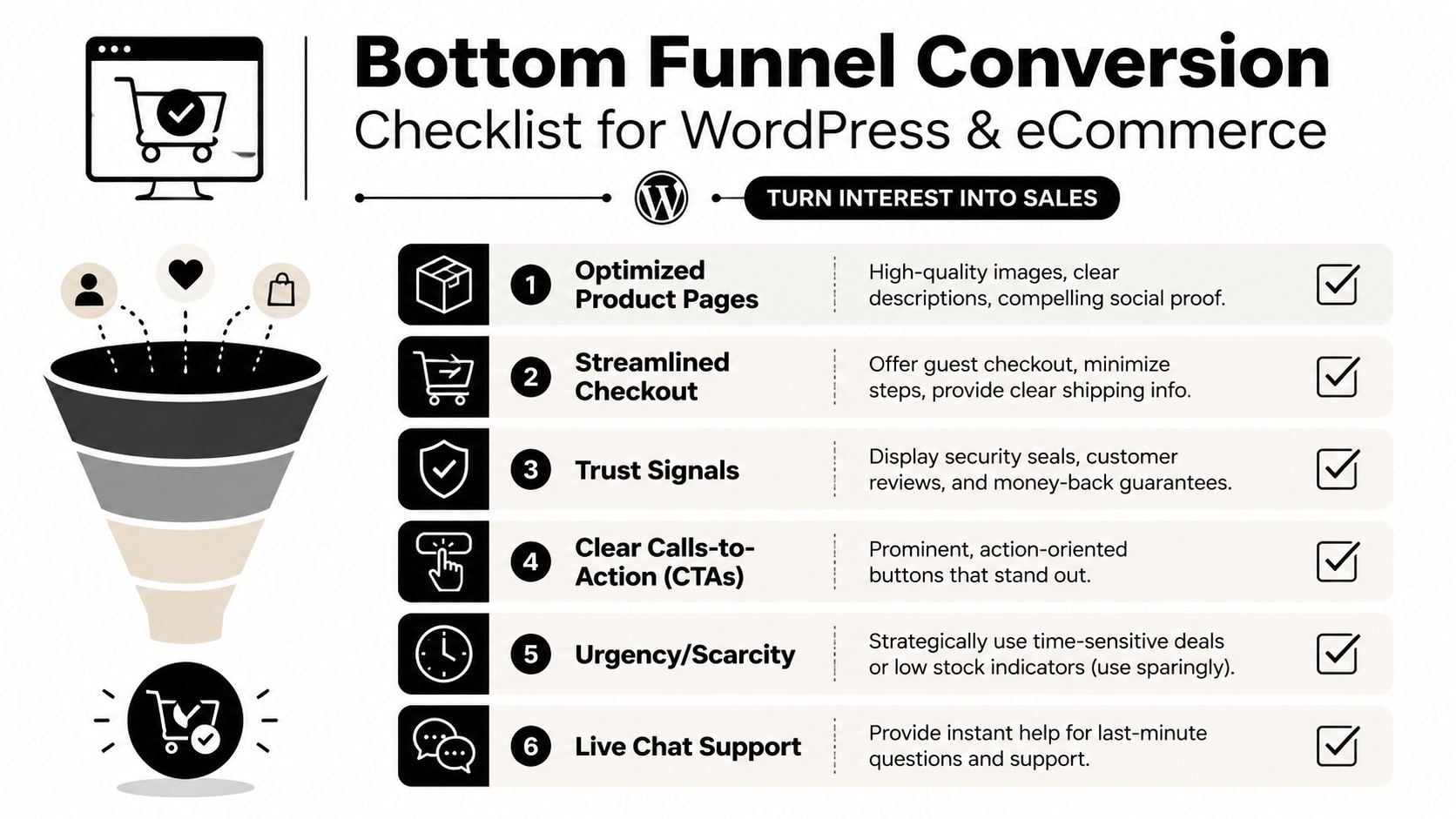
The bottom of the funnel is where buyers stop browsing and start weighing risk. They're asking practical questions. Is this worth it? Can I trust this company? How long will this take? What happens if something goes wrong?
For WordPress sites and eCommerce builds, that's the point where small fixes often produce the biggest gains.
Cut friction before you chase persuasion
Many businesses try to improve conversions by making pages more persuasive. In practice, removing friction usually comes first.
A good bottom-funnel review checks:
- Forms that ask only for what's needed right now.
- Pricing pages that are clear enough to reduce uncertainty.
- Checkout flow that doesn't surprise people with hidden costs or awkward steps.
- Mobile usability because hesitation gets worse on a small screen.
- Trust signals placed close to action points, not tucked away in the footer.
A survey of 1,200 UK SMEs showed that structured sales funnel optimization resulted in an average conversion rate uplift of 34% within the first six months, with Dorset firms seeing even higher gains. That result usually doesn't come from one big redesign. It comes from fixing decision-stage blockers consistently.
For more practical examples, this guide on how to improve website conversion rate is a useful companion when you're reviewing your own service pages, quote forms, or checkout flow.
Run simple A-B tests with a clear purpose
Before changing anything, decide what you're testing and why. Don't test five things at once.
Good A-B test ideas include:
CTA wording
“Get a Quote” versus “Request Pricing” can attract different levels of intent.Form length
A shorter quote form often increases completions, especially on mobile, but can reduce lead detail. That's a real trade-off, so test it.Trust placement
Reviews, secure payment icons, and delivery or service reassurance often work best close to the action button.Page structure
On product pages, move delivery, returns, and proof higher if customers seem to stall before adding to basket.
Here's a useful explainer on bottom-funnel thinking in action:
What a strong bottom funnel page usually includes
The specifics vary by business, but strong decision-stage pages tend to share the same ingredients.
- A direct headline that matches buyer intent.
- A clear next step such as buy now, request quote, book consultation, or call.
- Proof close to action through reviews, testimonials, or recognisable client logos.
- Risk reduction through returns information, FAQs, delivery clarity, or support access.
- No unnecessary exits that distract people at the point of decision.
Reduce doubt first. Then strengthen the offer.
For service firms, this may mean stripping clutter from contact pages and replacing vague copy with turnaround times, process steps, and what happens after someone enquires. For eCommerce, it often means cleaner product pages, better product imagery, visible stock or fulfilment information, and a simpler checkout.
Beyond the Sale The Profitable Post-Purchase Funnel
A lot of businesses treat the sale as the finish line. It isn't. It's the handover point between acquisition and retention.
Most funnels stop too early
Recent data from the UK Department for Business and Trade (2025) reveals that while 68% of Dorset-based e-commerce brands optimize checkout, fewer than 12% have systematic post-purchase engagement strategies, losing 40% of potential lifetime value. That gap is one of the biggest missed opportunities in sales funnel optimization for UK SMEs.
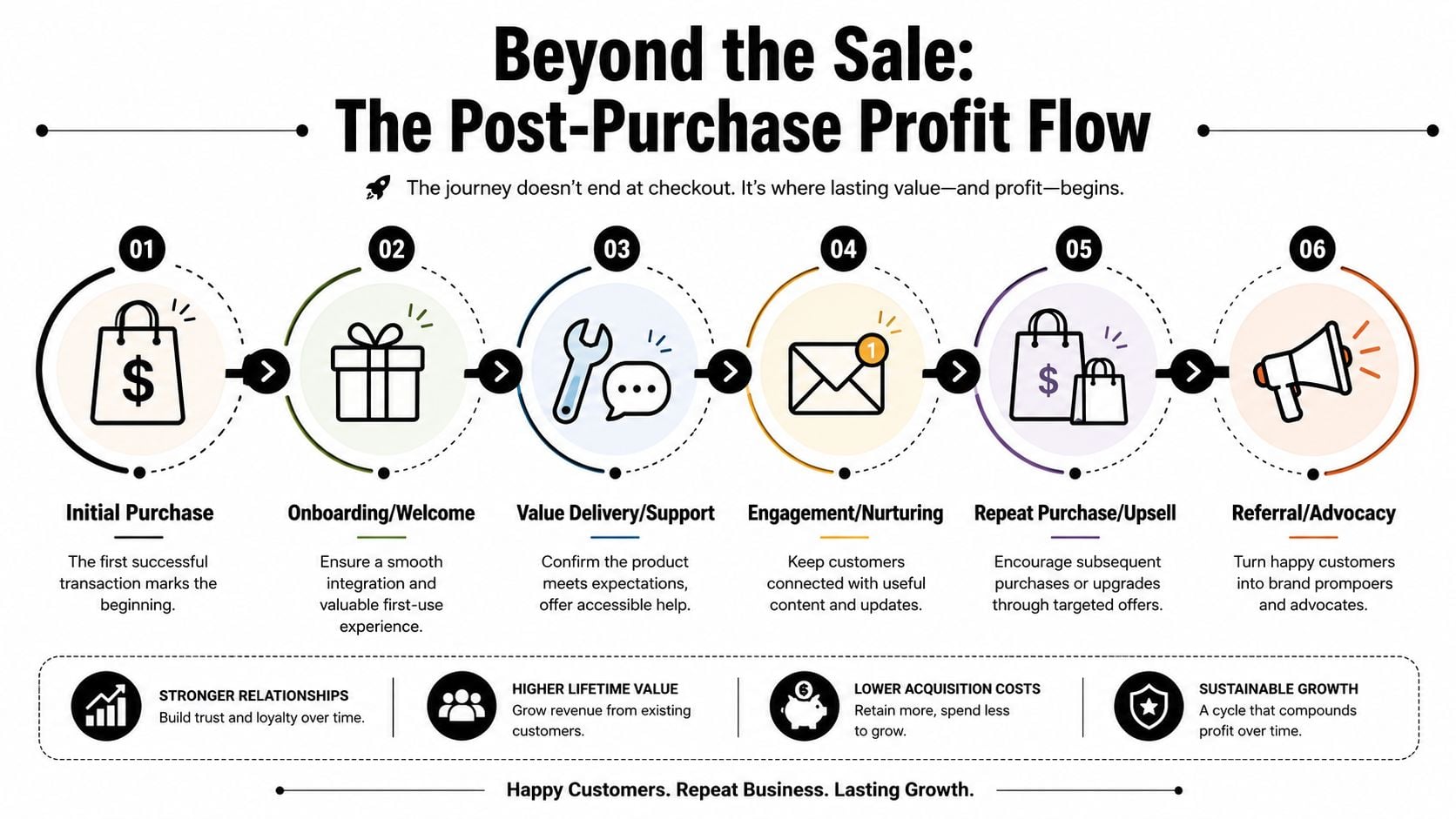
This matters even more when acquisition gets harder and more expensive. If you've already paid in time, effort, or ad spend to win a customer, letting that relationship go cold is wasteful. Yet many businesses send a receipt, maybe one dispatch email, and then go silent.
That silence creates what I'd call post-purchase decay. The customer received the product or service, but there's no guided next step. No welcome. No usage prompt. No review request. No relevant follow-up offer.
What to build after the first purchase
Post-purchase funnels don't need to be complicated. They need to be intentional.
A practical setup might include:
- A welcome or thank-you email that sets expectations and reassures the buyer.
- Support content that helps them use what they bought or understand what happens next.
- Review prompts sent at the right moment, once value has been delivered.
- Reorder or upsell logic based on what they bought and when.
- Re-engagement messages for customers who go quiet.
Many local retailers and service firms can gain ground quickly. A Dorset gift shop can invite a second purchase with a thoughtful follow-up. A trades business can ask for a review and suggest annual maintenance. A membership organisation can use onboarding emails to reduce dropout after sign-up.
The first sale proves interest. The second sale proves trust.
For online shops, this guide on how to increase eCommerce sales is useful because it pushes beyond checkout and into repeat buying behaviour. That's where a lot of profit sits.
The retention funnel also improves the rest of your marketing. Repeat buyers are easier to convert, more likely to leave reviews, and more likely to refer others when the experience has been well handled.
Your Continuous Optimization Toolkit and Next Steps
Sales funnel optimization isn't a one-off website task. It's an operating habit. Businesses that do it well review behaviour regularly, test deliberately, and keep tightening the path from first visit to repeat business.
A simple operating rhythm
You don't need a huge team to do this properly. You need consistency.
A workable rhythm looks like this:
- Weekly checks on traffic quality, enquiry flow, basket or checkout behaviour, and obvious page issues.
- Monthly tests on one meaningful variable, such as CTA wording, form length, or social proof placement.
- Quarterly reviews of the whole journey, including post-purchase follow-up and CRM handoff.
- Shared definitions so marketing, sales, and service teams all mean the same thing by lead, opportunity, and customer.
If your website and CRM still feel disconnected, fix that sooner rather than later. A clearer view of the user journey makes every optimisation decision stronger. This overview of what user journey mapping means for growing businesses is a good place to sharpen that thinking.
Don't ignore the dark funnel
The final point is one many SMEs miss. Not every buyer announces themselves when they start researching. The dark funnel describes the anonymous research people do before they ever fill in a form or call your office. Verified UK data notes that 60% of UK B2B buyers conduct anonymous research, which can cause a 30% underreporting of conversion sources, making integrated CRM and analytics essential for accurate measurement.
That's why direct traffic often looks bigger than it really is. Buyers may have read your content, seen a recommendation, checked your reviews, compared your pricing, and only then arrived as a so-called direct visit. If you only judge the last click, you'll keep undervaluing the pages and channels that build trust earlier.
Better funnel decisions come from better visibility, better follow-up, and cleaner handoffs. Keep the process simple, but keep it moving.
If your website gets attention but doesn't turn enough of that attention into enquiries, sales, or repeat customers, DesignStack can help you fix the journey properly. As a Dorset-based digital agency, the team builds conversion-focused WordPress and eCommerce websites, supports branding and content structure, and helps businesses create a clearer path from first click to loyal customer.