Brand Refresh: A Practical Guide for 2026
You can usually spot the moment before a brand refresh gets discussed. The website looks slightly tired, the brochure still uses old photography, the logo feels a bit too small on mobile, and sales calls are starting with quiet apologies about how things “don't quite match anymore”. For many Dorset and UK SMEs, that's the primary trigger, not vanity, but a growing gap between what the business has become and what the market sees.
A proper brand refresh closes that gap. It is not a logo polish, and it is definitely not a weekend creative exercise. It is a practical programme that updates the parts customers touch, then makes sure those parts work together across the website, social media, signage, packaging, proposals, and advertising.
Table of Contents
- What a Brand Refresh Actually Means for Small Businesses
- When a Refresh Is the Right Move and When It Isn't
- How to Run a Brand Refresh From Audit to Launch
- Brand Refresh Cost and Timeline Benchmarks for UK SMEs
- Two Dorset Brand Refresh Stories and What They Teach
- Measuring Whether Your Brand Refresh Actually Worked
- Working With an Agency and Common Refresh Questions
What a Brand Refresh Actually Means for Small Businesses
A 12-year-old business can look successful on paper and still feel stale to the people it needs to win. The founder has changed the service, the team has improved delivery, and the product is better than it was five years ago, but the online presence still says otherwise. That mismatch is exactly where a brand refresh earns its keep.
Beyond the logo
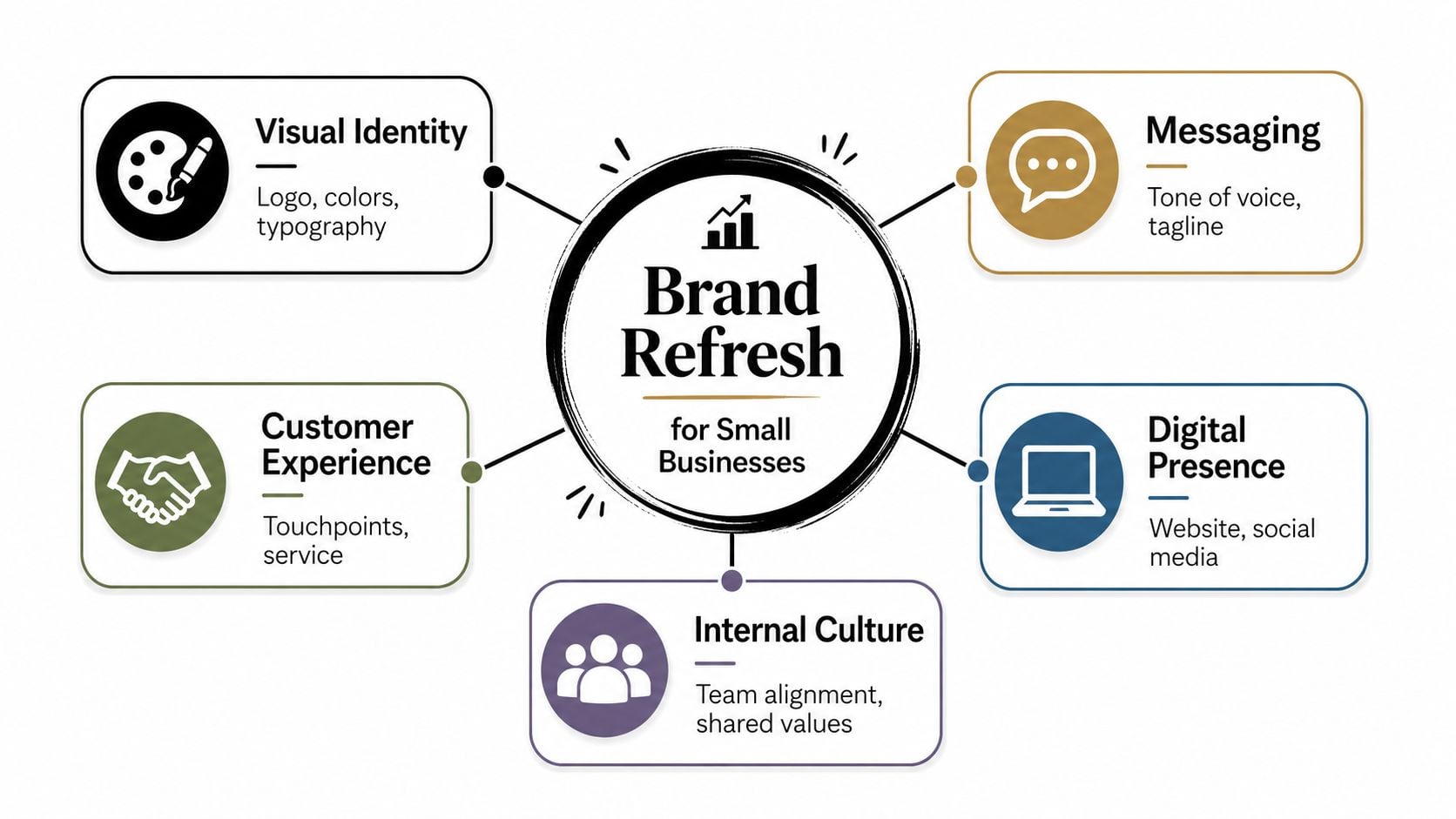
A refresh usually reaches name, logo, visual identity, mission, brand architecture, and the rollout across the website, social channels, packaging, and advertising. That broader scope matters because the UK business sector is dominated by SMEs, and any change has to land consistently across many customer-facing assets, not just on one new mark. The practical benchmark is simple, a refresh is finished when the guidelines, messaging, and touchpoints line up, not when the design file is approved.
That is why a refresh is closer to a system update than a cosmetic tidy-up. If you want a good companion read on the consistency side of this, the internal guide on brand consistency shows why the same rules need to follow customers from homepage to invoice.
Practical rule: if customers would notice the new logo but still see the old business in the rest of the journey, the refresh is incomplete.
Why the distinction from a full rebrand matters
The difference between a refresh and a full rebrand is not just semantic. Independent guidance puts SME refresh budgets around $10,000 to $100,000, and refreshes typically cost 20 to 40% of a full rebrand, with delivery windows of roughly 2 to 3 months versus 6 to 8 months for a full rebrand. Those ranges make sense once you see the work involved, because a refresh usually preserves more equity and focuses effort on alignment rather than reinvention. Brand refresh versus full rebrand guidance is useful reading if you need to separate the two before briefing anyone.
A good refresh can still feel substantial. It may sharpen the tone, simplify the visual system, modernise the website, and tidy the content structure so the whole business feels clearer. But it does not need to throw away every association customers already trust.
For teams looking at launch planning as well as refresh planning, Chicago Brandstarters' 2026 brand launch guide is a useful reference point because it treats rollout as part of the job, not an afterthought.
When a Refresh Is the Right Move and When It Isn't
A refresh earns its place when the business has changed and the customer-facing experience has not kept up. If enquiries are weak because the offer is unclear, or the website makes simple jobs harder than they should be, a new identity on its own will not fix performance. The costly mistake is treating a visual change as a cure for a commercial problem.
Clear triggers that justify a refresh
A refresh usually makes sense when the business has moved on from the brand people still see. A dated visual system, a new audience, a merger or ownership change, a shift in the market, or a repositioning that is not reflected across the website and sales materials are all good reasons to act. In those cases, the brand has drifted away from the value it now delivers.
There is also a practical reason to take consistency seriously. A strong brand only helps revenue when people see the same promise repeated clearly across the journey, from the site to the follow-up email and the proposal. The consistency and revenue link is a reminder that execution matters as much as the design itself. If the refresh is sloppy, customers notice the inconsistency before they notice the new look.
Warning signs that point somewhere else
A weak brand is not always the problem. A website that fails to convert, muddled messaging, poor product-market fit, or an awkward enquiry path can make a business feel tired without any need for a full identity rethink. The clue is in the symptom. If customers recognise the business but do not understand it, the message needs work. If they understand it but still do not enquire, the journey needs work.
If the business is credible offline but confusing online, fix the digital path before you redraw the logo.
That usually means looking at the website first. If the homepage, service pages, and contact route are doing the heavy lifting, the refresh needs to start there, not with a new colour palette. A useful check is the list of website red flags that point to a makeover, because those symptoms often show up before anyone admits the brand needs attention.
There is also a digital readiness angle here. Many UK SMEs have a website and some social presence, but the way those channels work together is often uneven. That means a refresh may need to begin with clarity, conversion paths, and the parts of the journey customers use, not with broad visual rollout across every surface. UK SME digital use and brand refresh context points in the same direction, the site and enquiry path usually deserve attention before the stationery does.
A simple decision filter
Use a refresh when the business has outgrown its current presentation and the issue is visible across multiple touchpoints. Hold back when the core fault sits in the offer, the message, or the website flow. If the problem can be traced to one weak part of the journey, fix that surface first. If you cannot explain the problem in one sentence, a diagnostic audit is the safer next move.
How to Run a Brand Refresh From Audit to Launch
A refresh works best when it behaves like a controlled programme. The early temptation is to jump straight to design, but that usually creates pretty assets that miss the actual bottlenecks. Start with a full audit, because if you don't know what exists, you'll miss something important later.
Audit what customers actually see
Map every customer-facing surface. That means the website, landing pages, social profiles, email signatures, proposals, slide decks, packaging, signage, printed collateral, and any ad creative still in circulation. Then gather customer feedback and benchmark the current position, including how people describe the business now, what they remember, and where they drop off in the journey.
A good audit also checks the weak links. The site might have strong headlines but poor product pages. Social may look polished while enquiry forms are clumsy. A refresh needs to expose those gaps before any new design system gets locked in.
Strategy before visuals
Once the audit is clear, the critical decisions begin. Positioning, messaging, and brand architecture come first, because the visual system should support those choices rather than substitute for them. If the business serves more than one audience, or offers several services under one name, this is the point to decide what stays together and what needs separation.
The visual identity stage comes after that. Logo, typography, colour, and imagery should all reflect the strategy, not fight it. If the style looks modern but the tone still sounds vague, the refresh won't feel coherent.
Rollout and launch need their own discipline
Many projects slip at this stage. The website should be updated alongside social profiles, email signatures, decks, signage, and printed collateral, because inconsistent execution can undo the benefits of the design work. The rollout is also a phase where internal alignment matters, since the team needs to know what changed, why it changed, and how to use the new system.
For a small business team needing a working reference on sequencing, the internal guide on how to rebrand a small business is a useful companion.
When you need to see the flow rather than just read about it, the launch video can help anchor the sequence:
A refresh should end with people using the system confidently, not with a folder of unused design files.
If you want one agency-shaped checklist for the whole job, keep it simple. Audit what exists. Decide what the business should say. Design the visual system. Roll it across every touchpoint. Then launch it internally and externally with enough clarity that the team can hold the line.
Brand Refresh Cost and Timeline Benchmarks for UK SMEs
Money and time are the two questions every owner asks first, and they should be. A budget that ignores rollout breadth, or a timeline that ignores review cycles, almost always ends in compromise. The primary cost driver is not the logo, it's the number of surfaces that need to change cleanly.
Brand refresh vs full rebrand
| Factor | Brand Refresh | Full Rebrand |
|---|---|---|
| Scope | Update existing identity, messaging, and touchpoints | Rebuild the brand more broadly, often including deeper strategic change |
| Typical SME budget | Roughly $10,000 to $100,000 | Higher than a refresh, with refreshes usually at 20 to 40% of the full rebrand cost |
| Delivery window | About 2 to 3 months | About 6 to 8 months |
| Main risk | Under-scoping touchpoints | Rebuilding too much too fast |
| Best fit | Brand has equity but looks or feels out of date | Brand no longer fits the business direction or market position |
These benchmarks come from independent guidance on SME branding budgets and timings, and they line up with what happens in practice. Branding agency cost guidance is useful if you're trying to sanity-check a proposal.
Where the budget really goes
Most SMEs underestimate how many things need updating. A website might be the biggest line item, but social avatars, email signatures, decks, packaging, signage, and printed collateral all need the same rules applied consistently. If the inventory is incomplete, the rollout leaks, and post-launch metrics become hard to trust.
That under-scoping problem is the most common technical failure. One surface stays old, another gets updated in a hurry, and the result is a brand that looks half-finished rather than refreshed. The fix is not more polish, it is a better inventory.
How to size the work
Use business complexity as the starting point. A single-location service business with a simple website will not need the same delivery plan as an SME with product pages, local signage, brochures, and a sales team using presentation templates every week. The more customer-facing surfaces you have, the more the refresh behaves like an operational project.
If you want the shortest useful rule, it's this. The bigger the footprint, the more likely the budget belongs to rollout and governance, not to initial design concepts.
Two Dorset Brand Refresh Stories and What They Teach
A refresh is easier to understand when you look at what happened on the ground. In Dorset, I've seen one pattern work cleanly and another drift badly, and the difference came down to sequence. The winning approach fixed the website and enquiry path first, then rolled the visuals outward.
The focused refresh that kept the funnel intact
One local professional services business had a decent reputation but a site that no longer matched how it sold. The team refreshed the messaging, reworked the product pages, tightened the enquiry flow, and only then applied the wider visual system across supporting assets. The result was a brand that felt newer without making customers relearn how to buy.
That sequencing mattered. The business didn't ask the market to admire the redesign first, it made the buying route clearer first. For SMEs, that usually does more for enquiries than a broad visual splash ever will.
The broader refresh that stalled
Another Dorset firm went straight to the new identity. The logo looked smarter, the palette was cleaner, and the printed materials arrived on time. But the website stayed awkward, the product pages still lacked clarity, and the enquiry forms remained buried in the same old structure.
The result was frustration inside the team. The new look created expectation, but the experience didn't match it. A refresh can't carry a broken funnel on its back, and customers won't reward design work if the path to contact still feels like a chore.
Hard truth: if the website and enquiry journey are weak, a new identity just gives the problem better lighting.
The lesson is plain. Prioritise the surfaces where customers decide, enquire, or buy. Brand expression matters, but conversion paths matter more when resources are tight. That's especially true for local SMEs competing against larger brands that already have stronger recognition.
Measuring Whether Your Brand Refresh Actually Worked
A refresh without measurement is just expensive taste. If the team can't tell whether the work improved recognition, trust, or conversion, then it's impossible to know what to keep, what to fix, and what to roll back. Measurement gives the refresh commercial discipline.
Set baselines before launch
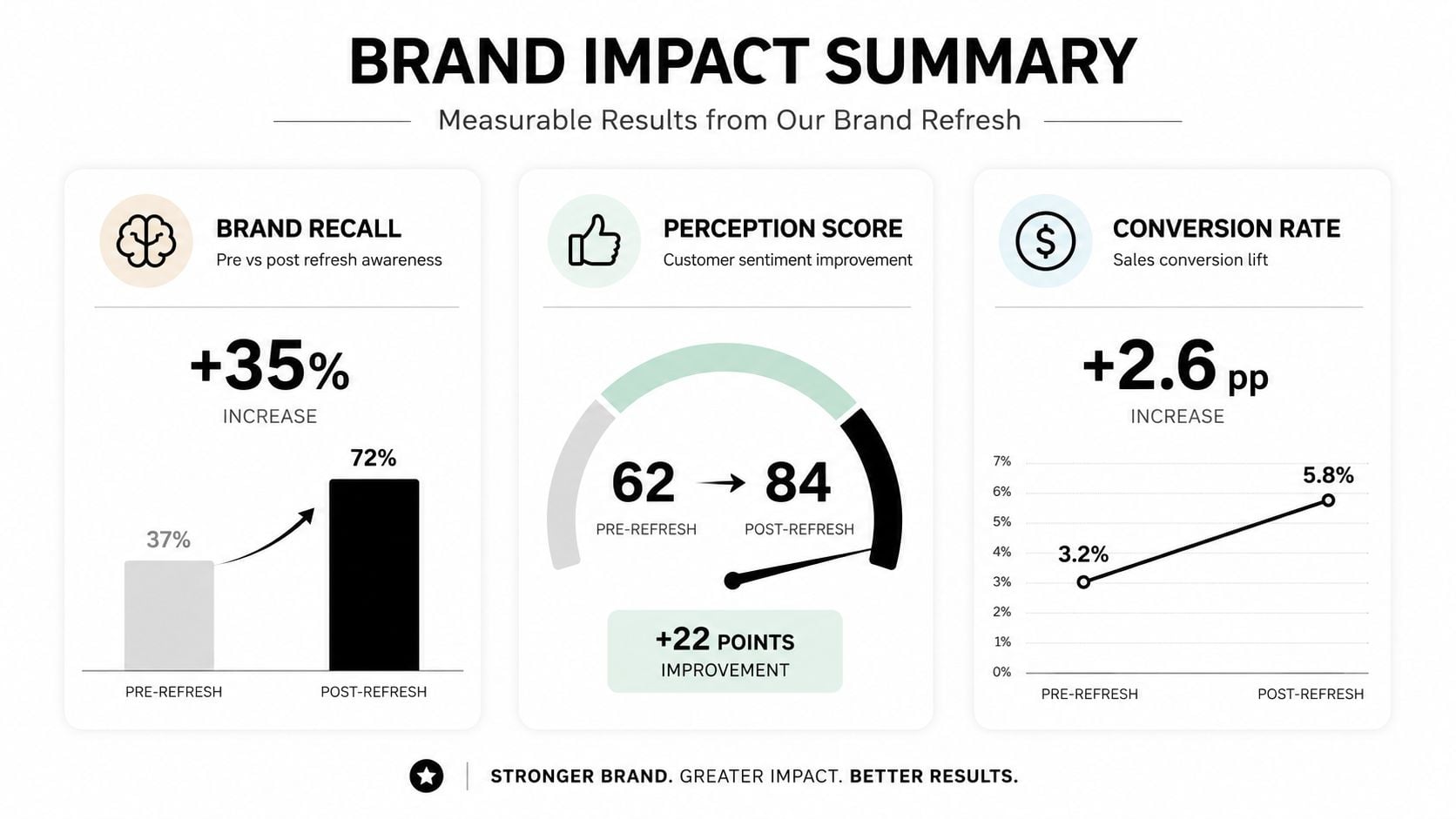
Start by recording brand recall, perception, and conversion metrics before anything goes live. Then re-test at 60 and 120 days, with at least 200 respondents per wave, so the sample is large enough to spot useful movement. Those same data points also give the team a clean before-and-after story, which helps avoid arguing from opinion.
The practical benchmarks often used in refresh programmes are a 25 to 40% rise in branded search, a 15 to 20% increase in direct traffic within 90 days, and a 20-point NPS lift if the refresh is working. This measurement framework is one of the clearer sources for setting expectations without guessing.
Check the rollout, not just the visuals
Six months after launch, audit 20 random brand touchpoints and check whether they comply with the new guidelines. If compliance is below 90%, that's a rollout problem, not a design problem. The reason matters, because design teams can't fix what operations teams haven't adopted.
The same logic applies to the website itself. If the pages look right but the analytics tell a different story, the work is unfinished. The internal guide on website analytics is useful if you need a practical lens on what to watch after the launch.
Keep the measurement simple
A one-page scorecard is usually enough. Include awareness, traffic quality, branded search, enquiries, and customer feedback. If the refresh made the business clearer and more credible, the numbers and the qualitative comments should move in the same direction.
Working With an Agency and Common Refresh Questions
The best agency relationships are boring in the right way. Scope is clear, pricing is fixed, revisions are defined, and the post-launch support is spelled out before anyone starts arguing over shades of blue. If that's missing, the project usually gets noisy at the wrong moment.
What to ask before you sign anything
Ask how the scope covers the website, social profiles, email signatures, decks, signage, and printed materials. Ask how many revision rounds are included, what happens after launch, whether hosting is part of the plan, and how accessibility is being reviewed. For Dorset businesses that want a local partner, DesignStack is a Dorset-based digital agency delivering web design, branding, and graphic design for brands that want to stand out online and in print, with a portfolio including Crossfit Durnovaria, The Lobster Pot, and the Weymouth & Portland Chamber of Commerce.
If you're also managing social presence as part of the refresh, the timing of profile changes matters. A resource like build your X audience with SupaBird can help with the channel growth side, but the brand work still needs to be aligned before any public rollout.
Questions owners ask quietly
Should you keep the existing name? Usually, yes, if it still holds equity and the problem sits in presentation or clarity rather than recognition. Should you refresh if the website is the issue? Only if the redesign is paired with a better content structure and enquiry journey.
Can a refresh hurt trust? Yes, if it reduces usability or makes older and disabled users work harder to understand the site. Accessibility and clarity matter more than visual drama in professional services, community organisations, and local retail.
Who should do the work first if the budget is tight? The website, product pages, and enquiry paths. Everything else can follow once the core journey is clean.
DesignStack helps Dorset and UK SMEs turn a tired brand into a clearer, more consistent system across the website, print, and day-to-day touchpoints. If your refresh needs practical sequencing, fixed-cost delivery, and a team that understands both branding and web design, visit DesignStack and start the conversation.