

WordPress Web Design Agency Near Me: A Guide for UK SMEs
Your website probably isn't your first problem of the day, but it keeps turning into one. It's slow on mobile, hard to update, enquiries are patchy, and every small change seems to need an email, a wait, and another invoice. That's usually when business owners start searching for a WordPress web design agency near me.
The problem is that “near me” can send you in the wrong direction if you treat it as a map result instead of a hiring decision. A nearby agency should give you easier communication, better local context, and stronger accountability. It shouldn't just give you a short drive.
If you're a Dorset business owner, or an SME anywhere in the UK, the smart move is to look for a local partner who can build, support, and improve your site over time. That matters far more than finding the closest supplier with a slick homepage.
Table of Contents
- Why a Local WordPress Agency Matters More Than Ever
- Finding Your Local Shortlist Beyond a Simple Search
- The Core Evaluation Checklist for Your WordPress Project
- Pricing Support and Hosting Understanding the True Cost
- Warning Signs How to Spot an Unreliable Agency
- The DesignStack Difference A Local WordPress Partner in Dorset
- Frequently Asked Questions About Hiring a Web Designer
Why a Local WordPress Agency Matters More Than Ever
A few years ago, having a website was enough to look established. That isn't true now. In 2024, 81% of UK businesses with 10+ employees had a website, and 69% were also selling online, which shows how far websites have moved from brochure sites to working commercial tools for growth, sales, and enquiries, according to UK business website and online selling data.
That changes the reason people search for a local agency. You're not just hiring someone to make a homepage look cleaner. You're hiring a team to help your website support lead generation, bookings, product sales, trust, and easier day-to-day management.
In Dorset, that local angle matters in practical ways. A nearby agency should understand how people search for trades, hospitality, professional services, attractions, and community organisations across Weymouth, Dorchester, Portland, Bridport, and the wider South West. That local understanding has a direct effect on page structure, service area content, calls to action, and how your business appears in local search. If local visibility is part of the brief, it's worth reviewing how local SEO for businesses fits into the site plan before any design work starts.
Practical rule: A local agency is useful when it brings local market context, clearer communication, and post-launch accountability. Proximity on its own isn't a business advantage.
What works is a partner who asks how the site should help the business run better. What doesn't work is a supplier who talks only about colours, layouts, and launch dates.
Finding Your Local Shortlist Beyond a Simple Search
Start with search, but don't stop at search. The first three results in the map pack aren't automatically the strongest agencies for your project, and a polished homepage can hide a very thin delivery process.
Google's UK research points in the right direction here. Local search matters for discovery, but businesses need better ways to judge agencies on outcomes rather than postcode. It also notes that the stronger local choice is often the agency that reduces operational risk around areas such as privacy and security after launch, as summarised in this discussion of UK local agency selection.
Build the shortlist properly
A better shortlist usually comes from checking a few things side by side:
- Google Business Profile quality: Look for recent reviews, real project photos, and evidence that the agency still actively works with clients.
- Relevant local work: If you're in Dorset, it helps to see examples from Dorset or nearby areas. Local service businesses often need different page structures from national brands.
- Clear service detail: Good agencies explain what's included. They don't hide behind broad claims like “full digital solutions”.
- WordPress depth: Not every web designer is a strong WordPress partner. Some are effectively template resellers.
If you're comparing local options, it also helps to review what a specialist WordPress developer near you should handle beyond visual design, including support, performance, and content management.
Look for signs of local commercial understanding
A Dorset café, a solicitor in Weymouth, and a retailer with national shipping all need different website decisions. A local agency should recognise that quickly. Ask whether they've worked with businesses that depend on local visibility, repeat visits, seasonal traffic, or event-led enquiries.
I'd also look at whether they understand how search is changing. Businesses reviewing local agencies should increasingly be aware of resources on leveraging GEO frameworks for SEO, because visibility now depends on clearer entity signals, structured content, and stronger topical framing, not just old-style keyword placement.
The strongest shortlist usually gets smaller once you ask, “Who will still be useful to us six months after launch?”
That question filters out a lot of agencies very quickly.
The Core Evaluation Checklist for Your WordPress Project
Most bad agency hires happen because the buyer asks broad questions and gets broad answers. “Can you build us a WordPress site?” is too vague to tell you anything useful. You need to test portfolio fit, technical standards, content workflow, and any commercial requirements that matter to your business.
Portfolio fit
A portfolio should tell you more than whether an agency can make pages look modern. It should show whether they can solve the type of problem you have.
If you run a service business, ask to see sites built for lead generation, service pages, location pages, and contact journeys. If you run a membership group or community organisation, ask how the agency handles updates, events, user journeys, and internal admin. If you sell online, ask for examples where product structure and checkout flow were clearly considered.
Good questions include:
- What was the client trying to improve?
- How was the site planned around user actions?
- Who manages the content now?
- What happens after launch if the business needs changes?
A strong portfolio gives context. A weak one is just screenshots.
Technical standards
For many SME projects, challenges arise. A site can look fine in a presentation and still be difficult to use, slow on mobile, or awkward to maintain.
For accessibility, UK public sector rules require many sites to meet WCAG 2.1 AA, and government guidance recommends publishing an accessibility statement and testing pages and components continuously rather than relying on a single audit, as reflected in this overview of accessibility expectations for WordPress projects. Even when a private business isn't under the same public sector duty, that process is still the sensible benchmark.
Ask how the agency tests:
- Keyboard navigation
- Focus order
- Forms and error states
- Colour contrast
- Labels and plugin output
For performance, mobile has to be the baseline. Google recommends LCP under 2.5 seconds, INP under 200 ms, and CLS under 0.1 for a good experience, and those are useful QA targets when assessing WordPress builds, as outlined in this WordPress performance guidance.
A WordPress site doesn't get slow by accident. It usually gets slow because nobody controlled the theme, plugin stack, scripts, or image handling.
If an agency can't explain how it keeps a site lean, expect problems later.
SEO and content workflow
A good WordPress build makes SEO easier. It doesn't promise rankings. It creates a sensible structure for pages, headings, metadata, internal linking, image handling, and content updates.
Ask whether the agency plans content around real business priorities. That might mean service pages for each offer, location pages where appropriate, clear calls to action, and a simple editor experience so your team can publish updates without breaking layouts.
For many businesses, this is also where agency fit becomes operational. If you want one supplier to handle build, structure, and support, a WordPress website development company should be able to explain its process in plain English, not technical fog.
eCommerce and operational needs
If the site will take payments, process bookings, manage restricted shipping rules, or support member access, the brief needs more depth from day one. Too many agencies bolt commerce onto a brochure site and call it done.
This matters even more in regulated or constrained fulfilment scenarios. If your business has product restrictions, regional delivery limits, or sector-specific rules, it's worth reading Ship Restrict compliance insights, because generic plugin setups often fail when real operational rules meet checkout logic.
Here's a simple scorecard you can use in agency calls:
| Evaluation Area | What to Look For | Score (1-5) |
|---|---|---|
| Portfolio | Relevant projects with clear business goals and practical outcomes | |
| Technical Proficiency | Accessibility testing, mobile performance process, clean build approach | |
| SEO and Content | Sensible page structure, editable templates, content guidance | |
| eCommerce Capability | Checkout logic, product structure, operational fit, plugin discipline | |
| Support | Clear ownership for updates, fixes, hosting, and maintenance | |
| Proposal Clarity | Scope, exclusions, timelines, responsibilities, and review rounds |
Pricing Support and Hosting Understanding the True Cost
A cheap quote feels efficient right up until the missing pieces start appearing. That usually happens after the build starts, or worse, after launch.
For UK SMEs, this matters because small businesses make up 99.9% of the UK business population, so budget predictability matters, and a low launch price can become expensive if it excludes essentials such as hosting, security, and accessibility fixes. That's why total cost of ownership is a better decision tool than the headline fee, as noted in this SME-focused pricing perspective.
What pricing models usually mean in practice
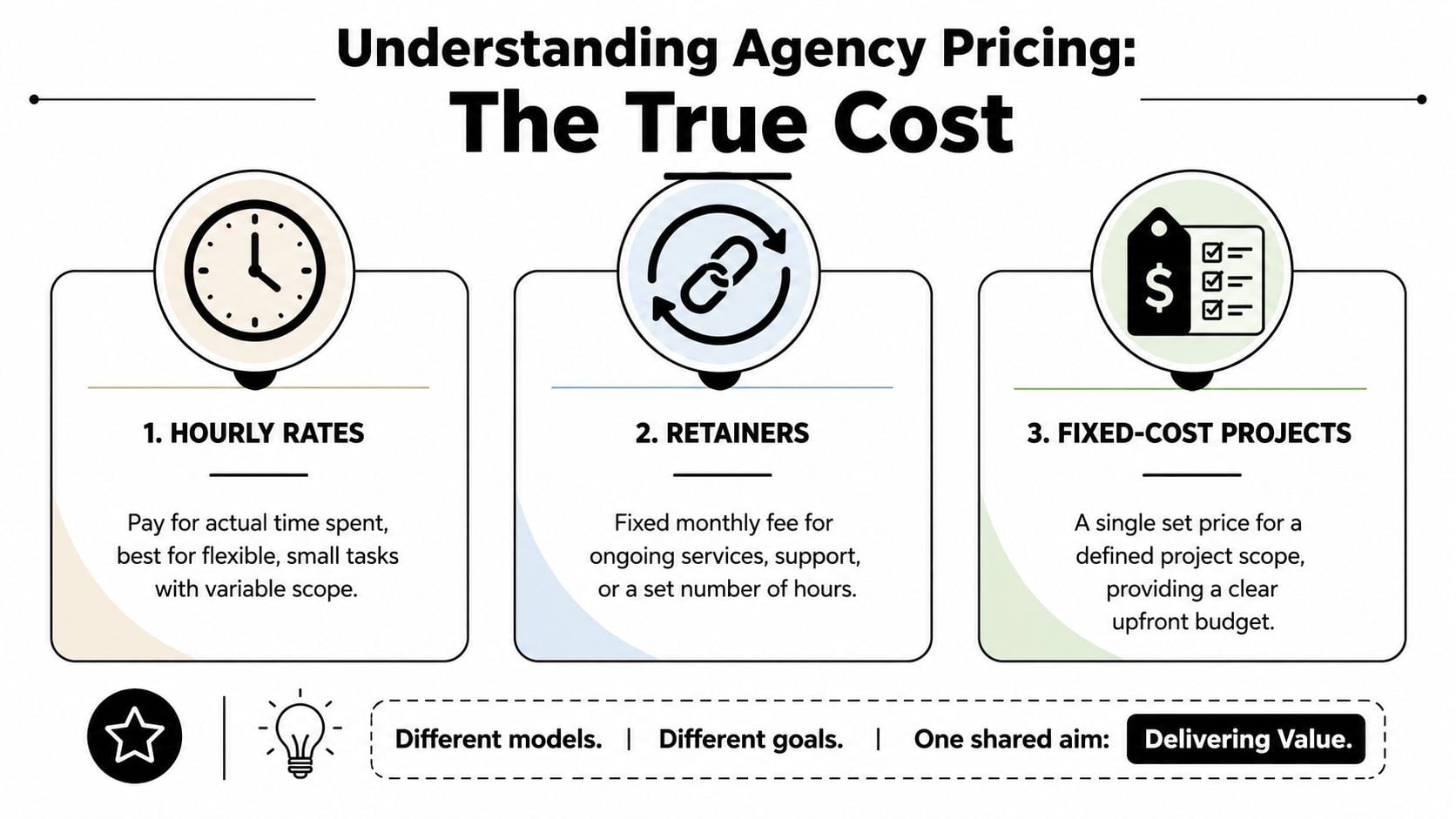
Three models come up most often.
- Hourly rates: Better for small tasks, troubleshooting, or undefined scopes. They can work well, but the budget can drift if the brief isn't tight.
- Retainers: Useful when you need ongoing support, content help, SEO input, and steady improvements each month.
- Fixed-cost projects: Usually the clearest choice for SMEs when the scope is defined properly and both sides understand what's included.
If you want budget clarity before signing off a project, reviewing a realistic WordPress website development cost breakdown helps frame the right questions.
What cheap quotes often leave out
This is the part many business owners only discover later.
Look closely for exclusions such as:
- Managed hosting: Who maintains the server environment, backups, updates, and uptime checks?
- Plugin licences: Premium tools often renew annually. If they're essential, who pays and who manages them?
- Security hardening: Some agencies launch the site and leave the rest to you.
- Content migration: Moving old pages, blogs, products, or media can take real time.
- Post-launch support: Small fixes are inevitable after go-live.
- Accessibility remediation: If issues are found later, are they included or treated as extra work?
Cheap projects often stay cheap only if you accept the risk, the omissions, and the admin burden yourself.
That's why pricing should be discussed as an operating model, not just a design fee.
Warning Signs How to Spot an Unreliable Agency
Some red flags show up before the proposal even lands in your inbox. If you spot them early, you can avoid a lot of wasted time.
Red flags in the sales process
Poor agencies usually reveal themselves in ordinary conversations.
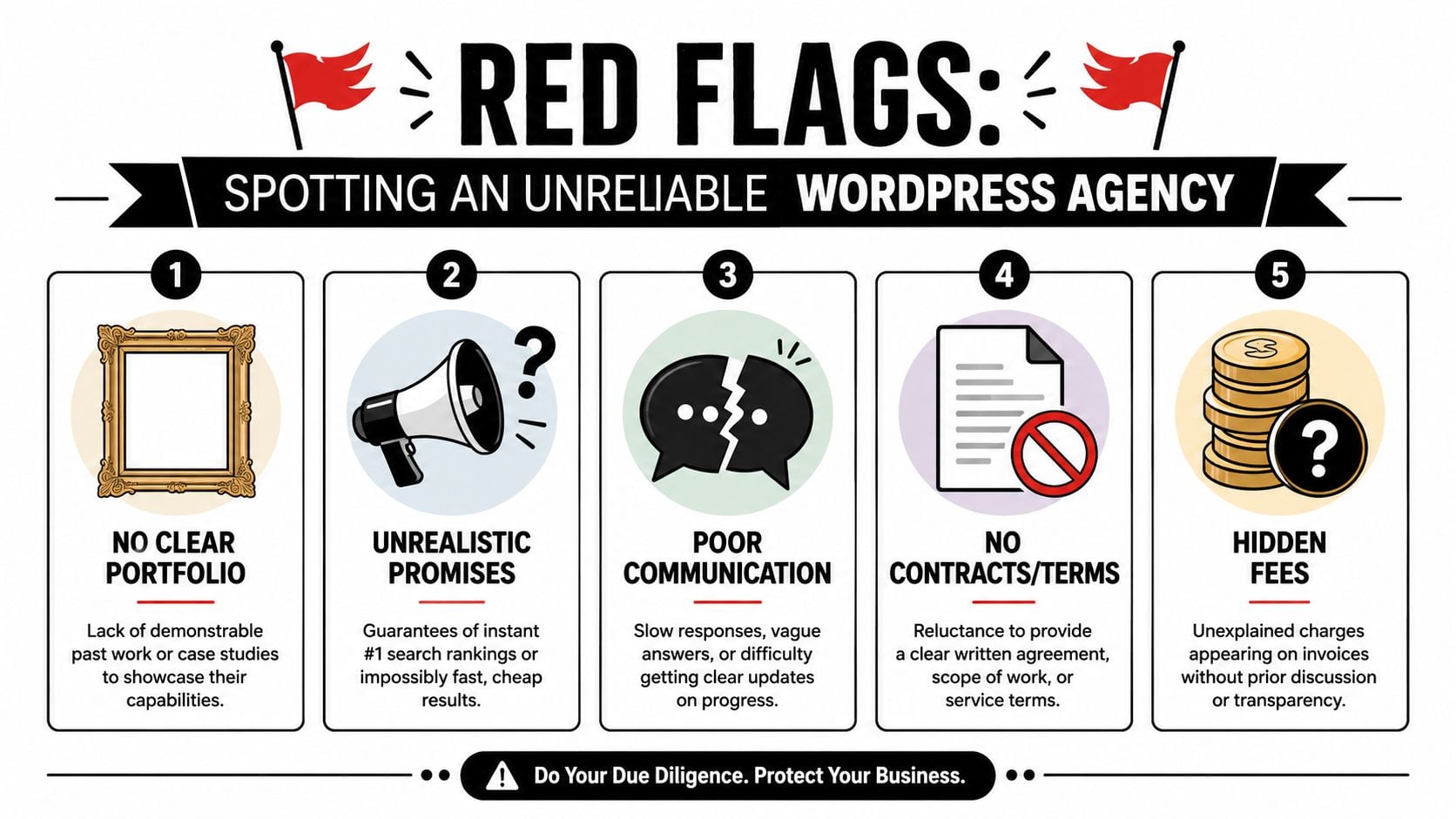
- They dodge specifics: If you ask what's included and get broad marketing language back, expect scope problems later.
- They promise too much: Instant rankings, “done in days”, and vague claims of easy growth usually point to weak process.
- They communicate badly at the start: Slow replies and unclear answers don't improve once the invoice is paid.
This short video covers some of the issues buyers should watch for when comparing providers:
Red flags in the proposal
The proposal matters because it shows how the agency thinks.
Watch for these warning signs:
- No proper scope: You should be able to see pages, deliverables, revisions, and responsibilities in writing.
- No ownership clarity: If nobody is clearly responsible for hosting, updates, forms, analytics, or training, the gaps become your problem.
- Outdated portfolio work: If the agency's own site looks neglected, or their examples feel old, ask why.
- No terms or process: Good delivery relies on a clear review and approval structure.
- Hidden extras: If everything useful is “phase two”, the original quote probably wasn't honest.
If an agency can't explain its process clearly before the project starts, it probably can't manage the project clearly once it's live.
The DesignStack Difference A Local WordPress Partner in Dorset
For Dorset businesses, local partnership is easiest to judge through real work. One useful example is the kind of project a community-focused organisation needs. A group such as the Weymouth & Portland Chamber of Commerce doesn't just need a nice-looking site. It needs clear navigation, dependable updates, easy content management, and a structure that supports events, members, and public credibility.
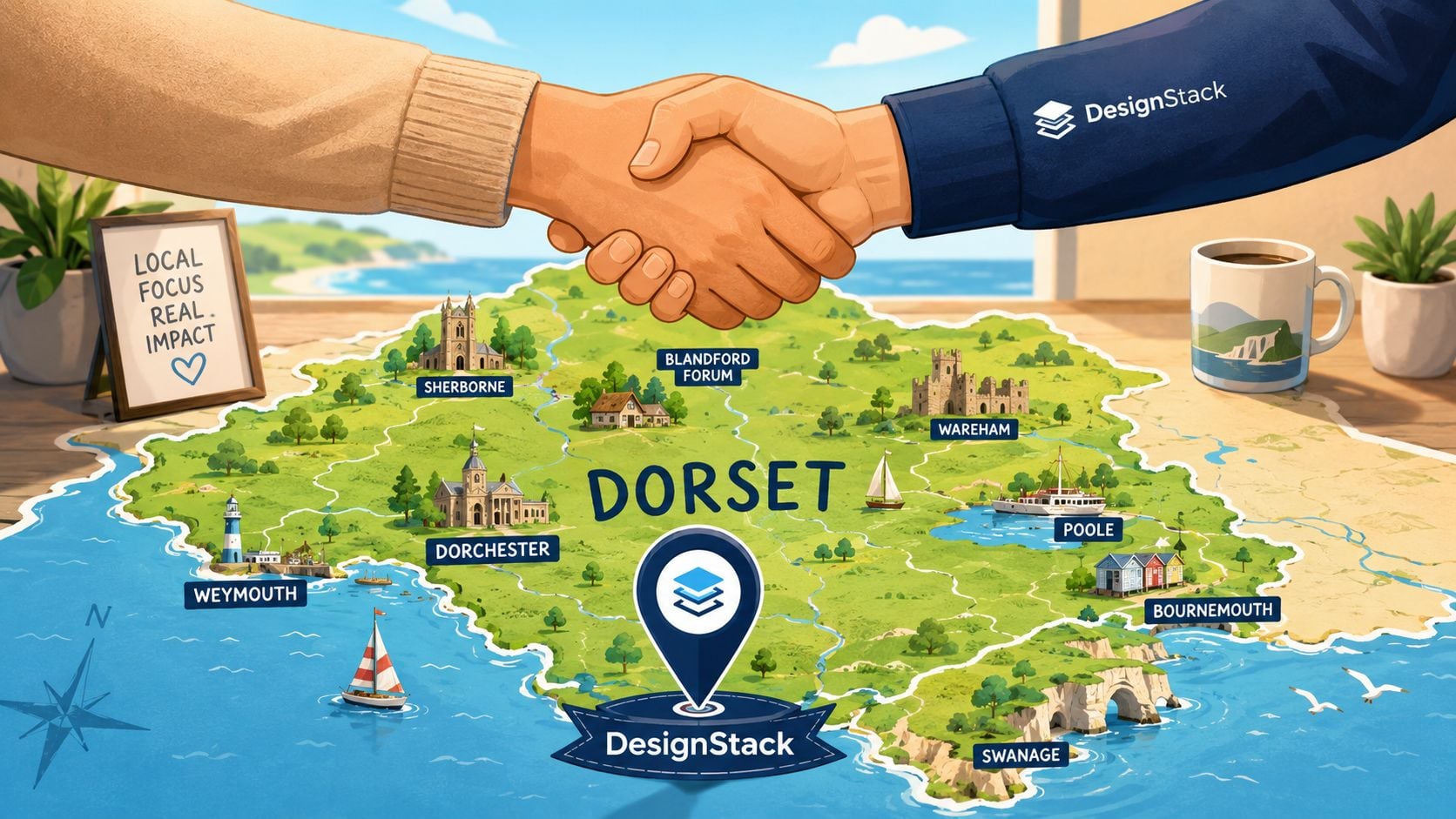
That's the difference between hiring a supplier and hiring a partner. The work has to fit the organisation behind it. For a Dorset client, that often means responsive page layouts, a practical admin experience, clear calls to action, and enough support after launch that the site keeps improving instead of stagnating.
One local option is website design in Dorset, where DesignStack outlines its WordPress design and development work, fixed-cost pricing approach, and post-launch update support. The useful part for SMEs isn't the label. It's the operating model: defined scope, regular communication, and a site the client can use.
In practice, local businesses tend to value the same things. They want a team that answers questions promptly, translates technical decisions into business terms, and doesn't disappear once the homepage is approved.
Frequently Asked Questions About Hiring a Web Designer
How much should a small business budget for a WordPress website?
There isn't one universal figure because scope changes everything. A simple brochure site, a service-led lead generation site, and an eCommerce build all require different levels of planning, content work, and support. The better question is what's included over the life of the site, not just the launch fee.
How long does a WordPress project usually take?
That depends on content readiness, feedback speed, and project complexity. A straightforward site can move quickly when the brief is clear and approvals are organised. Custom functionality, migrations, and eCommerce rules usually add time.
Do I need to provide my own text and images?
Usually, you'll need to provide at least some business-specific material, because nobody knows your services, team, or products better than you do. A good agency should still help shape that content, guide page priorities, and flag gaps early.
Should I hire a freelancer or an agency?
That depends on risk and support needs. Freelancers can be a good fit for small, tightly defined jobs. An agency is usually safer when you need strategy, design, development, hosting, support, and clearer continuity if one person is unavailable.
Is WordPress still a good choice for SMEs?
Yes, for many businesses it is. WordPress works well when you need a flexible content-managed site, straightforward editing, and room to expand into bookings, memberships, or online selling. The build quality matters more than the platform label.
What should I ask in the first meeting?
Ask who does the work, what's included, what happens after launch, how changes are handled, and how the agency approaches speed, accessibility, security, and content management. If the answers are vague, keep looking.
If you're reviewing options for a new WordPress site and want a local team that can handle design, build, and ongoing support in plain English, DesignStack is a Dorset-based option worth considering.

Leave a Reply