Solutions on Demand: A Practical Guide for UK Businesses
You're probably dealing with the same problem I see all the time around Dorset. The website is slow, the logo looks tired, the SEO isn't moving, and you've got a launch or busy season coming up before you've got time to hire someone properly. That's where solutions on demand stop being a buzzword and start being a buying decision.
The core question isn't whether the model sounds modern. It's whether you need capacity now, whether you can justify a full-time hire, and whether a fixed project, a subscription, or a support retainer is the cleanest way to get the work done without tying up cash you need elsewhere.
Table of Contents
- A Week in the Life of a Dorset Business Owner
- What Solutions on Demand Actually Means
- The Main Delivery Models Explained
- On Demand Versus In-House and Traditional Agencies
- How to Choose and Implement an On-Demand Provider
- Real Examples From Dorset and the UK
- Common Myths Worth Leaving Behind
- Your Quick Decision Checklist and Common Questions
A Week in the Life of a Dorset Business Owner
A café owner in Weymouth rings up on Monday because the menu has changed, the booking form is broken, and the site still doesn't look right on mobile. By Tuesday, the same owner is asked for a brand refresh by a supplier, and by Thursday they're thinking about search visibility because summer footfall is around the corner. None of that needs a full marketing department, but all of it needs doing properly.
A lot of Dorset SMEs live in that gap. You don't need ten people, you need someone who can jump in, fix the website, tidy the branding, and keep the SEO moving without you managing a mini agency in-house.
The decision point most owners ignore
The pressure usually comes from three directions at once. First, there's the clock, because launches, seasonal demand, and campaign dates don't wait for recruitment. Second, there's the budget, because a permanent hire means salary, holiday, training, and the risk of paying for idle time.
Third, there's the capability gap. A lot of small firms can sell, serve, and ship, but they can't spare the time to learn web systems, content, hosting, and search properly.
Practical rule: if the work is urgent, repeatable, and tied to revenue, buy capacity before you buy headcount.
That's why solutions on demand matter. They let you commission exactly what you need, when you need it, instead of carrying the cost of a full-time person before the workload exists.
What Solutions on Demand Actually Means
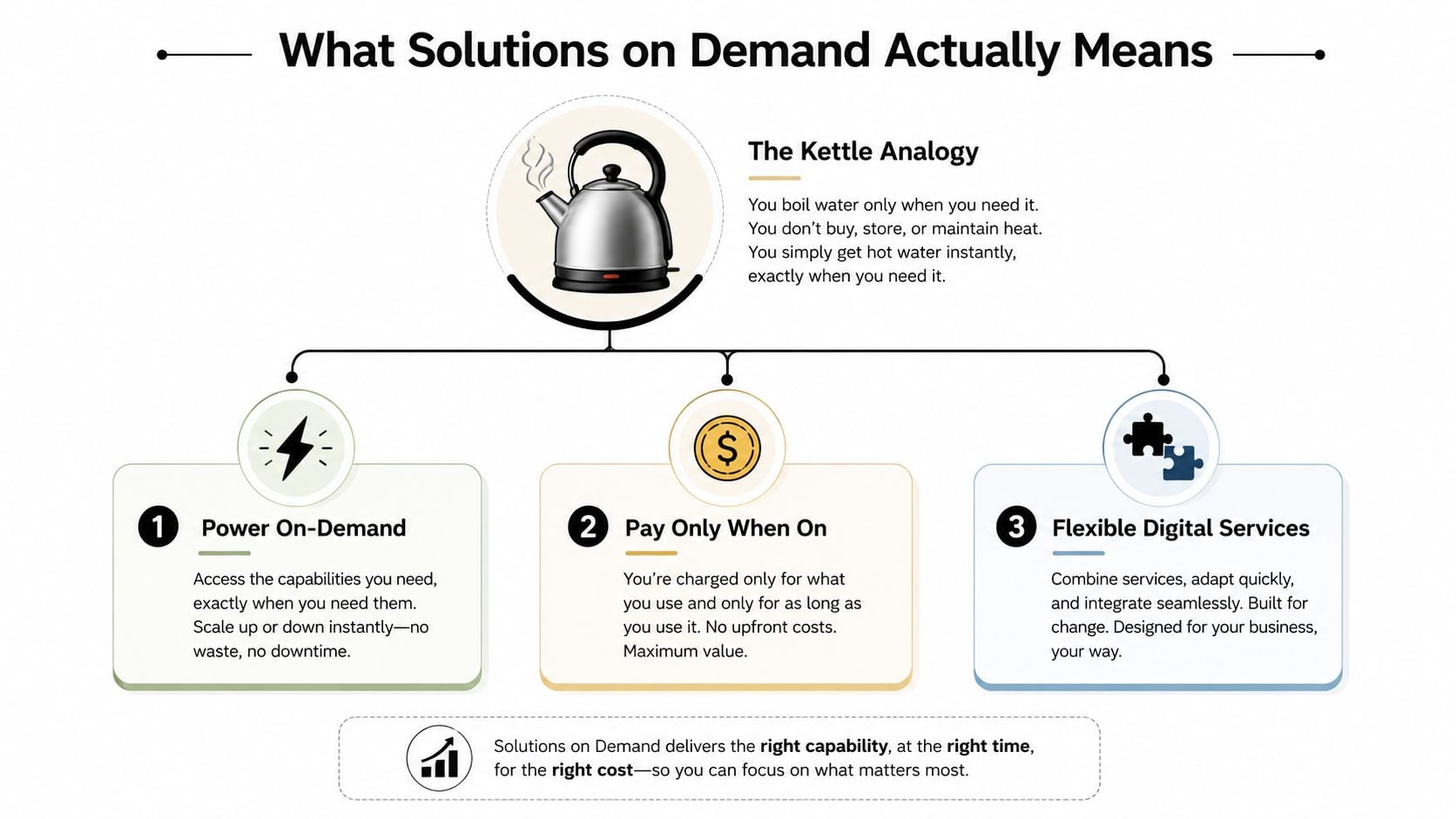
A kettle stays off until you need hot water, then it heats up and returns to idle. Solutions on demand operates similarly, where the "power" is digital capacity, web support, SEO, design, hosting, or software that activates only when the job appears.
In plain English, it covers services and systems delivered flexibly instead of as a one-off purchase or a permanent hire. In the UK, that often means subscription SaaS, managed web design, on-call SEO, retained branding support, and always-on hosting or maintenance.
Why the model exists at all
The UK is already a heavy user of subscription and managed digital services. One market summary says the UK sits among the countries with the most SaaS companies globally, second only to the US, and that US has more than 8x as many SaaS businesses as the UK, with end-user SaaS spend poised to exceed US$172 billion in 2022 after rising nearly 450% since 2015. The same summary links that growth to the spread of recurring, always-on service delivery rather than one-off procurement Spendesk SaaS statistics.
That matters because the buying habit has changed. Buyers now expect the service to be available when they need it, not only during office hours or after a tender cycle.
What you should recognise in a proposal
If a supplier talks about monthly platform fees, managed support, credit-based work, or fixed scope with post-launch care, you're looking at solutions on demand in practice. It might be software, but it might also be a service bundle that includes design, SEO, maintenance, and revisions.
The core idea is simple. You're not buying a thing and walking away. You're buying access, flexibility, and response.
The Main Delivery Models Explained
The tricky part isn't understanding the phrase. It's knowing which buying model fits your business without wasting money or locking yourself into the wrong arrangement.
Four models, four different jobs
A subscription is best when the work is ongoing and predictable. You pay a regular fee for access to a platform or service, and the SLA usually focuses on uptime, support windows, and issue response. This suits firms that need steady hosting, content access, or a managed tool they'll use every month.
A pay-as-you-go model suits bursty work. You buy hours, credits, or units of output as needed, and the SLA tends to cover turnaround time rather than deep ongoing ownership. That's useful if you only need help when campaigns, seasons, or fixes appear.
A fixed-cost project is the cleanest model when the deliverable is clear. You agree the scope, price, revisions, and handover up front, which makes budgeting easier. For many small businesses, this is the least messy way to get a new site, a rebrand, or a launch build done.
A retainer buys continuity. You pay for reserved capacity each month, and the SLA usually includes response times, scheduled work, and a defined scope for ongoing changes. It suits businesses that need a reliable partner, but not a full-time employee.
| Model | Pricing logic | Typical SLA | Best for |
|---|---|---|---|
| Subscription | Regular fee for access or service | Uptime and support coverage | Hosting, software, managed tools |
| Pay-as-you-go | Charge by hour, credit, or task | Turnaround and responsiveness | Occasional fixes and bursts of work |
| Fixed-cost project | One price for a defined scope | Delivery milestones and revision terms | Website builds, branding, launch work |
| Retainer | Monthly fee for reserved capacity | Response times and ongoing support | Continuous updates and content help |
Bottom line: if you can describe the job clearly and you want certainty, start with a fixed-cost project. If you need an ongoing safety net after launch, add a short retainer.
One useful test is whether the work needs a platform, a specialist team, or both. A business researching visual tools such as ai clothing video generator may only need software access. A business that needs a website, SEO guidance, and launch support usually needs service delivery as well as tooling.
On Demand Versus In-House and Traditional Agencies
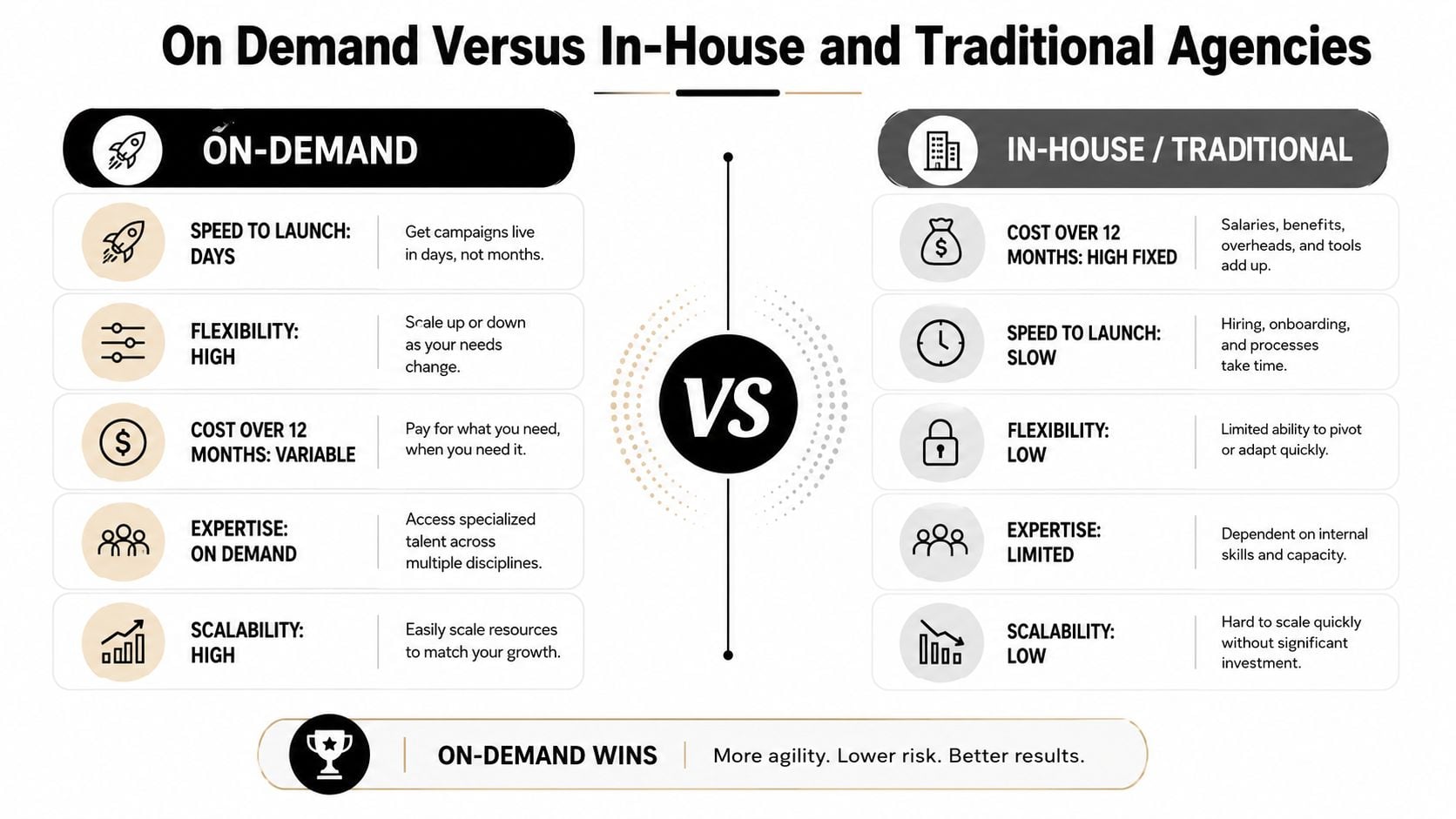
The wrong comparison is “cheap versus expensive”. The right comparison is speed, control, flexibility, and total cost of ownership.
What you actually get for the money
Hiring in-house gives you day-to-day availability, but it also gives you payroll risk, onboarding time, and skill gaps. A traditional long agency contract gives you a team, but it can also give you slow handoffs, rolling account costs, and work that keeps happening even when your need drops.
On-demand delivery wins when you need to launch quickly, stay flexible, and keep accountability tight. It also makes more sense in the current UK hiring climate. Labour-market data showed vacancies fell to 904,000 in February to April 2024, the lowest since April to June 2021, while payroll numbers remained high. The same data shows the labour pool is still constrained, and around 1.6 million people are economically inactive due to long-term sickness, which makes external capacity more attractive than waiting to recruit UK labour-market data summary.
The practical takeaway is blunt. If you need websites, branding, hosting, and SEO work done by next month, outsourcing beats writing a job advert and hoping the right person applies.
My default recommendation for most SMEs
For most Dorset and UK SMEs, the cleanest setup is a fixed-cost project for the core build, followed by a short on-demand support window for fixes, updates, and handover. That gives you a defined outcome, a clear finish line, and enough continuity to stop the launch from falling apart after sign-off.
The reason I favour that model is simple. It protects cash, forces scope discipline, and avoids paying for idle time. If you need a broader view of support and maintenance after launch, this website support and maintenance resource is a useful reference point.
A traditional agency retainer still has its place, but only when the business needs ongoing output every month. If you don't, you're subsidising overhead you can't use.
How to Choose and Implement an On-Demand Provider
Start with a plain-English scope. If you can't describe the job in a paragraph, you're not ready to buy it yet. Write down what needs doing, what a finished result looks like, what the deadline is, and what's out of scope.
What to ask before you sign
Then push on the SLA. Ask for response times, revision rounds, uptime commitments if hosting is included, and what happens when something breaks after launch. If the provider won't put those points in writing, walk away.
Check handover terms next. You want to know who owns the files, the site, the brand assets, and any account access created during the job. If ownership is vague, the provider is keeping control you'll wish you'd challenged earlier.
You should also ask about practical UK matters, not just creative work. VAT handling, contract terms, and time-zone overlap matter more than most owners admit, especially if you need fast approvals or local support. If the provider is overseas, make sure their availability matches your working day and your deadlines.
Non-negotiable: if you can't leave with the assets and the access, you haven't bought a solution, you've rented dependency.
A useful implementation sequence looks like this:
- Kickoff with the scope, deadline, and approval chain.
- Milestones for draft, review, and final build.
- Sign-off on design, content, and functional checks.
- Launch with a defined support period.
- Post-launch review to catch bugs, tidy content, and confirm the handover.
If you want a sharper picture of what a capable supplier looks like, this creative agency in UK page helps frame the sort of service mix that should be discussed before work starts. For firms that need a web build and ongoing care, the right setup is usually less about fancy tooling and more about process discipline.
Real Examples From Dorset and the UK
A Weymouth hospitality business needed a website rebuild before peak season. The owner didn't want a permanent hire because the need was urgent, seasonal, and tied to a launch date. A fixed-cost on-demand package solved the immediate problem by refreshing the logo, rebuilding the site, and tightening the SEO basics in one go.
Another UK professional services firm had the opposite issue. The website was slow, outdated, and embarrassing in sales meetings, but the team didn't need a large marketing department. They moved to a managed WordPress build, kept a one-month support window after launch, and asked for ongoing content guidance instead of a heavy retainer.
Why those decisions worked
In both cases, the buyer made the same sensible call. They bought the result they needed, not the internal structure they didn't need. That's the big advantage of on-demand delivery, it lets a small team behave like a bigger one during a specific window without carrying permanent overhead.
If you're comparing agencies in the same way, this WordPress developer near me resource is a good reminder that proximity matters when you need quick decisions, clear communication, and a clean handover.
The useful part isn't the brand story. It's the decision logic. The businesses didn't wait for the perfect internal hire. They bought capacity, got the site moving, and kept control of the budget.
Common Myths Worth Leaving Behind
The first myth is that on-demand means low quality. It doesn't. Quality comes from the provider's process, scope control, and accountability, not from whether you paid monthly or fixed price. A badly run retainer can be worse than a well-run project.
The second myth is that this model only suits startups. That's lazy thinking. Established SMEs use on-demand delivery precisely because they've already learned where the holes are, and they need burst capacity without adding staff.
The third myth is that SLAs are just marketing fluff. They're not if they're written properly. Response times, revision limits, support hours, and ownership terms can all be enforced if they're drafted clearly and attached to the work.
If you're still unsure how to judge value, this is SEO worth it for small business page is useful background. The risk isn't choosing solutions on demand. The risk is choosing it badly, with a vague brief and no exit terms.
Your Quick Decision Checklist and Common Questions
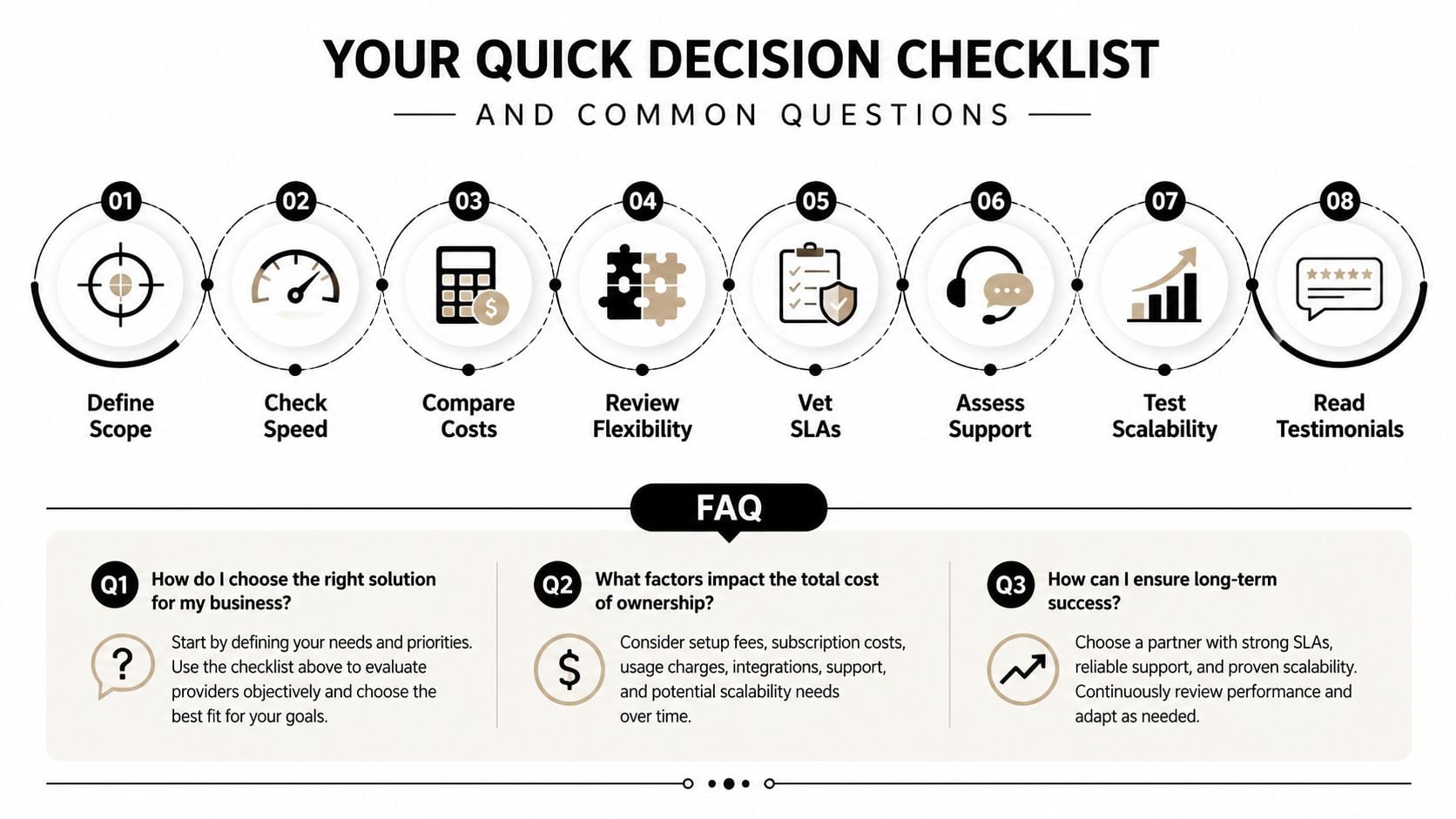
You are usually ready for an on-demand provider when the work is clear, the deadline is tight, and hiring someone full-time would leave you carrying spare capacity you do not need. Start there, because that is the core decision.
Use this before you sign anything.
- Define scope clearly: write the job in plain English, including what is included and what sits outside the brief.
- Check speed: ask when work starts, how milestones are set, and who is accountable if delivery slips.
- Compare costs: look at the full bill, including setup, revisions, support, and any extra charges for changes.
- Review flexibility: confirm what changes are allowed, what triggers a new quote, and how scope creep is handled.
- Vet SLAs: get response times, support hours, ownership terms, and escalation routes in writing.
- Assess support: ask what happens after launch, who fixes issues, and whether ongoing help is included or charged separately.
- Test scalability: make sure the model can cope if the workload grows or the brief changes.
- Read testimonials: look for examples from businesses like yours, not generic praise copied onto a sales page.
If you are comparing agencies in the same way, this guide to how to choose a web design agency can help frame your decision.
FAQ
Is on-demand cheaper than hiring? For short bursts, usually yes. You avoid payroll overhead, holiday cover, and paying for idle time when the workload drops. For steady, full-time demand, hiring can make more sense.
How long does a typical project take? There is no sensible standard answer. The timeline should be agreed before work starts, tied to scope, and written into the SLA or project plan.
What if the provider disappears? Do not leave this to trust. Your contract should cover exit terms, asset ownership, handover access, and what happens if support stops.
Can WordPress, eCommerce, and SEO all fit the same model? Yes. They are often bought as a fixed-cost project with a support retainer after launch, or as a monthly service where the scope stays tight and the SLA is clear.
If you want a local view of whether to hire, subscribe, or commission a fixed-cost project, speak to DesignStack.