
SEO Services Price in the UK: What You Should Pay in 2026
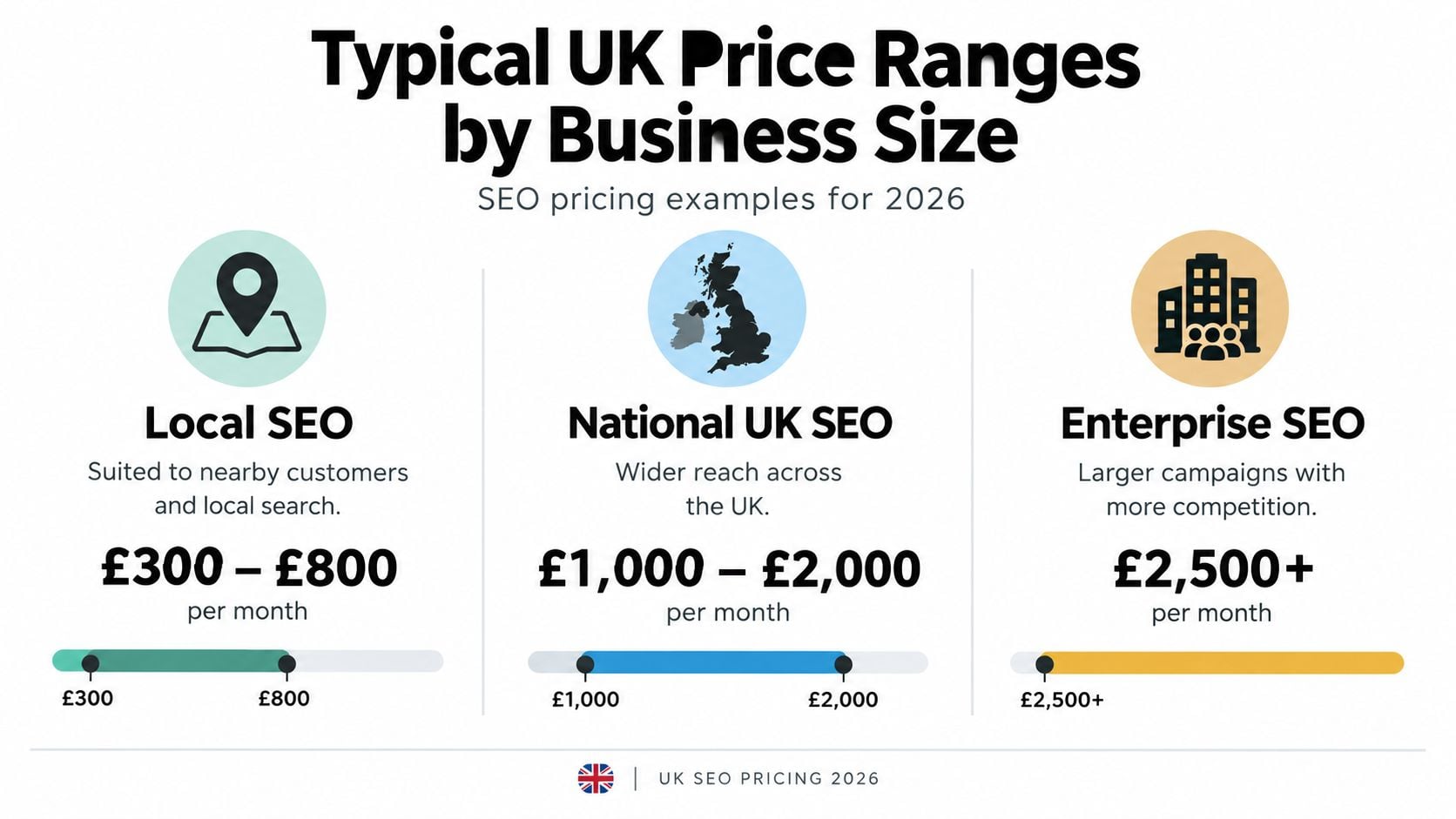
For most UK businesses in 2026, an SEO services price falls between £300 and £800 per month for local SEO, £1,000 and £2,000 for national UK coverage, and £2,500 and £5,000 for mid-market campaigns. Freelancers typically charge roughly 30% to 50% less than agencies for comparable scopes.
If you've just opened two quotes and you're staring at two very different numbers for what looks like the same job, you're not missing something obvious. You're seeing how this market works. The headline fee tells you very little until you know what market you're targeting, how much work is included, and how success will be measured.
Think of SEO as a staged budget decision, not a single purchase. You fix what matters first, you pay for steady work next, and you only scale up when the enquiries justify it.
Table of Contents
- Why SEO Pricing Varies So Much Across the UK
- How SEO Pricing Models Work
- Typical UK Price Ranges by Business Size
- What Drives the Cost of SEO Work
- Sample Packages for Different Budgets
- How to Evaluate Value and Choose a Local Agency
- Your Next Step Toward a Clear SEO Budget
Why SEO Pricing Varies So Much Across the UK
A Weymouth café owner gets two proposals in the same week. Both say monthly SEO. Both promise better visibility. One is a few hundred pounds a month, the other is well over a thousand, and on paper they read almost identically.
That gap usually isn't about one provider being greedy and the other being generous. It's about scope hiding behind the same label. One quote might cover a Google Business Profile tidy up and a monthly report, while the other includes technical fixes, new service pages, review support, and link outreach aimed at a much wider area.
The three questions that explain the gap
Ask these before you compare any numbers:
- How are you being charged: Is it a retainer, a fixed project, or hourly advice, and what happens if the work runs over?
- What moves the price: How many locations, services, or products are included, and how competitive is that market?
- How will value be judged: Are you buying rankings on a chart, or calls, bookings, and enquiries you can count?
Geography matters more than most buyers expect. A café wanting lunchtime trade from people already in Weymouth is playing a small, local game. An online retailer shipping across the UK is competing with national brands on every product page, so the volume of technical work, content, and link acquisition is completely different.
If two quotes look the same but cost very differently, the cheaper one hasn't removed the work. It has usually removed the hours.
There's also a timing trap. A site that's just moved platforms or changed domain needs careful handling first, which is why some businesses start with specialist SEO website migration services before they even think about monthly growth work. Paying for content while redirect errors lose your existing traffic is money spent in the wrong order.
Once you can answer those three questions, the quotes stop feeling random. You can see what each provider is really selling.
How SEO Pricing Models Work
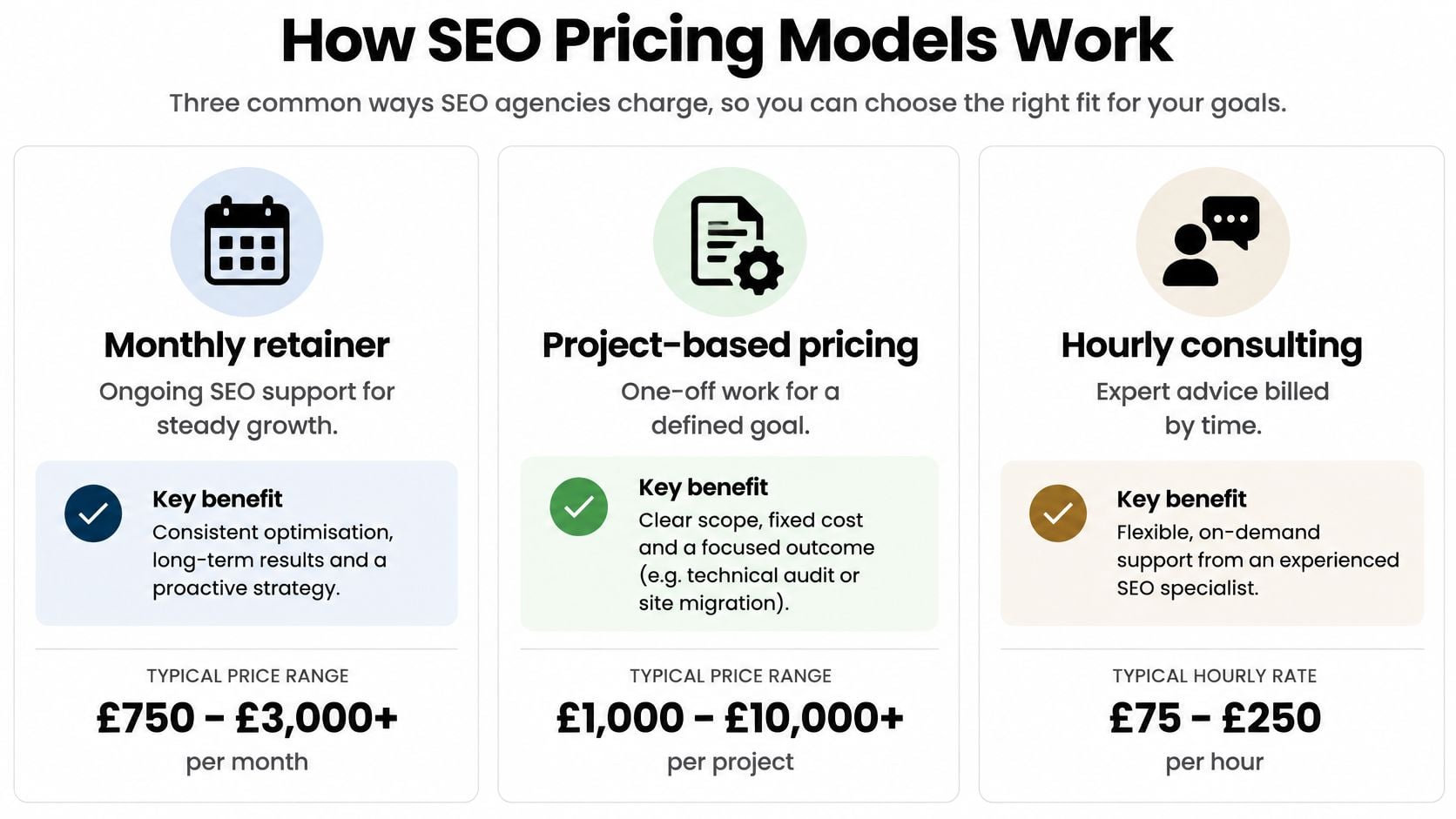
Most quotes you'll receive fit one of three models. The gym analogy helps here because the structure, not just the price, decides whether a model suits you.
A monthly retainer is like a gym membership. You pay a set amount each month for ongoing access to a team and a repeating programme of work. That usually suits steady growth, because someone is publishing, fixing, reporting, and adjusting every month without you rebuying the service each time.
The image below sets the three models side by side so you can compare them at a glance.
Retainers, projects, and hourly work
Project pricing is the one off block of personal training sessions. You agree a defined job, such as a technical audit with a fix list, a set of new landing pages, or a migration, and you pay a fixed fee for that outcome. It's clear and easy to budget for, but it ends when the scope ends, so anything new becomes a fresh conversation.
Hourly or day rate work is pay as you go. It's handy when you need a second opinion, help untangling a specific problem, or advice your own team will implement. The risk is simple. Small questions turn into long calls, long calls turn into investigations, and the bill grows without a finished piece of work to show for it.
Each model has a trade off worth naming:
- Retainers give continuity: Momentum builds month to month, but you should ask how unused time is handled so hours don't disappear.
- Projects give clarity: You know the cost and the deliverable upfront, but flexibility is limited once the scope is signed.
- Hourly work gives control: You only buy advice when you need it, but you carry the job of doing the actual implementation.
Some buyers also ask about paying only when results arrive. If that idea appeals, it's worth reading guidance on how to evaluate outcome-driven SEO partnerships so you understand what counts as a result and who controls the levers that produce it.
For most small businesses, the sensible sequence is a fixed project first to fix foundations, then a modest retainer tied to a prioritised backlog. If your site runs on WordPress, that backlog often starts with the kind of work covered by WordPress SEO services, where plugin choices, page speed, and site structure all affect what the retainer needs to include.
Match the model to your stage. Limited budget and a broken site means project first. A sound site and steady ambition means retainer.
Typical UK Price Ranges by Business Size
Benchmarks are useful, as long as you treat them as a compass rather than a promise. A 2026 UK pricing sample compiled from 128 published prices across 47 providers reported £300 to £800 per month for local SEO, £1,000 to £2,000 for national UK coverage, and £2,500 to £5,000 for mid-market campaigns, according to the 2026 UK marketing cost index from Whito.
The chart below shows those bands in a form you can scan quickly.
What each band usually means in practice
A Dorset retailer with one shop and a handful of key services sits in that local band because the job is contained. You're optimising a small set of pages, one location, and searches from people nearby who are ready to visit or call.
An eCommerce brand selling nationally is in a different world. Hundreds of products, category pages, filters, stock changes, and competitors in every town all add hours. The fee rises because the activity volume rises, covering more technical work, more content production, more link acquisition, and more detailed reporting.
Provider type shifts the number too. The same benchmark found freelancers charged approximately 30% to 50% less than agencies for comparable scopes, per the source linked above. That doesn't automatically make a freelancer better value. You're buying one person's time and availability rather than a team, so ask what happens during holidays or busy periods.
There's helpful wider context here, but it needs careful handling. A UK SME focused analysis places indicative spending at £500 to £1,500 per month for small businesses, £1,500 to £5,000 for medium businesses, and £5,000 or more for full service growth programmes, as set out in BeeBrilliant Marketing's guide to how UK SMEs do SEO. Those bands overlap the first benchmark rather than contradict it, because they're grouped by business size instead of geographic reach.
Practical rule: Compare the deliverables attached to a price, not the label on the package. Two providers can both say local SEO and mean entirely different amounts of work.
One more reality check. A business combining SEO with paid search, social media, email, and content at a mid range level could spend approximately £6,000 to £8,000 per month before advertising spend, based on the Whito index linked earlier. That's why small firms should stage their spend rather than trying to buy everything at once.
Use these ranges to sense check a quote. If a national campaign is priced like a local one, ask what's missing. If a single location business is quoted mid market money, ask what extra work justifies it.
What Drives the Cost of SEO Work
A local firm's quote can cover a few targeted fixes or months of work across its website. The difference comes down to which parts need attention and who will carry out the work. SEO spending is easier to assess when each task has a clear purpose and price.

Foundations first, then rooms, then reputation
Technical SEO covers issues that can stop search engines from finding or understanding pages. This may include crawl and indexation problems, canonical tags, JavaScript rendering, schema markup, and page speed. Finding a fault is one job; fixing it may call for developer time. Check whether the quote includes implementation, or only a list of recommended repairs.
On-page optimisation improves the pages you already have. Work can include rewriting titles and headings, improving internal links, and making service details clearer. A trades business with strong pages but muddled wording may get more value from this work than from commissioning new content.
Content production takes time beyond writing. The work can involve researching what customers search for, planning pages so they serve different purposes, drafting and editing content, and reviewing its performance. If a quote includes new pages, ask how many, who writes them, and whether revisions are included.
Link acquisition and digital PR aim to earn relevant mentions from other websites. Researching prospects, pitching ideas, following up, and preparing useful material all take skilled time. A low-cost package may not include this work, so check rather than assume.
The short video below shows these cost drivers visually.
Measurement takes time too. Someone needs to review organic clicks, rankings, indexed pages, enquiries, and conversion rates, then explain what has changed. A free SEO website audit can help identify which areas need attention before you commit to ongoing work.
A useful quote names its costs clearly: strategy, implementation, content, link work, and measurement. If it gives one total under “SEO” with no explanation, ask what tasks that fee covers and what falls outside it.
The UK SEO market includes businesses with different levels of demand, while skilled specialists have limited working hours. For a local or small business, the practical question is which work should come first, not whether every service belongs in the initial budget.
Sample Packages for Different Budgets
Limited budgets are the norm, not the exception. A 2025 survey of 439 UK SMEs reported that 67% identify budget constraints as their main barrier to SEO success, according to SEO Caddy's UK SME SEO report for 2025.
That same study associated basic spending below £500 per month with 34% median traffic growth and moderate spending of £500 to £2,000 with 89% growth, per the source above. Treat those figures cautiously. The study was published by an SEO provider and isn't an independent market benchmark, so use it to think about priorities, not to forecast your own results.
Three tiers and what to buy first
Starter tier, under £500 per month. Picture a Dorset trades firm with a sound website that isn't being found locally. The smart spend here is narrow. Fix high impact technical errors, tidy the Google Business Profile so opening hours, services, and photos are accurate, and make sure the main service pages say clearly where the firm works. No blog programme, no link campaign. Just remove the blockers.
Local growth tier, £500 to £2,000 per month. Now picture a professional services firm wanting enquiries from several nearby towns. This budget can add local landing pages for each area, regular content that answers real client questions, review generation, and conversion improvements such as clearer contact routes and stronger calls to action. Reporting should track calls and form submissions, not just visits.
Larger programme, above that range. A retailer expanding nationally needs product and category optimisation at scale, ongoing technical maintenance, digital PR, and deeper reporting. At this level you're funding a team rhythm, where content, technical fixes, and outreach happen in parallel rather than taking turns.
- Prioritise fixes over volume: One broken contact form or slow mobile page can waste every visit your SEO earns.
- Prioritise revenue pages: Improve the services or products that make money before chasing informational traffic.
- Prioritise conversion paths: Clear pricing guidance, trust signals, and simple booking steps turn visits into enquiries.
Doing less, but fixing high impact issues first, often outperforms a larger generic package spread thinly across everything. The cheapest package is only a bargain if it produces enquiries. Traffic that arrives, shrugs, and leaves hasn't saved you money at all.
How to Evaluate Value and Choose a Local Agency
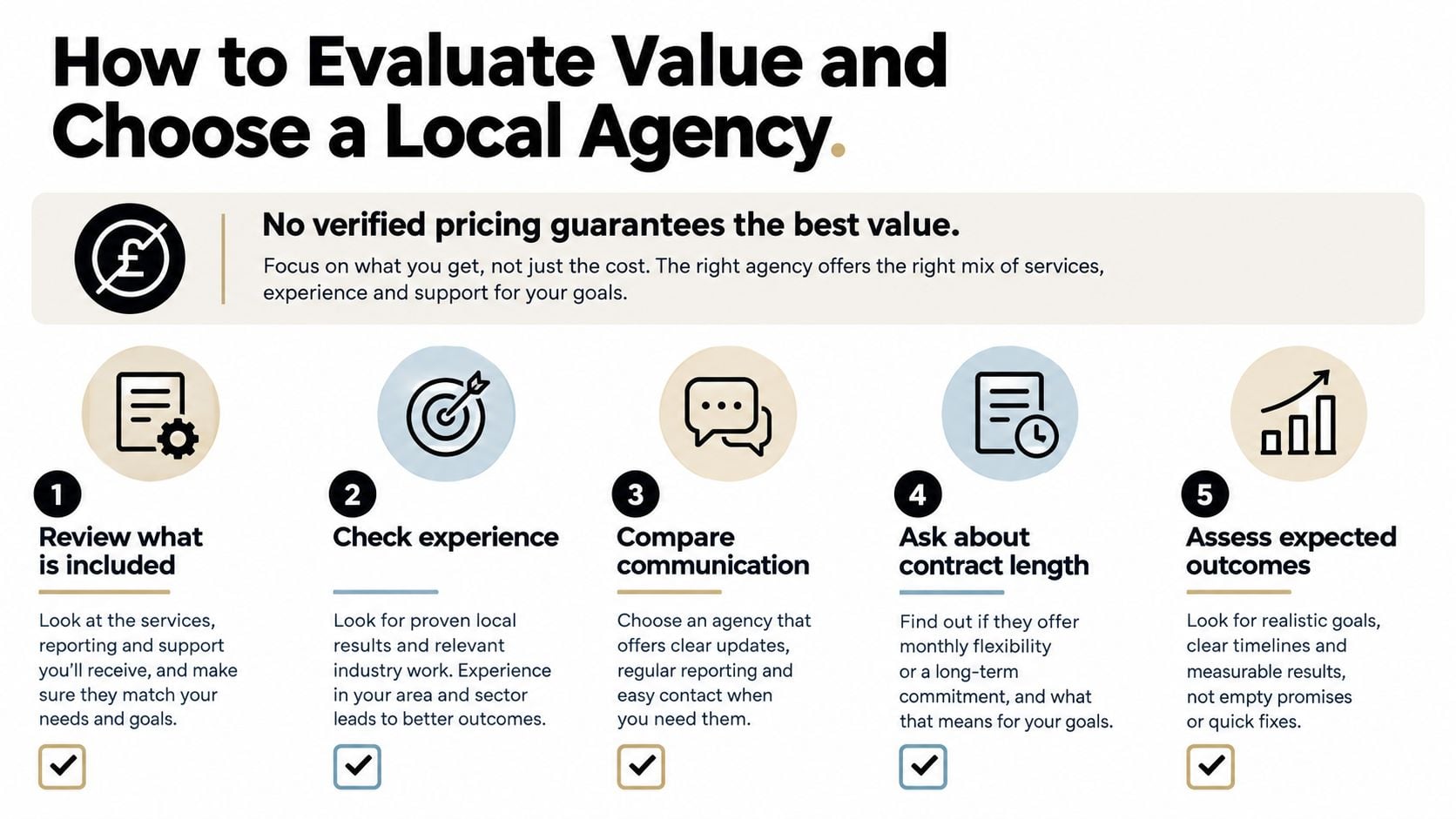
Here's an uncomfortable fact that should shape how you buy. Published UK commentary notes there's no verified nationwide primary survey recording what all UK businesses pay for SEO, a point covered in the SEO Works industry report linked earlier. So nobody can give you an official average. You have to judge value from scope.
The checklist below gives you a fair basis for comparing any two providers.
What a credible quote should state
Put a cheap generic retainer beside a scoped local engagement at a similar monthly figure. The generic one lists activities like keywords tracked and reports sent. The scoped one names the market covered, the hours or outputs included, reporting frequency, and the review period before you judge progress.
Ask every provider for baseline measurements before work starts:
- Organic clicks and indexed URLs: So you can see whether more of your site is being found and visited.
- Rankings for revenue terms: Focused on services you'd want enquiries for.
- Leads and conversion rate: Calls, forms, bookings, or sales, measured the same way each month.
- A monthly change log: A plain record of what was done, so results can be tied to actions.
Search itself is also shifting under your feet. Google states AI Overviews had more than 1.5 billion monthly users and had expanded to 200 countries and territories by June 2025, according to Google's overview of AI marketing questions for 2025. That figure is global, not UK specific, so it doesn't prove a traffic impact for a Dorset business. It does mean you should ask how a provider handles addressing uneven brand visibility in AI search, and whether reporting covers qualified actions alongside rankings.
As one local reference point, DesignStack is a Weymouth based Dorset digital agency offering SEO alongside responsive WordPress websites, eCommerce builds, hosting, content guidance, and social media integration. It works to fixed cost pricing with three design revisions as standard and one month of post launch updates, and its portfolio includes local names such as Crossfit Durnovaria, The Lobster Pot, and the Weymouth & Portland Chamber of Commerce.
Use the same checklist on every agency, local or national, and read balanced guidance on whether SEO is worth it for a small business before you sign. The agency that answers these questions plainly, in writing, is usually the safer pair of hands.
Your Next Step Toward a Clear SEO Budget
Pull the threads together in order. First understand which pricing model you're being offered. Then check the fee against the UK benchmark for your market size. Then look at what's driving the cost, line by line, and match the whole thing to a budget tier you can sustain without panic.
That sequence matters because it stops you comparing headline prices that were never describing the same job. A lower fee with no technical implementation, no content, and no meaningful reporting isn't cheaper in any useful sense. It's just smaller.
Hold onto one test throughout. Enquiries, bookings, calls, and conversion rate matter more than rankings alone. A page one ranking for a phrase nobody buys from is decoration, whereas a modest position on a service page that sends steady, qualified calls is valuable.
Judge an SEO services price by the enquiries it can realistically support, not by the length of the keyword report.
Before you contact any agency, gather three things. They'll make every conversation shorter and every quote more honest.
- Your current monthly budget: The figure you can commit to steadily, not a number you'd need instant results to justify.
- Your priority pages or locations: The services, products, or towns that matter most to revenue.
- Your baseline: Current traffic, enquiries, and where they come from, even if the numbers feel embarrassingly small.
With those in hand, you can request a scoped proposal and compare it fairly against others, including the SEO companies in Bournemouth and elsewhere in Dorset that local buyers often shortlist. Ask each one to price the same priorities, with the same baselines, over the same review period.
You don't need the biggest budget in your market. You need a clear one, spent in the right order, measured against enquiries. That's a decision any small business can make with confidence.
If you'd like a scoped, plainly priced SEO proposal built around your priority pages and a realistic monthly budget, talk to the Weymouth team at DesignStack about what should be fixed first and what can wait. Bring your current traffic and enquiry numbers, and you'll get a clear view of what each pound would buy before you commit to anything.