App Development Cost: A UK Guide for 2026
A simple app MVP in the UK can start at around £20,000, most business apps land between £40,000 and £100,000, and complex enterprise solutions can exceed £250,000. If you're pricing an app properly, though, the fundamental question isn't just build cost. It's total cost of ownership, because the quote you receive is rarely the full financial picture.
Those who enquire about an app are in the same position. They have a strong idea, a clear business problem, and a rough sense that mobile could open a new revenue stream, improve customer service, or modernise an internal process. Then they start searching for prices and find everything from bargain-basement freelancer quotes to six-figure agency proposals.
That gap feels suspicious until you understand what sits underneath it. A login screen isn't the same as a booking engine. A brochure-style app isn't the same as a regulated product handling personal data. And a cheap quote that ignores planning, maintenance, and launch activity often becomes the most expensive option later.
A sensible app budget works the same way as any other serious business investment. You need to know what you're building, what level of risk you're accepting, and what happens after launch. That's where most cost guides fall short. They talk about screens and features, but skip the hidden budget items that decide whether the project stays commercially viable.
Table of Contents
- So You Have an App Idea What Now
- The Core Factors That Determine Your App Price
- Understanding Common App Development Pricing Models
- Realistic UK App Budgets and Timelines in 2026
- The Hidden Costs Beyond the Initial Quote
- How to Get an Accurate App Development Quote
- Your Path to a Successful App Launch with DesignStack
So You Have an App Idea What Now
A founder walks into a meeting with a clear problem and one dangerous assumption. The problem is real. Customers abandon bookings halfway through. Staff waste hours updating people manually. Sales teams keep answering the same status questions. The assumption is that the next step is asking three agencies for a build price.
At that point, any quote is only a rough signal.
The first job is to turn the idea into a business case and an initial scope. That means getting specific about who the app is for, what behaviour needs to change, what the first release must prove, and what happens behind the screen once users start tapping buttons. An app that saves your team two hours a day has a different budget logic from an app that needs to win users in a crowded market, support paid acquisition, and convert first-time downloads into active customers.
That distinction affects total cost of ownership, not just build cost. A cheap quote can become an expensive project if the early discovery work is weak. I have seen businesses approve development before agreeing the core user journey, admin workflow, or success metric. They usually pay for that later in rework, delayed launch dates, and features nobody uses.
Start with day-one value. What does the first version need to achieve to justify being built?
For some companies, the answer is operational. Reduce phone calls, cut booking admin, improve reporting, or give customers self-service access. For others, the first version is a market test. Can the product attract signups, retain users, or support a funding round? If external funding is part of the plan, Fundl's app crowdfunding tips are useful because they force harder questions about demand, positioning, and what people will support with money.
A good brief is rarely a long feature list. It is a set of decisions.
Who is the primary user? What is the one task they need to complete without friction? Which features are required for launch, and which can wait until real usage data comes in? Which internal systems need to connect? Who on your side will own content, approvals, support, and post-launch updates? Those answers shape cost far more than the phrase “we need an app.”
Early-stage teams often benefit from reviewing what goes into app development for startups before asking for proposals. It helps frame the project properly, especially if you are comparing an MVP, a pilot, and a full commercial launch.
The hidden budget item many guides skip is discovery quality. If discovery is rushed, every later number is less trustworthy. If discovery is done properly, you get a sharper scope, fewer assumptions, and a quote that reflects the product you need, not a generic app with a hopeful price tag.
That is the point where budgeting becomes useful. Before that, you are pricing an idea. After that, you are planning an investment.
The Core Factors That Determine Your App Price
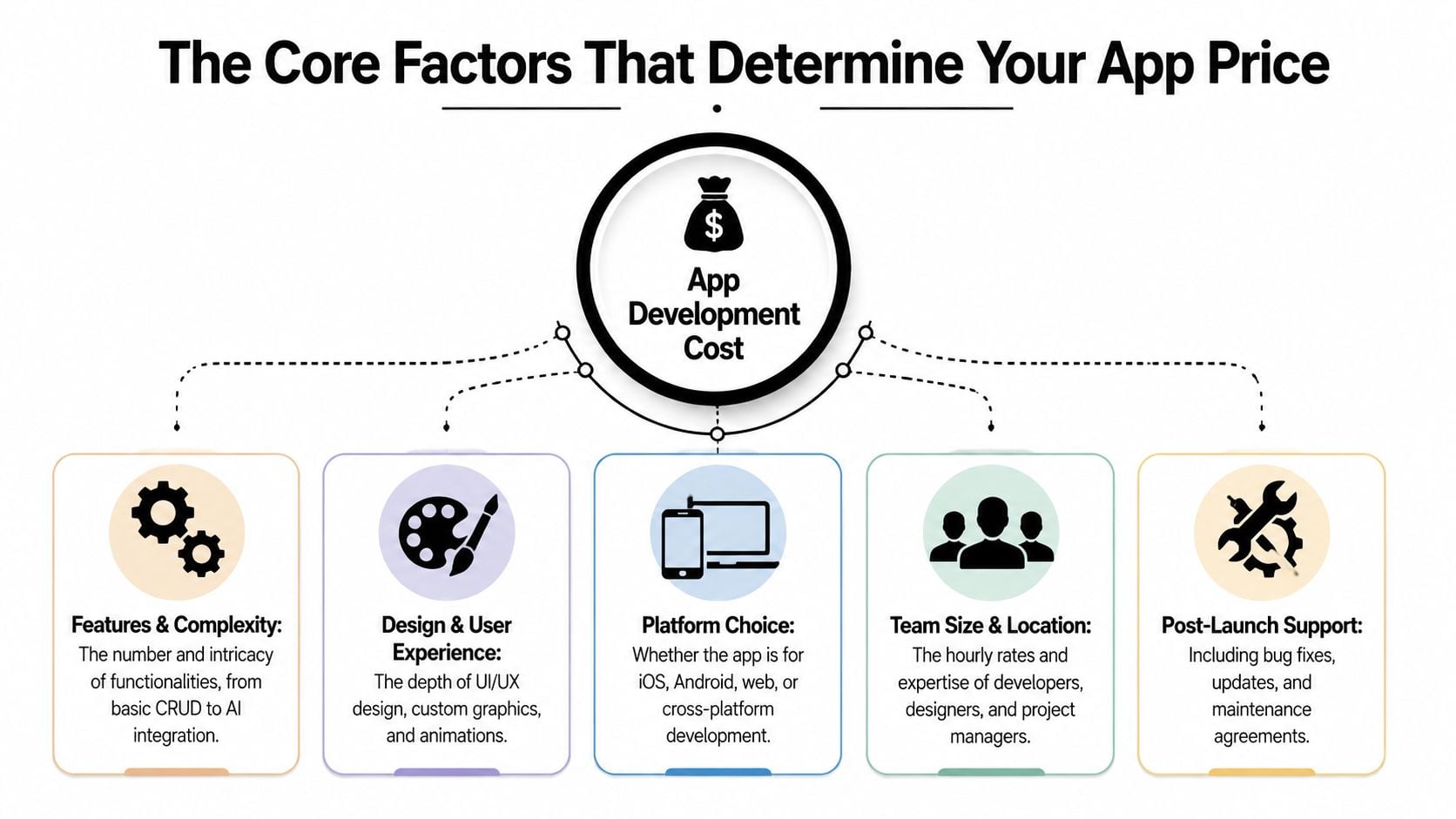
The biggest pricing mistakes happen after a confident first meeting, when everyone says “yes, that sounds straightforward” and only later realises the app needs approvals, edge-case handling, reporting, integrations, and support tools. The quote did not change because a developer got expensive overnight. It changed because the full product finally came into view.
That is why app cost is not one number. It is the combined price of product decisions, technical complexity, operational needs, and risk reduction.
Features define the build size
Features are usually the first thing clients talk about, but the actual cost sits in the detail behind each one. “User accounts” might mean basic email sign-up, or it might mean roles, permissions, approval flows, profile types, audit trails, and passwordless login. “Booking” might mean a simple calendar, or it might mean live availability, cancellations, refunds, reminders, and staff-side management.
The practical way to control cost is to split features into three groups:
- Launch-critical features: the few actions the product must deliver well from day one
- Business operations features: tools your team needs to run the service properly
- Post-launch growth features: ideas that should wait until usage data proves they matter
Total cost of ownership begins to play a significant role. Building too much too early does not only increase the initial quote. It also increases testing, support, content setup, onboarding, and future maintenance.
Platform choice affects more than build cost
A single-platform launch usually costs less upfront than supporting both iOS and Android from day one, but the cheaper route is not always the better commercial decision. The right choice depends on who the users are, how they discover the product, and what the app needs to do on the device.
Cross-platform can reduce duplicated effort in some cases. Native can make more sense when performance, device-specific behaviour, or long-term product plans justify it. A web app can work well for validation or internal tools. Each route changes the build process, QA effort, release management, and post-launch support burden.
Businesses comparing those options often start with UK mobile app development services for iOS, Android, and cross-platform products to understand the delivery trade-offs before asking for fixed numbers.
Design changes adoption, support load, and rework
Design cost is often underestimated because people picture screens, not decisions. In practice, UX work covers user flows, screen hierarchy, form logic, error handling, onboarding, accessibility, and the small interactions that stop people getting stuck.
I have seen businesses save money by trimming visual polish for phase one. I have also seen teams create expensive problems by rushing UX and then paying to rebuild journeys that users could not complete. Good design is not about making the app look expensive. It is about reducing friction, increasing completion rates, and avoiding avoidable rework.
If the app depends on trust, repeated use, or a fast first-time experience, design deserves proper budget.
Backend complexity is where many quotes drift
The front end gets attention because it is visible. The backend often decides the true build effort.
An app with simple content and user accounts is one thing. An app that manages bookings, payments, documents, permissions, notifications, reporting, admin controls, and business rules is a different class of product. The same applies when the system needs to stay reliable under load, keep records clean, or support internal teams with dashboards and workflows.
This is also where discovery quality has a direct cost impact. If backend rules are vague at quote stage, early estimates tend to be softer than clients expect. Once the logic is properly mapped, the number usually becomes more accurate, but not always lower.
Integrations, compliance, and internal process add hidden weight
Third-party integrations increase cost because your team is no longer building in a closed environment. Payment providers, CRMs, ERPs, booking platforms, maps, and internal databases all come with their own limitations, failure points, documentation quality, and testing demands. Even a “simple sync” can create a lot of technical and operational work.
Compliance adds another layer. If the app handles personal data, financial information, health data, or anything sensitive, the budget needs to cover secure architecture, permissions, auditability, testing, and release discipline. That work protects the business, but it also affects delivery time and cost.
The same goes for internal process. If your organisation needs multiple approvals, legal review, stakeholder sign-off, content migration, staff training, or support planning, those activities influence the total budget whether they appear in the original feature list or not.
Commercial goals change what the app really costs
Two apps with similar functionality can have very different budgets because they are built for different outcomes. An internal operations app, a funded startup MVP, and a public consumer launch do not need the same level of polish, analytics, scalability, or release preparation.
Many budgeting guides often stop too early. They focus on build cost and ignore the marketing cost multiplier. If the app needs paid acquisition, App Store optimisation, launch content, retention campaigns, or investor-facing traction targets, the product needs stronger onboarding, analytics, messaging, and iteration capacity from the start. That does not just affect marketing spend later. It can affect what should be built now.
The fairest way to price an app is to assess the whole ownership picture. Build, test, launch, support, improve, and market. That is the number clients live with.
Understanding Common App Development Pricing Models
Pricing model choice changes more than procurement. It affects how risk is shared, how changes are handled, and whether the final cost stays close to the first number on the proposal.
Most app projects come to market under two commercial structures. Time and Materials or Fixed-Cost. Both can work. The right one depends on how clear the scope is, how often priorities are likely to change, and how much budget certainty the business needs before work starts.
Time and Materials
Time and Materials means you pay for the team's actual time. It suits products that are still being shaped, where user feedback, stakeholder input, or technical findings are expected to change the plan as the build progresses.
I recommend this model when a client already has a product owner, makes decisions quickly, and accepts that learning during delivery is part of the investment. It is often the honest option for startups testing commercial assumptions or for businesses replacing messy internal processes in stages.
The risk is straightforward. If discovery is shallow, the estimate stays loose. If decisions drift, the budget drifts with them. That is not automatically a problem, but it needs active management, regular review, and clear reporting on what has been spent and what has been learned.
Fixed-Cost
Fixed-Cost pricing gives you a defined scope for a defined price. For SMEs, that usually makes internal approval easier because finance, leadership, and operations can assess the commitment before development begins.
But fixed-cost only works if the brief is specific enough to price properly. Weak discovery creates a predictable chain of problems. The agency adds contingency to protect itself, or leaves assumptions vague to keep the headline figure attractive. Later, those gaps show up as change requests, delays, or arguments about what was included.
That is why discovery quality matters so much to total cost of ownership. A cheap quote built on poor discovery often becomes an expensive build to manage.
| Pricing model | Best for | Main benefit | Main risk |
|---|---|---|---|
| Time and Materials | Evolving products with changing priorities | Flexibility | Budget can expand if scope is not controlled |
| Fixed-Cost | Well-defined projects with clear approval needs | Predictability | Scope disputes and variation costs if discovery is weak |
A fixed quote without proper discovery is only fixed on paper.
Which model works best for most SMEs
For many SMEs, the strongest setup is a paid discovery phase followed by a fixed-cost build for the agreed first release. That structure puts uncertainty where it belongs, at the start, before the larger spend is committed.
It also gives clients a better basis for comparing proposals. Two agencies can quote the same feature list and still be pricing very different levels of thinking, QA, release support, and post-launch responsibility. The number on page one is not the whole commercial picture.
Ask how changes are costed. Ask what happens if assumptions are wrong. Ask what support is included after launch, because handover and support planning often connect directly to broader website maintenance costs and ongoing support, especially when the app relies on admin panels, APIs, or linked web systems.
The best pricing model is the one that exposes risk early instead of hiding it in the quote. That is how you protect budget, timeline, and launch quality at the same time.
Realistic UK App Budgets and Timelines in 2026
A director approves a £35,000 app budget because the feature list looks manageable. Three months later, the quote still looks cheap, but the true cost has started to show up in delays, missing admin tools, extra integration work, and a launch plan that was never properly priced. That is why budget ranges only help if they reflect total ownership, not just the first build.
For UK businesses planning an app in 2026, the commercial reality usually falls into three bands. There is the first-release MVP, the production app for an established SME, and the larger platform with heavier technical and operational demands. The label matters less than the job the app needs to do, how much risk sits in discovery, and what has been left outside the initial quote.
Example App Budgets and Timelines UK 2026
| App Tier | Typical Cost Range | Development Timeline | Example Features |
|---|---|---|---|
| MVP | £20,000 to £60,000 | 2 to 4 months | User login, basic profiles, simple dashboard, one core journey, limited integrations |
| Medium-complexity business app | £40,000 to £100,000 | 4 to 6 months | Customer accounts, admin area, booking or ordering flow, notifications, several key integrations |
| Complex enterprise app | £60,000 to over £250,000 | 9 to 18+ months | Real-time data, advanced backend logic, multiple integrations, compliance-heavy workflows, scalable infrastructure |
These are working ranges, not promises. A well-scoped project at the lower end can stay efficient. A vague brief in the same category can drift upward fast, especially when the team is still making product decisions during build.
What actually sits inside each tier
An MVP should prove demand, test one strong user journey, and give the business enough control to operate the service. In practice, that often includes login, onboarding, a core action, light reporting, and some level of admin support. It rarely includes every nice-to-have feature raised in stakeholder meetings.
The middle tier is where many SMEs end up. This is the bracket for apps that need to work properly on day one, support real operational use, and connect with existing systems. Booking platforms, customer portals, member apps, and service management tools often sit here. If that sounds close to your project, these examples of mobile app development for small business are a useful benchmark for the level of product and planning involved.
Enterprise-level work costs more for reasons clients can usually feel once the project starts. More user roles. More data rules. More integrations. More approval steps. More testing across edge cases, devices, permissions, and failure states.
Why similar apps can have very different prices
Two apps can look similar in a pitch deck and carry very different delivery costs.
One has a clean brief, one decision-maker, one integration, and a realistic first-release scope. The other has partial requirements, multiple departments, uncertain user flows, legacy systems, and compliance checks still to be clarified. The second project is not just bigger. It carries more discovery quality risk, which usually shows up later as rework, change requests, and slower delivery.
The screens clients can see are only part of the cost. The expensive mistakes usually start earlier, in weak scoping, unclear workflows, and technical assumptions that were never tested.
That is also why timelines stretch. Design approval can take longer than expected. API access arrives late. Internal stakeholders change their minds. Testing surfaces cases nobody captured during discovery. A six-month plan can still be sensible, but only if the groundwork is sound.
Use budget bands carefully
Budget tables help with early planning, but they do not replace proper definition. I have seen founders under-budget by focusing on the visible app and ignoring the supporting pieces that make it usable in practice. Admin tools, reporting, analytics, content management, release preparation, and post-launch fixes are often where the total cost of ownership becomes clear.
A realistic budget is the one that includes those decisions up front. That protects cash flow, timeline, and launch quality far better than a low headline number ever will.
The Hidden Costs Beyond the Initial Quote
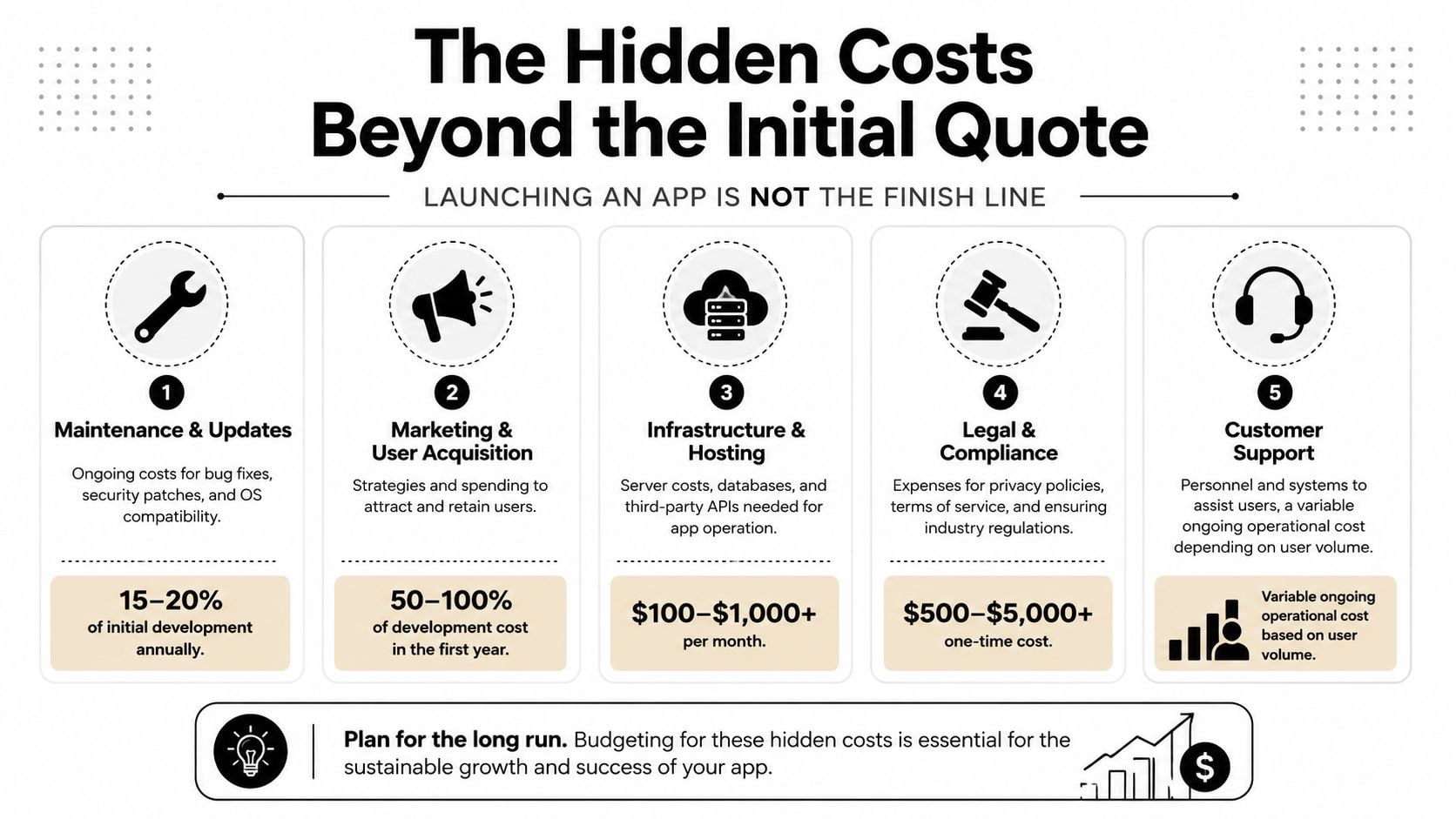
A quoted build price rarely matches the full cost of owning the app for the first 12 months.
I see the same pattern often. A business approves the build, gets through design and development, and assumes the hard budget decisions are finished. Then operating costs start showing up. Release management, support, updates, analytics, user acquisition, content changes, and second-phase improvements all need budget. If they were not planned early, they hit cash flow at exactly the point the business expected relief.
That gap usually starts before launch. If discovery was rushed, hidden costs appear later as rework, workaround features, extra testing, and longer internal approval cycles. A cheap quote can become an expensive project because the original definition was too weak to expose the actual scope.
Maintenance is an ownership cost
Apps do not stay finished for long. iOS and Android updates change behaviour. Third-party services deprecate endpoints. Security updates need applying. Live users find edge cases that never appeared in staging. As traffic grows, hosting, monitoring, and database usage usually grow with it.
For businesses already running websites and digital systems, the pattern is familiar. Mobile support follows the same logic as sensible website maintenance costs. You are paying to keep a live product stable, secure, and usable, not just to fix the occasional bug.
The practical question is not whether maintenance will be needed. It is whether you want to budget for it early or fund it reactively under pressure.
The marketing cost multiplier
This is one of the biggest planning misses in app projects, especially for first-time founders and SMEs. They budget for the build and assume launch creates traction by itself. It rarely does.
Appscrip's UK app pricing article notes that many cost guides ignore launch marketing altogether, even though customer-facing apps often need a material spend on acquisition and activation. That point matters because an app with low usage can look like a product problem when the underlying issue is simple. Not enough of the right users ever saw it.
For a customer-facing launch, budget usually extends into areas such as:
- Paid acquisition: Search, social, app install campaigns, local targeting, or partner promotions
- Conversion support: Landing pages, app store copy, screenshots, explainer content, and FAQs
- Onboarding and retention: Email setup, push notifications, CRM flows, and follow-up campaigns
- Measurement: Analytics configuration, event tracking, attribution, and reporting
A weak launch budget distorts decision-making. Teams judge the app before it has enough real usage to produce reliable feedback.
Operational costs surface fast
Some costs sit outside the build quote but still decide whether the app succeeds in day-to-day use.
- Customer support: Someone needs to answer login issues, refund queries, booking problems, and account requests
- Internal training: Staff need time and documentation to use the admin side properly
- Content operations: Product details, pricing, locations, offers, policies, and imagery all need upkeep
- Compliance and review work: Legal text, consent flows, accessibility fixes, and release checks often continue after launch
- Feature iteration: Real usage changes priorities. Version two is usually shaped by what users do, not what stakeholders predicted
These are not edge cases. They are standard ownership costs.
If your budget only covers design and development, you have funded production. You have not funded outcomes.
The businesses that control app spend best usually do one thing differently. They plan total cost of ownership from the start, including discovery quality risk, launch activity, and post-release operations. That approach produces a less flattering headline number, but it is far more reliable than approving a low quote and discovering the missing budget after the app goes live.
How to Get an Accurate App Development Quote
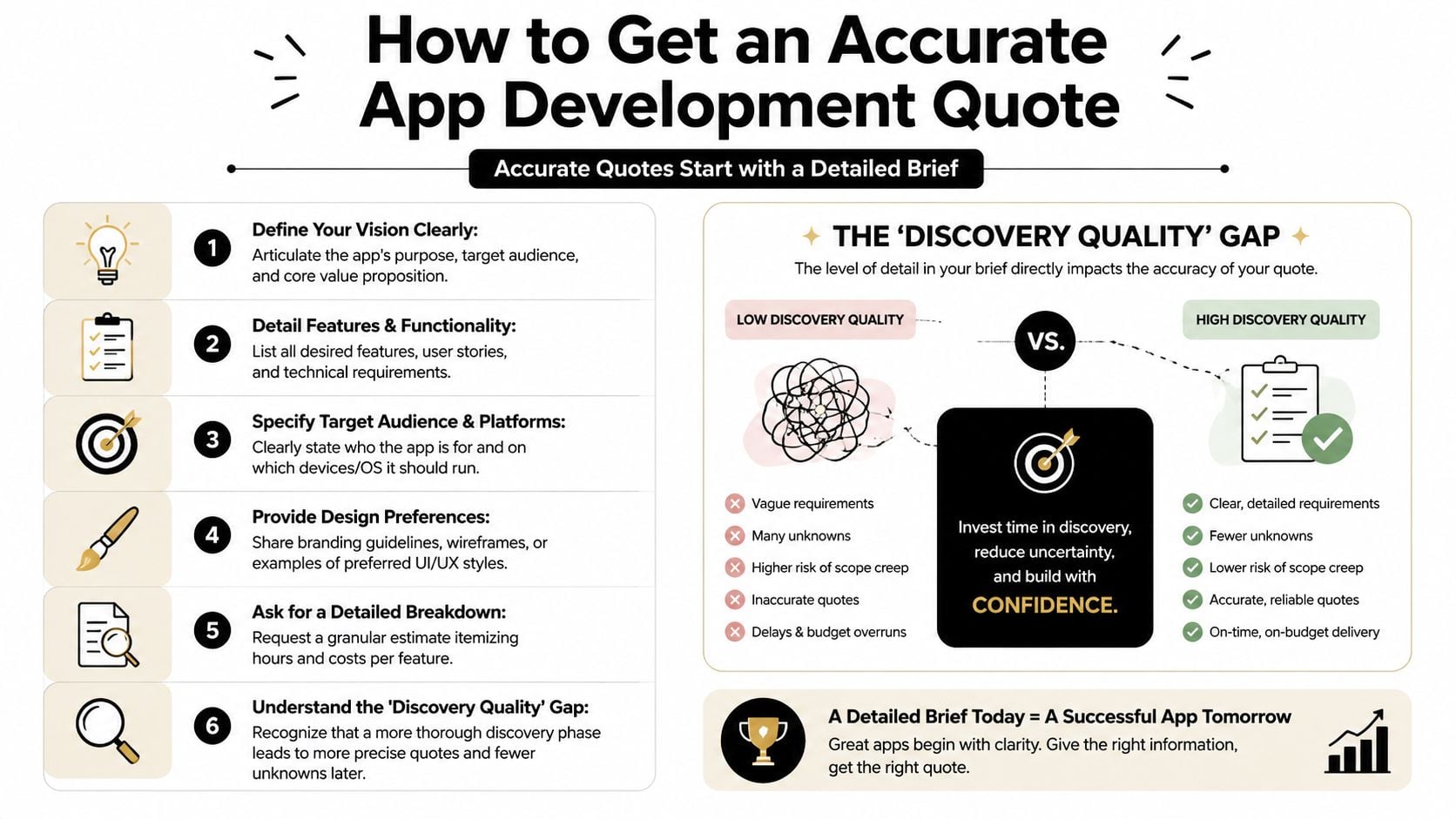
The easiest way to waste money on an app is to rush the brief. Businesses often worry that spending more time in discovery slows momentum. In practice, poor scoping is what creates the expensive delays, rework, and scope arguments later.
One of the strongest warnings on this comes from Red Eagle's analysis of UK app development cost, which states that projects with inadequate scoping and rushed discovery can run 40% or more over budget, adding £36,000 to £58,000 to a project initially estimated at £90,000 to £145,000. That's not a rounding error. That's the difference between a manageable project and a commercially painful one.
A serious quote starts with a serious brief.
What a useful brief actually includes
A strong brief doesn't need technical jargon. It needs decisions. The agency can help shape the technical route, but you need to define the business intent clearly.
Use this checklist before asking for proposals:
- Business purpose: What problem does the app solve, and for whom?
- Primary user groups: Customers, members, staff, drivers, patients, field teams, or mixed audiences.
- Core actions: What are the few tasks users must complete without friction?
- Must-haves and nice-to-haves: Separate launch-critical items from future enhancements.
- Existing systems: List payment tools, CRMs, booking software, stock systems, or internal platforms that may need to connect.
- Operational owner: Decide who internally signs off decisions and keeps the project moving.
If you want a practical starting point, a structured design brief template guide helps turn scattered ideas into something agencies can quote properly.
What to ask when reviewing a proposal
The best proposals don't just give a total. They show how the total was formed. You should be able to understand what's included, what assumptions have been made, and where changes would affect cost.
Ask for clarity on these points:
| Question | Why it matters |
|---|---|
| What exactly is in scope for version one? | Prevents assumptions turning into disputes |
| Which integrations are included? | Third-party work often expands quietly |
| What testing is covered? | Cheap quotes often underweight QA |
| What happens if requirements change? | This reveals real commercial risk |
| What support is available after launch? | Ownership continues after release |
This short video is a useful companion when you're preparing to request quotes and compare agencies.
Why discovery deserves budget
Some buyers still treat discovery as overhead. That's the wrong frame. Discovery is where weak assumptions are exposed while they're still cheap to fix.
Spend more effort before development starts. It's the cheapest point in the entire project to correct the wrong idea.
A precise quote is rarely the fastest quote to produce. It's the one backed by enough thinking to survive contact with reality.
Your Path to a Successful App Launch with DesignStack
Most app projects don't fail because the original idea was bad. They fail because the budget was framed too narrowly. The team priced the build, skipped the hard scoping work, underestimated post-launch support, or forgot that customer acquisition costs money too.
That's the central lesson in any honest conversation about app development cost. The build matters, but so do the decisions before it and the obligations after it. Discovery quality affects whether the quote holds. Maintenance affects whether the product stays usable. Marketing affects whether anyone adopts it.
For SMEs, the safest route is usually straightforward. Define the commercial goal, narrow the launch scope, insist on a detailed brief, and choose a pricing model that matches your tolerance for uncertainty. That won't make app development cheap, but it will make it manageable.
A good agency partnership should make the process calmer, not murkier. You should know what you're buying, why it costs what it costs, and what will be required once the app goes live. That's how sensible businesses protect budget and reduce nasty surprises.
If you're planning an app and want a clearer view of scope, budget, and the full cost of ownership, DesignStack can help you map it out with practical advice, fixed-cost thinking, and a discovery-led approach that keeps the project grounded in real business goals.