


Cross Platform App Development: A UK Business Guide
The most popular advice about cross platform app development is also the least useful: build once, launch twice, and the savings will take care of themselves. That can be true, but only when the product, team, and release plan suit a shared codebase.
UK businesses face a particularly practical decision. Android and iOS were close to parity in early 2026, with Android at about 50.1% and iOS at about 49.4%, according to UK StatCounter-based market reporting. Choosing one platform means leaving a substantial part of the potential audience unserved. Choosing cross-platform means accepting a different set of engineering and maintenance trade-offs.
The useful question isn't only, “How much will version one cost?” It's, “What will it take to keep both apps reliable, accessible, secure, and visually consistent over the next 12 to 24 months?” The answer depends on device testing, payments, biometrics, offline behaviour, backend integrations, platform updates, and the skills available to maintain the product after launch.
Table of Contents
- Why Cross Platform App Development Is Not Automatically Cheaper
- What Cross Platform App Development Actually Means
- Comparing the Main Cross Platform Frameworks
- Realistic Costs and Timelines for UK Projects
- When Cross Platform Makes Sense for UK Businesses
- A Dorset SME Scenario in Practice
- Checklist for Choosing an Approach or Hiring an Agency
Why Cross Platform App Development Is Not Automatically Cheaper
Cross platform app development can reduce duplicated build work, but it does not make a serious mobile product inexpensive by default. A shared codebase may cover business logic and much of the interface. App-store releases, device testing, permissions, operating-system changes, and platform-specific defects still need engineering time.
For a UK SME, the commercial case is clear. The UK app development industry was valued at £32.3 billion in 2026, with 15,282 businesses operating in the industry, according to UK app development industry data. This is a mainstream digital investment market. Many organisations need to serve customers on both major mobile ecosystems without financing two entirely separate native products.
The initial build invoice is only one part of the decision. Assess the cost of keeping both apps reliable, secure, accessible, and consistent over the next 12 to 24 months.
Where the initial saving appears
A cross-platform project can share:
- Core business logic, including account rules, product calculations, and booking workflows.
- API integration patterns, although each platform still requires thorough testing.
- Reusable interface components, where the design accounts for platform behaviour.
- Developer knowledge, especially when an existing web team already uses JavaScript or TypeScript.
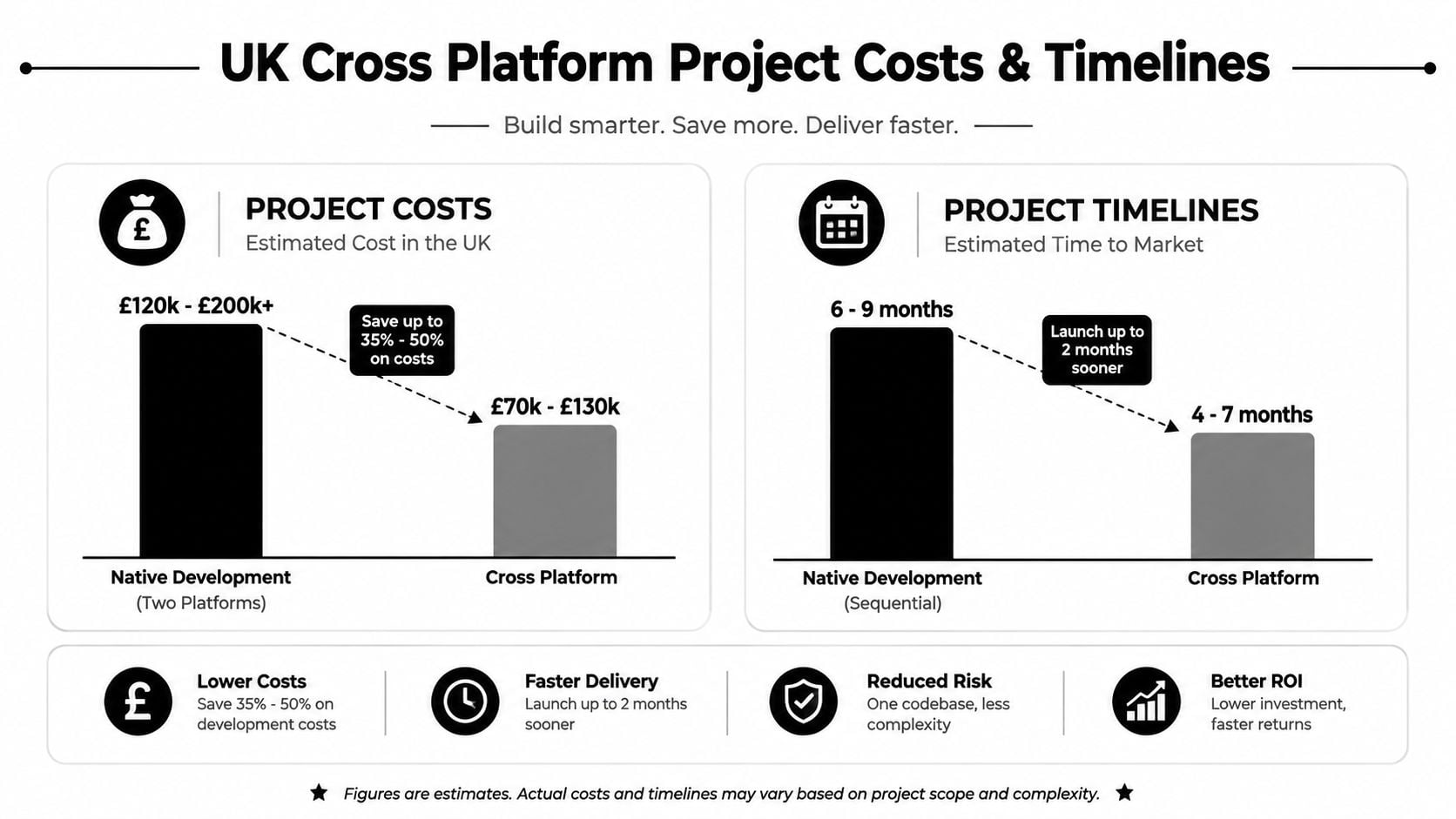
A UK cost analysis reports that Flutter, React Native, and .NET MAUI projects can deliver both platforms for around 60% to 75% of the cost of two native apps, with delivery potentially 30% to 50% faster in suitable cases (UK app development cost analysis). Treat those figures as a planning indication, not a promise. The result depends on the product scope, the framework team's experience, and the number of native integrations required.
Where the bill returns
Maintenance often exposes the difference between a convincing demo and a dependable product. A payment flow may work in a simulator but fail on particular devices. Biometric login can require native configuration. Push notifications, background processing, camera access, Bluetooth, offline storage, and accessibility testing may each require platform-specific code or troubleshooting.
Practical rule: Treat cross-platform as a way to share selected product work, not as a promise that every mobile task happens once.
Framework hiring also affects the total cost. A web developer may already understand parts of the shared stack, yet production support still demands knowledge of build pipelines, store requirements, native debugging, and framework upgrades. If that expertise is unavailable after launch, the agency handover becomes part of the ownership cost.
The UK market also operates across two stores by default. 58% of British mobile app publishers release on both Google Play and the Apple App Store, according to IBISWorld's UK app development industry data. The lower first invoice represents value only when shared architecture continues to reduce maintenance effort instead of creating a growing queue of platform-specific exceptions.
What Cross Platform App Development Actually Means
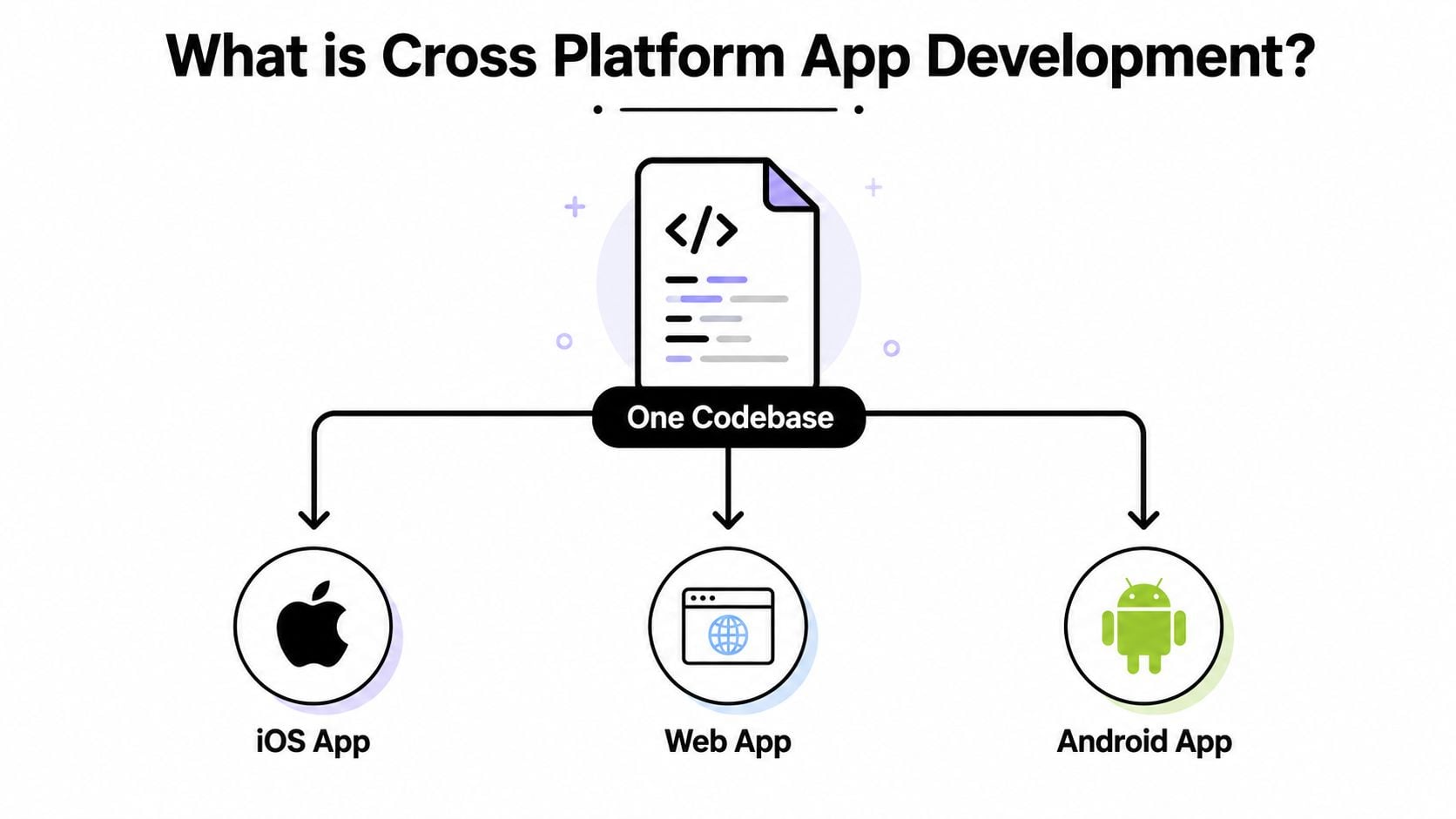
Think of a mobile product as a house with shared plans but two different building regulations. Cross platform app development lets a team create one main set of instructions for the product, then produce versions for iOS and Android. The shared instructions can cover navigation, data handling, validation, authentication logic, and much of the visual system.
That doesn't mean one identical file magically becomes two finished apps without intervention. Each output still needs platform configuration, store assets, permissions, signing, testing, and review. Some features can be shared cleanly, while others need a native module or a platform-specific adjustment.
The three-layer mental model
A useful way to assess a proposed architecture is to separate it into three layers.
The shared layer contains the parts most likely to benefit from code reuse. This may include API calls, state management, business rules, form validation, and a component library.
The platform layer connects the product to iOS and Android capabilities. Cameras, location services, secure storage, notifications, biometrics, and background tasks may use framework plugins, native libraries, or custom bridging.
The delivery layer covers the operational work around the code. Developers must configure certificates, manage store submissions, test release builds, monitor crashes, handle permissions, and respond to changes in Apple and Google policies.
This distinction matters because agencies sometimes describe a project as “one codebase” while leaving the platform and delivery layers vague. Ask which features are genuinely shared and which ones require Swift, Kotlin, Objective-C, Java, or native configuration.
Cross-platform, native, and hybrid
A native app is built specifically for one operating system, commonly with Swift for iOS or Kotlin for Android. Native development offers direct access to platform APIs and design conventions, but a business targeting both ecosystems maintains separate implementations.
A cross-platform app uses a framework such as React Native, Flutter, or .NET MAUI to target multiple operating systems from a shared project. The framework may render native controls, communicate with native components, or draw its own interface, depending on the technology.
A hybrid app usually places web content inside a native wrapper or WebView. That can be a sensible route for a web-first service, internal tool, or content-led product, but it isn't interchangeable with every cross-platform approach. The interface still needs mobile-first thinking, which is closely related to what user interface design involves.
The distinction gives business owners better questions to ask. Don't ask only whether a framework supports iOS and Android. Ask how it renders interfaces, how it handles new device features, where native code may be needed, and who will own those decisions after launch.
Comparing the Main Cross Platform Frameworks
Framework choice should follow the team and product, not a conference trend. A Dorset SME with an established React website has a different risk profile from a Microsoft-focused business with strong C# skills. A design-heavy consumer app also needs different compromises from an internal workflow tool.
UK market commentary reports that React Native is often the default choice for UK mobile projects because existing web teams can contribute with JavaScript and TypeScript. The same analysis associates Flutter with tighter design consistency across iOS and Android, making the decision partly about available talent and partly about the desired interface (cross-platform framework commentary).
| Framework | Best Suited For | Talent Pool in the UK | UI Control | Long-Term Maintenance Risk |
|---|---|---|---|---|
| React Native | Products supported by React or JavaScript teams | Broad where web development skills already exist | Strong, with platform-specific work when required | Plugin compatibility and native exceptions need active ownership |
| Flutter | Branded products needing a consistent visual system | Good, but Dart experience may need to be built or hired | High control through Flutter's rendering approach | Framework and package upgrades must be managed carefully |
| .NET MAUI | Businesses already invested in Microsoft and C# | Useful for teams with .NET capability | Good, with access to native platform features | Smaller specialist availability can affect recruitment and support |
| Progressive web apps | Services where browser access is more important than store presence | Often accessible to front-end web teams | Flexible web-based control | Browser, device, and offline limitations may restrict the experience |
React Native
React Native is often practical when a business already has a React website or a JavaScript-based delivery team. Developers can reuse familiar patterns, and the organisation may avoid creating a completely separate mobile skill set. That doesn't make every React Native project straightforward. Native modules, upgrades, performance-sensitive screens, and unusual device integrations still need experienced mobile engineering.
Flutter
Flutter suits products where the business wants close control over visual consistency. That can help a brand maintain a distinctive interface across both platforms, although the team must still respect platform expectations around navigation, gestures, permissions, and accessibility. A uniform design isn't automatically a good user experience if it ignores how iOS and Android users expect apps to behave.
.NET MAUI
.NET MAUI is a natural candidate for organisations with existing Microsoft systems, C# developers, and established .NET tooling. It can reduce the distance between a mobile project and a wider business platform. The commercial question is whether the internal team or chosen agency can support mobile-specific issues rather than treating MAUI as a desktop development exercise transferred to a phone.
Progressive web apps
A PWA may be the right answer when customers need quick access without an app-store installation, or when the product is mainly forms, content, account management, and service workflows. It becomes less suitable when the proposition relies on deep device integration, store discovery, dependable background behaviour, or a polished app-specific experience.
Before appointing a team, review its mobile app development services for UK businesses and ask for evidence of maintenance work, not only launch screenshots.
Realistic Costs and Timelines for UK Projects
Framework choice affects cost, but it does not determine it. A customer account area with a few straightforward screens is a different project from a marketplace involving payments, messaging, inventory, offline support, staff permissions, and third-party integrations. Scope, decision-making, and integration risk usually shape the estimate more than the framework name.
For UK SMEs, the useful comparison is total ownership over the first year or two. Cross-platform can reduce duplicated product work across iOS and Android, but those gains depend on the framework, the availability of developers who can support it, and how much platform-specific code the product needs. Industry comparisons commonly place cross-platform delivery within the earlier reported cost and timeline ranges (UK app development cost analysis). Treat those figures as planning context, not a quotation.
What a credible estimate should include
A useful proposal makes each workstream visible:
- Discovery and specification: Confirming user roles, journeys, integrations, data requirements, and release priorities.
- UX and interface design: Defining mobile flows, states, error handling, accessibility, and platform-aware components.
- Application development: Building the shared product layer and identifying areas that require native implementation.
- Backend and integrations: Connecting accounts, payments, stock, bookings, notifications, analytics, and administration tools.
- Quality assurance: Testing devices, network conditions, permissions, account states, store requirements, and regression scenarios.
- Launch preparation: Preparing store assets, privacy information, release builds, review responses, and production monitoring.
A screen-only quote leaves out the work that protects reliability. It may look cheaper at approval stage, then expand during integration, testing, or store submission.
Where savings disappear
Savings reduce when the product depends on unusual hardware, intensive animation, complex background processing, or operating-system-specific security. They also reduce when developers repeatedly override the framework to make iOS and Android behave differently.
Hiring affects the longer-term calculation. A familiar framework may be easier for a UK agency to staff, while a less common choice can create handover and maintenance risk. Testing also needs a defined device and operating-system policy, a defect reproduction process, and a plan for urgent releases.
Budget for dependency updates, store changes, crash monitoring, security fixes, support, and incremental improvements after launch. Use UK app development cost guidance to frame an early discussion, then require a feature-level scope showing assumptions, exclusions, risks, and expected maintenance work.
When Cross Platform Makes Sense for UK Businesses
Cross platform app development is usually a strong fit when the business needs broad reach, a controlled first release, and a product that can share most of its behaviour between iOS and Android. That often describes customer portals, booking services, retail accounts, membership products, delivery coordination, and internal field workflows.
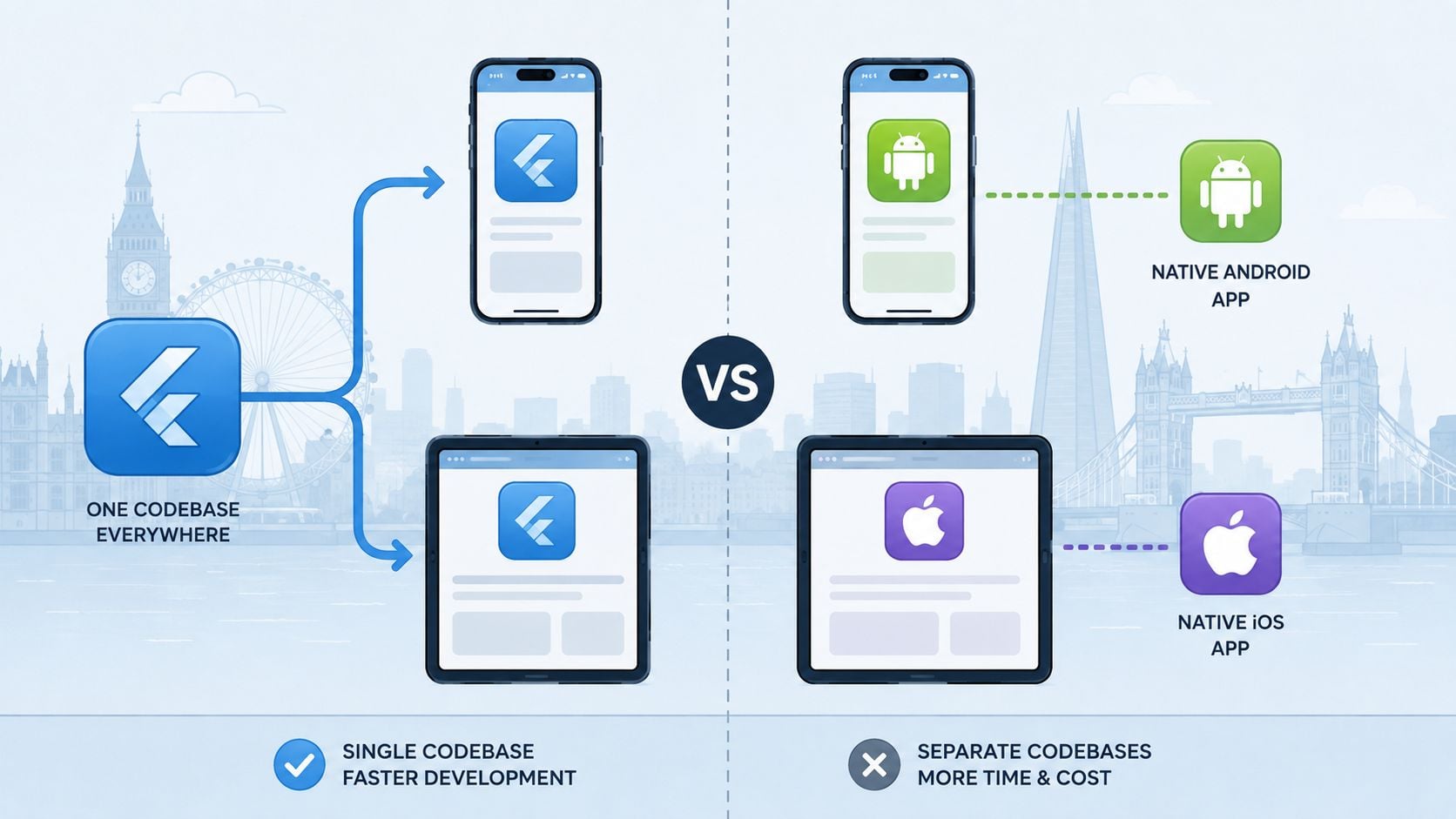
The UK's near-even platform split makes dual-platform access commercially important. A single-platform launch can create a strategic gap before the business has learned how customers use the product. Cross-platform delivery can help a smaller team reach both stores without staffing two fully separate product teams.
Four questions to ask before choosing
Can the first release share most of its behaviour? If both platforms need the same account, catalogue, booking, or content flows, a shared architecture is more likely to pay off. If each platform needs a completely different experience, the expected reuse falls.
Does the business need speed more than specialised performance? Cross-platform often supports rapid iteration, particularly when an existing web team can contribute. Native may be the safer option for demanding graphics, advanced on-device processing, deep operating-system integration, or unusually strict latency requirements.
Can the team support exceptions? A framework decision isn't complete until someone owns native modules, release configuration, dependency upgrades, and difficult device defects. An SME without that capability should account for agency support or specialist recruitment.
Will the product need both stores for the long term? If the answer is yes, compare maintenance effort across the full ownership period. If the product is mainly a browser-based service, a PWA may provide a simpler route.
The framework adoption trend shouldn't become a reason to copy another company's architecture. UK market commentary reports that React Native and Flutter account for an estimated 40% to 45% of new UK app projects in 2026, compared with 25% in 2022, while native spending remains dominant at 55% to 60% (UK smartphone applications market analysis). These figures point to a mixed market, not a universal winner.
For businesses building an internal team, it can help to browse mobile developer openings and compare the skills agencies and employers are seeking.
A short technical review can expose the answer quickly. Map the highest-risk features, test a small vertical slice on both platforms, and price the support model before committing to the full build.
The best choice is the architecture that keeps the product dependable after launch. A shared codebase is valuable, but only when it remains an advantage as features, devices, integrations, and user expectations change.
A Dorset SME Scenario in Practice
Consider a Dorset hospitality business with several venues, a loyal local customer base, and a website that already handles menus, contact enquiries, and basic bookings. The owner wants an app for reservations, loyalty rewards, notifications, and digital vouchers. The first instinct is to commission separate iOS and Android apps, but the budget won't support two large product teams.
A disciplined discovery process starts with the customer journey, not the framework. The business needs to know whether customers would use an installed app frequently, whether notifications offer real value, and whether the existing booking system has a reliable API. If the app repeats website content, a mobile-first website or PWA may deserve consideration before a store-based product.
Scoping the first release
The team might prioritise:
- Account access, with clear password recovery and secure session handling.
- Venue discovery, including opening details and location information.
- Booking requests, connected to the existing reservation process.
- Digital rewards, designed around a simple, testable rule set.
- Notifications, used only where customers have a clear reason to opt in.
The team should leave complex referral rules, advanced personalisation, and staff administration for later unless they directly support the launch objective. A cross-platform build can still become expensive if version one tries to reproduce every business process at once.
Testing the ownership case
The owner should ask who will maintain the app when Apple or Google changes a permission flow, when the booking provider changes its API, or when a customer reports a fault on a particular device. The answer needs to cover monitoring, store releases, support response, analytics, and small improvements, not just a warranty period.
A Dorset SME can use mobile app development for small businesses as a starting point for discussing scope and commercial fit. The important decision isn't whether the business can obtain two store listings quickly. It's whether the app will earn its place alongside the website and existing customer channels.
The representative business may choose cross-platform because its core workflows are shared and its audience uses both ecosystems. It may also choose to delay the app until customer research confirms demand. Both decisions are more responsible than approving a build because an agency promises a low initial cost.
Checklist for Choosing an Approach or Hiring an Agency
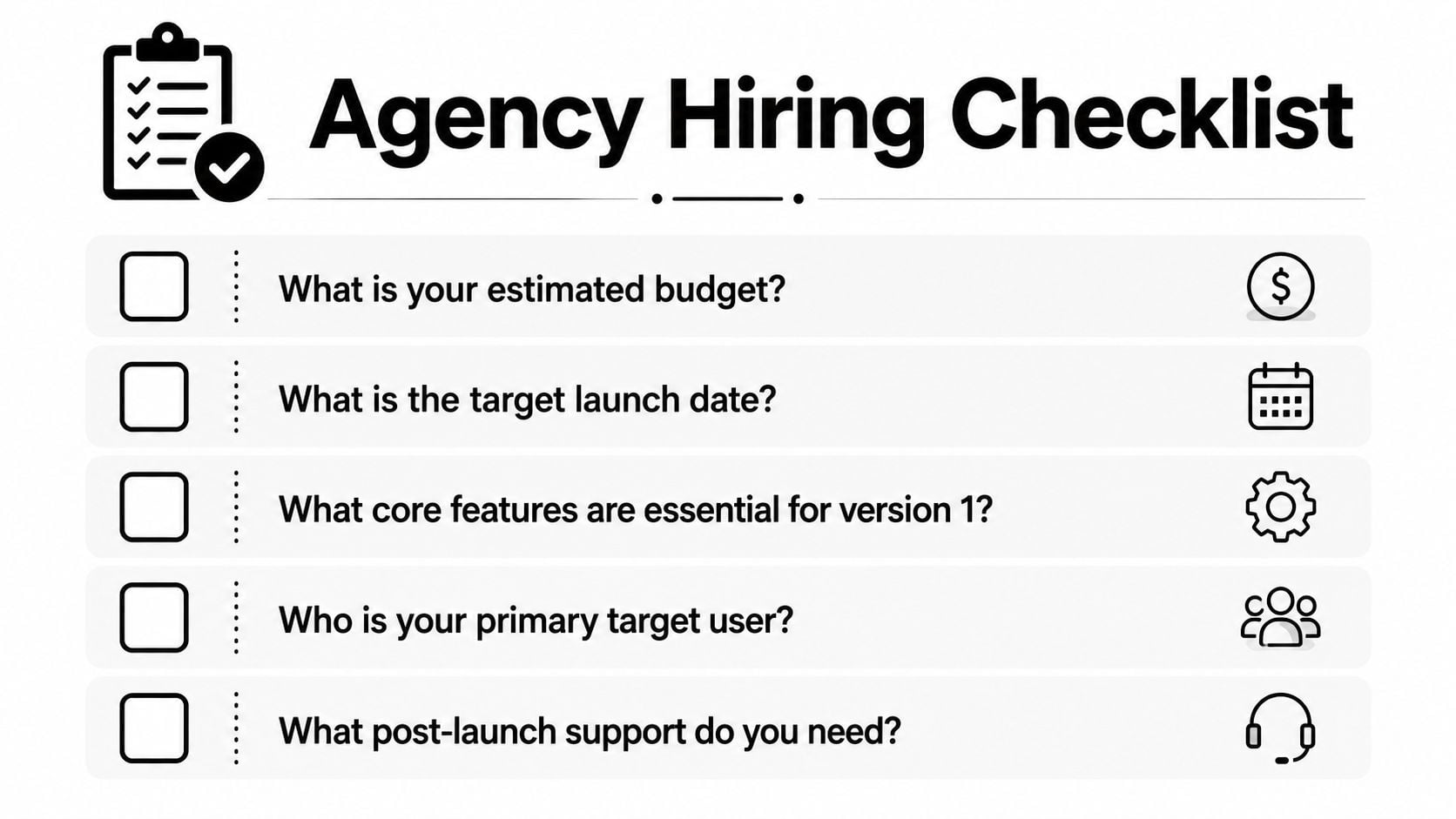
Treat the agency proposal as an engineering and ownership document, not a collection of attractive screens. A credible supplier should explain what will be shared, what may require native work, how testing will be performed, and what happens after the first store release.
Questions to resolve before signing
- What does version one need to achieve? Identify the smallest release that tests the commercial proposition. Separate essential journeys from attractive additions.
- Which features are shared? Ask for a feature-by-feature explanation of shared code, framework plugins, custom native modules, and platform-specific screens.
- How will the agency test the product? Confirm the device policy, accessibility approach, slow-network testing, payment testing, permission states, crash reporting, and regression process.
- Who owns the source code and accounts? Clarify repository access, app-store accounts, design files, backend credentials, documentation, and handover arrangements.
- What is included after launch? Request a written support model covering dependency updates, operating-system changes, store submissions, defect response, security fixes, and enhancement work.
Framework recruitment also deserves a practical review. If React Native is under consideration, this React Native hiring strategy for 2026 can help a business think about the capabilities required beyond basic JavaScript familiarity. A developer who can build screens isn't automatically equipped to diagnose native build failures, manage release pipelines, or make sound mobile architecture decisions.
Compare proposals on total ownership
Ask each agency to price the same scope and identify assumptions in the same format. Look for vague phrases such as “full testing”, “ongoing support”, or “native-like performance” unless the proposal defines what those terms mean.
Review the best app development company options with a focus on relevant experience, communication, documentation, and post-launch availability. DesignStack is one Dorset-based option that provides iOS and Android app development alongside web design, branding, WordPress, eCommerce, hosting, SEO, and content guidance.
The right partner won't insist on cross-platform because it's fashionable. They'll show how the proposed architecture fits the audience, the internal team, the feature risks, and the ownership budget.
DesignStack can help UK SMEs assess app requirements, compare cross-platform and native routes, and plan the supporting web, brand, and backend experience. Visit DesignStack to discuss a practical mobile product plan based on your users, launch priorities, and long-term maintenance needs.



Leave a Reply