


10 Ecommerce Website Builder Reviews for UK Businesses
You're a shop owner in Dorset with six browser tabs open, and each review names a different “best” ecommerce website builder. One praises ease of use, another focuses on design, and a third recommends a platform whose pricing looks attractive until you check payment fees, shipping rules and the cost of essential add-ons.
The disagreement doesn't necessarily mean one source is wrong. These sites test different things, publish on different schedules, use different affiliate models and vary widely in how much detail they provide about UK plans. The useful question is which lens each review applies, and whether that lens matches your store.
The list below assesses what each source does well, where it falls short for a UK small or medium-sized business, and what type of retailer it suits. It also separates two decisions that reviews often blur together: a hosted builder for a quicker, lower-maintenance launch, and agency-built WordPress ecommerce for deeper control over SEO, design, hosting and integrations. The right choice depends less on a headline ranking than on how much operational flexibility you need after launch.
Table of Contents
- 1. Website Builder Expert WBE
- 2. Expert Reviews UK
- 3. Forbes Advisor UK Software Reviews
- 4. TechRadar UK
- 5. Creative Bloq
- 6. Tom's Guide
- 7. Ecommerce-Platforms.com
- 8. Tech.co
- 9. EXPERTE.com Ecommerce Builders
- 10. Cybernews Website Builders
- Top 10 Ecommerce Builder Review Sites, Comparison
- Matching a Builder to Your Store and Next Steps
1. Website Builder Expert WBE
Website Builder Expert is one of the more useful starting points for a UK business owner who wants a structured shortlist rather than ten disconnected product pages. Its UK editorial voice, comparison tables and hands-on recommendations make the site approachable for someone choosing between hosted options such as Wix, Squarespace and Shopify.
The strongest feature is transparency around testing. WBE publishes methodology information, scoring rubrics and category weightings, which gives readers a better basis for judging why one builder outranks another. Its guides also tend to explain suitability in practical terms, such as whether a platform is better for a small catalogue, a visually led brand or a business expecting more advanced selling features.
Practical rule: Treat a ranking as a starting point, then test the top two platforms with your own products, delivery rules and payment requirements.
The limitation is scope. WBE is stronger on hosted builders than open-source systems, so it may not give a WordPress and WooCommerce project the same depth as a specialist agency or developer. Affiliate disclosures and promotional offers also mean you should separate editorial testing from discounts or branded recommendations.
For a Dorset retailer, pair its shortlist with a more technical comparison of WordPress, Squarespace and Wix. WBE suits owners who want a clear first pass and don't want to spend days learning ecommerce terminology before narrowing their options.

2. Expert Reviews UK
Expert Reviews takes a pragmatic consumer-technology approach that works well for smaller merchants who want specific answers. Its individual reviews of Wix, Squarespace, IONOS, GoDaddy and Square Online often discuss UK pricing, plan names and the practical differences between entry-level and commerce tiers.
That UK focus is valuable because a global review can leave you translating currencies, checking whether a payment method is available locally and working out whether a feature belongs to the plan you can buy. Expert Reviews is also useful when comparing inventory handling, product variants, point of sale and multichannel selling, rather than treating a store as a collection of templates.
Where its testing helps
The site combines roundups with deeper single-product reviews. That gives you two useful reading modes: a fast shortlist when you're still exploring, and a more detailed assessment when one platform is close to a decision. Its testing notes across website-builder coverage also help indicate whether an article reflects hands-on use rather than a rewritten feature list.
The weakness is freshness. Some individual pieces date from earlier years and may have been refreshed rather than fully retested, so check the publication and update dates before trusting details about plans, interfaces or integrations. The site also has less coverage of developer-led builds and open-source commerce stacks.
Expert Reviews suits a small retailer choosing a mainstream hosted platform. It's less useful if you already know you need WooCommerce, custom product logic, advanced content architecture or a migration plan from an established store.
3. Forbes Advisor UK Software Reviews
Forbes Advisor UK is helpful as a cost sanity check. Its software reviews generally frame platforms in business-owner language, with UK pricing, plan comparisons, pros and cons, and an explanation of who each product is best suited to.
That makes it a useful second opinion when a specialist review recommends a platform but you're unsure whether the pricing and plan structure make sense for a UK business. It can also clarify whether a feature sits inside the plan you need, rather than being available only through an upgrade or separate service.
What it does well
Forbes Advisor's tone is direct. A business owner can usually identify the main benefits, limitations and intended customer without navigating a highly technical assessment. The UK edition also reduces the risk of relying on a US-centric article that uses unfamiliar terminology or presents costs in a way that doesn't match your buying decision.
The trade-off is depth. Forbes Advisor UK has fewer ecommerce-specific roundups than specialist comparison sites, and individual reviews don't always provide the same detailed examination of catalogue management, fulfilment, checkout recovery or migration. Not every platform receives an equally thorough ecommerce-focused treatment.
Use it to validate UK plan names, broad costs and suitability, not as your only source for a store that depends on complex shipping, marketplace synchronisation or custom SEO work. It's a good fit for an owner comparing familiar hosted builders and looking for a straightforward explanation before opening trials.
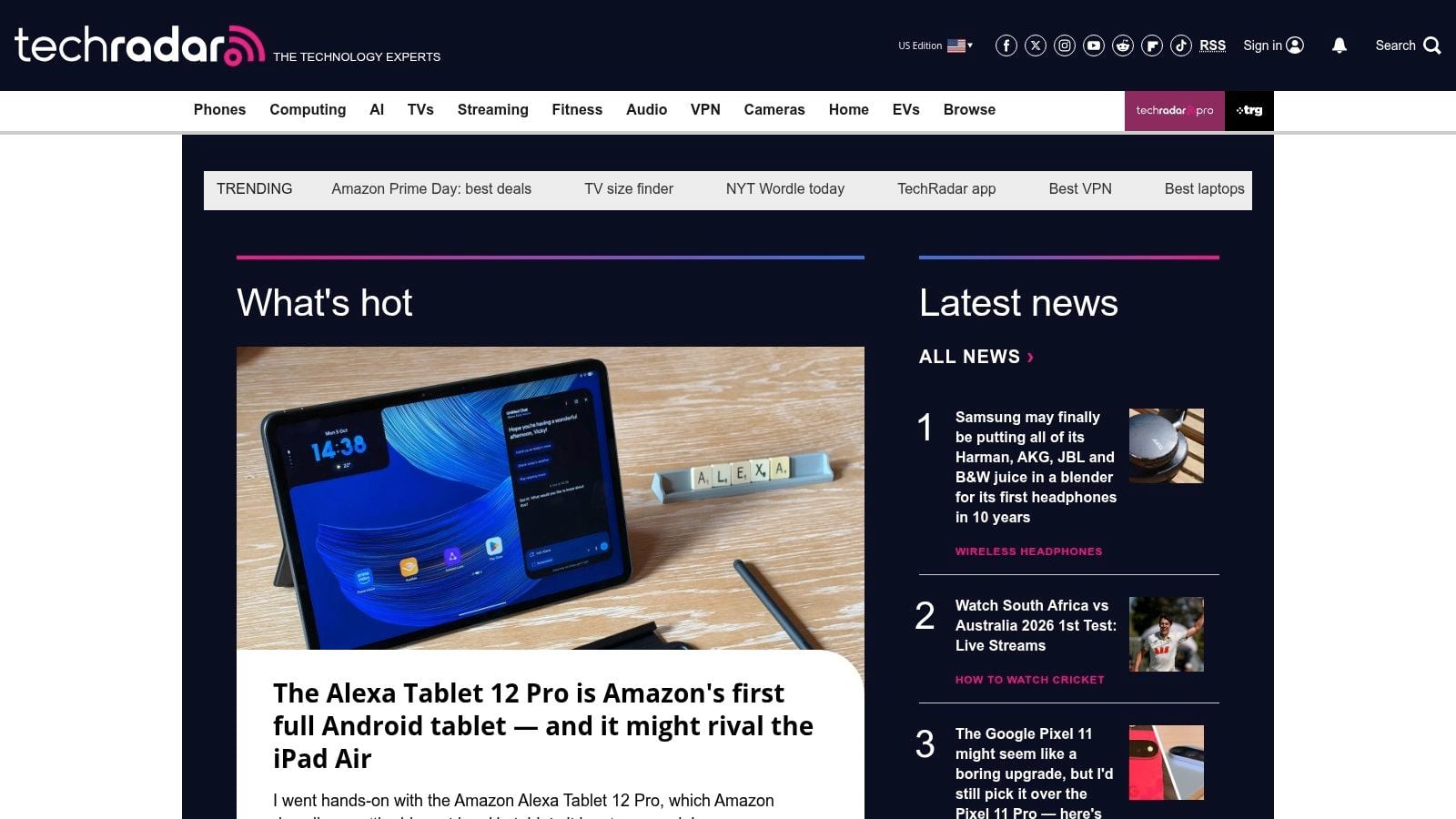
4. TechRadar UK
TechRadar offers broad market coverage and tends to explain trade-offs clearly. Its ecommerce roundups, individual builder reviews and FAQs often distinguish between an all-in-one hosted platform and a WordPress-based system that relies on plugins, hosting and more hands-on management.
That distinction matters because the cheapest monthly plan isn't necessarily the cheapest way to run a store. A hosted product usually bundles hosting, security maintenance and platform updates. WordPress gives you greater control, but someone must manage the hosting environment, backups, updates, plugin compatibility and technical fixes.
TechRadar's “why you can trust” notes and testing explanations give readers useful context, while its strengths and limitations sections make it easy to identify whether a platform suits a small business or a larger operation. Pricing overviews are also useful for an initial comparison, although you should verify current UK prices directly with the provider.
A review that praises flexibility may be describing developer freedom, not less work for the owner.
Some articles mix general website builders with pure ecommerce tools. That can confuse a service business looking for a simple site with a retailer that needs stock, payments and fulfilment. Pages can also feel busy because of advertising and affiliate links.
Use TechRadar for broad orientation, then compare the likely build route with a practical guide to ecommerce website design cost. It suits owners who want to understand the market before deciding whether hosted convenience or WordPress flexibility better matches their plans.
5. Creative Bloq
Creative Bloq approaches website-builder reviews from a design and brand perspective. That's valuable for a maker, studio, fashion label, food brand or independent retailer whose storefront needs to communicate quality before a customer reads the product description.
The publication is particularly good at judging visual polish, template quality, content presentation and the relationship between branding and commerce. It can help you spot when a platform gives a strong creative starting point, and when an attractive template hides limited selling functionality.
Where the design-first view helps
A brand-led shop needs more than a payment button. Product photography, editorial content, campaign pages, typography and mobile presentation all affect how customers understand the offer. Creative Bloq gives those considerations more attention than a purely technical platform comparison.
Its small-business and creator recommendations are also useful for identifying a sensible first platform. A new retailer may not need enterprise functionality on day one, but it does need a site that supports strong imagery, clear product storytelling and a coherent brand system.
The limitation is operational depth. Enterprise catalogue structures, advanced fulfilment, complex tax requirements and large-scale integrations receive less attention because the publication isn't a pure ecommerce specialist. Affiliate-supported content and design-led crossover can also make a visually impressive option seem more suitable than it is for a demanding retail workflow.
Creative Bloq is best used alongside a checkout and delivery review. Ask whether the platform supports your actual product variants, stock rules, delivery messages, returns process and payment providers. It's a strong lens for visual brands, but it shouldn't decide the whole purchase on design alone.
6. Tom's Guide
Tom's Guide is built for readers who want to make a decision quickly. Its head-to-head comparisons, including Wix versus Shopify-style matchups, reduce complicated platform differences into plain-English choices for non-technical business owners.
That makes it useful when you're already comparing two familiar products. A clear side-by-side article can expose the practical difference between a platform that prioritises ease of use and one that offers stronger ecommerce depth, without requiring you to understand every technical term first.
Useful for a first shortlist
The step-by-step setup content is another strength. It shows the journey from choosing a template to adding products and configuring a basic store, which helps an owner estimate how much work they can realistically do themselves. Many articles also include UK-relevant pricing guidance, although the current provider page should always be the final check.
The weakness is depth. Some reviews may be older pieces that have been refreshed rather than completely retested, and niche or advanced features get less attention than the main purchase path. You may not find enough detail about stock synchronisation, specific UK delivery integrations, exportability, server access or complex SEO requirements.
Use Tom's Guide when you need to narrow a broad list to two or three options. Then inspect the checkout on mobile, request a demonstration using your catalogue and confirm how the platform handles payment failure, delivery choices and returns. It's a good decision aid for a time-pressed owner, but it shouldn't replace platform testing.
7. Ecommerce-Platforms.com
Ecommerce-Platforms.com offers one of the most ecommerce-focused lenses in this list. Its platform-by-platform reviews, screenshots, roundups and niche guides are aimed at people who are choosing, expanding or migrating a store rather than just publishing a business website.
That focus produces useful detail around product management, selling channels, app ecosystems and platform capabilities. The wider library also helps when your business has a more specific requirement, such as print-on-demand, marketplace selling or an AI-assisted store-building workflow.
The specialist advantage
A specialist site is more likely to ask whether a platform can support an operating business, not just create a polished homepage. That makes Ecommerce-Platforms.com useful for comparing Shopify, WooCommerce and other systems through the lens of catalogue management, checkout and growth.
Its main drawback is commercial tone. Affiliate-supported content can make recommendations feel more sales-oriented, and depth varies by article and author. Pricing and feature details can also change quickly, so confirm plan inclusions, transaction charges, app costs and UK payment coverage before committing.
For a smaller retailer, the most useful exercise is to convert a review into a requirements list. Note which functions are native, which need an app and which require custom development. Then compare the resulting total with a practical guide to the best ecommerce platform for a small business.
This source suits owners who are thinking beyond launch day. It's less necessary for a simple brochure site with occasional sales, but valuable when inventory, channels, fulfilment or migration may become significant.
8. Tech.co
Tech.co is designed to accelerate shortlisting. Its comparison pages use clear scoring criteria, “best for” labels and side-by-side summaries, so a business owner can quickly identify which builders appear relevant before spending time on full reviews.
The site covers the major hosted platforms well. Its matrix-style format is particularly useful if your initial decision is between products with similar positioning, such as a simple all-in-one builder and a more commerce-heavy platform.
Fast answers, thinner context
Tech.co's strength is digestibility. You can quickly compare broad capabilities, pricing presentation and intended use cases without reading a long technical article. Recent updates also make it useful for a current first pass, provided you still verify the details with the provider.
The limitation is methodology detail. Research-based scoring may explain the criteria without showing every implementation test in enough depth for a technical procurement decision. UK-specific payments and shipping nuances receive less emphasis, which matters if your business depends on Royal Mail, courier rules, click-and-collect, delivery exceptions or local payment preferences.
Treat the scores as triage, not proof. Open the live demos, check whether your preferred payment methods are supported, and model the cost of apps, transaction charges and fulfilment tools. A platform can rank well in a general comparison while still being awkward for your delivery model.
Tech.co suits an owner who needs a fast shortlist and has relatively standard requirements. It's less suitable as the final authority for a retailer with unusual products, multi-location stock or a carefully controlled WordPress SEO setup.
9. EXPERTE.com Ecommerce Builders
EXPERTE.com provides a tidy comparative view of ecommerce builders, with unified scoring, clear tables and plain-English “best for” conclusions. That consistency makes it easy to compare several platforms using the same general framework rather than jumping between review styles.
The site is useful at exposing limitations as well as strengths. A short recommendation that says a tool is suitable for beginners but weaker for advanced customisation can be more useful than a long feature list that treats every capability as an advantage.
The UK gap
The global focus is also the central limitation for a UK buyer. Pricing, shipping assumptions, tax settings and payment availability may not map neatly to your business. A feature marked as available still needs checking against the UK plan, local payment providers and the shipping services you intend to use.
Affiliate links are another reason to read the evaluation critically. They don't automatically invalidate the content, but they reinforce the need to verify recommendations independently and compare the total cost of ownership rather than the advertised subscription.
EXPERTE.com is excellent for a broad first shortlist. It's less dependable as the final source for UK operational decisions, especially if delivery options, returns, VAT messaging or marketplace stock accuracy are central to your store. Use its comparisons to identify candidates, then test those candidates against your own checkout and fulfilment process.
10. Cybernews Website Builders
Cybernews brings a security-aware, technology-focused view to ecommerce website builder reviews. Its concise roundup uses recent updates, use-case labels and quick pros and cons, making several platforms easy to compare at the shortlist stage.
Its coverage of AI-assisted builders helps business owners judge whether newer tools could reduce the work involved in initial setup. Security receives useful attention too. An ecommerce store handles customer accounts, orders and payments, so platform maintenance, provider responsibilities and integration quality affect risk even when you do not manage the server.
What remains unanswered
Cybernews offers less UK-specific pricing detail than a dedicated UK publication. Its methodology is also explained less fully than WBE's or TechRadar's, leaving uncertainty about how thoroughly each builder was tested and whether checkout was assessed with UK delivery and payment scenarios.
Cybernews rounds up pros and cons quickly, so treat its recommendations as candidates. Verify plan inclusions, transaction charges, UK payment coverage, shipping integrations, data export and SEO controls directly with each provider before committing. Security claims need the same practical check: hosted protection does not remove the need to review third-party apps, administrator access or staff processes.
It works well as a current check on platform trends and security considerations, rather than as your only buying guide. For a UK retailer, pair it with our guide to the best website builder for ecommerce in the UK, which examines local pricing and fulfilment, then test the complete store rather than judging the homepage alone.
Top 10 Ecommerce Builder Review Sites, Comparison
| Source | Core Focus & Features | Quality / Trust ★ | Value & Pricing 💰 | Target Audience 👥 | Unique Selling Point ✨🏆 |
|---|---|---|---|---|---|
| Website Builder Expert (WBE) | UK test-led roundups, published methodology, side-by-side tables | ★★★★★ | 💰 Free guides; transparent testing; affiliate links | 👥 Small UK businesses choosing builders | ✨ Detailed "how we test" + comparison tables 🏆 |
| Expert Reviews (UK) | Individual builder reviews, UK pricing & plans, hands‑on checks | ★★★★ | 💰 Free guides; explicit UK pricing; some older pieces | 👥 UK merchants needing practical guidance | ✨ Clear UK pricing + POS/ecommerce focus 🏆 |
| Forbes Advisor UK (Software Reviews) | Business-oriented reviews with plan comparisons and "best for" notes | ★★★★ | 💰 Free; useful cost/plan validation for UK buyers | 👥 Business owners sanity‑checking costs | ✨ Straightforward "who it's best for" clarity 🏆 |
| TechRadar (UK) | Expert-tested roundups across builders, tools, and trade-off analysis | ★★★★★ | 💰 Free; frequently updated; ad/affiliate supported | 👥 SMBs & tech-savvy buyers | ✨ Balanced market view & trade-off explanations 🏆 |
| Creative Bloq | Design-first buyer guides assessing visual & ecommerce suitability | ★★★★ | 💰 Free; design-led recommendations; affiliate links | 👥 Creatives, brands & visual-first stores | ✨ Design-focused evaluations for brand-led commerce 🏆 |
| Tom's Guide | Practical head-to-heads and quick lists with setup how-tos | ★★★★ | 💰 Free; quick shortlist + deeper dives | 👥 Time‑pressed, non‑technical SMEs | ✨ Plain‑English comparisons & step-by-step guides 🏆 |
| Ecommerce-Platforms.com | Ecommerce-only deep dives, migration & niche guides | ★★★★★ | 💰 Free; extensive platform coverage; affiliate links | 👥 Store owners and scaling merchants | ✨ Niche ecommerce depth & migration resources 🏆 |
| Tech.co | Matrix-style scoring, weighted criteria and "best for X" labelling | ★★★★ | 💰 Free; research-backed shortlists; affiliate content | 👥 Buyers needing fast shortlisting | ✨ Clear scoring framework + "best for" labels 🏆 |
| EXPERTE.com (Ecommerce Builders) | Hands-on testing across many builders with unified scoring | ★★★★ | 💰 Free; broad, global comparisons; affiliate links | 👥 Buyers seeking concise comparisons | ✨ Wide coverage with tidy "best for" picks 🏆 |
| Cybernews: Website Builders | Security-aware roundups, AI tooling coverage, recent updates | ★★★★ | 💰 Free; concise pros/cons; less UK pricing detail | 👥 SMBs focused on security & performance | ✨ Security + AI tooling emphasis in reviews 🏆 |
Matching a Builder to Your Store and Next Steps
The best platform depends on the work you want to own. A hosted builder suits an owner who wants to launch quickly, keep technical maintenance to a minimum and manage products through one supported dashboard. Shopify, Wix, Squarespace, Square Online and similar systems can reduce the need to arrange hosting, security updates and platform maintenance separately.
That convenience has a trade-off. You work within the provider's checkout, URL structure, template system and integration ecosystem. Monthly plans may look simple, but the actual cost can include payment charges, premium themes, apps, email tools, fulfilment connections and upgrades needed as the store becomes more demanding.
Agency-built WordPress ecommerce takes the opposite approach. A WordPress and WooCommerce build can provide deeper control over page structure, structured data, SEO fields, content architecture, design and integrations. It can also support a more personalised customer journey when an off-the-shelf builder forces your products or fulfilment process into a generic pattern.
You're also taking on more responsibility, directly or through an agency. Hosting, backups, updates, plugin compatibility, security, performance and technical support need a clear owner. The right agency should explain those responsibilities and provide transparent pricing rather than presenting WordPress as a maintenance-free alternative.
UK demand makes this distinction practical, not theoretical. Online sales represented 27.8% of all retail sales in Great Britain in June 2025, compared with 27.4% in May, while online spending rose 2.3% month on month and 4.5% compared with June 2024, according to the Office for National Statistics. Your store needs to keep working when demand changes, not just look good during a launch promotion.
Before committing, check:
- UK pricing: Confirm the current plan, renewal cost, VAT treatment, transaction fees, app charges and whether the displayed price assumes annual billing.
- Payments: Test cards, PayPal, wallets and payment-failure recovery. Don't assume “card payments supported” covers the methods your customers expect.
- Shipping: Confirm Royal Mail or courier integrations, local collection, delivery-rate rules, estimated arrival messaging and international duties or VAT handling.
- Returns: Check whether the platform can display returns information clearly, connect to a returns portal and keep the process usable on mobile.
- SEO and migration: Verify editable titles, descriptions, canonicals, redirects, structured data, robots controls, export options and what happens if you leave.
- Performance: Test a representative product page, category page, cart and checkout on a real mobile connection. The SQLI benchmark report found that only 14 of 672 UK retail websites, approximately 2.1%, achieved a good Google mobile performance score, while the median score was 42 out of 100. Treat template quality, script control and image handling as buying criteria.
- Review freshness: Check every review's publication and update date. A platform interface, plan or payment integration can change without the headline ranking changing with it.
DesignStack, a Weymouth-based agency, is one option when a custom build makes more sense than a hosted template. The studio builds WordPress ecommerce sites with fixed-cost pricing, three design revisions and one month of post-launch updates, and provides hosting for web applications. If you need WordPress themes for online stores, the important decision is still the wider system around the theme, including content structure, checkout, hosting, support and long-term SEO control.
Start by writing down your catalogue, delivery rules, payment methods, integrations and content priorities. Use the review sources to create a shortlist, but make the final decision from a controlled test of your own store workflow and the full cost of keeping it reliable.
DesignStack builds responsive WordPress ecommerce sites, supports SEO and content planning, and provides fixed-cost projects with three design revisions, hosting for web applications and one month of post-launch updates. If hosted builders leave you short on design or SEO control, visit DesignStack to discuss a custom ecommerce build for your business.


Leave a Reply