


How Much to Charge for Website Redesign
You've got a redesign enquiry in your inbox. The client says the site feels dated, mentions “around ten pages”, and asks for a fixed price by Friday. The temptation is obvious: count the pages, multiply by a familiar figure, and send the quote.
That approach is how profitable projects become exhausting ones.
A website redesign isn't priced by the number of screens someone can list in an email. It's priced by the decisions, risk, technical work and commercial importance hidden behind those screens. A five-page ecommerce site with a fragile checkout, poor mobile experience and a messy URL structure can demand more work than a fifteen-page brochure site on a stable CMS.
If you're deciding how much to charge for website redesign, start with scope and risk. Then use day-rate maths to test whether the fixed fee protects your margin. The client should receive a clear price, but you should arrive at it through disciplined estimating rather than guesswork.
Table of Contents
- Why Page Count Is the Wrong Place to Start
- Classifying the Redesign and Estimating Effort
- Choosing the Right Pricing Model
- Hidden Cost Drivers That Change the Quote
- Building a Proposal That Survives the Client
- Negotiating Without Undercutting Yourself
- Your Redesign Pricing Checklist
Why Page Count Is the Wrong Place to Start
Page count is a useful inventory measure. It isn't a pricing model.
A page count tells you how many URLs or templates exist. It doesn't tell you whether the homepage is a reusable layout or a bespoke landing page, whether the client has supplied usable copy, whether the site connects to a CRM, or whether the redesign must preserve years of organic search equity.
That distinction matters because a redesign often includes work the client can't see. You may need to map old URLs, create redirects, rebuild forms, test keyboard navigation, configure analytics, migrate structured content, check mobile layouts and train the client's team. None of that becomes easier because the website has fewer pages.
My pricing rule: charge for the business and technical risk you're taking on, not for the number of rectangles appearing in the sitemap.
A five-page site may justify a substantial fee when it generates high-value enquiries, handles bookings, supports a membership process or sells products. Conversely, a larger brochure site may need little more than a controlled visual refresh if the CMS, content structure and customer journey are already sound.
Before quoting, inspect the existing information architecture. Your information architecture guide is useful when the client describes the project in visual terms but the core problem sits in navigation, content grouping or user journeys.
The UK pricing bands I use
The following market bands are practical starting points, not universal tariffs:
- Visual refresh, £1,500 to £5,000: Existing platform, sound structure, limited template changes and no major migration.
- Small-business redesign, £3,000 to £8,000: New responsive templates, clearer UX, content adjustments and a controlled WordPress implementation.
- Professional or mid-market redesign, £8,000 to £20,000: Multiple templates, content strategy, integrations, stronger SEO work and more involved stakeholder management.
- eCommerce redesign, £10,000 to £40,000: Product presentation, filters, cart and checkout journeys, payment flows, analytics and extensive device testing.
- Enterprise work, £20,000 to £80,000 or more: Bespoke architecture, multiple systems, complex governance, large content estates and substantial launch risk.
These bands align with the scope-weighted UK benchmark ranges provided in the website redesign estimation guide. They shouldn't replace an estimate. They should stop you from treating a revenue-critical rebuild as graphic artwork.
The commercial context supports that caution. Internet sales represented 26.9% of Great Britain's total retail sales in July 2024 and 27.0% in September 2024, while online spending increased 6.7% year on year in September 2024, according to Office for National Statistics retail data. For a retailer, the redesign affects a meaningful part of the sales environment. Price the work accordingly.
Classifying the Redesign and Estimating Effort
Start every enquiry by placing the project in a tier. Then break that tier into workstreams. This gives you a fast commercial view and a technical estimate you can defend when the client asks why the fee isn't just "pages multiplied by price".
| Tier | Example project | Effort (days) | Indicative fee |
|---|---|---|---|
| Visual refresh | Existing CMS, limited templates, restrained layout changes | 5 to 12 | £1,500 to £5,000 |
| Small-business redesign | Brochure site with responsive templates and standard forms | 10 to 20 | £3,000 to £8,000 |
| Professional or mid-market redesign | Multiple templates, content strategy and integrations | 18 to 36 | £8,000 to £20,000 |
| eCommerce redesign | Product templates, shopping journey, checkout and analytics | 25 to 60 | £10,000 to £40,000 |
| Enterprise project | Bespoke systems, complex migration and multiple stakeholders | 50+ | £20,000 to £80,000+ |
The fee bands in the table are marketplace benchmarks, not government statistics. Treat them as a sense check. Your actual quote should come from effort, rate and risk.
Build the estimate by workstream
For a typical redesign, estimate discovery and requirements at 2 to 4 days, UX and visual design at 4 to 8 days, WordPress development at 6 to 15 days, content and SEO migration at 2 to 6 days, and testing and launch at 2 to 4 days. Add project management at 15% to 20% of delivery time, using the effort guidance in the IPSE UK freelancer day-rate survey.
That produces an illustrative 18 to 36-day project. At a UK day-rate range of £350 to £700, the result is approximately £6,300 to £25,200 before contingency, based on the same IPSE reference. The lower end suits a controlled brochure-site rebuild. The upper end reflects bespoke templates, ecommerce, integrations or migration uncertainty.
Write your design brief before you finalise the estimate. It should identify the goal, audiences, templates, content types, platform, integrations, approval process and launch constraints.
Convert the estimate into a fixed fee
Once you've calculated effort, add internal contingency for unknown technical debt. The recommended internal allowance is roughly 10% to 20%, while the client receives a fixed, itemised scope rather than a visible uncertainty surcharge.
A useful estimate sheet includes:
- Discovery and requirements.
- Information architecture and user flows.
- Design system and responsive templates.
- Platform implementation.
- Content migration and content responsibilities.
- SEO migration, redirects and metadata.
- Integrations and analytics.
- Accessibility checks.
- Quality assurance and launch.
- Training and post-launch support.
For clients who need a cleaner way to turn an approved estimate into billing paperwork, an estimate invoice workflow can help keep the commercial process organised. It doesn't replace scope control, but it reduces the chance that your proposal, estimate and invoice describe different pieces of work.
Choosing the Right Pricing Model
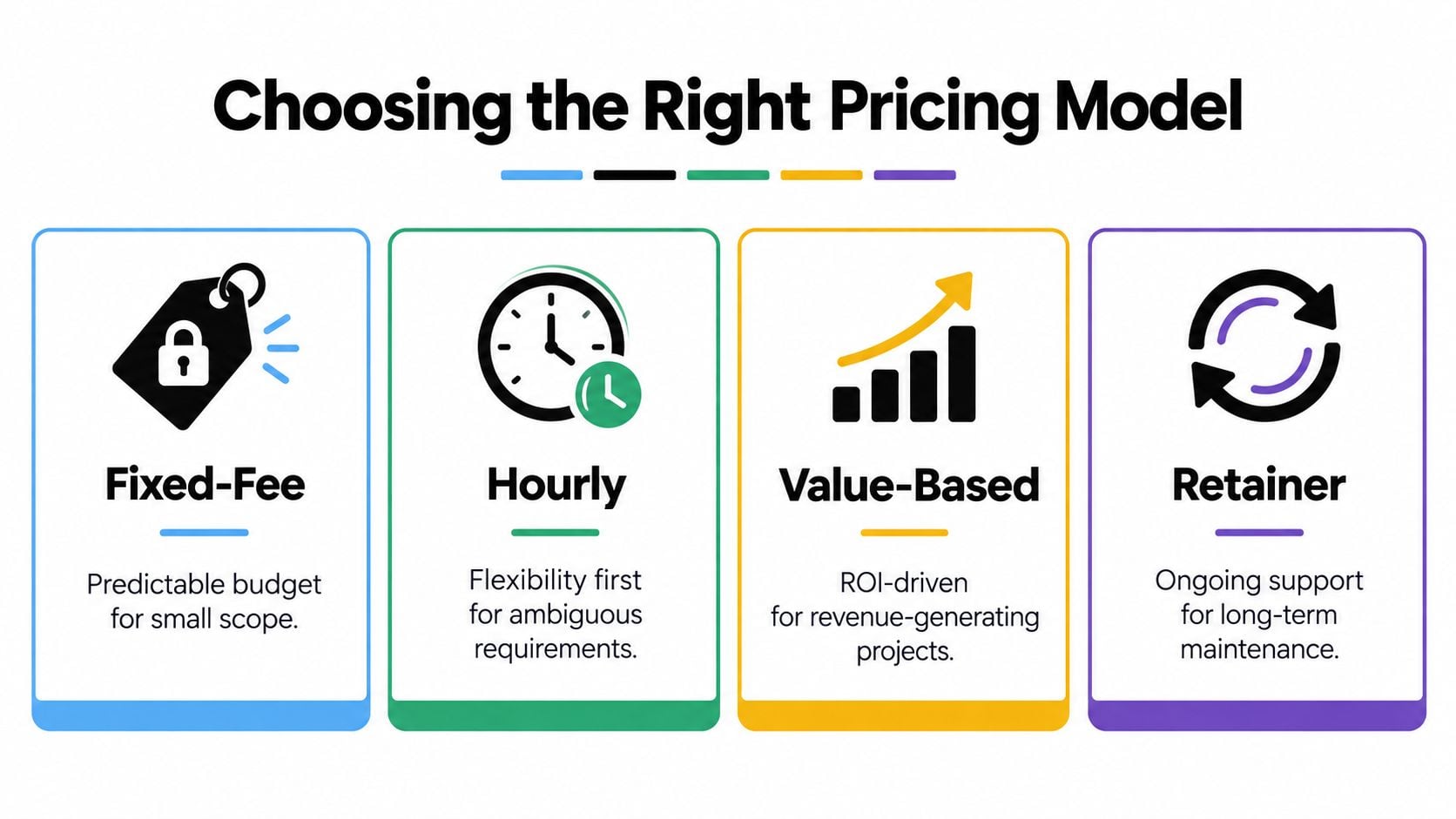
Most redesigns should use a fixed fee built from a day-rate estimate. That gives the client budget certainty and gives you a private calculation that exposes whether the project is commercially sensible.
Other models have their place.
Fixed fee for controlled scope
Use a fixed fee when the platform, templates, content responsibility, integrations and approval process are clear. A professional redesign estimated at 24 days and a £500 day rate gives you a £12,000 delivery basis before any internal contingency. The client sees one agreed project price, while your team works to defined acceptance criteria.
The weakness is obvious. If the scope is vague, a fixed fee turns uncertainty into your unpaid labour. Write assumptions and exclusions before you offer one.
Hourly pricing for genuine uncertainty
Hourly or daily billing suits discovery, legacy-system investigation and briefs that have not yet been defined. If the client wants you to audit an unfamiliar CMS, assess integrations or prototype options before committing to a build, sell that investigation separately.
Don't use hourly billing as an excuse for weak estimating. Clients dislike watching the meter run, and agencies often lose trust when the final figure bears little resemblance to the informal expectation.
Value-based pricing for commercial responsibility
Value-based pricing makes sense when the redesign directly supports a valuable sales process, ecommerce journey or lead-generation system. It doesn't mean promising a conversion uplift. It means recognising that a site generating high-value enquiries deserves strategic work beyond visual styling.
Separate the fixed build from optional measurement and optimisation. Define metrics such as qualified enquiries, add-to-cart activity, checkout completion or revenue per visitor, then report what changed without claiming that design alone controlled the result.
Retainers for continuing work
A retainer belongs after launch, not as a hiding place for unfinished scope. Use it for monitoring, content updates, testing, accessibility maintenance, SEO checks and agreed development capacity.
If you're comparing external delivery models, resources such as transparent staffing pricing can help you understand how ongoing capacity is presented commercially. Your own retainer should be just as clear. State the included hours or deliverables, response expectations, rollover rules and exclusions.
The right model depends on uncertainty. Fixed fee suits defined delivery. Hourly suits investigation. Value-based pricing suits commercially important optimisation. Retainers suit continuing responsibility.
A short explainer can help clients understand why those models produce different commercial outcomes:
Hidden Cost Drivers That Change the Quote
The visible redesign is usually the easy part to describe. The expensive work sits underneath it.
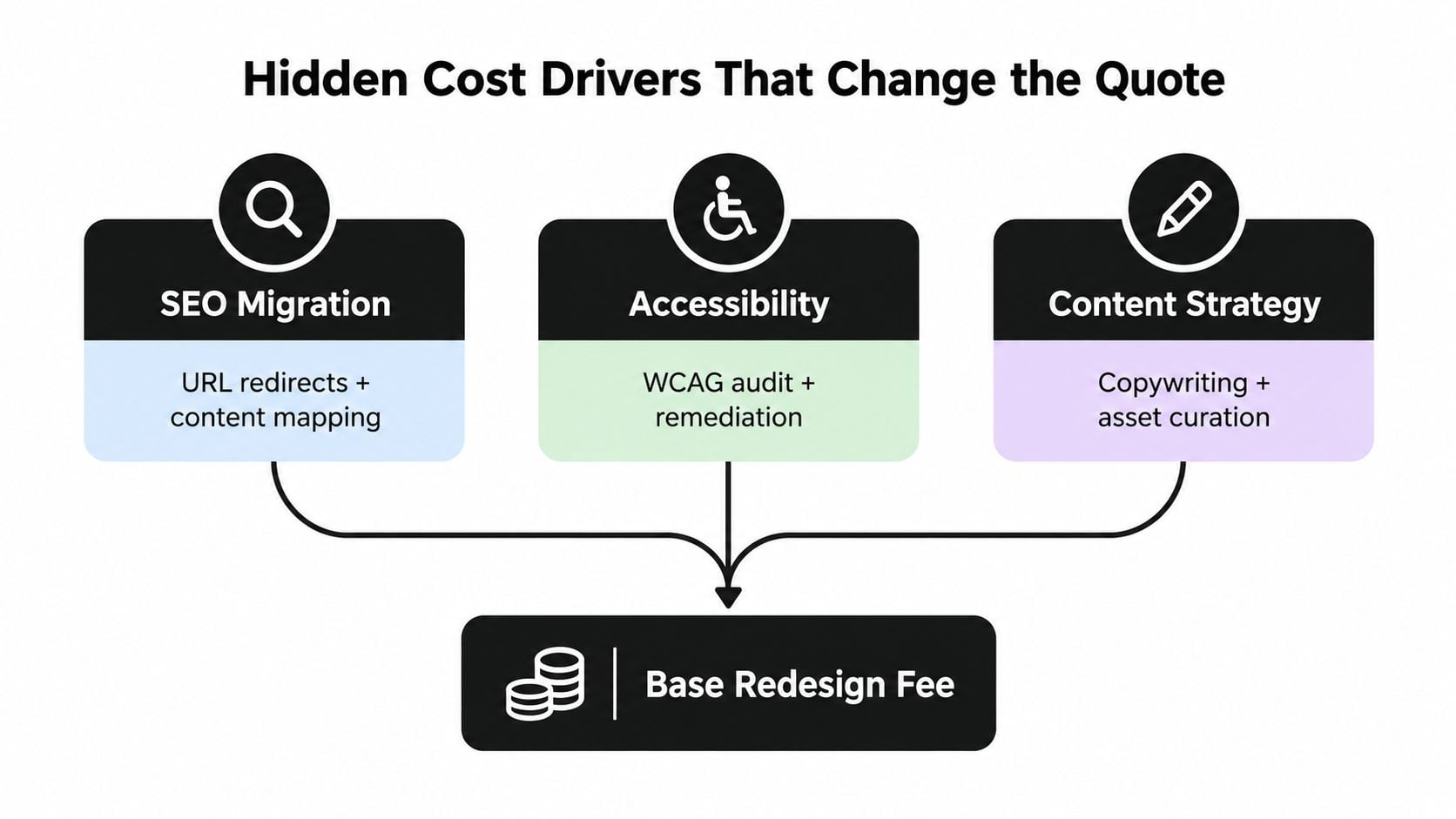
A client may ask for a new homepage, product pages and contact form. Your estimate changes sharply if those pages also need URL mapping, accessibility remediation, checkout diagnosis, structured data, analytics events, CRM integration or content rewriting.
SEO migration is protection work
A redesign that changes URLs, templates or content relationships can damage search visibility if the team doesn't map the old structure to the new one. Price for crawling the existing site, classifying important URLs, mapping destinations, implementing redirects, checking metadata, preserving internal links and validating the live environment.
This isn't optional polish. It protects value the client has already built. Include content migration services as a defined workstream when the project involves rewriting, restructuring or moving a substantial content library.
Accessibility needs a line item
Accessibility shouldn't be an invisible promise inside “quality assurance”. Scope the audit, keyboard testing, screen-reader checks, form review, colour and typography decisions, accessible content and document review, remediation and evidence.
UK businesses already have duties under the Equality Act 2010 to make reasonable adjustments for disabled users. The European Accessibility Act has applied since 28 June 2025 to covered digital services sold to EU consumers, as described in the accessibility context supplied for this brief. The legal treatment depends on the business and service, so don't present a redesign quote as legal advice. Do identify accessibility work and its limits.
A cosmetic refresh can be poor value if it leaves inaccessible navigation, forms, checkout steps or PDFs untouched. Charge for the risk reduction instead of absorbing it.
Mobile and conversion work are different from responsiveness
Responsive layout work makes the interface fit different screens. Conversion optimisation asks whether mobile users can understand the offer, select a product, complete a form or finish checkout without friction.
The commercial case is particularly strong for ecommerce. Recent UK ecommerce data reports that mobile accounted for 62.3% of sales activity in July 2026, while the average conversion rate rose from 1.94% to 2.26% year over year, according to IRP Commerce data. Those figures don't justify a guaranteed improvement from a redesign. They do justify charging for a baseline measurement plan, mobile UX diagnosis, checkout review, analytics configuration and post-launch analysis.
Also price integrations, structured content, consent management, event tracking, image preparation and CMS training. These are the tasks that turn a handsome mock-up into a working commercial asset.
Building a Proposal That Survives the Client
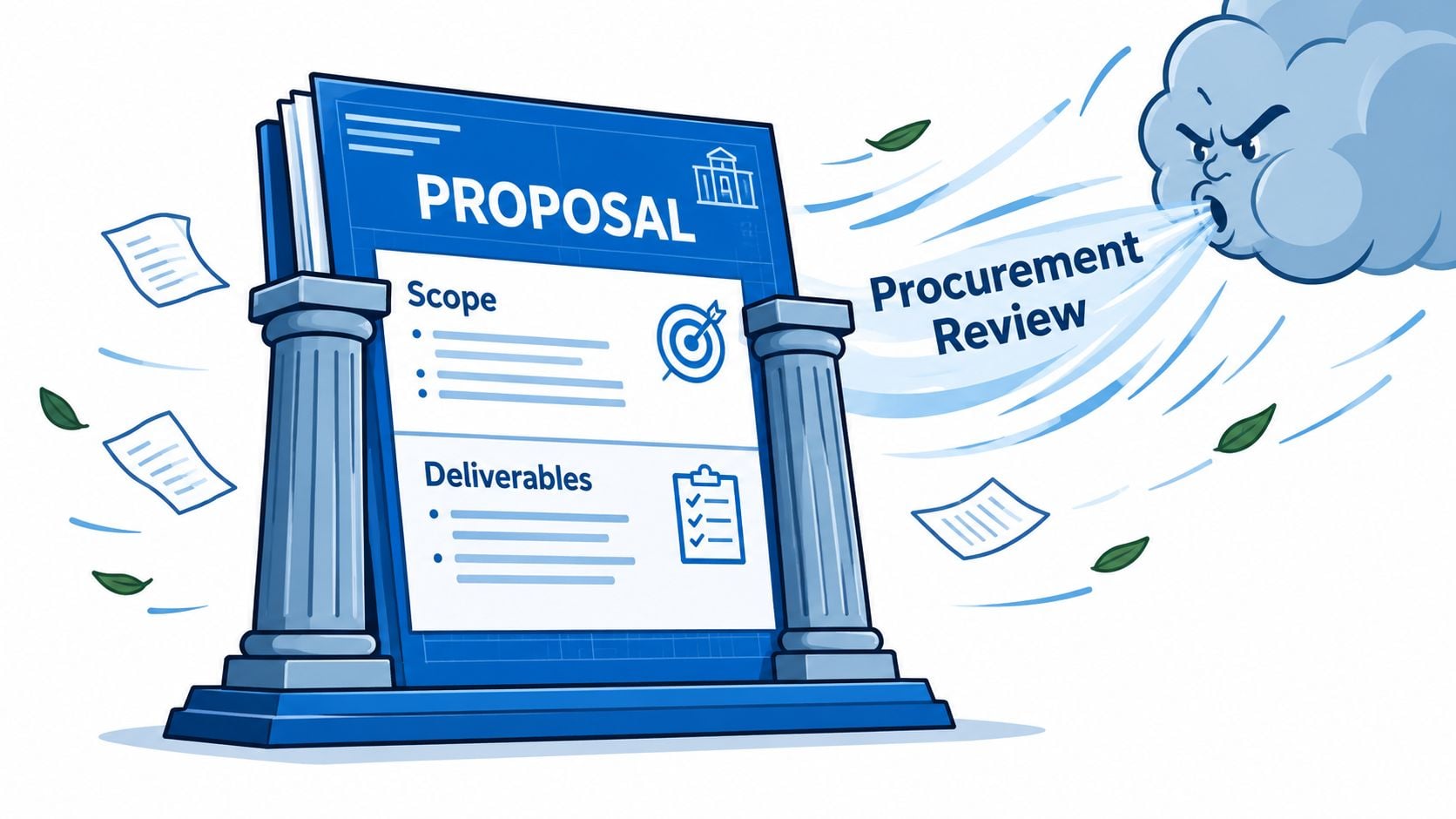
A proposal should make the project easier to approve and harder to misunderstand. Procurement teams, directors and internal stakeholders will test the boundaries of your wording. Give them clear boundaries to test.
Put the commercial promise first
Open with the outcome and project definition, then list the included work. A defensible proposal normally contains:
- Project scope: Identify the templates, content types, platform and integrations included.
- Deliverables: List approved wireframes, designs, implemented templates, migration tasks, testing and launch outputs.
- Client responsibilities: State who supplies copy, images, product data, approvals, access credentials and legal content.
- Assumptions: Define page volumes, reusable components, supported browsers, hosting arrangements and third-party services.
- Revision policy: State how many review rounds are included and what counts as a revision.
- Timeline: Tie dates to client feedback, content delivery and approval milestones.
- Payment schedule: Use staged payments linked to agreed project milestones.
- Support: Separate launch defect cover from new development, ongoing content work and future enhancements.
If contract language isn't your strength, a graphic design services contract provides a useful starting point for thinking through ownership, approvals, payment and responsibilities. Adapt it to the actual project and obtain appropriate professional advice where needed.
Define support before launch
DesignStack's stated delivery model uses fixed-cost pricing, three design revisions and one month of post-launch updates. If you use a similar structure, define it precisely. A revision changes an agreed design direction within the approved scope. It doesn't introduce a new page type, new integration or completely different brand direction.
Post-launch support should cover defects and a defined amount of agreed work. State whether new content, feature requests, plugin changes, hosting issues and third-party failures are included or charged separately.
Good exclusions don't sound defensive. They sound organised:
Example wording: “The fee includes three design revision rounds for the agreed templates. New page types, additional integrations, copywriting, photography, paid licences and changes requested after approval are quoted separately.”
That sentence protects both sides. The client knows what to expect, and you don't have to renegotiate your margin every time the brief expands.
Negotiating Without Undercutting Yourself
When a client says, “Can you do it for less?”, don't defend your price for ten minutes. Ask what they want to remove.
A lower fee must buy a smaller project. Remove a template, defer content migration, reduce integration work, move accessibility remediation into a separate phase or replace bespoke functionality with an existing component. Don't keep the original scope and quietly accept less money.
Anchor the conversation on scope
Say: “The current fee reflects the agreed templates, migration, analytics and launch support. If the budget needs to come down, we can remove or defer specific items.”
Then give choices. A visual refresh might preserve the existing customer journey. A conversion-focused rebuild might add research, mobile diagnosis and measurement. A larger ecommerce or replatforming phase might carry the migration and checkout risk separately.
This approach gives the client control without making your expertise negotiable. It also reveals whether the budget issue is real or whether the client wants to see if you'll fold.
Use phases to solve cash flow
Some clients can afford the project but don't want one large payment. Split discovery, design, implementation and launch into milestones. Staged payments improve cash flow without reducing the fee or changing the work.
If you offer a discounted build in exchange for a future retainer, write the arrangement carefully. The retainer must pay for actual ongoing capacity, monitoring or improvements. It shouldn't subsidise an underpriced launch project that you already know will overrun.
Know when to walk away
Walk away, or reprice sharply, when the client refuses to identify a decision maker, won't provide content, expects unlimited revisions, insists on an impossible deadline or treats accessibility and SEO as free extras. Those aren't minor administration problems. They directly increase delivery risk.
A polite response is enough: “I don't think the current budget and delivery expectations allow us to do this responsibly. I'd rather decline than promise a result the scope can't support.”
Protecting the relationship doesn't require accepting the work. Clear refusal is more professional than a resentful project delivered late.
Your Redesign Pricing Checklist
Before sending the next quote, ask:
- Goal: What business outcome should the redesign support?
- Scope: Which templates, content types and journeys are included?
- CMS: Is the existing platform staying, changing or being assessed?
- Timeline: Is the deadline realistic for content, approvals and testing?
- Stakeholders: Who decides, and who can request changes?
- Budget: What range has the client approved?
- Technology: Which integrations, forms, analytics and payment systems need testing?
Run the project through the website redesign checklist, then calculate three internal numbers: delivery days, UK day rate and contingency. Reprice when the client adds hidden complexity, and walk away from unlimited revisions, missing content or undefined technical ownership.
My default recommendation is simple: use a scope-weighted fixed fee for the redesign and a separate retainer for genuine post-launch support. Never let a vague “website refresh” turn into unpaid SEO, accessibility, content and development work.
DesignStack provides fixed-cost WordPress redesigns, responsive ecommerce builds, SEO and content guidance, with defined revision and post-launch support terms. If you're quoting a redesign in Dorset or elsewhere in the UK, visit DesignStack to discuss the scope before you commit to a price.



Leave a Reply