


Mobile App Development Cost: UK Guide 2026
A basic mobile app in the UK commonly starts around £8,000 to £30,000+, and a highly complex build can reach £85,000 to £250,000+. The number most buyers miss is the one that follows launch, because maintenance, hosting, security, and support can keep the bill growing long after the first release.
You're probably in the familiar spot of trying to work out whether an app is a sensible investment or just a very expensive idea with a clean interface. That question gets clearer once you separate the build price from the full cost of ownership, because the first quote rarely tells the whole story.
Table of Contents
- What Mobile App Development Cost Actually Looks Like in the UK
- Three Factors That Drive Your Mobile App Budget
- Choosing a Pricing Model That Protects Your Budget
- Platform and Feature Decisions That Shape Cost
- The Hidden Costs Most UK Businesses Overlook
- Smart Ways to Reduce Your Mobile App Development Spend
- Should You Build an App or Improve Your Mobile Web First
- Choosing the Right Development Partner
What Mobile App Development Cost Actually Looks Like in the UK
A Dorset retailer once asked for “a simple customer app” and expected something close to a brochure-site budget. That expectation usually disappears once the conversation moves from the idea to the actual build, because even modest apps need planning, design, testing, deployment, and maintenance.

In the UK, a basic mobile app is commonly estimated at £8,000 to £30,000+, a medium-complexity app at £35,000 to £80,000+, and a highly complex app at £85,000 to £250,000+. Those ranges are useful because they show how quickly cost rises once you add real business logic, backend work, or multi-platform demands, rather than treating “an app” as one fixed product type. Sparx IT Solutions' UK pricing guidance makes the same point in different wording, simple projects still sit well into five figures once a professional team is involved.
A practical way to read the numbers is by business shape, not by wish list. A straightforward booking or enquiry app usually sits nearer the lower end, a customer portal with login, data handling, and admin tools moves into the middle, and apps with richer workflows or multiple connected systems tend to push into the top bracket.
Practical rule: if the app needs to remember users, sync data, or talk to other systems, the quote stops being “small” very quickly.
Labour rates also shape the final figure. Software development pay gives you a clear reason budgets rise once you move beyond a rough prototype, and the nexus IT group salary guide is a useful reminder that experienced developers, testers, and product people are not low-cost inputs. That is why agencies such as DesignStack's mobile app development services spend so much time on scoping before they quote, because vague requirements usually turn into costly rework later.
The build price is only part of the picture. Hosting, app store accounts, support, bug fixes, and small feature changes keep adding to total cost of ownership after launch, and UK SMEs often underestimate that from the start. A sensible budget covers the launch and the running cost, otherwise the app may look affordable on paper and become expensive to maintain in practice.
Three Factors That Drive Your Mobile App Budget
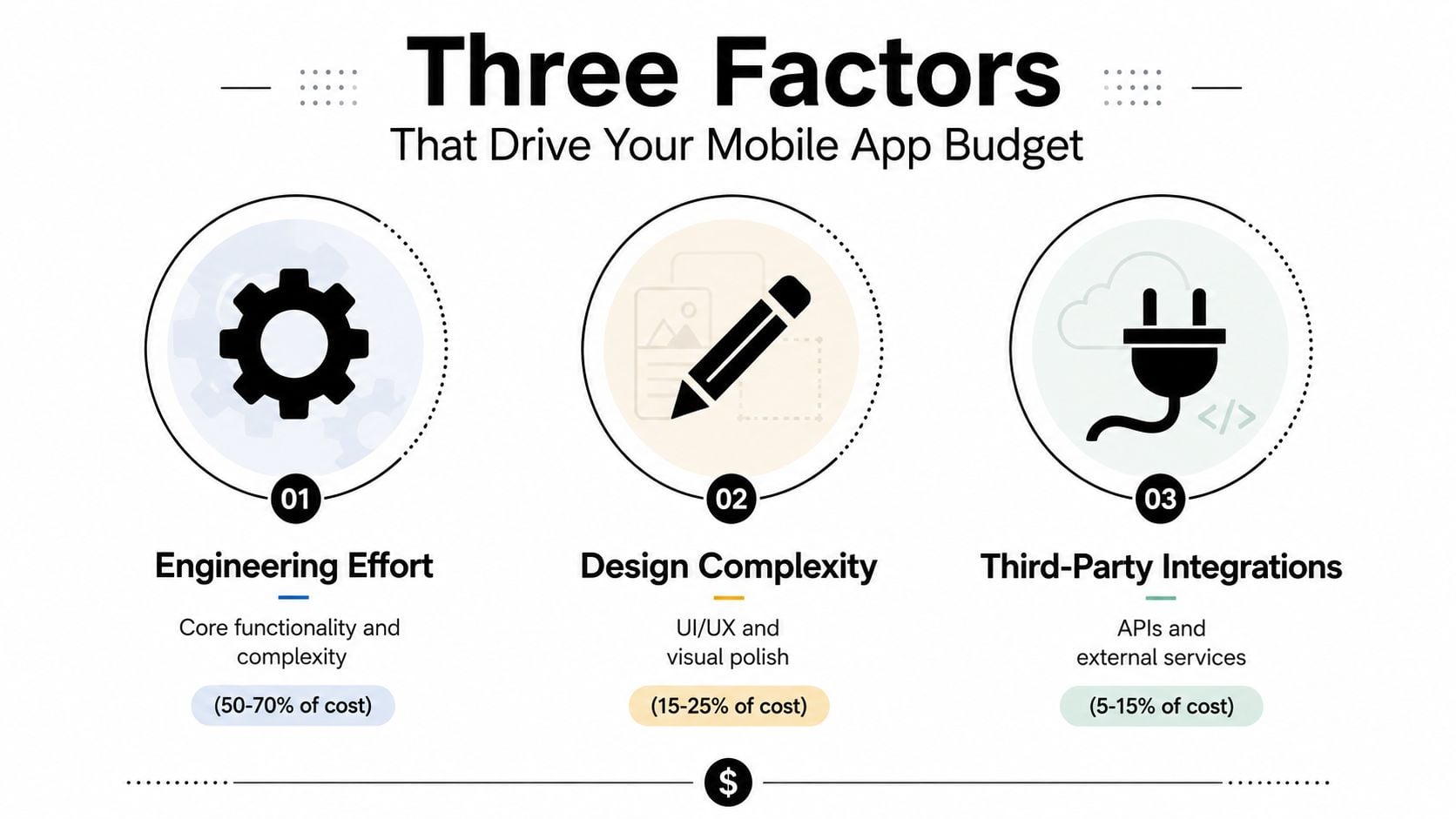
The biggest mistake I see is treating platform choice as the main cost question. It matters, but the budget is usually driven by engineering effort, because features, integrations, backend logic, testing, and release complexity decide how many hours the team has to spend.
Engineering effort drives the budget
For UK mobile app budgets, the most useful cost driver is engineering effort, not the platform label on its own. Native iOS and Android work needs separate skills, and once you split across two codebases, every feature needs more coding, more testing, more release work, and more maintenance. The UK government's National Careers Service is a helpful reminder that software development is a skilled profession with wide pay variation by experience, which is one reason build costs climb quickly once a project moves beyond a basic prototype.
Labour rates shape the quote
Developer pay in the UK gives you a realistic clue about why app builds add up. The nexus IT group salary guide shows how software pay expectations vary by role and experience, which means design, coding, QA, and project coordination quickly become a substantial delivery cost even before post-launch support is included. If you want to understand why that coordination matters, what user experience design involves is a useful reference, because UX work affects the structure of the app as much as the visuals.
Where the hours usually go
The clearest cost split is still the simplest one. According to GoodFirms, development accounts for 40% to 60% of total app cost, UI/UX design takes 20% to 25%, and QA/testing runs 15% to 20%, with discovery and launch making up the rest. That is why a quote that looks lean on paper can still become expensive once proper design and testing are included.
A useful way to read that split is through project shape.
| Project shape | What pushes the budget |
|---|---|
| Simple customer app | Few screens, light backend, limited integrations |
| Operational app | Login, data handling, admin views, support flows |
| Complex product | Multiple systems, custom workflows, tougher QA |
If user experience is a major selling point, the design phase becomes harder to trim safely. A focused resource such as what user experience design involves helps explain why UI and journey work carry real cost rather than being decorative extras.
Choosing a Pricing Model That Protects Your Budget
The pricing model matters almost as much as the idea itself. Two projects with the same scope can end up very differently once one is locked into a vague contract and the other has clear deliverables, revision limits, and a change-control process.
Fixed-price suits clarity
Fixed-price works best when requirements are stable and the business wants certainty. It keeps budgeting straightforward, which is why many small firms prefer it, especially if they're already juggling marketing, stock, or service delivery and can't afford endless scope drift.
Time-and-materials gives flexibility
Time-and-materials is useful when the product is still taking shape. It gives room to learn, but it needs strong governance, because every loose brief turns into extra hours. That model can work well for internal teams with a sharp product owner, but it's risky if nobody is actively making decisions.
Dedicated teams fit long-running products
Dedicated teams make sense for longer programmes where the app is a core product rather than a one-off build. The trade-off is commitment, because you're effectively investing in ongoing capacity, not just a discrete delivery.
Budget certainty is usually worth more to SMEs than theoretical flexibility they'll never use.
If you're reviewing agencies, a page like DesignStack's creative agency approach in the UK shows how fixed-cost delivery, revision cycles, and ongoing updates can be structured without turning the project into a blank cheque. For most smaller businesses, that transparency matters more than a low opening number.
Platform and Feature Decisions That Shape Cost
A client usually arrives with a feature list and a budget, then discovers the actual cost sits in the choices underneath both. The first question is rarely about design. It is whether the app needs one codebase, two native builds, or a staged approach that keeps the first release lean.
Native and cross-platform are not the same cost story
Native iOS and Android builds use platform-specific skills, such as Swift for iOS and Kotlin or Java for Android, so they usually take more developer time than a single-codebase build. Adding a second platform is not a neat doubling of effort, because QA, release management, and maintenance also grow, and every feature needs checking twice. Cross-platform pricing trends are discussed in Statista's mobile app development coverage, which reflects the wider point, platform choice changes the shape of delivery, and engineering depth changes the bill.
Choose native when device access really matters
Native makes sense when the app depends on smooth access to device-level features, tighter performance, or a more polished experience on one platform first. It is the better choice when your users are already concentrated on one side of the market, or when the product needs deeper integration with phone capabilities.
That often includes apps that rely on camera performance, location handling, Bluetooth, push notifications, or other hardware-led interactions. Those requirements can be awkward in a generic build, and the workarounds usually show up later in support calls.
Choose cross-platform when speed and scope matter more
Cross-platform is often the better commercial fit for SMEs that want to test a product without paying for two separate builds from day one. It can reduce duplication, but it still needs disciplined design and testing, because one codebase does not remove product complexity.
The budget pressure usually comes from the feature list. Real-time data, AI, offline sync, and heavy API work all add logic, error handling, and regression risk. A clean login screen is rarely where money disappears. Once an app starts coordinating payments, live status updates, role-based access, or external services, the estimate usually moves fast.
For Android-specific builds, Android app development services are a reminder that platform decisions should follow business need, not fashion. The cheapest route on paper is not always the cheapest route to maintain.
The Hidden Costs Most UK Businesses Overlook
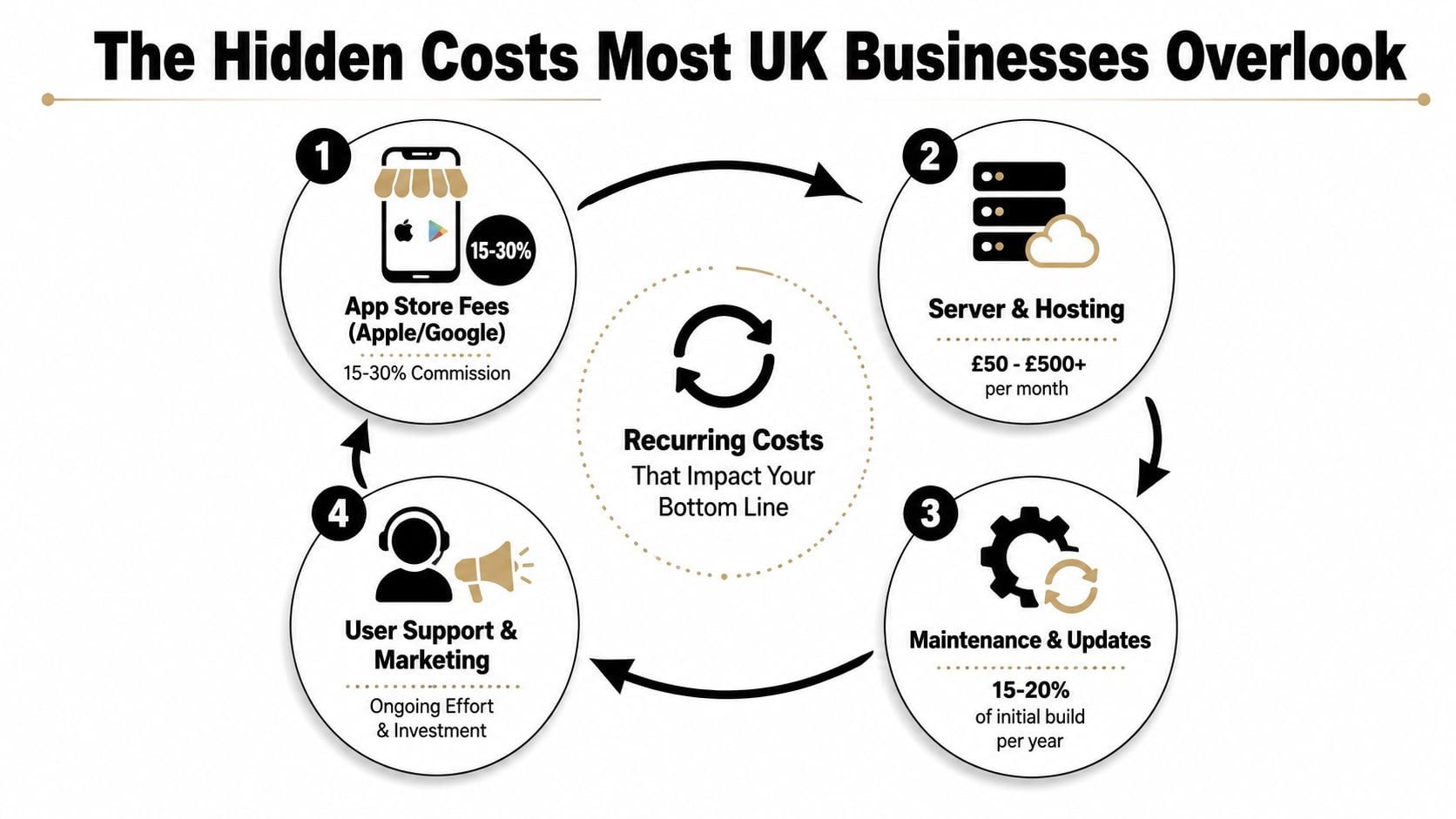
Many budgets go wrong here. The build is only the first invoice, and once the app is live, the business starts paying for keeping it available, secure, and functional.
Maintenance never really stops
Industry guidance commonly estimates maintenance at 15% to 20% of build cost annually, and Appscrip's launch-cost guidance treats infrastructure and maintenance as separate budget items, which is the right way to think about it. That spend covers bug fixes, platform updates, security patches, and the small changes that keep the app working as operating systems evolve.
Hosting and support are real line items
A live app needs hosting, monitoring, and practical support. Even when the app looks simple to users, someone still has to watch performance, manage services, and deal with account issues or broken integrations.
Compliance and store overhead belong in the model
App-store accounts, privacy work, and routine security updates are not optional extras. They're part of operating the product properly, especially when the app handles customer data or supports transactions.
For a UK SME, the hidden cost question should be broader than “what does it cost to build?”. A more useful comparison is with website maintenance pricing in the UK, because app ownership works the same way, the headline launch spend is only part of the annual commitment.
If a supplier can only quote the build and won't discuss support, you're not getting the full picture.
Smart Ways to Reduce Your Mobile App Development Spend
The best savings come from removing uncertainty, not cutting corners. A vague brief almost always costs more than a well-prioritised one, because the team spends time guessing and correcting instead of building.
Start with a minimum viable product that solves one business problem properly. If the first release does three things well, it's usually better value than a bloated version that tries to do ten things badly.
Prioritise features by commercial value, not by internal enthusiasm. The owner might want every possible workflow on day one, but if only one or two functions will drive use, that's where the initial budget should go.
A few practical moves keep costs under control:
- Write requirements early. Clear user roles, screen lists, and acceptance criteria reduce rework.
- Limit revision churn. Agree how many rounds of changes are included before the contract starts.
- Choose the platform deliberately. Don't pay for both native builds unless the second platform is already justified.
- Use fixed-cost quotes where possible. They help SMEs plan cash flow and avoid open-ended delivery.
- Validate mobile web first. If demand is still uncertain, a lean web journey may reveal the truth faster than a full app.
That last point matters more than most founders expect. A mobile app is not automatically the highest-ROI starting point, especially when the business is still proving demand.
Should You Build an App or Improve Your Mobile Web First
UK retail internet sales reached £4.2 billion in June 2025, and online sales made up 27.4% of all retail spending, so mobile demand is already happening through web and commerce channels. That doesn't make apps irrelevant, but it does mean many SMEs should prove the use case before committing to a native build. Office for National Statistics retail sales data is a strong reminder that customers are already shopping and browsing on connected devices in volume.
Build an app when the experience needs app-only features
An app makes sense when the business needs push notifications, offline use, or device-level integration that a responsive website can't replicate well. Those are the moments where an app becomes more than a container for content.
Improve mobile web first when conversion is the real goal
If the site mainly needs quicker browsing, simpler checkout, better enquiry flow, or cleaner booking journeys, mobile web is often the smarter first spend. It's easier to test, easier to update, and usually less risky than funding a custom app before demand is proven.
Use the user behaviour you already have
If customers are already arriving by mobile, the question is whether they need an app to return more often, or whether a sharper web journey would do the job. For many local firms, the answer is still the latter.
A responsive website wins when the business wants reach, speed, and lower maintenance. An app wins when retention, device integration, or offline utility justifies the extra ownership cost.
Choosing the Right Development Partner
The cheapest quote is often the most expensive mistake. A proper partner protects the budget by being explicit about what's included, what isn't, and how change requests are handled once the build starts.
Ask for fixed deliverables, not broad promises
A strong proposal should spell out the screens, user flows, integrations, testing scope, and launch support. If those things are vague, the project can drift, and drift is where SME budgets get damaged.
Check how revisions and updates are handled
Revision policy matters because design and functionality changes always happen. A good partner will say how many rounds are included, what counts as a change request, and how post-launch support is handled once the app is live.
Look for honest communication, not sales polish
You want regular updates, clear deadlines, and a team that tells you early when something has changed. That's how you avoid discovering problems at the end of a sprint, when they're more expensive to fix.
Evaluate the proposal beyond the number at the bottom
A proposal should be judged on its clarity, not just its total. Ask these questions before signing anything:
- What is included in the base scope? Make sure design, testing, and deployment are listed.
- What happens if scope changes? Change control should be written down.
- Who supports the app after launch? Ongoing maintenance needs a named process.
- What similar work have you delivered? Relevant portfolio work matters more than generic claims.
For small businesses, a partner that combines clear pricing, transparent updates, and post-launch support is usually safer than one offering a bargain quote with no explanation. That's one reason agencies such as DesignStack position fixed-cost delivery and ongoing support as part of the commercial relationship, not an afterthought.
If you're planning a mobile app and want a clearer view of scope, cost, and what needs to happen after launch, talk to DesignStack. They can help you decide whether an app, a mobile web upgrade, or a phased build is the right investment for your business, and they'll do it with the kind of fixed-cost clarity that keeps UK projects under control.



Leave a Reply