Mobile App Development Company for Startups: Partnering
You're probably in one of two positions right now. Either you've got a founder deck, a rough product idea, and pressure to “get the app built”, or you've already spoken to a few agencies and realised the quotes, timelines, and opinions don't line up.
That confusion is normal. Hiring a mobile app development company for startups isn't just a procurement decision. It's an early business decision about product, budget, risk, and whether a mobile app is even the right first move for your company.
For UK founders, the consequences are more significant than most list-style articles admit. Build too much too early and you burn cash. Build the wrong thing and you learn nothing. Choose the wrong partner and you inherit delays, unclear ownership, and technical debt before you've even found traction.
The smarter approach is to slow down before you speed up. Decide whether an app is justified, define a lean first version, then choose a partner that can help you reduce risk instead of only writing code.
Table of Contents
- Defining Your App and Scoping a Lean MVP
- Your Evaluation Checklist for App Development Companies
- Insightful Interview Questions for Development Partners
- Common Red Flags and Key UK Considerations
- Structuring the Engagement From Contract to Launch
- Choosing a Partner Not Just a Programmer
Defining Your App and Scoping a Lean MVP
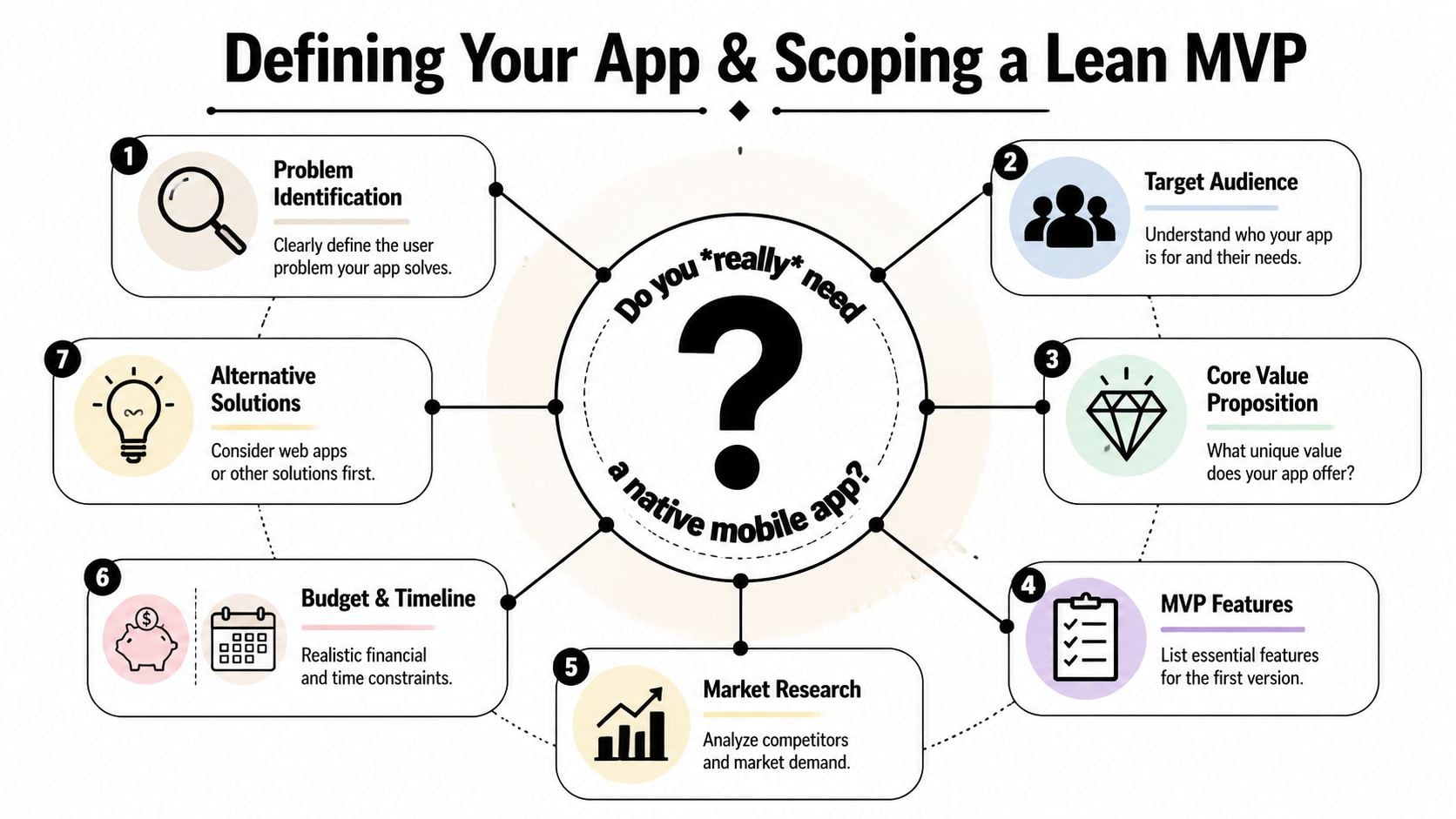
Start with the business case not the format
Most founders start with the wrong question. They ask, “Who can build my app?” when they should ask, “Do I need a native mobile app yet?”
That matters in the UK because mobile reach by itself isn't a differentiator. Ofcom reports that 89% of UK adults use a smartphone, which is why many use cases can be handled more cheaply through a web-first product or PWA instead of a full native build, as discussed in this UK app versus PWA decision angle.
A simple rule helps here:
- Choose a responsive website if users mainly need information, content, lead capture, or simple transactions.
- Choose a PWA if you want app-like access in the browser without the cost and friction of app stores.
- Choose a native or cross-platform app if retention depends on repeat usage, device features, offline access, or fast recurring transactions.
Founders often overestimate how much users want “an app” and underestimate how much they just want the task solved quickly. If a booking flow, marketplace listing, calculator, dashboard, or onboarding sequence works well on the web, that may be enough to validate demand before you commit to app store delivery.
Practical rule: If the product's core value doesn't improve through push notifications, offline use, camera access, location, or repeated habit-based usage, a web-first launch is often the safer first step.
Before you brief any agency, sketch the experience. Even a low-fidelity plan helps you spot unnecessary screens and feature creep. If you need a simple explanation of that planning stage, this guide to wireframes in web design is a useful starting point.
Scope the first version with discipline
A lean MVP isn't a stripped-down version of every idea. It's the smallest product that proves one thing worth knowing.
That's why an MVP-first process matters. About 35% of failed startups cite lack of market need and about 10% cite poor timing, according to Stripe's startup statistics. Validation with real users is cheaper than confidence built in a meeting room.
Use this filter when defining version one:
Name the user problem clearly
Not “we need an app for our brand”. Better: “busy parents need to rebook sessions in under a minute”.Define one core action
Every strong MVP has a centre. Book. Order. Track. Message. Report. If your first release has five equal priorities, it has no priority.Remove support features that don't prove demand
Admin dashboards, advanced profiles, loyalty systems, referral mechanics, and in-app chat often appear too early.Decide what you must learn after launch
Do you need to know whether users return? Whether onboarding makes sense? Whether they complete the key action without help? Those questions shape the build.Set a boundary for version one
If a feature doesn't help acquire the first users, help them complete the main task, or help you learn from their behaviour, it usually belongs later.
A startup doesn't win by shipping the longest feature list. It wins by learning faster than it spends.
The founders who handle app investment well are not the ones with the biggest initial roadmap. They're the ones who can explain, in plain language, what the first release must prove and what can wait.
Your Evaluation Checklist for App Development Companies
A shortlist gets easier when your scope is clear. Without that, every proposal looks plausible because each supplier is pricing a different product.
What good looks like before you ask for a quote
Start with evidence, not charisma. A polished sales call means very little if the company can't show work that resembles your product stage and complexity.
Here's the checklist I'd use.
- Relevant portfolio: Look for apps with similar user journeys, not just similar industries. A fitness app and a logistics app may both have maps, accounts, and notifications, but the retention logic is different.
- Product thinking: A strong partner asks what should be removed, not just what should be added.
- Clear team structure: You should know who handles design, who manages delivery, who writes the code, and who tests.
- Defined process: Expect a visible path from discovery to design, development, testing, and launch.
- Communication rhythm: Weekly updates and sprint demos prevent bad surprises. Silence creates them.
- Technical fit: For startup work, React Native or Flutter are often sensible options when speed and cost matter, but the team should explain why they've chosen a stack rather than defaulting to habit.
- IP clarity: The contract should state who owns the codebase, designs, and product assets once invoices are paid.
A practical sense check helps too. Read how they present themselves outside the sales pitch. This roundup on choosing the best app development company is useful because it frames the comparison around fit, process, and reliability rather than hype.
How to compare pricing without fooling yourself
UK app pricing is rarely “cheap”, and pretending otherwise wastes time. In the Western Europe / UK bracket, a simple MVP app is typically estimated at $25,000–$50,000, a medium-complexity app at $50,000–$100,000, and a high-end app at $100,000+, according to this breakdown of startup app development pricing. The same source estimates $8,000–$20,000 for a simple MVP in India and Southeast Asia, which shows how much geography affects cost.
That's why a very low UK quote should trigger scrutiny, not relief.
| Model | Best For | Pros | Cons |
|---|---|---|---|
| Fixed price | Clearly defined MVPs | Budget clarity, easier approval, stronger scope discipline | Change requests can become friction if the scope is vague |
| Time and materials | Evolving products with active founder input | Flexible, adapts to learning, useful for ongoing iteration | Final cost can drift if priorities aren't tightly managed |
| Milestone based | Projects with clear phases | Better cash-flow control, natural review points | Poorly defined milestones can create disputes |
What “good” pricing looks like:
- A written scope tied to the quote: If the feature list is fuzzy, the price is fictional.
- Assumptions stated up front: Device support, third-party integrations, admin tools, content migration, analytics, and testing should all be explicit.
- Post-launch support addressed: Maintenance isn't an extra detail. It's part of ownership.
- Trade-offs explained: A credible company will tell you what happens if you cut scope, shorten timelines, or add platforms.
Cheap proposals usually hide cost in one of three places. Reduced quality, reduced support, or future change requests.
Insightful Interview Questions for Development Partners
Most founders ask safe questions. “Can I see your portfolio?” “How long will it take?” “What's your process?” Those questions aren't useless, but they won't tell you what it's like when the project hits friction.
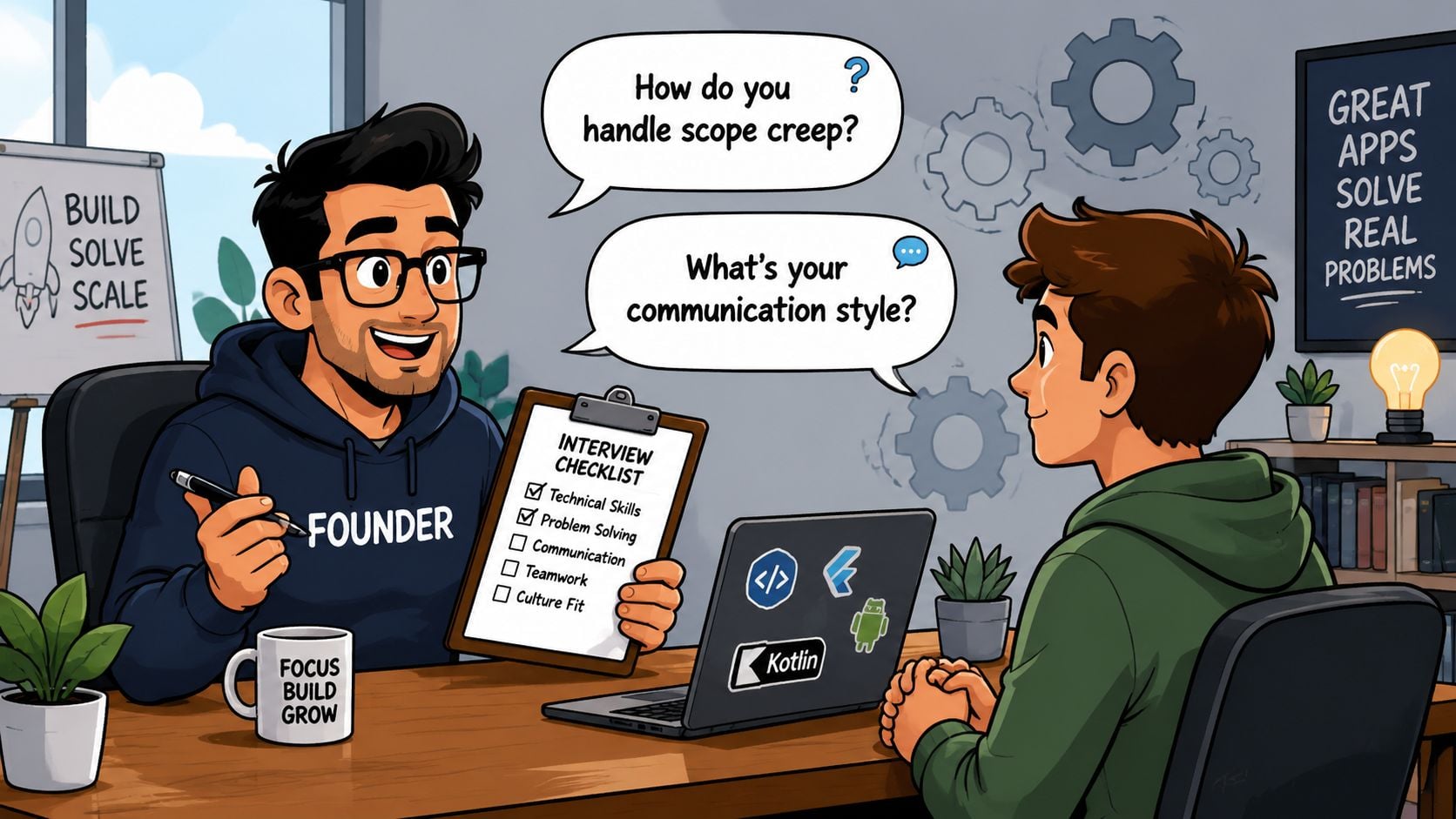
Ask questions that expose how they actually work
Ask for specifics that reveal behaviour.
Tell me about a startup project where the original scope was wrong. What did you change and why?
A good answer shows judgment. A weak answer shows they only follow instructions.Who will I speak to every week once the contract is signed?
You need to know whether access disappears after the sales stage.How do you handle user feedback after launch?
You're testing a business, not just shipping software.What do you need from me to keep this moving?
Good partners know founder bottlenecks are real and design around them.What would make you advise against building this as an app right now?
This is one of the best filters. If they can't challenge the premise, they're probably acting as an order-taker.
Listen for the quality of the answer not just confidence
Strong partners explain trade-offs in plain English. They'll mention priorities, risks, and constraints without hiding behind jargon.
Weak partners tend to answer in abstractions. They say they're “agile”, “full service”, or “startup friendly” but never describe what happens in an actual sprint, who signs off designs, or how issues are escalated.
One useful way to judge this is to watch how experienced teams discuss collaboration and delivery:
Another revealing question is simple: What happens if we learn, halfway through, that one major feature should be cut?
The right answer isn't defensiveness. It's a process for re-prioritising scope, budget, and launch goals.
The interview isn't there to confirm they can code. It's there to confirm they can think with you under pressure.
Common Red Flags and Key UK Considerations
A bad partner rarely looks bad in the proposal stage. The warning signs show up as ambiguity, evasiveness, and false certainty.
Red flags founders can spot early
Some red flags are easy to miss because they sound positive at first.
- “We can build everything on your wishlist.”
That usually means nobody is protecting scope. - A bid far below the rest.
Low pricing can reflect the use of offshore resources, but it can also hide missing QA, thin project management, or unrealistic assumptions. - No named team members.
If you don't know who's doing the work, you don't know what you're buying. - Vague language around testing and acceptance.
If there's no clarity around what “done” means, disputes arrive late and expensively. - Reluctance to discuss previous problems.
Every experienced team has dealt with delays, scope mistakes, and technical surprises. Mature companies can explain what they learned.
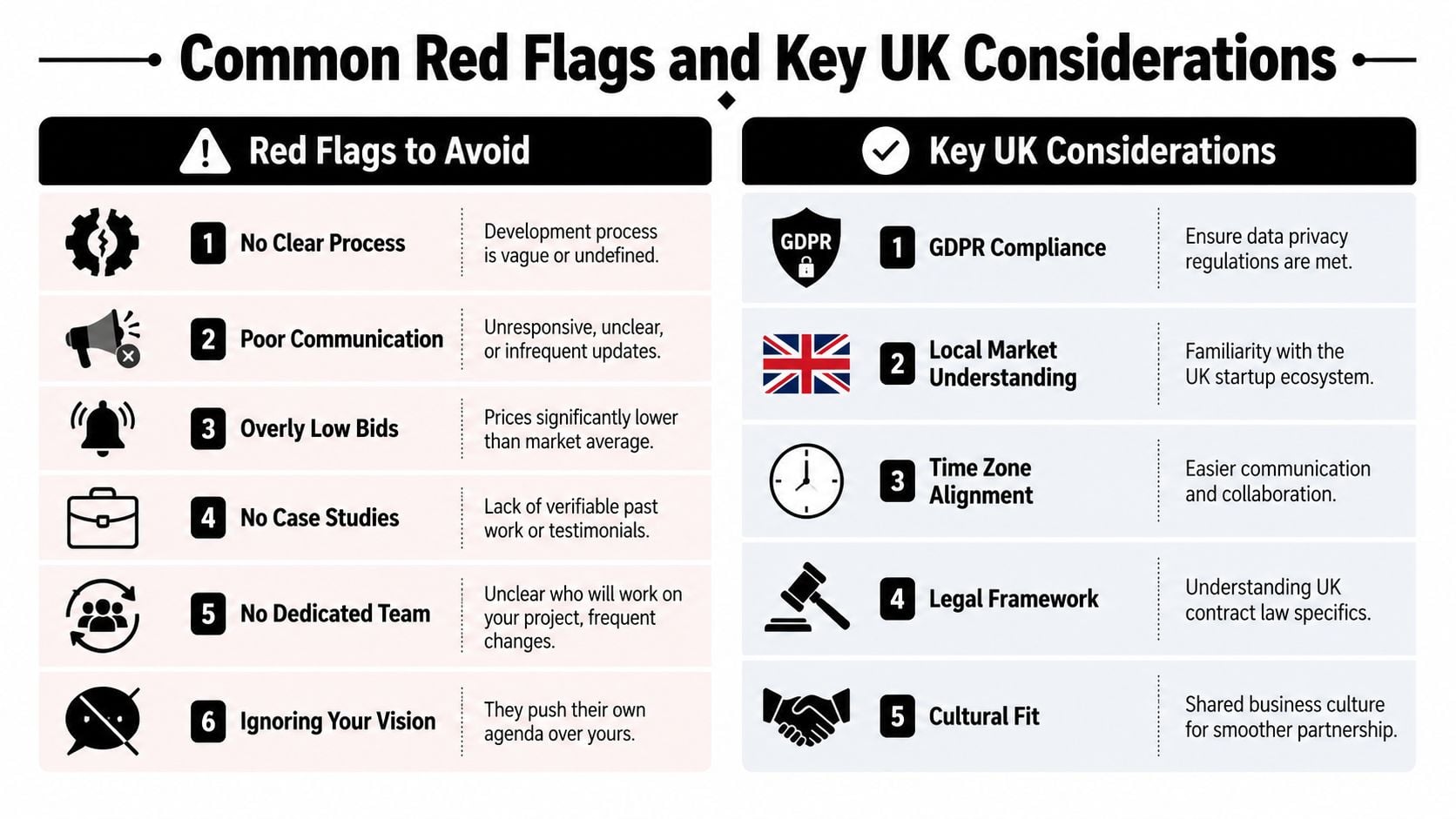
A founder can usually test for these issues by asking to see a sample proposal, a sample sprint update, and a sample acceptance process. You're not just checking competence. You're checking whether the company works in a way that reduces operational risk.
UK issues that affect the real cost after launch
The bigger blind spot is what happens after the build. Many founders compare agencies on delivery cost and ignore operating cost.
That's risky in the UK. ICO guidance affects how you handle personal data in analytics, onboarding, and support flows. The Digital Markets, Competition and Consumers Act 2024 also raises scrutiny on subscription clarity and cancellation friction, which is why this overview of post-launch compliance for app companies matters well beyond launch day.
This changes how you should evaluate a partner. Ask how they approach privacy-by-design, consent, retention of personal data, app store update cycles, and subscription UX. If they treat those issues as legal fine print for later, you'll be fixing product decisions after release.
For funded or funding-ready startups, there's another practical UK angle. If you're mapping the commercial path around the app, including capital strategy, it can help to find UK mobile app investors early so your product roadmap and fundraising narrative stay aligned.
For a broader sense of what local delivery involves, this guide to mobile app development services in the UK is worth reading before you sign anything.
Compliance is part of product design. If analytics, onboarding, subscriptions, and cancellation flows aren't handled properly, the business model gets harder to defend later.
Structuring the Engagement From Contract to Launch
The best projects don't feel chaotic. They move through clear decisions, visible deliverables, and regular check-ins that keep the founder engaged without forcing them into daily micromanagement.
What a healthy delivery rhythm looks like
A sensible engagement usually starts with a compact discovery phase. The team clarifies user flows, confirms scope boundaries, maps technical dependencies, and decides what won't be in version one.
Then design starts with the critical journey first. Not every screen. Just the screens that prove the product works. Login, onboarding, browse, checkout, booking, confirmation, tracking. Whatever your core loop is, it gets designed and tested before edge cases consume time.

After that, development should happen in visible slices. A founder should be able to review progress at each milestone and answer practical questions such as:
- Is the core journey getting faster or more confusing?
- Are we still building only what the MVP needs?
- Have any third-party tools created hidden complexity?
- Are testing issues being fixed as they appear or stockpiled for the end?
The technology choice matters here. A cross-platform stack such as React Native or Flutter is often the sensible startup option when launch speed and cost control matter. This is especially relevant because around 38% of startup closures are linked to insufficient funding and about 90% of startups fail overall, as noted in this guide to mobile app development for startups. Reducing unnecessary upfront engineering is a commercial decision, not just a technical one.
Build for launch and the month after launch
Launch is not the finish line. It's the first live test of whether the product and operating model are workable.
A healthy engagement includes user acceptance testing, app store preparation, analytics setup, content checks, and a plan for immediate fixes once real users arrive. Teams that already work from a structured release process tend to handle this better. Even though it's written for websites, this launch checklist shows the kind of operational discipline founders should expect before anything goes live.
The long-term market case for doing this well is strong. The global mobile app development market is projected to grow at a 23.8% CAGR from 2025 to 2035, rising from $116.87 billion in 2025 to $988.5 billion by 2035, according to Market Research Future's mobile app development market report. The same source states the market was valued at $94.4 billion in 2024, with major application segments including entertainment ($418.5 billion), e-commerce ($320.0 billion), and banking ($250.0 billion). For a startup, that doesn't mean “build more”. It means build on foundations you won't regret maintaining.
The strongest engagements keep one principle intact from contract to launch. Every decision should either reduce risk, improve learning, or support scale later.
Choosing a Partner Not Just a Programmer
The choice isn't between one agency and another. It's between two types of relationship.
One is transactional. You hand over a spec, they hand back code, and everyone acts surprised when the first release doesn't match user behaviour. The other is strategic. The team challenges weak assumptions, protects the budget from feature creep, and treats launch as the start of product learning rather than the end of production.
The best partner protects your business from bad decisions
Many founders misread value. A company doesn't become the right partner because it says yes quickly. It becomes the right partner when it knows when to say no.
That means no to features that distract from the core job. No to timelines built on wishful thinking. No to technical shortcuts that make the second release painful. And no to building a native app at all if a PWA or web-first product would validate the model faster.
A thoughtful product partner also understands the wider support around a startup. If your roadmap includes innovation funding, tax incentives, or technical claim documentation across markets, specialist advisers can matter as much as coders. For example, teams exploring international innovation support may find Australia's R&D specialists useful when the product work intersects with research and commercialisation planning.
Partnership is what gives the build long term value
The best mobile app development company for startups doesn't just produce features. It improves decisions.
That shows up in small things. Clear weekly updates. Honest conversations when priorities shift. Sensible scoping. Useful feedback on onboarding and retention. A willingness to explain trade-offs in plain language. Good user-centred thinking matters here, and if you want to sharpen your view of that side of product work, this introduction to user experience design is a solid reference.
Founders don't need a supplier who provides only agreement. They need a partner who can help them preserve cash, test demand, ship cleanly, and keep the product maintainable after launch.
Choose on that basis and the build has a much better chance of becoming a business asset rather than an expensive first draft.
If you want a partner that can help you shape the right first release, keep scope under control, and launch with clear communication and fixed-cost discipline, take a look at DesignStack. They support startups with websites, branding, hosting, and app development, which makes them a practical option for founders who need more than code and want a joined-up digital launch.