How to Build a Brand from Scratch: A UK SMB Guide
You’ve got the idea. Maybe it’s a new café in Weymouth, a trades business ready to look more established, or a service company that’s grown through word of mouth and now needs a proper identity. What usually happens next is less exciting. The logo gets rushed, the website goes live half-finished, the messaging changes from one platform to the next, and the whole thing feels stitched together.
That’s why learning how to build a brand from scratch matters before you start designing anything. A brand isn’t a badge you add at the end. It’s the system that helps people recognise you, trust you, and remember why they should choose you.
Small businesses in Dorset don’t need theory-heavy branding advice. They need something practical, affordable, and grounded in how people buy. If you’re building from zero, the job is to create a brand that looks right, sounds right, and works properly online from day one.
Your Big Idea Needs a Strong Brand
Most small business owners begin with the same assumption. They think branding starts with a name or a logo.
It doesn’t.
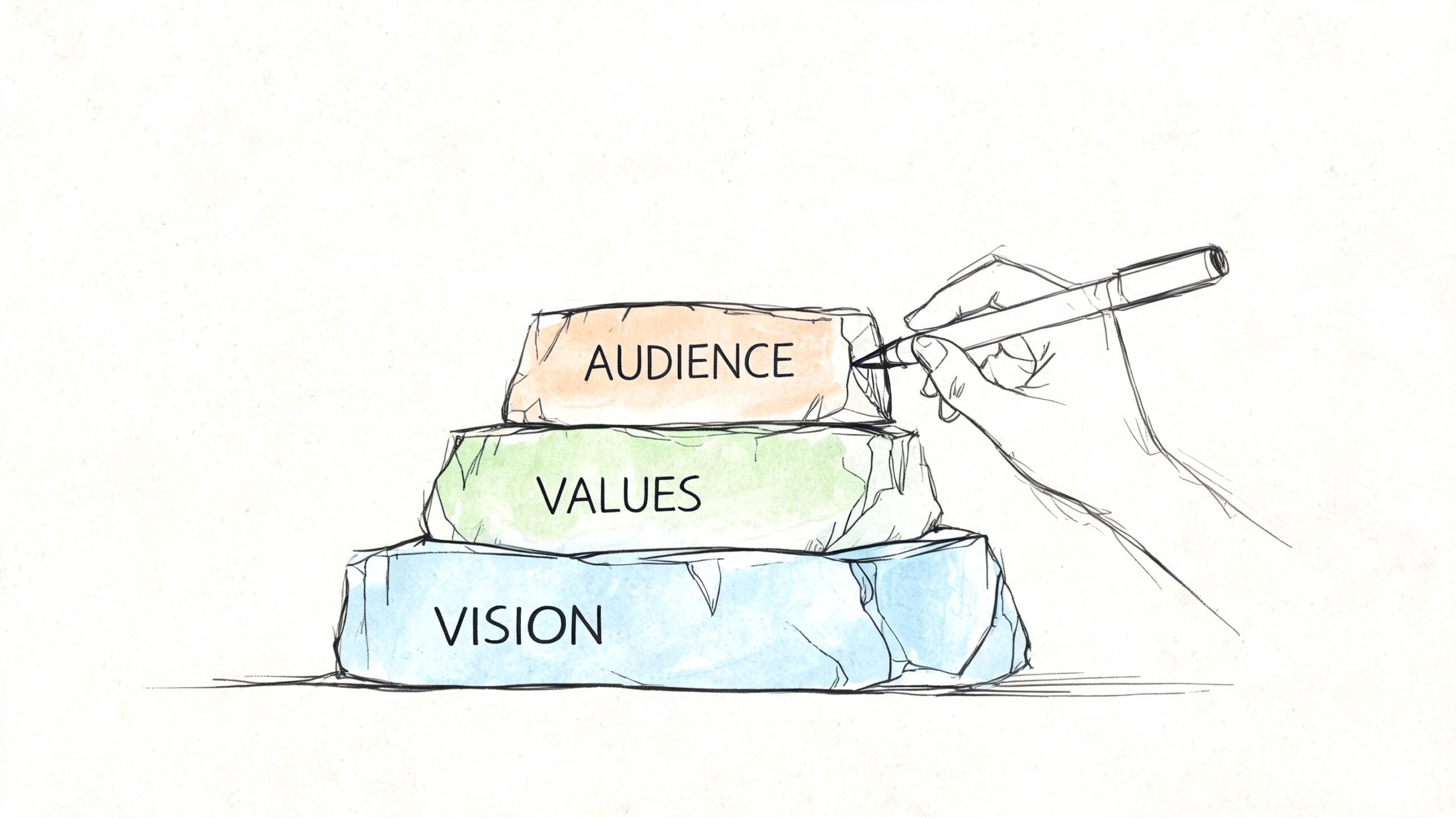
Branding starts with clarity. If you don’t know what you stand for, who you serve, and why someone should pick you over the next business on Google, the visual side becomes guesswork. You might still end up with something attractive, but it won’t have much weight behind it.
A strong brand helps customers answer three questions quickly:
- What do you do: Can people grasp your offer without digging?
- Who is it for: Is it obvious whether you’re right for them?
- Why trust you: Do you look and sound like a business that can deliver?
That matters even more when you’re new. An established company can lean on reputation. A startup can’t. A new business has to build confidence through every touchpoint, from the name and website to the tone of an email and the design of a quote.
Practical rule: If your branding creates confusion, your marketing gets expensive fast.
Around Dorset, that usually shows up in familiar ways. A retailer wants to start selling online but has no consistent look across shop signage, Instagram, and packaging. A local professional service has a decent referral network but no website that reflects the quality of the work. A founder has a good business model but speaks to everyone, so no one feels addressed directly.
Good branding fixes that by giving your business structure. It sharpens your offer, makes design decisions easier, and gives your website a clear job to do. It also stops you wasting money on piecemeal decisions that need redoing six months later.
What works is a simple sequence. Define the strategy first. Choose a name you can use. Build a visual and verbal identity that fits the business. Put that into a website that acts as your digital home. Then make sure people can find it.
Laying the Foundation Your Brand Strategy
The strongest brands don’t start with colour palettes. They start with decisions.
In the UK, 68% of successful startups attribute their initial traction to rigorous market research and defined brand purpose, while failing to do that is linked to a 52% higher pivot rate within the first two years, according to this brand-building breakdown. If you skip strategy, you usually pay for it later in rewrites, redesigns, and a business that never sounds fully sure of itself.
Start with your purpose
Your purpose doesn’t need to be grand. It just needs to be honest and useful.
A Dorset bookkeeping firm doesn’t need to “transform the financial future of Britain”. It might exist to make compliance and cashflow less stressful for local business owners. That’s clear. It’s believable. It can shape messaging, service design, and content.
Use this test:
- Write down why the business exists
Keep it plain. One sentence is enough. - Strip out generic language
Remove words like “quality”, “cutting-edge”, and “solutions” unless you can prove them in everyday work. - Link it to the customer’s real problem
What frustration are you removing, or what result are you helping them reach?
If your statement could sit on any competitor’s website, it isn’t finished.
Build audience personas that are usable
A lot of small businesses create an “ideal customer” that’s too vague to be useful. “Business owners in Dorset” is not a persona. It’s a broad category.
Useful personas tell you how to write, what to emphasise, and where to focus your website and content. For a local business, that often means splitting audiences by buying behaviour rather than industry alone.
A practical way to do it:
- Primary buyer: The person most likely to contact you first. For example, a shop owner in Weymouth who needs more online sales.
- Secondary buyer: Someone who influences the decision. That might be a business partner, manager, or committee member.
- Main pain point: What’s broken right now? Poor visibility, dated branding, low trust, confusing website, weak enquiries.
- Decision filter: What makes them say yes? Speed, clarity, local knowledge, reliability, fixed pricing, low hassle.
- Likely objection: What makes them hesitate? Cost, time, fear of getting it wrong, bad experience with a previous supplier.
The best persona work feels close enough that you can picture the actual conversation on the phone.
Write a positioning statement
Once you know your purpose and audience, define your place in the market.
A simple positioning statement can follow this shape:
| Element | Prompt |
|---|---|
| Audience | Who are you for? |
| Offer | What do you provide? |
| Difference | What do you do differently? |
| Outcome | What changes for the customer? |
For example, a local service brand might position itself around being practical, responsive, and easy to work with for small firms that don’t have in-house marketing support. That gives every later decision a reference point.
If you’re stuck, compare three local competitors and note what they all say. Then avoid repeating it.
Naming Your Business and Securing Your Digital Territory
A business name has two jobs. It needs to suit the brand, and it needs to be available.
People often overcomplicate the first part and ignore the second. They fall in love with a name, then discover the domain is taken, the Companies House listing is too close to an existing company, or the social handles are inconsistent. That’s avoidable if you treat naming as a practical process instead of a burst of inspiration.
What makes a strong name
You don’t need a clever name. You need one that works.
There are a few broad directions:
- Descriptive names tell people what you do. These are easier to understand quickly, but they can sound less distinctive.
- Evocative names suggest a feeling, place, or character. These often work well for hospitality, retail, and lifestyle brands.
- Founder-led names can work well for consultancies and professional services where trust sits closely with the person.
- Abstract names can be flexible, but they usually need more brand-building effort because they don’t explain themselves.
For most small businesses, the sweet spot is a name that’s simple to say, easy to spell, and broad enough to grow with you. If you call the business “Weymouth Facebook Ads Expert”, you might regret it when you start offering wider services.
Run the checks before you commit
Treat this as due diligence, not admin.
- Check Companies House
Make sure the name isn’t already registered or confusingly similar to a business in your space. - Check the domain
Look for a usable .co.uk and, if possible, the .com too. - Check social handles
Consistency matters. If your Instagram, Facebook, LinkedIn, and TikTok all use different versions of the name, your brand starts fragmented. - Check trademarks
Do a basic UK trademark search before you put money into design and signage. - Say it out loud
If customers can’t pronounce it, remember it, or repeat it over the phone, it will cost you. - Test it in context
Put the name into a sample homepage heading, email signature, invoice, and social bio. Some names look fine on paper and weak in real use.
Avoid the common traps
Some names fail because they’re too narrow. Others fail because they chase originality at the expense of clarity.
Watch for these problems:
| Naming trap | Why it causes trouble |
|---|---|
| Trendy spellings | Harder to search, harder to remember |
| Overly local limitation | Fine for one town, restrictive if you expand |
| Generic terms only | Blends in with competitors |
| Long multi-word names | Awkward in domains and social handles |
A good name doesn’t need to impress everyone. It needs to give the right people confidence and leave room for growth.
Crafting Your Visual and Verbal Identity
This is the point where your brand becomes visible and audible. Customers start forming judgments before they’ve read much at all. They notice the logo, colour choices, type, photography, and how the business sounds in a headline or email.
In the UK, consistent brand presentation across all platforms can increase revenue by up to 23%, according to this branding ROI analysis. That matters because consistency is what turns a business from “I think I’ve seen them before” into “I know who they are”.
Build the visual side as a system
A logo matters, but it’s only one part of the identity.
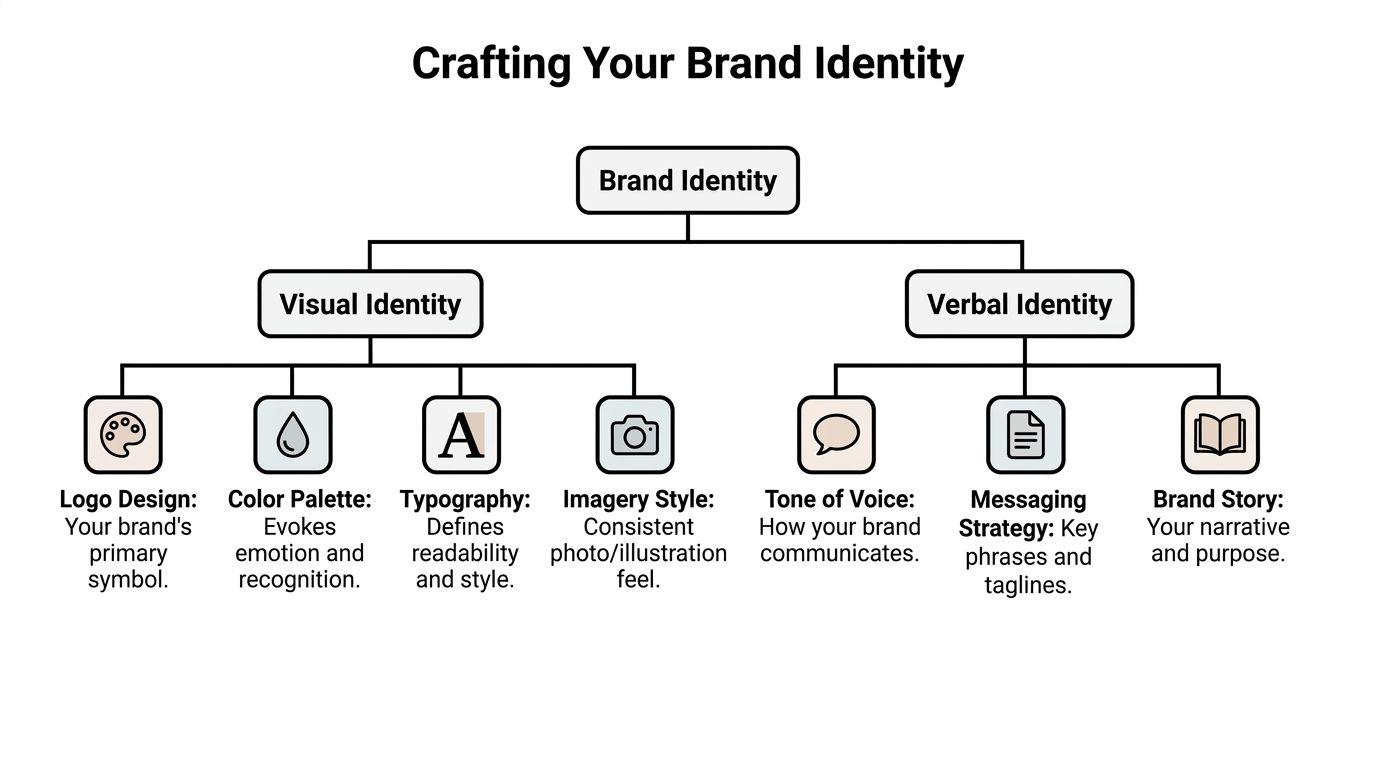
Your visual brand usually needs these pieces working together:
- Logo design for your main mark, plus simplified versions for small spaces
- Colour palette that fits the tone of the business and works across screen and print
- Typography that supports readability as well as personality
- Imagery style so your photography, icons, and graphics don’t feel unrelated
For example, a premium food brand might use restrained colours, elegant typography, and close-up product photography. A family activity business might need brighter tones, friendlier type, and energetic imagery. Neither approach is better. The point is fit.
If you sell products in physical spaces, think beyond the website. Packaging, menus, labels, signage, and stickers all carry the brand. A useful reference for seeing how visual identity translates into physical retail branding is this collection of cafe logos for vinyl stickers, especially if you’re trying to make a small venue look considered rather than improvised.
Shape the verbal identity properly
A lot of brands look coherent and sound generic. That usually means no one defined the verbal side.
Your verbal identity includes:
| Element | What it controls |
|---|---|
| Tone of voice | Whether you sound formal, warm, direct, playful, or expert-led |
| Messaging | The phrases and points you repeat consistently |
| Brand story | Why the business exists and what it helps people do |
A Dorset trades business, for instance, doesn’t need polished corporate language if its customers value honesty and speed. A legal or financial brand may need more formality, but it should still sound human. If every sentence reads like it came from a brochure template, trust drops.
Good tone of voice isn’t about sounding clever. It’s about sounding right for the customer and consistent across every channel.
Make consistency practical
The mistake I see most often is creating brand assets but not rules. That’s when the Instagram graphics look one way, the website another, and printed material like it belongs to a different business.
Create a short brand guide with:
- Logo usage rules
- Approved colours
- Font choices
- Photography direction
- Writing examples
- Words to use and words to avoid
If you need support creating those assets, a service like brand and graphic design support can package the visual pieces into something a small business can use day to day, rather than a folder of isolated files.
The test is simple. If someone sees your website, leaflet, social post, and quote document in the same week, it should feel like one business speaking clearly.
Building Your Digital Home A WordPress Website
Your website is where the brand has to perform. Not just look good. Perform.
A new business can survive for a while with a basic social presence, but it can’t build long-term trust on rented platforms alone. Social media changes. Listings get buried. Algorithms move the goalposts. Your website is the one place you control fully, which is why it needs to be treated as the centre of the brand.
Why WordPress makes sense for most SMBs
For most UK small businesses, WordPress is still a sensible choice because it gives you flexibility without boxing you into a rigid template ecosystem. It works well for brochure sites, service businesses, blogs, membership sites, and eCommerce when built properly.
That last part matters. A weak WordPress site isn’t usually a WordPress problem. It’s a planning problem.
What a new brand needs is a website that:
- Loads cleanly on mobile
- Makes the offer obvious
- Guides people to one clear next step
- Can grow as the business grows
- Lets you edit content without rebuilding the whole thing
A local restaurant site needs different priorities from a B2B service company, but both still need clarity, speed, and structure.
The pages that do the heavy lifting
Many startup websites try to say everything at once. The homepage becomes a wall of text, the navigation gets messy, and users don’t know where to click.
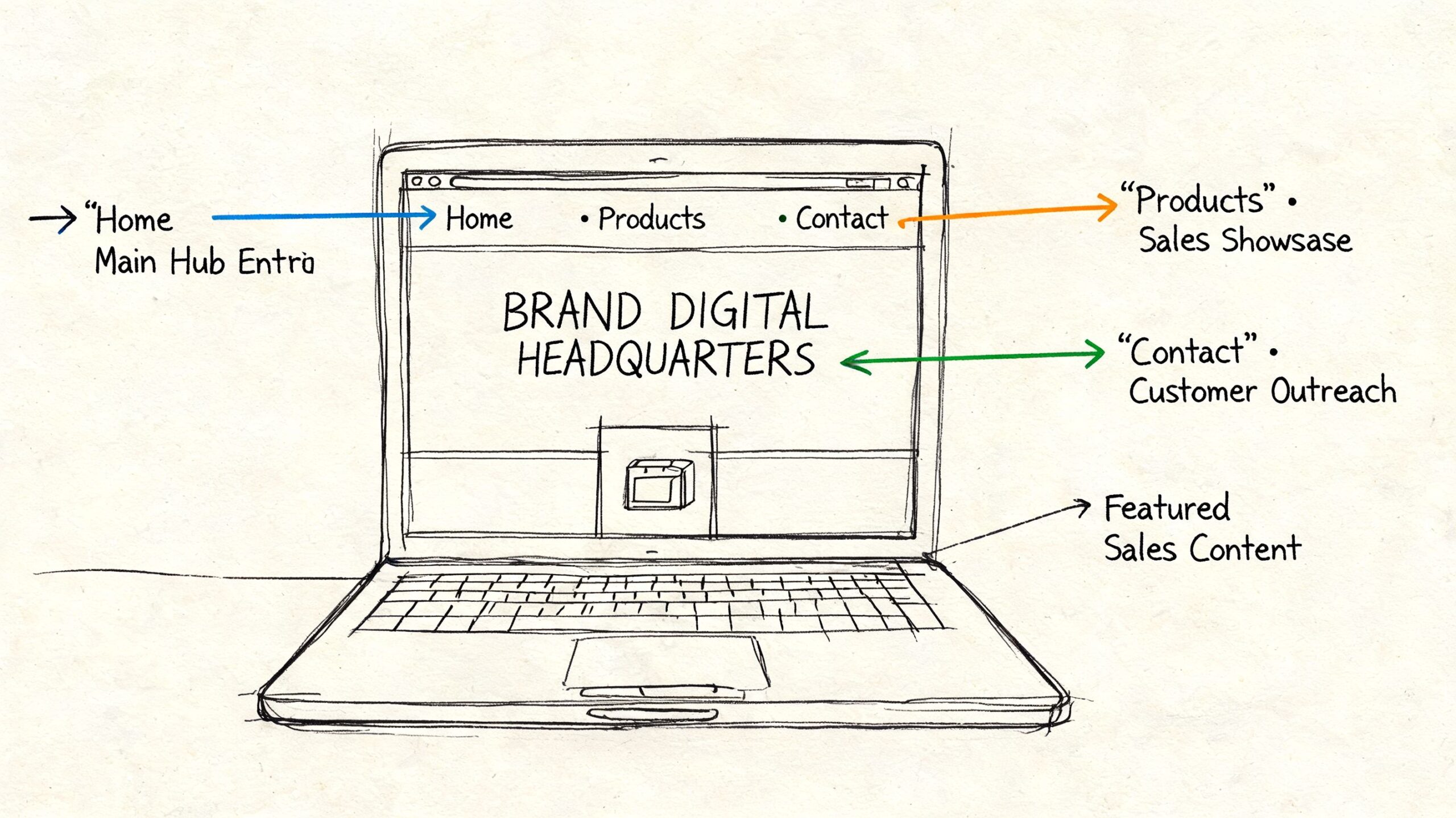
A stronger setup is usually straightforward:
| Page | Job |
|---|---|
| Home | Explain what you do and direct visitors onward |
| About | Build trust and show the people or values behind the business |
| Services or Products | Help people understand what they can buy |
| Contact | Remove friction from getting in touch |
| Blog or Resources | Support SEO and demonstrate expertise |
That doesn’t mean every business needs dozens of pages on launch. It means every page should have a purpose.
A service page shouldn’t just describe the service. It should answer the concerns a buyer has before they enquire. A contact page shouldn’t just list an email address. It should make taking the next step feel simple.
If a visitor has to work out what you want them to do next, the site isn’t doing its job.
There’s a helpful walkthrough on choosing the right build partner in this guide on finding a website designer who understands your vision. That’s worth reading before you commission anything, especially if you’ve never run a web project before.
A quick visual example helps here:
What works and what usually fails
What works is a website that respects how people browse. They scan headings, look for proof, check whether you seem current, and decide quickly whether you feel credible.
What fails is familiar:
- Stock messaging that could belong to any business
- Homepage sliders that bury the core message
- Too many calls to action competing for attention
- Thin service pages with no real substance
- No local relevance for a business that depends on local enquiries
For Dorset businesses, local proof matters. If you serve Weymouth, Dorchester, Portland, or Poole, say so naturally where it helps. If your work suits retailers, trades, hospitality, or membership organisations, show that in the way the site is structured.
A website should feel like your best salesperson, not your digital business card.
Preparing for Launch The SEO and Content Checklist
A brand launch without visibility is mostly a private event. You can have the right identity and a strong website, but if nobody can find you, momentum stalls.
That’s where basic SEO and content planning come in. Not the overcomplicated version. The useful version.
In regions like Dorset, 61% of local retailers struggle with online visibility, and Adobe’s brand guide notes that hyper-local trends can yield a 2.5x higher ROI for SMEs compared to generic national approaches. For a small business, that means “web design Weymouth” or “florist Portland Dorset” can matter more than broad national terms that are harder to win.
Your pre-launch checklist
Use this list before the site goes live:
- Set target keywords: Choose a main search phrase for each core page. Keep it relevant to the page, the service, and your area.
- Write strong page titles: Your homepage and service pages should tell search engines and users what the page is about in plain English.
- Add local relevance: Mention service areas naturally in page copy where it helps a real reader.
- Check heading structure: Each page should have a clear top heading and organised subheadings.
- Prepare Google Business Profile: If local customers matter, this should be ready alongside the website.
- Create launch content: Publish a small set of useful pages or articles that answer real customer questions.
- Review contact paths: Test forms, buttons, phone links, and email delivery before launch.
One missed detail can undermine the whole launch. I’ve seen good websites lose early leads because forms weren’t forwarding properly or confirmation emails landed in junk. If email reliability is a concern, this guide on how to stop email from going to spam in Gmail is a practical starting point for checking common causes.
Go local before you go broad
A lot of startup brands chase wide visibility too soon. They write generic pages aimed at the whole UK, even though most of their likely customers are within driving distance or searching for a local provider.
That’s usually the wrong order.
Start with:
| Priority | Example |
|---|---|
| Service plus location | accountant in Weymouth |
| Problem plus location | shop signage design Dorset |
| Niche plus location | WordPress website for Dorset café |
This approach helps new businesses build traction where they can realistically compete. Once local visibility improves, broader content becomes easier to justify.
Build content that supports trust
Your first content doesn’t need to be frequent. It needs to be useful.
A new business might launch with:
- A clear homepage
- Well-written service pages
- An about page with real substance
- Two or three blog posts answering common questions
- A short FAQ if customers ask the same things repeatedly
If you want ongoing support with visibility after launch, search engine optimisation for small businesses is usually most effective when it’s tied directly to your site structure, local targeting, and content plan rather than treated as a separate bolt-on.
Your Launch Plan and Sustaining Growth
Launch day matters less than the first few months after it.
A lot of owners treat launch as a finish line. They publish the site, post on social media, tell a few contacts, and assume the brand is now “done”. In practice, that’s when the actual work starts. You need to reinforce the message, watch how people respond, and keep improving what isn’t landing.
What to do in the first three months
Month one is about getting everything live and checking the basics. Are people visiting the right pages? Are enquiries coming through? Are there any obvious friction points?
Month two is where patterns start to appear. You’ll usually see which pages people engage with, which services get attention, and where your messaging still needs tightening.
Month three is where consistency starts to matter. Keep posting, keep refining, keep following up local opportunities, and keep the site current. A quiet website starts to make even a good business look neglected.
Launching a brand once is easy. Running it consistently is what builds recognition.
Keep a simple measurement routine
You don’t need a complicated dashboard at the start. You do need a habit.
Check basic signals such as:
- Which pages get visited most
- Whether people contact you from the site
- What search terms begin to appear
- Which social posts or emails drive actual action
- Whether users drop off at particular pages
Google Analytics and Search Console are enough for most early-stage businesses. The point isn’t to drown in data. It’s to spot what deserves attention.
Sample 3-Month Brand Launch Budget & Timeline
| Phase / Item | Month 1 | Month 2 | Month 3 | Estimated Cost (£) |
|---|---|---|---|---|
| Brand strategy and messaging | Complete | Review | Refine | Varies |
| Visual identity assets | Complete | Apply across channels | Top-up items | Varies |
| Website build and launch | Complete | Fix snags | Improve pages | Varies |
| SEO setup | Complete | Monitor | Expand | Varies |
| Launch content | Publish core pages | Add supporting content | Add another useful piece | Varies |
| Email and social rollout | Announce launch | Follow-up campaign | Ongoing posting | Varies |
| Maintenance and updates | Basic checks | Routine updates | Routine updates | Varies |
This doesn’t need to be expensive to work. It does need to be organised.
The strongest new brands aren’t always the loudest. They’re the ones that stay coherent after launch. Same message. Same quality. Same standard across every customer touchpoint.
If you’re building a brand from scratch and want practical support with the strategy, visuals, website, or launch planning, DesignStack offers branding, WordPress web design, graphic design, and digital support for businesses across Dorset and the UK.