


How to Conduct Competitor Analysis for Your Small Business
You've got a website that's getting a steady trickle of visits, a few enquiries here and there, and a nagging feeling that a nearby business is winning the work you should be getting. Maybe your prices look fine, your branding feels polished enough, and your team is busy, but the calls still drift elsewhere. That's usually the moment competitor analysis stops being a theory exercise and becomes a practical business tool.
For UK small businesses, how to conduct competitor analysis isn't about copying whoever shouts loudest. It's about comparing the firms customers choose, the reasons they choose them, and the gaps you can close faster than a larger rival can react. In a market where the UK had an estimated 5.5 million private-sector businesses at the start of 2024 and 99.9% were SMEs (U.S. Small Business Administration guidance), most of the competition is local, agile, and close enough to feel personal.
Table of Contents
- Why Competitor Analysis Matters for Small Businesses
- Defining Your Real Competitors
- Gathering Data on Competitor Websites and Digital Presence
- Scoring Competitors with a Simple Comparison Matrix
- Turning Findings into a SWOT and Action Plan
- Keeping Your Competitor Analysis Alive
- Your 30-Day Competitor Analysis Action Plan
Why Competitor Analysis Matters for Small Businesses
A Weymouth café owner can spend weeks tweaking the menu, redesigning the homepage, and lowering prices, then still wonder why the shop across town is getting the same locals through the door. The answer is rarely luck. More often, the rival's offer, presentation, and trust signals line up better with what customers want at the exact moment they're deciding.
That's why competitor analysis is the cheapest market research most SMEs can run. It doesn't need a paid panel, a consultancy retainer, or a giant dataset. It starts with looking at what nearby businesses are already doing, then comparing that against your own site, branding, and service story before you launch changes you can't easily undo.
Practical rule: don't analyse competitors to imitate them, analyse them to find the gap they've missed and you can own.
The temptation is to copy the slickest-looking business, but that's usually a mistake. A glossy homepage can hide weak fulfilment, slow response times, or unclear pricing. A structured competitor analysis forces you to separate what looks impressive from what wins enquiries, which is a much more useful distinction for small businesses with limited time and budget.
It also gives you a better basis for decisions about redesigns, pricing changes, or campaign planning. If a rival's website makes it obvious what they do, who they help, and how to contact them, you can benchmark your own journey against that. If their branding feels clear while your service pages are vague, you've found a fixable problem, not a mystery.
For a wider view on whether those website changes are worth the effort, it helps to think about search and visibility as part of the same commercial decision. This guide on whether SEO is worth it for small business sits neatly alongside competitor research because both questions are really about return on attention, not just traffic.
Defining Your Real Competitors
The easiest mistake in competitor analysis is to stop at the obvious names. A Dorset professional services firm might list two similar agencies in town and call it a day, even though prospects are also comparing them with national specialists, freelancer collectives, directory marketplaces, and even AI-assisted search results that surface alternatives before a website visit happens. The right shortlist is smaller, sharper, and based on how customers choose.
Build a three-layer rival set
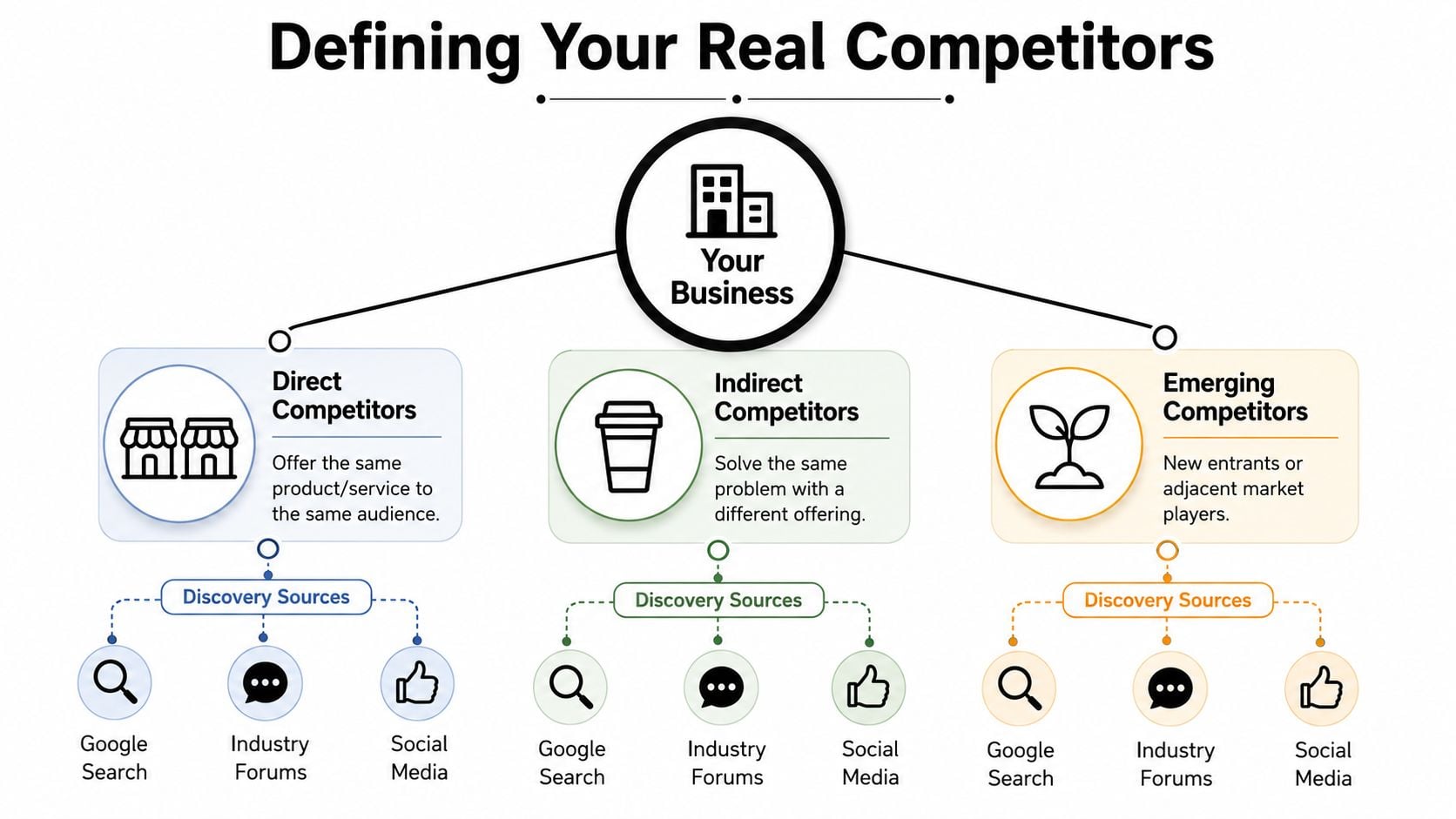
Start with direct competitors, the businesses offering the same service to the same audience. These are the most obvious comparison points, and they usually deserve the most attention first. Then add indirect competitors, which solve the same customer problem in a different way, such as a marketplace, template platform, or broader service bundle. Finally, include emerging competitors, which might be new entrants, adjacent providers, or channels that are changing how people discover and evaluate you.
The practical test is simple. If a business appears in the same search results, gets mentioned in the same reviews, or comes up in sales conversations, it belongs on the list. That's why Google Search, industry forums, social media, local directories, customer surveys, sales call notes, and trade association member lists are all useful discovery sources. You're not building a theoretical market map, you're building a working one.
Shortlist tightly, then go deep
Keep the set tight. A shortlist of three to ten competitors is usually enough to compare like-for-like features, messaging, and channels without drowning in tabs and notes (HubSpot competitor analysis guidance). Once the list gets much bigger than that, the exercise turns into admin rather than insight.
For a Dorset-based accountancy practice, for example, the direct rivals might be two local firms with similar packages. Indirect rivals could include online bookkeeping subscriptions and fractional finance services. Emerging rivals might be AI search results, national firms entering the region, or niche platforms that answer questions before prospects reach a contact form.
A useful competitor isn't the one with the most similar logo, it's the one that gets chosen instead of you.
That distinction matters because buyer behaviour isn't neatly linear. UK shopping and browsing habits are fragmented across search, mobile, marketplaces, and social discovery, so some substitutes capture demand before a classic rival ever appears in the comparison set (Xero's competitor analysis guidance). Once you see that, the job becomes clearer. You're not just comparing businesses, you're comparing routes to purchase.
Gathering Data on Competitor Websites and Digital Presence
Once the rival set is defined, the next job is evidence. For small businesses, the most useful data usually lives on websites, pricing pages, review profiles, and social channels, because that's where customers form first impressions and decide whether a business feels credible enough to contact.
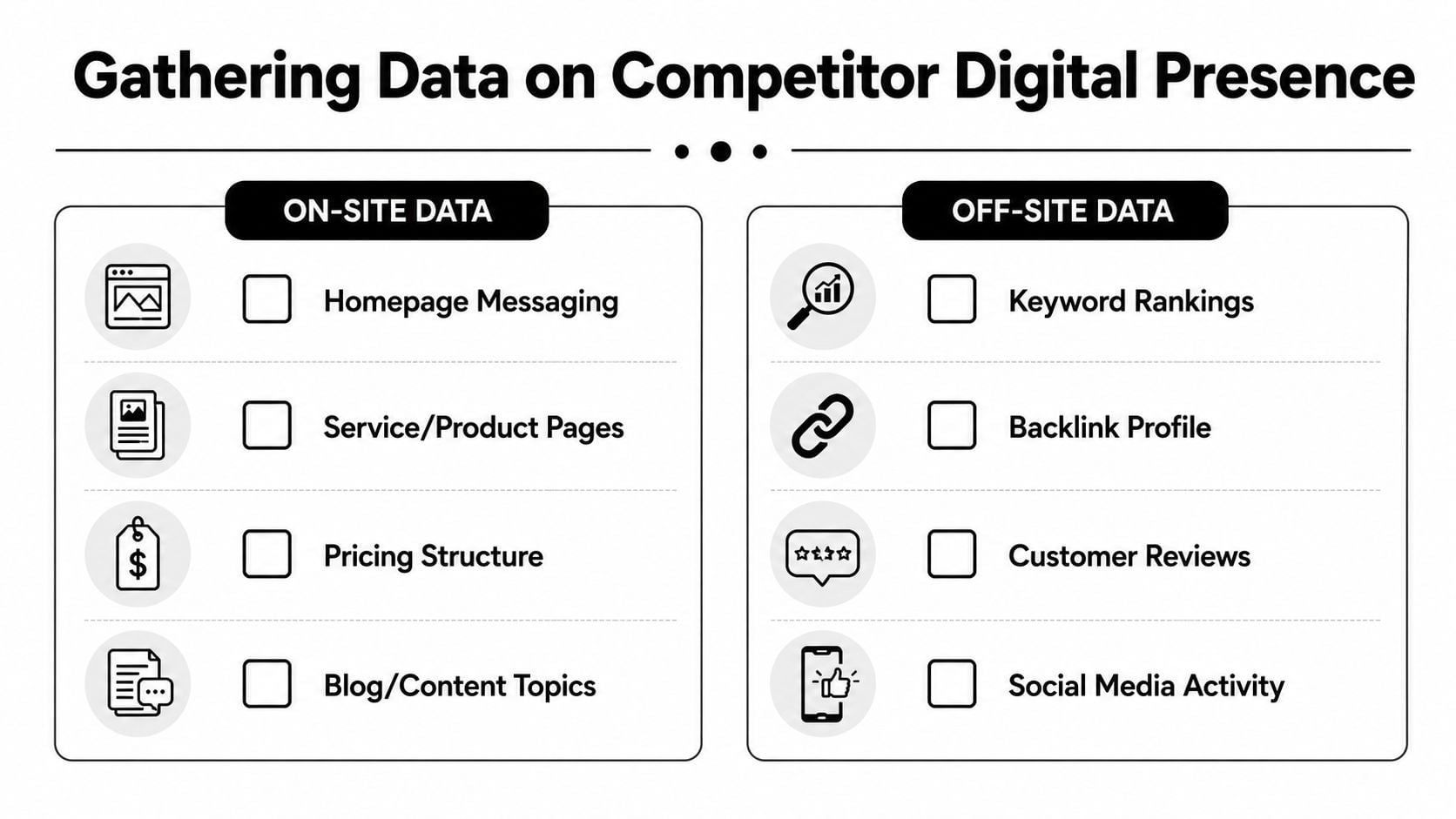
Start on-site. Record the homepage message, the service or product pages, the pricing structure, and the content themes. Look for clarity, not just design polish. If a competitor makes their offer obvious in one scroll and your own page buries it under jargon, that's actionable. If they use a lead magnet, case studies, or trust badges near the main call to action, note that too.
Capture both visible and technical signals
Off-site data matters just as much. Track the competitor's keyword visibility, backlink profile, customer reviews, and social media activity. For UK businesses, this is especially important because trust is closely tied to site experience and review quality, not just visual branding. The practical evidence should come from the source itself, such as the pricing page, an accessibility statement, a review platform, or a performance test.
Free tools go a long way here. Google Search tells you what shows up for local-intent queries. Page-speed testers and basic SEO checkers show whether a site is technically sound. Review platforms reveal recurring praise and complaints. If you want broader visibility, use a simple SEO tool and compare which pages get referenced most often. For teams that need a more structured way to pull public data at scale, the guide to choosing scraping APIs is a useful reference point for understanding the trade-offs between manual collection and automated gathering.
A Dorset-style checklist for each rival can stay simple:
- Homepage message: Is the offer clear in seconds, or does it hide?
- Service pages: Do they explain outcomes, process, and next steps?
- Pricing: Is it transparent, packaged, or completely hidden?
- Reviews: What do customers praise or complain about repeatedly?
- Social presence: Are they active, dormant, or inconsistent?
- Technical basics: Does the site feel fast, mobile-friendly, and easy to use?
Use the evidence, not the shine
The goal isn't to admire the neatest website. It's to spot which rivals make buying feel easy. One business might look less polished but convert better because the journey is clearer. Another might have plenty of traffic yet weak trust signals, which creates an opening for a better-supported offer.
For teams that want to go deeper into the digital side, this analytics guide for websites sits naturally alongside competitor work because you can only improve what you can measure. The best audits connect the public-facing evidence to actual behaviour, not vanity metrics.
Scoring Competitors with a Simple Comparison Matrix
A matrix stops competitor analysis turning into a pile of disconnected notes. It lets you compare each rival against the same criteria, which is the only reliable way to spot patterns instead of impressions. For most small businesses, the easiest columns are price, service quality, digital presence, and trust signals.
The trick is not to score everything equally by default. If most of your enquiries come from people comparing responsiveness and proof of expertise, those criteria should carry more weight than, say, social activity. Weight the columns according to what drives your sales, not what looks neat in a spreadsheet.
A lightweight way to score rivals
Use a simple 1 to 5 scale if that helps, or keep it qualitative if your team prefers fewer false precisions. What matters is consistency. Score every rival using the same evidence source, then add a note beside each score so you can defend it later.
| Criterion | Competitor A | Competitor B | Your Business | Evidence Source |
|---|---|---|---|---|
| Price | Mid | Low | Mid | Pricing pages |
| Service quality | Strong | Mixed | Strong | Service pages, customer feedback |
| Digital presence | Strong | Moderate | Strong | Search results, website review |
| Trust signals | Moderate | Strong | Strong | Reviews, case studies, contact clarity |
If you want a wider view of tools that help with this kind of work, the top competitor research platforms page is useful because it shows how different tools surface different layers of evidence. The tool matters less than the discipline of comparing the same thing in the same way.
A worked example from Dorset
Take two hypothetical Dorset web design agencies. Competitor A charges more but uses clear packages, stronger proof, and a more polished lead path. Competitor B looks cheaper on the surface, yet its service pages are vague and its review profile is thin. If your own business sits between them on price but closer to Competitor A on trust, you may not need to undercut anyone. You may need to sharpen positioning and make that trust easier to see.
This page on what domain authority means is useful if you're comparing search strength, because it helps separate brand reputation from a wider SEO signal. That distinction matters when a competitor seems “bigger” online but is stronger in only one area.
Best practice: record the exact source for every score. That keeps the matrix repeatable, which matters when you revisit it next quarter.
The final value of the matrix is strategic, not decorative. It should reveal where your business can win without racing to the bottom on price. If the comparison shows rivals are weak on clarity, responsiveness, or conversion flow, those are the places to invest first.
Turning Findings into a SWOT and Action Plan
A matrix is useful, but it still isn't strategy. The next step is to translate the scores into a SWOT-style gap map, then turn that into actions your team can complete this quarter. That means identifying what the market rewards, what competitors do badly, and what you can change without rebuilding the business from scratch.
Sort the gaps into priorities
Start with the issues that directly affect enquiries. If a competitor's homepage explains the offer better, your fix might be a clearer hero section and a tighter service summary. If reviews show that buyers care about speed and reassurance, your response could be a stronger testimonial block or a more specific support promise. If pricing is confusing, simplify the structure or make the value behind each tier easier to compare.
The best action plans separate must-do fixes from nice-to-have improvements. A must-do fix directly affects conversion, trust, or clarity. A nice-to-have may improve the brand later, but it doesn't unblock decisions today. That distinction keeps small businesses from spending a quarter polishing the wrong thing.
For content-led changes, this guide to content strategy is a practical companion because competitor findings usually expose content gaps before they expose design problems. A rival may not be winning because their site looks prettier. They may be winning because they answer questions earlier, faster, and more clearly.
Assign owners and deadlines
An action plan without owners is just a wish list.
That line sounds blunt because it's true. If no one is responsible for rewriting the service page, redesigning the landing page, or updating the proof section, the insight dies in a notebook. Give every task a named owner, a deadline, and a simple success measure so it doesn't drift.
A useful structure is:
- Website tasks: homepage rewrite, service page refresh, contact flow improvements
- Content tasks: new comparison page, FAQ update, case study addition
- Brand tasks: visual consistency, tone of voice, trust proof placement
- Marketing tasks: review generation, landing page promotion, email follow-up
The point is to make the findings fundable and executable. A small business doesn't need a giant roadmap. It needs three or four clear moves that reduce friction and improve confidence fast.
Keeping Your Competitor Analysis Alive
Competitor analysis falls apart when it becomes a one-off PDF. Rivals change prices, launch services, update content, and shift messaging all the time, and the businesses that notice first usually have a better chance of responding before the market moves again.
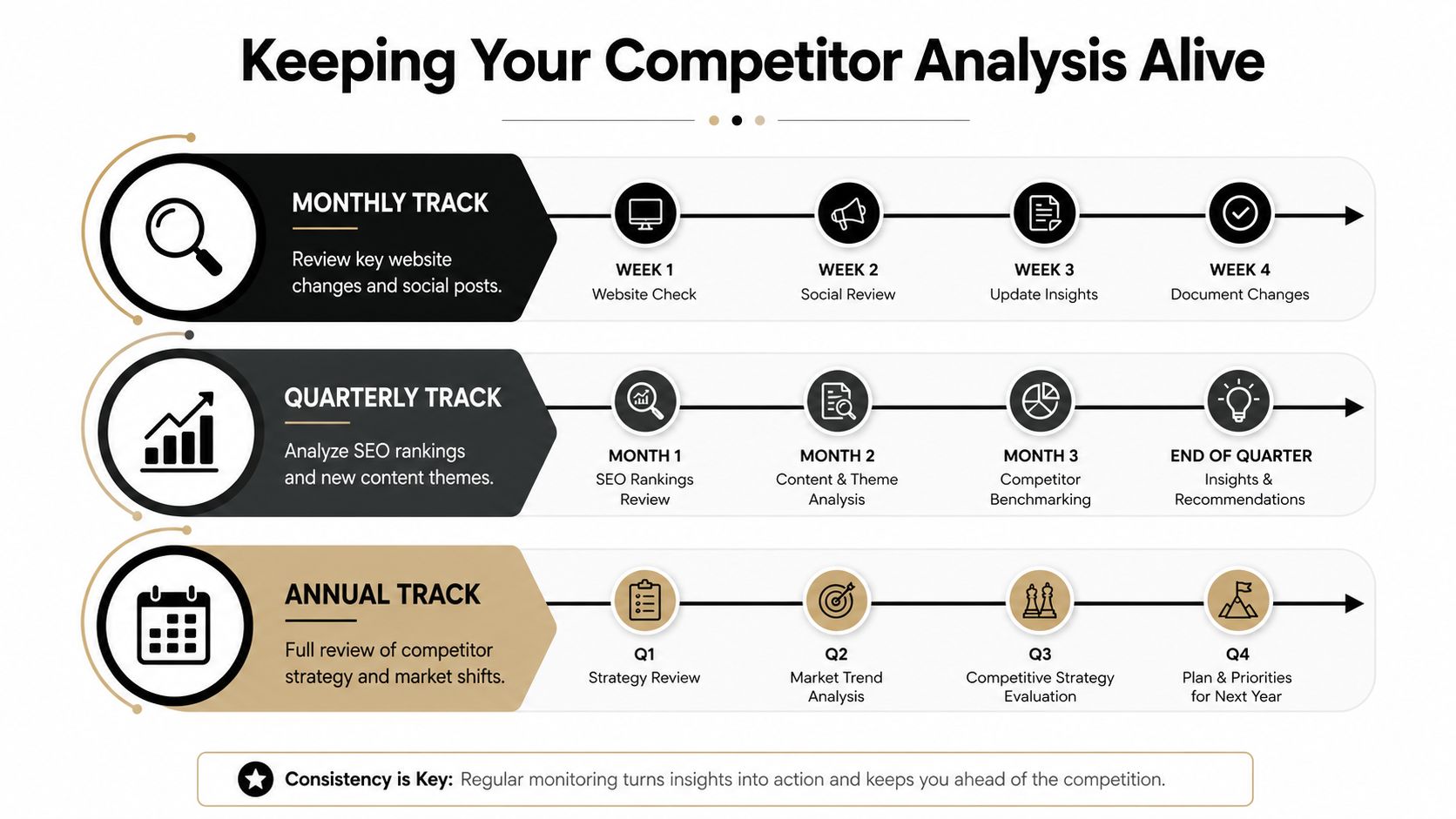
The lightest sustainable rhythm is monthly, quarterly, and annual. Monthly, check obvious changes, such as homepage updates, pricing edits, new offers, or active social posts. Quarterly, review search visibility, content themes, and review trends. Annually, step back and assess the bigger strategic shifts, including positioning, service range, and whether new substitutes have become more important.
Don't confuse polish with strength
A common mistake is over-weighting visible marketing polish and under-weighting harder-to-copy operating factors. A beautiful site means very little if support is slow, fulfilment is patchy, or the checkout path is clumsy. Good analysis checks what the business delivers, not just how well it presents itself.
That's where first-hand testing matters. Read the reviews, use the site, submit the form, and judge the friction yourself. If the competitor makes it hard to buy, contact, or understand the offer, that weakness is often more valuable than a flashy campaign.
Track launches, pricing shifts, and messaging changes regularly, because the businesses that move quickly rarely announce that they're changing the rules.
For UK SMEs, this doesn't need to be heavy. A simple monthly note, a quarterly review sheet, and an annual refresh are enough to keep the analysis useful. Anything more complicated tends to get ignored.
Your 30-Day Competitor Analysis Action Plan
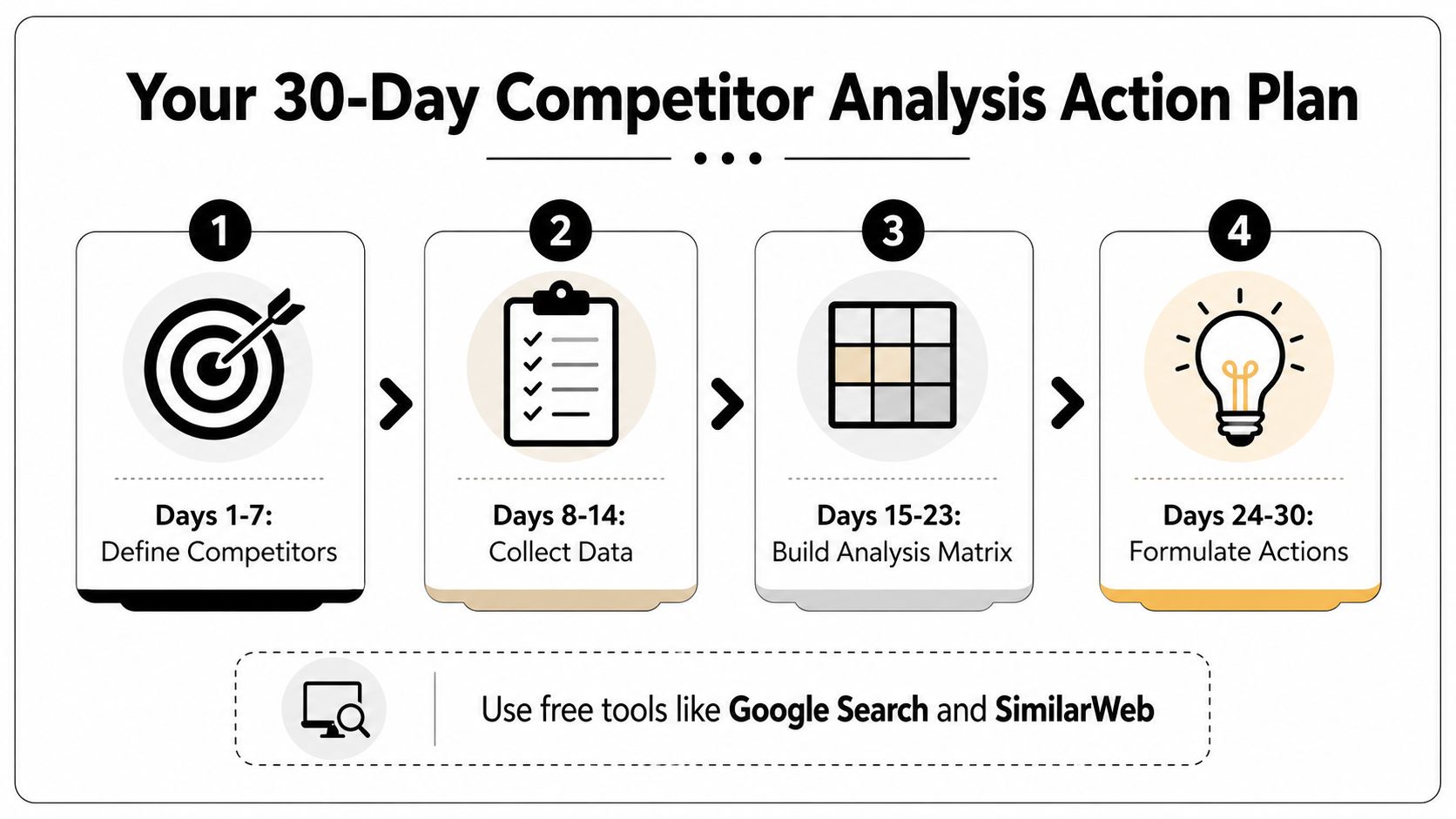
Days 1 to 7, define your rival set. Pick your direct, indirect, and emerging competitors, then keep the list tight enough to analyse properly. Use Google Search, local reviews, customer comments, and sales notes to build the shortlist, and record why each business made the cut.
Days 8 to 14, collect evidence. Capture website messaging, pricing, content themes, trust signals, review patterns, and social activity. If you want a simple working template, create columns for competitor name, type, source, key observation, and action idea. Keep the evidence plain and repeatable so you can update it later without starting over.
Days 15 to 23, build the matrix. Score each rival on the criteria that matter most to your enquiries, then note what they do better, what they do worse, and where your own business already has an edge. If you need a visual reminder of how to measure progress after the changes go live, this guide to measuring website success is a good companion piece.
Days 24 to 30, turn the findings into actions. Pick the top three fixes you can complete in a quarter, assign owners, and set a date for the next review. If the work needs design, SEO, or content support, bring in a specialist who can translate the analysis into pages, branding, and conversion improvements instead of leaving it as a document.
If you want your analysis turned into clearer pages, sharper positioning, and a website that supports real enquiries, DesignStack can help. The team works with Dorset and UK businesses that need practical web design, branding, and SEO decisions grounded in competitor insight, not guesswork.



Leave a Reply