


Digital Marketing Hampshire: A Local Growth Playbook
You've probably had the same month Hampshire owners always have. The phone's busy enough to feel hopeful, the inbox is full of enquiries that go nowhere, and every agency pitch sounds strangely similar once you strip out the polished language. If you're running a business in Southampton, Portsmouth, Winchester, Basingstoke, or the New Forest, the question isn't whether you need digital marketing, it's which gaps are costing you leads right now, and who should own the fix.
Table of Contents
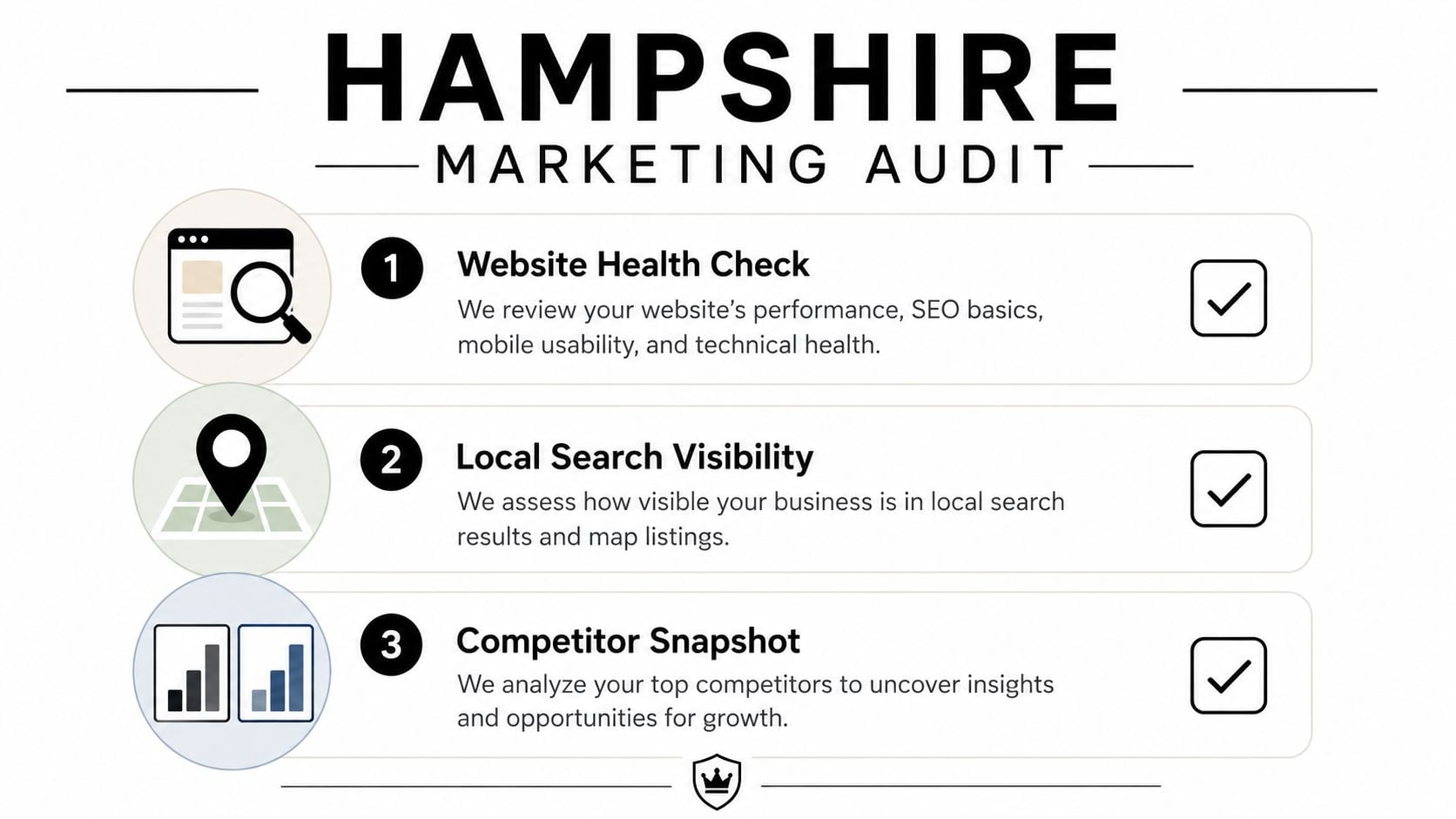
- Start with a Hampshire Marketing Audit You Can Run This Week
- Win the Local Pack with Google Business Profile and Local SEO
- Turn Your WordPress Site into a Conversion Engine
- Build Hampshire Town by Town Content That Search Engines Reward
- Plan Paid Advertising Across Hampshire Towns
- Measure What Matters and Keep Ownership of Your Assets
- Choose a Hampshire Digital Marketing Agency Without Getting Burned
Start with a Hampshire Marketing Audit You Can Run This Week
A Southampton trades firm can waste months by paying for ads before checking whether its website loads properly on mobile or whether Google even understands which towns it serves. A better move is to block out 60 minutes and run a blunt audit of what's already happening, then decide what deserves budget first.
Start with the search terms that matter in your town
Search your real service terms in the towns you cover, not just broad county phrasing. “Electrician Southampton” is a different commercial opportunity from “electrician Hampshire”, and the same is true for Winchester, Basingstoke, Gosport, or Fareham.
Practical rule: if your business doesn't appear where local buyers are searching, don't call it a branding problem. Call it a visibility problem.
Check the Google Business Profile, the website's mobile experience, and the pages that already bring enquiries. Pull the last three months of leads and sort them by source, even if that source data is messy. That quick exercise usually exposes the issue, whether it's weak local visibility, poor conversion, or a channel mix that's been left to drift.
Use a simple workbook and don't overcomplicate it. The point is to establish a baseline before anyone sells you a strategy.
- Search visibility: note where you rank for each town and service combination.
- Google Business Profile: compare your listing with the local pack top three.
- Website health: check mobile layout, page speed, and whether key service pages load cleanly.
- Lead sources: identify which calls, forms, and emails came from search, paid, social, or referrals.
A good audit turns “we need marketing” into “these are the exact gaps”. That makes every later decision clearer, and it stops you buying services you don't need. If you want a structured starting point, the SEO audit process is a sensible internal benchmark for what a proper review should cover.
Win the Local Pack with Google Business Profile and Local SEO
Hampshire-focused local SEO guidance now treats mobile optimisation, Hampshire-specific content, local schema markup, quality local citations, and review management as the core of “near me” visibility, not optional extras. That's the right stance. If you're chasing map-pack leads for a plumber, solicitor, accountant, salon, or independent retailer, those are the pieces that matter before anything else.
Make Google Business Profile earn its place
Start with the basics most businesses half-finish. Pick the right primary category, add relevant secondary categories, complete every service field, and use real photos from work you've done in Hampshire. Geo-tagging isn't magic, but real local images help buyers trust that you operate where you claim.
Reviews matter because they change both ranking confidence and conversion behaviour. Ask customers at the right moment, after delivery, after a resolved issue, or after a project handover, not in a blanket email blast that feels desperate.
Then build the rest of the local stack in the right order. Town pages should exist only where you serve, and each page needs different evidence, not copied text with a town name swapped in. Add schema markup, clean citations, and internal links from relevant blog posts back to the service pages that convert.
| Source | What it powers | Priority |
|---|---|---|
| Google Business Profile | Map-pack visibility, calls, directions, reviews | Highest |
| Google Search results | Organic clicks for town and service terms | Highest |
| Major UK directories | Consistent business details and citation trust | High |
| Local chamber or trade listings | Community relevance and referral support | Medium |
| Relevant industry directories | Authority in your niche | Medium |
Hampshire's search market is broad enough that you can't treat the county as one generic location. A business in Southampton doesn't need the same page structure or proof points as one serving the New Forest. That's why the local SEO framework should be built around real service areas, not a county-wide slogan.
Local SEO works when it helps the buyer make a decision quickly. Anything that doesn't help the buyer decide is decoration.
Turn Your WordPress Site into a Conversion Engine
A site that ranks and still fails to generate calls is a leaky asset. It's not “good enough for now”, it's actively costing you money because every visitor has to work too hard to figure out what you do, where you serve, and why they should trust you.
Treat trust as a design requirement
For Hampshire SMEs, the strongest trust signals are usually plain and practical. Use real project photos, named local testimonials, professional body logos where they're valid, and enquiry forms that are short and GDPR-compliant. The home page should confirm your service area above the fold, not hide it behind a footer link.
Mobile matters most because local buyers often search while they're on the move or ready to act. That means click-to-call buttons, obvious enquiry paths, and pages that don't bounce around as they load. If a visitor has to pinch and zoom just to find your phone number, the site is losing leads.
Build the site for the next action
A portfolio-style site shows off work. A conversion-first WordPress site pushes the visitor toward a decision. That difference shows up in the small things, like a thank-you page that triggers a tracked conversion, or a form that routes enquiries to the right team member instead of dumping everything into one generic inbox.
If you compare the two approaches, the pattern is obvious.
- Portfolio site: beautiful visuals, thin service explanation, no clear next step.
- Lead site: service promise, local proof, visible calls to action, tracked enquiry flow.
- Strong local site: fast mobile pages, town relevance, and a clean path from landing page to contact.
The point isn't to make the website flashy. The point is to make it easier for someone in Southampton or Winchester to take action without thinking too hard.

For teams planning a rebuild, the website conversion guide is the right reference point for what to fix before you spend more on traffic. In practice, a better site often lifts enquiry quality faster than extra ad budget ever will.
Build Hampshire Town by Town Content That Search Engines Reward
Generic “digital marketing tips” blogs are the easiest way to waste time in Hampshire. They're too broad, too safe, and too disconnected from buying intent. A better content plan is built town by town, because a buyer in Portsmouth doesn't search, think, or compare in exactly the same way as a buyer in Basingstoke or the New Forest.
Write for real local intent
Your service pages should prove you work in the places you mention. If you're a heating company, “Landlord gas safety checks in Shirley, Southampton” is better than a bland county page because it matches a search with genuine intent and local proof. If you're in hospitality, a guide to “New Forest wedding venues and what couples ask” fits the questions buyers bring to the table.
A practical Hampshire content map might look like this.
- Southampton: service pages with commercial and trades proof, plus pages aimed at dense residential districts.
- Portsmouth: content built around city-centre demand, home services, and competitive local search.
- Winchester: professional services, premium positioning, and trust-led case studies.
- Basingstoke: business district content, B2B services, and lead-generation pages.
- New Forest and South Downs: location-led guides, hospitality, events, and lifestyle content.
- Gosport and Fareham: practical service pages with clear local coverage and nearby proof.
The mistake is churning out posts that could belong to any county in the UK. Search engines are much more likely to reward content that shows local familiarity, especially when it's backed by town-specific examples and internal links to pages that convert. If you need a model for shaping topics into a usable system, the content strategy guide is the right place to start.
Keep the publishing rhythm realistic
Small teams don't need volume theatre. One pillar page per service, two supporting posts per month, and quarterly refreshes of the strongest pages is a sane pace. That keeps your content tied to actual search demand, rather than drifting into editorial noise.
The businesses that win here are the ones that write for buyers, not for content calendars. A page that answers a local question clearly will outperform ten vague posts that never get cited or linked.
Plan Paid Advertising Across Hampshire Towns
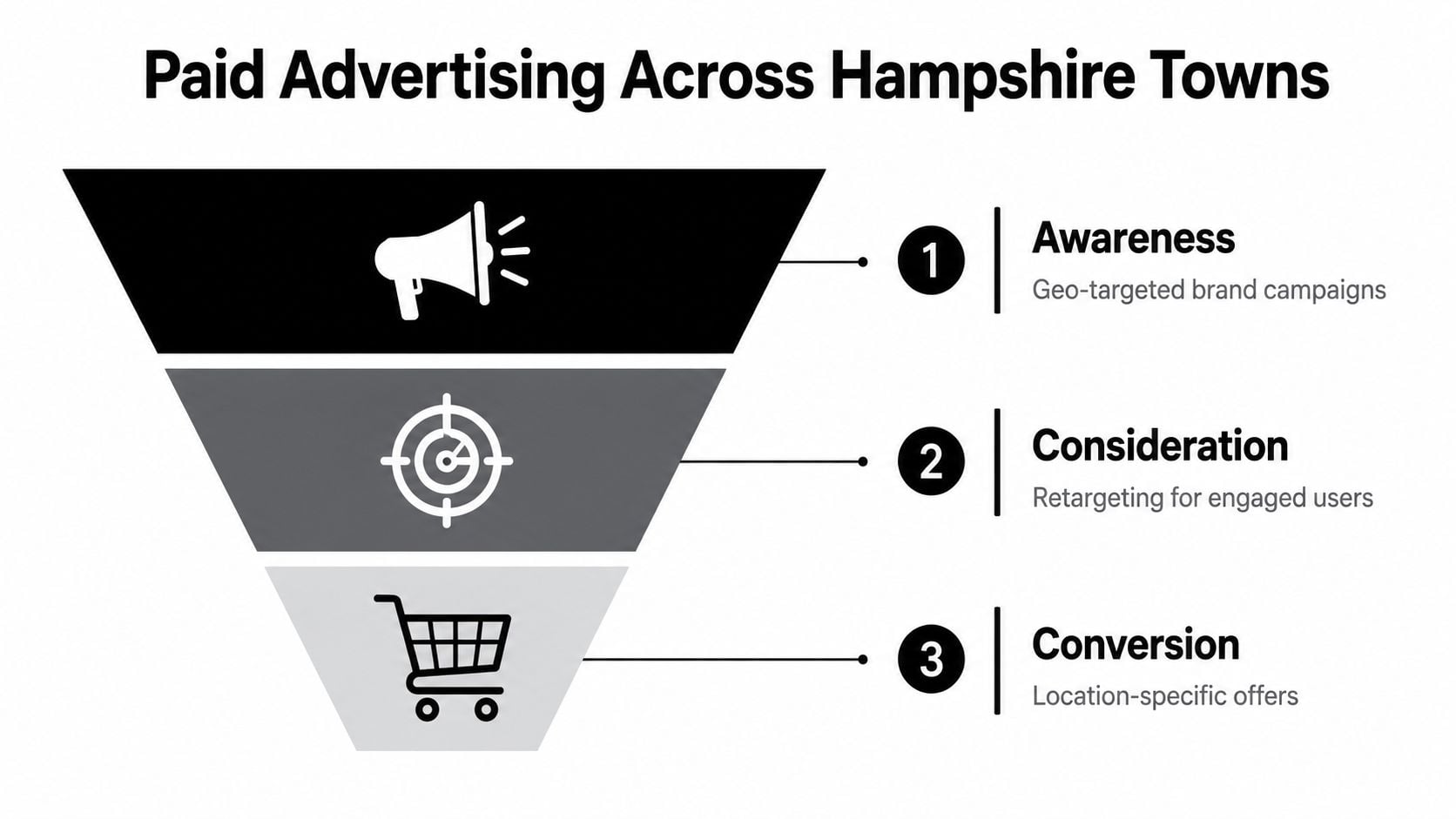
Paid search and paid social are where Hampshire budgets leak fastest, usually because the account is built around broad intent and lazy geography. If you're a trades company, clinic, law firm, or home service provider, a county-wide “get more leads” campaign is too vague to be useful. The account has to mirror how people buy in Southampton, Portsmouth, Winchester, Basingstoke, Eastleigh, Fareham, Gosport, Havant, and beyond.
Geo-target like an operator, not a tourist
Set targeting around the towns and drive-time areas you can serve. Exclude locations that look close on a map but don't fit the customer profile, or where response times would be poor. If your team can't realistically handle leads from a commuter belt, don't pay for them.
Use tighter intent where margin depends on lead quality. Exact-match campaigns at town level make sense for high-value services, while broader campaigns can work for brand and remarketing. That split keeps your budget focused on people who are already signalling intent, not just casually browsing.
Dayparting matters for businesses that answer the phone live. If you only pick up during working hours, don't burn budget at times when nobody can respond quickly. The same logic applies to service areas, because a lead from the wrong part of Hampshire is not a lead you can profit from.
Match channel to the buyer's behaviour
Facebook groups can work for trades and home services if the message feels local and practical. Instagram is more useful for hospitality, retail, and lifestyle brands around the South coast and the New Forest. LinkedIn is the better play for professional services targeting business parks in places like Southampton and Basingstoke. Nextdoor has a role in residential neighbourhoods where hyper-local trust matters.
A simple weekly content rhythm is enough for most small teams:
- One local post: a job, offer, update, or customer story from Hampshire.
- One community interaction: reply to a local group, council post, or partner business.
- One proof asset: a review screenshot, short video, or before-and-after image.
- One paid refresh: update audiences, creative, or exclusions based on recent lead quality.
You don't need to post everywhere. You need to appear in the places where your best customers already spend time, then back that presence up with search and paid campaigns that point to the same offer.
Measure What Matters and Keep Ownership of Your Assets
Most Hampshire businesses don't have a traffic problem, they have a measurement problem. They can tell you impressions went up or a campaign “looked busy”, but they can't say whether the leads were qualified, whether the enquiries came from the right towns, or whether they own the accounts that produced the results.
Separate visibility, efficiency, and conversion
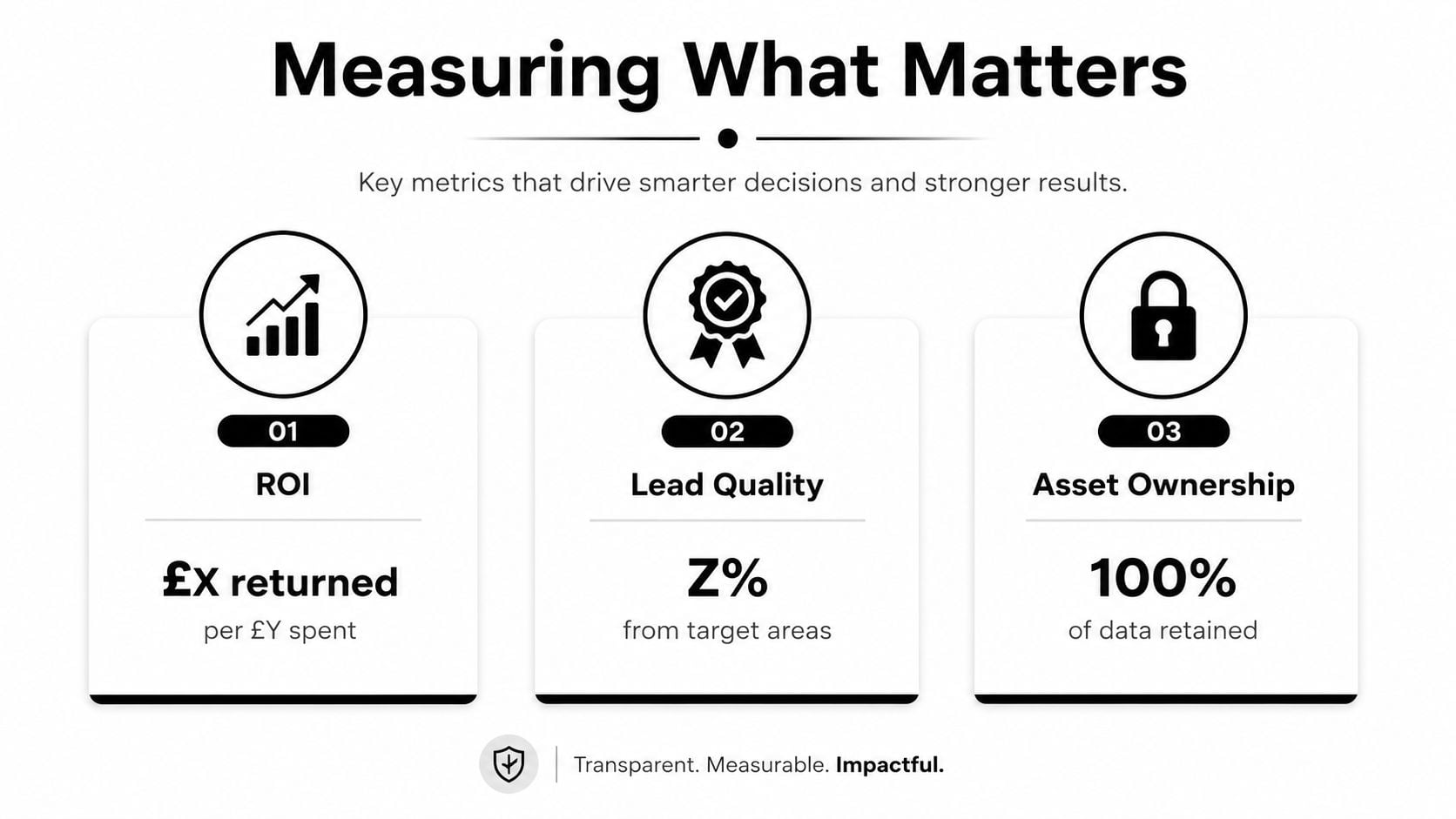
Your KPIs should sit in three buckets. For local SEO, watch map-pack rankings, organic clicks, and branded search behaviour. For paid, focus on cost per qualified lead, conversion rate, and return on ad spend. For conversion, track form completions, phone calls, and booked appointments.
That split matters because each channel does a different job. Local search tells you whether people can find you. Paid media tells you whether the offer and targeting are efficient. The website tells you whether the traffic turns into revenue.
The most useful reports are simple enough that an owner can read them without translating agency jargon. If an account manager won't explain bad performance in plain English, the reporting is probably hiding something. A proper dashboard should make it obvious what worked, what didn't, and what changed since last month.
If the reporting looks busy but the pipeline looks flat, ask which numbers are actually tied to enquiries.
Own the accounts before you spend
Four assets should stay in your name or under your control from day one, the Google Business Profile, the domain, the Google Ads and Meta Ads accounts, and the analytics property. That sounds basic, but it's one of the biggest risk points in local marketing because ownership determines what happens if you change provider.
The analytics setup guide is a useful reference if you want a clearer view of how tracking and reporting should be structured. A decent partner can help you configure it, but they shouldn't own the data that belongs to your business.
Watch for red flags in the first 30 to 90 days.
- Vanity rankings: lots of movement, no meaningful lead growth.
- Blended reporting: channels merged together so no one can see what's working.
- Locked accounts: you can't access your own ad data or business profile.
- No next step: the agency can't explain what happens after the first month.
The agencies that deserve your trust make measurement part of the service, not a mystery feature. If they can't show you what good looks like early, they probably won't show you it later either.
Choose a Hampshire Digital Marketing Agency Without Getting Burned
The wrong agency relationship usually fails before the first campaign even starts. The contract is long, the pricing is fuzzy, the ad accounts are locked away, and the reporting is padded with jargon so you can't tell whether anything useful happened. That's not a partnership, it's a dependency.
Ask better questions before you sign
A good Hampshire agency should be able to answer these without sounding defensive.
- Who owns the ad accounts and analytics property?
- What will you deliver in the first 30, 60, and 90 days?
- Which KPIs will you report for local SEO, paid, and conversion?
- What happens if results are weak after the initial setup period?
- Do you have case studies from businesses in my town or sector?
- How do you separate lead quality from lead volume?
- Who does the work, and where is it done?
- What's included in the fee, and what costs extra?
- How many revision rounds are standard on creative and web work?
- What does handover look like if we part ways?
These questions cut through sales language fast. If the answer to ownership is vague, walk away. If the answer to measurement is vague, walk away faster.
Look for operational discipline, not glossy promises
Good signs are usually boring. Fixed-cost pricing is easier to plan around, scheduled updates keep projects moving, and a proper handover window reduces risk after launch. Three revision rounds as standard on creative work is also a sensible sign that the agency expects to collaborate properly instead of shipping one draft and hoping you'll accept it.
One more thing matters in Hampshire more than most agencies admit. If they can't show they understand the difference between Southampton, Portsmouth, Winchester, Basingstoke, the New Forest, and the surrounding towns, they probably don't understand your buyer either.
The right partner should help you build a measured plan, keep control of your assets, and improve what already exists before chasing shiny new channels. That's how local growth becomes predictable instead of expensive.
If you want a Hampshire digital marketing partner that can turn this kind of plan into a clear website, brand, and campaign system, DesignStack builds WordPress sites, SEO support, and social-ready assets with fixed-cost pricing and straightforward project management. Visit DesignStack to talk through what your Hampshire business needs next and get a practical route from audit to launch.



Leave a Reply