

How Long Does It Take to Build an Ecommerce Website?
A standard bespoke UK ecommerce website usually takes 6 to 12 weeks to build. In practice, the full range can be as short as 4 weeks for a simple template-led launch and over 6 months for a complex build with integrations, compliance work, and post-launch optimisation.
If you're asking this question, you're probably in one of two places. Either you need to launch quickly because the business opportunity is already there, or you've been quoted wildly different timelines and want to know what's realistic. Both are sensible concerns.
The easiest way to think about ecommerce timelines is to compare them to building a house. A template store is like fitting out a well-made new-build from a standard plan. A custom WooCommerce site is more like building from a specially designed blueprint on a solid plot. A fully bespoke ecommerce system is closer to an architect-designed home with specialist trades, planning complications, and custom joinery throughout. They all end up as a house, but they don't take the same time, cost the same, or involve the same decisions.
That matters because ecommerce in the UK isn't a side channel anymore. The market is projected to reach 1 million dedicated ecommerce users by 2025, while UK online retail sales hit £127 billion in 2024 after a 3.4% increase from the previous year, according to UK ecommerce market figures compiled by Space & Time. So speed matters, but building the right thing matters more.
Table of Contents
- How Long Does Building an Ecommerce Website Really Take?
- Typical Build Timelines From Templates to Bespoke Systems
- The Six Stages of an Ecommerce Build and How Long Each Takes
- What Really Controls Your Project Timeline?
- Are You Ready to Start? A Pre-Project Checklist
- Beyond Launch The Hidden Timeline to Profitability
- Your Ecommerce Build Questions Answered
How Long Does Building an Ecommerce Website Really Take?
For most businesses, the honest answer to how long does it take to build an ecommerce website is this: it depends on what you're building, what you've prepared, and what has to happen after launch.
A simple store can move fast if the structure is straightforward, the products are organised, and the decision-makers respond quickly. A more serious build slows down for good reasons. You may need custom product filters, shipping rules, Stripe or PayPal setup, stock system integrations, customer account logic, or legal review. None of that is wasted time. It's the difference between a shop that merely exists and one that trades properly.
The house analogy helps because clients often focus on the visible front of the project. They picture the homepage, product pages, and checkout. They don't always picture the groundwork underneath: planning, data, payment setup, mobile testing, returns content, cookie consent, and order emails. That's like judging a build by the kitchen tiles while ignoring the foundations.
Three realistic ways to answer the question
- Fast launch. A template-led build with ready content can go live quickly if the scope is tight.
- Standard agency build. A bespoke UK ecommerce site commonly lands in the 6 to 12 week range, especially for a professional WooCommerce project, as outlined in this guide to bespoke ecommerce website timelines in the UK.
- Complex project. Once you add custom workflows, platform migration, API connections, compliance review, and post-launch tuning, the timeline stretches well beyond the build itself.
Practical rule: Ask whether you're measuring the time to a website launch, or the time to a working ecommerce operation that your team can run with confidence.
That distinction saves a lot of frustration. A launch date is one milestone. A business-ready ecommerce site is the full project.
Typical Build Timelines From Templates to Bespoke Systems
Not every ecommerce site needs the same level of build. Some businesses need a clean, fast route to market. Others need a site that reflects a strong brand, supports growth, and connects cleanly with operations.
Think of the options like house types. One is a flat-pack solution you can assemble fast. One is a custom home built from an agreed plan. One is a specialist build with structural complexity and more people involved.
Ecommerce Build Timelines at a Glance
| Build Type | Typical Timeline | Best For |
|---|---|---|
| Template-based ecommerce site | Around 4 to 6 weeks when content is ready and functionality is standard | Startups, small catalogues, simple launches |
| Custom WordPress or WooCommerce build | 6 to 12 weeks for a standard bespoke build | SMEs that want tailored branding, better UX, and room to grow |
| Bespoke or integration-heavy ecommerce system | 2 to 6 months total, sometimes longer for advanced setups | Businesses with custom workflows, inventory sync, migrations, or specialist requirements |
Template builds are the flat-pack option
A template or theme-based ecommerce site is the fastest route. You're starting with an existing structure and changing the branding, content, and core settings rather than inventing every page pattern from scratch.
This works well when the catalogue is manageable and the business can live with standard layouts. It doesn't work as well when the buying journey needs to be distinctive, or when product structure and filtering need more thought.
The biggest advantage is speed. The trade-off is flexibility.
Custom WooCommerce builds are the sensible middle ground
For many UK SMEs, this is the sweet spot. You get customized design, a stronger brand fit, and enough flexibility to create a better shopping experience without entering full bespoke territory.
If you're comparing platforms, this overview of the best ecommerce platform for small business is useful because platform choice changes the pace of the whole project. A good fit can keep the build efficient. A poor fit creates workarounds from day one.
A custom WordPress or WooCommerce project is like building from a personalised blueprint. The rooms are designed around how you live, but you're still using proven construction methods. That's why the timeline is often realistic and manageable.
A quick launch isn't the same as a good launch. The right build is the one that matches the next stage of the business, not just the next available deadline.
Bespoke systems are architect-designed builds
Once a project needs API links to stock systems, custom checkout behaviour, account-level pricing, or unusual back-office rules, the timeline changes. According to Wired in Commerce on ecommerce development planning, a mid-complexity UK e-commerce store with custom design, payment gateway integration, and API connections typically needs 3 to 4 months for development alone, with the full lifecycle taking 2 to 6 months total.
These projects are rarely delayed because developers are coding too slowly. They take time because more things need to be agreed, tested, and signed off.
The Six Stages of an Ecommerce Build and How Long Each Takes
Clients often hear a single number such as ten weeks and assume the project is one continuous block of design and coding. It isn't. It moves through stages, and each stage has its own purpose, approvals, and risks.
Here's the process in a form most business owners can use.
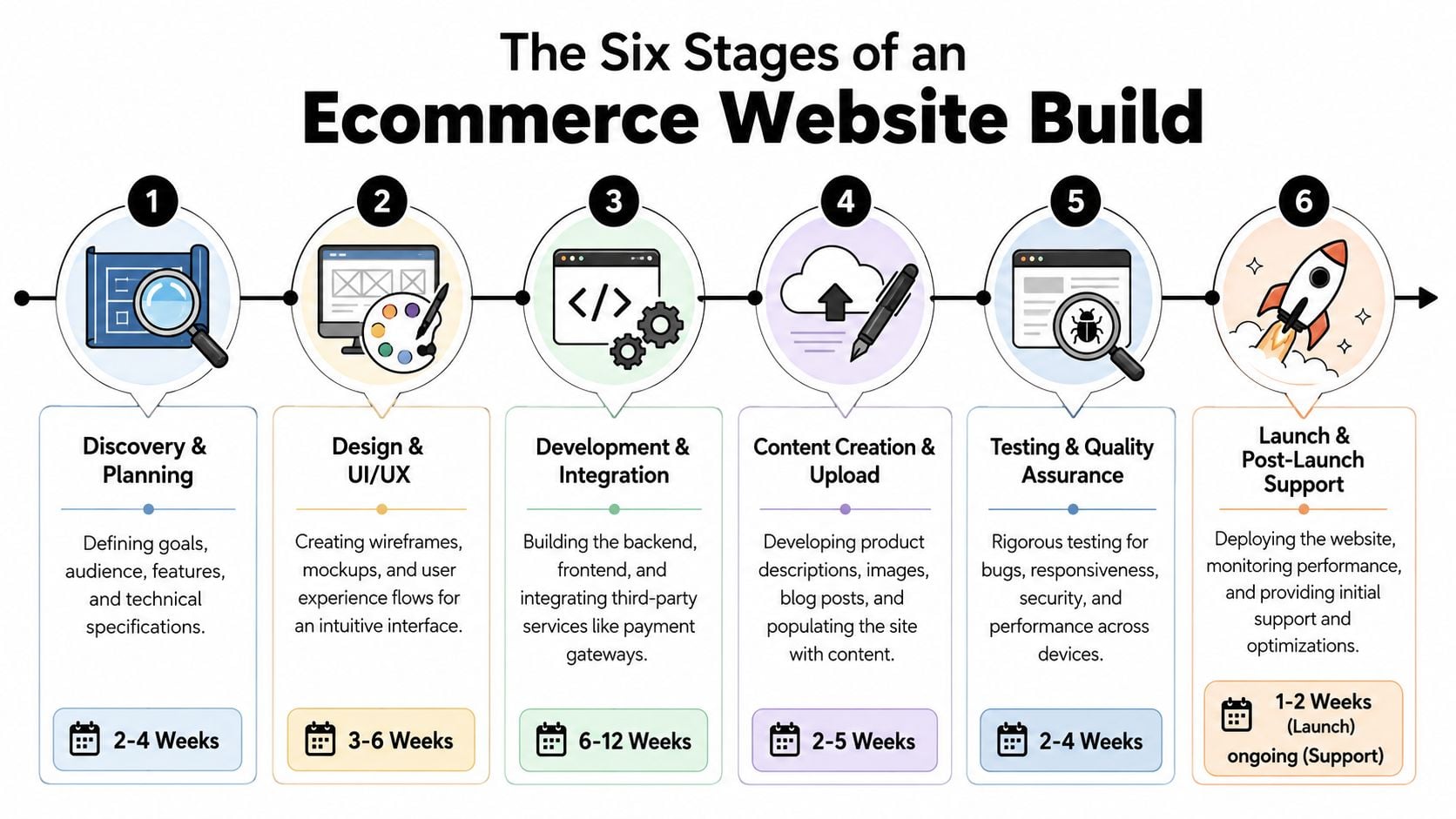
If you're weighing up custom work against a pre-built route, it helps to review a practical ecommerce web design template approach before committing to scope.
Discovery and planning
The blueprint gets drawn. Goals, audience, product structure, delivery model, payment options, and technical requirements all get clarified.
Without this stage, projects drift. Teams start discussing colours before they've agreed whether the shop needs guest checkout, product variants, or local delivery logic.
Typical tasks here include:
- Defining scope. Which features are required at launch, and which can wait.
- Mapping the store. Categories, product types, navigation, and key journeys.
- Choosing the stack. Platform, plugins, gateway, shipping approach, and any integrations.
Design and user experience
This stage shapes how the shop feels to use. Home page hierarchy, category layouts, product cards, product detail pages, basket behaviour, and mobile checkout all matter more than decorative flourishes.
A strong ecommerce design phase resolves buying friction early. It also reduces expensive changes later, because the team is approving direction before development is deep underway.
Development and integration
This is the construction phase. Templates are built, checkout logic is configured, content management is set up, and third-party services are connected.
For larger projects, this is often the longest stage. That's why mid-complexity builds with custom design and integrations can take months overall, as noted earlier from the Wired in Commerce planning guidance.
Content population
Content preparation often causes projects to falter. Product titles, descriptions, images, SKUs, pricing, legal pages, category copy, FAQs, shipping details, and returns content all need to be clean and approved.
Some agencies can help shape and import content, but they can't invent missing product knowledge. If your catalogue lives in spreadsheets, Dropbox folders, inbox threads, and someone's head, this stage takes longer.
Testing and quality assurance
The site may look finished before it's ready. Testing checks what happens when a customer uses it. That includes mobile layouts, filter behaviour, add-to-basket flows, payment success and failure states, shipping logic, order emails, and browser quirks.
A rushed QA phase creates the worst kind of launch problems. Not dramatic disasters. Small, expensive leaks in conversion.
Launch and handover
Launch is the handover moment, not the finish line. The domain is pointed, payment flows are confirmed live, analytics are checked, redirects are reviewed, and the team gets clear guidance on how to manage products and orders.
A smooth launch usually comes from disciplined work earlier in the process, not last-minute heroics.
What Really Controls Your Project Timeline?
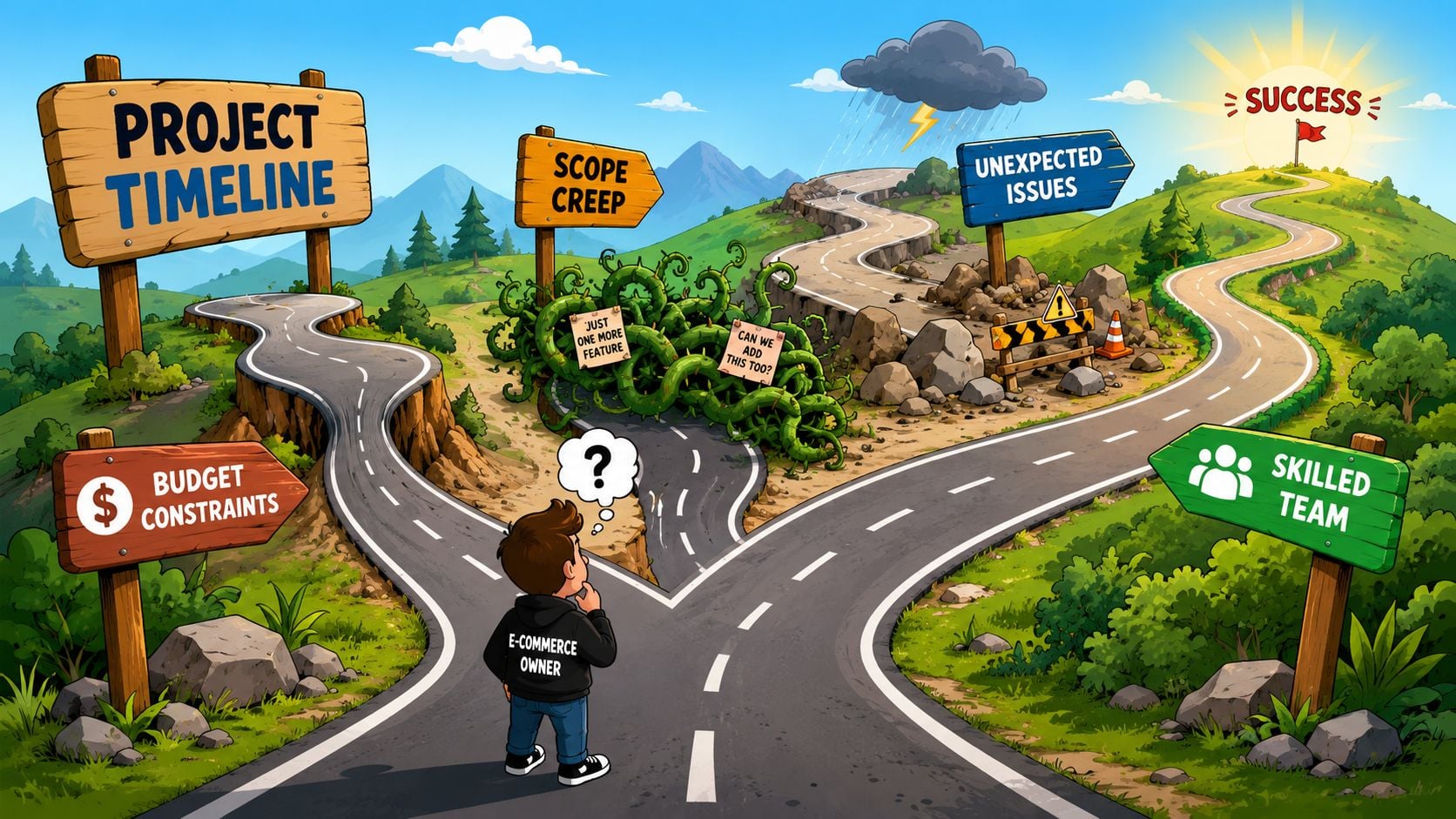
Most ecommerce timelines don't slip because the original estimate was dishonest. They slip because the project behaves differently once real people, real content, and real decisions enter the room.
The build itself is only one part of the schedule. The rest depends on how organised the business is, how clear the scope remains, and how complex the operational side turns out to be.
If you're budgeting alongside scheduling, this guide to ecommerce website design cost helps because cost and timeline usually move together.
The biggest delay is usually content
This catches clients by surprise. They assume development is the bottleneck. Usually, it isn't.
According to Suplex on ecommerce project timelines, the single most critical cause of delay in UK e-commerce projects is content readiness, not development speed. Most projects take 8 to 16 weeks from signed brief to launch only when product images, descriptions, and pricing are pre-approved. When content is missing during development, timelines can extend to 4 to 9 months.
That matches what agencies see all the time. The layout is ready. The checkout is ready. The product data isn't.
If you want a faster launch, don't ask the developer to work faster. Get the product information approved earlier.
Other factors that move the date
Some variables speed a project up. Others inadvertently add weeks.
- Fast decisions. One clear approver keeps momentum. Committees slow everything down.
- Stable scope. Adding subscriptions, trade pricing, or a stock sync halfway through changes the house after the walls are up.
- Complex integrations. Inventory systems, CRMs, shipping tools, and accounting links all need setup and testing.
- Migration risk. Rebuilding a new store is one thing. Migrating products, redirects, and customer expectations from an old one is another.
- Feedback quality. Useful feedback is specific and grouped. Drip-fed opinions create churn.
What helps projects stay on track
A good timeline usually comes from three behaviours:
- Prepare content before development gets deep.
- Decide what is launch-critical and what can wait.
- Keep one person accountable for approvals.
Businesses often think speed comes from choosing the cheapest route. In practice, speed usually comes from preparation.
Are You Ready to Start? A Pre-Project Checklist
A lot of delays can be prevented before the first design file is opened. If the groundwork is clear, the project moves. If the business is still deciding what it sells, how it ships, and who approves the homepage, the schedule becomes fragile.
This checklist is the ecommerce equivalent of preparing the site before the builders arrive.
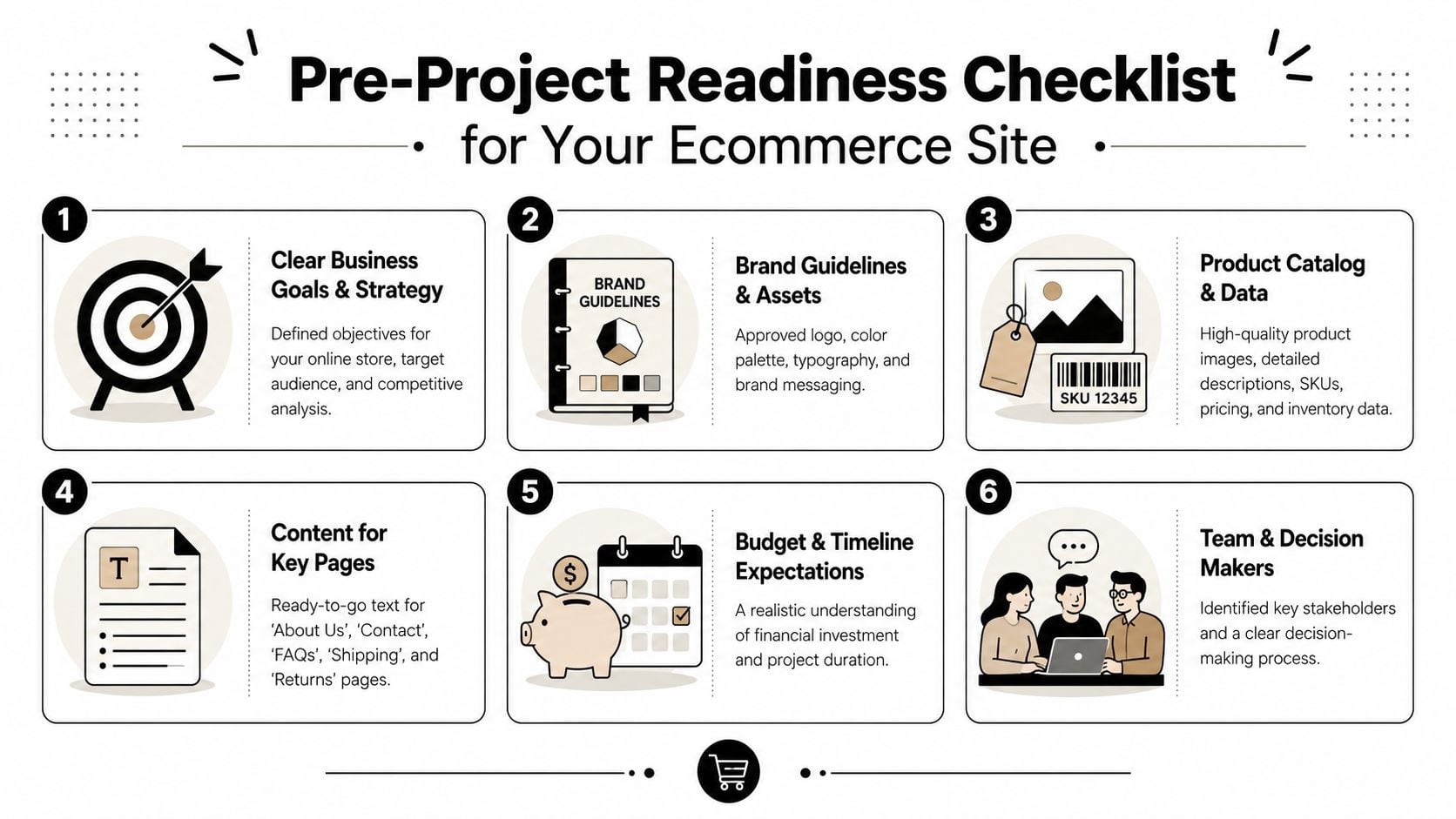
A practical website launch checklist is also worth keeping nearby because launch readiness starts much earlier than is often assumed.
What to gather before the brief is signed off
- Business goals. Are you trying to launch a first store, replace an underperforming one, support wholesale, or improve conversion on mobile.
- Brand assets. Logo files, colour palette, typography choices, packaging references, and any existing brand rules.
- Product data. Titles, descriptions, prices, variants, SKUs, imagery, and stock details in one organised place.
- Core content. About, delivery, returns, contact details, FAQs, and trust-building copy.
- Operational decisions. Shipping regions, payment methods, tax handling, and who manages orders after launch.
- Decision-makers. One lead contact with authority to collect feedback and sign work off.
What good preparation looks like
Good preparation isn't glamorous. It's a clean spreadsheet, approved images, a realistic scope, and fewer hidden surprises.
A business that's ready doesn't need to know how to code or write a technical brief. It just needs to answer practical questions clearly. What are you selling. Who is it for. What must the site do on day one. What can wait until phase two.
The best ecommerce projects don't start with design inspiration. They start with organised information and clear decisions.
That one shift can save weeks.
Beyond Launch The Hidden Timeline to Profitability
A common scenario goes like this. The site launches on Friday, orders start coming in on Monday, and by week two the business expects the hard part to be over. In practice, launch is closer to getting the keys to a new house. You can move in, but snagging, inspections, storage, heating, and daily routines still need work before the place supports how you live.
The same applies to ecommerce. A store can be live, taking payments, and still be weeks or months away from being fully business-ready.
Launch-ready is not the same as profit-ready
I often tell clients that launch marks the end of the build phase and the start of the trading phase. Those are different timelines with different risks. The build gets the house standing. Trading shows whether the rooms work, whether people can find the front door, and whether the heating bill is sensible.
That matters because post-launch work is not cosmetic. It usually includes compliance checks, accessibility fixes, returns and delivery policy refinements, analytics validation, merchant account reviews, and the first round of conversion improvements based on real customer behaviour.
Some of that can be handled before go-live. Some of it only becomes clear once the store is trading and real users start clicking, abandoning baskets, contacting support, and testing edge cases your team did not see in staging.
The hidden phase after go-live
Often, timelines become misleading. A client hears "10-week build" and reasonably assumes the business will be settled in week 10. A better expectation is this: week 10 may get the doors open, while the next 8 to 16 weeks are used to fix weak spots, tighten operations, and turn early sales into consistent performance.
That period usually covers four areas.
- Compliance and policy tidy-up. Privacy, cookies, accessibility, delivery wording, pricing clarity, and returns content often need another review once the site is live in full.
- Search and content refinement. Category copy, product copy, metadata, internal linking, and indexing checks affect whether customers can find the site at all. A practical SEO checklist for new websites helps teams catch the basics before traffic is wasted.
- Checkout and conversion fixes. Real users expose friction quickly. Payment hesitation, awkward field labels, coupon confusion, poor mobile spacing, and shipping surprises all show up here.
- Operational adjustment. Order emails, stock rules, customer service workflows, fulfilment handoffs, and reporting often need tuning once volume starts.
According to Nielsen Norman Group's guidance on measuring UX outcomes, teams need live behavioural data to judge whether user experience changes are working. That is the point many ecommerce owners miss. Performance work depends on evidence from actual customers, not assumptions made during design.
What profitability usually depends on
Profit rarely comes from the build alone. It comes from the build plus the first rounds of improvement after launch.
A well-planned template site may reach stable trading fairly quickly if the catalogue is small, the offer is clear, and paid traffic is ready to send qualified visitors. A larger store with complex shipping, multiple customer types, and organic search goals usually takes longer to settle. The house analogy fits here too. A one-bedroom flat is faster to furnish and run than a custom home with outbuildings, security systems, and three entrances.
In agency projects, the stores that reach confidence sooner tend to share the same traits. Clear margins. Clean analytics. Fast decision-making. A willingness to release phase one, then improve what the evidence supports.
The stores that struggle after launch usually have different issues. Too many plugins. Weak product data. Unclear proposition. No one owns SEO. No one reviews checkout drop-off. Legal content is copied in late and never checked against the actual customer journey.
A more realistic way to judge the timeline
If the question is how long it takes to build an ecommerce website, the honest answer has two parts. There is the build timeline to launch. Then there is the trading timeline to stability and profitability.
Treating those as one continuous project leads to better decisions. It protects budget, sets better expectations, and stops the team from declaring success too early.
Launch opens the front door. Profit comes after the house is inspected, organised, and proven to work day after day.
Your Ecommerce Build Questions Answered
A client usually asks these questions when the project stops feeling theoretical and starts feeling like a real build. The plans are approved, the budget is committed, and everyone wants to know what could still slow the move-in date.
That is a sensible point to ask. Building an ecommerce site works like building a house. The drawings matter, but so do the snags, inspections, utilities, and the first few weeks of living in it.
How many design revisions should you expect
Set the number of revision rounds before design starts.
That does not shut down collaboration. It keeps decisions moving and stops the project drifting into repeated subjective changes. In practice, two to three structured rounds are usually enough for a standard brochure-led ecommerce build, provided feedback is consolidated by one client-side decision maker.
Problems start when five stakeholders send separate comments, each reviewing from a different angle. The designer is then solving politics, not design. A tighter process gets better work approved faster.
Do hosting and security affect the timeline
Yes. They often affect the final stage more than clients expect.
A store can look finished on the surface and still be unready for launch if the hosting environment is slow, backups are untested, user permissions are loose, or payment settings are incomplete. Those are the equivalent of a house with painted walls but no working locks or boiler sign-off.
Security and hosting choices also shape the first months after launch. Cheap hosting can create slow pages, update conflicts, and checkout instability. That does not just create technical issues. It delays trust, both for your team and for customers.
What support should happen after launch
Post-launch support should cover bug fixes, device checks, small content corrections, and basic trading reviews once real orders start coming through. Hidden issues often appear during this period. A tax rule behaves differently on one product type. An order notification goes to the wrong inbox. A promotional banner breaks the mobile layout.
Compliance often needs attention here too. Cookie controls, privacy wording, returns information, accessibility fixes, and payment process checks are sometimes treated as loose ends, then left until the site is already live. That is one reason a launch date and a business-ready date are often different.
The strongest handovers leave you with three clear outcomes:
- A live scope list showing what is finished and what is still queued
- Short-term support for early trading issues and customer-facing fixes
- A prioritised improvement plan based on real usage, not guesswork
If you want a realistic plan for your own store, DesignStack can help you map the right route. The team builds ecommerce websites for Dorset and UK businesses with fixed-cost pricing, clear project updates, three design revisions as standard, and one month of post-launch updates so the launch is properly supported.



Leave a Reply