


How to Choose a Domain Name: A 2026 Guide for UK Businesses
Let's get straight to it: choosing a domain name comes down to finding something that’s short, memorable, brandable, and instantly clicks with your UK business. Your domain is your digital address, so getting it right from the very beginning is crucial for building trust and pulling in the right customers.
Why Your Domain Name Is Your Most Important Digital Asset
Picking your domain isn't just a box to tick on a to-do list; it’s the very first brick you lay for your brand's online home. Think of it as your digital shopfront, your online business card, and a massive clue for search engines, all wrapped up in one. For a UK business, a great domain can immediately signal you're local, professional, and trustworthy.
A strong domain name has a real, tangible impact on how potential customers see you. It sets the tone and can be the tiny detail that makes someone click your link instead of a competitor's. That first impression happens in a split second, making the name itself one of your most powerful marketing tools.
Defining Your Brand First
Before you dive into a domain name generator, take a step back. The first and most important thing to do is get crystal clear on your brand's identity. Is your business a local plumbing service rooted in Dorset, or are you aiming to build a national e-commerce brand selling artisan coffee? The answer will point you toward the right kind of name.
To get that clarity, ask yourself a few pointed questions:
- What's our mission? Are you trying to be the fastest emergency plumber in Manchester, or are you selling unique, handcrafted jewellery across the UK? Be specific.
- Who are we talking to? A name that resonates with corporate clients in the finance sector will look very different from one designed to attract young, eco-conscious shoppers.
- What makes us special? Your domain can hint at what sets you apart. Maybe it’s your commitment to quality, your unbeatable speed, or a highly specialised skill.
A domain name is the anchor of your brand. It’s not just an address; it’s a promise to your customers about who you are and what you deliver. Getting this right sets the stage for everything that follows.
Ultimately, the goal is to land on a name that doesn't just work for you today but gives you room to grow. A name that’s too specific, like bristolweddingcakes.co.uk, might feel limiting if you later decide to expand into event catering. On the other hand, a name that's too vague might just get lost in the noise.
Brainstorming a Memorable and Brandable Domain
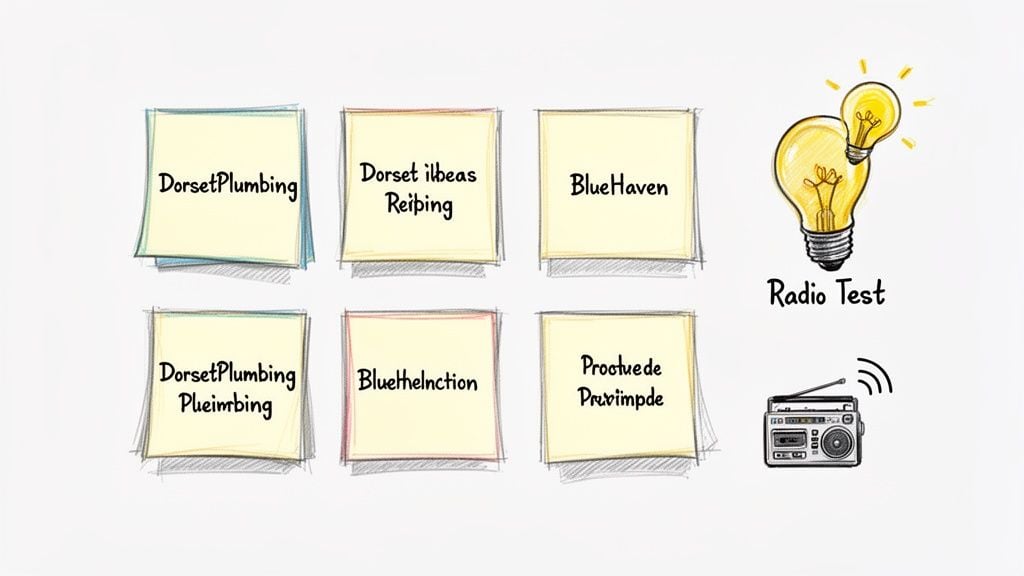
This is where the real work begins—moving from abstract ideas to concrete possibilities. Forget trying to find the one perfect name straight away. Instead, your goal is to build a solid shortlist of 10-15 strong contenders.
Think of it as sifting for gold. You start with a pile of rough ideas and slowly filter out the duds until you're left with a handful of valuable nuggets. Having a pool of quality options to choose from makes the final decision much easier and more confident.
Creative Brainstorming Techniques
A great domain name walks a fine line between being descriptive and being uniquely brandable. For instance, a name like DorsetPlumbingPros.co.uk is fantastic for local SEO, clearly telling both customers and search engines what you do and where. On the other hand, a brandable name like AquaFlow.co.uk gives you more room to grow if you decide to expand your services or locations down the line.
To get the creative juices flowing, here's an actionable list of techniques to try.
- List Your Core Keywords: Start by jotting down 5-10 words that are central to your business. A Weymouth-based web design studio might list 'Weymouth design', 'Dorset web', 'creative', and 'digital'.
- Use a Thesaurus for Variations: Look up synonyms for your core words. This is a brilliant way to uncover more creative—and available—options. Instead of 'group', you might land on 'venture', 'path', or 'focus', adding a unique flair.
- Combine and Blend Words: Create something truly unique by merging two relevant words. Think of how 'Evernote' came from 'forever' and 'note'. A local bakery could blend 'sweet' and 'artisan' to become 'Sweetisan'.
- Add Action Verbs or Modifiers: Inject some energy into your name with words like 'Get', 'Go', 'Pro', 'Digital', or 'Hub'. A marketing agency, for example, could stand out with a name like
GetNoticed.co.uk.
The All-Important Radio Test
Once you have a handful of names you like, it’s time to put them through a crucial, but often skipped, test. I call it the "Radio Test," and it’s deceptively simple: say each name out loud.
Imagine telling a potential customer your website address over the phone or hearing it mentioned on a local radio ad. Can they easily understand it and type it into a browser without any guesswork? If you find yourself having to clarify, "Is that the number 2 or the word 'two'?" or "Does that have a hyphen in it?" then it's failed the test.
Numbers and hyphens are the biggest offenders. They cause confusion and can send potential customers straight to a competitor's site. A name like Elite-Plumbing24.co.uk is a minefield of potential errors compared to the clean and simple ElitePlumbing.co.uk.
If your domain name needs explaining, it's not the right one. The entire process of how to choose a domain name should prioritise clarity, which is a cornerstone of effective website design and a positive user experience.
Choosing the Right TLD for Your UK Business
That little bit at the end of your web address—the .co.uk or .com part—is what we call a Top-Level Domain, or TLD. It might seem like a tiny detail, but it’s one of the first things potential customers and search engines notice. It sets an immediate expectation about who you are and where you operate.
For any UK business, this choice usually boils down to the two big players: .co.uk and .com. Getting this right isn't just about ticking a box; it’s a core branding decision that can affect how much people trust you and how easily they find you online.
The .co.uk Advantage: The Go-To for UK Customers
If your business primarily serves customers here in the UK, a .co.uk is almost always the best bet. It’s the digital equivalent of a local phone number. There's a mountain of evidence showing that British shoppers inherently trust and prefer to buy from .co.uk websites.
Here’s why it works so well:
- It builds instant familiarity. A
.co.uktells visitors from Manchester to Margate that you’re on their home turf. You understand the currency, the culture, and the market. - It can help with local SEO. Search engines are smart enough to use the TLD as a hint for location. Having a
.co.ukcan give you a slight edge when someone in the UK is searching for the services or products you offer. - It signals commitment. It shows you’re not just an overseas company dropping into the market, but a business that is specifically set up to serve UK customers.
Think about it. If you’re a plumber in Portsmouth or a bakery in Birmingham, .co.uk just feels right. It directly supports your local presence. Understanding how these signals work is a key part of good search engine optimisation.
When to Consider .com: Thinking Globally
On the flip side, .com is the undisputed king of the internet on a global scale. It’s the world’s most recognised TLD, carrying an authority and international feel that .co.uk can’t quite match.
You should seriously lean towards a .com domain if:
- You're planning to go international. If your roadmap includes selling to customers in the US, across Europe, or anywhere else, a
.comhas no borders. - Your business is purely digital. For software companies, online-only platforms, or blogs aiming for a worldwide audience,
.comis the standard and what people will often type by default. - Your ideal .co.uk is already taken. If
yourbrand.co.ukis gone but the.comis available, grabbing it is a no-brainer.
My Pro Tip: Honestly, the best approach for most ambitious UK businesses is to register both. Use the
.co.ukas your main website and have the.comversion automatically redirect to it. This simple move protects your brand from competitors and catches any customers who type the wrong extension out of habit.
What About Other TLDs? Finding Your Niche
Beyond the big two, there's a whole world of newer, more descriptive TLDs. These can be a fantastic way to stand out and instantly communicate what you're all about.
For instance, you could look at:
- Hyper-Local TLDs: If your business is centred entirely on a specific region, a
.londonor.scotTLD can create a powerful local identity that.co.ukcan't. - Industry-Specific TLDs: An extension like
.design,.art, or.photographyleaves no doubt about what you do. For a graphic design studio, something likecreativefoundry.designis memorable and highly relevant.
Ultimately, the right TLD is the one that aligns with your business goals. It’s about sending the clearest, most effective message to the people you want to turn into customers.
How to Check Availability and Avoid Legal Issues
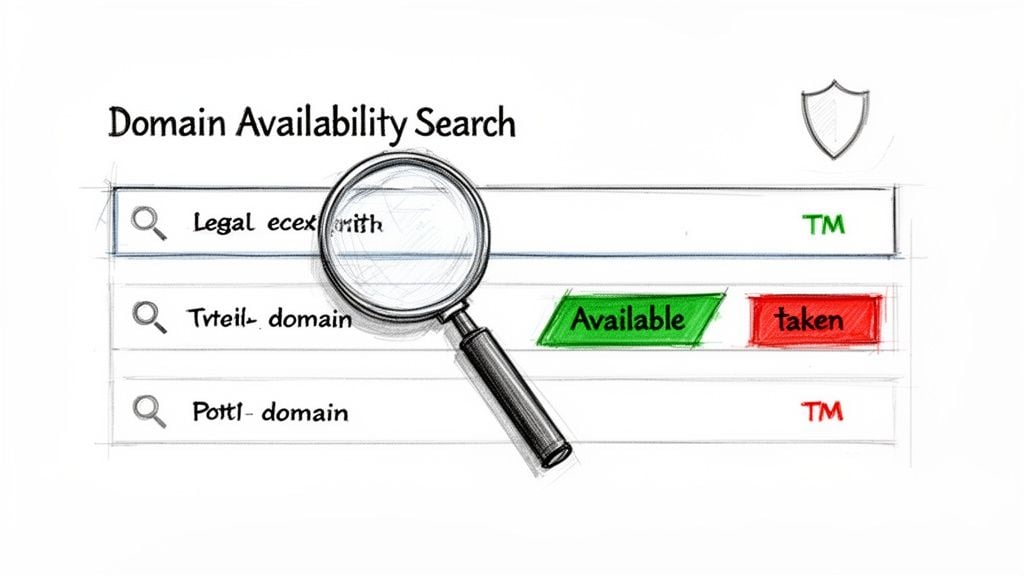
So, you’ve got a shortlist of brilliant domain name ideas. The next part is a moment of truth: finding out if your favourite is actually available and, crucially, if it’s legally safe to use.
This isn’t just about plugging a name into a search box. Think of it as essential groundwork that can save you from a forced, and often expensive, rebrand down the road.
The first stop is, of course, a quick availability check. Every domain registrar has a search bar front and centre on their website. Pop your desired name in there, and it will instantly show you if the .co.uk, .com, or other extensions are free or taken.
But hold on a second. Just because a domain is technically available to register doesn't mean you can or should use it. This is a common trap many new business owners fall into.
Going Beyond a Simple Domain Search
Before you pop the champagne for finding an available name, you need to do some proper digging to ensure you’re not treading on someone else’s toes. It’s a non-negotiable step to check a couple of key UK databases.
Here’s your quick research checklist:
- Check for Trademarks: Head over to the UK's Intellectual Property Office (IPO) and use their free search tool. This is where you find out if another company has already trademarked your name (or one that’s confusingly similar) for their products or services. Getting this wrong is a surefire way to get a legal letter in the post.
- Check Registered Business Names: A quick search on the Companies House register is your next task. This tells you if a limited company is already trading under that name. While it’s not as legally binding as a trademark, having an identical name will almost certainly cause brand confusion and dilute your marketing efforts.
Don't skip these checks. I've seen businesses invest thousands in branding, only to receive a cease-and-desist letter a few months later because they overlooked a registered trademark. A few minutes of research now can save you an immense amount of trouble.
What to Do if Your First Choice Is Taken
It happens all the time—your perfect domain is already gone. Don't lose heart; this is simply a chance to get a bit more creative. If YourBrand.co.uk is taken, think about these practical alternatives:
- Add a Logical Modifier: Can you add a simple, relevant word? A marketing agency might try
YourBrandDigital.co.uk, or a local shop could go forYourBrandDorset.co.uk. - Try a Different TLD: If the .co.uk is snapped up, what about the .com? Or could a niche TLD like .london or even .design work for your brand?
- Make a Slight Tweak: Sometimes, a small change can open up new options. Just be careful not to make the name too complicated or difficult for people to spell and remember.
Once you’ve confirmed availability and cleared the legal checks, a guide to registering your domain name can help you through the final admin. Taking the time to do this verification work is the first step in protecting your brand for the long haul.
Securing and Protecting Your New Domain
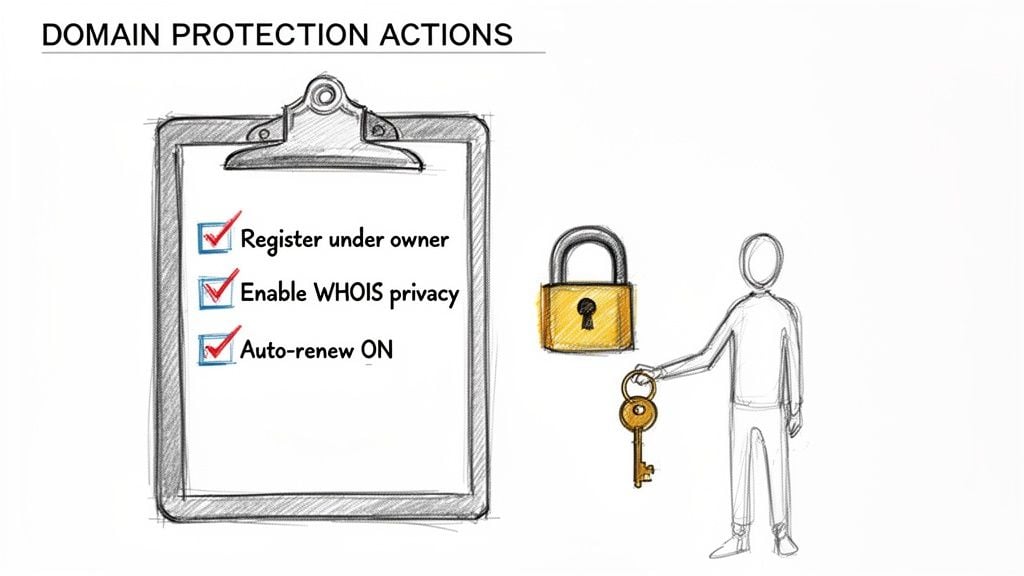
You’ve done the hard work and found a name that’s available and legally sound. Now it's time to make it officially yours. This last part of the process involves registering and, just as importantly, protecting your new domain. To do this, you’ll need to go through a domain registrar—the company that handles the formal registration for you.
A word of warning: don't just jump at the first cheap offer you find. It’s tempting, but look for a reputable company with transparent pricing, 24/7 support, and a control panel that’s easy to navigate. I’ve seen too many businesses get stung by sneaky hidden fees for renewals or transfers, so always read the small print.
Once you’ve settled on a good registrar, you’re ready to buy. But before you click that button, there’s a crucial detail many business owners get wrong.
Maintain Full Ownership and Control
During the registration, you'll be asked for the owner's contact details. It is absolutely vital that the domain is registered in your name, with your business address and your email address. Never, ever let your web developer or an agency register it for you using their details.
Think of your domain registration like the deed to your shop or office. If your name isn’t on it, you don’t legally own it. This can turn into a nightmare if you ever decide to switch developers or part ways with an agency. Keeping ownership in your name means you always have the final say over your most valuable digital asset. And while you've checked for immediate legal conflicts, it’s also smart to understand what is intellectual property protection in a broader sense to defend your brand as it grows.
With the domain now in your name, there are two quick security settings you need to switch on straight away.
A Checklist for Domain Security
Protecting your domain isn't a one-off job; it's about setting up the right defences from day one. For any serious business, these two features are non-negotiable.
- Activate WHOIS Privacy Protection: By law, every domain registration is recorded in a public database called WHOIS. This log shows the owner’s name, address, and contact information. Domain Privacy (sometimes called ID Protection) hides your personal details and shows the registrar’s information instead. This is your best defence against spammers, scammers, and endless sales calls. Most good registrars now offer this, many for free.
- Enable Auto-Renewal Immediately: Your domain is registered for a fixed time, usually one or two years. If you forget to renew it, it expires and someone else can buy it. I can't overstate how catastrophic—and expensive—this mistake can be. Turning on auto-renewal is the simplest way to prevent this and ensure your website never goes dark by accident.
A domain name is a foundational business asset. Letting it expire is like a shop owner losing the keys to their building. Protecting it with privacy and auto-renewal is the cheapest insurance you’ll ever buy for your brand.
By taking these simple steps, you’re not just buying a name—you’re securing your digital headquarters, protecting your data, and laying a solid foundation for your business online.
Your Domain Is Registered. Now What?
So, you’ve secured your domain name. Excellent! That's a huge first step. Many business owners think that’s the finish line, but it’s really just the starting gun. Your domain is the address, but now you need to build the house.
Think of it this way: your domain is the unique postcode for your business online, while web hosting is the actual plot of land where your website will live. Your hosting service is where you'll store all the files, pages, and images that make up your site. The good news is that connecting the two is straightforward. Your domain registrar will have clear instructions for 'pointing' your domain to your web host, effectively linking your address to your new property.
Build Your Brand and Look the Part
Once the technical bits are sorted, it’s time to start building your brand’s presence and credibility. Here are the two immediate things you should do:
-
Set Up a Professional Email: It’s time to ditch the
yourbusiness@gmail.comaddress. Setting up an email likeinfo@yourbrand.co.ukordave@yourbrand.co.ukis a simple move that instantly makes your business look more established and trustworthy to potential clients. -
Claim Your Social Media Handles: Before you do anything else, check if your business name is available on Instagram, Facebook, LinkedIn, TikTok, or wherever your customers hang out. Securing matching handles creates a clean, consistent brand identity and makes it dead simple for people to find and follow you across the web.
Getting these fundamentals right turns your newly registered domain from a simple name into a genuine business asset. As you continue to build out your online presence, it's well worth looking into a free GBP optimisation to really cement your footprint in local search results.
A Few Common Questions When Choosing Your Domain
Even with the best-laid plans, a few nagging questions always seem to pop up when it's time to finalise your domain name. It’s completely normal. Let’s walk through some of the most common queries we get from UK businesses, so you can move forward with total confidence.
What Should I Do if My Perfect .co.uk Domain Is Taken?
First off, don't worry. This happens to nearly everyone. The perfect name you’ve dreamt up is often already registered, but that’s just a small hurdle, not a dead end.
Your first port of call should be to check for the .com version. If that’s gone too, it's time to get a little creative. The key is to add something logical and relevant without making it a mouthful.
Here are a few ideas we often suggest to clients:
- Add your location: Think
bristolbakers.co.ukormanchesterprinters.co.uk. It’s brilliant for local SEO. - Add a descriptive word: Words like
digital,studio,group, orhqcan work wonders. For instance,arrowcreative.co.ukcould becomearrowdigital.co.uk. - Try a small, logical twist: Could you add a verb?
getmyservice.co.ukis a solid alternative ifmyservice.co.ukis taken.
Just be careful not to make it too long or complicated. The aim is a memorable alternative, not a confusing one.
Should I Use Hyphens or Numbers in My Domain Name?
Honestly, it’s best to steer clear of both.
Hyphens are a real pain to communicate verbally. Imagine telling someone your website over the phone or on a podcast—you’re forced to say "my-business-name," which is clunky and easily forgotten. It fails the classic "radio test." Worse, hyphenated domains sometimes carry a whiff of being spammy or low-quality, which is an impression you definitely want to avoid.
Numbers are just as tricky. Does your customer search for fivestardecor.co.uk or 5stardecor.co.uk? This kind of ambiguity creates an unnecessary barrier for your audience. A clean, simple name made of words is always going to be more professional and easier for people to remember.
A great domain name is effortless to remember and share. If you have to explain it, it’s not the right one. Stick to simple, pronounceable words for the best results.
How Much Should I Expect to Pay for a Domain Name?
For a brand-new, unregistered domain—like a standard .co.uk or .com—you’re typically looking at somewhere between £10 and £20 per year. Be a bit sceptical of any "first-year-for-99p" deals, as the renewal price in the second year can shoot up dramatically. Always check the full-term cost.
You might also come across what are called "premium" domains. These are short, catchy, high-value names that are being resold by their current owners. The prices here can be anything from a few hundred pounds to well into the thousands. For most new businesses in the UK, a standard, newly registered domain is all you need and is far more cost-effective.
Ready to create a website that truly represents your business? The team at DesignStack has over 20 years of experience helping UK businesses build a powerful online presence with professional web design, branding, and reliable hosting. Start your project with us today.


Leave a Reply