

WordPress Website Design Packages: A Practical Buyer’s Guide
You're probably looking at two WordPress quotes that appear to describe the same website, yet differ by thousands of pounds. One includes hosting and updates, another counts those as extras. One promises “SEO”, another means only a plugin installation. A third looks cheap until you discover that your support ends shortly after launch.
That's why WordPress website design packages need comparing beyond the build price. You're buying a business asset, not a brochure that gets handed over and forgotten. The sensible question is what the site will cost, deliver and require over its first year and beyond.
Table of Contents
- Why WordPress Website Design Packages Exist and Who They Are For
- What a WordPress Package Actually Includes
- Typical Package Tiers and Realistic Price Ranges
- The Hidden Costs Behind the Headline Price
- How to Choose the Right Package for Your Business
- Red Flags and Questions to Ask Before Signing
- Why a Dorset-Based Local Agency Makes a Difference
Why WordPress Website Design Packages Exist and Who They Are For
A package exists because most small businesses need certainty before they need complexity. A sole trader, hotel, trades firm or professional practice usually wants a clear scope, a usable website and one accountable supplier. They don't want to translate a freelance developer's technical estimate into a business budget, then compare it with an agency proposal that bundles strategy, design and support under different labels.
The UK market is mature enough for this approach to make sense. The web design services industry is estimated at £685.1 million in 2026, with 2,206 businesses operating in the sector, and it grew 3.6% year on year from 2025 to 2026, according to UK web design industry statistics. That creates plenty of choice, but it also means quotes vary sharply in what they include.
WordPress remains a mainstream platform for British businesses. Depending on the measurement source, the UK had roughly 1.38 million to 1.41 million WordPress websites in 2026, as reported in WordPress statistics for the UK. A package can therefore give an SME access to a familiar CMS, responsive templates, SEO foundations and room to add functionality without starting again.
The buyers who benefit most
Packages suit businesses with a defined commercial need:
- Start-ups that need a credible presence without commissioning a bespoke system.
- Established SMEs replacing an outdated site that no longer reflects the business.
- Trades and local services that need service pages, enquiry forms and calls from search.
- Hospitality businesses that need menus, galleries, booking journeys or seasonal updates.
- Professional firms that need authority, clear navigation and a manageable publishing system.
A fixed scope works particularly well when the business can name its core pages, audience and primary action. That might be a phone call, an enquiry form, an online booking or a shop purchase.
When a package is the wrong purchase
Don't buy a standard package if you need a multi-vendor marketplace, a complex membership platform, unusual permissions, a bespoke customer portal or several systems exchanging data. Those projects need discovery, technical planning and staged delivery. Calling them “custom packages” doesn't make the scope predictable.
If you're comparing local suppliers, start with a WordPress web design agency near you and ask each one to describe the same deliverables. A good package removes ambiguity. It doesn't hide it behind a neat price card.
What a WordPress Package Actually Includes
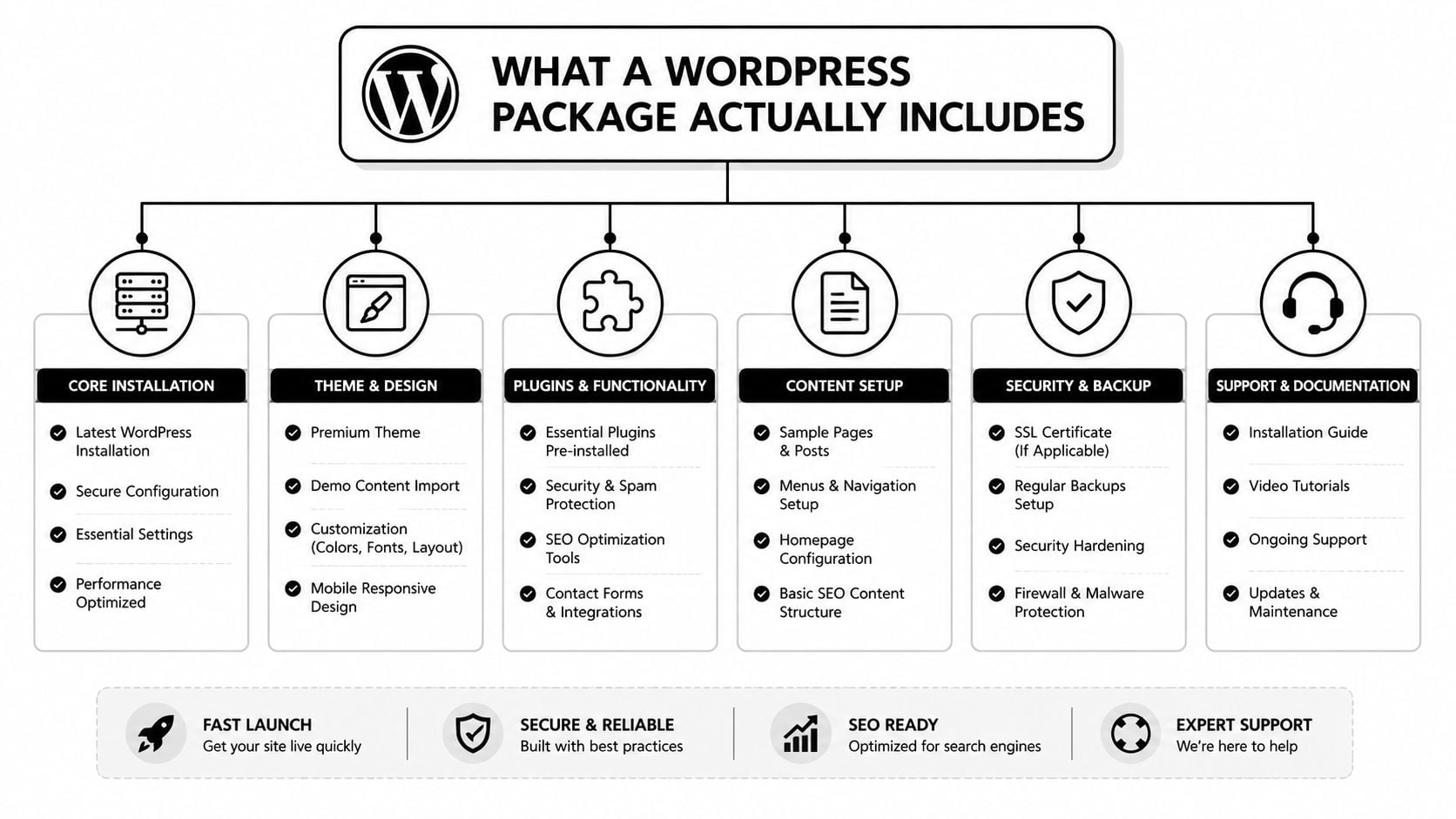
The package name tells you very little. The deliverables tell you whether you're buying a properly planned website or a theme with your logo placed on top.
Design is more than choosing a theme
A sound design process starts with structure. It should consider your brand, page hierarchy, mobile layouts, calls to action, imagery and the way visitors move from an initial question to an enquiry or purchase.
A thin package swaps colours and fonts on a pre-built theme. A useful package defines page layouts, shows how responsive versions behave and gives you a stated number of design review rounds. Ask whether the designer is creating a flexible system for future pages or merely styling the pages listed in the quote.
Development turns the plan into a working site
Development should cover the WordPress installation, page construction, navigation, forms, content management settings and the agreed integrations. You should also receive a handover that explains how to edit pages, add posts and manage routine content.
A booking business may need a calendar, availability rules and payment flow rather than a simple contact form. If activities or appointments are central to the business, an activity booking WordPress plugin can be a useful starting point for discussing the required integration. The important question is whether the package includes configuration, testing and training, not just the plugin name.
Content needs a named owner
Content delays projects more often than most buyers expect. Your quote should state who supplies page copy, images, product information, metadata and redirects. If the agency writes the content, check how many pages and revision rounds are included. If you write it, ask for a content template and clear deadlines.
SEO-ready content means more than filling boxes. Strong delivery uses sensible headings, descriptive page titles, useful internal links and copy that answers the customer's actual question.
Technical foundations need evidence
Technical SEO should cover items such as clean URLs, XML sitemaps, indexing controls, image handling, structured data where appropriate and basic performance work. It doesn't guarantee rankings, and any supplier promising that it does is selling you a fantasy.
Hosting and security should also be explicit. Look for SSL, backups, update responsibility, malware or security monitoring and a process for restoring the site if an update causes trouble. WordPress gives you flexibility, but that flexibility creates maintenance decisions.
Support is part of the product
Support might mean a set number of hours, tickets, training sessions or post-launch fixes. Those are not interchangeable. Ask what response time applies, which channels you can use and whether content edits count as support or are charged separately.
The WordPress maintenance and support service should be described separately from emergency repair work. A package that includes a month of launch support but no plan for updates may still leave you carrying the operational risk.
Practical rule: If a quote doesn't state what happens after launch, it isn't a complete package quote.
Typical Package Tiers and Realistic Price Ranges
UK buyers commonly encounter three broad tiers. The labels vary, but the trade-offs are fairly consistent. The ranges below reflect the sort of pricing a Dorset or wider UK agency may quote, rather than offshore production rates.
| Tier | Typical Price Range | Page Count | Design Level | Support Period |
|---|---|---|---|---|
| Starter | £800 to £1,800 | 4 to 6 pages | Template-led | 3 months |
| Growth | £2,000 to £5,500 | 8 to 15 pages | Custom design | 6 months |
| Custom | £6,000 to £15,000 plus | Defined in discovery | Bespoke functionality | Defined in contract |
Starter
A starter package is suitable for a straightforward brochure site. Expect a home page, about page, services, contact page and perhaps a small portfolio or testimonials area. The design should be adapted to your brand, but you shouldn't expect unlimited layout changes or unusual functionality.
Basic SEO may include page titles, headings, image fields and a sitemap. It probably won't include a substantial content strategy, competitor research or ongoing optimisation. That's fine if you need a clear presence and can manage your expectations.
The common mistake is buying a starter package for a business that already needs booking, eCommerce or multiple service pages. The lower initial price won't compensate for rebuilding the structure later.
Growth
A growth package is the sensible choice for many established SMEs. It should provide a more considered page structure, custom-designed layouts, blog setup, on-page SEO and an agreed integration such as a CRM, booking tool or newsletter platform.
This tier should also explain how new pages will be created after launch. A business that plans to add services or publish useful articles needs a system, not a finished set of static screens. Check whether copywriting, image preparation and redirects are included, because those details can alter the workload substantially.
For a wider discussion of the factors that influence WordPress website development cost, compare the scope rather than treating the price band as a menu.
Custom
Custom work is for shops, multilingual sites, membership areas, advanced integrations and websites with workflows that don't fit a standard build. The right process begins with discovery and technical specification, not a promise that every feature is “included”.
The trade-off is time and decision-making. Custom projects need stronger content preparation, more testing and clearer acceptance criteria. If an agency gives you a custom price without asking detailed questions about users, payments, integrations and administration, the estimate is probably premature.
The Hidden Costs Behind the Headline Price
The build invoice is only the opening line of ownership. A WordPress website needs a place to live, software licences, backups, security attention and someone responsible for changes.
Independent UK pricing guidance puts annual running costs at roughly £150 to £2,000 per year beyond the original build, depending on the site and support arrangement, as outlined in this UK small business website cost guide. That range is broad because a simple brochure site and a busy shop have very different requirements.
| Cost Line | Low (£/yr) | High (£/yr) |
|---|---|---|
| Hosting | £120 | £600 |
| Plugin and theme licences | £50 | £400 |
| Security and backup add-ons | £80 | £300 |
These lines can overlap with the broader annual estimate, so don't add them mechanically without checking the supplier's inclusions. Some agencies bundle hosting and licences. Others transfer every renewal to you after launch.
What you're paying for over two years
Hosting may be basic shared hosting or managed WordPress hosting with more active monitoring and technical support. Premium plugins can renew annually, and a site using several commercial tools may accumulate meaningful licence costs. Backups are not useful if nobody checks that they work or knows how to restore them.
Then there's human time. Core updates, plugin patches, security checks, content revisions and SEO upkeep may sit inside a maintenance retainer or be billed hourly. If your site changes regularly, leaving that work out of the budget is false economy.
Take a mid-tier build priced within the growth range. Its 24-month ownership cost is the build fee plus two years of hosting, licences, security and agreed support. You can calculate it accurately only from the quote, because the package may include some of those items and exclude others. Ask for a written total rather than accepting “hosting from” or “support available” as a budget.
UK guidance also highlights the practical value of mobile optimisation, lightweight themes, forms, SEO setup and updates. A package that spends heavily on visual flourishes while neglecting those basics is badly prioritised, particularly for lead generation and eCommerce, where mobile usability affects the customer journey. The cost of cheap website design is often revealed through the work you have to commission afterwards.
A cheap website isn't cheap if every useful change becomes a separate invoice.
How to Choose the Right Package for Your Business
Put two or three quotes into the same comparison document. Don't compare the supplier's tier names. Compare the decisions the package allows you to make and the responsibilities it leaves with you.
Filter one is business fit
Write down the website's primary job in one sentence. If it must generate enquiries, prioritise service pages, proof, forms, mobile usability and tracking. If it must sell products, prioritise catalogue structure, checkout, payments, delivery information and product management.
Ask whether the package gives you room to add a new service, publish useful content, book consultations or connect a CRM without rebuilding the whole site. You don't need every advanced feature on day one, but you do need an architecture that won't block the next sensible step.
Filter two is ownership cost
Request the first-year and second-year costs separately. Include hosting, domain renewal, plugin and theme renewals, support, content changes and SEO work. A quote that looks more expensive at launch may be cheaper to operate if it includes useful support and avoids duplicated setup work.
A UK pricing guide notes that small business WordPress sites often fall within the £2,500 to £8,000 range depending on scope, while the value of mobile performance, forms, SEO and updates is frequently underexplained, as discussed in this UK website pricing guidance. Treat that band as context, not a substitute for a specification.
Filter three is support
Support needs a response time, an expiry date and a definition. Ask whether it covers defects, content edits, plugin conflicts, training or emergency recovery. “Unlimited support” sounds generous until you discover that it means informal advice with no committed response.
Filter four is exit control
You should know who owns the domain, hosting account, database, design files, content and paid licences. Check what happens if you cancel the agency's hosting or maintenance. A WordPress website should remain a transferable business asset, not a hostage to an undocumented setup.
Score each quote for fit, ownership cost, support and exit terms. The lowest headline figure often loses once you score the full arrangement. If you're considering overseas development capacity for a technically separate task, review options such as hiring LATAM developers carefully, while keeping accountability, communication and project ownership explicit.
Here's the video element to use as another prompt for your evaluation:
Red Flags and Questions to Ask Before Signing
The most expensive mistakes usually appear in the contract, not the design mock-up. A polished homepage can distract you from vague revision limits, unclear ownership and a support period that ends just as real-world issues begin.
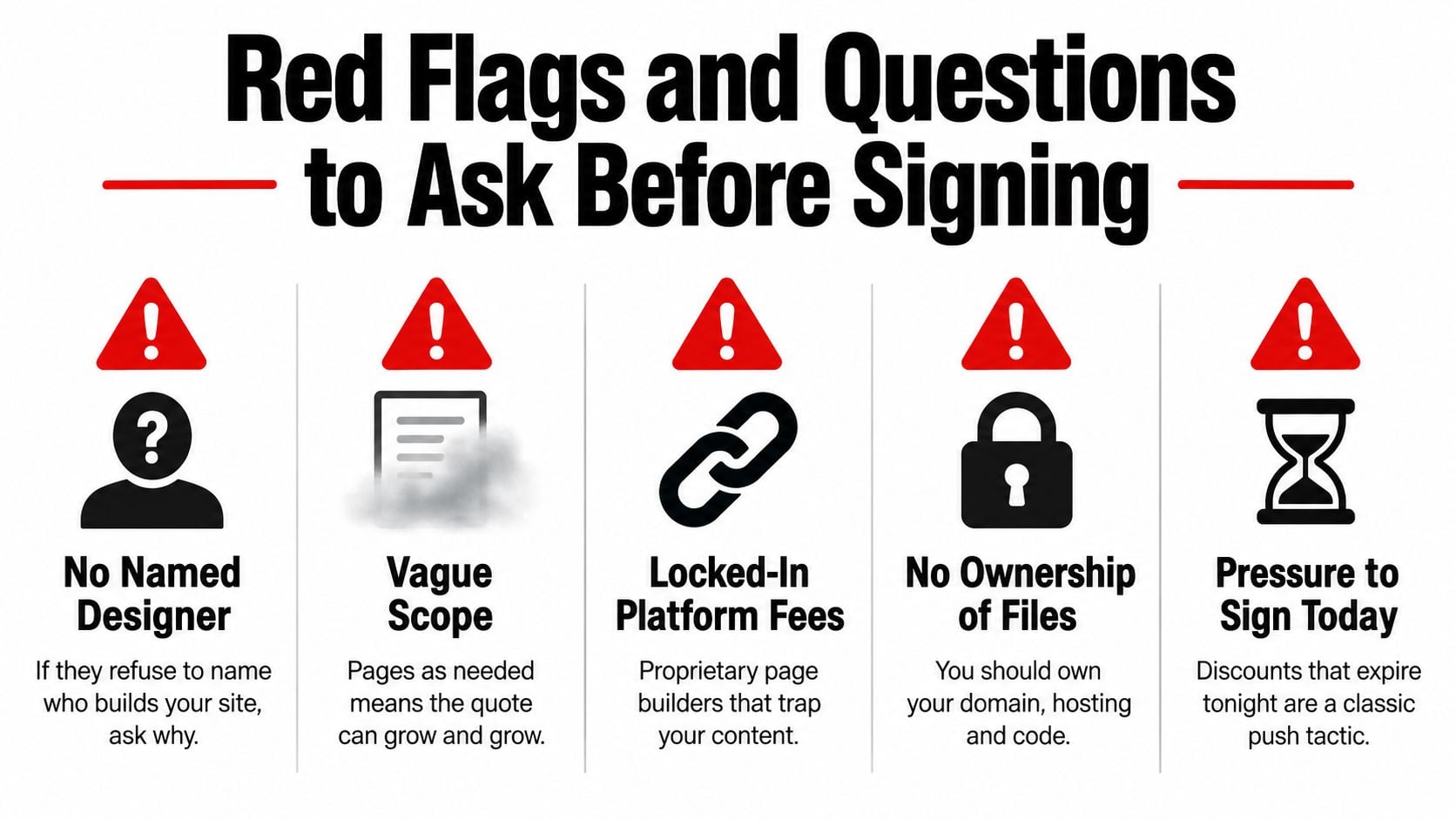
Be wary if the agency won't name the theme, hosting provider or principal tools. You don't need to dictate every technical choice, but you do need to know whether the site uses a maintained WordPress setup or a proprietary builder that makes migration difficult.
Read the small print before approving the design
Look for these warning signs:
- Vague scope: “Pages as needed” gives the quote room to expand without giving you a reliable budget.
- Unclear revisions: Ask how many review rounds are included and what counts as a new requirement.
- Unstated licences: Find out which plugins and themes need renewal after the initial term.
- Weak ownership wording: The agreement should cover the domain, database, content, design files and code.
- Short support windows: A brief post-launch period may leave you paying for defects that appear after handover.
Ask direct questions in writing. Who owns the website if you leave? What happens to hosting if you cancel? Can another developer access the files and database? Which services renew, who pays them and what happens if a plugin is discontinued?
Separate SEO setup from SEO activity
“SEO included” can mean technical setup only. That may cover headings, metadata, indexability, sitemaps, schema and internal links. It may not include keyword research, content planning, link acquisition, performance reporting or ongoing optimisation.
That distinction matters because the site's foundation and its continuing search work are different services. If you need both, ask for separate deliverables and an agreed reporting routine.
Contract test: If the agency can't answer ownership, renewals, support and SEO questions in writing, the package isn't ready to buy.
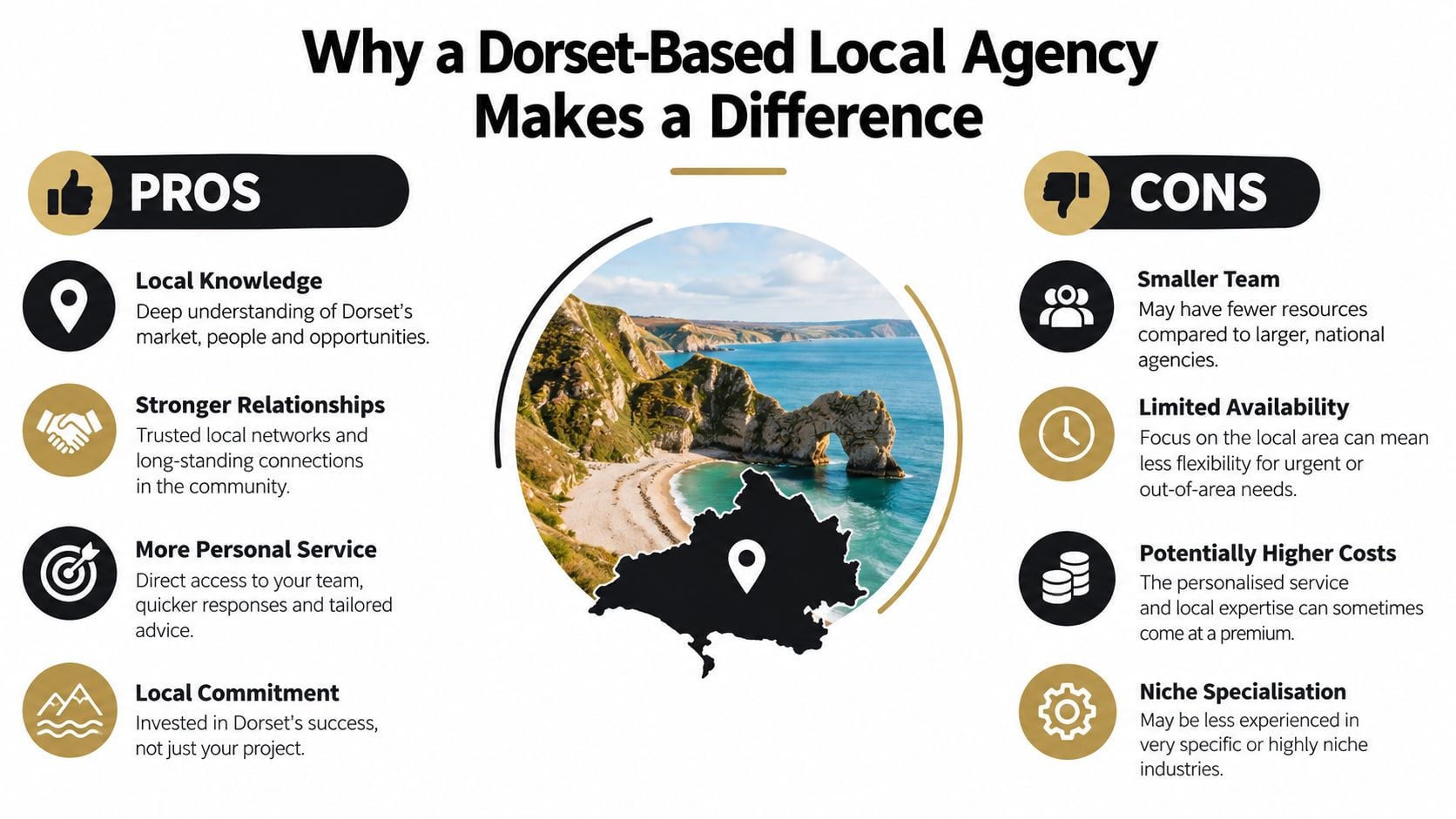
Why a Dorset-Based Local Agency Makes a Difference
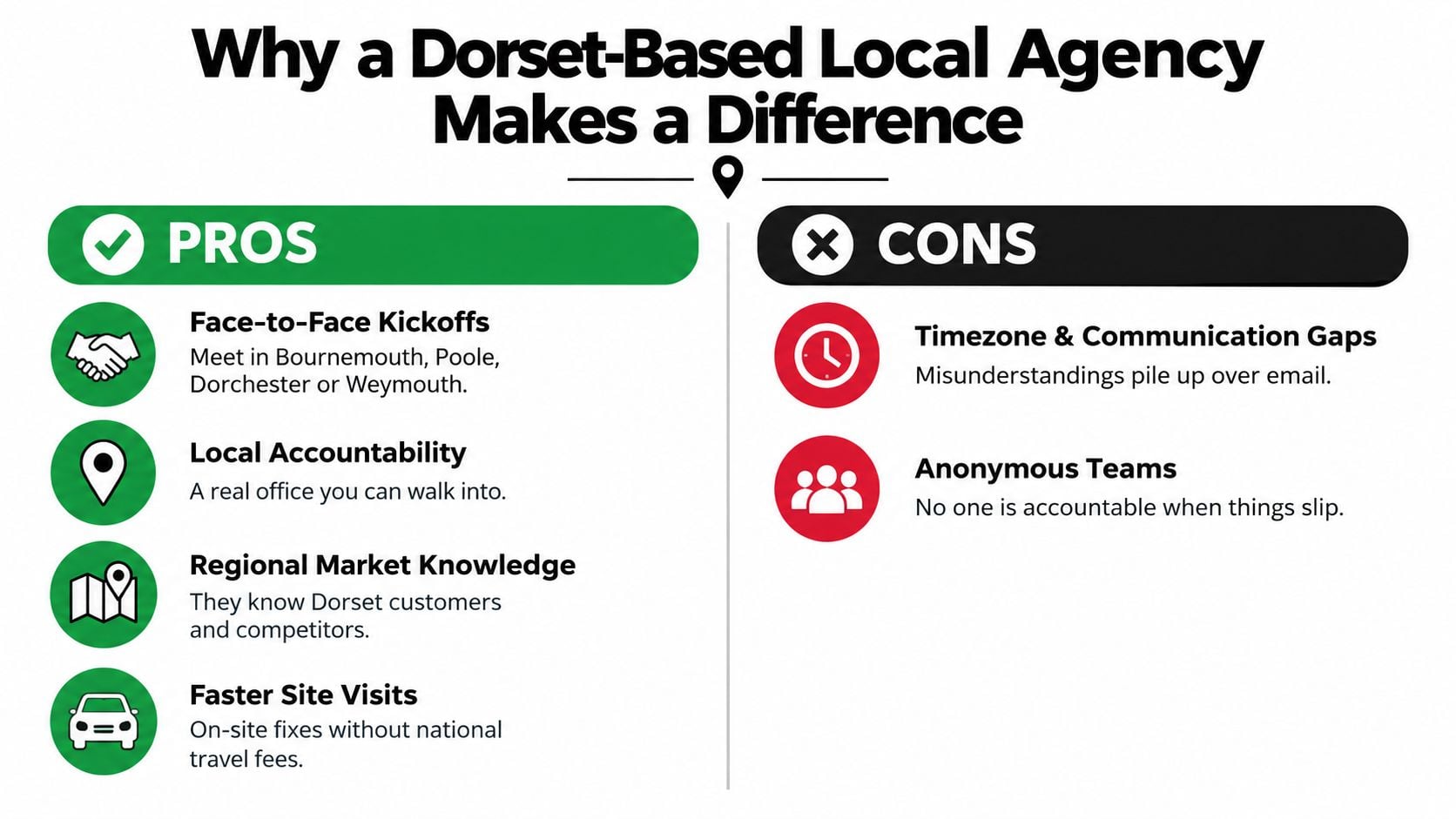
Local isn't automatically better, but accountability is easier to create when you know who you're dealing with. A Dorset business can meet its web team in Bournemouth, Poole, Dorchester or Weymouth, discuss the brief without several rounds of paraphrasing and resolve misunderstandings before they become change requests.
That face-to-face contact is particularly useful during discovery and content planning. A designer can understand how you describe your services, what customers ask on the phone and which parts of the business you're reluctant to explain online. Those details often produce better pages than a generic questionnaire.
Regional context improves practical decisions
A Dorset agency may already understand the difference between a tourism-led business, a marine supplier, a local professional service and a town-centred retailer. That doesn't replace research, but it gives the conversation a useful starting point. You can discuss local competitors, seasonal demand, photography locations and the language customers commonly use.
On-site support can also be practical rather than ceremonial. A team that can visit your premises may help capture authentic imagery, review signage and train staff in person. Those tasks are harder when every decision travels through email and screen sharing.
Local reputation creates accountability
A local supplier has a reputation to protect among nearby businesses, networks and referrals. That doesn't guarantee perfect delivery, so still check the specification and contract. It does make it easier to identify the people responsible for the work and to have a direct conversation when a project slips.
If you're looking for a WordPress developer near you, ask whether the relationship includes strategy, build, hosting and post-launch help or only development hours. Distance matters less than competence, but communication and ownership matter everywhere.
The right package is the one that gives your business a usable site, a clear ownership position and a realistic plan for the months after launch. DesignStack provides fixed-cost WordPress website builds with defined design revisions, hosting options and post-launch updates for businesses that want those responsibilities agreed upfront. Visit DesignStack to discuss your pages, integrations and ongoing support needs before comparing quotes.
Leave a Reply