

Branding for a Company: A Practical UK SME Playbook
You've probably got a logo, a website, a van, a proposal template and a social account that all look like they belong to different businesses. The logo may be perfectly respectable. The problem is that your team still has to make up the message, visuals and customer experience from scratch every time someone asks for a quote.
That's the branding problem for most Dorset SMEs. Branding for a company isn't the purchase of a mark. It's the operating system that helps people recognise you, understand your value and trust what happens next. This playbook shows how to build that system without turning a busy quarter into an endless rebrand.
Table of Contents
- Why Most Small Businesses End Up With a Logo Instead of a Brand
- The Strategic Foundations Every UK SME Needs First
- Positioning, Naming and Messaging That Travel Together
- Building a Visual Identity Your Team Can Actually Maintain
- A Realistic 12-Week Rollout Timeline and SME Budget
- Turning Visible Branding Into Repeat Trust
- Your First 30 Days and Common Questions Answered
Why Most Small Businesses End Up With a Logo Instead of a Brand
Last spring, a Bournemouth trades owner paid £450 for a logo through a marketplace. It looked tidy on a screen, but at a Poole networking breakfast he struggled to answer a simple question: what makes the firm different from three rivals on the same estate? He pointed at the logo, then talked about being reliable, which every rival said too.
That scene is common because a logo is easy to buy and easy to approve. A brand is harder. It asks you to decide who you serve, what you promise, how you behave when something goes wrong and what evidence makes your promise believable.
Practical rule: If your team can't explain the difference without showing the logo, you haven't finished the branding work.
A logo is an identifier. A brand includes positioning, verbal identity, visual identity, customer experience and proof. It appears in the quote your estimator sends, the way your receptionist answers the phone, the photos on your Google Business Profile, the van parked outside a Weymouth home and the follow-up email after the job.
Confusing the two creates practical waste:
- Sales materials drift: One employee describes the service as premium, another focuses on low prices, and a third talks about speed.
- Channels contradict each other: The website sounds formal while Instagram sounds casual, and the printed brochure uses colours nobody can reproduce online.
- Referrals lose momentum: A customer recommends you, but the prospect can't immediately connect the recommendation to a clear reason to choose you.
- Internal decisions slow down: Every new flyer, landing page or proposal becomes a fresh debate about what the business should look and sound like.
The UK's branding economy shows why this matters beyond appearance. A UK government speech citing Brand Finance reported that investment in branding rose from £4.8 billion in 1990 to £14 billion in 2011, demonstrating that brand-building became a long-term business investment rather than merely a marketing cost. The same source said brands can represent 50% to 70% of market value in consumer-product sectors, which underlines the commercial importance of recognition, trust and differentiation. The UK brand consultancy market overview provides the source context.
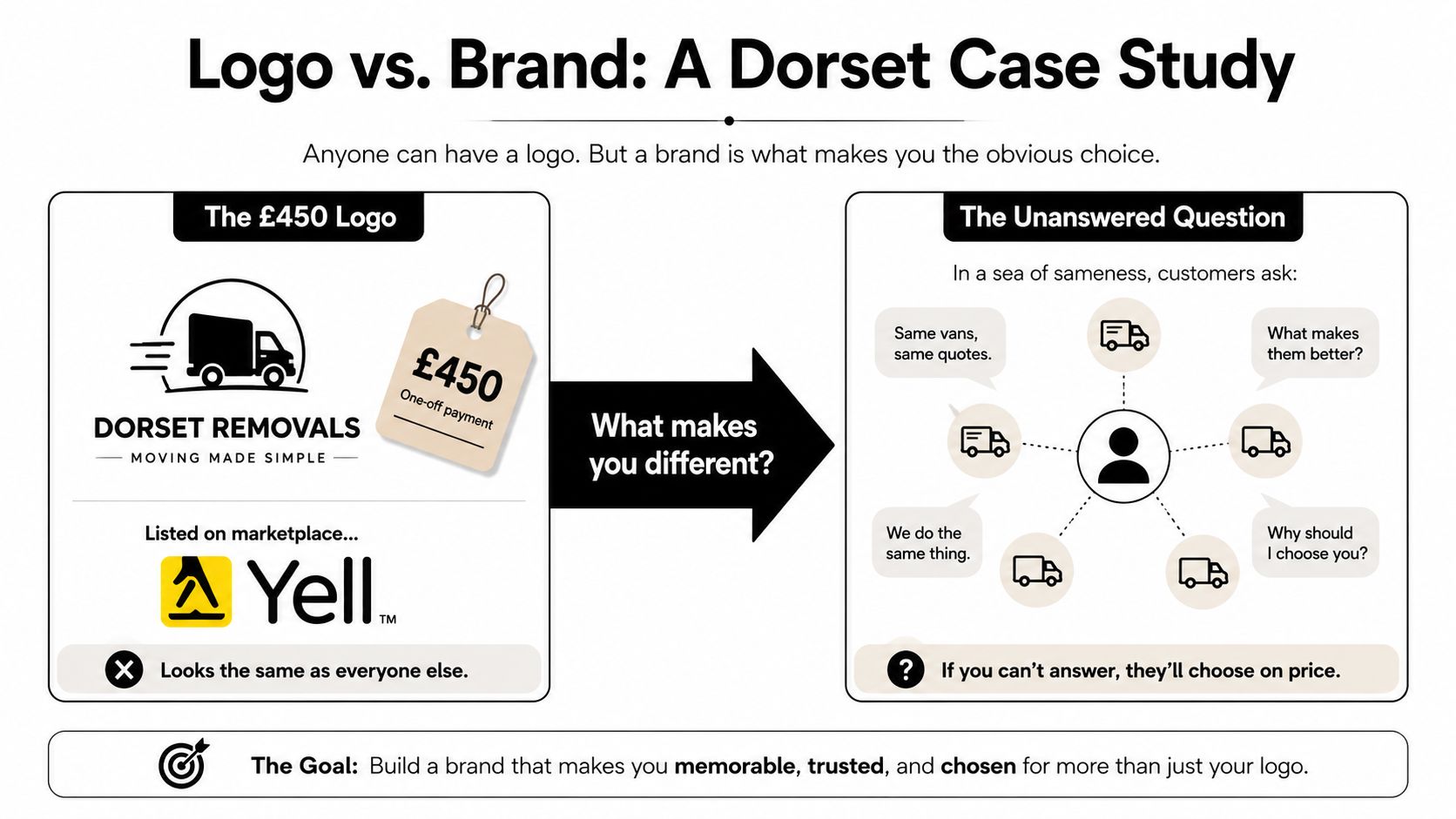
Start with the logo design process if you need a mark, but don't mistake the deliverable for the whole job. A small company can build a useful brand inside a quarter by locking its strategic decisions first, creating a maintainable identity second and rolling the system into daily work immediately.
The Strategic Foundations Every UK SME Needs First
Design work becomes much easier once the business has made four decisions: why it exists, who it serves, where it competes and what proves its claims. These decisions shouldn't sit in a presentation that nobody opens. They should change the words on the homepage, the services you promote and the enquiries you reject.
Take an independent coffee bar opening on Dorchester High Street. Its purpose might be to give local workers and visitors a calm, reliable place for carefully prepared coffee and simple food. That purpose affects the offer. The owner may prioritise fast morning service, comfortable seating and local suppliers rather than trying to become a late-night destination.
A chartered surveying practice in Wimborne needs a different foundation. Its purpose could centre on giving property owners clear, defensible advice before they commit to expensive work. That leads to a more measured tone, clearer explanation of technical terms and proof built around qualifications, professional memberships, project experience and well-structured reports.
Audience changes the business decision
The coffee bar may serve commuters, nearby workers, weekend visitors and parents meeting after the school run. Those groups don't necessarily search in the same way or value the same experience. The owner needs to decide which audience matters most at launch, then shape the menu, opening information, photography and local search profile around that priority.
The surveyor may be speaking to homeowners, landlords, developers, solicitors or commercial property managers. A single generic message such as “professional surveying services” forces every visitor to work out whether the firm understands their situation.
Competition reveals the space you can own
List the alternatives customers already consider. For the coffee bar, that includes other independents, chains, convenience shops and making coffee at home. For the surveyor, it includes established practices, specialist consultants and delaying the decision altogether.
Look for repeated language, not just repeated colours. If every competitor promises quality and expertise, those words won't position you. A stronger distinction might involve a specific type of property, a clearer process or a more useful outcome.
Proof makes the promise credible
A Chamber of Commerce membership can support trust, but it shouldn't carry the entire argument. The coffee bar can show its preparation standards, supplier relationships, menu decisions and staff knowledge. The surveying practice can demonstrate its qualifications, explain its process and publish useful guidance that helps clients understand what they're buying.
This guide to unique value propositions is useful when your team keeps describing activities instead of customer outcomes.
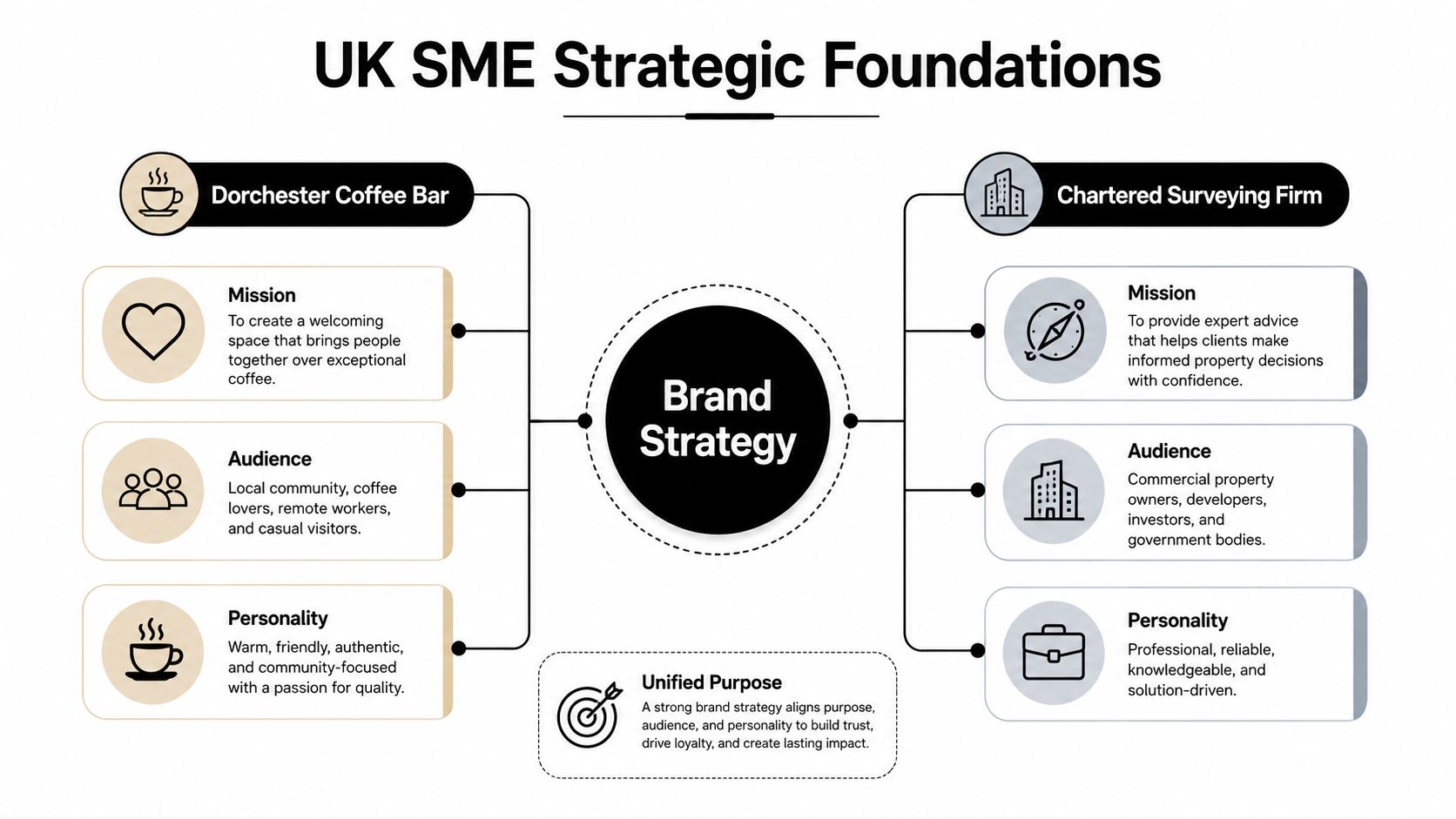
The two businesses could be neighbours and still need completely different foundations. The coffee bar needs an inviting, recognisable presence that works quickly in local search and from the pavement. The surveying firm needs authority, clarity and reassurance across longer sales conversations. Templates save time after those decisions are made. They can't make the decisions for you.
Positioning, Naming and Messaging That Travel Together
Positioning, naming and messaging should be handled as one workflow. Your position defines the space you want to own. Your name signals or supports that space. Your messaging gives the sales team a repeatable way to explain it.
For the Dorchester coffee bar, a useful working position might be: “A welcoming independent coffee bar for people who want properly made coffee and an unhurried break in the centre of town.” The Wimborne surveyor might use: “Clear, practical building advice for Dorset property owners who need confidence before they spend.”
Neither statement is a finished strapline. Each gives the owner a filter for naming, copy and design.
Choose a naming route with open eyes
A founder-led name can feel personal and work well for professional services, but it may make future expansion harder. A descriptive name makes the offer obvious, though it can sound interchangeable. An evocative name gives you more room to build meaning, but it needs stronger supporting messaging. An acquired trade name may bring recognition, but it also demands careful checks for reputation and ownership.
| Route | Typical cost band | Speed | Trademark risk | Best for |
|---|---|---|---|---|
| Founder-led | Low | Fast | Moderate | Practices built around personal expertise |
| Descriptive | Low to moderate | Fast | Higher if generic | Clear local services and straightforward offers |
| Evocative | Moderate | Moderate | Moderate | Businesses seeking a distinctive platform |
| Acquired trade name | Variable | Slower | Requires careful investigation | Firms buying recognition or entering an established market |
These bands are planning guidance, not a quotation. Check Companies House, domain availability and the UK Intellectual Property Office before committing. A name that sounds excellent in a workshop can become expensive if another business already owns the relevant rights or if customers constantly mishear it.
Build a message people can reuse
Use four components:
- Promise: What useful change does the customer get?
- Proof: Why should they believe you?
- Personality: How should the business sound?
- Action: What should the reader do next?
The coffee bar might invite people to view the menu, visit the shop or order ahead. The surveyor might ask prospects to book an initial conversation. Keep one primary action across the homepage, email signature, tender response and Instagram bio.
Good brand storytelling doesn't mean writing a dramatic founder myth. It means connecting your reason for existing to customer evidence in language your team can repeat without sounding rehearsed. If the positioning says “clear, practical advice”, the proposal shouldn't bury the reader in unexplained terminology.
Building a Visual Identity Your Team Can Actually Maintain
A small business doesn't need a complicated brand manual. It needs decisions that a non-designer can apply correctly on a busy Tuesday afternoon.
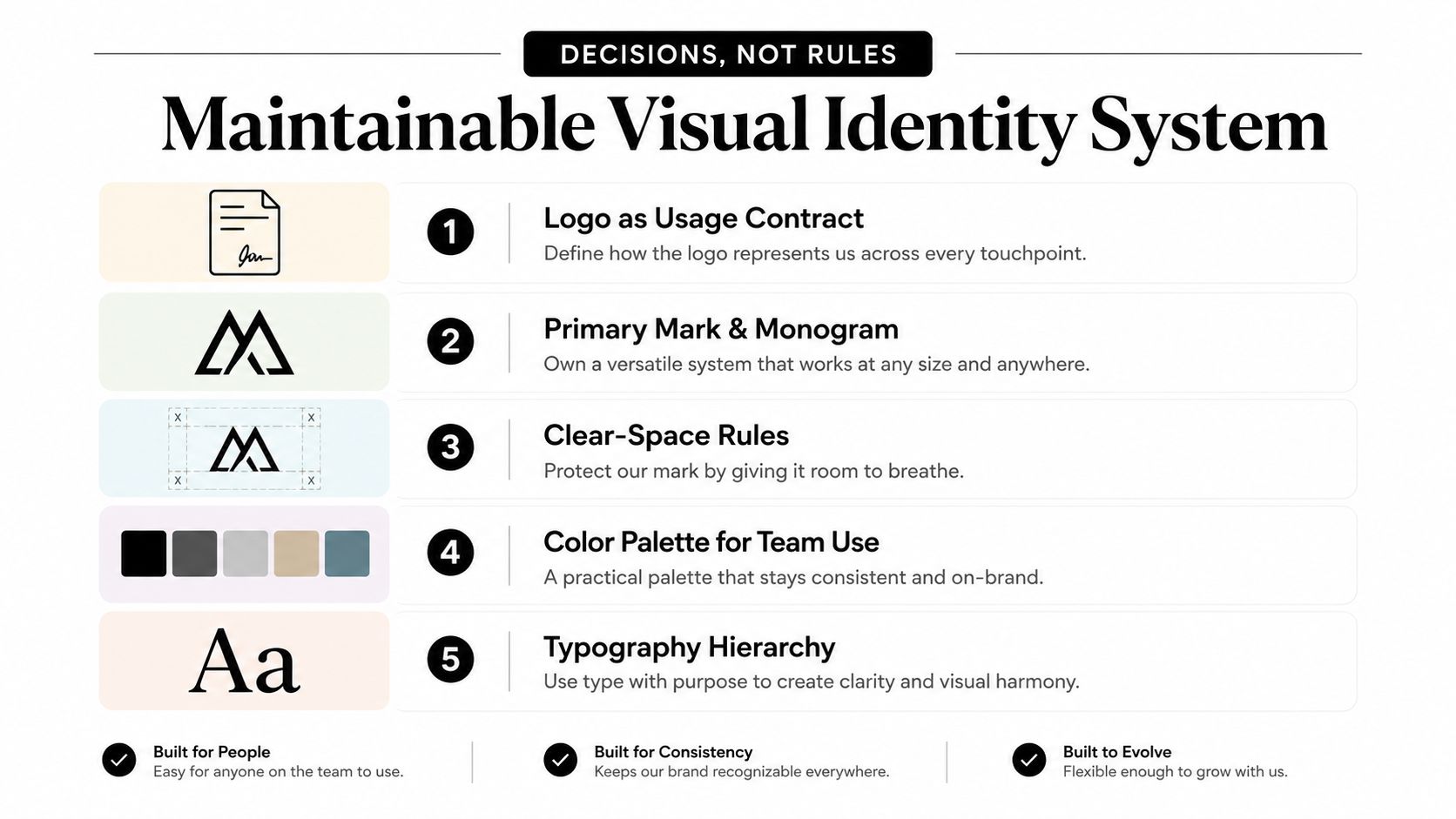
Start with the logo as a usage contract, not a piece of artwork. Specify the primary mark, a compact version or monogram, minimum size, clear space and approved colour versions. Add a short do-not list covering stretched proportions, unapproved recolouring, drop shadows, busy backgrounds and improvised edits.
Make every core choice operational
Choose one primary typeface and one supporting face from Google Fonts or Adobe Fonts. The important point isn't fashion. It's dependable access, clear hierarchy and a sensible reading experience across proposals, web pages and social graphics.
Build the colour palette around two working colours and neutrals. Record HEX, RGB and CMYK values so the web developer, printer and sign fitter aren't each guessing at a different version of the same blue. Test contrast before launch, particularly for buttons, navigation and small text.
Photography needs equally plain direction. Write whether images should feel warm or clinical, people-first or product-led, spontaneous or carefully composed. If an iPhone image is acceptable for social content but not for a brochure, say so. If stock photography is banned, make commissioning original images part of the rollout rather than an afterthought.
Tone of voice belongs in the same system. Give the team a paragraph they can quote: perhaps “clear, calm and practical, with technical terms explained in ordinary English”. Then add examples for a delayed appointment, a difficult complaint and a successful project.
Keep the guide short enough to use
A one-page cheatsheet usually beats a 40-page document that gets ignored after the launch meeting. Include the logo files, colour values, type hierarchy, image direction, tone paragraph and a contact for approvals.
The Crowbert brand consistency guide is a useful reference for thinking about how repeated application protects recognition across touchpoints. For implementation, a practical style guide creation process should focus on the assets your team uses, not on rules nobody will encounter.
Consistency doesn't mean making every communication identical. It means making the important signals stable while allowing the content to respond to the customer and context.
A Realistic 12-Week Rollout Timeline and SME Budget
A rebrand fails when it becomes an open-ended side project. Give it a decision calendar, name the owner for each stage and book approval meetings before the work begins.
For a Dorset SME, a quarter is enough to move from uncertainty to a usable system if the leadership team responds promptly. The following bands are practical planning ranges, not fixed market prices.
| Phase | Weeks | Activities | Budget Range |
|---|---|---|---|
| Discovery | 1 to 2 | Interviews, competitor audit, strategy workshop | Included in chosen route |
| Strategy | 3 to 4 | Positioning, naming and messaging | Included in chosen route |
| Identity | 5 to 7 | Two concept routes, review and decision meeting | Included in chosen route |
| Production | 8 | Refinement, cheatsheet and templates | Included in chosen route |
| Digital rollout | 9 to 10 | Website, social headers, email signature and Google Business Profile | Included in chosen route |
| Physical rollout | 11 | Signage, uniforms, packaging and print | Additional production costs may apply |
| Launch | 12 | Briefing, announcement email and local outreach | Included in chosen route |
A DIY route of £500 to £1,500, a freelancer route of £2,500 to £6,000 and a Dorset studio route of £5,000 to £15,000 are the planning bands supplied for this SME playbook. This guide to branding agency charges gives further context for comparing scope and fees.
Spend where judgement matters
Keep tone of voice, routine social content and everyday customer communications in-house. Your team owns the lived experience, so outside copy rarely replaces their knowledge.
Outsource naming conflicts, trademark searches, signage fitting and original photography when stock imagery won't represent the business properly. Use Friday decision meetings during the concept stage. If nobody has authority to choose, the project will collect opinions instead of reaching an outcome.
UK SMEs represent 99.85% of businesses, account for 60% of private-sector employment and generate 51% of turnover, according to the cited UK branding market source. That scale makes a reusable system more sensible than a collection of bespoke assets that only one person knows how to operate. The same source reports that 79% of buyers commission branding before they have a business email address, a useful warning for early-stage owners: identity without governance creates rework.
Turning Visible Branding Into Repeat Trust
A customer trusts a brand when the business behaves in a way that confirms its promise. Design helps by making that promise easy to recognise, but it can't repair an unanswered complaint, an unclear invoice or a service that arrives later than agreed.
The UK trust picture makes the gap clear. In its 2025 UK special report, Edelman found that 80% of people trusted brands they use, while only 37% trusted brands in general. Edelman's UK Brand Trust report shows why familiarity and broad trust shouldn't be treated as the same thing.
For a Weymouth trades company, the customer journey should feel connected. The van outside the house should resemble the website used to book the job. The invoice should match the quote. The follow-up email should sound like the person who answered the phone.
Track behaviour, not brand enthusiasm
Set a baseline before launch, then review performance at 90 days and 180 days. Use the measures you already have access to:
- Repeat purchase rate: Are existing customers returning?
- Referral rate: Do new enquiries mention a recommendation?
- Average review score: Are customers describing the promised experience?
- Website engagement: Do visitors reach the pages that explain the offer?
- Enquiry-to-quote conversion: Does clearer positioning improve the quality of conversations?
These measures won't prove that a colour change caused a sale. They will show whether the new system is supporting the behaviours you need. The IPA reports that the top 20% of consistent brands achieve 28% more Very Large Business Effects, including sales value, profit and market-share gains. The UK brand consistency research summary explains the benchmark and its practical implication.
Consistency is a performance discipline. It isn't a demand that every post, page and proposal look identical.
If the numbers don't move, don't order another logo. Check whether staff use the templates, whether the promise is specific, whether proof appears where buyers need it and whether customer service delivers the advertised experience.
Your First 30 Days and Common Questions Answered
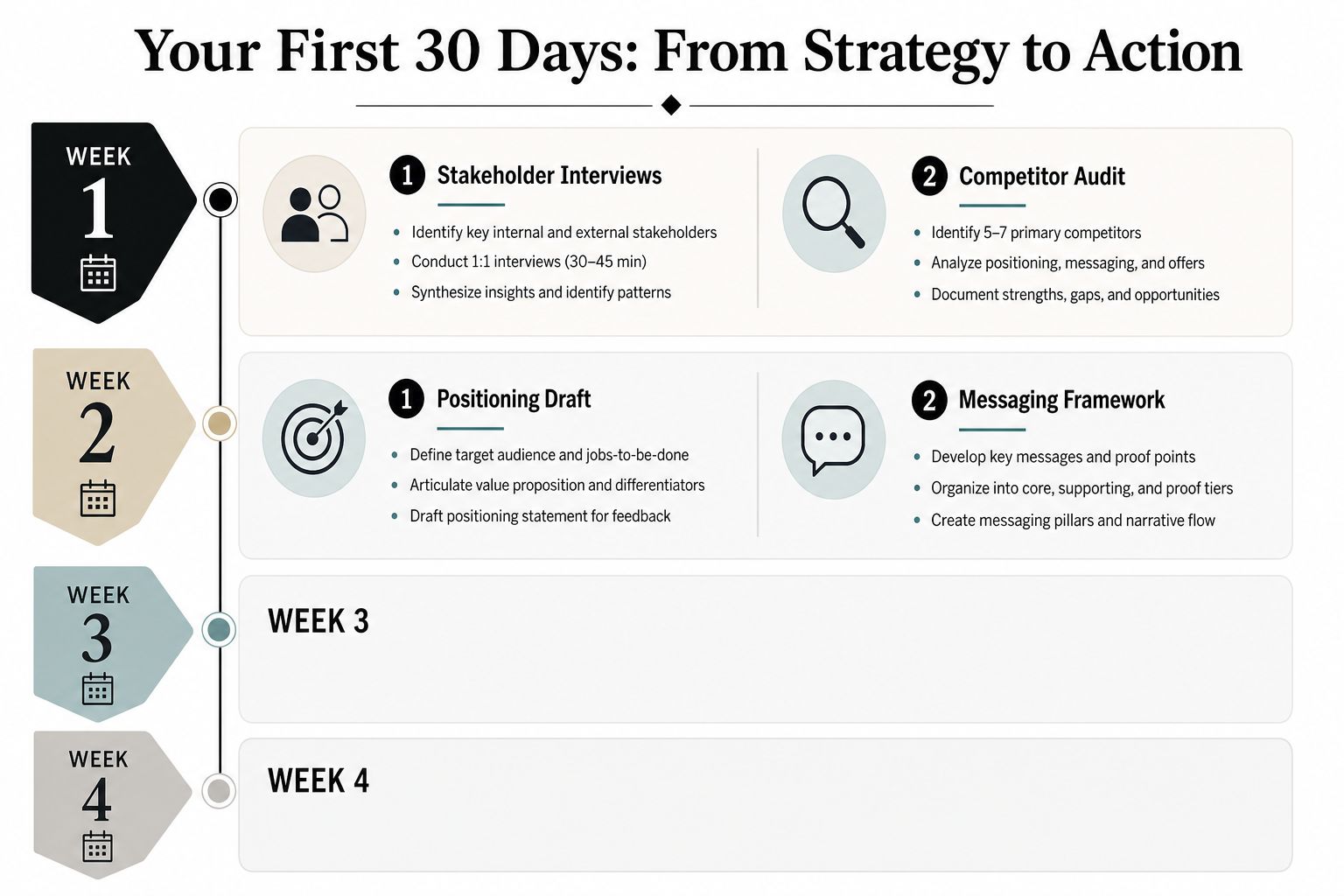
Make the first month administrative and concrete. You don't need a grand launch before you know what the business is trying to say.
Week one
Book stakeholder conversations with the owner, sales lead, delivery team and whoever handles complaints. Allow a few focused hours across the week, then audit five local competitors across their websites, Google Business Profiles, social accounts and printed materials. Record repeated claims, missing information and opportunities to sound more useful.
Week two
Draft the positioning statement and create a naming shortlist. Test each option with staff and a small number of trusted customers. Check Companies House, domain availability and the UK Intellectual Property Office before design work starts.
Week three
Create a moodboard and inventory existing assets. Gather the current logo files, vehicle artwork, website imagery, proposal templates, social graphics, signage and printed stock. Mark each item as keep, update or replace.
Week four
Choose rollout priorities and write the internal brief. Start with the touchpoints customers see most often, usually the website, email signature, proposal, Google Business Profile and social headers. Don't print thousands of items until the core system has survived real use.
Common questions from Dorset owners
How long does rebranding take for a five to fifteen-person firm?
A focused project can move through strategy, identity and rollout within a quarter, provided one decision-maker gives timely approval. Delays usually come from unclear ownership, not from the design itself.
What budget should we allow?
For planning, strategy-only work sits below a full identity and rollout. A DIY route may suit a confident owner with time, while a freelancer or studio earns its fee when the business needs positioning, naming judgement, templates and implementation handled together.
When should I hire a Bournemouth or Poole studio?
Choose a local studio when the work affects signage, premises, printed materials, website structure and several staff members. A freelance designer is often enough for a defined identity task with a clear brief and an available decision-maker.
How do I protect a new name?
Check Companies House for company-name conflicts, then search the UK Intellectual Property Office for relevant trade marks. A company registration doesn't automatically give you broad trade mark protection, so get specialist advice where the name is commercially important.
Should we rebrand before rebuilding the website?
Yes, if the current website reflects the confusion you're trying to solve. Lock the positioning, message and visual system first, then rebuild the site around those decisions. Otherwise, you'll pay to redesign the same pages twice.
Start this Monday with the stakeholder interviews and competitor audit. By Friday, you should know what customers value, what rivals repeat and which parts of your current identity create friction.
DesignStack helps Dorset businesses turn branding decisions into a usable identity system, including strategy, logo suites, brand guidelines and the website assets needed for consistent rollout. If your team needs a practical partner for a rebrand and digital implementation, visit DesignStack and discuss what needs fixing first.
Leave a Reply