

Your Rebranding Strategy: A Guide for UK SMBs in 2026
You know the moment. The business is growing, the service has improved, the team is sharper than it was two years ago, but the brand still looks and sounds like an earlier version of the company. The website undersells the work. The logo feels dated. Sales conversations drift because different people describe the business in different ways.
That's usually when owners start asking whether they need a new logo. In practice, that's rarely the actual question.
A rebrand becomes necessary when the brand no longer matches the business you're trying to build. For UK SMBs, that decision carries real operational weight. It affects your website, signage, printed materials, vehicles, proposals, email signatures, team confidence, and how clearly buyers understand what you do. Done properly, a rebranding strategy gives the business a cleaner story and a more usable system. Done badly, it creates confusion and waste.
Most guides focus on the creative reveal. Far fewer deal with the awkward realities, like deciding what to keep, auditing every old asset still in circulation, and getting your team aligned before anything goes live. That's where most first rebrands succeed or fail.
Table of Contents
- Is Your Brand Still Working For You
- Building Your Rebrand Foundation on Facts Not Feelings
- Defining Your New North Star and Brand Messaging
- Budgeting Timelines and When to Call the Pros
- Executing Your Vision From Logo to Live Website
- Launching and Measuring Your Rebrand's Success
Is Your Brand Still Working For You
A lot of first rebrands start with mild embarrassment.
An owner opens the homepage before a sales call and winces. A retailer realises the packaging and shop signage no longer reflect the quality of the product. A professional services firm sees that competitors with weaker delivery are presenting themselves more clearly. Nothing is on fire, but the brand has started creating drag.
That drag shows up in small ways first. Leads arrive half-informed. Prospects ask basic questions your website should already have answered. Existing customers know you, but new customers don't quickly understand why you're different. The business may have evolved, but the brand hasn't caught up.
The problem usually isn't just the logo
When people say their brand feels outdated, they often mean several things at once:
- The visuals feel inconsistent across the website, socials, proposals, print, and signage.
- The messaging is fuzzy because nobody has agreed on a clear value proposition.
- The customer experience doesn't match the promise being made in marketing.
- The team improvises too much because there isn't a shared system behind the brand.
That's why a rebranding strategy has to do more than make the business look better. It has to make the business easier to understand, easier to trust, and easier to present consistently. If your brand changes but your communication stays messy, you've only changed the packaging.
A good rebrand removes friction. It helps customers recognise what you do, why it matters, and why they should choose you.
Consistency matters more than many owners expect. If your site sounds formal, your Instagram sounds casual, your brochures use old colours, and your team describes the offer four different ways, buyers notice. Design and messaging work best when they support the same story across every touchpoint. That's the practical side of brand consistency in day-to-day marketing.
Rebranding is a business decision
The strongest reason to rebrand isn't boredom. It's misalignment.
You may be moving upmarket. You may have outgrown a DIY identity. You may have added services that the old brand doesn't explain. You may have merged offers into one clearer proposition. Sometimes the business has matured, but the public-facing brand still signals “small, basic, early-stage”.
That's fixable, but only if the rebrand starts with the business model, customer expectation, and operational reality. A practical rebrand asks hard questions before anyone starts choosing fonts.
Building Your Rebrand Foundation on Facts Not Feelings
The first serious mistake in most rebrands is starting with design references before anyone has audited the current brand. Owners often know something feels off, but they haven't pinned down what's still valuable, what's confusing customers, and where the internal disagreements sit.
Start with evidence.
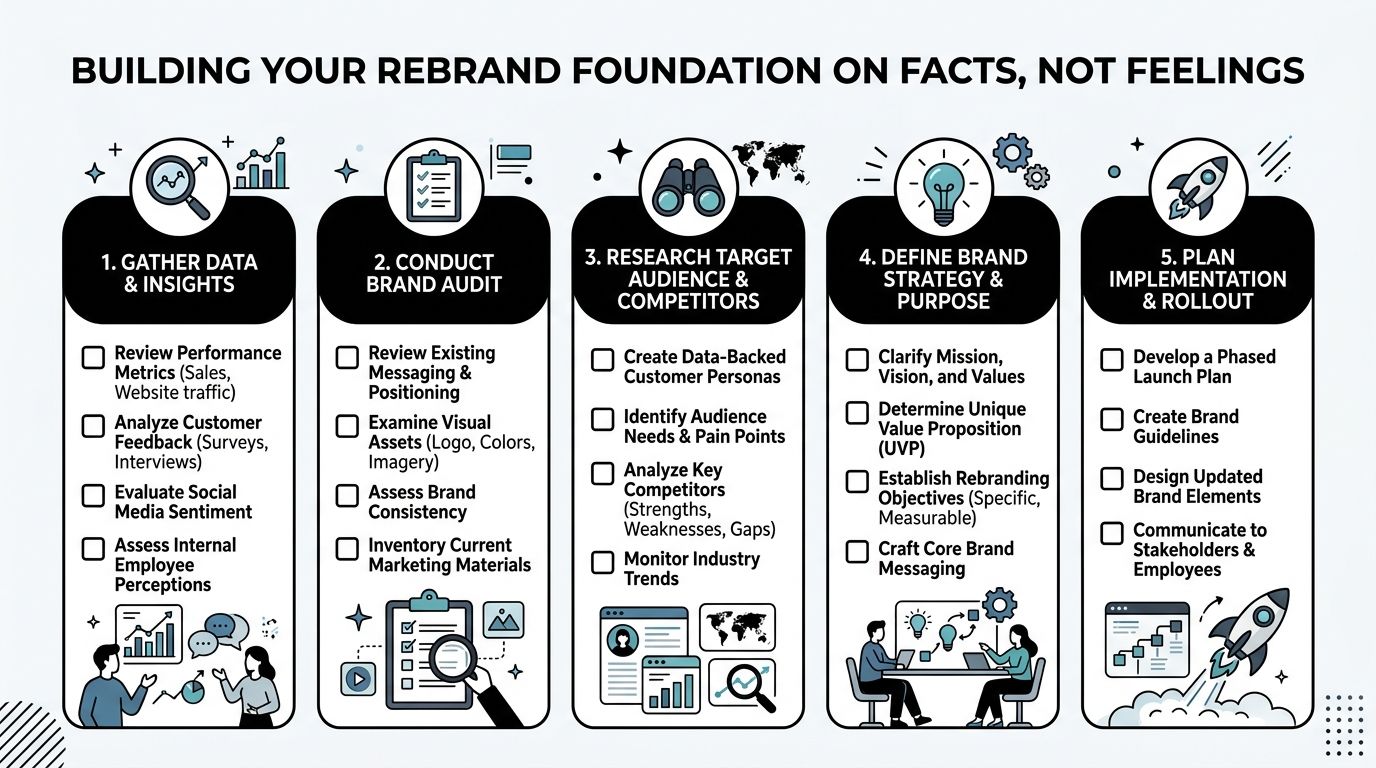
What to audit before any design work starts
A proper audit should include the visible brand and the lived brand.
Look at the obvious assets first. Review your website, logo files, social headers, printed materials, sales decks, signage, packaging, email signatures, and any templates staff use. Then review the less obvious layer, which is the language. Compare headlines, service descriptions, proposal copy, About page text, and sales call phrasing. You're looking for mismatch, duplication, and drift.
A brand equity inventory matters here. UK guidance on rebranding repeatedly warns against removing familiar names, colours, or cues without checking what customers already recognise and value, because that can alienate the people you've already worked hard to win over, as discussed in this overview of rebrand pitfalls and brand equity inventory.
Use a working checklist like this:
- Visual equity. Identify assets customers already associate with you. This might be a colour, a symbol, a packaging style, or even a photography approach.
- Message clarity. Collect the phrases you use most often. Then check whether they're plain English or internal jargon.
- Customer perception. Ask recent customers how they describe your business in their own words.
- Competitive position. Review a sensible set of direct competitors and note how they frame price, expertise, speed, trust, or specialism.
- Activation gaps. Find the places where the brand promise sounds strong in marketing but falls apart in delivery, onboarding, or support.
If your team produces regular content, it helps to assess the underlying planning too. Messaging becomes inconsistent when nobody has documented what topics matter, what tone you use, and how each channel supports the buying journey. That's where a practical content strategy for business websites helps anchor the rebrand in something repeatable.
Later in the process, a short external perspective often helps reset assumptions.
Why internal alignment comes before launch planning
A rebrand can look polished on launch day and still fail because the leadership team never agreed on what success meant.
That's not a minor issue. Recent 2025 data indicates that 68% of UK SME rebrands face internal resistance or employee confusion post-launch because leadership failed to align on success metrics and vision during internal workshops, which then creates mixed messaging for customers, according to this UK SME rebranding analysis.
That's why internal workshops should happen early, not as a final sign-off exercise. The point isn't to get everybody to vote on colours. The point is to force clarity on the essentials:
- What's changing and what must remain recognisable
- Who the ideal customer is now
- What the business wants to be known for
- Which problems the new brand should solve
- How success will be judged after launch
Practical rule: If your directors can't explain the new position in similar language, your customers won't understand it either.
In workshops, I'd rather see honest disagreement early than false harmony. A useful session surfaces tension around pricing, audience, tone, and ambition. That tension isn't a problem. Hidden tension is.
Defining Your New North Star and Brand Messaging
Once the audit is done, the next job is to decide what the new brand is trying to make true. Not what it should look like. What it should help the business achieve and communicate.
That decision becomes your North Star. It gives designers, copywriters, developers, and internal teams one shared direction.
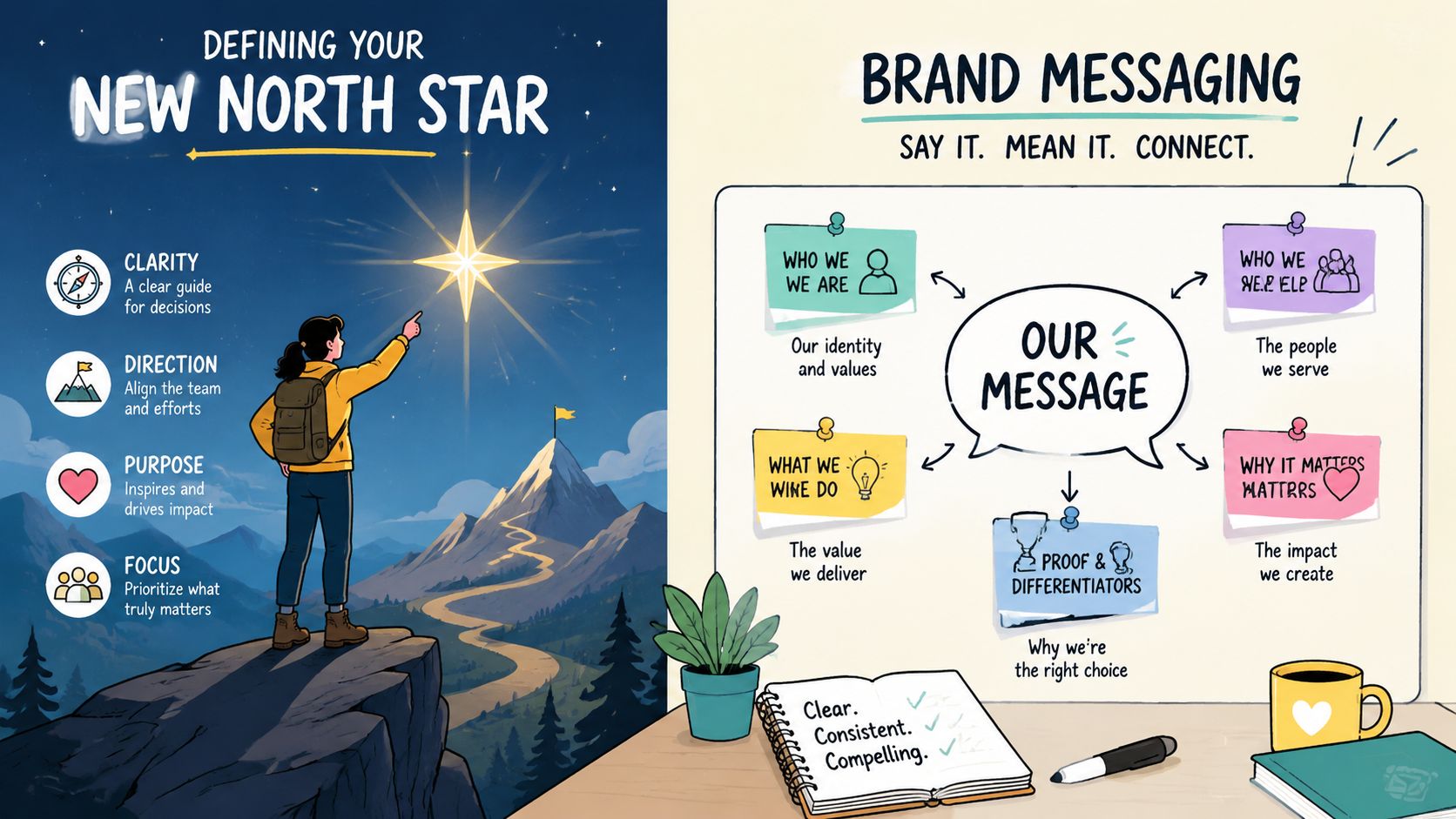
The questions that shape positioning
Most SMBs don't need a grand manifesto. They need a clear strategic brief that answers a few uncomfortable questions with precision.
Ask:
| Question | Why it matters |
|---|---|
| Who are we trying to attract now? | Because old messaging often reflects the previous customer, not the next one. |
| What do we do better or differently? | Because “quality service” isn't positioning. It's baseline. |
| What do we want to be known for? | Because reputation becomes stronger when it's focused. |
| What tone fits the buyer and the offer? | Because a premium service, a local shop, and a membership organisation won't all sound the same. |
A lot of businesses discover that they've been describing features instead of value. They talk about what they provide, not what changes for the customer. Repositioning means tightening that gap.
That's where a defined unique value proposition for your brand becomes useful. It helps turn vague claims into a sharper statement of relevance.
Turning strategy into usable messaging
Your messaging should be practical enough that a designer can interpret it and a salesperson can repeat it.
A simple framework usually works best:
- Core positioning statement. One plain sentence covering who you help, what problem you solve, and why your approach is different.
- Three messaging pillars. These are the recurring themes that support the position, such as trust, speed, specialist knowledge, or simplicity.
- Tone of voice notes. Define how the brand should sound. Clear, expert, calm, direct, warm, technical, or whatever fits.
- Proof points. Use qualitative proof if you don't have formal data yet. Think process, experience, responsiveness, sector understanding, or service model.
The best messaging gives the creative team boundaries. Without that, design becomes decoration.
This matters in every sector, including hospitality. If you look at examples of how to succeed in restaurants, the stronger concepts are usually built around a clear point of view, a recognisable audience, and an experience that matches the promise. Branding for a restaurant isn't just visual style. It's position, language, offer, and atmosphere working together. The same logic applies to professional services, retail, and eCommerce.
By the end of this stage, you should have a brief that tells your creative team what the brand needs to say before it decides how the brand should look.
Budgeting Timelines and When to Call the Pros
This is the point where ambition meets reality.
Most SMB owners underestimate two things. First, how many moving parts a rebrand touches. Second, how much money gets spent outside the design files themselves. The visual work matters, but the rollout usually determines whether the project feels controlled or chaotic.
What a UK SMB rebrand usually needs to budget for
There isn't one universal number because scope changes everything. A business updating name, website, signage, print, and sales materials is taking on a different project from one that's refining messaging and refreshing visuals.
Still, there are useful planning ranges. In the UK, a full rebranding strategy is typically a 6-to-12-month project, and for small and medium-sized businesses, it can cost between £5,000 and £50,000. These costs often represent 10% to 20% of a company's total annual marketing budget, based on this UK rebranding guide.
That range exists because budgets usually need to cover several layers at once:
- Strategy work. Research, workshops, positioning, messaging, and decision-making.
- Identity design. Logo, colour system, typography, templates, and guidelines.
- Website work. Design, build, content updates, testing, and launch support.
- Rollout items. Sales decks, stationery, social graphics, packaging, signage, and internal files.
- Launch activity. Internal communication, public announcement, and follow-up asset updates.
A useful early exercise is to separate must-have, should-have, and later-phase items. That keeps you from spending launch budget on things that could wait.
The hidden costs that catch owners out
The hidden costs are usually physical and operational.
Businesses tend to budget for logo design and website work, then forget about van graphics, shopfront signage, uniforms, exhibition materials, old brochures, editable document templates, PDF lead magnets, office walls, invoices, email footers, and stock that still carries the previous identity.
There are also technical and legal costs in some rebrands. For UK businesses, domain migration costs range from £10 to £2,000 for premium new domains, with trademark filing fees between £170 to £270, according to this guide to rebranding and domain migration in the UK.
Watch for residue: old assets don't disappear because the new logo is approved. Someone has to find them, replace them, or retire them.
That's why I always recommend an asset register before launch. A simple spreadsheet is enough if it's thorough. List every place the old brand lives. Add owner, status, replacement date, and whether it's customer-facing. That one document prevents a surprising amount of waste.
When in-house works and when it does not
In-house can work when the scope is narrow, the existing positioning is already clear, and someone internally can own the project from start to finish. A contained visual refresh is one thing.
A full rebrand is different. If you're changing messaging, service structure, website architecture, domain setup, and external rollout at the same time, you're managing a business change project, not just a design task.
A professional partner becomes more useful when:
- Leadership needs an external referee to get decisions made
- The website is central to lead generation
- There are many physical and digital assets to update
- SEO risk matters
- The team doesn't have time to manage detail
If you're comparing support options, look at process before style. Ask how the agency handles research, approvals, content, migration, rollout, and post-launch fixes. For example, branding agency pricing and scope should be viewed alongside delivery method, not in isolation. DesignStack is one option in that mix for businesses that need branding, website work, and supporting rollout under one roof.
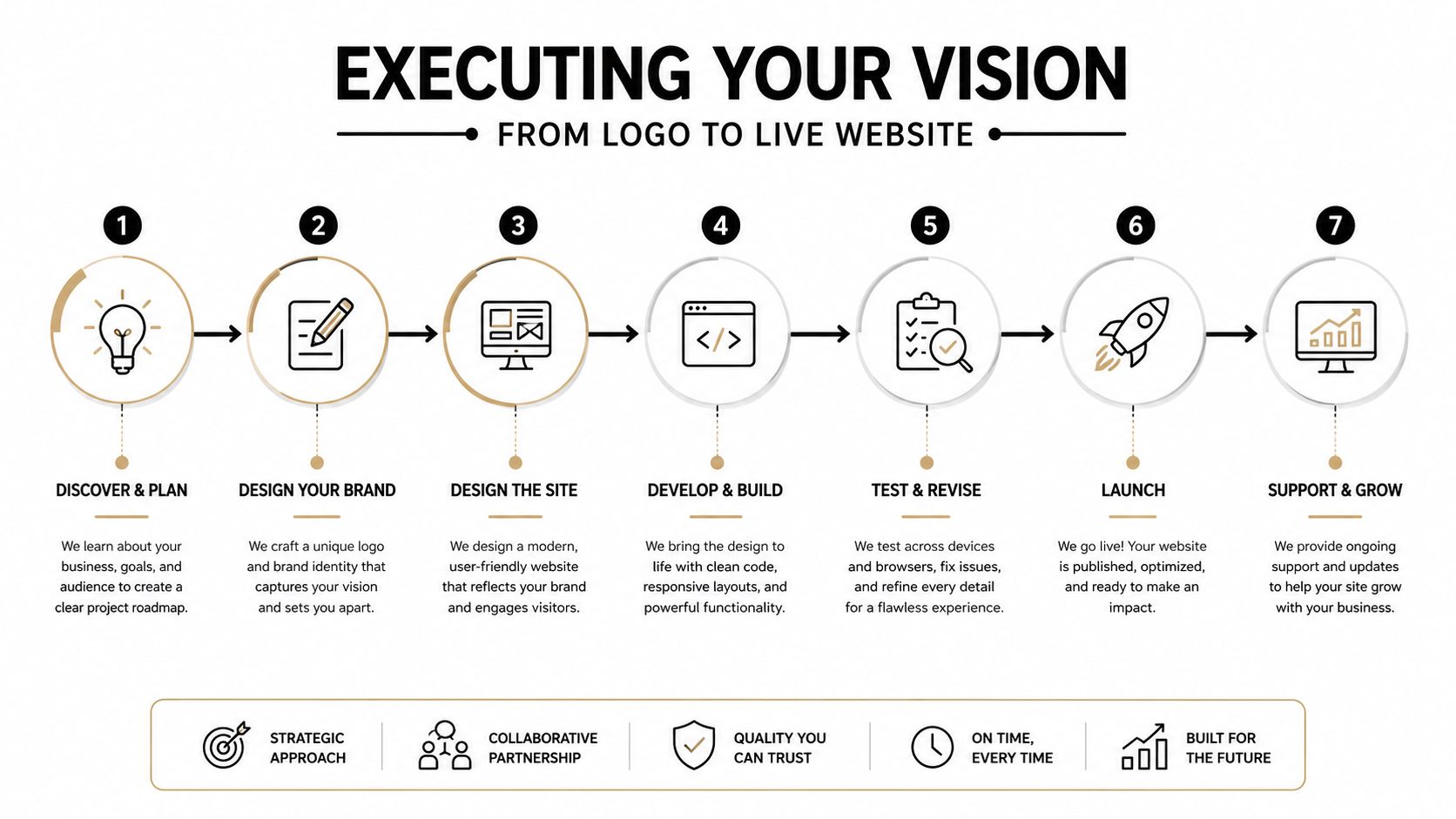
Executing Your Vision From Logo to Live Website
Execution is where many rebrands lose discipline. Teams rush because they want to see the new identity live, and suddenly the website is being rewritten before the core rules are finished.
That usually creates rework.
Brief the identity before you judge the design
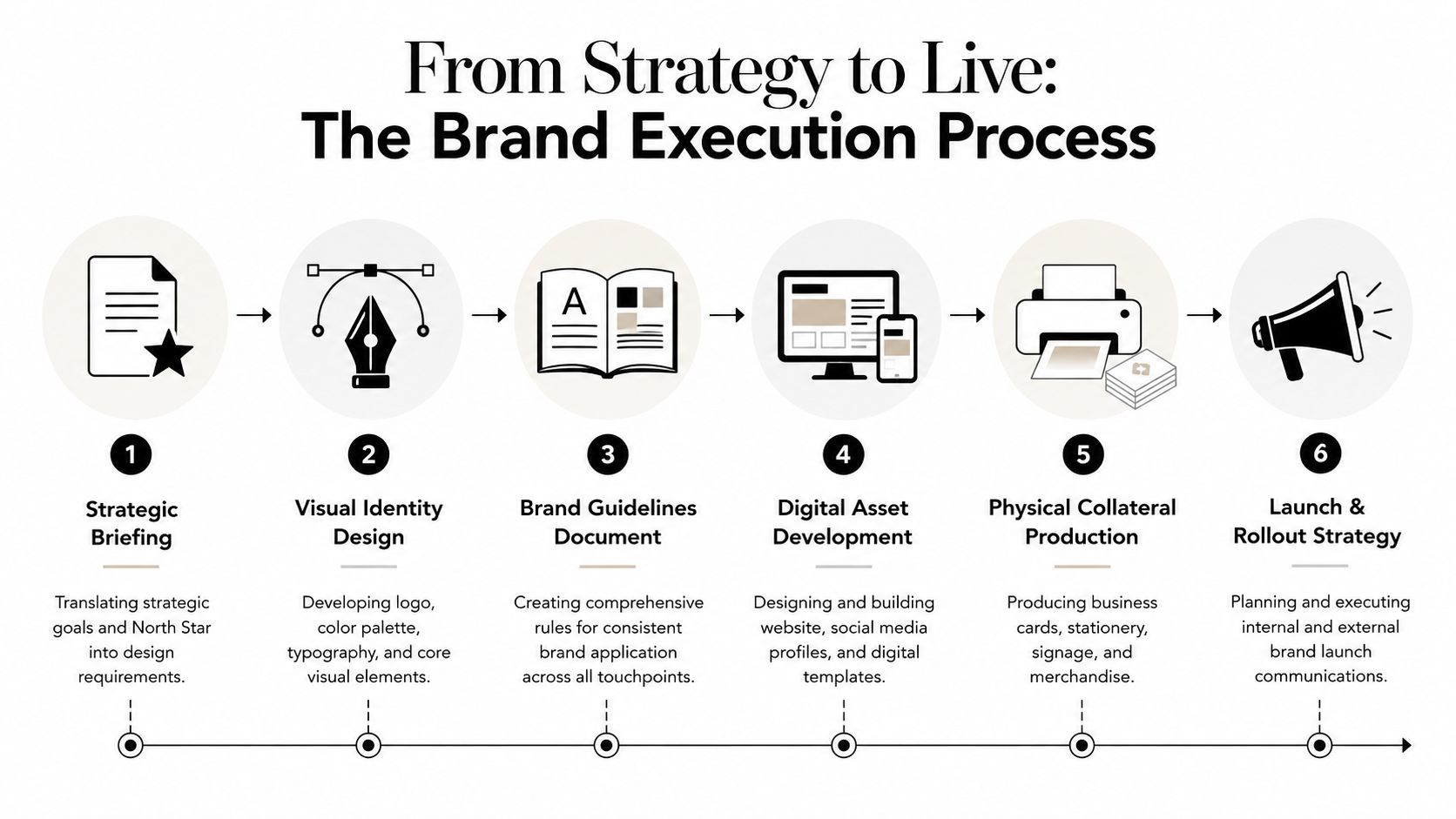
Good identity work needs a proper brief. That brief should include the agreed positioning, ideal customer, tone, competitors, practical applications, and what existing equity should be preserved.
If you skip that, feedback becomes subjective. You'll hear things like “can we make it pop more?” or “it doesn't feel premium enough” without any shared criteria. A stronger review process asks whether the design supports the intended position, works across digital and print, remains legible at small sizes, and feels coherent with the audience you're trying to reach.
A clean visual system usually includes:
- Primary logo and supporting versions
- Colour palette with practical use rules
- Typography choices for web and print
- Image direction
- Template set for everyday marketing
- Guidelines for consistent application
If the new brand only works on a presentation slide, it is not ready. It has to work on a mobile screen, a PDF, a sign, and an invoice.
Handle the website rollout like a migration project
For many SMBs, the website is the most important branded asset because it also carries search visibility, lead capture, and first impressions.
That means a rebrand website launch should be treated as a migration project, not just a redesign. For UK SMEs, the typical rebrand timeline of 3-6 months includes 8-14 weeks specifically for website design and build and 2-4 weeks for SEO and migration, according to this website rebranding guide for small businesses.
If the domain is changing, plan carefully. If the domain is staying the same, still treat the launch as a structured move.
A practical rollout list looks like this:
- Lock the sitemap early so content and redirects can be planned properly.
- Rewrite key pages to match the new messaging, especially the homepage, service pages, About page, and contact journeys.
- Map old URLs to new destinations so users and search engines don't hit dead ends.
- Update on-page brand language including headings, metadata, imagery, and downloadable files.
- Test forms, tracking, mobile layouts, and internal links before launch day.
- Update external references after launch such as directory listings, social bios, and major partner links.
The key is sequencing. Identity first. Core messaging second. Website structure third. Migration and testing after that. Teams that reverse the order often end up rebuilding pages twice.
Launching and Measuring Your Rebrand's Success
A rebrand isn't finished when the website goes live. It's finished when the business starts operating consistently under the new brand and the results can be measured against the reason for doing it.
That's why launch planning should be calm and deliberate, not theatrical for the sake of it.
Choose a rollout style that your business can sustain
Some brands need a single coordinated launch. Others are better served by a phased rollout, especially when physical assets, long print cycles, or internal training are involved.
There's no universal right answer. The better question is whether the business can support the launch without confusing customers. If your team is still using old decks, old wording, and old visuals two weeks after launch, the rollout is too loose.
A sensible launch checklist includes:
- Internal first. Make sure staff know the new positioning, language, and visual rules before customers see them.
- Priority touchpoints next. Website, Google Business Profile, social channels, email signatures, proposals, and top sales materials usually come first.
- Lower-risk items after. Older collateral can be retired in a planned sequence if needed.
Track proof not applause
Owners often look first at comments on LinkedIn or whether people say the new logo looks nice. That feedback has some value, but it doesn't tell you whether the rebrand is working commercially.
The better test is movement in the metrics that relate to clarity, trust, and conversion. A successful rebranding strategy in the UK market can increase engagement by 20% to 30% and boost conversion rates by 15% to 25% within 120 days post-launch, according to this guide to measuring rebrand success.
That doesn't mean every project will land in exactly the same way. It means measurement should be built around business outcomes, not just appearance.
Use a practical scorecard:
| Area | What to watch |
|---|---|
| Engagement | Are people spending more time with the updated brand and responding to content more positively? |
| Conversion | Are more visitors taking the action you want, such as enquiries, bookings, or purchases? |
| Lead quality | Are the right types of customers arriving more often? |
| Sales clarity | Are conversations becoming easier because prospects understand the offer sooner? |
If your website is central to the rebrand, proper website analytics and reporting should be in place before launch so you can compare performance cleanly.
Launch day gives you visibility. Measurement tells you whether the rebrand solved the original problem.
A disciplined rebrand feels less dramatic than many expect. It's organised, documented, and a bit unglamorous in places. That's usually a good sign. The businesses that handle rebranding well don't just produce a nicer identity. They build a clearer operating system for growth.
If your business is considering a first rebrand and you want a practical view of the work involved, DesignStack can help you plan the strategy, website, and rollout in a way that fits the realities of an SMB budget and timeline.

Leave a Reply