

Sustainable Website Design: Cut Carbon, Grow Business
The internet produces about 3.7% of global greenhouse gas emissions, placing it among the world's top CO₂ emitters and in the same broad league as aviation's annual footprint, according to Glide Design's overview of sustainable web design. That changes the conversation. A website isn't weightless just because it lives on a screen.
For a UK small business, sustainable website design isn't a niche environmental extra. It's a practical way to build a site that loads faster, wastes less, and gives visitors fewer reasons to leave. The same decisions that reduce digital waste often improve usability, search visibility, and day-to-day manageability.
The part that usually gets missed is infrastructure. Generic advice says “use green hosting” and “add a CDN”, but regional businesses don't always need the same setup as national or international brands. A Dorset firm serving mostly UK visitors has different priorities from an online shop shipping worldwide. Hosting location, caching strategy, and asset weight all affect both carbon impact and local performance.
Table of Contents
- Why Your Website Has a Carbon Footprint
- What Is Sustainable Website Design Really
- The Business Case for Going Green Online
- Practical Strategies for Sustainable Design and Development
- Choosing Sustainable Hosting and Infrastructure
- Long-Term Sustainability with Content and SEO
- Commissioning Your Sustainable Website A Checklist
- Frequently Asked Questions
Why Your Website Has a Carbon Footprint
The web runs on electricity, and every visit adds to that demand. Each page load triggers work across three places at once: the server that delivers the files, the network that carries them, and the visitor's device that has to process and display everything on screen.
The impact grows because websites have become heavier over time, while the number of sites online keeps rising. For a UK small business, that usually shows up in familiar places: oversized hero images, autoplay video, multiple tracking tools, web fonts, plugin bloat, and pages built for visual effect rather than speed.
None of that is free. A heavier page needs more data transfer, more processing power, and more battery on mobile devices. If your audience is local and often browsing on 4G in town centres, on older phones, or with patchy rural connections, the cost is not just environmental. It affects usability and conversion as well.
That is why carbon and performance are closely linked on most SME sites.
In practice, the waste is often cumulative rather than dramatic. One script might not look like a problem. Five scripts, uncompressed images, a chat widget, and a page builder theme usually are. I see this regularly on brochure sites and ecommerce builds where good intentions get buried under add-ons that no longer earn their keep.
There is also an infrastructure decision in the background. UK businesses often assume a global CDN is always the greenest and fastest option. Sometimes it is. Sometimes a lean site on UK-based green hosting is the better fit, especially if most customers are in the UK and the site does not rely on heavy dynamic content. The right answer depends on where your users are, how much media you serve, and whether lower latency from edge delivery outweighs the extra infrastructure involved.
A practical test helps. If a page feels slow, runs hot on a phone, or struggles on mobile data, there is usually unnecessary weight somewhere in the stack.
Sustainable web design starts with removal. Smaller media files, fewer third-party requests, better caching, and cleaner templates cut the work needed for every visit. If you want a practical place to start, this guide on how to improve website loading speed covers many of the same fixes that reduce both page weight and waste.
What Is Sustainable Website Design Really
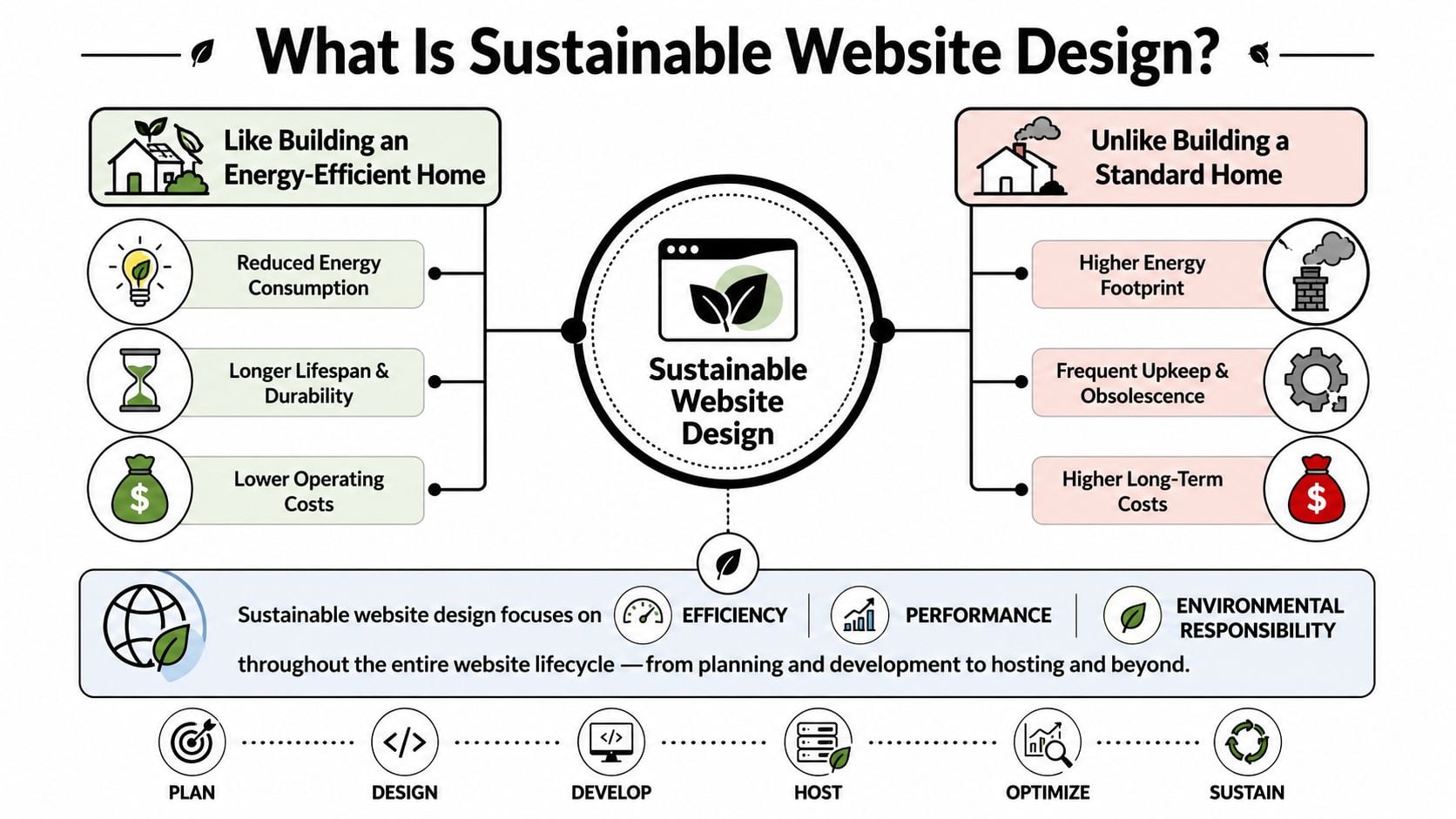
A website does not need to look “green” to be sustainably designed. It needs to use less energy, less bandwidth, and less processing power while still helping the business win enquiries, sales, or bookings.
For a UK SME, that usually means making better decisions across the full stack. Design, content, hosting, media, tracking tools, and ongoing maintenance all affect how much work a site creates for servers, networks, and visitor devices. Sustainable web design is the discipline of reducing that work without weakening the commercial purpose of the site.
Efficiency comes first
The starting point is resource efficiency. If an image, script, animation, or tracking tag does not add clear value, it should not be there. Every extra asset increases the amount of data transferred and the amount of processing required on the visitor's device.
The practical goal is not austerity. It is restraint.
That distinction matters on real projects. A product gallery may be worth the weight because it helps sales. A background video on a service page often is not. Sustainable design asks teams to judge features by outcome, not by novelty.
Sustainability includes technical choices behind the scenes
It also goes beyond front-end design. Hosting location, caching setup, CMS choice, third-party services, and CDN use all shape the footprint of a website over time.
UK context is particularly relevant. A small business serving customers mainly in Manchester, Leeds, Bristol, or London does not always need the same infrastructure as a brand with global traffic. In some cases, UK-based green hosting is a sensible choice because it keeps the setup simpler and aligns well with a local audience. In other cases, a global CDN still earns its place because it reduces latency, improves resilience, or handles media delivery more efficiently. The better option depends on audience geography, content type, and how heavily the site relies on dynamic assets.
Performance and usability are part of the same job
The second pillar is performance optimisation, but not as a technical afterthought. It belongs in the original brief. Decisions made early, such as template complexity, image handling, font loading, and script governance, are far cheaper to get right than to fix after launch.
A sustainable site is often easier to use because it removes friction. Pages load sooner. Key information appears faster. Older phones cope better. Mobile users on weaker UK connections are less likely to give up halfway through a task.
A sustainable site is a site where each design decision earns its place.
User-centred design still sits at the core
The third pillar is user-centricity. Sustainable websites respect attention, battery life, data usage, and accessibility needs. They help people complete a task with less effort.
That has direct design consequences. Clear page structure matters. So does readable typography, sensible navigation, and content that answers the question quickly. If a visitor has to fight through pop-ups, autoplay media, cookie banners layered on banners, and five competing calls to action, the problem is not only conversion. It is waste.
A useful test is whether the site can justify each layer of complexity. Ask:
- Does this feature improve the outcome enough to justify its weight
- Can this page do the same job with fewer assets or fewer requests
- Is this third-party tool producing measurable value
- Will the site still be easy to update and govern in a year
That is what sustainable website design really means in practice. It is not a trend or a visual style. It is a way of building websites that are lighter to run, clearer to use, and better suited to the needs of a business and its customers.
The Business Case for Going Green Online
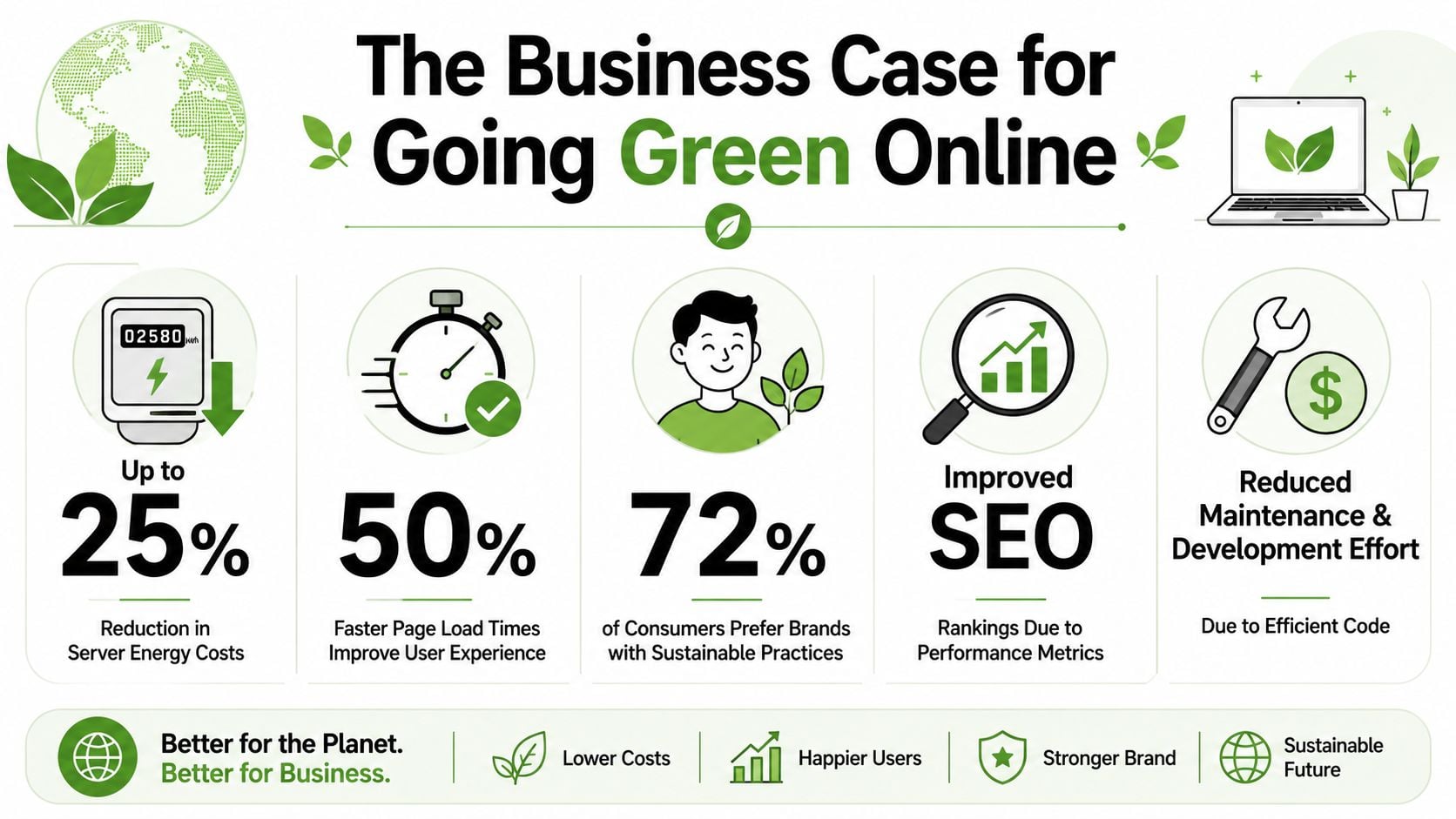
Many business owners are open to the environmental case, but they still want to know whether sustainable website design helps the bottom line. In practice, it often does, because efficiency removes waste from both the visitor experience and the technical setup behind it.
Better sites usually come from lighter builds
A lighter site is often easier to maintain. Developers spend less time working around bloated themes, unnecessary plugins, and overlapping scripts. Content editors have a clearer structure to work with. Hosting resources are used more efficiently.
There's also a direct infrastructure angle. Eco-friendly web hosting can reduce a website's carbon footprint by around 30 to 60%, depending on implementation and traffic levels, according to Linearity's design statistics article. For many SMEs, that's one of the simplest meaningful changes because it doesn't require a full rebuild to start improving the footprint.
Sustainability supports trust
Brand perception matters too. Customers increasingly pay attention to whether a business acts responsibly. The strongest version of this isn't a badge in the footer or a vague sustainability paragraph. It's a website that behaves responsibly. It loads quickly, avoids digital clutter, and doesn't bury users under intrusive pop-ups and trackers.
That same Linearity source notes that this aligns with growing UK consumer preference for brands that support eco-friendly practices, which strengthens the case for sustainable website design as a market differentiator. The important point is not to overplay it. Most customers won't choose a company solely because its website is lighter. But they will notice a site that feels faster, clearer, and better run.
Search and conversion benefit from the same work
Google doesn't rank pages because they are “green”. It rewards pages that perform well, meet user needs, and provide a strong experience. Sustainable practices often support those signals.
Here's where the practical overlap matters most:
| Website decision | Sustainability effect | Business effect |
|---|---|---|
| Compressing images | Less data transferred | Faster load times |
| Removing unnecessary scripts | Less processing | Fewer performance bottlenecks |
| Better hosting choices | Lower infrastructure impact | More stable delivery |
| Simplified templates | Less bloat | Easier editing and maintenance |
The mistake is treating sustainability as a moral layer added after commercial goals. In most SME projects, it works better as a quality standard. If the site is lean, reliable, and focused, the environmental benefit and the business benefit often arrive together.
Practical Strategies for Sustainable Design and Development
Most sustainability gains come from ordinary technical discipline. Not from flashy ideas. Not from a complete reinvention of the web. Just better decisions, made earlier.
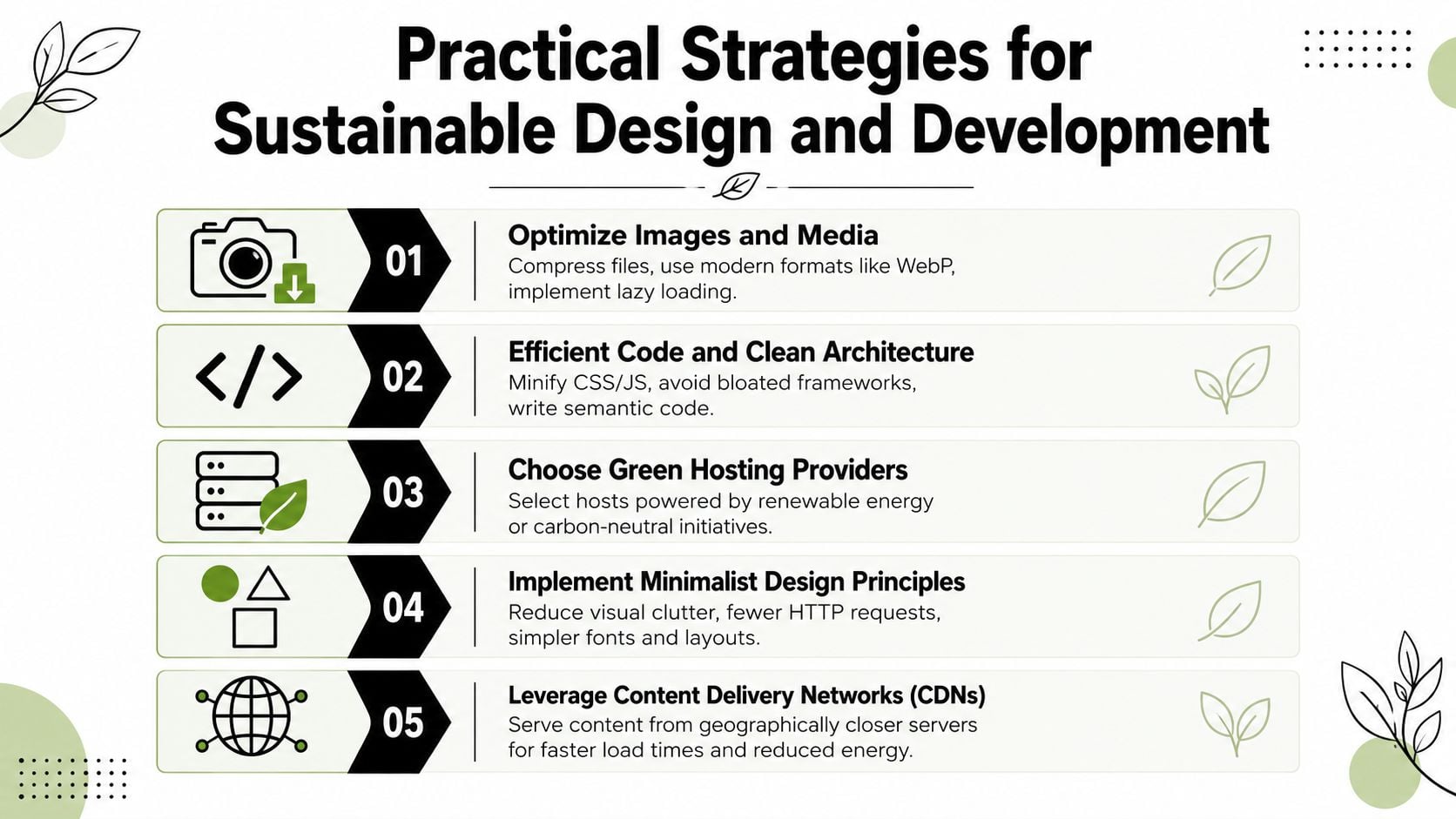
Reducing average page weight from 3 MB to 1.5 MB can cut per-request data transfer by around 50%, and when paired with renewable-energy hosting it can help UK businesses reach under 1 gCO₂e per visit, according to Ronins' sustainable web design guidance. That's why weight reduction is usually the first serious lever to pull.
Start with the heaviest assets
For most small business websites, the biggest waste sits in media.
- Optimise images before upload. Resize them to the actual display size, compress them properly, and use modern formats where appropriate. If you need a practical workflow, DesignStack's guide on how to optimise images for websites is a useful reference.
- Use lazy loading where it helps. Images and embeds below the fold don't need to load immediately.
- Treat video carefully. Background video often looks impressive in a pitch deck and underperforms in real life. If video is important, use it where it supports a clear business goal.
Image-heavy businesses can learn from a simple parallel outside web design too. The same discipline used to compress files to email applies here. Large files create friction, whether you're sending them to a client or forcing every site visitor to download them.
Keep the front end lean
The next savings usually come from code and third-party tools.
The fastest script is often the one you never added.
A common problem on WordPress sites is plugin accumulation. One plugin handles forms, another analytics, another pop-ups, another animation, another schema, and another social feeds. Each may look harmless in isolation. Together they create extra requests, more processing, and more maintenance risk.
What works better:
- Choose fewer dependencies. If one well-built tool covers the requirement, use that instead of stacking several.
- Minify and combine carefully. This still helps, but don't treat it as a cure for bloated architecture.
- Audit third-party scripts. Chat widgets, tracking tags, review embeds, and ad pixels all add cost.
Design choices that quietly reduce waste
Not every sustainability decision is technical in the narrow sense. Some sit in the design brief.
A restrained layout often performs better than a heavily layered one. System fonts can be the right choice in some projects. SVG icons are often better than loading multiple image assets. Clear hierarchy reduces the urge to solve communication problems with motion and visual excess.
A good working checklist during design review is simple:
- Can the same message be delivered with fewer assets
- Will this still load well on a mid-range phone
- Does this effect help the visitor complete a task
- Would removing it make the page better
That's the practical shape of sustainable website design. It isn't anti-design. It's anti-waste.
Choosing Sustainable Hosting and Infrastructure
Hosting choices shape the footprint of a website long after launch. Against this backdrop, generic advice often becomes too simplistic for UK businesses, especially those serving a mostly local or regional audience.
Local green hosting versus global CDN
A green host is usually the right starting point, but “best” depends on who your visitors are and where they are coming from. A Dorset accountant, a London law firm, and an online retailer shipping across Europe may all need different infrastructure decisions.
For many UK SMEs, UK-hosted providers or UK-CDN-edge nodes can cut network hops and reduce data-transfer distances, which lowers both latency and energy per request, according to Leap Eco's discussion of sustainable web design. That matters because local users don't always benefit from an overly global setup if most requests are already concentrated in the UK.
A simple comparison helps:
| Option | Usually best for | Main advantage | Main trade-off |
|---|---|---|---|
| UK green hosting | Mostly UK audience | Strong local performance and lower travel distance | Less useful if traffic is widely international |
| Renewable-powered CDN | Distributed audience | Better delivery across multiple regions | Can add unnecessary complexity for local-only sites |
| Hybrid setup | Mixed traffic patterns | Balances local speed and broader reach | Needs more careful configuration |
What PUE actually tells you
One useful hosting metric is Power Usage Effectiveness, or PUE. It reflects how efficiently a data centre uses energy overall, not just how much reaches the servers.
Best-practice UK data centres now achieve PUE values of around 1.4 to 1.5, while weaker setups can sit much higher, meaning far more energy is spent on cooling and overhead rather than computation, as noted by Leap Eco. You don't need to become an infrastructure specialist, but it's worth asking hosting providers about energy sourcing, efficiency, and where workloads are served from.
For ongoing support, migrations, and hosting decisions, a practical reference point is DesignStack's page on website hosting and maintenance.
A sensible decision framework for UK SMEs
This is usually the most sensible way to decide:
Mostly local customers
Prioritise UK-based green hosting first. Add CDN support only where it solves a real performance issue.National UK coverage
A UK host with strong caching and UK edge delivery is often enough.International traffic or heavy media
A renewable-powered CDN becomes much more valuable.
Hosting closer to your real audience often beats hosting that only sounds impressive on paper.
The trade-off is straightforward. Global infrastructure can improve delivery when your audience is spread out. But if nearly all your users are in the UK, keeping delivery local is often better for both speed and sustainability.
Long-Term Sustainability with Content and SEO
A sustainable website can't rely on launch-day decisions alone. Sites become inefficient over time because teams add pages, tools, downloads, and scripts faster than they remove them.
Content pruning is a sustainability job
Most SME websites contain pages that no longer help users. Old campaign pages, duplicate service pages, outdated downloads, expired event content, and archived news posts all add clutter. They may still be crawlable, indexable, and stored on the server even when they have no real value.
That matters because there's a recognised gap in UK-specific analysis of how hosting location affects carbon footprint versus SEO for regional businesses, and a more nuanced approach tied to local traffic patterns is still needed, according to Osky's overview of sustainable web design methods. Content strategy belongs in that same practical conversation. If a page doesn't support search intent, lead generation, or customer service, it may be digital waste.
A content audit should ask:
- Is this page still useful to a current customer
- Does it rank, convert, or support another valuable page
- Should it be improved, merged, redirected, or removed
SEO gets better when waste goes down
Sustainable SEO is not about publishing less. It's about publishing with more intent.
Strong pages answer questions quickly. They avoid unnecessary duplication. They reduce thin content and improve internal linking so both users and search engines reach the right destination faster. Technical SEO also plays a role. Clean architecture, sensible indexing, fewer broken paths, and lighter pages all reduce wasted crawl activity and improve the overall quality of the site.
If you need a plain-English refresher on the technical side, DesignStack's guide on what is technical SEO is a good place to start.
A few long-term habits do most of the work:
- Review content regularly. Don't let the site grow unchecked.
- Consolidate overlap. One strong page is better than several weak ones.
- Retire dead assets. Old PDFs, media files, and obsolete landing pages all add noise.
- Keep templates disciplined. New pages should inherit lean patterns, not fresh bloat.
The best sustainable websites stay lean because someone keeps making editorial decisions. Left alone, most sites expand into waste.
Commissioning Your Sustainable Website A Checklist
If you're hiring an agency or planning a rebuild, ask direct questions early. Sustainable website design is much easier to achieve when it's part of the brief, not a rescue job near launch.
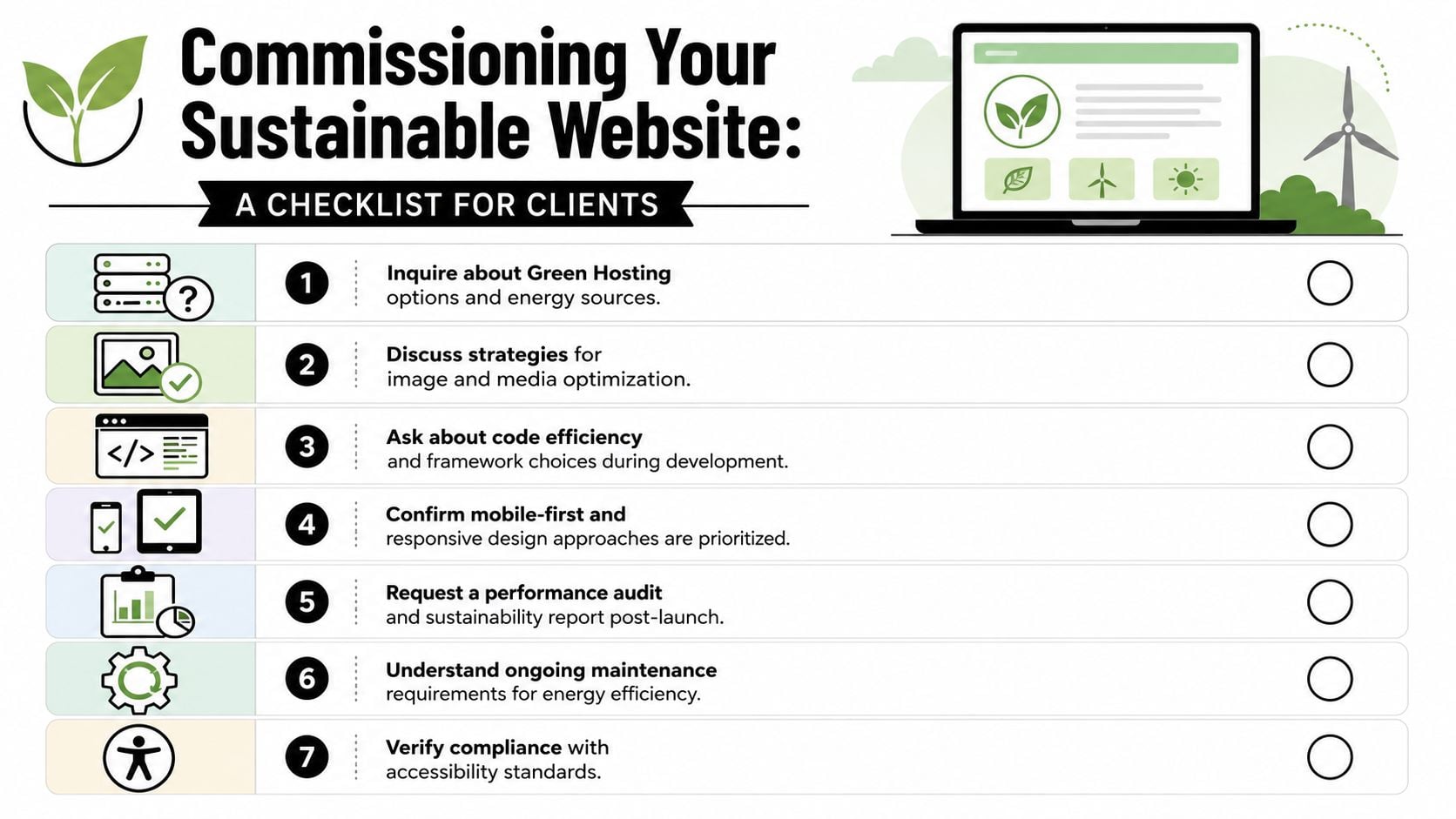
Use this checklist in discovery calls and proposal reviews:
- Ask about hosting. Is the site being placed on renewable-powered or clearly greener infrastructure, and where is that infrastructure located?
- Set a performance budget. Agree limits for page weight, scripts, and media use before design starts.
- Discuss image handling. Confirm how images will be resized, compressed, and served.
- Review third-party tools. Ask which plugins, trackers, embeds, and widgets are necessary.
- Check template discipline. Make sure service pages, blog posts, and landing pages won't all grow into different technical snowflakes.
- Request post-launch review. Ask for a proper check on performance, broken assets, and avoidable waste once the site is live.
- Plan for maintenance. A site only stays efficient if someone keeps it that way.
For launch preparation, this practical website launch checklist is a useful companion to the sustainability questions above.
Frequently Asked Questions
Is a sustainable website more expensive to build
Not always. Sometimes it's cheaper because simpler builds are easier to develop and maintain. Costs can rise if you're fixing an already bloated site or replacing a stack of legacy tools, but those costs usually come from complexity that already exists.
Does sustainable website design limit creativity
No. It limits waste. A site can still feel premium, distinctive, and on-brand without relying on oversized assets, autoplay video, or unnecessary effects. Good creative work usually gets sharper when the team has to justify every element.
Can an eCommerce site still be sustainable
Yes, but product imagery, filtering tools, apps, and third-party integrations need tighter control. eCommerce sites benefit from the same discipline as brochure sites, only with more moving parts to manage.
How do I measure whether my website is improving
Look at practical indicators. Page weight, load behaviour, hosting setup, media efficiency, and script count all tell you something useful. The point isn't to chase a perfect badge. It's to reduce avoidable waste while keeping the site commercially effective.
Should a UK business always choose UK hosting
Not always. If most of your audience is in the UK, local green hosting is often the better first choice. If your audience is spread across several countries, a renewable-powered CDN or hybrid setup may make more sense.
What usually goes wrong on these projects
Too many third-party additions, oversized imagery, theme bloat, and no one owning the site after launch. Sustainable website design works best when it is treated as an ongoing standard, not a one-off feature.
If you want a website that loads quickly, stays manageable, and makes smarter infrastructure choices for a UK audience, DesignStack can help. The team builds WordPress websites, branding, and digital systems for businesses that want clear communication, reliable support, and a site that performs properly long after launch.



Leave a Reply