

What Is Unique Value Proposition: A 2026 Guide for Your
You've probably had this feeling already. You know your business does good work, your customers are happy, and your service is solid, yet when someone lands on your website or compares you with two or three local competitors, you sound much the same as everyone else.
That's where most small business owners get stuck. They write things like “quality service”, “friendly team”, or “customized solutions”, then wonder why those words don't bring better leads. The problem usually isn't effort. It's clarity.
If you've been asking what is a unique value proposition, the short answer is this: it's the reason a customer chooses you instead of someone else. But the useful answer goes further. A good UVP helps a busy buyer understand who you help, what problem you solve, and why your offer is a better fit than the alternatives sitting one tab away in their browser.
Table of Contents
- Why Your Business Gets Lost in the Crowd
- The Three Core Ingredients of a Great UVP
- A Simple Framework for Crafting Your UVP
- Real-World UVP Examples in Action
- Validating Your UVP with Real Customers
- Three Common UVP Mistakes and How to Fix Them
Why Your Business Gets Lost in the Crowd
Most businesses don't disappear because they're bad. They disappear because they look interchangeable.
A unique value proposition is the strategic answer to why a customer should choose one offer over another. In the UK, that matters because there are about 5.5 million small businesses, according to the Federation of Small Businesses. When buyers have that many options, being good isn't enough. You have to be clear.
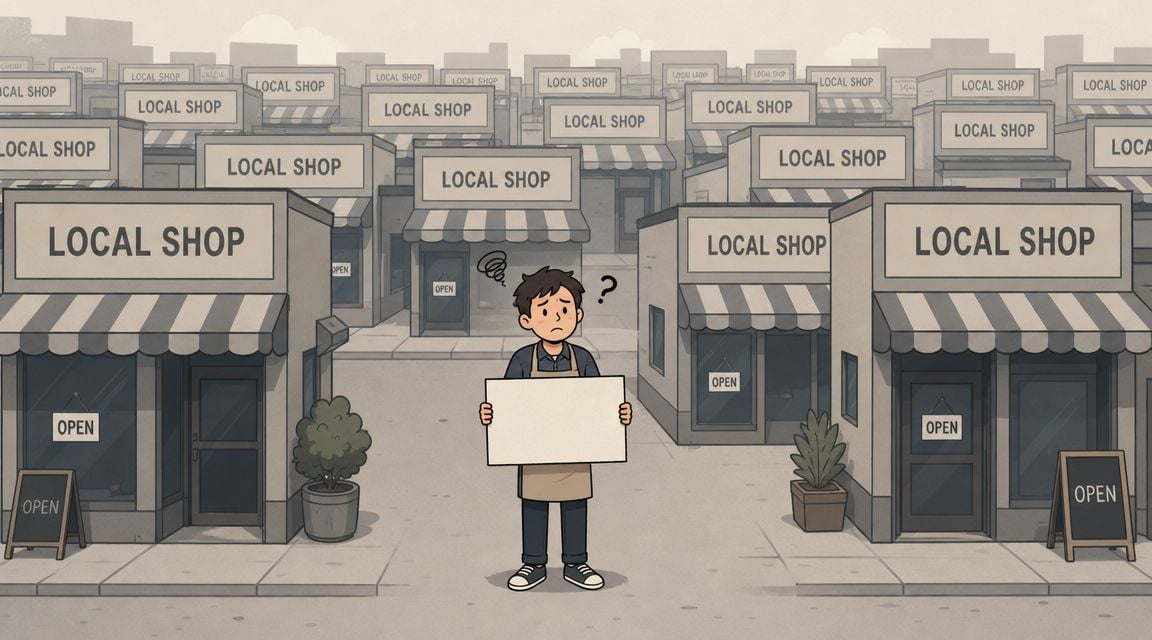
A lot of owners think they have a visibility problem when they really have a positioning problem. They improve the logo, post on social media, maybe even run ads, but the message still sounds broad. If your homepage says the same thing as five nearby competitors, customers won't work hard to spot the difference.
Start with the choice your customer is making
Your customer isn't asking, “Is this a nice business?” They're asking:
- Who is this for: Does this business understand companies like mine?
- What problem does it solve: Will this remove friction, save time, or reduce risk?
- Why this option: Is there a reason to choose this over the others?
That's why a UVP sits so close to your brand strategy. It shapes your homepage headline, your service pages, your sales conversations, and even your brand identity development process.
A UVP isn't decoration. It's a decision shortcut for the customer.
If you create content as part of your visibility strategy, messaging consistency matters there too. For businesses using short-form video, this guide to brand awareness for video creators is useful because it shows how repeated, recognisable messaging builds recall across channels.
The Three Core Ingredients of a Great UVP
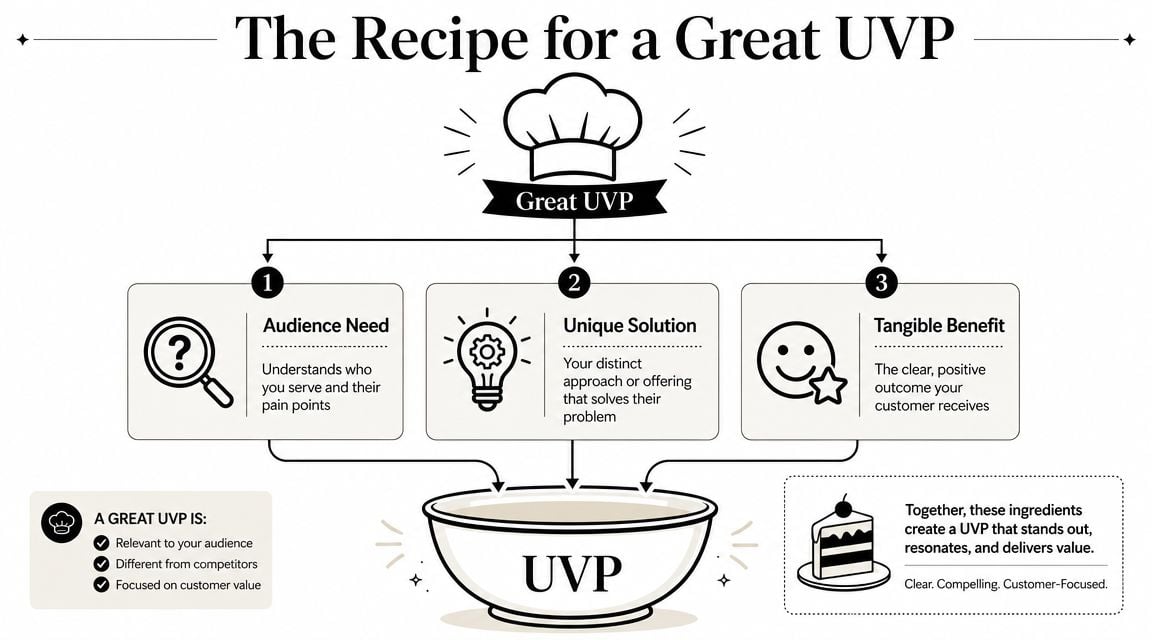
Think of a UVP like a simple recipe. If one ingredient is missing, the whole thing tastes flat.
Most weak UVPs fail because they jump straight to “what we do” and skip the rest. A stronger one combines three parts: the audience, the problem, and the result delivered through a distinctive offer.
Start with the customer, not your service list
The first ingredient is who you help and what they're struggling with.
That sounds obvious, but many businesses start with “we offer web design, print, SEO, branding”. That's a service menu, not a value proposition. A customer cares less about your category labels and more about whether you understand their situation.
A better starting point looks like this:
- Audience: Independent retailers who need to sell online without managing a complicated system
- Problem: Their current website looks dated, is hard to update, and doesn't build trust
- Context: They need something professional without open-ended costs or technical confusion
Many owners get confused. They think narrowing the audience means turning away work. Usually, it does the opposite. Specificity helps the right buyer recognise themselves.
Here's a helpful explainer if you want to connect this to the wider brand picture: what brand identity design means in practice.
Add the outcome and the reason to believe
The second ingredient is your solution, but described in plain language. The third is why your offer is different enough to believe.
This is the point where features become useful. Features on their own are bland. Features tied to an outcome create meaning.
For example:
- Weak: “We build responsive WordPress websites.”
- Stronger: “We build WordPress websites for service businesses that need a site they can update easily after launch.”
Then add a differentiator:
- Differentiator: fixed-cost pricing, clear revisions, post-launch support, or a more defined process than competitors offer
Practical rule: If a rival could copy your sentence and paste it onto their site without changing a word, it isn't a UVP yet.
A short video can help if you prefer to learn visually:
A great UVP usually answers three questions in one go. Who is it for? What problem does it solve? Why should I trust this particular offer?
A Simple Framework for Crafting Your UVP
You don't need a workshop, a whiteboard wall, or a stack of sticky notes to draft a useful UVP. You need a sentence structure that forces clarity.
A strong UVP should be specific and ideally quantified. The Office for National Statistics says 93% of UK adults were recent internet users in 2024, so for most businesses your first impression happens online. That first impression needs proof, not padding.
A practical template you can fill in today
Use this as a working draft:
We help [target customer] who struggle with [specific problem] achieve [clear benefit] through [your solution], with [differentiator or proof point].
That's the core shape. Don't aim for clever. Aim for useful.
Here's a table you can work through.
| Component | Guiding Question | Your Answer |
|---|---|---|
| Target customer | Who exactly are you trying to help? | |
| Specific problem | What frustrates them, delays them, or costs them opportunities? | |
| Clear benefit | What better outcome do they want? | |
| Your solution | What do you provide that gets them there? | |
| Differentiator or proof | Why should they believe you over another provider? |
If your message still sounds woolly after filling this in, the issue is usually one of these:
- The audience is too broad: “businesses” tells the reader almost nothing.
- The problem is too vague: “need marketing help” is weaker than “need a site that explains their service clearly and generates enquiries”.
- The proof is missing: without specifics, the claim feels generic.
How to make your UVP sound credible
Concrete details do the heavy lifting. If you offer fixed pricing, say that. If clients get three design revisions, say that. If support continues after launch, say how. Facts turn promises into something a buyer can assess.
For example, a Dorset agency such as DesignStack can describe its offer around SMEs that want fixed-cost web design, branding, hosting, and post-launch support, using factual details like three design revisions, one month of post-launch updates, and over 20 years of experience. That's much stronger than saying “professional websites with great service”.
A good UVP also needs the right surrounding content. If your homepage promise is clear but your service pages are vague, trust drops fast. For this reason, content strategy for business websites is essential. The message has to hold together across the whole site.
Real-World UVP Examples in Action
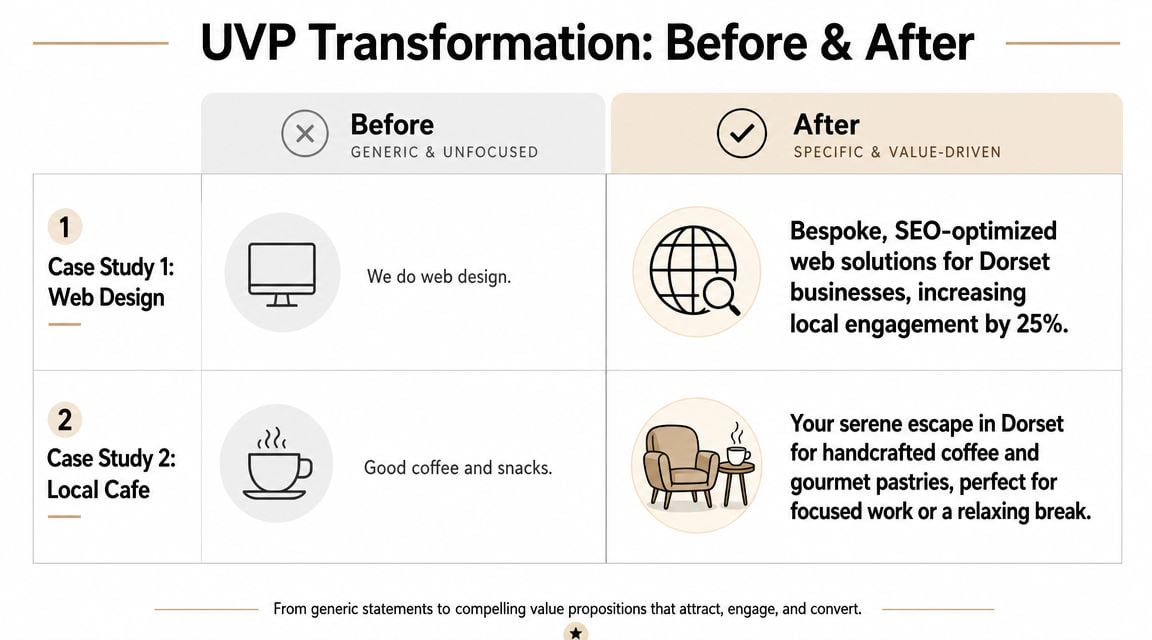
The easiest way to understand what is a unique value proposition is to watch weak statements turn into stronger ones.
Most businesses don't start from zero. They start with a generic line that needs sharpening.
Local retailer example
Before: We sell fresh seafood.
After: For local customers who want quality seafood without guessing what's available, we offer a clear pre-order and collection service that makes buying fresh catch simpler and more reliable.
Why it works:
- Audience: local customers
- Problem: uncertainty and inconvenience
- Benefit: easier buying with less friction
- Difference: pre-order and collection process
This kind of UVP is useful for a business like The Lobster Pot because it shifts the message from product category to buying experience.
Professional service example
Before: We provide accountancy services for businesses.
After: We help growing small businesses stay organised and confident with straightforward accountancy support, fixed monthly pricing, and advice explained in plain English.
Why it works:
- The audience is clearer
- The problem is emotional as well as practical
- The offer is easier to compare
- The differentiator is delivery style plus pricing structure
Buyers often remember the way you reduce uncertainty more than the full list of services you offer.
eCommerce example
Before: We sell sustainable home products.
After: We help busy households choose well-made home essentials without endless searching by curating practical products with clear materials information and simple online ordering.
This works because the message isn't trying to sound noble or trendy. It focuses on the shopper's job to be done.
If you're refining the story around your offer, it can also help to look at how messaging connects to public-facing brand storytelling. This guide on how to build a powerful brand narrative for PR is a useful companion because it shows how strategic messaging becomes a broader story people can repeat.
For more applied inspiration, reviewing brand identity examples from live projects can help you see how positioning and visual presentation support each other.
Validating Your UVP with Real Customers
A UVP is not a sacred line you carve into stone. It's a working hypothesis.
Effective UVPs are outcome-led and should be stress-tested against competitors. Semrush's guidance on unique value propositions recommends keeping claims that rivals do not make. That's especially important in crowded UK service markets, where many firms use near-identical wording.
Treat it like a test, not a plaque on the wall
If your UVP says “fixed-cost website support for service firms that need quick updates and clear communication”, test whether people respond to that better than “bespoke digital solutions for modern brands”.
You're not only checking what sounds nicer. You're checking what creates recognition, trust, and action.
Good questions to ask are:
- Do prospects repeat it back clearly: If they can paraphrase it, the message is landing.
- Does it survive comparison: If a competitor says almost the same thing, your wording still needs work.
- Does it trigger the right enquiry: Better wording should attract better-fit leads.
Simple ways to test without a big budget
You don't need expensive research tools to validate a UVP.
- Homepage headline test: Run two versions of your main headline over time and watch which one leads to better enquiry quality.
- Sales call language: Use the UVP in discovery calls and listen for where people lean in, ask questions, or go quiet.
- Email replies: Send two positioning angles to warm leads and compare the responses qualitatively.
- Competitor check: List nearby competitors and strip out every claim they also make. What's left is closer to your true differentiator.
If your UVP can't survive a quick scan of competitor websites, it isn't ready yet.
Measurement matters here. If you're unsure what to track on your website after changing your message, this guide on how to measure website success gives you a sensible starting point.
Three Common UVP Mistakes and How to Fix Them
Most bad UVPs fail in familiar ways. The good news is that they're easy to spot once you know what to look for.
A UVP is not the same as a slogan or a generic “we do websites” claim. Strong definitions frame it as a clear statement of the specific benefit and problem solved, but many businesses still fail to tie it to a measurable outcome that sets them apart from local competitors, as explained in Mailchimp's guide to unique value proposition examples.
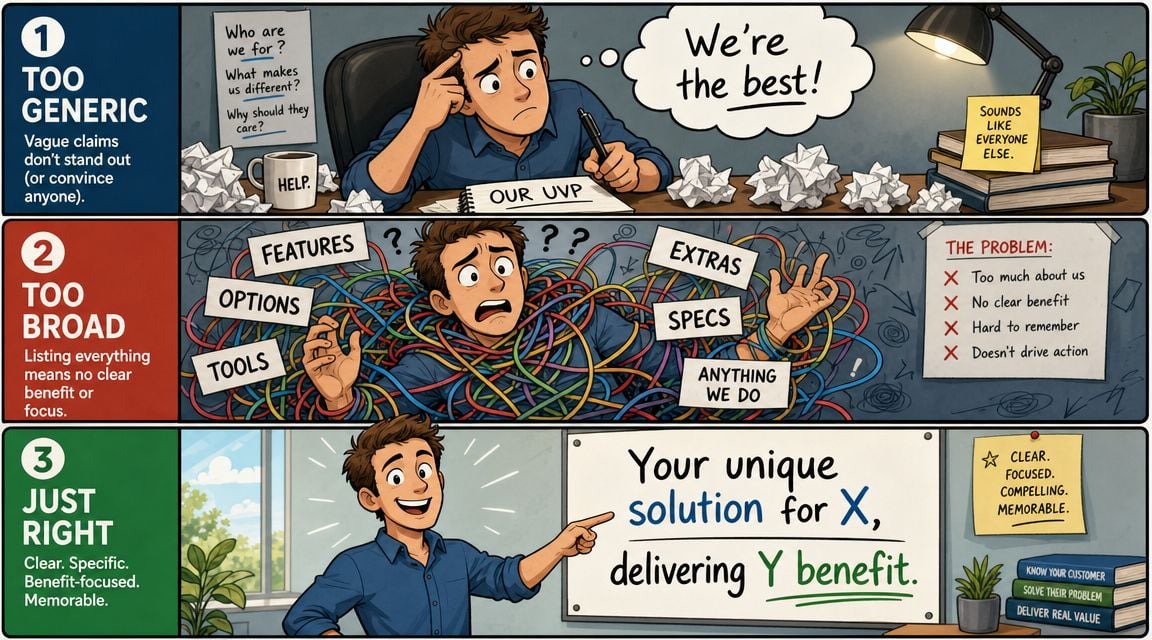
Mistake one using empty buzzwords
Words like “groundbreaking”, “reliable”, and “high quality” sound safe. They also sound forgettable.
Fix it by replacing adjectives with evidence. Don't say “excellent support”. Say what support looks like.
Mistake two confusing a UVP with a slogan
A slogan aims to be memorable. A UVP aims to make a choice easier.
“Built for growth” might work as a tagline. It doesn't tell a buyer who it's for, what it solves, or why it's different. Write the UVP first. Trim it into a slogan later if needed.
Mistake three listing features instead of benefits
Features matter, but only after the customer understands why they should care.
- Feature-led: We offer WordPress, hosting, SEO, and app development.
- Benefit-led: We help growing businesses manage their online presence in one place, with a website and support setup that's easier to maintain.
The fix is simple. Translate every feature into a customer outcome.
If your current messaging sounds like everyone else in your sector, DesignStack can help you turn a vague offer into a clearer brand position, then carry that through your website, branding, and supporting content. You can explore their work and services at DesignStack.

Leave a Reply