

How Much Does Website Hosting Cost? A 2026 Guide
So, you're trying to figure out what you should actually be paying for website hosting. It’s a fair question, and one I hear all the time. For most UK small businesses, the honest answer is somewhere between £3 and £40 a month.
The final figure really hinges on what your website needs to do, a bit like choosing a physical space for your business.
Your Quick Guide to UK Hosting Costs in 2026
Think of choosing a host like picking a spot on the high street. You could rent a small kiosk, a decent-sized shop, or a massive two-floor superstore. Each option comes with a different rent and gives you a different amount of space and footfall capacity. Website hosting works in much the same way.
Getting your head around these different tiers is the first step. You wouldn't rent a giant warehouse for a small pop-up, and you certainly don't need a top-of-the-line server for a simple five-page website. Making the right choice from the get-go means your site can handle visitors smoothly and has room to grow, all without you paying for power you just don't need yet.
First, let's get a quick overview of what you can expect to pay. This table breaks down the typical monthly costs you'll find in the UK market for 2026.
UK Hosting Costs at a Glance for 2026
| Hosting Type | Best For | Typical Monthly Cost (UK) |
|---|---|---|
| Shared Hosting | New websites, blogs, small local businesses | £3 – £15 |
| VPS Hosting | Growing businesses, small eCommerce stores | £20 – £40 |
| Managed WordPress | WordPress sites needing speed & security | £15 – £45 |
| Cloud Hosting | Sites with traffic spikes, high availability needs | £10 – £60+ |
| Dedicated Hosting | High-traffic eCommerce, large enterprises | £60 – £200+ |
This gives you a solid starting point for budgeting. As you can see, getting online doesn't have to break the bank, but scaling up requires a bit more investment.
A Realistic Financial Baseline
To put those numbers into context, it helps to see exactly what your money buys you. For a local service business in Dorset just starting out, an affordable shared plan is the perfect launchpad. On the other hand, a national eCommerce brand needs a far more robust and secure setup to handle transactions and traffic.
I always tell clients to think of their hosting plan as the foundation of their digital shop. A wobbly foundation means slow load times and security holes—things that will send customers running. A solid one builds trust and supports your growth.
The real trick is to match your spending to your business goals. Based on 2026 pricing data, a UK business can get online with a very modest investment. Shared hosting, the most common starting point, will set you back just £3 to £15 per month. When you need more power for something like a growing online shop, a Virtual Private Server (VPS) is the next logical step, usually costing £20 to £40 per month for a managed plan.
For the big players—high-traffic sites where any downtime is a disaster—dedicated hosting is the only real choice, with prices starting from £60 to £200+ monthly. You can explore more detailed cost breakdowns for UK businesses to see how these figures shake out in different scenarios.
Understanding the Main Types of Website Hosting
Picking the right home for your website is a bigger deal than most people realise. It has a huge knock-on effect on your site’s speed, security, and, of course, your budget. To get a feel for what you should be paying, you first need to understand the main options out there. The easiest way to think about it is like renting property: each type comes with a different amount of space, privacy, and control.
Before diving into the most common types, it's worth knowing that options like cloud hosting explained use a flexible network of servers. It’s a powerful approach, but for most UK small businesses, the journey usually begins with one of three more traditional hosting models.
This image lays out the typical monthly costs you can expect for these three main types of hosting here in the UK.
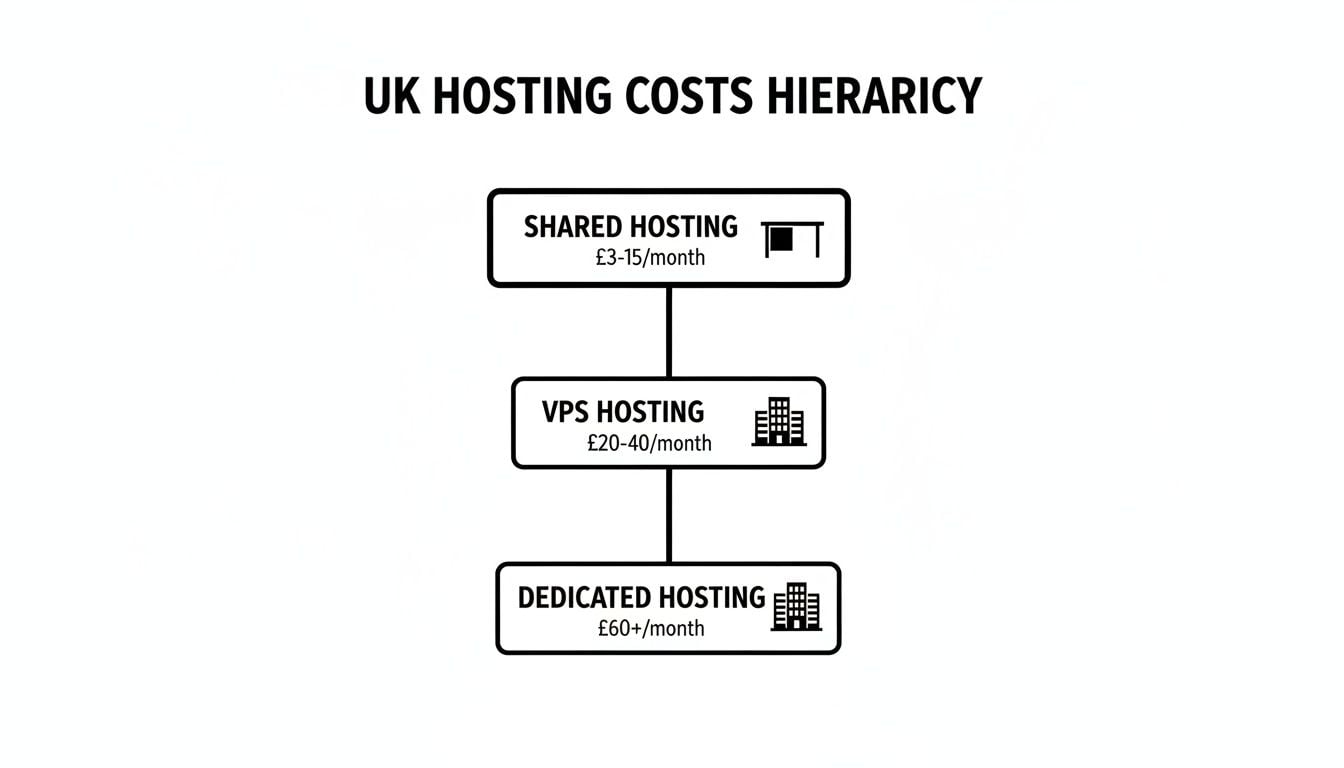
As you can see, there's a big jump in both price and power as you move from a shared space to your own dedicated server.
Shared Hosting: Your First Digital Flatshare
Shared hosting is by far the most popular and cheapest option out there. It’s the perfect starting point for brand-new websites, local businesses, and personal blogs. Think of it as a digital flatshare: you and a bunch of other websites all live on one big server, sharing everything—from processing power to memory and storage space.
Shared hosting is an excellent entry point because it’s cost-effective and easy to manage. However, a noisy neighbour—a site on the same server that suddenly gets a huge traffic spike—can slow your site down.
Because the provider’s costs are spread across so many users, you pay a very low price, usually somewhere between £3 and £15 per month. It's a fantastic launchpad, but it has its limits. Once your website starts getting popular, you'll probably feel the need to move out of the flatshare and find a place with a bit more elbow room.
VPS Hosting: Your Own Private Office
When you’ve outgrown your flatshare, a Virtual Private Server (or VPS) is the logical next step. This is like leasing a private, serviced office inside a larger building. You still share the physical server with others, but you have your own partitioned space with guaranteed resources. No one else can hog your memory or processing power.
This setup gives you a major boost in performance and security compared to shared hosting. It’s a brilliant middle ground for growing businesses, small e-commerce shops, or any website that’s starting to feel sluggish on a shared plan. You get far more control and stability without the expense of renting the whole building. Expect to pay in the range of £20 to £40 per month.
Dedicated Hosting: Your Own Commercial Building
Dedicated hosting is the top of the line. This is the equivalent of having your own commercial building, all to yourself. You rent an entire physical server, and every last drop of its resources—all the processing power, memory, and storage—is exclusively yours.
This gives you absolute peak performance, security, and control. You can tweak the server environment to your heart’s content, which makes it essential for:
- High-Traffic Websites: Sites attracting tens of thousands of visitors every day.
- Large eCommerce Stores: A must-have for securely handling lots of simultaneous sales.
- Resource-Intensive Applications: Perfect for running complex software or managing huge databases.
Naturally, this kind of power comes with a higher price tag. Costs start from around £60 per month and can easily climb to £200 or more, depending on the server’s specs. It's a serious investment, but for any large-scale operation where speed and reliability are make-or-break, it’s non-negotiable.
Of course, your hosting choice is closely tied to the platform your website is built on. For many business owners, a good Content Management System (CMS) is the engine running their site. Understanding how your hosting and CMS interact is vital, a topic we explore further in our comprehensive review of website content management systems.
What Really Drives Your Website Hosting Costs?
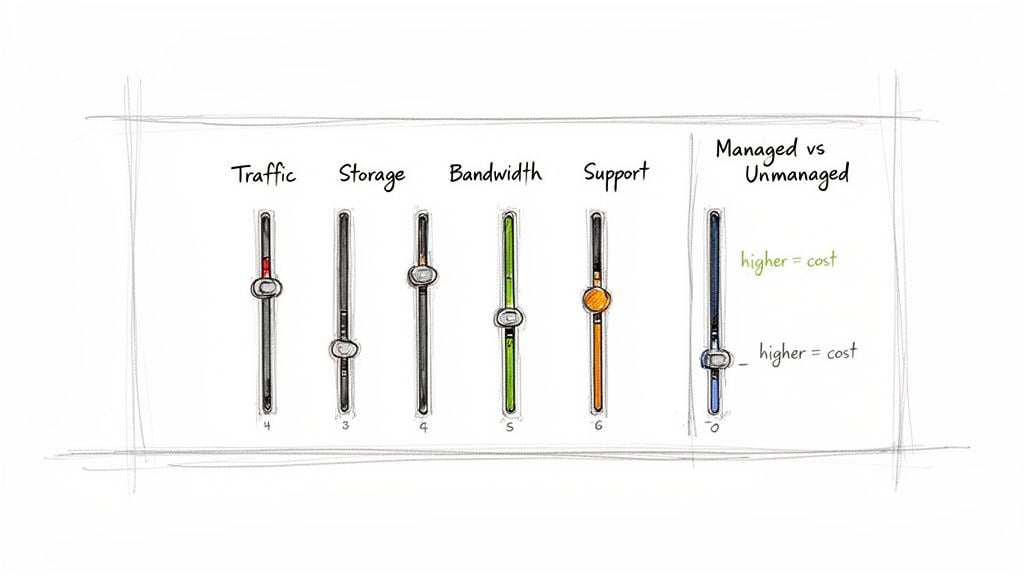
Picking a hosting type gives you a starting point, but what really shapes the final bill are the specifics of your plan. Getting a handle on these factors is the only way to know what you’ll actually end up paying. Think of it like buying a car—the base model has one price, but the engine size, trim level, and optional extras are what determine the final figure.
A cheap plan that seems like a bargain can quickly become a false economy. The package that works beautifully for a local photographer's portfolio will buckle under the strain of an e-commerce site on Black Friday. When you look past the headline price, you can see the true value and find a plan that actually supports your business goals without any nasty surprises down the line.
Traffic, Storage, and Bandwidth
First up, let's talk about the core resources that your website consumes: traffic, storage, and bandwidth. These have the biggest and most direct impact on both your site's performance and your monthly bill. If your website were a physical shop, these would be its size, stockroom capacity, and the number of customers it could handle at once.
- Traffic (Visitors): This is simply the number of people coming to your site. A plan built for 5,000 monthly visitors will grind to a halt if you suddenly get a surge of 50,000. More popular sites need more server horsepower to stay quick and responsive, and that costs more.
- Storage (Disk Space): This is how much room your website’s files, from images and videos to databases, take up on the server. A simple blog needs very little, but an online shop with thousands of high-resolution product photos needs a serious amount of space. If you run out, your site can go offline.
- Bandwidth: This is the total amount of data your site transfers to its visitors. Every page view, image load, and file download uses bandwidth. Videos and high-quality photos are particularly hungry, and if you go over your plan's limit, you could face extra charges or even a temporary suspension.
It's easy to see how these three are tangled together. A spike in traffic almost always means you’re using more bandwidth, and a site packed with large media files (storage) will burn through bandwidth much faster with every visitor.
Managed vs. Unmanaged Hosting
The next big decision that will shape your costs is how much hands-on work you want the hosting company to do for you. This choice affects not just your budget but also how you spend your time.
Managed Hosting is like having a dedicated property manager for your website. The provider handles all the technical heavy lifting—security patches, software updates, performance tweaks, server maintenance, and crucial backups. It costs more, but it buys you an enormous amount of time and peace of mind.
On the other hand, unmanaged hosting is the complete DIY option. You get the server space and that's it; you're responsible for everything from security and updates to troubleshooting. While it looks cheaper initially, it demands a lot of technical skill and hours of your time. For most business owners, the extra cost of a managed plan is an investment that pays for itself.
Support, Security, and Extra Features
Finally, the quality of service and the 'extras' included in a plan are huge factors in the total cost. This is often where budget hosts cut corners, leaving you exposed when you can least afford it.
This is where the UK's growing digital maturity really helps. The Data Processing & Hosting Services industry is on track to become a £10.8 billion market by 2026, growing at a steady 2.4% annually. This growth isn't just about numbers; it shows that businesses are demanding better service and more flexible solutions. As this in-depth industry analysis from IBISWorld points out, this fierce competition gives you more choice and better value than ever before.
Here are a few other critical features to check for:
- Customer Support: Is help available 24/7 over the phone, or are you stuck with slow email tickets during office hours? When your site is down, fast, knowledgeable support is priceless.
- Security Features: Does the plan come with a free SSL certificate, regular malware scans, and a web application firewall (WAF)? For any business site, these are non-negotiable essentials.
- Backups: Automatic daily backups are your safety net. Some cheaper plans only back up weekly or charge extra for restores, which is a massive risk you shouldn't take.
- Performance Tools: Things like a Content Delivery Network (CDN) and built-in server caching can make your site dramatically faster for visitors around the world. These are often included in mid-range plans and up. For an extra boost, check out our guide to the top WordPress plugins that can revolutionise your website.
Decoding Pricing and Dodging Hidden Fees
Trying to figure out hosting prices can feel like you're navigating a maze of special offers and confusing terms. Let’s be honest: that eye-catching price you first see is almost never the full story. To avoid nasty surprises down the line, you need to understand how providers actually structure their costs.
One of the first decisions you'll make is whether to pay monthly or annually. Monthly plans give you flexibility – if you're not happy, you can walk away without a big financial loss. But if you’re in it for the long haul, paying annually is almost always the smarter financial move, often saving you up to 50% over the year.
Of course, your website's performance isn't just about the host; it's also connected to your underlying internet service. Getting a good deal here is just as important. For those looking to manage their total online costs, learning about finding affordable internet plans is a great place to start.
The Real Cost of "Cheap" Hosting
Here's the biggest trap for anyone new to websites: the hidden fee. That unbelievably cheap £2.99/month introductory offer? It's designed to shoot up dramatically at renewal time, sometimes by 300% or more. It’s a classic hook to get you signed up and locked in.
The true cost of website hosting isn’t what you pay to sign up; it’s the total you'll spend over the lifetime of your site. Always, always read the fine print to find out the renewal rate before you commit.
And that’s just the beginning. Many budget hosts rely on upselling you on things that should be standard, turning what looked like a bargain into a money pit. As we point out in our guide to the hidden costs of cheap website design, cutting corners at the start often costs you far more in the end.
An Actionable Checklist of Hidden Costs to Watch For
To become a savvy buyer, you need to know which questions to ask. Use this checklist to dig deeper with any potential host and get a true picture of what you'll be paying. Don't just ask about today's price—ask what it will cost you next year.
Steep Renewal Prices: This is the most common trick in the book. Before you click "buy," find out what the price will be after the introductory period ends. It's often buried in the terms and conditions.
Domain Privacy Fees: When you register a domain, your name and address go on a public record. Domain privacy hides this information, but many hosts will charge £10-£20 per year for this essential service, even if they gave you the domain for "free."
Essential Backup Costs: Never assume daily backups are included. Some cheap plans only back your site up weekly, or worse, they'll charge an eye-watering fee (sometimes £50+) just to restore your site when something goes wrong.
Website Migration Fees: Want to move an existing website over? Be careful. Many providers will hit you with a £100 or more fee for a migration service that better hosts include for free.
SSL Certificate Costs: An SSL certificate (the padlock in the browser bar) is non-negotiable for security and trust. While many hosts now provide free ones, some still try to charge you or push expensive premium certificates you simply don’t need.
Email Hosting Charges: A professional email like
yourname@yourbusiness.co.ukis vital for credibility. Watch out for basic plans that don't include email hosting, forcing you to buy it as a separate, often costly, add-on.
Sample Hosting Budgets for UK Businesses
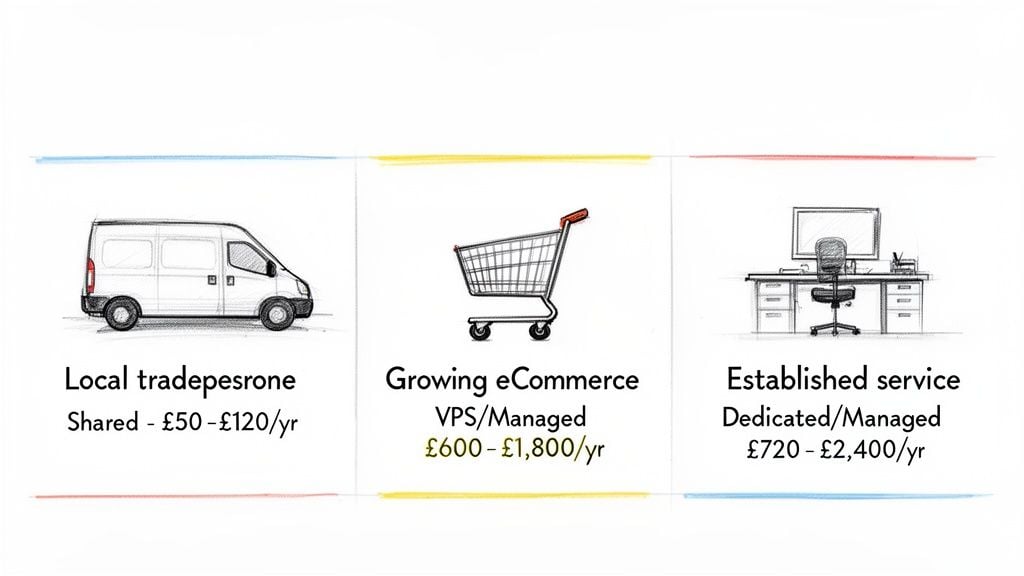
It’s one thing to know the theory behind hosting costs, but it’s another thing entirely to see what those numbers look like for real UK businesses. To bring it all to life, let’s walk through a few common scenarios: a local tradesperson, a growing eCommerce shop, and an established B2B company.
Seeing these examples will help you match your own business needs to a realistic budget, whether you plan to manage it all yourself or hand the technical bits over to an expert.
Budget Example 1: The Local Tradesperson
Let's start with a classic example: a plumber, electrician, or gardener based in Dorset. Their website has one main job – to look professional and bring in leads. It’s essentially an online brochure showcasing their work, sharing testimonials, and making it dead simple for potential customers to get in touch.
The technical needs here are pretty straightforward. They aren't dealing with huge waves of traffic or processing payments directly on the site.
- Recommended Hosting: A quality Shared Hosting package is the perfect starting point. It has more than enough power for a fast, simple website built with something like WordPress.
- Realistic Annual Budget (DIY): Somewhere in the range of £40 – £90 per year. This will get you a reliable plan from a good provider, which usually throws in a free domain name and SSL certificate for the first year.
- Realistic Annual Budget (Managed Service): You're looking at around £250 – £450 per year. This is for an agency-managed option where they don't just host the site, but also handle all the security updates, maintenance, and support. It's the "peace of mind" package.
This approach gives them a solid digital presence without paying for horsepower they simply don't need, letting them focus on their actual work.
Budget Example 2: The Growing eCommerce Brand
Now, picture a UK online shop that's hit its stride. It started small, but now traffic and sales are climbing steadily. They're juggling a growing product catalogue, customer accounts, and the usual sales rushes around Christmas and Black Friday. For this business, website speed and security are directly linked to their bottom line.
A slow website means abandoned baskets, and a security scare could destroy customer trust. They've clearly outgrown a basic shared plan.
For an eCommerce business, every second of downtime or slow performance is money walking out the door. Investing in a robust hosting environment isn't a cost; it's an essential business asset that protects your revenue stream.
Here’s an actionable plan for what this business needs to do:
- Select the Right Hosting Type: Upgrade immediately to a Managed VPS (Virtual Private Server). This guarantees dedicated resources for speed and adds crucial security layers for handling payments and customer data. Don't stick with shared hosting.
- Set a Realistic Annual Budget: For a self-managed VPS, budget between £300 – £600 per year. For a fully managed service where an expert partner handles all technical tasks, budget £600 – £1,200+ per year.
- Verify Key Features: Ensure the plan includes automatic daily backups, a free SSL certificate, a CDN for faster global loading, and 24/7 expert support. These are non-negotiable for an online store.
- Plan for Scalability: Choose a provider that makes it easy to increase your VPS resources (CPU, RAM) with a few clicks. This is vital for handling unexpected traffic spikes during sales or marketing campaigns.
This level of investment and planning makes sure their online store is fast, secure, and always open for business, creating a smooth experience that encourages sales and supports their growth.
Budget Example 3: The Established Service-Based Company
Finally, think about an established B2B consultancy or a successful professional services firm. Their website is a vital tool for generating high-value leads. It's packed with detailed articles, case studies, and maybe even a private client portal. For them, performance and reliability are all about maintaining their professional credibility.
As they continue to scale, even a VPS might start to feel restrictive. This is where having exclusive server resources becomes a serious strategic move. In fact, the market for dedicated servers is booming, with a projected global value of $29.6 billion by 2026 and a staggering 18.9% annual growth rate. As these in-depth web hosting statistics show, this trend highlights a clear shift towards businesses demanding maximum control and performance.
- Recommended Hosting: A Dedicated Server or a powerful Cloud Hosting plan. This gives them exclusive use of an entire server's resources, guaranteeing phenomenal performance, bulletproof security, and the ability to handle massive traffic spikes without breaking a sweat.
- Realistic Annual Budget (DIY/Unmanaged): This starts from £1,000 – £2,500+ per year. This price covers the hardware rental, but their in-house team is on the hook for all software, security, and maintenance.
- Realistic Annual Budget (Fully Managed): You're looking at a range from £2,500 – £5,000+ per year. This is a premium white-glove service that includes the dedicated server plus an expert team managing every single aspect of the infrastructure, 24/7.
Summary of Hosting Budgets
To make it even clearer, here’s a table summarising our recommendations. It maps different UK business types to the right hosting solution and a realistic annual budget.
Sample Hosting Budgets for UK SMBs
| Business Type | Recommended Hosting | Estimated Annual Budget (UK) | Key Justification |
|---|---|---|---|
| Startup / Local Tradesperson | Shared Hosting | £40 – £450 | Low traffic and simple functional needs; focus is on affordability and professionalism. |
| Growing eCommerce Site | Managed VPS Hosting | £600 – £1,200+ | Needs dedicated resources for speed and security to handle transactions and traffic spikes. |
| Established B2B Company | Dedicated or Cloud Hosting | £2,500 – £5,000+ | Requires maximum performance, security, and control for lead generation and brand reputation. |
| Agency-Hosted Client | Varies (often VPS) | £250 – £600 | A managed, all-in-one solution for businesses that want zero technical hassle. |
Ultimately, these examples show there's no single "cost" for website hosting. The right investment depends entirely on your business's size, complexity, and ambitions.
Your Checklist for Choosing the Right Hosting Plan
Right, let's get down to it. Making that final decision on website hosting can feel like a massive commitment. You've waded through the different types, the cost factors, and the potential hidden fees. Now it's time to put all that knowledge to good use.
Think of this as your final pre-flight check before your website takes off. I've boiled everything down into a straightforward list of questions. Use them to size up potential providers and, just as importantly, to get crystal clear on your own business needs. Getting this right now means picking a plan that not only fits your budget today but can also grow with you down the line.
Questions to Ask Yourself First
Before you even glance at a hosting provider's flashy sales page, you need a firm grasp of what your business actually requires. A bit of honest self-reflection here is the single best way to find a plan that delivers real value for money.
- What is my website's main job? Is it a simple digital business card, a lead-generation machine, a bustling blog, or a full-blown online shop? Your answer here will point you straight toward the right kind of hosting.
- What's my realistic starting traffic? Be brutally honest. There's no sense paying for a plan that can handle 50,000 visitors a month if you're only expecting 500. You can, and should, upgrade as you grow.
- How much technical work do I really want to do? Have you got the time and expertise to handle server updates and security yourself (unmanaged)? Or would you rather pay a little extra for an expert to take care of it all (managed)?
- What's the five-year plan? If you're dreaming of adding an eCommerce store, a members-only section, or you're planning a marketing push that could spike your traffic, pick a host that makes it simple to scale up later.
- What is my absolute maximum annual budget? Figure out your ceiling for the total cost, including those sneaky renewal price hikes. This stops you from getting locked into a plan you can't afford in year two.
The most common mistake I see businesses make is either over-investing in server resources they don't need or under-investing in the expert support they desperately do. A clear self-assessment is the key to striking the right balance.
Questions to Ask Every Potential Host
Once you've got your own requirements sorted, it's time to put the providers under the microscope. Don't let a tempting introductory price fool you. Use these questions to dig deeper and find out the true value and long-term cost of any plan you're considering.
- What is the renewal price? Ask this straight away. You need to know exactly what the plan will cost after the initial discount vanishes.
- Are automatic daily backups included for free? The follow-up question is crucial: are restores also free if something goes wrong?
- Is a free SSL certificate included as standard? This is a non-negotiable security feature in this day and age. It should never be an extra.
- What does your 24/7 support actually consist of? Is it a real, knowledgeable person on the phone, or just a sluggish email ticketing system that leaves you waiting?
- Do you offer a free website migration service? If you're moving an existing site, this can easily save you £100 and a world of stress.
- What specific security features are built-in? You're looking for mentions of malware scanning, a Web Application Firewall (WAF), and DDoS protection.
- Is professional email hosting (
you@yourdomain.co.uk) part of the package? Some hosts sting you with an extra charge for this essential business feature.
Frequently Asked Questions About Hosting Costs
Let's wrap up by tackling some of the questions we hear all the time from business owners trying to get their heads around hosting costs. A few clear answers here can save you a world of trouble later on.
Is Free Hosting Ever a Good Idea?
In a word? No. While it might seem tempting, using free hosting for a legitimate business is like building your flagship store on borrowed land with no security. It's just not a professional or sustainable way to operate.
Free plans are a false economy, and they come with some serious deal-breakers:
- Unprofessional Look: Your site will be plastered with ads you don't control and stuck with a clunky web address like
yourbusiness.freewebhost.com. It immediately tells customers you're not invested in your own brand. - Awful Performance: Expect your site to be painfully slow. You're sharing a tiny slice of a server with hundreds, if not thousands, of other free accounts, which means constant slowdowns and crashes.
- Zero Control: Forget custom features or installing essential tools. You're stuck with whatever the free provider gives you, which is never enough.
- Major Security Risks: These platforms have virtually no security measures in place, making your business and customer data an easy target for hackers.
For any business that wants to build trust and grow, the tiny saving simply isn't worth the damage to your reputation and the inevitable technical headaches.
Do I Have to Buy My Domain and Hosting Together?
Not at all. It's a common misconception that your domain name and hosting plan must come from the same company. While providers love to bundle them—often luring you in with a "free domain for the first year" offer—they are completely separate services.
In fact, keeping them separate is often the smarter move. You can buy your domain from a dedicated registrar and simply point it to your chosen web host. This gives you far more control and prevents a difficult hosting provider from holding your domain name hostage if you ever decide to switch.
Your domain name is your single most important online asset. Keeping it registered separately from your hosting gives you total freedom and makes moving to a new host a painless process down the line.
What Happens When My Plan Renews?
Ah, the classic hosting trap. That brilliant introductory price you signed up for is almost guaranteed to jump up dramatically when it’s time to renew—we’re often talking increases of 200-300%. This is a standard tactic in the industry, so you have to go in with your eyes open.
Before you commit, always hunt for the regular price, not just the flashy discount. A plan that looks slightly more expensive today but has a reasonable renewal rate will almost always be cheaper in the long run than a "bargain" that triples in cost after 12 months. Knowing this upfront saves you a nasty surprise and helps you budget properly for the true cost of your website.
Ready to get a professional website with reliable, managed hosting that won't break the bank? At DesignStack, we provide an all-in-one solution, taking care of the technical details so you can focus on your business. Learn more about our web design and hosting services and let's build your online presence with confidence.

Leave a Reply