

How a Design Works Logo Unfolds From Brief to Brand
So, you're thinking about a new logo. It’s easy to assume the process kicks off with a designer firing up their software and sketching away, but that’s not how great logos are born. The real work begins long before that, starting with a simple conversation.
The Blueprint for a Powerful Logo
Before a single pixel is pushed, the first step is always a deep dive into your business. This is the briefing stage, and it's far more than just filling out a form. Think of it as a collaborative workshop where we lay the strategic groundwork for the entire project.
This initial brief acts as the architectural blueprint for your brand's most visible asset. Without a solid plan, a designer is just guessing at what might work. A strong brief ensures your final logo doesn't just look good; it functions as a strategic tool to connect with your audience and drive your business forward.
Building Your Strategic Foundation
The goal of the briefing process is to translate your mission, audience, and market position into a clear visual strategy. It’s about making sure every design choice is deliberate and serves a purpose. This process really boils down to three core pillars.
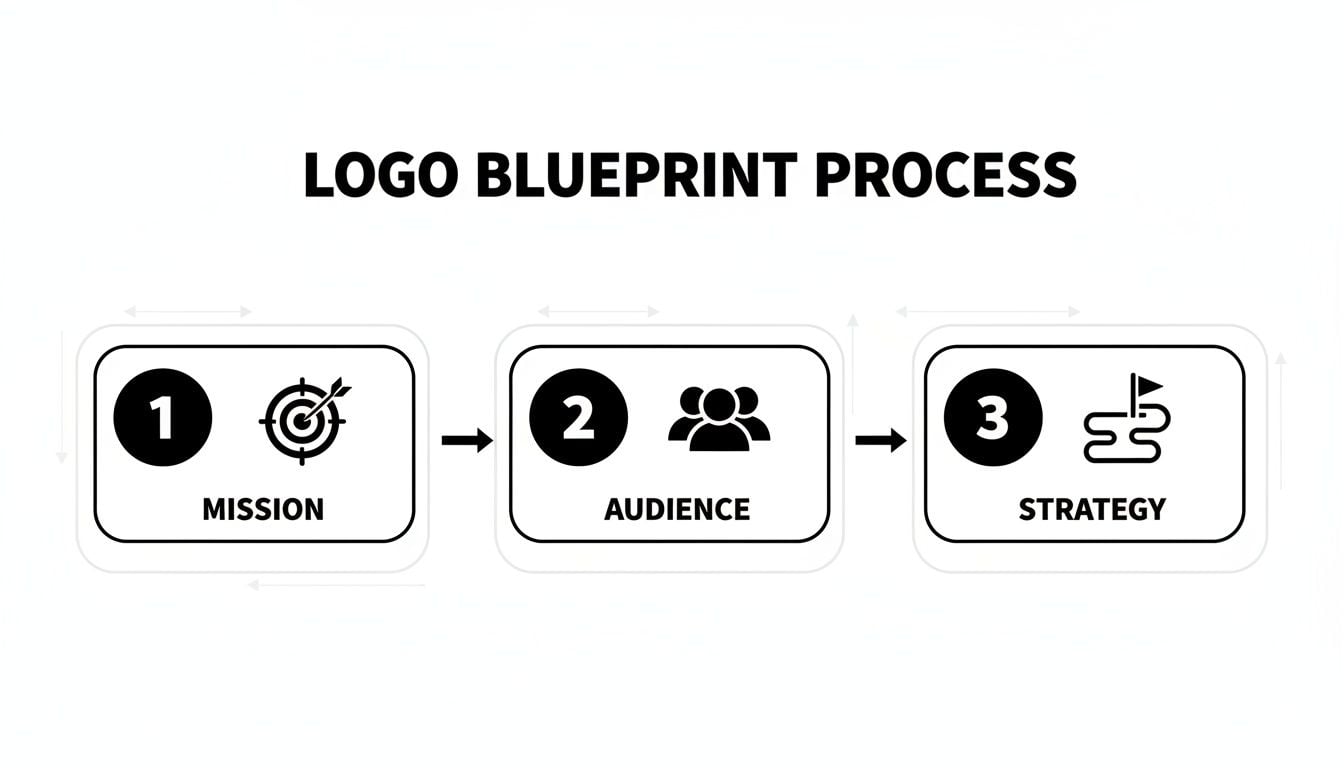
As you can see, everything flows from understanding your core purpose to identifying who you're talking to, and finally, figuring out the best way to visually bridge that gap. This groundwork is absolutely non-negotiable. It helps avoid subjective feedback later and keeps the project focused on what really matters: results.
A great logo is born from strategy, not just creativity. It's the visual translation of your company's promise to its customers, making the initial briefing stage the most important part of the entire design process.
To get this right, a good designer will walk you through a series of focused questions. You can prepare for this conversation and ensure a successful outcome by following this actionable checklist:
- 1. Define Your Mission: Write down a clear, one-sentence answer to "What problem do we solve for our customers?" This is your core purpose.
- 2. Profile Your Ideal Customer: Create a short persona. Who are they? What do they value? What are their pain points? The more specific, the better.
- 3. Analyse Your Competitors: List your top three competitors. Note what you like and dislike about their branding. Identify a visual gap you can own.
- 4. Choose Your Brand's Personality: Select 3-5 keywords that describe your brand's desired feel (e.g., "playful, modern, trustworthy" or "luxurious, traditional, expert").
Getting clear, honest answers to these questions provides the raw material needed to design a logo that isn't just a pretty picture, but a true reflection of your brand.
Laying the Groundwork with Research and Discovery
Once we have a solid brief in hand, the real detective work starts. This isn't just about having a quick scroll through Pinterest for inspiration. It's a proper deep dive into your market, your customers, and your competition. From this point on, how a professional design works logo is all about strategy, not just pretty pictures.
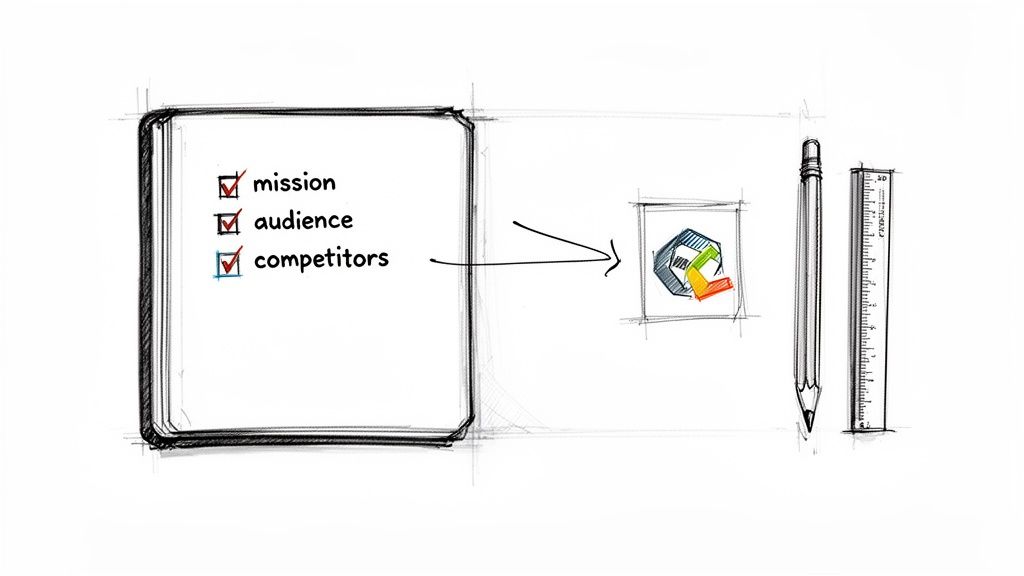
The main goal here is to get a feel for the visual "language" of your industry. We meticulously analyse what's working for others, what isn’t, and—most importantly—where we can carve out a unique space for your brand. This stops us from creating a logo that just blends in or, even worse, looks like a knock-off of a competitor.
Analysing the Competitive Landscape
A huge part of this stage is looking closely at your direct and indirect competitors. We gather up their logos and branding to see what common threads appear in their colour schemes, fonts, and overall style. For a local Dorset business, for example, we'd look at both regional rivals and the big national players to find a visual angle that’s entirely yours.
This analysis helps us spot patterns and, crucially, find gaps in the market. We break it down into a few key areas:
- Colour Palettes: What are the go-to colours in your sector? Is everyone using the same corporate blue or trustworthy green? If so, that’s our signal to steer clear and try something different.
- Typography Choices: Are your competitors all using modern, clean sans-serif fonts, or are they sticking to more traditional serifs? Understanding this helps us decide whether to fit in or purposefully stand out.
- Symbolism and Imagery: Are there any overused icons? Think about it: if every local plumber has a water droplet in their logo, we know that’s a well-trodden path we need to avoid.
- Overall Tone: Does the market feel buttoned-up and corporate, or is it more relaxed and friendly? This helps us shape the personality your new logo will project.
By looking at all these elements, we build a clear picture of the visual "noise" you're up against. This allows us to find a space that feels authentic to you, ensuring your new logo is both original and commercially savvy.
The discovery phase isn’t about copying what works. It’s about understanding the existing conversation so you can say something new and memorable. It sets a solid foundation for genuine creativity.
This groundwork is absolutely vital in the UK's graphic design industry, which is projected to be worth a massive £4.2 billion by 2026. This growth is fuelled by businesses spending more online, where they need distinctive branding for their websites, apps, and social media.
While big London firms often get the headlines, smaller agencies like ours in Weymouth fill a crucial role for local businesses. We create logos that fit perfectly with their digital marketing and SEO strategies. You can find out more about this growing market and its economic impact with these UK graphic design market insights on ibisworld.com. All this research makes sure the creative ideas that come next are not only imaginative but built on a solid, strategic foundation.
The Creative Stage: From Blank Page to Brand Concepts
This is where all that groundwork—the research, the strategy meetings, the deep dive into your business—starts to take visual form. The focus shifts from analysis to pure creation. We put the spreadsheets and reports to one side and begin translating everything we've learned into tangible logo concepts. It’s an exciting, open-ended phase where we explore every possibility.
You might be surprised to learn that for many designers, ourselves included, this process rarely starts on a computer. It almost always begins with a simple pencil and paper. Sketching lets us explore dozens of ideas rapidly, without getting bogged down by software. It's about capturing the raw energy of a concept in its simplest form.
Exploring the Creative Avenues
Once we’ve filled pages with rough sketches and identified the most promising directions, we head to the screen to start building digital mockups. This is where the strongest ideas are fleshed out and refined. A huge part of this is figuring out the right type of logo that will best tell your brand's story. How a design works logo-wise often comes down to this single choice.
Let’s imagine we're working with a new artisan bakery in Dorset. The creative exploration could go in a few different directions:
- Wordmarks: We might develop a custom-lettered logo that focuses entirely on the bakery’s name. A warm, hand-drawn script could instantly communicate that artisan, personal touch.
- Symbols or Icons: Another path is to create a standalone mark. Think of a stylised wheatsheaf or a simple rising sun, symbols that wordlessly speak to natural ingredients and the freshness of the morning bake.
- Combination Marks: Often the most versatile option, this approach blends the name and a symbol. Picture the bakery's name sitting elegantly alongside that wheatsheaf icon, giving them the best of both worlds.
Each of these formats sends a different message. A clean, minimalist mark can feel modern and sophisticated, while a more rustic, heritage-style design taps into a sense of tradition and comfort. Our job is to explore these avenues and present the ones that truly align with the strategy we built together.
Presenting a Curated Set of Concepts
We’ll never overwhelm you with every single sketch and minor variation. A professional designer’s role is to curate. We present a focused selection of the most distinct and viable concepts—usually a handful of very different creative directions that are all rooted in the initial brief.
A concept presentation isn’t a final decision. It's the start of a conversation, a chance to see how strategy looks in practice and work together to find the perfect fit.
Most importantly, no concept is ever presented without a story. We’ll walk you through the thinking behind every choice: why a certain typeface was chosen, what the colour palette represents, and how the overall style connects back to your business goals. This rationale is what separates professional design from a simple beauty contest. It turns a subjective choice into a strategic, collaborative decision. This is precisely the kind of detailed thinking we apply to our graphic design services in Dorset, ensuring every creative choice has a purpose.
Refining and Finalising Your New Brand Identity
You’ve chosen a concept. That’s a massive step, but we’re not quite at the finish line yet. Now comes the really collaborative part: refining that initial idea into something truly polished and powerful.
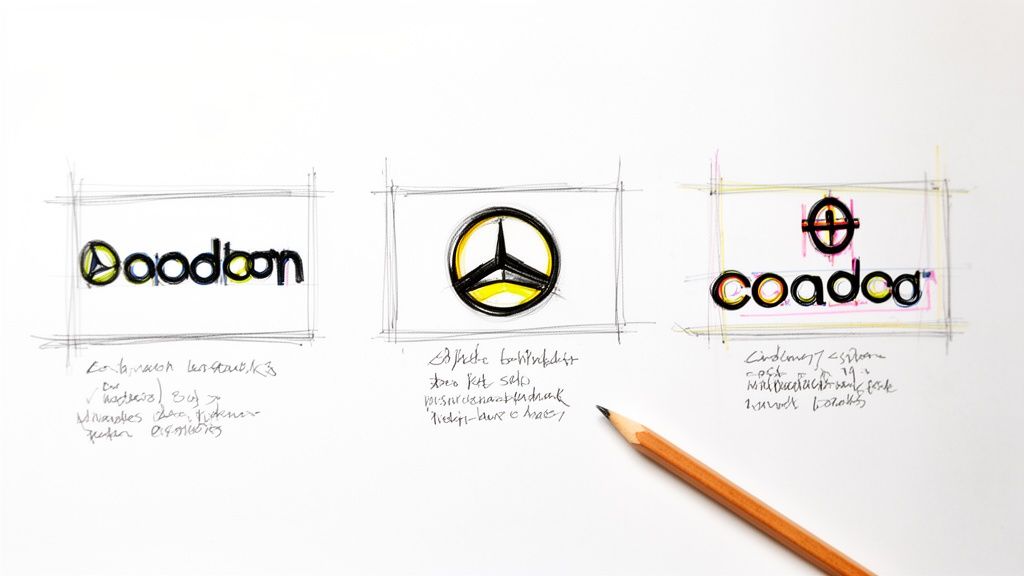
Think of the chosen concept as a fantastic piece of clay. It has all the potential, but now we need to shape it together. Your feedback is what guides the process, allowing the designer to tweak proportions, adjust colour palettes, and fine-tune the typography until every element works in perfect harmony.
How to Give Feedback That Actually Works
Nothing stalls a creative project faster than vague feedback. Comments like "I just don't like it" or "Can you make it pop more?" don't give a designer much to work with. The trick is to be specific and link your thoughts back to the project's goals.
To make this refinement stage as smooth as possible, here’s how to frame your feedback for the best results:
- Go back to the brief. Does the design feel true to the mission and personality we agreed on at the start? It's the North Star of the project.
- Explain the 'why'. Instead of just saying a font feels "wrong," try to pinpoint the reason. For example, "This typeface feels a bit too corporate, but our brand is meant to be more approachable and friendly."
- Think like your customer. Take a step back from your own personal tastes. Will this design connect with your target audience? Is it memorable and easy for them to understand?
- Stress-test it. Picture your new logo in the real world. How will it look as a tiny favicon on a browser tab? Or embroidered on a shirt? Or on the side of a van? Great logos are built to be versatile.
The best designer-client relationships are true partnerships. Constructive feedback isn't just criticism; it's the shared energy that turns a good idea into a perfect final logo.
This back-and-forth is central to how a professional design works logo process gets results. It's a huge part of the service, especially in the UK, where branding and identity design make up 25% of the graphic design industry's massive £4.2 billion revenue. Much of this is driven by start-ups and small businesses needing affordable, high-impact logos, which has increased the demand for fixed-price packages that include revision rounds. You can dig deeper into the growth trends in the UK graphic design market on nextmsc.com.
Ultimately, these revision rounds ensure every detail is spot-on—from its legibility at small sizes to its emotional impact. By working together, we create a final identity that you’re not just happy with, but genuinely proud to show the world.
Preparing Your Logo for Real-World Use
Getting a fantastic logo designed is a huge milestone, but it’s only half the story. The real magic happens when that logo gets out into the world, and that's where this final handover stage is so critical. This is the part where you get all the assets and know-how to make sure your new brand identity looks sharp and professional, no matter where it appears.
Think of it as the difference between having a great-looking car and having the keys, the manual, and a full tank of petrol. Without the right tools, that beautiful design is just going to sit in a folder.
Your Essential Logo Files
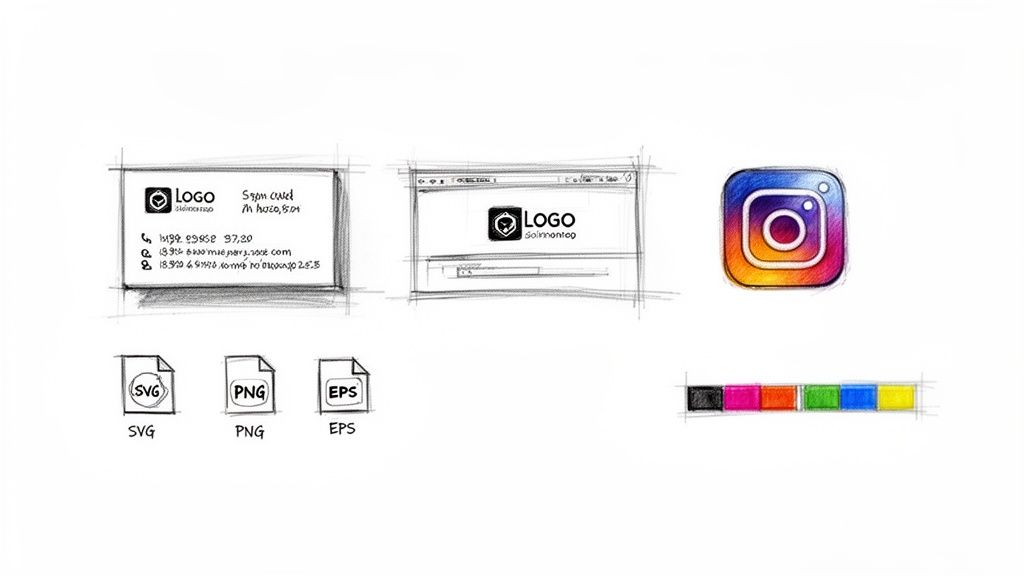
When the final files arrive, it’s usually in a zip folder packed with different logo versions. It can look a bit intimidating with all those acronyms, but there's a good reason for it. Each file format is designed for a specific job, and using the right one is key to keeping your brand looking its best.
This isn't about making things complicated; it's about making sure your logo is foolproof. Here’s a quick rundown of what you’ll get and when to use it.
For Anything on a Screen (Websites, Social Media, Apps):
- SVG (Scalable Vector Graphic): This is your go-to file for digital use. Because it's a vector, it can be stretched to any size without becoming blurry or pixelated. Your logo will look perfectly crisp on a tiny phone screen and a giant desktop monitor.
- PNG (Portable Network Graphic): The superpower of a PNG is its transparent background. Whenever you need to place your logo over a photo or a coloured block on your website, this is the file you’ll want to grab.
For Anything Being Printed (Business Cards, Flyers, Banners):
- EPS (Encapsulated PostScript): This is the gold standard for professional printers. If you're getting anything from business cards to massive banners made, the print shop will almost certainly ask for an EPS file. It's a vector, so it guarantees a high-quality result.
- PDF (Portable Document Format): While we all know PDFs for documents, a high-resolution PDF of your logo can also be a handy, universal vector file. It’s easy for anyone to open and view, even without fancy design software.
A well-designed logo should be versatile enough to work everywhere, from a website header to physical items like custom text windshield banner decals.
Essential Logo File Formats and Their Uses
Understanding your file types is the first step to deploying your brand like a pro. This table breaks down the most common formats you'll receive from your designer.
| File Type | What It Is (Vector/Raster) | Best Used For |
|---|---|---|
| SVG | Vector | Websites, web applications, and any digital use where you need the logo to scale perfectly on different screens. |
| EPS | Vector | Professional printing for business cards, brochures, signage, and merchandise. This is the file your printer loves. |
| Vector (usually) | Sharing with vendors, internal documents, and general-purpose viewing. A good universal option. | |
| PNG | Raster | Websites, social media posts, and presentations, especially when you need a transparent background. |
| JPG | Raster | General digital use where a transparent background isn't needed, like in email signatures or simple web images. |
Having this kit of files ensures you're always prepared and never have to compromise on quality.
The Brand Style Guide: Your Rulebook for Consistency
Even more important than the files, in many ways, is the brand style guide. This is your brand's instruction manual. It’s a simple, clear document that lays out the rules for using your logo, colours, and fonts to keep everything looking cohesive.
A brand style guide protects your investment. It ensures that no matter who is working on your marketing—from a new employee to an external supplier—your brand's visual identity remains strong and consistent.
This guide is what prevents your brand from slowly drifting off-course. It details your official colour palettes (HEX codes for web, CMYK for print, and Pantone for specific spot colours) and sets your typography rules.
For instance, our work on packaging design relies heavily on these strict guidelines to create a unified look on the shelf. You can see how we apply these principles across different products in our portfolio, like with these custom branded cans on designstack.co.uk. That consistency is ultimately what builds a recognisable and trusted brand.
How to Choose the Right Design Partner
I’ve seen it happen countless times: a brilliant business idea held back by a logo that just doesn't connect. A great logo is more than a pretty picture; it’s the result of a strategic partnership. Choosing who creates it is one of the most critical decisions you'll make for your brand.
It’s tempting to go for a cheap online logo maker or a quick-turnaround freelancer. And while those have their place, a lasting brand identity needs more. A professional agency isn't just selling you a final image; they're bringing a team of specialists to the table to ensure your logo is commercially effective, not just aesthetically pleasing.
What to Look For in a Design Partner
Finding the right agency or designer is about more than just scrolling through portfolios. You're starting a creative relationship, and for it to work, it needs to be built on trust, clear communication, and a shared understanding of your goals.
So, how do you vet potential partners? Here’s what to look for to make sure your investment pays off.
- A Strategic Process: Do they jump straight to drawing, or do they start with a detailed brief? A professional knows that a design works logo is built on solid strategy first.
- Local Market Knowledge: An agency that understands your local market—especially for businesses in specific regions like Dorset—can offer invaluable insights that a generic designer would miss.
- Clear and Open Communication: Are they good listeners? Do they ask smart questions? The entire project hinges on a strong two-way dialogue.
- Transparent, Fixed-Cost Pricing: You should always know exactly what you’re paying for upfront. Fixed-cost packages prevent nasty surprises down the line.
- Support After the Handover: What happens once the logo is finished? A good partner will provide guidelines and support to help you roll out your new brand identity correctly.
A strong portfolio shows what a designer can do. A strong process shows how they think. Prioritise partners who demonstrate a clear, strategic, and collaborative approach to design.
The demand for quality branding is undeniable. The UK's graphic design sector is a testament to this, with an estimated 10,943 businesses operating in 2026. This growth is driven by businesses that realise professional design isn't a cost but an investment. With so many options out there, it’s vital to find a partner who truly aligns with your vision. You can see more on the industry's health in these UK graphic design business statistics on ibisworld.com.
The process is a lot like hiring a web developer; it's all about finding an expert who genuinely gets what you're trying to achieve. For more on this, our guide on finding a website designer who understands your vision offers some great parallels. In the end, the right partner will feel less like a contractor and more like an extension of your own team.
Ready to invest in a logo that works as hard as you do? DesignStack offers professional branding and web design with fixed-cost pricing and a collaborative process. Let's build your brand together at designstack.co.uk.
Leave a Reply