

Digital Marketing for Local Businesses Unlocked
Digital marketing for local businesses is all about getting your name in front of customers right in your neighbourhood. Think of it as setting up shop on the new digital high street – the one everyone’s browsing on their phones and computers. It means showing up on Google Maps when someone’s looking for a coffee, engaging with your community on social media, and having a website that convinces visitors to walk through your actual door.
Why Your Business Needs Digital Marketing to Thrive
Imagine your town’s busiest street has gone completely digital. If your business isn't there, you’re basically hidden away down a quiet back alley. For local shops, service providers, and professionals, having a solid online presence isn't just a "nice-to-have" anymore; it's absolutely essential for survival and growth. Your competitors are already out there, grabbing the attention (and the pounds) of customers actively searching for what you offer.
The good news is, you can compete, and you can win. This guide is your roadmap to mastering the key parts of digital marketing for local businesses. It’s about much more than just sticking up a Facebook page; it’s about building a smart, connected strategy where every piece works together to create real momentum.
The Modern Customer Journey Starts Online
The days of relying purely on word-of-mouth and passing trade are long gone. Today, word-of-mouth takes the form of online reviews, and "window shopping" starts with a Google search on a smartphone, often while on the go.
The data backs this up completely. In the UK, searches including terms like 'near me' or 'local' have skyrocketed by over 200% in recent years as people’s habits have shifted firmly online. This is precisely why getting your digital marketing right is a game-changer. Without an optimised Google Business Profile, you're invisible when 46% of all Google searches are for local information, and a staggering 88% of those searchers will call or visit a business within 24 hours.
This flowchart breaks down the core parts of a winning local digital marketing plan.
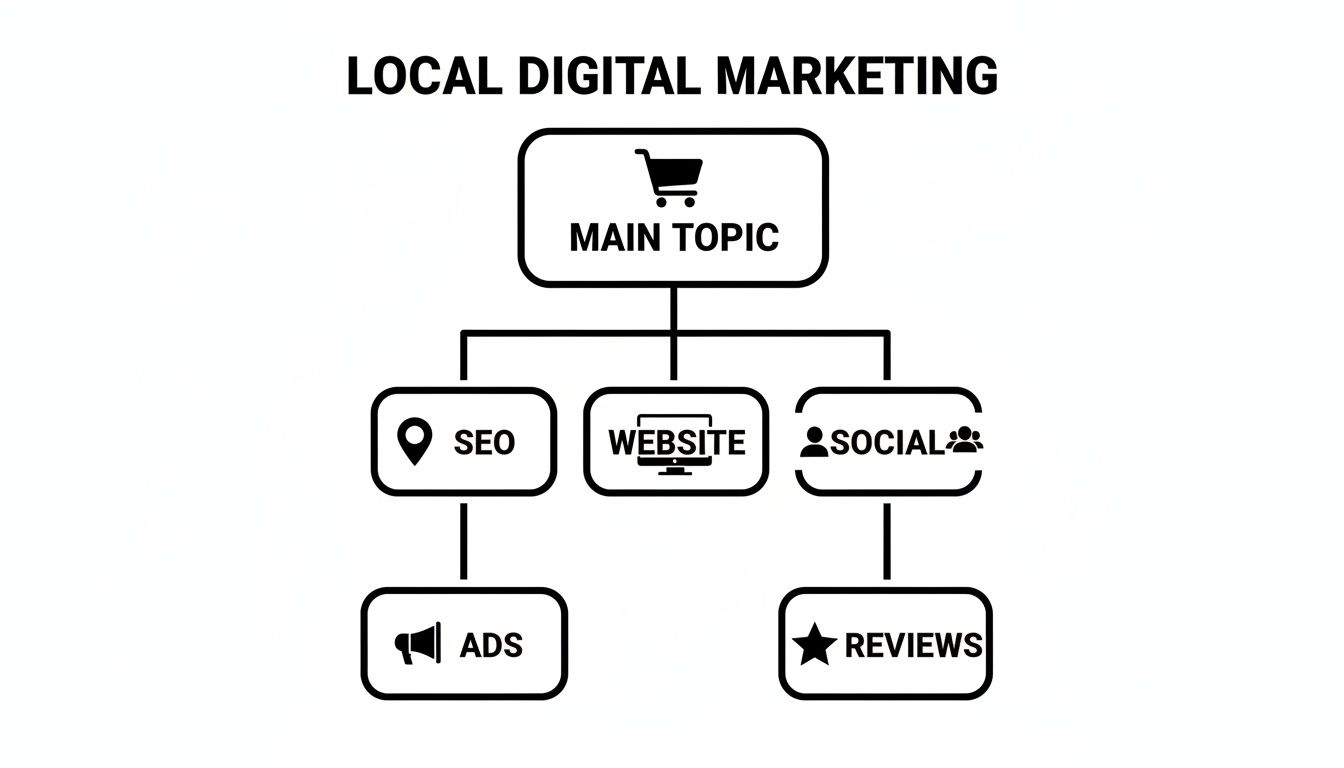
As you can see, your website and local SEO are the foundation. They support all your other activities, like social media, paid ads, and managing your reputation.
An Actionable Plan for Local Success
We've designed this guide to give you a clear, step-by-step plan. It’s for business owners who need practical advice, not a lecture full of technical jargon. Here is an actionable list of what this guide will help you achieve:
- Dominate Local Search: Be the first name customers see when they're ready to buy.
- Convert Website Visitors: Turn your website into a tireless, 24/7 sales assistant.
- Engage Your Community: Build a loyal local following through social media.
- Use Targeted Ads: Drive immediate footfall and phone calls when you need them most.
- Build Your Reputation: Let your happy customers become your most powerful marketing tool.
To not just survive but truly thrive, every local business needs a smart digital marketing strategy, as we explore in A Practical Guide to Digital Marketing for Local Business. Right, let's get started.
Right, let's talk about getting your local business found on Google.
Think of it this way: your local high street isn't just made of bricks and mortar anymore. It’s digital. When someone in your area needs a plumber, a haircut, or a great cup of coffee, they aren't pounding the pavement; they're pulling out their phone. If you want to win their business, you have to show up right at that moment, and that all starts with mastering local search.
Your most powerful tool for this is your Google Business Profile (GBP). It's so much more than a simple listing. It's your digital shop window, your welcome mat, and your 24/7 receptionist all rolled into one. Leaving it incomplete is like having a sign with letters missing – it suggests you’re either closed or just don't care.
Your Digital Storefront: The Google Business Profile
Getting your Google Business Profile right isn't just a good idea; it's the bedrock of your local online presence. This is the profile that feeds Google Maps and the all-important "Map Pack" at the top of the search results. It’s where customers get instant answers on your hours, services, and how to find you.
Honestly, a fully fleshed-out GBP is the single most effective thing you can do to boost your visibility with local customers. Don’t just fill it out—perfect it. Every single section is a chance to show both Google and potential customers why you’re their best option.
Think of a well-managed Google Business Profile as your best salesperson, working around the clock for free. It answers common questions, showcases what you do best, and guides people right to your door before they've even clicked through to your website.
To help you get started, I’ve put together a checklist. This isn’t just about the basics; it’s about using every feature Google gives you to stand out and turn those searchers into paying customers.
Your Google Business Profile Optimisation Checklist
Work your way through this table to make sure your profile is firing on all cylinders. Each of these tasks directly impacts how you rank in local searches and convinces people to choose you over the competition.
| Optimization Task | Why It Matters | Action Step |
|---|---|---|
| Claim & Verify | This is step zero. Without verification, you have no control. | Find your business on Google, click "Own this business?", and follow the steps, which usually involves receiving a postcard with a code. |
| Choose Precise Categories | Specificity attracts qualified customers. | Don't just pick 'Restaurant'. Be specific: 'Italian Restaurant', with 'Pizza Delivery' as a secondary category. Use all relevant options. |
| Write a Compelling Description | This is your chance to tell your story and sell your business. | Use all 750 characters. Explain what makes you unique, mention key services, and weave in your town or neighbourhood name naturally. |
| Upload High-Quality Media | People buy with their eyes. A blank profile feels untrustworthy. | Add plenty of photos: your storefront, inside, your team at work, and your products. A short video tour is even better. |
| Use Google Posts Weekly | This shows your profile is active and keeps customers informed. | Think of them as free mini-adverts. Post about offers, new stock, or events. Aim for at least one post a week. |
| Build out the Q&A Section | You can control the narrative and save yourself time answering common questions. | Proactively add your own FAQs (e.g., "Do you have parking?") and then answer them yourself. This helps customers and Google. |
| Enable Messaging | It provides a direct, low-friction way for customers to contact you. | Turn on the messaging feature and make sure you respond quickly. A fast response time is displayed on your profile. |
Taking the time to get this right really pays off. For a more detailed guide, check out our complete walkthrough on free GBP optimisation that covers every last detail.
The Power of NAP Consistency
Once your GBP is in good shape, Google starts looking for other clues across the web to confirm your details. The single most important signal here is your NAP: your Name, Address, and Phone number.
Imagine you sent out party invitations with two slightly different addresses. Some of your guests would inevitably get lost, right? It's exactly the same for Google. Your NAP has to be 100% identical everywhere it’s listed online, from your own website to directories like Yelp, Yell, and any industry-specific sites.
Even a tiny variation, like "Street" on your website but "St." on a directory, can create confusion for search engines. It seems small, but it erodes the trust Google has in your data.
This consistency acts as a huge vote of confidence. It proves to Google that you are a legitimate, established business located exactly where you claim to be. This foundational trust is absolutely essential if you want to rank at the top of local search results.
Building a Website That Converts Local Customers
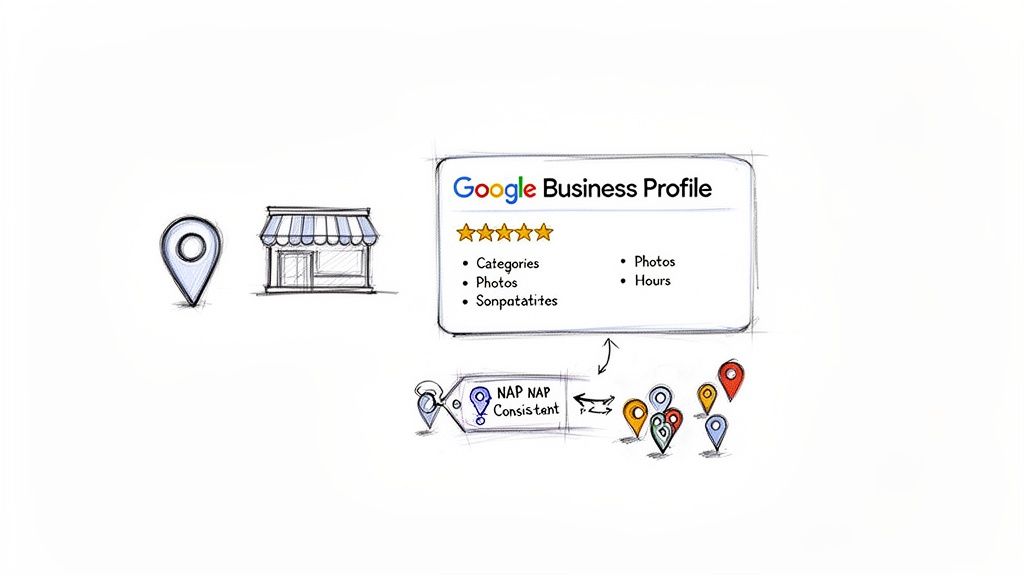
Think of your Google Business Profile as your digital shopfront, grabbing the attention of passers-by. Your website, on the other hand, is the actual shop they step into. It’s where the real conversation begins. Your site needs to be more than just a pretty online brochure; it should be your best salesperson, working 24/7 to turn curious visitors into loyal customers.
Sadly, many local business websites fall flat. They look nice enough but don't actually do anything to generate leads or sales. To make a real impact with your digital marketing for local businesses, your website needs to be quick, a breeze to use on a mobile, and built from the ground up for the local community you serve.
Prioritise Mobile Design and Blazing Speed
Let’s be honest: most of your local customers will find you on their phone, probably while they’re out and about. If your website is a pain to navigate on a small screen or takes an age to load, you've put up a massive digital barrier. It's the online equivalent of a jammed front door – people will just give up and head to your competitor.
Speed isn't just a nice-to-have, either. Google has made it crystal clear that site speed is a major ranking factor. A zippy website creates a better experience, and Google rewards that with a bump in search rankings. Every second of loading time you shave off could be another customer you keep.
Create Hyper-Local Landing Pages
This is one of the most powerful, yet often overlooked, tactics for any local business. Instead of a single, generic "Services" page, you need to create hyper-local landing pages. These are individual pages dedicated to a specific service in a specific town or neighbourhood you cover.
This strategy turns your website from a blunt instrument into a set of precision tools. Imagine you're a plumber based in Weymouth, but you also serve Dorchester and Poole. A hyper-local approach would mean having separate pages for:
- Emergency Plumber in Dorchester
- Boiler Repair Services in Poole
- Blocked Drain Clearance in Weymouth
Suddenly, you're not just a plumber near Dorchester; you're the go-to emergency plumber in Dorchester. When someone there frantically searches for help, your perfectly tailored page is far more likely to show up at the top of Google and convince them you’re the right choice.
A hyper-local landing page tells both the customer and Google, "Yes, we are the perfect solution for this specific problem in your exact location." It removes all doubt and builds immediate relevance and trust.
To make these pages sing, make sure the town name is in the page title, headings, and sprinkled naturally throughout the text. Go a step further by embedding a Google Map of the specific area and including testimonials from happy customers in that town. It's powerful, targeted proof.
An Actionable Checklist for a High-Converting Local Website
Use this checklist to audit your own site and turn it into a customer-generating machine.
- Optimise for Mobile First: Grab your phone and actually use your website. Is the text easy to read? Can you tap buttons without pinching and zooming? If it’s a frustrating experience for you, it’s a deal-breaker for your customers.
- Boost Your Page Speed: Use a free tool like Google's PageSpeed Insights to get a score. Often, the biggest culprits are massive image files. Compressing your images before uploading is a simple fix that makes a huge difference.
- Make Your Contact Info Obvious: Your phone number should be right at the top of every single page. On a mobile, it absolutely must be "clickable" so a customer can call you with a single tap.
- Create Clear Calls to Action (CTAs): Tell people exactly what you want them to do next. Use big, bold, action-focused buttons like "Get a Free Quote," "Book an Appointment," or "Call Us Today."
- Build Out Local Landing Pages: Don't try to do it all at once. Start with your most profitable service in your most important town. Create one brilliant page, then replicate the process for other services and areas. If a full redesign feels overwhelming, take a look at our guide to finding a website designer who understands your vision.
Connecting with Your Community Online
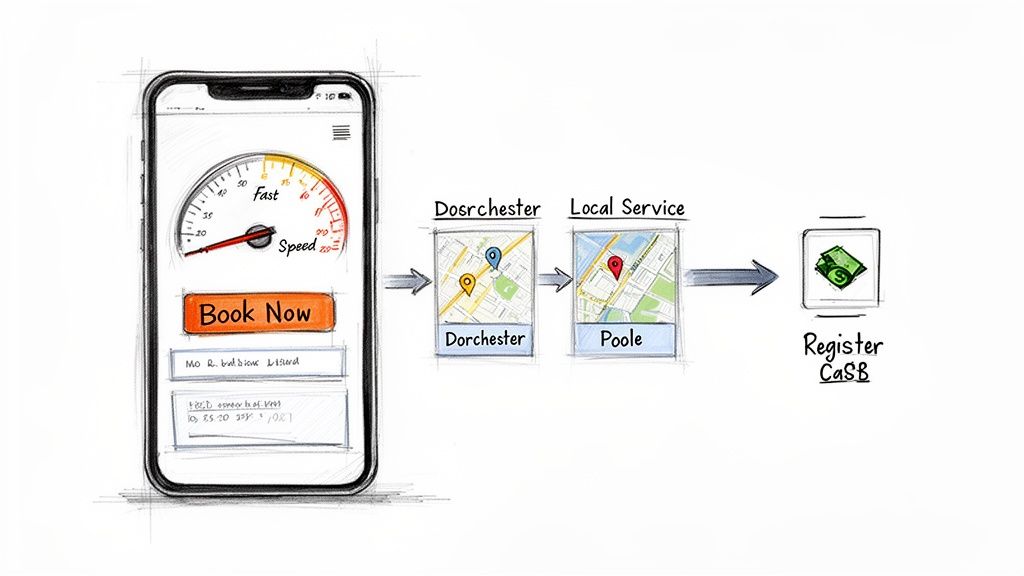
If your website is your digital shopfront, think of social media as the modern-day town square. It’s where you stop selling and start building real relationships with the people in your local area. For a local business, the goal isn't to go viral worldwide; it's about being a present, helpful, and human part of your community.
It’s the digital equivalent of a friendly chat over the counter. This is your opportunity to share what you’re passionate about, listen to what people are saying, and become that familiar, trusted face in the neighbourhood. Done right, this approach turns casual followers into loyal customers and even advocates for your business.
Choosing Your Platforms Wisely
Don't fall into the trap of thinking you need to be everywhere at once. It’s a surefire way to spread yourself too thin. The real secret is to be strategic. You need to be on the platforms where your ideal customers are already spending their time, and where your business can really shine.
It's far better to master one or two channels than to have a weak presence on five. For instance, if your business is very visual—like a café, gift shop, or interior design studio—then platforms like Instagram and Pinterest are your natural home. On the other hand, if you're a B2B service provider like an accountant or a commercial solicitor, you'll get much more traction building professional networks on LinkedIn.
A Practical Framework for Valuable Content
The biggest question I hear from local businesses is, "But what do I actually post?" Let's simplify things. Forget about complicated marketing funnels for a moment and focus on one simple goal: be genuinely valuable. Every post should aim to either entertain, educate, or connect with your audience on a truly local level.
And this isn't just a nice idea—the numbers back it up. Social media has become a lifeline for UK local businesses trying to connect with their communities. Recent UK stats show that 70% of small businesses are actively using social channels for their content marketing. Why? Because it generates three times more leads at a 62% lower cost than many traditional methods. Whether you're in retail or professional services, it's a powerful way to speak directly to people in your area. You can explore additional digital marketing strategies for local businesses to see how this fits into the bigger picture.
Your social media should feel less like an advertisement and more like an open-door invitation. It’s where people get to know the faces behind the business and feel a part of your story.
To get you started, I’ve put together a list of practical content ideas you can use today. This isn't just about posting for posting's sake; it's about building a content rhythm that fosters community and brings in valuable leads.
Five Actionable Content Ideas for Your Local Business
Use these prompts to build a simple content plan that your local audience will actually care about, helping you grow a strong, engaged following.
Go Behind the Scenes: People are naturally curious and love authenticity. Show them the messy-but-brilliant process of how your products are made, how you set up for a client, or just a typical day in your shop. It builds trust and makes you relatable.
Feature a Loyal Customer: With their permission, of course! Share a photo and a quick story about one of your regulars. This not only celebrates your customers but also acts as powerful, real-world social proof for others.
Promote a Local Event: Are you hosting a workshop, heading to a local market, or sponsoring the community fete? Post about it! It shows you're invested in the local area, not just operating within it.
Share Genuinely Helpful Tips: A local gardener could share tips for planting in your region's soil. A baker could give advice on getting the perfect sourdough starter. You're establishing your expertise and providing value with no strings attached.
Collaborate with Another Local Business: Partner up with a non-competing business down the street for a joint giveaway or a cross-promotion. You instantly get introduced to their audience and double your reach. It’s a win-win.
Driving Immediate Traffic with Local Paid Ads
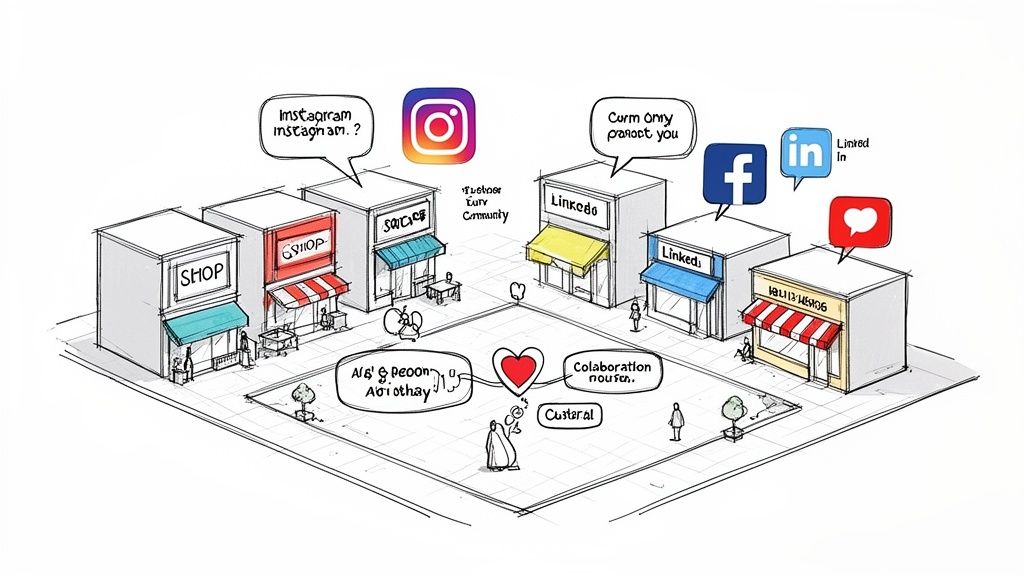
While all the SEO and content work is building your reputation for the long haul, sometimes you just need the phone to ring today. This is where paid advertising comes in. It’s your fast-track to getting in front of customers, generating instant visibility, calls, and feet through the door.
Think of it as renting the best spot on the digital high street. Instead of waiting patiently for Google to recognise your authority, you can pay to place your business right at the top of the search results, at the exact moment a local customer is looking for what you offer. The two heavyweights here are Google Ads and Meta Ads (which covers both Facebook and Instagram).
Precision Targeting for Local Success
But where these platforms really shine for a local business is their laser-focused targeting. You can dial in your audience so precisely that you’re not wasting a single penny advertising to people who are too far away to ever visit.
A plumber in Bristol, for instance, can set up a Google Ad to appear instantly when someone in the BS5 postcode searches "emergency plumber near me". They're not paying for clicks from someone in Manchester; only from potential customers right on their doorstep.
It's the same story on social media. A café in Brighton could use Meta Ads to show a tempting video of their new brunch menu to people currently within a one-mile radius of their front door, specifically between 10 am and 1 pm. That’s not just advertising; it's putting the right offer in front of the right person, in the right place, at the perfect time.
Paid advertising isn't an expense; it's a measurable investment in immediate business growth. You set the budget, you define the audience, and you see the results in real-time.
Your Actionable Guide to Starting with a Small Budget
You don't need a huge marketing fund to get started. The key is to be smart, start small, and learn as you go. Here’s a simple checklist to get your first local campaign off the ground without making common, costly mistakes.
1. Start on One Platform: Don't overwhelm yourself by trying to learn Google and Meta at the same time. If people actively search for your service in a moment of need (like a locksmith or a tyre centre), Google Ads is your best bet. If what you sell is more visual or impulse-driven (a boutique, a restaurant, a beautician), then Meta Ads will probably serve you better.
2. Define a Small, Test Budget: Set a daily budget you’re completely comfortable with—even just £5-£10 a day is enough to start. The initial goal isn't to get a flood of customers; it's to gather data on what messages and targeting work. You can always increase the spend later.
3. Use Hyper-Local Targeting: This is the most important step. On Google, target by specific postcodes or a radius around your business. On Meta, start with location targeting first before layering on interests. Make sure your ads are only being shown to people who can actually buy from you.
4. Write Compelling, Local Ad Copy: Your ad needs to scream "local". Use phrases that resonate, like "Serving the Cardiff area" or "Manchester's top-rated pizza". And always include a crystal-clear call to action that tells people what to do next: "Call Now for a Quote" or "Book Your Table Online".
5. Monitor and Adjust: Log in to your ads manager every couple of days. What’s getting clicks? What’s being ignored? Don’t be afraid to pause ads that aren’t performing and try a new headline or a different image. This constant cycle of testing and refining is how you turn a small test budget into a profitable marketing machine.
Building Trust and Measuring Your Growth
Everything we've talked about—from your local SEO to your social media posts—is designed to do two things: build genuine trust with customers and deliver growth you can actually see. These two pillars are what transform your marketing from a simple cost into a real, revenue-driving part of your business.
Think of online reviews as the new word-of-mouth. A constant flow of positive feedback on Google doesn't just give your local search ranking a nudge; it’s powerful social proof that helps potential customers choose you. Nurturing a fantastic reputation is a non-negotiable part of digital marketing for local businesses.
Mastering Your Online Reputation
You can't just cross your fingers and hope for good reviews; you need a simple, repeatable system. The perfect time to ask for feedback is right after you’ve delivered a great service or sold a product. That's when the positive feeling is at its peak.
Something as simple as a follow-up email or a small card with a QR code linking to your Google review page can work wonders. Just as important is responding to all your reviews, both the glowing ones and the not-so-great ones. It shows you’re paying attention and that you genuinely care.
Here’s a quick checklist for getting your review management in order:
- Make It Easy to Leave a Review: Get a direct link to your Google review form and share it. The fewer clicks it takes, the more likely people are to do it.
- Respond to Positive Reviews Promptly: Thank the customer by name. If they mentioned something specific they liked, reference it! It shows you're actually reading what they write.
- Handle Negative Reviews Professionally: This is crucial. Never get into a public spat. Acknowledge their complaint, apologise that their experience wasn't perfect, and always offer to take the conversation offline to find a solution.
Measuring What Matters Most
So, how do you know if all this effort is actually paying off? The key is good measurement. But diving into analytics can feel like trying to drink from a firehose. The secret is to ignore the noise and focus on the few numbers that truly impact your bottom line. Using data analytics for small businesses is essential here.
For a local Dorset business, especially one watching its budget, proving that marketing works is everything. Yet, there’s a big gap here. UK data shows that while 83% of marketers see measuring ROI as a top priority, only 36% feel they can do it accurately. This is a huge deal, especially when you consider that smart content marketing can generate three times more leads for 62% less than traditional methods. With 92% of UK marketers holding or increasing their SEO budgets, the pressure to show results is on.
Don't drown in data. Focus on tracking a few key metrics that tell you if your marketing is actually working—are people calling you, visiting your site from local searches, and getting in touch?
Instead of getting lost in spreadsheets, just concentrate on these three signals. You can find them all for free within your Google Business Profile Insights and Google Analytics. For a more detailed walkthrough, our guide offers essential tips and tricks for Google Analytics 4 mastery.
- Phone Calls from Your Google Profile: This is a hot lead—someone ready to talk.
- Website Traffic from Local Search: This shows your SEO is bringing nearby people to your virtual front door.
- Contact Form Submissions: These are qualified enquiries sent directly to your inbox.
Keeping an eye on these numbers gives you a clear, honest picture of what's working. It empowers you to stop guessing and start making confident decisions that fuel real growth for your business.
Your Top Local Digital Marketing Questions, Answered
Jumping into digital marketing for your local business can feel a bit overwhelming. There are so many options, and it’s easy to feel like you’re already behind. It’s completely normal to have questions.
We’re going to clear up some of the most common ones we hear from business owners just like you. The goal isn’t to get bogged down in technical jargon, but to focus on what really matters: connecting with local customers and making it simple for them to choose you.
Where Should I Start If My Budget Is Tiny?
This is the number one question we get, and the answer is always the same: start with the free stuff. Before you even think about spending money on ads, you need to get your foundations sorted. With a small budget, your best investment is your time, not your cash.
The most powerful, high-return activities in local digital marketing cost you nothing but time. Nail these basics first, and you'll build a solid foundation for future growth and paid campaigns.
Your first job is to claim and fully complete your Google Business Profile. Think of it as your digital shop window—it's the single most important free tool you have. Once that's looking sharp, shift your focus to getting reviews from happy customers and making sure your business name, address, and phone number are identical everywhere online.
How Much Time Does Digital Marketing Really Take?
There's no single magic number here, but consistency always wins over short bursts of intense effort. It’s far more effective to set aside a few focused hours every week than it is to try a massive marketing push once a quarter and then do nothing.
For a business owner managing their own marketing, a good starting point is around 3-5 hours per week.
Here’s what that could look like, broken into small, manageable tasks:
- Google Business Profile (30 mins): Share a new Google Post—maybe a special offer or a behind-the-scenes photo. Take time to reply to any new reviews or questions that have come in.
- Social Media (1-2 hours): Plan and schedule two or three simple posts for the week ahead. Pop in for 15 minutes each day to reply to comments and interact with other local accounts.
- Website & SEO (1 hour): Write a short, helpful blog post or spend time improving a page on your website for a specific service you offer.
- Review & Plan (30 mins): Quickly look at what happened last week. Which post got the most engagement? Did you get any new leads? Use that info to plan your focus for the coming week.
This approach stops things from feeling overwhelming and helps you build real momentum, week after week.
Ready to turn your online presence from a simple listing into your most effective tool for attracting local customers? The team at DesignStack specialises in creating professional websites and smart digital strategies for businesses that want to get noticed. Get in touch with us today to discuss your project.


Leave a Reply